
This article discusses psychoactive substances intended for adults (18+). If you have a health condition or take medication, consult a doctor before use. Our age policy
Microdosing Surveys: What They Report
Definition
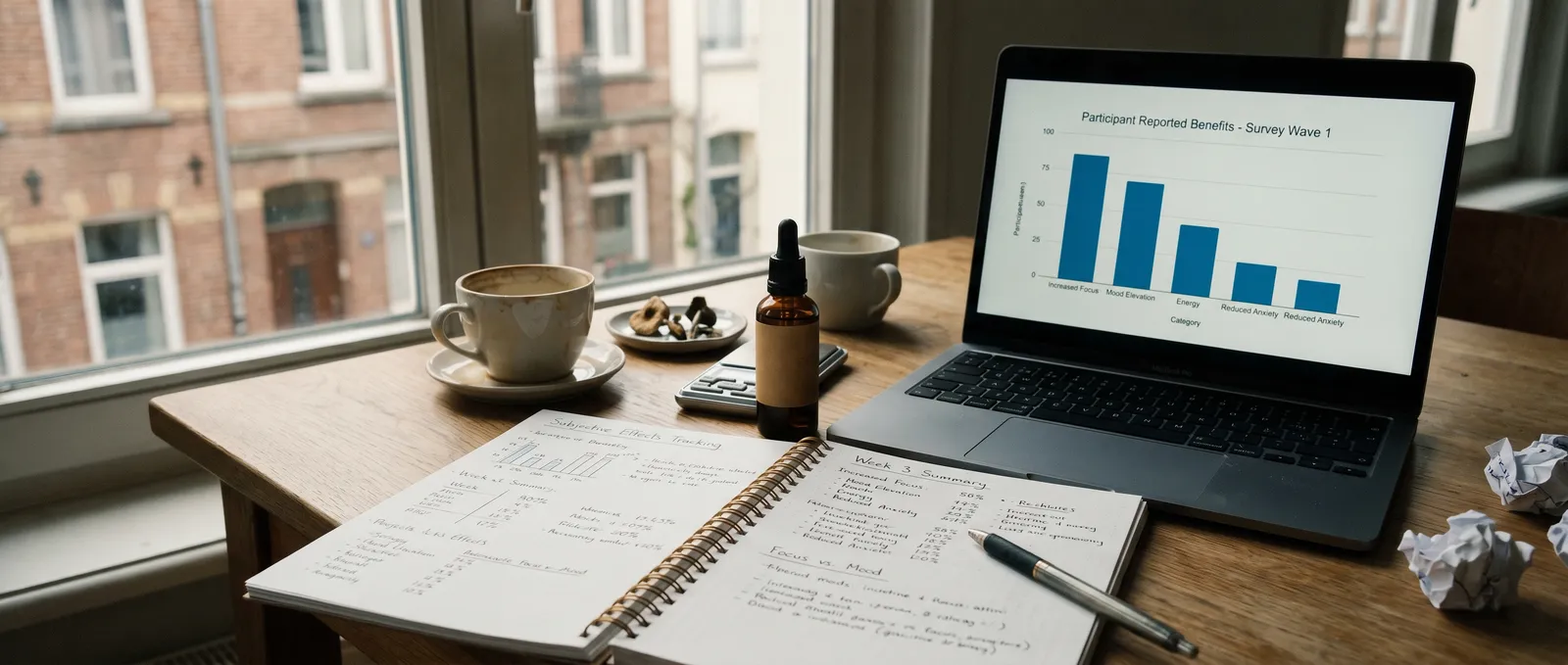
Microdosing surveys are large-scale questionnaires gathering self-reported data on why people microdose, perceived benefits, and adverse effects. According to Lea et al. (2020), about 25% of microdosers reported at least one undesired effect in the past year — a figure rarely highlighted alongside the positive findings.
Microdosing surveys what they report is a question more people are asking as interest in sub-perceptual dosing grows. A microdosing survey is a large-scale questionnaire — a type of observational research tool that gathers self-reported data on why people microdose, what substances they use, what benefits they perceive, and what adverse effects they encounter. This guide on microdosing surveys what they report is written for adults interested in reading the survey data critically. According to Rosenbaum et al. (2020), the majority of published microdosing evidence still comes from observational surveys rather than controlled trials, meaning the findings tell you what people report — not necessarily what the substance caused.
Below you'll find the primary data table summarising the largest surveys published to date, followed by sections explaining what each column actually means, where the gaps are, and how to interpret these numbers without fooling yourself.
Major Microdosing Survey Data at a Glance
The largest microdosing surveys have collectively gathered data from over 12,000 respondents, though sample quality varies enormously between studies.
| Survey / Study | Year | Sample Size | Primary Substance | Top Reported Benefits | Adverse Effects Reported | Study Type |
|---|---|---|---|---|---|---|
| Global Drug Survey (Winstock et al.) | 2019 | ~6,700 microdosers | LSD, psilocybin | Improved mood (26%), focus (15%), creativity (13%) | Anxiety (7%), physiological discomfort (5%) | Cross-sectional survey |
| Microdosing.nl / Kuypers et al. | 2019 | 1,116 | Psilocybin truffles, LSD | Enhanced mood, cognitive performance, reduced anxiety | Headache (6%), difficulty concentrating (4%) | Observational online survey |
| Anderson et al. (Quantified Citizen) | 2019 | 909 | Psilocybin, LSD | Improved mood, attention, well-being | Physiological discomfort, impaired mood on dose days | Prospective longitudinal (app-based) |
| Lea et al. (Nature, 2020) | 2020 | 4,050 | Psilocybin, LSD | Health-related motivations, lower depression/anxiety scores vs. non-microdosers | ~25% reported at least one undesired effect in past year; ~10% called it adverse | Cross-sectional survey |
| RAND Psychedelics Survey | 2025 | Nationally representative U.S. panel (exact N pending full publication) | Psilocybin, LSD | Preliminary: mood and focus improvements most cited | Data forthcoming | Probability-based national survey |
| Szigeti et al. (self-blinding citizen science) | 2021 | 191 (completed protocol) | Psilocybin, LSD | Psychological well-being improvements — BUT matched by placebo group | No serious adverse events | Citizen-science placebo-controlled |
What Surveys Actually Measure (and What They Don't)
Microdosing surveys measure self-reported perceptions of benefit and harm — not objective pharmacological effects. Every survey in that table shares a structural limitation: respondents self-select. People who had a bad time microdosing and stopped after a week are less likely to fill in a 40-minute questionnaire about microdosing. People who are enthusiastic about it are more likely. This introduces what researchers call "selection bias," and it inflates positive reports.
According to Lea et al. (2020), adults who microdose psychedelics report lower levels of depression and anxiety compared to non-microdosers — but the study's cross-sectional design cannot tell you whether microdosing reduced their depression or whether less-depressed people are more likely to microdose in the first place. The arrow of causation is invisible in survey data.
What surveys can do well: identify patterns of use, catalogue the range of reported effects (both positive and negative), and flag safety signals that deserve controlled investigation. They're a starting point, not a conclusion. The European Monitoring Centre for Drugs and Drug Addiction (EMCDDA) has similarly noted in its 2024 European Drug Report that self-report data on novel psychoactive substance use requires cautious interpretation due to these inherent methodological constraints. The MAPS (Multidisciplinary Association for Psychedelic Studies) organisation has also emphasised the need for controlled trials to supplement survey-level evidence.
Why People Say They Microdose
Mood improvement is the single most cited motivation across every major microdosing survey, reported by roughly 40–50% of respondents.

Across every major survey, the top three motivations are remarkably consistent:
- Mood improvement / reducing depression and anxiety — cited by roughly 40–50% of respondents in most samples
- Cognitive enhancement — focus, creativity, and problem-solving, cited by 20–35%
- General well-being and self-development — a vaguer category that captures 15–25%
Less prominent motivations include reducing substance use (alcohol, tobacco), managing chronic pain, and curiosity. Kuypers et al. (2019) noted that respondents with mental health concerns were significantly overrepresented compared to the general population — suggesting that microdosing attracts people who are already looking for relief.
A 2019 commentary in the Journal of Psychopharmacology (Kuypers et al.) clarified that "microdosing" in the psychedelic community means something specific: roughly 1/10th to 1/20th of a standard dose, taken on a schedule (typically every third day), with the explicit intention of sub-perceptual effects. This is different from the pharmacological use of "microdose" in drug development, where it refers to sub-therapeutic doses used for pharmacokinetic testing.
Substances and Products Commonly Referenced
In the Netherlands, where psilocybin truffles are legally available, many survey respondents report using truffle-based preparations. Those looking to buy psilocybin truffles for microdosing often choose products like the Microdosing XP Truffles pack or the Fresh Microdosing Truffles available at Azarius. Precision scales — such as the On Balance Myco digital scale — are frequently mentioned in survey free-text responses as essential for consistent dosing. If you want to get started with growing your own supply, mushroom grow kits are another option respondents mention, though dose standardisation becomes more difficult with home-grown material.
The Adverse Effects Column
Roughly 1 in 4 microdosers report at least one undesired effect per year, according to the largest survey to date. The positive reports get the headlines, but the adverse-effects data is arguably more useful for anyone actually considering microdosing. According to Lea et al. (2020), about 1 in 4 microdosers reported at least one undesired effect in the past year, and roughly 10% described their experience as genuinely adverse.
Commonly reported issues across surveys:
- Physiological discomfort — nausea, headaches, jaw tension, insomnia (5–8%)
- Mood disturbance — increased anxiety on dose days, irritability, emotional instability (4–7%)
- Cognitive fog — difficulty concentrating, feeling "off" rather than sharp (3–5%)
- Heart-related concerns — a less-reported but theoretically significant flag, since psilocybin and LSD both activate 5-HT2B receptors, which are implicated in cardiac valvulopathy with chronic stimulation (Roth, 2007)
The 5-HT2B concern is worth flagging specifically. No survey has documented actual valvular heart disease in microdosers — the exposure duration and receptor affinity may not reach the threshold seen with fenfluramine or methysergide. But the data simply doesn't exist yet to rule it out for long-term (12+ month) microdosing schedules. This remains an open question that no survey can answer; it requires echocardiographic follow-up studies.
For comparison, consider caffeine — a substance most people consider benign. Surveys of daily coffee drinkers routinely find that 20–30% report at least one undesired effect (jitteriness, insomnia, digestive upset), yet few would call coffee "dangerous." The microdosing adverse-effect rates sit in a similar range, but the substances involved are far less studied over long durations, which makes the comparison useful for calibration but not for reassurance.
The Placebo Problem: Szigeti et al. (2021)
The placebo group improved just as much as the microdose group in the largest self-blinding study to date. The largest placebo-controlled microdosing study to date wasn't run in a lab — it was citizen science. Szigeti et al. (2021) recruited participants who were already microdosing and asked them to self-blind using opaque capsules: some contained their microdose, some were empty placebos. Participants didn't know which was which on any given day.
The result: both the microdose group and the placebo group showed statistically significant improvements in well-being, mindfulness, and life satisfaction over the study period. The microdose group did not outperform the placebo group on any primary outcome measure.
This doesn't prove microdosing "does nothing." It proves that expectation — believing you've taken a microdose — produces measurable psychological improvements. Whether there's an additional pharmacological effect hiding underneath the placebo response is something that 191 completers cannot definitively answer. Larger, lab-controlled trials are needed.
What is citizen science in this context? It's a study design where participants act as both subjects and experimenters, following a protocol designed by researchers but executing it at home with their own substances. It's clever and scalable, but introduces variables (dose accuracy, adherence, substance purity) that a clinical lab would control.
How to Read These Findings Without Fooling Yourself
The single most important skill is checking whether the study has a control group — most microdosing surveys do not. If you're reading microdosing survey data — whether in a news article, a Reddit thread, or a peer-reviewed paper — here's a practical framework:

- Check the study design. Cross-sectional surveys (one-time questionnaires) cannot establish causation. Prospective longitudinal designs (following people over time) are better but still lack controls. Only placebo-controlled trials can isolate the drug effect from expectation.
- Look at the denominator. "85% of respondents reported improved mood" sounds impressive until you realise 85% of people who chose to keep microdosing and then fill in a survey about it reported improved mood. That's survivorship bias in action.
- Check for a control group. Lea et al. (2020) compared microdosers to non-microdosers, which is useful but not the same as random assignment. The groups may differ in dozens of unmeasured ways (income, exercise habits, therapy access, personality traits).
- Note the substance and dose. "Microdosing" in surveys covers everything from 5µg LSD to 0.3g dried psilocybin mushrooms to truffle preparations of unknown potency. These are not interchangeable. Psilocybin content varies 2–4x between mushroom species and even between flushes of the same grow kit.
- Read the adverse-effects section. It's usually buried. Dig it out. A 25% adverse-effect rate (Lea et al., 2020) is not trivial, even if most effects were mild.
- Ask: "Would I be in this sample?" Most survey respondents are male, educated, in their 20s–40s, from Western countries, and already experienced with psychedelics. If that's not you, the findings may not generalise to your situation.
What No Survey Can Answer
No survey — regardless of sample size — can confirm whether microdosing is pharmacologically active at the doses people typically use. Surveys are good at generating hypotheses. They are bad at confirming them. Specifically, no survey — no matter how large — can tell you:
- Whether microdosing is pharmacologically active at the doses people use (as opposed to a well-maintained placebo effect supported by ritual and expectation)
- Whether long-term microdosing is safe for your heart (the 5-HT2B question)
- What the optimal dose, frequency, or substance is for any specific outcome
- Whether the benefits persist after stopping, or disappear within days
These questions require randomised controlled trials, and as of early 2026, only a handful have been completed — most with small samples and short durations. The Beckley Foundation has been among the organisations pushing for more rigorous clinical microdosing research, including dose-finding studies that could finally establish whether sub-perceptual doses produce measurable neurological changes distinct from placebo. The field is moving, but it hasn't arrived.
The 2025 RAND Survey: What's New
The RAND survey is the first microdosing survey to use a probability-based, nationally representative sample rather than recruiting from psychedelic communities. The first report from the 2025 RAND Psychedelics Survey is notable because it uses a probability-based, nationally representative U.S. panel — a significant methodological upgrade over convenience samples recruited through psychedelic forums. This means the respondents weren't self-selected enthusiasts; they were drawn to represent the general population.
Full results are still being published, but the preliminary data confirms that microdosing has moved well beyond the Silicon Valley biohacker stereotype. The demographics are broader than earlier surveys suggested, and the motivations remain consistent: mood, focus, and general well-being dominate. Whether this larger, more representative sample will show the same effect sizes as earlier convenience samples remains to be seen — and that's exactly the kind of question a representative survey can help answer.
Microdosing Surveys vs. Clinical Trials: A Quick Comparison
Microdosing surveys and clinical trials answer fundamentally different questions — surveys tell you what people experience in the wild, while trials tell you what a substance does under controlled conditions. Here's how they stack up:
| Feature | Surveys (e.g., Lea et al.) | Clinical Trials (e.g., future RCTs) |
|---|---|---|
| Sample size | Often large (1,000–6,700+) | Usually small (20–200) |
| Control group | Rarely; sometimes non-microdosers | Yes — placebo or active placebo |
| Causation | Cannot establish | Can establish (with good design) |
| Ecological validity | High — real-world conditions | Lower — lab conditions may not reflect daily life |
| Dose standardisation | Poor — self-reported, variable | Strict — pharmaceutical-grade dosing |
| Cost and time | Relatively low | Very high |
Both approaches are necessary. Surveys generate the hypotheses; trials test them. The microdosing field currently has an abundance of the former and a shortage of the latter.
What We Don't Know (An Honest Assessment)
We want to be straightforward about the limits of this guide. We've summarised the microdosing surveys as accurately as we can, but we're a smartshop — not a research lab. We sell psilocybin truffles and related products, which means we have a commercial interest in this topic. We've tried to let the data speak and to highlight the adverse effects and placebo findings as prominently as the positive reports, but you should read us with the same critical eye you'd apply to any source with skin in the game. The honest truth is that the science of microdosing is still in its early chapters, and anyone — us included — who tells you the story is finished is getting ahead of the evidence.
Last updated: April 2026
Frequently Asked Questions
9 questionsWhat percentage of microdosers report adverse effects in surveys?
Did the self-blinding microdosing study find real effects beyond placebo?
What is citizen science in microdosing research?
Why can't microdosing surveys prove causation?
How does the 2025 RAND survey differ from earlier microdosing surveys?
What are the most commonly reported benefits of microdosing in surveys?
How large are microdosing survey sample sizes and why does that matter?
What substances do people most commonly report microdosing in surveys?
How often do survey respondents say they microdose?
About this article
Joshua Askew serves as Editorial Director for Azarius wiki content. He is Managing Director at Yuqo, a content agency specialising in cannabis, psychedelics and ethnobotanical editorial work across multiple languages. Th
This wiki article was drafted with AI assistance and reviewed by Joshua Askew, Managing Director at Yuqo. Editorial oversight by Adam Parsons.
Medical disclaimer. This content is for informational purposes only and does not constitute medical advice. Consult a qualified healthcare provider before use of any substance.
Last reviewed April 24, 2026
References (9)
- [1]Kuypers, K. P. C. et al. (2019). Microdosing psychedelics: More questions than answers? An overview and suggestions for future research. Journal of Psychopharmacology, 33(9), 1039–1057.
- [2]Lea, T. et al. (2020). Adults who microdose psychedelics report health related motivations and lower levels of anxiety and depression compared to non-microdosers. Scientific Reports (Nature), 10, 22435.
- [3]Szigeti, B. et al. (2021). Self-blinding citizen science to explore psychedelic microdosing. eLife, 10, e62878.
- [4]Anderson, T. et al. (2019). Microdosing psychedelics: personality, mental health, and creativity differences in microdosers. Psychopharmacology, 236, 731–740.
- [5]Roth, B. L. (2007). Drugs and valvular heart disease. New England Journal of Medicine, 356(1), 6–9.
- [6]RAND Corporation (2025). U.S. Psychedelic Use and Microdosing: First Report from the 2025 RAND Psychedelics Survey.
- [7]European Monitoring Centre for Drugs and Drug Addiction (EMCDDA). (2024). European Drug Report: Trends and Developments.
- [8]Beckley Foundation. (2023). Microdosing Research Programme: Overview and Objectives.
- [9]Multidisciplinary Association for Psychedelic Studies (MAPS). (2024). Research Bulletin: Microdosing and Survey Methodology.
Related Articles

Microdosing Silicon Valley History: How Sub-Perceptual Doses Went from Fringe to Boardroom
Sub-perceptual psychedelic dosing and Silicon Valley share roots stretching back to the 1960s, when engineers at Menlo Park research labs first combined LSD…
Microdosing vs Macrodosing
Microdosing vs macrodosing is a comparison between two psychedelic dosing strategies that use the same substances at vastly different levels — microdosing…

Microdosing Myths and Misconceptions
Microdosing myths and misconceptions is a category of persistent misinformation that has grown alongside the practice itself.

Microdosing When Inadvisable
Microdosing when inadvisable is a harm-reduction framework that identifies the specific medical, psychiatric, pharmacological, and situational circumstances…

Microdosing Protocols Fadiman Stamets: Full Comparison Guide
A microdosing protocol is a structured schedule dictating dose days and rest days, designed to produce sub-perceptual cognitive shifts without tolerance buildup.

The Microdosing Placebo Debate: How to Tell If It's Actually Working
The microdosing placebo debate is a scientific and practical controversy that examines whether sub-perceptual doses of psilocybin or LSD produce genuine…

Origin of Microdosing Fadiman: How His Protocol Became the Standard
The origin of microdosing as a formalised practice traces to James Fadiman's 2011 book The Psychedelic Explorer's Guide, which introduced sub-perceptual…

Microdosing Research Current State
The current state of microdosing research reveals a field caught between enthusiastic self-reports and sobering controlled data.
Microdosing Medication Interactions
Microdosing medication interactions describe how sub-perceptual doses of psilocybin or LSD affect — or are affected by — prescribed drugs.