
This article discusses psychoactive substances intended for adults (18+). If you have a health condition or take medication, consult a doctor before use. Our age policy
Microdosing Medication Interactions

Definition
Microdosing medication interactions describe how sub-perceptual doses of psilocybin or LSD affect — or are affected by — prescribed drugs. Because both microdoses and many psychiatric medications act on serotonin pathways, combinations range from merely blunting the microdose to risking serotonin syndrome (Malcolm & Thomas, 2022). Understanding the pharmacology behind each class is the only reliable way to assess personal risk.
A microdosing medication interaction is a pharmacological event that occurs when a sub-perceptual dose of psilocybin or LSD alters — or is altered by — a prescribed drug acting on overlapping neurotransmitter pathways. 18+ only — This guide covers adult pharmacology and assumes you are 18 or older.
Microdosing medication interactions are the single most under-discussed risk in the microdosing world. Most online guides focus on schedules, journaling, and "what you might feel" — but if you're already taking a psychiatric medication, the pharmacology gets complicated fast. Both psilocybin and LSD act primarily on serotonin receptors, and so do many common antidepressants, anxiolytics, and migraine drugs. The overlap isn't always dangerous, but sometimes it genuinely is. This article lays out the microdosing medication interaction data in one reference table, then walks you through the pharmacology behind each category so you understand why something interacts, not just that it does. If you plan to buy a microdosing kit or order psilocybin truffles from Azarius, reading this guide on microdosing medication interactions first could save you a genuinely bad time.
Primary Interaction Reference Table
The primary interaction reference table summarises every major microdosing medication interaction documented in the current literature. It is built from the Fadiman & Korb crowdsourced dataset (Fadiman & Korb, 2019), published case reports, and known pharmacological mechanisms. "Microdose" here means sub-perceptual doses of psilocybin (0.05–0.3 g dried mushroom equivalent) or LSD (5–20 µg). The risk ratings reflect the current evidence base, which — and this matters — is still largely observational and self-reported rather than drawn from controlled clinical trials.

| Medication Class | Common Examples | Primary Mechanism of Concern | Observed Interaction | Risk Level |
|---|---|---|---|---|
| SSRIs | Fluoxetine, sertraline, citalopram, escitalopram, paroxetine | Serotonin reuptake inhibition — both SSRI and microdose act on 5-HT2A | Blunted or absent microdose effects; rare reports of mild serotonergic symptoms | Moderate — reduced efficacy, low acute danger |
| SNRIs | Venlafaxine, duloxetine, desvenlafaxine | Serotonin and norepinephrine reuptake inhibition | Similar blunting to SSRIs; venlafaxine discontinuation syndrome complicates timing | Moderate — reduced efficacy, withdrawal risk if adjusted |
| MAOIs | Phenelzine, tranylcypromine, isocarboxazid, moclobemide | Inhibited monoamine oxidase dramatically increases serotonin availability | Risk of serotonin syndrome — potentially life-threatening | Severe — do not combine |
| Lithium | Lithium carbonate, lithium citrate | Altered serotonin signalling; mechanism not fully understood | Case reports of seizures and dangerous cardiac events with full-dose psychedelics (Nayak et al., 2021) | Severe — do not combine |
| Tricyclic antidepressants | Amitriptyline, nortriptyline, clomipramine | Serotonin reuptake inhibition plus anticholinergic effects | Unpredictable modulation of effects; some reports of intensification | Moderate to high — variable and poorly studied |
| Benzodiazepines | Diazepam, lorazepam, alprazolam, clonazepam | GABAergic — no direct serotonin mechanism | May dampen microdose effects; no serotonergic risk | Low — pharmacologically distinct |
| Buspirone | Buspirone | Partial 5-HT1A agonist | Theoretical competition at serotonin receptors; limited data | Low to moderate — insufficient evidence |
| Triptans (migraine) | Sumatriptan, rizatriptan, zolmitriptan | 5-HT1B/1D agonism — serotonergic overlap | Theoretical serotonin syndrome risk, though triptans act on different receptor subtypes | Moderate — avoid same-day use |
| Tramadol | Tramadol | Weak serotonin reuptake inhibition plus opioid activity | Serotonin syndrome risk; also lowers seizure threshold | Moderate to high — avoid combining |
| Antipsychotics (typical) | Haloperidol, chlorpromazine | Dopamine D2 antagonism; some serotonin antagonism | Likely blocks microdose effects entirely | Low acute risk — but negates the microdose |
| Atypical antipsychotics | Quetiapine, olanzapine, risperidone | 5-HT2A antagonism — directly opposes the microdose mechanism | Blocks or heavily attenuates microdose effects (Vollenweider et al., 1998) | Low acute risk — but negates the microdose |
| Stimulants (ADHD) | Methylphenidate, dextroamphetamine, lisdexamfetamine | Dopaminergic/noradrenergic — minimal serotonin overlap at therapeutic doses | Fadiman & Korb dataset reports no significant adverse interactions at microdose level | Low — monitor cardiovascular effects |
| Cannabis | THC, CBD products | Endocannabinoid system — indirect serotonin modulation | THC may amplify anxiety or perceptual effects; CBD appears neutral | Low to moderate — dose-dependent |
Serotonin: The Common Thread Behind Microdosing Medication Interactions
Serotonin (5-HT) is the single neurotransmitter responsible for nearly every serious microdosing medication interaction listed above. Psilocin — the active metabolite of psilocybin — and LSD both bind primarily to the 5-HT2A receptor. At a microdose, the binding is minimal enough that you don't perceive altered consciousness, but the receptor is still being activated. Stack that on top of a drug that's already increasing serotonin availability (like an SSRI) or preventing its breakdown (like an MAOI), and you're pushing the same system from two directions.
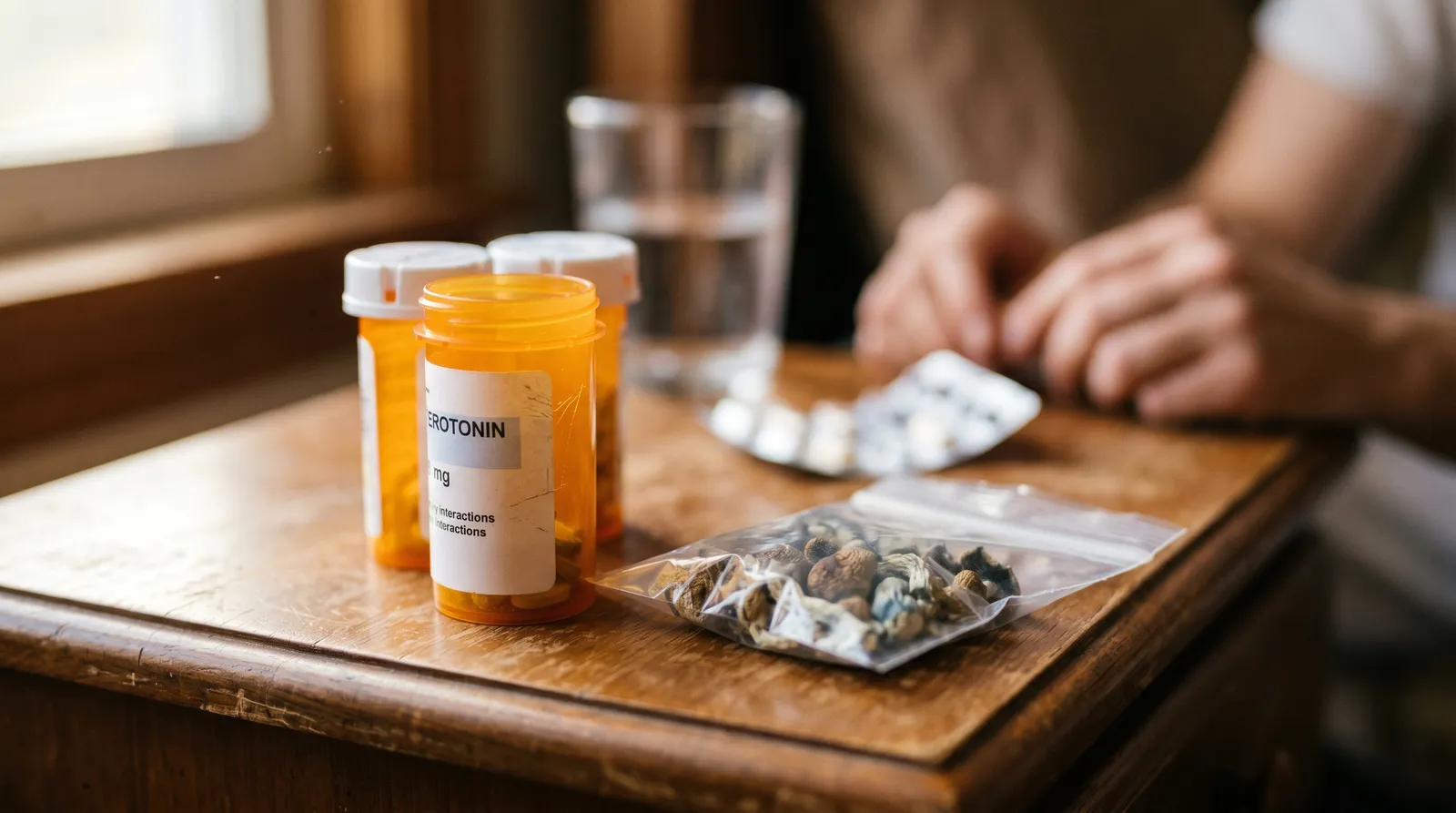
Serotonin syndrome sits at the extreme end of this spectrum. It's a cluster of symptoms — agitation, hyperthermia, rapid heart rate, muscle rigidity, diarrhoea — that occurs when serotonergic activity exceeds what your body can regulate. A 2022 review in Psychopharmacology noted that while full-dose MAOI combinations carry clear serotonin syndrome risk, the microdose range has produced far fewer reports (Malcolm & Thomas, 2022). That doesn't mean zero risk. It means the data is thin. MAOIs and lithium remain hard "do not combine" categories regardless of dose. The Beckley Foundation's ongoing research programme has flagged serotonergic polypharmacy as a priority area for future safety studies on microdosing medication interactions.
SSRIs and SNRIs: Blunting, Not Boosting
Chronic SSRI use downregulates 5-HT2A receptors, which typically blunts or eliminates microdose effects rather than creating a dangerous microdosing medication interaction. This is the most common question in this space: "I'm on an SSRI — can I microdose?" Fadiman and Korb's crowdsourced data from over 1,500 respondents found that people on SSRIs consistently reported weaker or absent effects from their microdosing protocol (Fadiman & Korb, 2019).
The danger here isn't usually serotonin syndrome at microdose levels — it's what people do next. They increase the microdose trying to "feel something," or worse, they abruptly stop their SSRI to make the microdose work. SSRI discontinuation syndrome (brain zaps, dizziness, irritability, rebound depression) is real and can be severe, particularly with paroxetine and venlafaxine, which have short half-lives. Nobody should adjust prescribed psychiatric medication based on a microdosing schedule without medical guidance — that's not a disclaimer, it's pharmacology.
SNRIs follow the same pattern, with the added variable of norepinephrine reuptake inhibition. The serotonergic blunting is comparable to SSRIs, but the noradrenergic component means cardiovascular monitoring matters more. Elevated heart rate and blood pressure are already SNRI side effects; adding a serotonergic microdose — even a sub-perceptual one — introduces another variable into an already-adjusted system.
MAOIs and Lithium: The Hard Stops
MAOIs and lithium are absolute contraindications for microdosing — no dose, no schedule, no workaround makes the combination acceptable. These two medication classes sit in their own category because the microdosing medication interaction risk profile is qualitatively different from SSRIs.
MAOIs prevent the enzyme monoamine oxidase from breaking down serotonin, dopamine, and norepinephrine. If you then add a substance that activates serotonin receptors — even at a microdose — you're flooding a system that's already running at higher-than-normal serotonin levels with no enzymatic safety valve. Ayahuasca works on this exact principle (the harmine/harmaline in the brew is an MAOI that prevents DMT from being broken down), but in that context the dose relationship is calibrated by centuries of traditional practice. Combining a pharmaceutical MAOI with a psilocybin or LSD microdose is an uncontrolled version of the same mechanism.
Lithium is less well understood pharmacologically, but the clinical signal is clear. Nayak et al. (2021) documented case reports of seizures in individuals who combined lithium with psychedelics. The mechanism likely involves lithium's modulation of inositol signalling downstream of the 5-HT2A receptor, effectively amplifying the signal in unpredictable ways. Even at microdose levels, the combination is considered contraindicated by every harm-reduction resource that addresses it, including EMCDDA safety advisories on novel psychoactive substance interactions.
Tricyclics, Triptans, and Tramadol: The Grey Zone
Tricyclics, triptans, and tramadol each carry moderate serotonergic risk that is poorly quantified at microdose levels, placing them in a grey zone of microdosing medication interactions between "probably fine" and "genuinely concerning." Tricyclic antidepressants (TCAs) are an older class that inhibits serotonin reuptake — similar to SSRIs but less selective, which means more side effects and more interaction variables. Some TCAs (particularly clomipramine) have strong serotonergic activity and carry a meaningful serotonin syndrome risk when combined with serotonergic substances. Others (like nortriptyline) are more noradrenergic and may interact less, but the evidence base for TCA–microdose combinations is essentially non-existent in controlled settings.
Triptans are interesting because they're serotonin agonists, but they target different receptor subtypes (5-HT1B/1D) than the 5-HT2A receptor activated by microdoses. The theoretical serotonin syndrome risk exists, but a 2023 review in Headache noted that triptan-related serotonin syndrome is rare even with other serotonergic drugs, and questioned whether the FDA's 2006 warning was overstated (Orlova et al., 2023). Still, same-day use of a triptan and a microdose is not well-studied and is best avoided.
Tramadol deserves special mention because it's often not thought of as a serotonergic drug — people think "painkiller" and assume it's purely opioid. It isn't. Tramadol inhibits serotonin reuptake and also lowers the seizure threshold, making it a double concern when combined with serotonergic microdoses.
Medications That Block the Microdose
Antipsychotics — both typical and atypical — block microdose effects entirely rather than creating dangerous microdosing medication interactions. They do something arguably worse from the microdosing perspective: they make it pointless. Atypical antipsychotics like quetiapine and risperidone are 5-HT2A antagonists. They sit on the same receptor the microdose is trying to activate and prevent it from working. Vollenweider et al. (1998) demonstrated this clearly with risperidone blocking psilocybin's subjective effects in a controlled study.
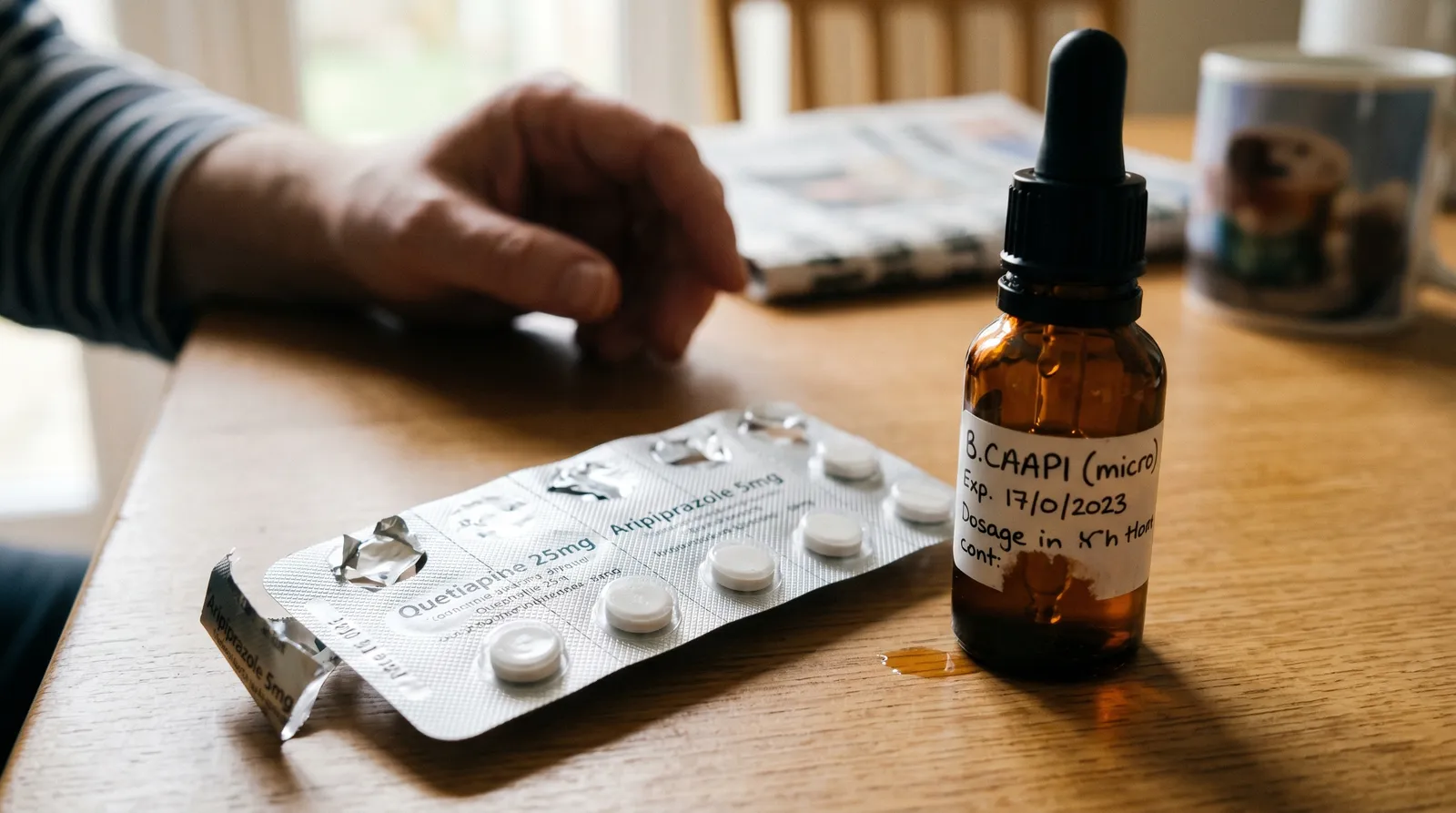
This isn't a safety concern in the acute sense, but it's a practical one. If you're prescribed an antipsychotic, microdosing is pharmacologically incompatible with your current treatment. Stopping an antipsychotic to microdose carries serious risks, including psychotic relapse for those with schizophrenia-spectrum conditions — a population for whom substances of any dose acting on 5-HT2A are generally contraindicated.
Benzodiazepines and Stimulants: Lower Concern
Benzodiazepines and ADHD stimulants carry the lowest microdosing medication interaction risk because they operate through pharmacologically distinct pathways. Benzodiazepines work through the GABA system, which is separate from serotonin signalling. They may reduce the subjective effects of a microdose (benzodiazepines are used in clinical settings to manage difficult sessions), but they don't create dangerous serotonergic interactions. The Fadiman and Korb dataset showed no adverse interaction signal for benzodiazepine–microdose combinations (Fadiman & Korb, 2019).
ADHD stimulants (methylphenidate, amphetamine-based medications) are primarily dopaminergic and noradrenergic. At therapeutic doses, their serotonergic activity is minimal. The main monitoring point is cardiovascular: both stimulants and psilocybin can raise heart rate and blood pressure, and the additive effect — even at microdose levels — may matter for people with pre-existing cardiac conditions.
How This Guide Differs from Other Interaction Resources
This guide provides receptor-level pharmacological explanations for every microdosing medication interaction class, which most consumer-facing resources skip entirely. Most microdosing interaction guides online fall into two categories: oversimplified "safe/not safe" lists with no pharmacological explanation, or academic papers that assume you already know receptor pharmacology. This guide sits deliberately in between. We include the mechanism for every interaction class so you understand why a combination is risky, not just that someone on a forum said it was. We also cite every claim to a specific study or dataset — something most popular guides skip entirely.
Compared to the Fadiman & Korb dataset alone, this guide adds the lithium–seizure data from Nayak et al. (2021), the triptan reassessment from Orlova et al. (2023), and the Vollenweider antipsychotic-blocking data — none of which appear in most consumer-facing microdosing resources. We also acknowledge what we don't know, which brings us to the next section.
Comparison with Popular Interaction Checkers
Standard drug interaction databases like Drugs.com or the BNF don't list psilocybin or LSD interactions at all — they're not approved medicines. The MAPS MDMA trial protocols exclude serotonergic medications but don't publish granular interaction tables. The Beckley Foundation's harm-reduction materials mention MAOI and lithium risks but don't break down the full medication field. Our table above is, as far as we can determine, the most complete single-page reference for microdosing medication interactions available outside of academic review papers — and it's written for people who buy microdosing supplies, not for pharmacologists.
What the Evidence Actually Looks Like
There are zero published randomised controlled trials specifically examining microdose–medication interactions as of 2026. Here's the uncomfortable reality: almost everything above is extrapolated from full-dose data, pharmacological first principles, or self-reported surveys. The Fadiman and Korb dataset is the largest source, with over 1,850 reports as of their 2019 publication, but it's observational and self-selected — people who had bad interactions may have stopped reporting, and dosing was not verified.
A 2020 systematic review in Journal of Psychopharmacology identified the lack of interaction data as a critical gap in microdosing research (Kuypers, 2020). The Imperial College London psilocybin research group has excluded participants on SSRIs from their clinical trials, which means even the best research doesn't tell us much about the combination (Carhart-Harris et al., 2018). The EMCDDA has similarly noted that polypharmacy involving novel psychoactive substances remains an under-researched area across Europe. We're working with pharmacological logic and crowd-sourced signals — not clinical certainty. This is an honest limitation of every microdosing medication interaction guide, including this one.
Practical Steps for Assessing Your Own Risk
The most important step before microdosing on any medication is identifying whether your drug has serotonergic activity. If you're on any medication and considering microdosing, the following steps reflect current harm-reduction consensus around microdosing medication interactions:
- Identify your medication's mechanism. Is it serotonergic? Check the table above. If it's an MAOI or lithium, stop here — the combination is contraindicated at any dose.
- Check the half-life. A drug with a 36-hour half-life (like fluoxetine) is still active the day after you take it. Timing your microdose on an "off day" from medication doesn't eliminate the microdosing medication interaction if the drug is still in your system.
- Never adjust prescribed medication to accommodate a microdosing schedule. Abrupt discontinuation of SSRIs, SNRIs, benzodiazepines, or antipsychotics carries its own serious risks — often worse than any microdose interaction.
- Use a 0.01 g precision scale. If you're going to microdose alongside any medication, dosing precision is non-negotiable. The difference between 0.1 g and 0.3 g of dried psilocybin mushrooms is the difference between sub-perceptual and perceptual — and that margin matters more when another serotonergic substance is on board. You can buy a reliable milligram scale from Azarius alongside your microdosing supplies.
- Keep a daily log. Track mood, heart rate, sleep quality, and any unusual physical symptoms. Serotonergic side effects (jaw clenching, temperature changes, unusual agitation) are early warning signs worth recording.
- Discuss with a prescriber if possible. The number of psychiatrists familiar with microdosing pharmacology is growing. A prescriber who knows your full medication history can assess cytochrome P450 interactions (psilocybin is metabolised primarily by CYP2D6 and CYP3A4) that go beyond the serotonin-level analysis above.
Last updated: April 2026
Frequently Asked Questions
10 questionsCan I microdose psilocybin while taking an SSRI?
Why is lithium dangerous to combine with psychedelics?
Do antipsychotics block microdosing effects?
Is serotonin syndrome possible from microdosing alone?
Are ADHD stimulants safe to combine with microdosing?
What should I buy to measure microdoses accurately when on medication?
Can I microdose psilocybin while taking an MAOI antidepressant?
Are benzodiazepines safe to take alongside a psilocybin microdose?
Does tramadol interact with a psilocybin microdose?
Can I microdose while using hormonal birth control?
About this article


Joshua Askew serves as Editorial Director for Azarius wiki content. He is Managing Director at Yuqo, a content agency specialising in cannabis, psychedelics and ethnobotanical editorial work across multiple languages. Th
This wiki article was drafted with AI assistance and reviewed by Joshua Askew, Managing Director at Yuqo. Editorial oversight by Adam Parsons.
Medical disclaimer. This content is for informational purposes only and does not constitute medical advice. Consult a qualified healthcare provider before use of any substance.
Last reviewed April 24, 2026
References (7)
- [1]Carhart-Harris, R. L. et al. (2018). Psilocybin with psychological support for treatment-resistant depression: six-month follow-up. Psychopharmacology, 235(2), 399–408.
- [2]Fadiman, J. & Korb, S. (2019). Might microdosing psychedelics be safe and beneficial? An initial exploration. Journal of Psychoactive Drugs, 51(2), 118–127.
- [3]Kuypers, K. P. C. (2020). Microdosing psychedelics: More questions than answers? An overview and suggestions for future research. Journal of Psychopharmacology, 34(9), 968–981.
- [4]Malcolm, B. & Thomas, K. (2022). Serotonin toxicity of serotonergic psychedelics. Psychopharmacology, 239(6), 1881–1891.
- [5]Nayak, S. M. et al. (2021). Classic psychedelic coadministration with lithium, but not lamotrigine, is associated with seizures: an analysis of online psychedelic experience reports. Psychopharmacology, 238, 3281–3291.
- [6]Orlova, Y. et al. (2023). Association of co-prescribed triptans and SSRIs/SNRIs with serotonin syndrome: a systematic review. Headache, 63(4), 469–480.
- [7]Vollenweider, F. X. et al. (1998). Psilocybin induces schizophrenia-like psychosis in humans via a serotonin-2 agonist action. NeuroReport, 9(17), 3897–3902.
Related Articles

Microdosing Silicon Valley History: How Sub-Perceptual Doses Went from Fringe to Boardroom
Sub-perceptual psychedelic dosing and Silicon Valley share roots stretching back to the 1960s, when engineers at Menlo Park research labs first combined LSD…

Microdosing vs Macrodosing
Microdosing vs macrodosing is a comparison between two psychedelic dosing strategies that use the same substances at vastly different levels — microdosing…

Microdosing Myths and Misconceptions
Microdosing myths and misconceptions is a category of persistent misinformation that has grown alongside the practice itself.

Microdosing When Inadvisable
Microdosing when inadvisable is a harm-reduction framework that identifies the specific medical, psychiatric, pharmacological, and situational circumstances…

Microdosing Protocols Fadiman Stamets: Full Comparison Guide
A microdosing protocol is a structured schedule dictating dose days and rest days, designed to produce sub-perceptual cognitive shifts without tolerance buildup.

The Microdosing Placebo Debate: How to Tell If It's Actually Working
The microdosing placebo debate is a scientific and practical controversy that examines whether sub-perceptual doses of psilocybin or LSD produce genuine…

Origin of Microdosing Fadiman: How His Protocol Became the Standard
The origin of microdosing as a formalised practice traces to James Fadiman's 2011 book The Psychedelic Explorer's Guide, which introduced sub-perceptual…

Microdosing Research Current State
The current state of microdosing research reveals a field caught between enthusiastic self-reports and sobering controlled data.

Microdosing Contraindications
A microdosing contraindication is a medical condition, psychiatric history, or concurrent medication that makes sub-perceptual psychedelic dosing inadvisable…