
This article discusses psychoactive substances intended for adults (18+). If you have a health condition or take medication, consult a doctor before use. Our age policy
Microdosing Local Help Resources
Definition
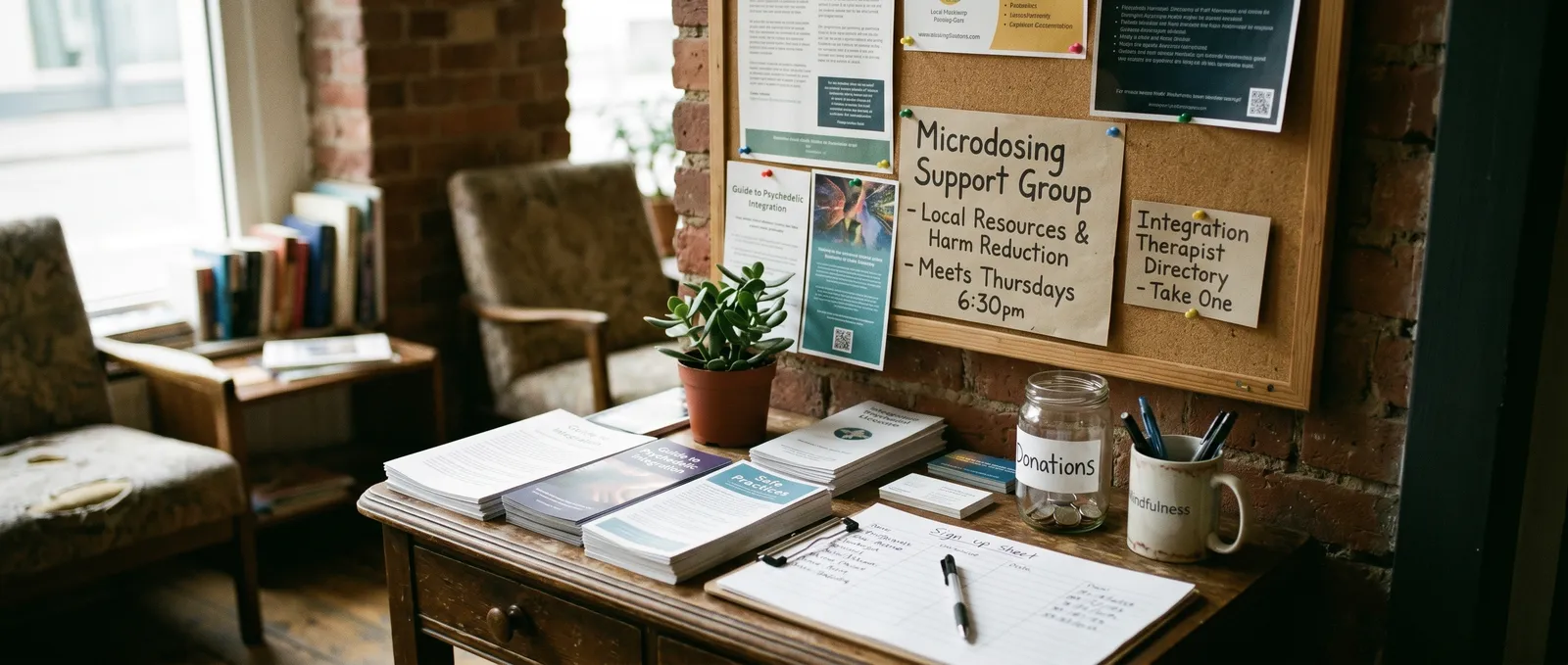
A microdosing local help resource is a harm-reduction service, integration therapist, peer-support group, or clinical research programme near you that supports adults who microdose. Rootman et al. (2022) found that microdosers engaging with community support reported greater mood improvements at one month compared to those practising in isolation.
A microdosing local help resource is a harm-reduction service, integration therapist, peer-support group, or clinical research programme near you that supports adults who microdose. This guide helps you find and evaluate these microdosing local help resources — whether you want a psychologist familiar with sub-perceptual dosing, a peer-support network, or a clinical trial you can actually enrol in. According to a RAND Corporation survey (2025), psilocybin was the most commonly microdosed psychedelic among American adults, yet most users reported having no professional support whatsoever. European data paints a similar picture: a Nature Scientific Reports study (Rootman et al., 2022) found that microdosers who engaged with community support reported greater mood improvements at one month compared to isolated users. The steps below help you build a local support network that fits your situation, and if you want to buy microdosing supplies such as psilocybin truffles, Azarius carries a curated selection you can order alongside building your support plan.
Step 1: Identify What Kind of Help You Actually Need
The first step in finding the right microdosing local help resources is categorising your specific need into one of five support types, because each requires a fundamentally different resource. Before you start searching for therapists or community meetups, work out which category you fall into:
- Pre-start guidance — You haven't begun microdosing yet and want a professional to assess whether it's appropriate given your mental health history, medications, or neurodivergence.
- Ongoing integration — You're already microdosing and want someone to help you make sense of subtle shifts in mood, cognition, or behaviour patterns.
- Adverse-reaction support — Something has gone sideways: persistent anxiety, depersonalisation, or mood destabilisation. You need someone who won't panic when you mention psilocybin.
- Peer community — You're looking for non-clinical support: people who share protocols, compare notes, and hold each other accountable.
- Clinical research — You want to microdose within a structured study where dosing, monitoring, and follow-up are handled for you.
Each of these requires a different type of resource. A psychedelic integration therapist and a clinical coordinator are not interchangeable. Get specific about your need before moving to Step 2.
Step 2: Find Psychedelic-Literate Therapists Near You
Psychedelic-literate therapists can be found through four main directories that cover Europe and North America. Not every therapist will be comfortable discussing sub-perceptual psilocybin use, so you need someone trained — or at least experienced — in psychedelic integration. Here's how to locate microdosing local help resources in the therapy space:
- MAPS Psychedelic Integration List — The Multidisciplinary Association for Psychedelic Studies maintains a directory of therapists trained in psychedelic integration across North America and Europe. Filter by country and modality.
- Psychedelic Support (psychedelic.support) — A European-focused directory of integration therapists, coaches, and retreat aftercare providers. Coverage is strongest in the Netherlands, Germany, and the UK.
- MIND Foundation (Berlin) — Runs the Augmented Psychotherapy Training programme. Their graduate directory lists therapists across German-speaking countries who are specifically trained in psychedelic-assisted protocols.
- Local psychotherapy registers — In the Netherlands, search the BIG-register for GZ-psychologen and filter by "experiential" or "transpersonal" orientation. In the UK, the UKCP register allows filtering by "psychedelic integration" as a specialism since 2023.
When you contact a therapist, ask directly: "Do you have experience supporting clients who microdose psilocybin or LSD?" If they hesitate or redirect to addiction services, they're not the right fit. You want someone who approaches microdosing as a practice to be discussed openly, not a problem to be solved.
Step 3: Locate Peer Support and Community Groups
Peer-support groups are free or donation-based communities where microdosers share experiences, compare protocols, and hold each other accountable. Clinical support costs money, but peer groups are typically free and surprisingly effective. A 2022 survey by the UC Berkeley Center for the Science of Psychedelics found that 68% of microdosers who maintained a consistent protocol for over three months credited peer accountability as a key factor.
Where to find microdosing local help resources in the community space:
- Meetup.com — Search "microdosing," "psychedelic integration," or "plant medicine" in your city. Amsterdam, Berlin, London, Lisbon, and Barcelona all have active groups meeting monthly or fortnightly.
- Psychedelic Society chapters — The Psychedelic Society (UK) runs local integration circles in over 15 cities. Similar organisations exist in Germany (GPTF), the Netherlands (Open Foundation), and Belgium.
- Reddit r/microdosing — Not local, but the community maintains a pinned list of regional meetups and Discord servers organised by country.
- Harm-reduction organisations — Unity (Netherlands), DanceSafe (US), The Loop (UK), and Safer Party (Switzerland) sometimes host integration events or can point you to local microdosing local help resources.
A word on vetting: any group that charges high fees for "microdosing coaching certifications" or promises specific therapeutic outcomes is a red flag. Good peer groups share experiences without prescribing. They don't sell protocols.
Step 4: Check for Clinical Trials You Can Join
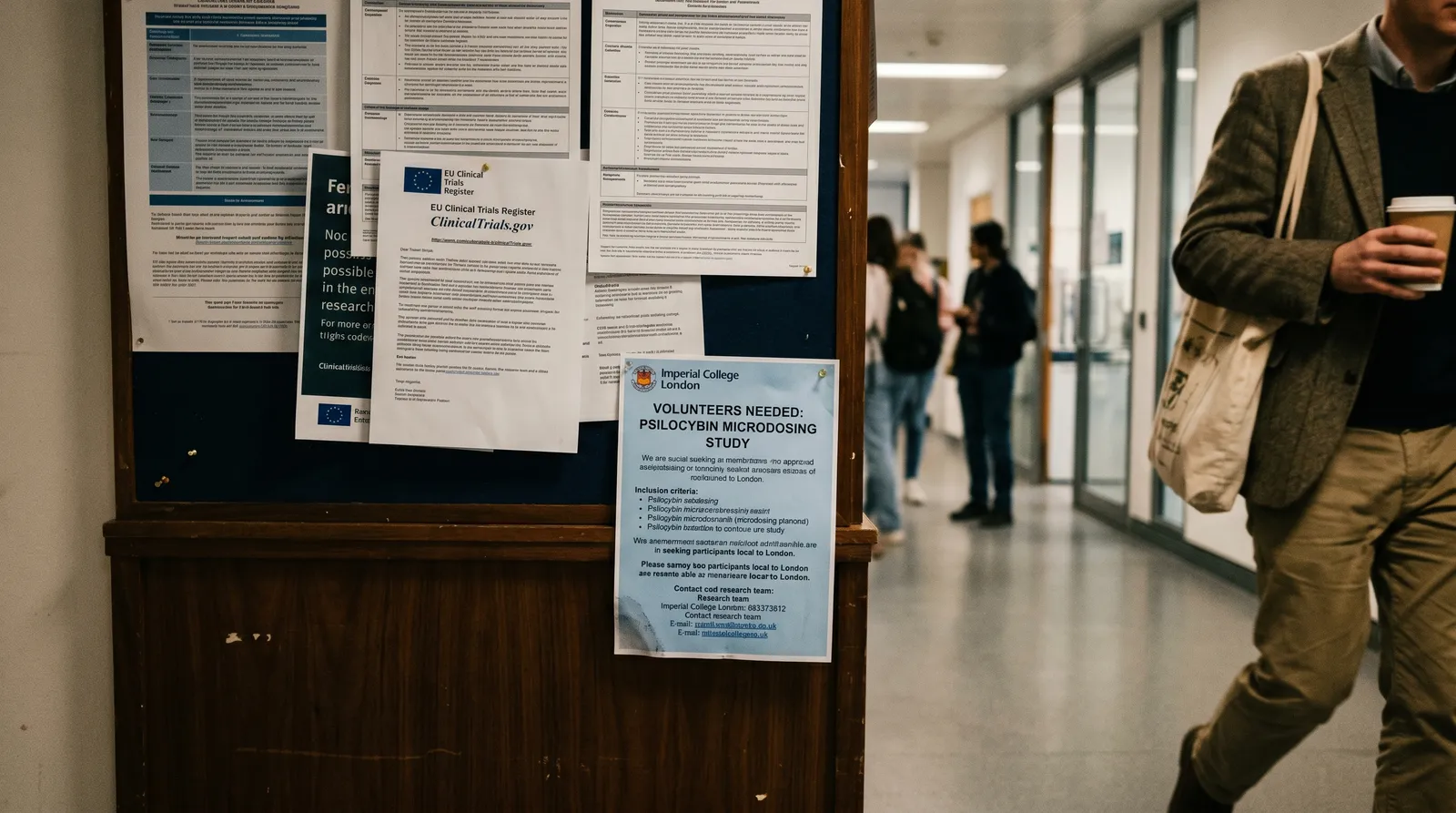
Active microdosing clinical studies can be found on ClinicalTrials.gov and the EU Clinical Trials Register, with current studies running at Imperial College London, Maastricht University, and the University of Zurich. If you want the most structured support available, a clinical study gives you pharmaceutical-grade dosing, medical monitoring, and follow-up — all free. The catch: eligibility criteria are strict, and most focus on specific conditions (depression, ADHD, cluster headaches).
Where to search:
- ClinicalTrials.gov — Filter by "psilocybin" or "LSD" + "microdose" + your country. As of early 2025, there are active microdosing studies at Imperial College London, Maastricht University, and the University of Zurich.
- EU Clinical Trials Register (clinicaltrialsregister.eu) — Covers European studies not always listed on the US database.
- Beckley Foundation — Their collaboration with Maastricht University produced a landmark double-blind microdosing study (Ramaekers et al., 2021) using LSD microdoses of 5–20µg. Check their website for upcoming recruitment.
- University research labs — Email directly. Seriously. Principal investigators at psychedelic research centres (Imperial, Johns Hopkins, Charité Berlin) often recruit via mailing lists before posting publicly.
Enrolment typically requires you to be medication-free (particularly SSRIs and lithium — see the dedicated interactions article for why), have no history of psychotic disorders, and commit to multiple in-person visits. It's not casual, but the support infrastructure is unmatched.
Step 5: Use Harm-Reduction Hotlines and Crisis Services
The most widely available psychedelic-specific hotline is the Fireside Project in the US (62-FIRESIDE), with European equivalents including Unity's service in the Netherlands and the Trimbos Drugsinfo line. Sometimes things go wrong. Microdosing is sub-perceptual by definition, but protocol errors happen — accidentally taking a full dose, unexpected interactions with medication, or psychological distress surfacing during a sensitive period. Knowing who to call before you need them is basic preparation.
- Fireside Project (US) — A psychedelic peer-support line (62-FIRESIDE / 623-473-7433) staffed by trained volunteers. Available for calls and texts during difficult psychedelic experiences of any intensity.
- Unity harm-reduction service (Netherlands) — Amsterdam-based harm-reduction service run by Unity. Provides phone and in-person support, particularly around festival season. They understand microdosing contexts.
- Trimbos Institute (Netherlands) — While primarily a research body, their Drugsinfo line (0900-1995) provides factual, non-judgmental information about substance use, including microdosing queries. Their 2023 annual report documented a 34% increase in psilocybin-related calls compared to 2021.
- TALK TO FRANK (UK) — Government-funded, surprisingly non-judgmental. Useful for basic interaction questions and referrals to local drug services.
- National crisis lines — If you're experiencing a psychiatric emergency (suicidal ideation, psychotic symptoms), call your national emergency number or crisis line first. Psychedelic-specific services are supplementary, not replacements for emergency care.
Step 6: Build Your Personal Support Map
A personal support map organises your microdosing local help resources into four tiers ranked by how often you'll access them. This isn't overthinking — it's the same logic as knowing where your nearest A&E is before you actually need it.
- Tier 1 (daily/weekly) — Your microdosing journal, a trusted friend or partner who knows what you're doing, and an online peer group for quick questions.
- Tier 2 (monthly) — A local integration circle or peer-support meetup. An integration therapist if budget allows.
- Tier 3 (as needed) — Harm-reduction hotlines, your GP (if they're open-minded — and many Dutch GPs are), or a clinical coordinator if you're enrolled in a study.
- Tier 4 (emergency) — National crisis line, A&E, or 112. For psychiatric emergencies only.
Write these down. Put them in your phone. The worst time to search for a psychedelic-literate therapist is when you're already distressed.
Common Mistakes When Seeking Support
The most common mistake is assuming your existing therapist will understand psychedelic microdosing — most do not. Here are the pitfalls we see repeatedly:
- Assuming your regular therapist will understand — Many CBT or psychodynamic therapists have zero training in psychedelic integration. Some will pathologise your microdosing practice reflexively. Screen before disclosing.
- Confusing a coach with a clinician — "Microdosing coaches" are unregulated. Some are excellent; some completed a weekend course. If you have a psychiatric history, you need a licensed professional, not a coach.
- Waiting until crisis point — Integration works best as maintenance, not emergency repair. Starting therapy after six months of unsupported microdosing is less effective than starting alongside your protocol.
- Ignoring medication interactions — If you're on SSRIs, MAOIs, or lithium, a therapist familiar with serotonergic pharmacology is non-negotiable. The dedicated interactions article covers specifics, but the short version: lithium plus psychedelics is a hard no, and SSRIs blunt effects unpredictably.
- Over-relying on online communities — Reddit is useful for protocol comparison but terrible for medical advice. "I felt weird on day 3" threads are not clinical data, though they sometimes feel like it at 2am.
What This Guide Cannot Do
We'll be straight with you: no guide replaces a face-to-face professional assessment. We sell psilocybin truffles at Azarius and we've helped thousands of customers get started, but we're shopkeepers, not clinicians. If you have a psychiatric history — particularly involving psychosis, bipolar disorder, or severe PTSD — please consult a licensed psychedelic-literate therapist before you buy or order anything. This guide points you toward microdosing local help resources, but it cannot evaluate your individual risk profile.
Comparing Support Types: Professional vs Peer vs Clinical
| Feature | Integration Therapist | Peer-Support Group | Clinical Study |
|---|---|---|---|
| Cost | €80–150/session (Western Europe) | Free or donation-based | Free |
| Personalisation | High — tailored to your history | Moderate — shared experiences | Low — standardised protocol |
| Clinical oversight | Yes (if licensed) | No | Yes (medical team) |
| Availability | Appointment-based | Monthly/fortnightly meetups | Fixed study schedule |
| Best for | Psychiatric history, medication interactions | Accountability, protocol sharing | Structured monitoring, research access |
| Limitation | Expensive, limited directories | No clinical authority | Strict eligibility, limited spots |
This comparison should help you decide which microdosing local help resources to prioritise based on your budget, needs, and availability.

How to Buy Microdosing Supplies Alongside Your Support Plan
Once you have your microdosing local help resources mapped out, the practical next step is sourcing your supplies from a trusted vendor. At Azarius you can buy psilocybin truffles specifically packaged for microdosing — including pre-portioned Microdosing XP Truffles and the McMicrodose strips that take the guesswork out of weighing. You can also order a precision scale (the On Balance Myco scale is popular for this) and empty capsules if you prefer to make your own. Many customers get their support network sorted first, then order their supplies so everything arrives in sync with their first integration session.

Last updated: April 2026
Frequently Asked Questions
10 questionsHow do I find a therapist who understands microdosing?
Are microdosing peer-support groups safe to attend?
Can I join a microdosing clinical trial?
What should I do if a microdose goes wrong?
Do I need professional support to microdose safely?
Where can I buy microdosing truffles alongside finding support?
How do I know if a microdosing support group or therapist is legitimate?
Is microdosing support available online if there are no local resources near me?
Can my employer find out if I'm using microdosing support services?
How much does microdosing coaching or integration therapy typically cost?
About this article
Joshua Askew serves as Editorial Director for Azarius wiki content. He is Managing Director at Yuqo, a content agency specialising in cannabis, psychedelics and ethnobotanical editorial work across multiple languages. Th
This wiki article was drafted with AI assistance and reviewed by Joshua Askew, Managing Director at Yuqo. Editorial oversight by Adam Parsons.
Medical disclaimer. This content is for informational purposes only and does not constitute medical advice. Consult a qualified healthcare provider before use of any substance.
Last reviewed April 24, 2026
References (5)
- [1]Rootman, J.M. et al. (2022). Psilocybin microdosers demonstrate greater observed improvements in mood and mental health at one month relative to non-microdosing controls. Nature Scientific Reports, 12, 11091.
- [2]Ramaekers, J.G. et al. (2021). A low dose of lysergic acid diethylamide decreases pain perception in healthy volunteers. Journal of Psychopharmacology, 35(4), 398–405.
- [3]RAND Corporation (2025). Psilocybin Was the Most Used Psychedelic in 2025. RAND Research Brief.
- [4]Trimbos Institute (2023). National Drug Monitor: Annual Report 2023. Utrecht, Netherlands.
- [5]UC Berkeley Center for the Science of Psychedelics (2022). Microdosing survey: community engagement and protocol adherence. Internal research summary.
Related Articles
Microdosing Silicon Valley History: How Sub-Perceptual Doses Went from Fringe to Boardroom
Sub-perceptual psychedelic dosing and Silicon Valley share roots stretching back to the 1960s, when engineers at Menlo Park research labs first combined LSD…
Microdosing vs Macrodosing
Microdosing vs macrodosing is a comparison between two psychedelic dosing strategies that use the same substances at vastly different levels — microdosing…
Microdosing Myths and Misconceptions
Microdosing myths and misconceptions is a category of persistent misinformation that has grown alongside the practice itself.
Microdosing When Inadvisable
Microdosing when inadvisable is a harm-reduction framework that identifies the specific medical, psychiatric, pharmacological, and situational circumstances…
Microdosing Protocols Fadiman Stamets: Full Comparison Guide
A microdosing protocol is a structured schedule dictating dose days and rest days, designed to produce sub-perceptual cognitive shifts without tolerance buildup.
The Microdosing Placebo Debate: How to Tell If It's Actually Working
The microdosing placebo debate is a scientific and practical controversy that examines whether sub-perceptual doses of psilocybin or LSD produce genuine…

Origin of Microdosing Fadiman: How His Protocol Became the Standard
The origin of microdosing as a formalised practice traces to James Fadiman's 2011 book The Psychedelic Explorer's Guide, which introduced sub-perceptual…
Microdosing Research Current State
The current state of microdosing research reveals a field caught between enthusiastic self-reports and sobering controlled data.
Microdosing Medication Interactions
Microdosing medication interactions describe how sub-perceptual doses of psilocybin or LSD affect — or are affected by — prescribed drugs.