
Stoned Ape Theory: Did Magic Mushrooms Make Us Human?
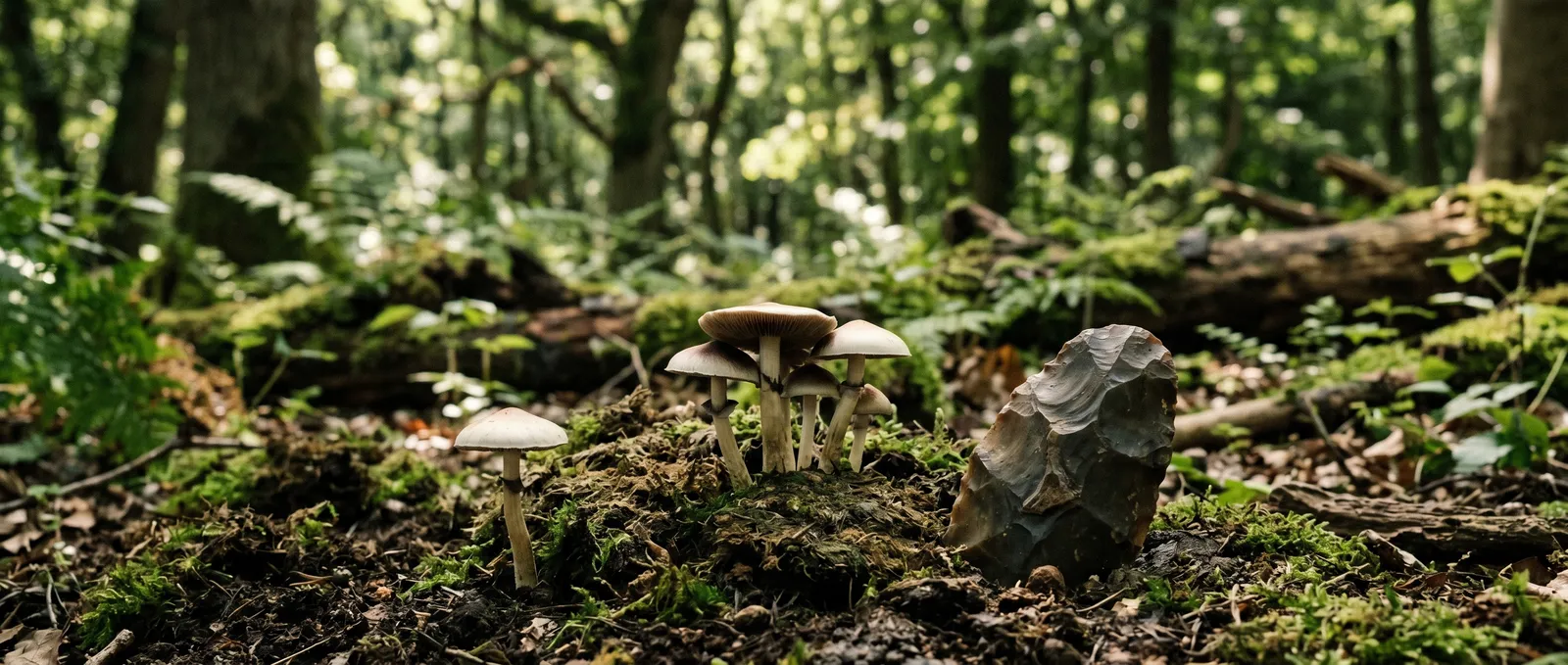
The Stoned Ape Theory is a 1992 hypothesis that claims psilocybin mushrooms catalysed the rapid expansion of the early human brain. Proposed by ethnobotanist Terence McKenna, it argues the missing link in cognitive evolution was a fungus rather than a fossil. The human brain roughly doubled in size in a geological blink — from around 600 cc in Homo erectus to over 1,400 cc in modern humans — and somewhere along the way we picked up language, art, religion and the ability to imagine futures that don't exist yet. Mainstream evolutionary biology has no single agreed cause for this. Into that gap walked McKenna with a properly wild idea: the missing link was a mushroom. We've been selling magic truffles since 1999 and we get asked about this hypothesis more often than you'd think, so it's worth a proper look. This isn't a dosing guide and it isn't a fan letter to McKenna — it's the hypothesis, the modern neuroscience that's quietly rescued bits of it, and the serious reasons most scientists still don't buy it. Written for adults, 18+.
Before we get into it, the explainer video below sets up the argument nicely in under ten minutes.
What the Stoned Ape Theory actually claims
The Stoned Ape Theory claims that psilocybin mushrooms accelerated cognitive evolution in early hominids who encountered them on the African savannah. Proposed by Terence McKenna in his 1992 book Food of the Gods, it focuses specifically on Psilocybe cubensis growing in the dung of cattle and other ungulates, which McKenna argued early humans would have foraged as they followed herds. "The missing evolutionary link, McKenna argued, was not a fossil. It was a fungus."

McKenna's mechanism was a dose ladder. Psilocybin is the active compound in magic mushrooms; in the body it converts to psilocin, which binds to serotonin receptors in the brain. His claim ran like this:
- Low doses sharpened visual acuity, giving hunters an edge
- Medium doses increased arousal and social bonding around the fire
- High doses produced visionary, ego-dissolving states that he linked to the birth of language, music and religion
It's a tidy story. Too tidy, as we'll see. But before dismissing it, it's worth noting that McKenna stumbled — half by accident, half by intuition — onto something that 21st-century neuroscience now takes very seriously: research suggests psilocybin doesn't just shift mood for an afternoon, it appears to physically remodel the brain.
Why modern neuroscience gave the theory a second life
Modern neuroscience gave the theory a second life because psilocybin turns out to be a psychoplastogen — a compound that, according to recent studies, promotes neuroplasticity, the brain's ability to rewire itself by forming new connections between neurons. In the words of the video above: "Psilocybin doesn't just change how you think. It literally changes the physical architecture of your brain."
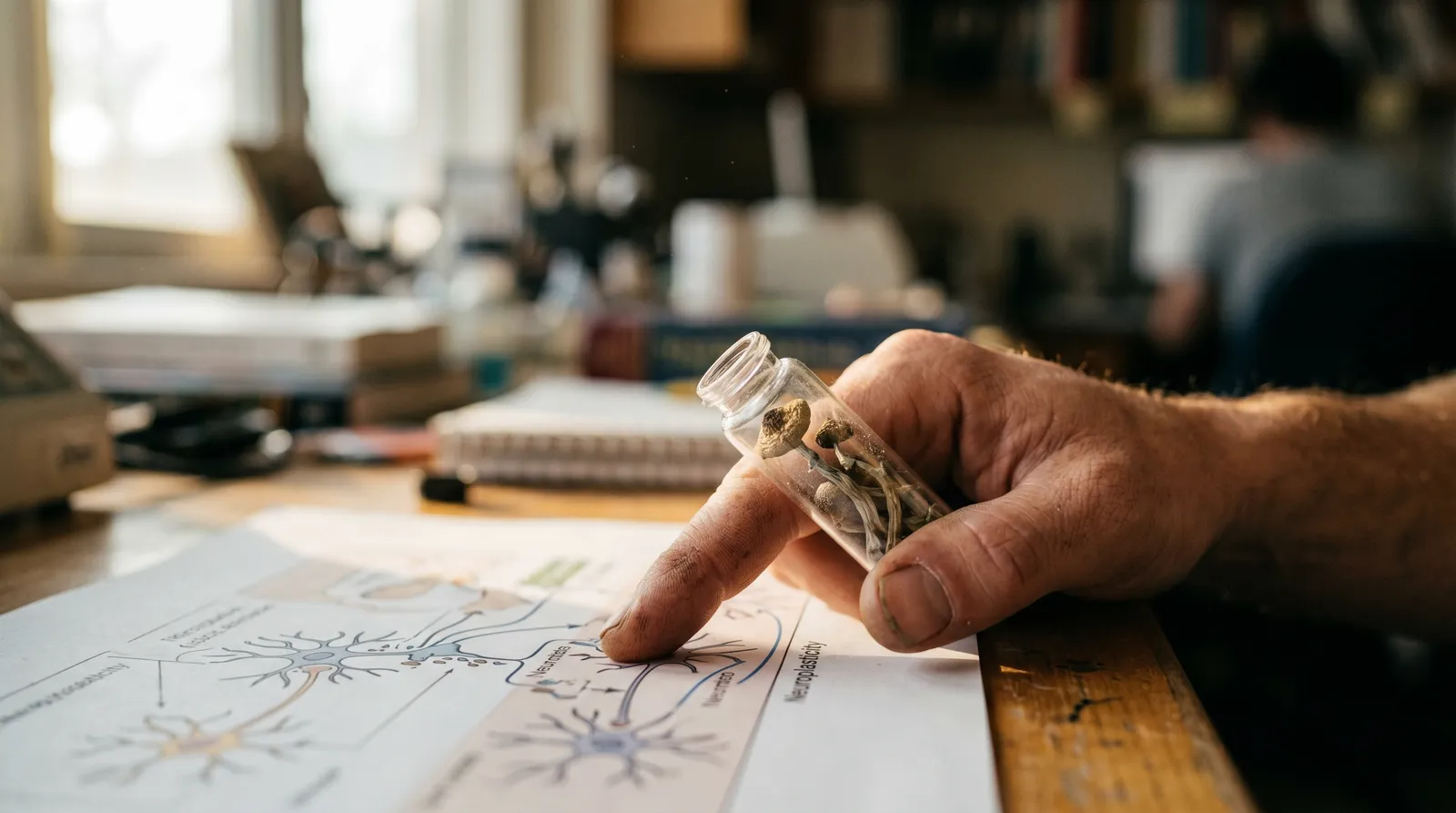
The mechanisms researchers have observed in rodent and cell studies include:
| Mechanism | What it means in plain language |
|---|---|
| Neurogenesis | Growth of new neurons, particularly in the hippocampus |
| Dendritogenesis | New dendrites — the branch-like structures neurons use to receive signals |
| Synaptogenesis | Formation of new synapses, the junctions where neurons communicate |
| Raised BDNF | Brain-derived neurotrophic factor, a protein that researchers say supports neuron health and growth |
| Network connectivity | Brain regions that normally don't talk to each other start exchanging signals |
None of this proves McKenna right. But it does mean the basic premise — that a fungus could meaningfully reshape a primate brain — is no longer the fringe claim it sounded like in 1992. Mycologist Paul Stamets has been a vocal supporter, and the modern psychedelic renaissance, with clinical psilocybin trials at Johns Hopkins, Imperial College London and the Beckley Foundation, has pulled the conversation back into serious rooms.
The serious problems with the hypothesis
The Stoned Ape Theory has four major problems, and an honest read of it requires sitting with them. Here are the main objections, ranked roughly by how damaging they are:
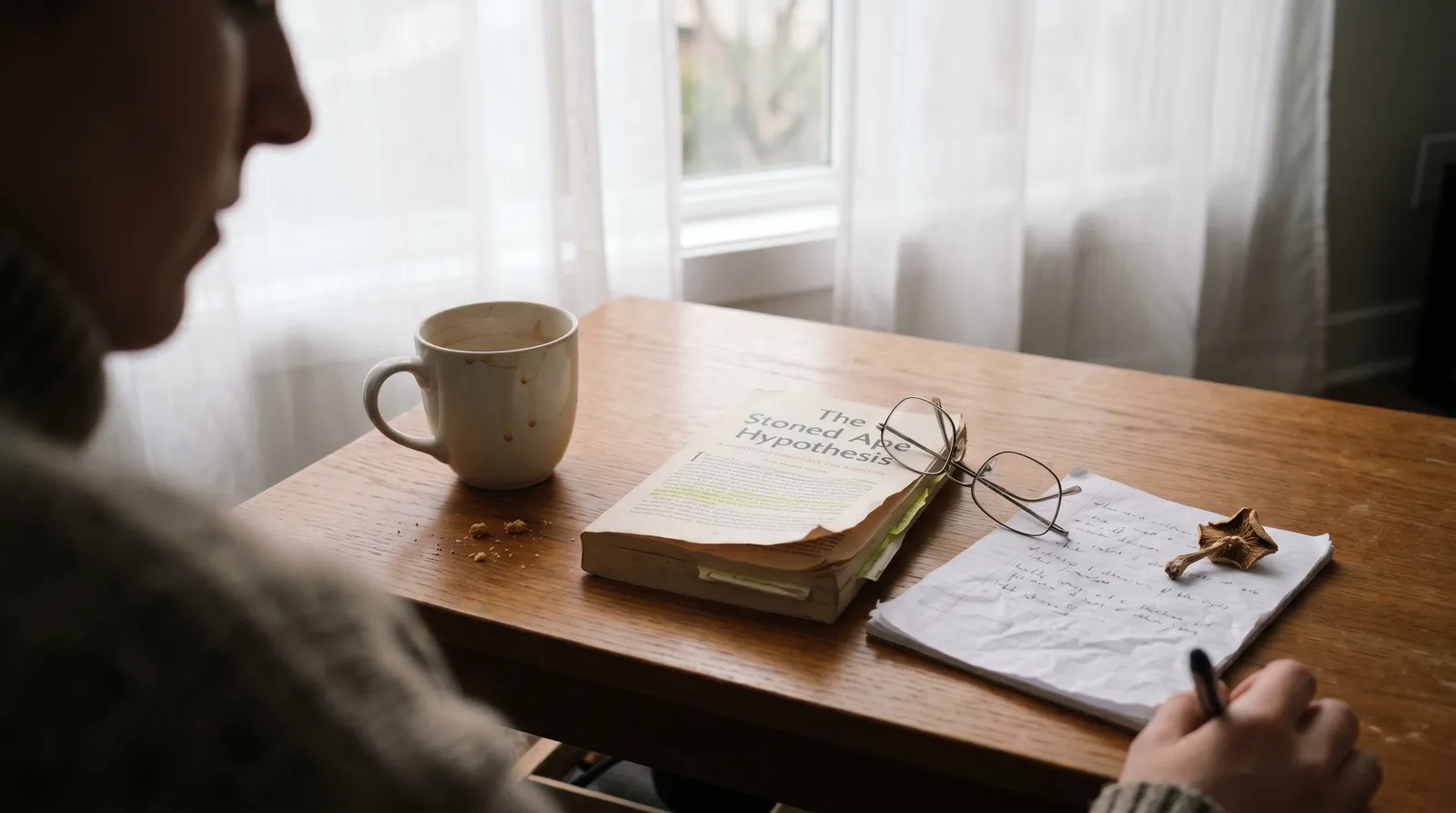
- No direct evidence. There's no fossil, no archaeological site, no preserved residue showing early hominids consumed psilocybin mushrooms. The whole scenario is inferred from McKenna's reading of African savannah ecology, not from a single hard data point.
- The visual acuity claim is weak. McKenna leaned on a 1960s study by Roland Fischer suggesting low-dose psilocybin sharpens edge detection. Subsequent work hasn't really borne this out, and "better hunting" is doing a lot of heavy lifting in his argument.
- The heredity problem. This is the big one. Any brain changes induced by eating mushrooms are acquired traits — they happen to one individual in one lifetime. Lamarckism, the idea that traits acquired during life can be passed to offspring, was rejected by mainstream genetics over a century ago. A hominid having a mushroom experience doesn't pass a bigger brain to its kids.
- Romanticised anthropology. McKenna painted Amazonian ayahuasca-using cultures and other psychedelic societies as inherently peaceful and matriarchal. Anthropologists who actually work with these groups dispute this — violence, hierarchy and conflict exist there as everywhere.
There is one wrinkle worth flagging. Epigenetics — the study of how environmental factors switch genes on and off, sometimes across generations — complicates the blunt "acquired traits can't be inherited" objection. It doesn't vindicate McKenna, but it means the door isn't quite as firmly shut as it was in 1992.
The updated version: cultural evolution, not magic genes
The strongest modern reframing comes from cognitive neuroscientist Bobby Azarian, who proposes a "New Stoned Ape Theory" that swaps Lamarck for something biology already accepts: gene-culture co-evolution, the idea that cultural innovations create new selection pressures that then shape genetic evolution.

In Azarian's reframing, psychedelics didn't directly mutate hominid DNA. Instead, they may have sparked cultural innovations — new tools, symbolic communication, ritual, cooperation — and those innovations changed which individuals survived and reproduced. Brains that handled symbols, language and social complexity well did better in the new psilocybin-shaped cultural environment, and those genes spread.
From our counter: this is the version we find genuinely interesting. It's a much more modest claim than McKenna's, and it doesn't require any biology that mainstream science rejects. Whether it's true is another question entirely — there's still no direct evidence — but it's at least a hypothesis that doesn't break the rules of evolutionary biology to make its point. Compared to other "what made us human" hypotheses — cooked food, throwing spears, pair bonding — the mushroom story isn't obviously worse, it's just harder to test. We'll be honest about the limitation here too: nobody is going to dig up a 200,000-year-old mushroom to settle this, so we're probably stuck arguing about it forever.
So, did magic mushrooms make us human?
Probably not on their own, and almost certainly not in the way McKenna described. The fossil record is silent, the heredity mechanism doesn't work, and the visual acuity claim doesn't hold up. But the question "what made us human?" still has no satisfying answer, and the modern neuroscience of psilocybin is strange and powerful enough that dismissing the fungus entirely feels lazy too. The honest position is somewhere uncomfortable in the middle: the original theory is wrong in most of its specifics, the updated cultural-evolution version is plausible but unproven, and the underlying biology is far more interesting than anyone in 1992 could have known.
Where Azarius fits in
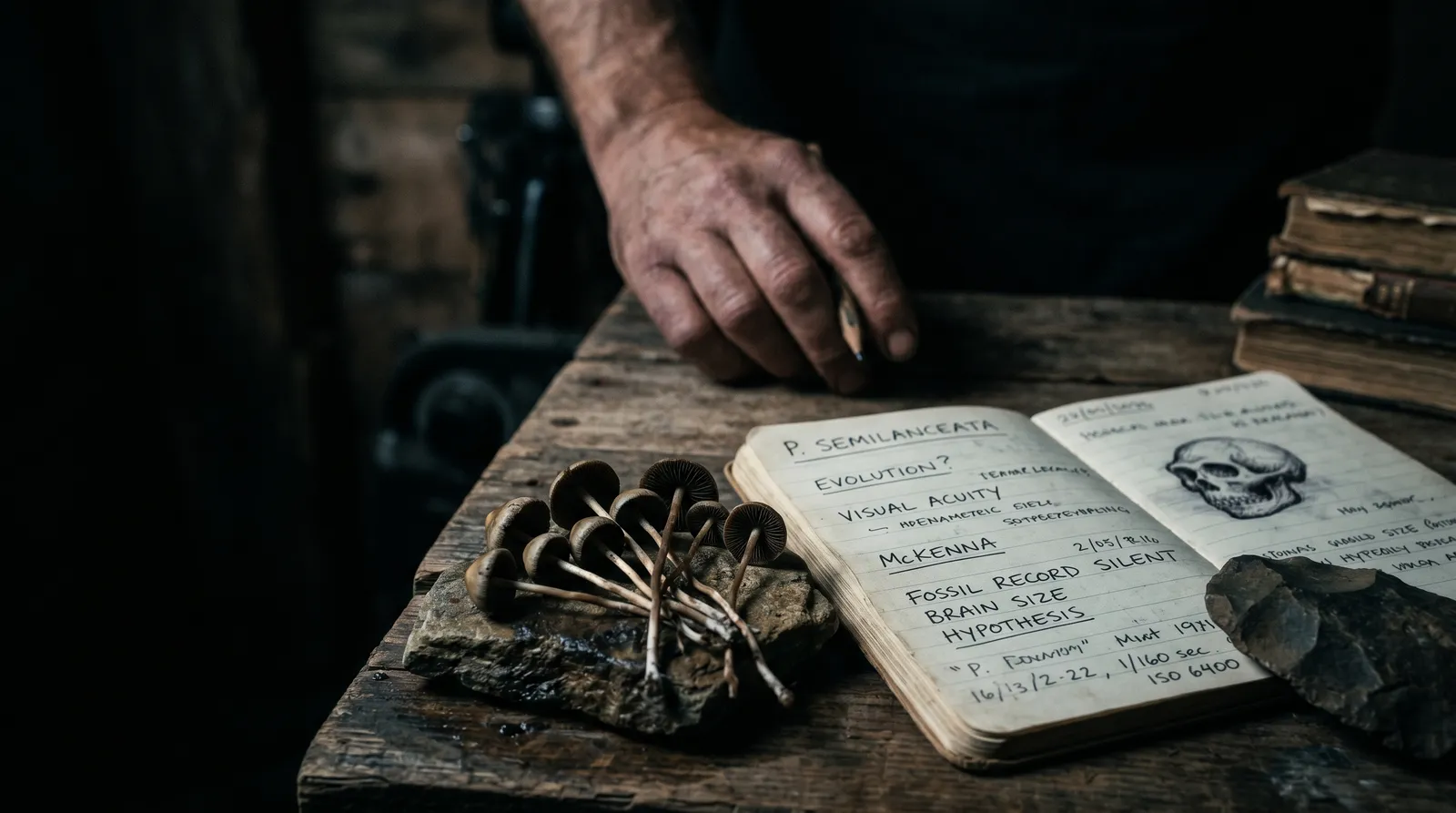
We've been an Amsterdam smartshop since 1999, and magic truffles have been on our shelves the whole time — both fresh from professional truffle farms in the Netherlands and the ten varieties we grow ourselves. You can buy or order them directly, and we also stock magic truffle grow kits for people who'd rather cultivate their own. A lot of our regulars get into microdosing rather than full doses. The Stoned Ape Theory is one of those rabbit holes that pulls people deeper into the science of these fungi, and that's a conversation we've always been happy to have.
Last updated: April 2026
Frequently Asked Questions
6 questionsIs the Stoned Ape Theory true?
Who came up with the Stoned Ape Theory?
What did Terence McKenna actually believe?
Is there any scientific evidence for it?
What does mainstream science say about it?
Where can I buy magic truffles in Amsterdam?
About this article


Adam Parsons is an external cannabis and psychedelics writer and editor who contributes to Azarius's wiki as both author and reviewer. On the writing side, he authors Azarius's kratom and kanna clusters, drawing on exten
This blog article was drafted with AI assistance and reviewed by Adam Parsons, External contributor. Editorial oversight by Joshua Askew.
Last reviewed June 12, 2026
Related Articles
Substrata: Our First Psybient Album
Substrata is our first psybient album: 20 tracks, 1h 22m of psydub and downtempo, free on YouTube with custom trippy visuals for every song.
F1 Hybrid Cannabis Genetics: Inside RQS Testing at Inexo
Royal Queen Seeds field-tested new F1 hybrid cannabis genetics for 3+ years at Inexo. Inside the trials, the traits selected, and the story of strain…
Strain Hunters Kyrgyzstan: Wild Landrace Hunt Recap
Strain Hunters Kyrgyzstan documentary recap: horseback landrace hunt to 3,550 m, purple high-altitude phenos, the 1971 ban, and what it means for…
Cloning Magic Mushrooms: Inside VICE's Blueprint
An Amsterdam smartshop take on VICE's Blueprint documentary — grow-room cloning, María Sabina's Oaxaca, and the mycology behind Psilocybe.

Amsterdam Smartshop History: From 1993 to Today
Amsterdam smartshop history from Conscious Dreams in 1993 to the 2008 mushroom ban and the rise of truffles — the full story, decade by decade.
When Did Humans Start Smoking Cannabis? 12,000 Years
When did humans start smoking cannabis? Chemical proof goes back 2,700 years — and the full plant-human story runs 12,000 years deep.
Ancient Psychedelic Mushrooms: Every Species Explained
A tour of ancient psychedelic mushrooms — from Aztec teonanácatl and the liberty cap to Amanita muscaria, María Sabina and the Stoned Ape idea of…
The Best Stoner Movies Ever — Ranked by Tier
The best stoner movies ever, ranked S to F tier. From Fear and Loathing to Pineapple Express — and the sequels to skip tonight.
Saint Vincent Pheno Hunt: A Landrace Survives a Volcano
The Saint Vincent pheno hunt documents Caribbean landrace sativa genetics rescued by Rastafarian farmers after La Soufrière erupted in 2021.