
Ancient Psychedelic Mushrooms: Every Species Explained
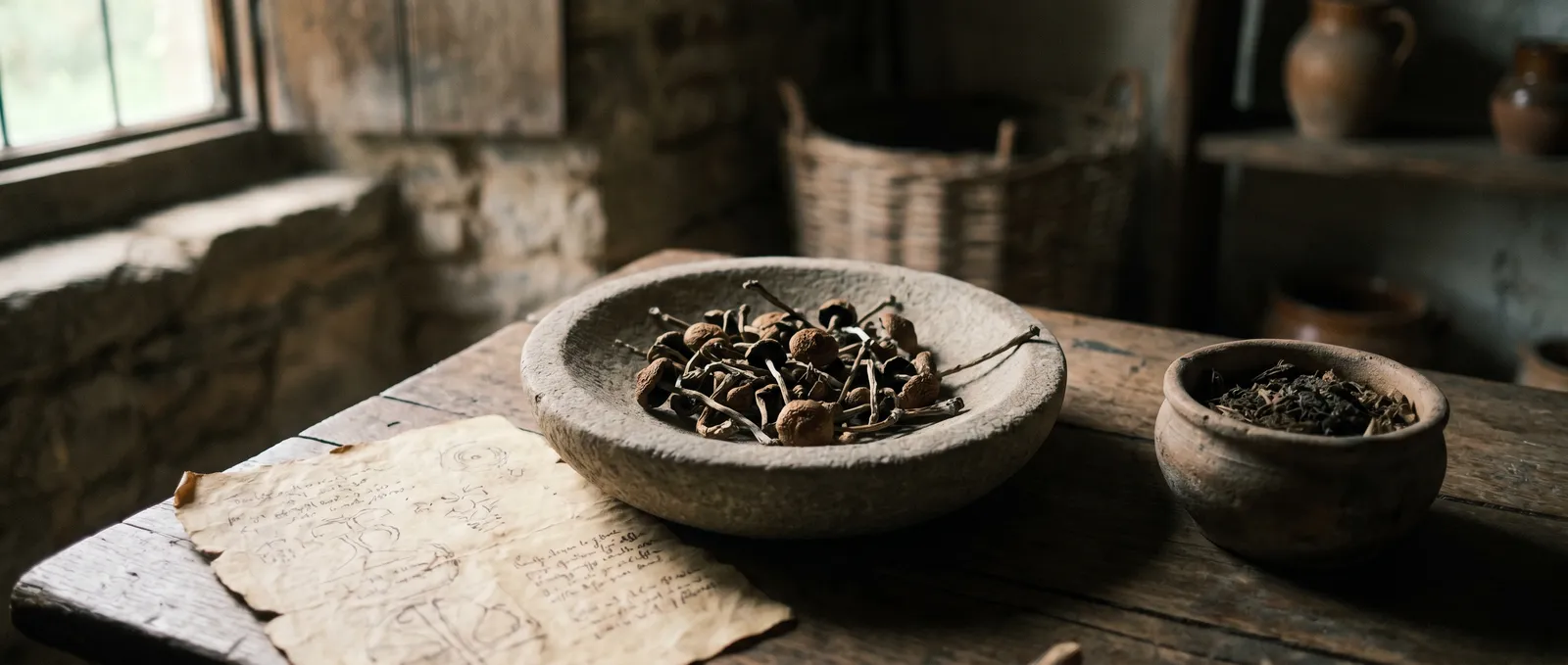
Ancient psychedelic mushrooms are a family of psilocybin-containing fungi that humans have used ceremonially for thousands of years across at least four continents. Long before anyone isolated a molecule or ran a clinical study, people were eating these ancient psychedelic mushrooms on purpose — and building entire belief systems around them. The story isn't really about one mushroom. It's about a relationship between humans and fungi that's older than writing, older than agriculture, and in a few cases tangled up with the spread of cattle and the myth of Santa Claus. Inner Thought Chronicles laid the whole thing out in one video, and it's good enough that we wanted to give it a proper home with the parts that actually stuck with us.
Video by Inner Thought Chronicles (@InnerThoughtChronicles). The piece below pulls out the species and history worth knowing — watch the full thing for the deep dive.
The mushrooms that built Mesoamerican religion
Mesoamerica is where the documented history of ancient psychedelic mushrooms is richest. The Aztecs called these mushrooms teonanácatl — usually translated as "flesh of the gods" — and used them in ceremonies for healing and divination thousands of years before any European wrote a word about them. When the Spanish church arrived, it tried to stamp the practice out as devil-worship, and the ceremonies were driven underground for roughly four centuries, surviving almost entirely through oral tradition in indigenous communities.
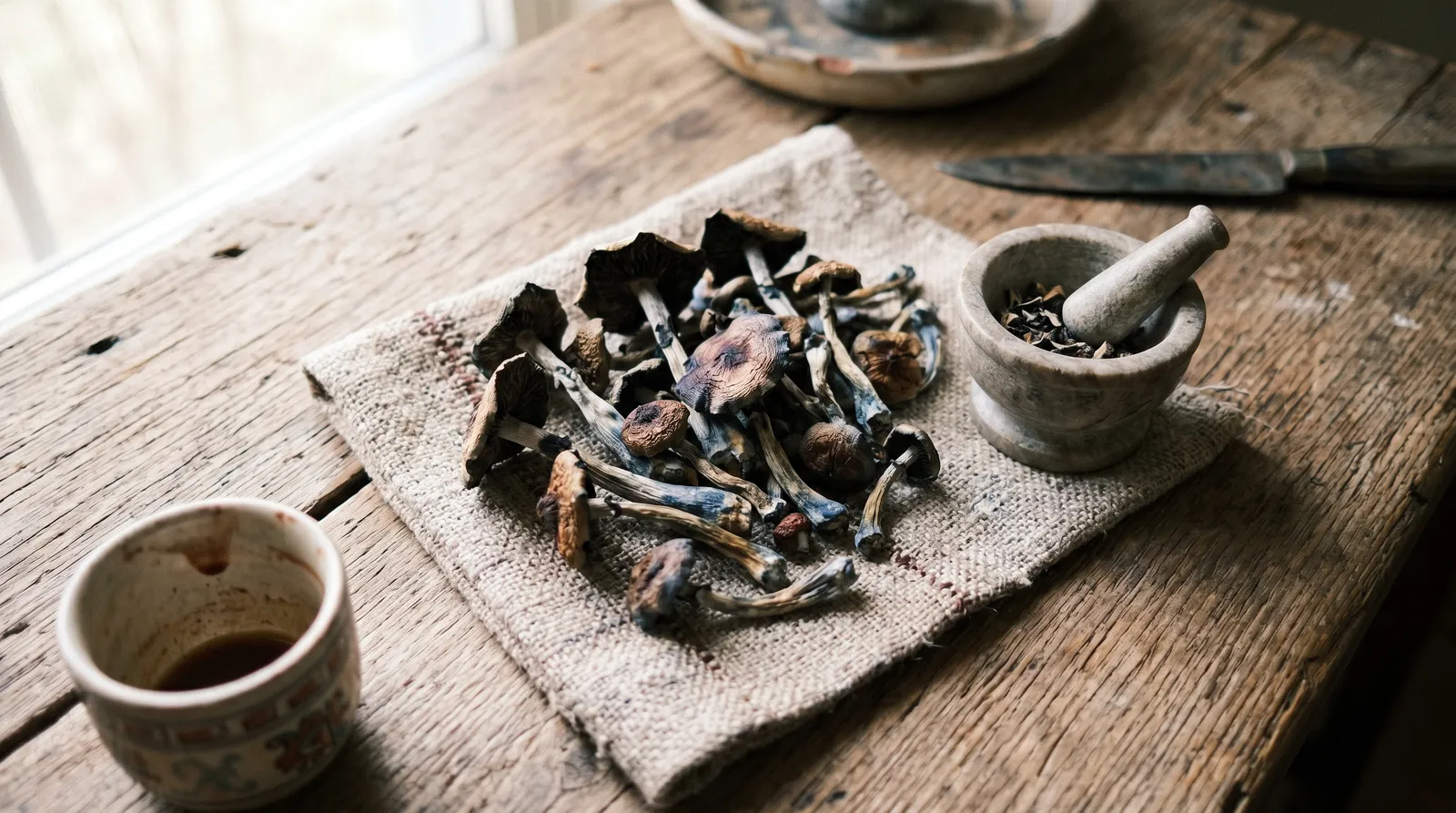
The thread back to the surface runs through one species. In 1955 the banker-turned-mycologist R. Gordon Wasson sat in on a Mazatec velada led by the curandera María Sabina in Oaxaca, and in 1957 he published "Seeking the Magic Mushroom" in Life magazine — the article that introduced psilocybin mushrooms to the West. Wasson sent samples to the Swiss chemist Albert Hofmann (the same man behind LSD), and in 1958 Hofmann isolated psilocybin and psilocin from Psilocybe mexicana. That single species is the literal starting point of modern psychedelic science.
But mexicana is only the famous one. The Mesoamerican picture is a whole cast, and the ecology maps neatly onto the cosmology — mushrooms fruiting in the exact places people considered sacred:
- Psilocybe mexicana — Mesoamerican grasslands; Hofmann's source and the Aztec teonanácatl; mild to moderate with emotional clarity and gentle visuals.
- Psilocybe caerulescens — fruits on freshly disturbed earth after landslides; a Mazatec and Mixtec symbol tied to upheaval; strong geometric visuals, earthy, 6–8 hours.
- Psilocybe zapotecorum — riverbanks and wetlands; linked to the Zapotec religious calendar and the underworld; deeply visual, dreamlike, emotional.
- Psilocybe aztecorum — alpine meadows above 3,000 m; high-altitude Aztec rites linked to rain gods; cognitive amplification, sharpened by altitude.
Notice the pattern: caerulescens fruits on ground torn open by landslides, zapotecorum near the water that symbolised the underworld, aztecorum up on the volcanic slopes closest to the sky. The mushrooms grew where the cosmology said the sacred lived. That's not a coincidence anyone designed — it's two systems, ecology and belief, that lined up so well they reinforced each other.
The liberty cap: Europe's biggest mushroom mystery
The liberty cap is one of the most widespread ancient psychedelic mushrooms on earth, yet Europe has almost no record of using it. Psilocybe semilanceata carpets grazed grasslands across the UK, Ireland, the Netherlands and most of northern Europe. It's potent, it's everywhere, and Europeans almost certainly walked past it for millennia. So where's the European equivalent of teonanácatl?
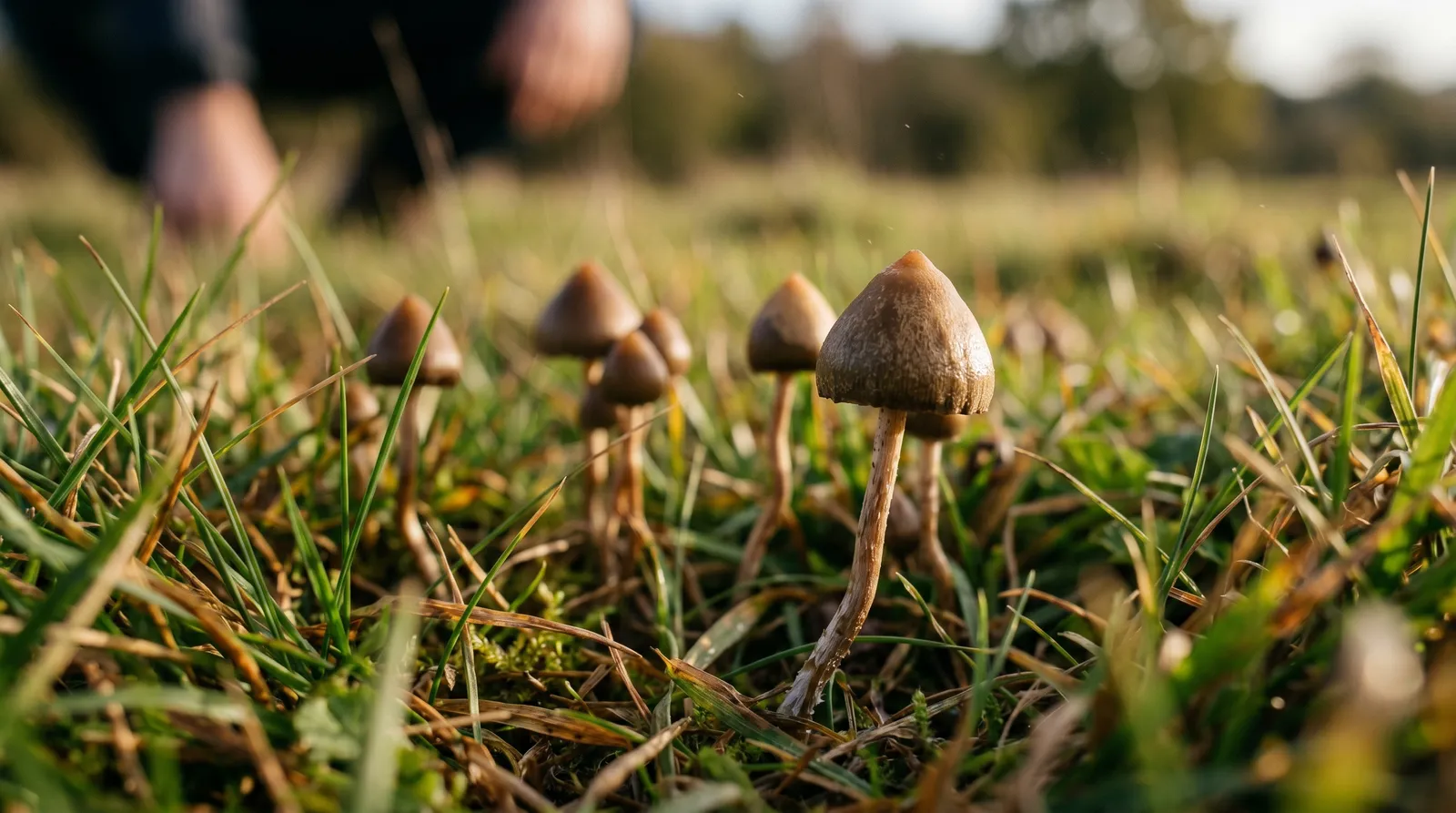
The honest answer is that we don't know, and that's the interesting part. There's no rich written record of ritual liberty-cap use the way there is in Oaxaca. That could mean Europeans genuinely didn't use it much — or, far more likely, that whatever oral traditions existed were lost when literacy, the church, and a few centuries of upheaval erased the people who carried them. The liberty cap is a reminder of how fragile cultural memory is: a mushroom can grow in every field in the country and still leave no trace in the record. Absence of evidence, as the cliché goes, isn't evidence of absence.
The mushrooms that travelled with us
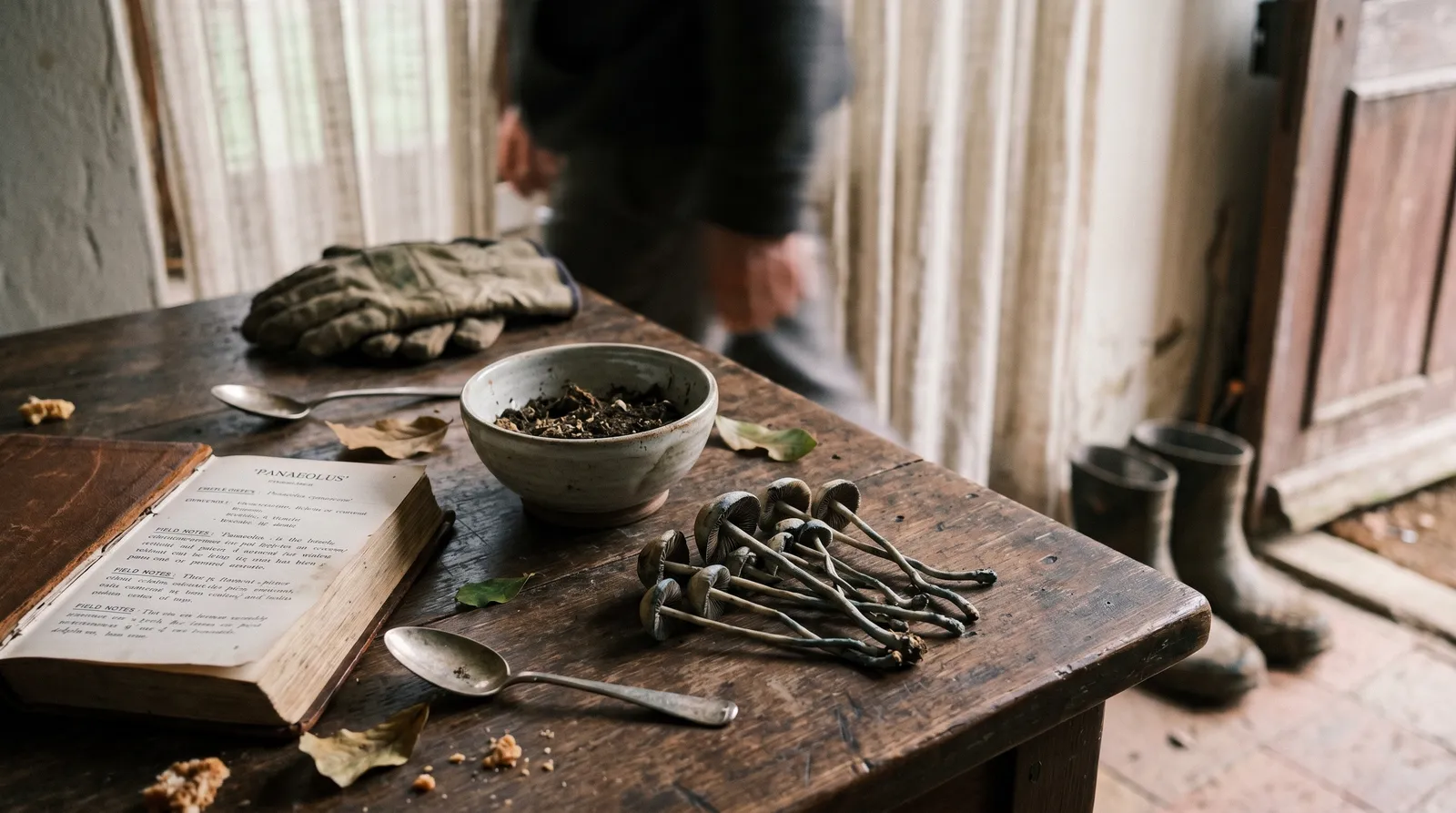
Some ancient psychedelic mushrooms didn't wait for humans to find them — they hitched a ride. Panaeolus cyanescens is one of the most potent psilocybin mushrooms going, and it has a peculiar habit: it loves cattle dung. As people domesticated cattle and moved them around the planet over the last several thousand years, this mushroom spread with the herds, colonising tropical and subtropical pastures from the Caribbean to Southeast Asia. Today it underpins a lot of the psychedelic tourism in places like Bali and Thailand — a species whose modern range was effectively drawn by human agriculture.
Then there's the new frontier. Psilocybe natalensis, an African species closely related to the famous cubensis, has comparable psilocybin and psilocin content but a reputation among users for a cleaner, less anxious headspace that's easier to navigate at higher doses. That profile makes it interesting to researchers, and it hints at something bigger — that the human–fungi relationship in Africa may run far deeper than the documented Mesoamerican record, we just haven't pieced it together yet.
Amanita muscaria: the odd one out
Amanita muscaria is the famous red-and-white toadstool from every fairy tale, and it isn't an ancient psychedelic mushroom in the usual sense. It contains no psilocybin at all. Its active compounds are muscimol and ibotenic acid, and they produce something completely different — a dissociative, dreamlike, sometimes delirious state that has more in common with a deep, strange sleep than with a psilocybin session.
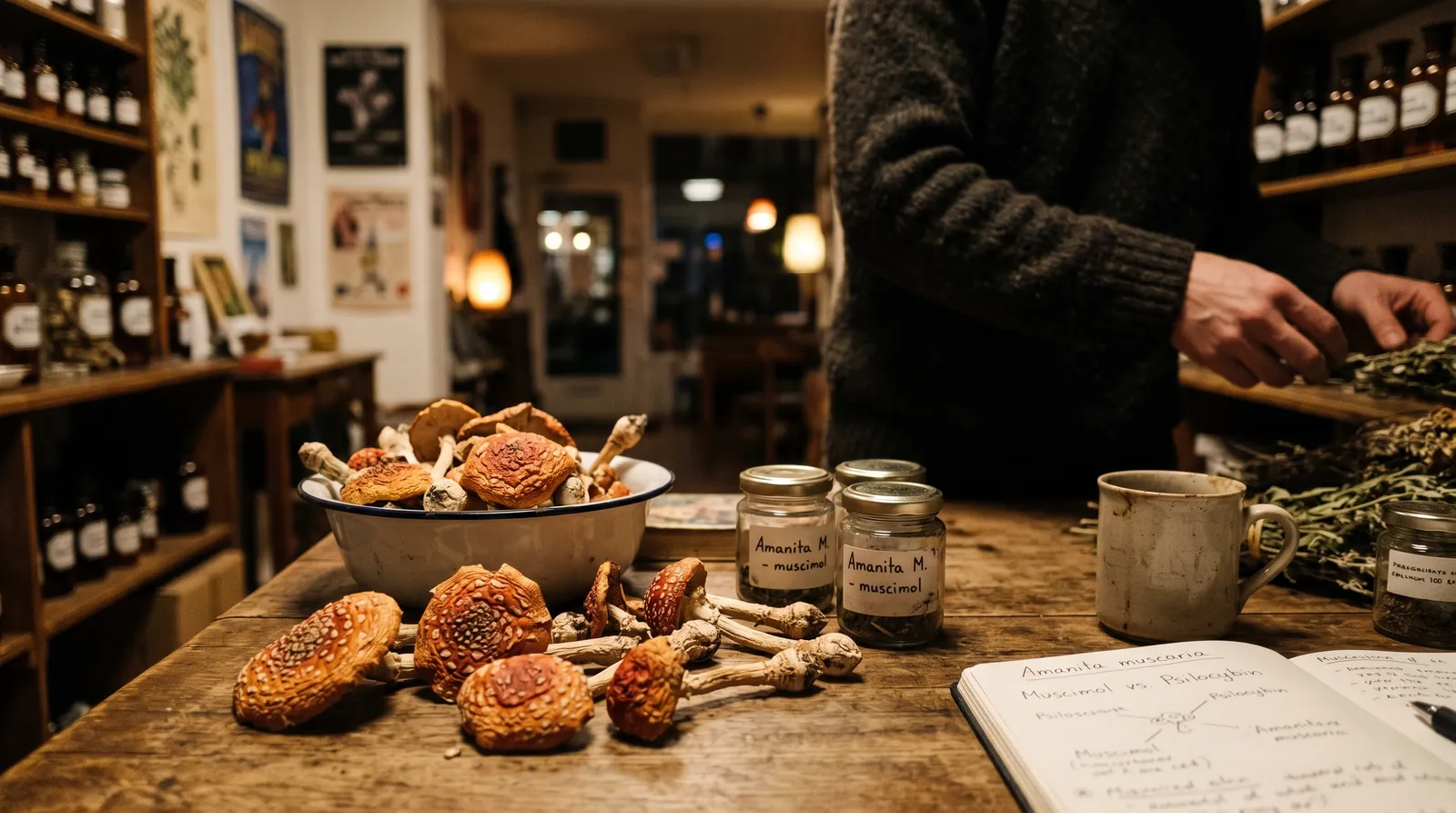
Its cultural home is Siberia, where shamans used it ceremonially for centuries. One detail tends to stick with people: muscimol passes through the body largely intact, so participants would sometimes drink the shaman's urine to recycle the active compound without the harsher side effects of the raw mushroom — an early, accidental bit of pharmacology. And those Siberian winter rituals, with a figure in red and white handing out a gift from the spirit world, are part of why some folklorists connect Amanita muscaria to the imagery we've since wrapped around Santa Claus. It sits at a crossroads of chemistry, myth and imagination — related to the psilocybin mushrooms only by the word "mushroom."
Did mushrooms shape the human mind?
No, there's no solid evidence ancient psychedelic mushrooms drove human cognitive evolution. In "Food of the Gods" (1992), Terence McKenna proposed that early humans eating psilocybin mushrooms on the African savanna drove a leap in cognition, language and culture. It's a seductive idea and it explains a lot in one stroke — which is also why scientists treat it with heavy scepticism. There's no fossil or genetic evidence for it, and it's best filed under fascinating speculation rather than established history.
What is solid is the boring-sounding version underneath the myth: humans and psychoactive fungi have shared the planet, and influenced each other, for an extremely long time. Modern research at institutions like Johns Hopkins and MAPS isn't discovering psilocybin — it's catching up to a relationship that indigenous communities maintained for thousands of years. The mycologist Gastón Guzmán spent his career cataloguing the genus and counted well over a hundred psilocybin-containing Psilocybe species worldwide. We've barely studied most of them.
Frequently Asked Questions
If there's one takeaway, it's that ancient psychedelic mushrooms were never a novelty — they were woven into religion, agriculture and myth across the ancient world, and modern science is mostly catching up to what indigenous communities already knew. If the history makes you curious about the present-day end of it, our magic truffles and Golden Teacher grow kits are the gentlest doorway in — buy a starter pack or order a grow kit and you're stepping into a very old story. Big thanks to Inner Thought Chronicles (@InnerThoughtChronicles) for the source video — go watch the full thing.
Last updated: June 2026
Frequently Asked Questions
5 questionsWhat was the first magic mushroom studied by science?
What does teonanácatl mean?
Are liberty caps the same as magic mushrooms?
Is Amanita muscaria a magic mushroom?
Did psychedelic mushrooms really shape human evolution?
About this article


Adam Parsons is an external cannabis and psychedelics writer and editor who contributes to Azarius's wiki as both author and reviewer. On the writing side, he authors Azarius's kratom and kanna clusters, drawing on exten
This blog article was drafted with AI assistance and reviewed by Adam Parsons, External contributor. Editorial oversight by Joshua Askew.
Last reviewed June 4, 2026
Related Articles
Substrata: Our First Psybient Album
Substrata is our first psybient album: 20 tracks, 1h 22m of psydub and downtempo, free on YouTube with custom trippy visuals for every song.
F1 Hybrid Cannabis Genetics: Inside RQS Testing at Inexo
Royal Queen Seeds field-tested new F1 hybrid cannabis genetics for 3+ years at Inexo. Inside the trials, the traits selected, and the story of strain…
Strain Hunters Kyrgyzstan: Wild Landrace Hunt Recap
Strain Hunters Kyrgyzstan documentary recap: horseback landrace hunt to 3,550 m, purple high-altitude phenos, the 1971 ban, and what it means for…
Cloning Magic Mushrooms: Inside VICE's Blueprint
An Amsterdam smartshop take on VICE's Blueprint documentary — grow-room cloning, María Sabina's Oaxaca, and the mycology behind Psilocybe.

Amsterdam Smartshop History: From 1993 to Today
Amsterdam smartshop history from Conscious Dreams in 1993 to the 2008 mushroom ban and the rise of truffles — the full story, decade by decade.
Stoned Ape Theory: Did Magic Mushrooms Make Us Human?
The Stoned Ape Theory claims psilocybin shaped human evolution. We weigh McKenna's hypothesis against modern neuroscience and its critics.
When Did Humans Start Smoking Cannabis? 12,000 Years
When did humans start smoking cannabis? Chemical proof goes back 2,700 years — and the full plant-human story runs 12,000 years deep.
The Best Stoner Movies Ever — Ranked by Tier
The best stoner movies ever, ranked S to F tier. From Fear and Loathing to Pineapple Express — and the sequels to skip tonight.
Saint Vincent Pheno Hunt: A Landrace Survives a Volcano
The Saint Vincent pheno hunt documents Caribbean landrace sativa genetics rescued by Rastafarian farmers after La Soufrière erupted in 2021.