
Strain Hunters Kyrgyzstan: Wild Landrace Hunt Recap
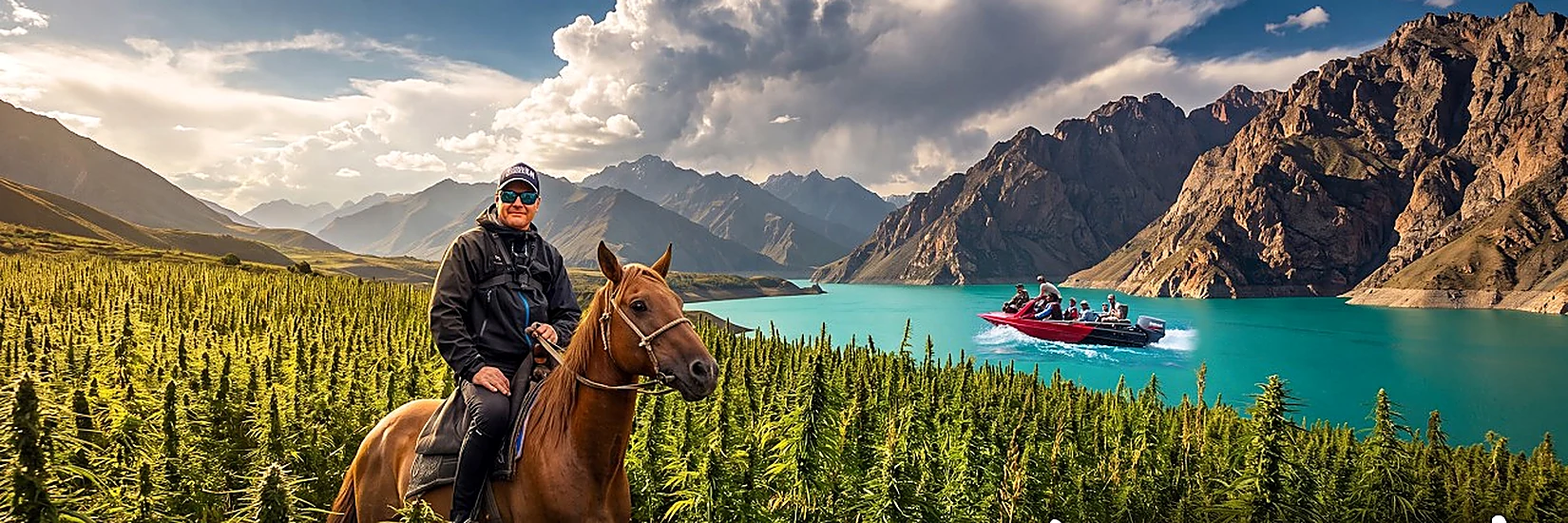
The Strain Hunters Kyrgyzstan expedition is a landrace-hunting documentary that follows Arjan Roskam, Dustin and Russian-Canadian collaborator Alan on horseback into the Celestial Mountains — up to 3,550 m — to collect wild cannabis genetics before drone-led eradication campaigns wipe out thousands of years of Silk Road heritage. It's part gene-preservation mission, part gruelling travelogue, part argument for policy reform in a country where growing a single bush can cost you twelve years in prison.
Video: We Rode Horses Into the Mountains to Find the Wildest Cannabis on Earth | Strain Hunters Kyrgyzstan — courtesy of the Strain Hunters YouTube channel.
We've watched every Strain Hunters episode since the series started, and this one lands differently. It's less about a trophy strain and more about a country where cannabis literally carpets the ecosystem while every second family has someone locked up over it. From behind the counter in Amsterdam we've been tracking landrace conservation for years, and Kyrgyzstan has always been the missing piece of the Central Asian puzzle — the blank spot between Afghan hash country and the Uzbek Mazar-i-Sharif line. This documentary fills it in.
Why the Strain Hunters Kyrgyzstan mission mattered — and why Alan came along
The Strain Hunters Kyrgyzstan trip exists because Arjan Roskam wanted unmapped genetics, and Kyrgyzstan is one of the last serious blank spots on the international hunting map. The addition of Alan — a Russian-born, Toronto-based creator with a huge Russian-speaking YouTube audience — is the tell. This wasn't a solo expedition, it was a bridge into a region that Western seed hunters have mostly ignored because the language, the terrain and the twelve-year prison sentences all say stay out.
Before the horses and the storms, the film opens somewhere much cleaner: a Thai medical breeding facility built to GMP standard, where the Kyrgyz seeds will eventually be grown out and stabilised. Eleven big rooms, eighteen small ones, Lot 27 selection running on a rolling basis, finished medicine shipping to Poland, Germany, England and Australia. One room smells of mangoes and bananas. Another holds four kilos of what the team just calls "full gas" — going to books, meaning archival mother selection. That contrast is the whole thesis of the episode in one edit: wild seeds hacked out of a mountainside in Kyrgyzstan, feeding a sterile Thai lab that ships pharmaceutical-grade flower to Europe. Hunt, breed, stabilise, deliver. That's the pipeline.
From Our Counter: Customers ask us what "landrace" actually means these days, because every seed bank slaps the word on something. Real landraces are populations, not strains — a whole genetic soup shaped by one valley's altitude, rainfall and human hands over centuries. What Arjan and Alan bagged in Kyrgyzstan is the soup. What you buy in a packet is what a breeder pulled out of it after ten years of work.
Riding into the Celestial Mountains: Bishkek, Toktogul and 30 km of horse a day
The Strain Hunters Kyrgyzstan crew flew into Bishkek, packed three cars and drove roughly seven hours along the historic Silk Road to remote Toktogul, watching the temperature climb from 12 °C to 30 °C and passing a valley Arjan claims held millions of horses. Bishkek itself gets a quick, honest sketch: friendly people, and a rougher edge where the real street problems aren't cannabis but cheap pharmacy-mixed alcohols that destroy livers in a hurry, plus imported synthetics filling the vacuum that the crackdown on natural cannabis created.
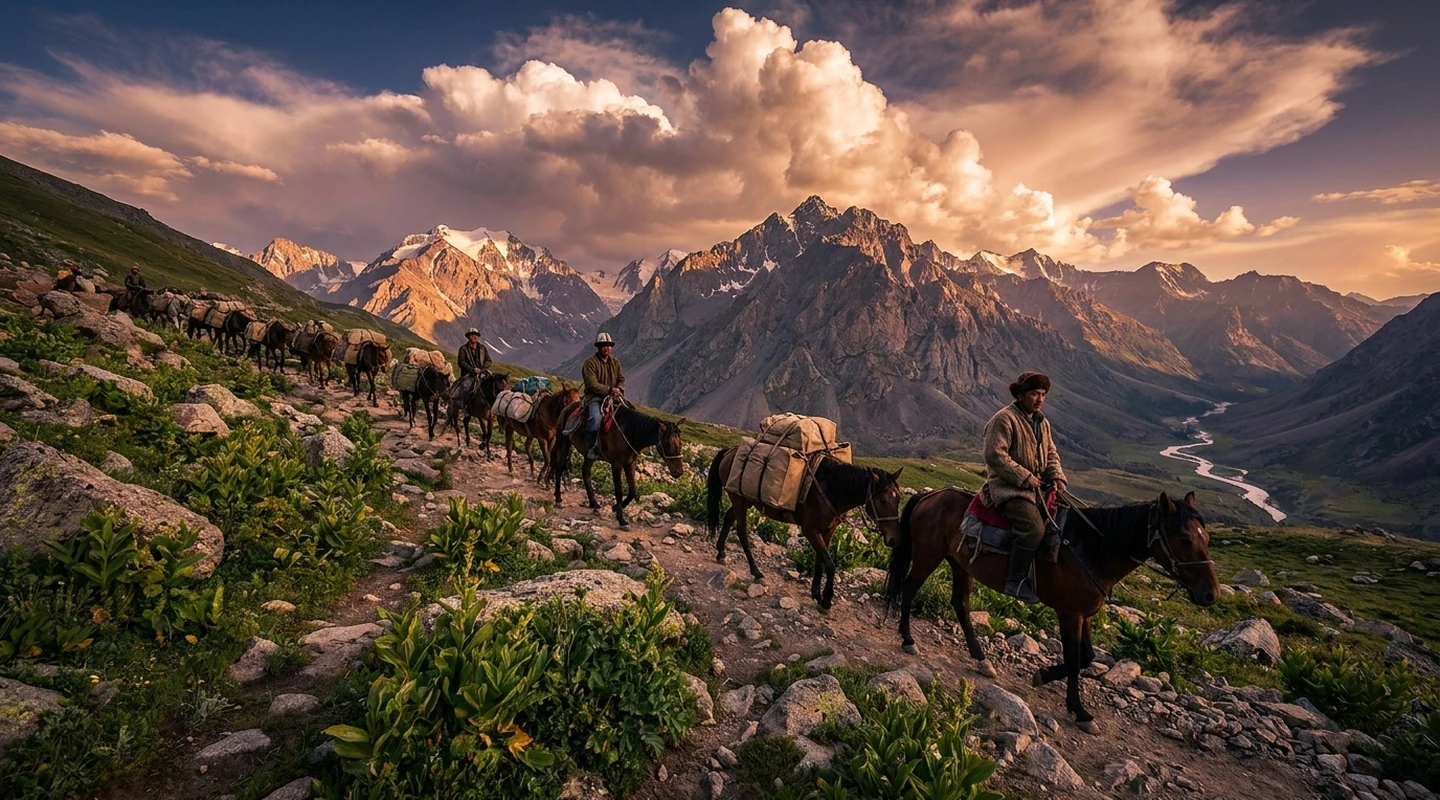
Once the road runs out around the 17-minute mark, the vehicles get parked and the nomad guides bring out 12 to 18 horses to carry four crew plus gear. From there it's zigzag switchbacks, 600 m drop-offs, vertigo, and a punishing 30 km horse-riding day that leaves everyone bruised. Freezing mountain rain hits without shelter. Equipment arrives by slow boat at 8:30 pm, dinner at 11 pm, everyone sleeping "in the earth," then up at 6 am for the Nomad Games. Lamb roasted over open bonfires. A three-hour lake crossing on a boat that runs out of gasoline. The final pass tops out around 3,550 m on the last day. This is the kind of trip that leaves you understanding why nobody had properly documented these genetics before.
The high-altitude landraces they found in Kyrgyzstan
The wild cannabis Kyrgyzstan produces at altitude is genuinely different from the wild hemp most people picture — the plants shift structure, colour and terpene profile dramatically over just a few hundred metres of elevation. Twenty minutes into the horse trek, at roughly 1,900 m, the team hit their first patch: two distinct phenotypes side by side, slim sativa structure, heavy with seed, fruity-earthy nose, and local horses casually grazing on them.
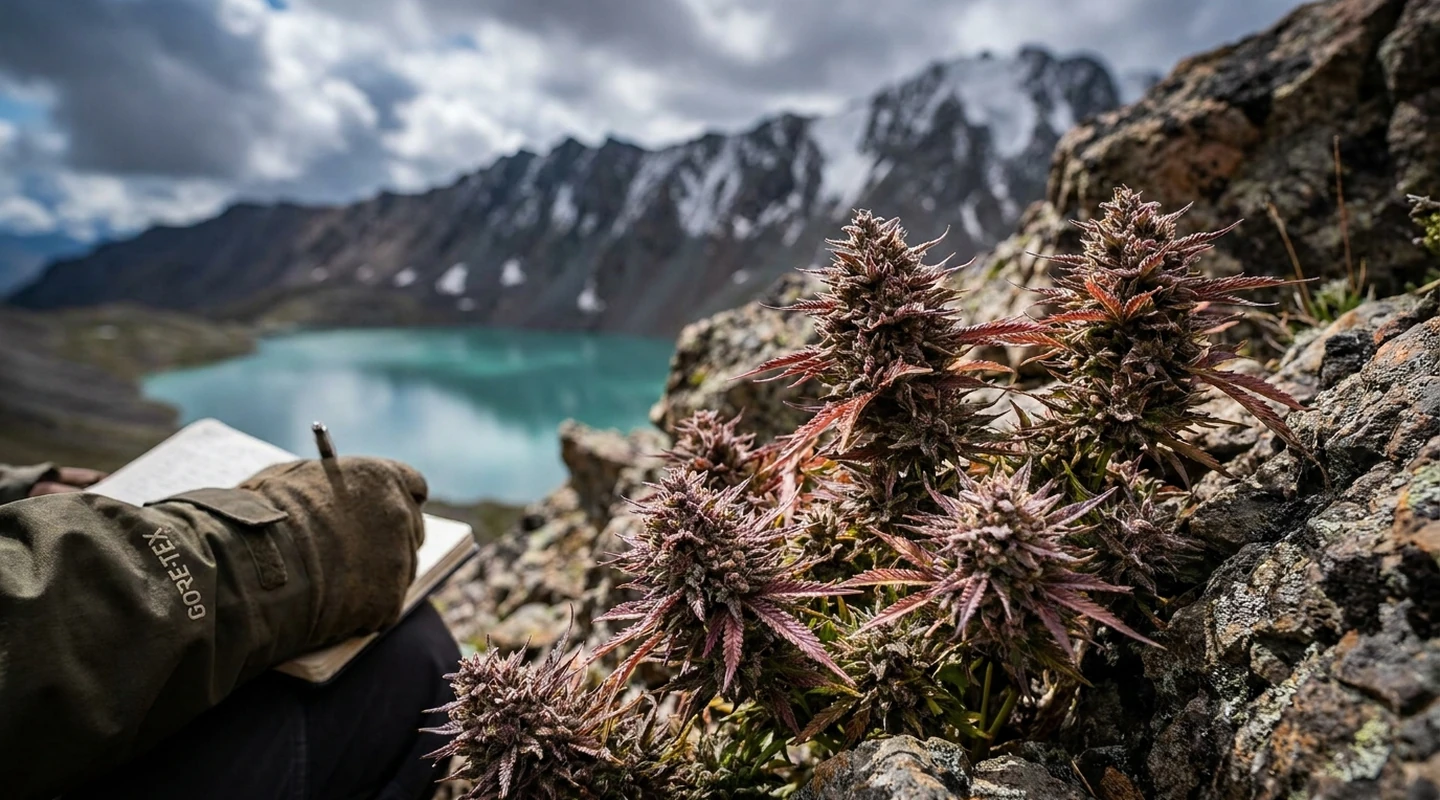
Climb another 200 m and the plants look like a different species. Extreme diurnal swings — 0 °C at night, 30 °C by day — flash the leaves vibrant purple and pink. The air is clean enough that spider mites don't exist up there; down at 500 to 1,000 m the same plant type is riddled with them. Resin production tightens up, actual visible trichomes appear, and the aromatic profile shifts toward what Arjan calls the Uzbek trail — musky, mossy, deeply mineral, "like licking a stone." That's the same structural and aromatic signature he traces back to a La Mano Negra Uzbekistan / Mazar-i-Sharif cross, which he considers the pre-gas foundation of what later became OG Kush and Sour Diesel.
Then there are the anomalies. Around 55 minutes in, at a lower artificial-lake basin, the team finds "zombie landraces" — plants that flowered early, then reverted to vegetative growth under stress, ballooning to three metres with tight node spacing and no viable female seed. Healthy males though. And the rotten-berry sativa near an inland settlement: instead of the piney woodiness you'd expect from wild hemp, several narrow-leaf phenos throw out an intense sweet bubblegum, red-fruit-in-a-basket smell that Arjan compares directly to modern Strawberry Haze. That aroma existing in a wild Kyrgyz valley is exactly the kind of finding that makes these trips worth the bruises.
| Altitude | Structure | Colour | Pests | Aroma notes |
|---|---|---|---|---|
| 500–1,000 m | Stressed, revegged "zombie" plants up to 3 m | Green, faded | Heavy spider mite load | Muted, hempy |
| ~1,900 m (day-one field) | Slim sativa, seed-heavy, two phenos side by side | Green | Light | Fruity, earthy |
| ~2,100 m | More compact, visible trichomes | Purple / pink flashes | None observed | Musky, mossy, mineral (Uzbek trail) |
| ~3,100–3,550 m (top pass) | Tight, resinous, wind-shaped | Deep purple | None | Concentrated, stone-like |
| Valley settlement | Diverse — narrow-leaf sativa next to wide-leaf indica in same population | Mixed | Variable | Rotten berry / bubblegum sativa pheno |
How the 1971 ban reshaped a plant that carpets the country
Kyrgyzstan's cannabis policy is the ghost haunting the whole Strain Hunters Kyrgyzstan story: until 1971, cannabis was woven into daily nomadic life as household medicine and even trade currency — elders describe it being gifted at weddings sixty years ago — and then a strict Soviet-era anti-cannabis declaration cracked down and never let up. Cultivating one bush in your own garden today can carry a 12-year prison sentence, and one local told the crew "every second family has one guy in jail" over a plant that grows wild on public beaches next to swimming children.
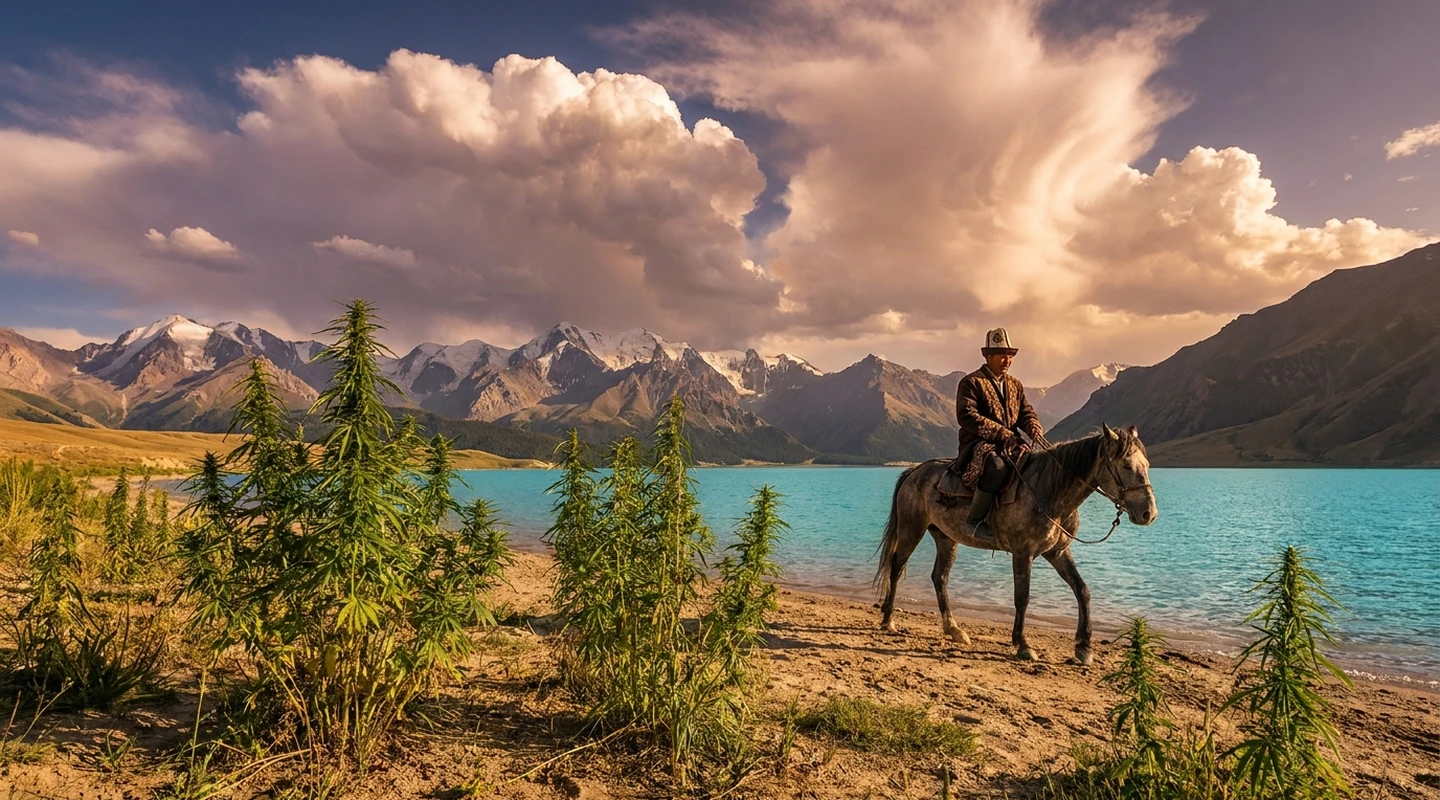
The enforcement side has modernised. Surveillance drones now scout the valleys to spot cultivation and eradication crews burn what they find. Meanwhile the nomads keep boiling wild cannabis leaves into medicinal teas, treating sick livestock — donkeys, horses, goats, sheep — with dried winter stocks, and feeding cannabis seeds to chickens because their grandmothers said it kept the birds healthy. The knowledge is intact. The plant is intact. Only the policy is out of step, and it's the policy driving the collapse.
The public-health knock-on is where the documentary gets its sharpest edge. With natural cannabis criminalised and hunted from the sky, the vacuum has been filled by cheap toxic alcohols mixed in the back of pharmacies, and by imported synthetic cannabinoids that are genuinely dangerous. UNODC reporting on Central Asia has flagged exactly this pattern for years — synthetic cannabinoid seizures rising as traditional cannabis is suppressed [1]. WHO data on the region tracks the alcohol-harm side of the same equation [2]. Arjan draws the contrast with the Netherlands — where the coffeeshop model dates back to roughly 1968–70, giving Dutch policy around 55 years of runway — and points to the Trimbos-instituut's tracking of Dutch heroin use, which has fallen to some of the lowest rates in Europe alongside a 20–30% decline in alcohol consumption among younger cohorts [3]. EMCDDA data situates the Dutch numbers in a broader European context of falling problem-opiate use where cannabis access is normalised [4]. The team's argument is straightforward: a normalised medical-cannabis framework could act as an exit ramp from the synthetics crisis, not a gateway into it. Their stated goal is to open a research and pension centre, prove medical use with real data, and take the case to Kyrgyz doctors, pharma associations and political parties.
From Our Counter: The Dutch/Kyrgyz split is genuinely stark when you see it from Amsterdam. Same plant, same molecule, same human demand — one country builds a taxable retail sector around it, the other sends people away for twelve years while drones set fire to a weed that grows on the riverbank. The documentary doesn't moralise about this. It just films it and lets the arithmetic speak.
What Kyrgyz cannabis genetics mean for the Strain Hunters seeds you can actually grow
The Kyrgyz cannabis genetics collected on the Strain Hunters Kyrgyzstan trip are currently being stabilised inside the Thai GMP breeding facility shown at the start of the film, which means they aren't in any packet on any shelf yet — but they feed the same hunt-breed-stabilise pipeline that produced the strains you can already grow at home from the Strain Hunters seed bank. Every one of those commercial releases started life as somebody's landrace hunt in Malawi, India, Colombia, Jamaica, Morocco. The pattern doesn't change.
If you want to grow the commercial end of that pipeline, a few honest pointers from what we've seen move off our shelves and back into customers' reports. Money Maker is the workhorse of the catalogue — a Malawi-influenced hybrid built to yield heavy without babying, which is what you want if you're new to the breeder and want to see what their stabilisation work actually delivers. White Lemon leans into the citrus-and-resin side of the White Widow lineage and finishes fast enough for indoor cycles that don't want to drag. For the sativa hunters who watched the rotten-berry pheno moment and thought "I want that in my tent," Damnesia is the closest structural cousin in the current line — Amnesia backbone, long flowering, terpene-driven.
For Central Asian character specifically — the musky, mineral, hash-heavy end that the Uzbek trail hinted at — Flowerbomb Kush is where the breeder's own preferred landrace references sit closest to what the documentary shows in the mountains. And if you're pheno-hunting at home and want to see how a modern breeder handles the sweet-fruit sativa expression the team found in the settlement valley, White Strawberry Skunk is worth putting a few beans of into a small run — it's not the Kyrgyz plant, but it shares the aromatic family Arjan kept name-checking on camera.
None of these contain the actual Kyrgyz seeds. That work is years away from a finished, stable release. What they do share is the methodology: hunt hard in a real place, breed patiently in a controlled one, and only release what holds up across generations. That's the whole reason to care about a documentary like this instead of just clicking on the next indoor grow video.
Last updated: July 2026
Frequently Asked Questions
8 questionsIs cannabis native to Kyrgyzstan?
What is the Strain Hunters series?
What is a landrace cannabis strain?
Why does high-altitude cannabis turn purple?
What does "gas" mean in cannabis?
Can you buy Kyrgyzstan landrace seeds?
What is revegging in cannabis?
Who is Arjan Roskam?
About this article


Adam Parsons is an external cannabis and psychedelics writer and editor who contributes to Azarius's wiki as both author and reviewer. On the writing side, he authors Azarius's kratom and kanna clusters, drawing on exten
This blog article was drafted with AI assistance and reviewed by Adam Parsons, External contributor. Editorial oversight by Joshua Askew.
Last reviewed July 18, 2026
Related Articles
Substrata: Our First Psybient Album
Substrata is our first psybient album: 20 tracks, 1h 22m of psydub and downtempo, free on YouTube with custom trippy visuals for every song.
F1 Hybrid Cannabis Genetics: Inside RQS Testing at Inexo
Royal Queen Seeds field-tested new F1 hybrid cannabis genetics for 3+ years at Inexo. Inside the trials, the traits selected, and the story of strain…
Cloning Magic Mushrooms: Inside VICE's Blueprint
An Amsterdam smartshop take on VICE's Blueprint documentary — grow-room cloning, María Sabina's Oaxaca, and the mycology behind Psilocybe.
Amsterdam Smartshop History: From 1993 to Today
Amsterdam smartshop history from Conscious Dreams in 1993 to the 2008 mushroom ban and the rise of truffles — the full story, decade by decade.
Stoned Ape Theory: Did Magic Mushrooms Make Us Human?
The Stoned Ape Theory claims psilocybin shaped human evolution. We weigh McKenna's hypothesis against modern neuroscience and its critics.
When Did Humans Start Smoking Cannabis? 12,000 Years
When did humans start smoking cannabis? Chemical proof goes back 2,700 years — and the full plant-human story runs 12,000 years deep.
Ancient Psychedelic Mushrooms: Every Species Explained
A tour of ancient psychedelic mushrooms — from Aztec teonanácatl and the liberty cap to Amanita muscaria, María Sabina and the Stoned Ape idea of…
The Best Stoner Movies Ever — Ranked by Tier
The best stoner movies ever, ranked S to F tier. From Fear and Loathing to Pineapple Express — and the sequels to skip tonight.
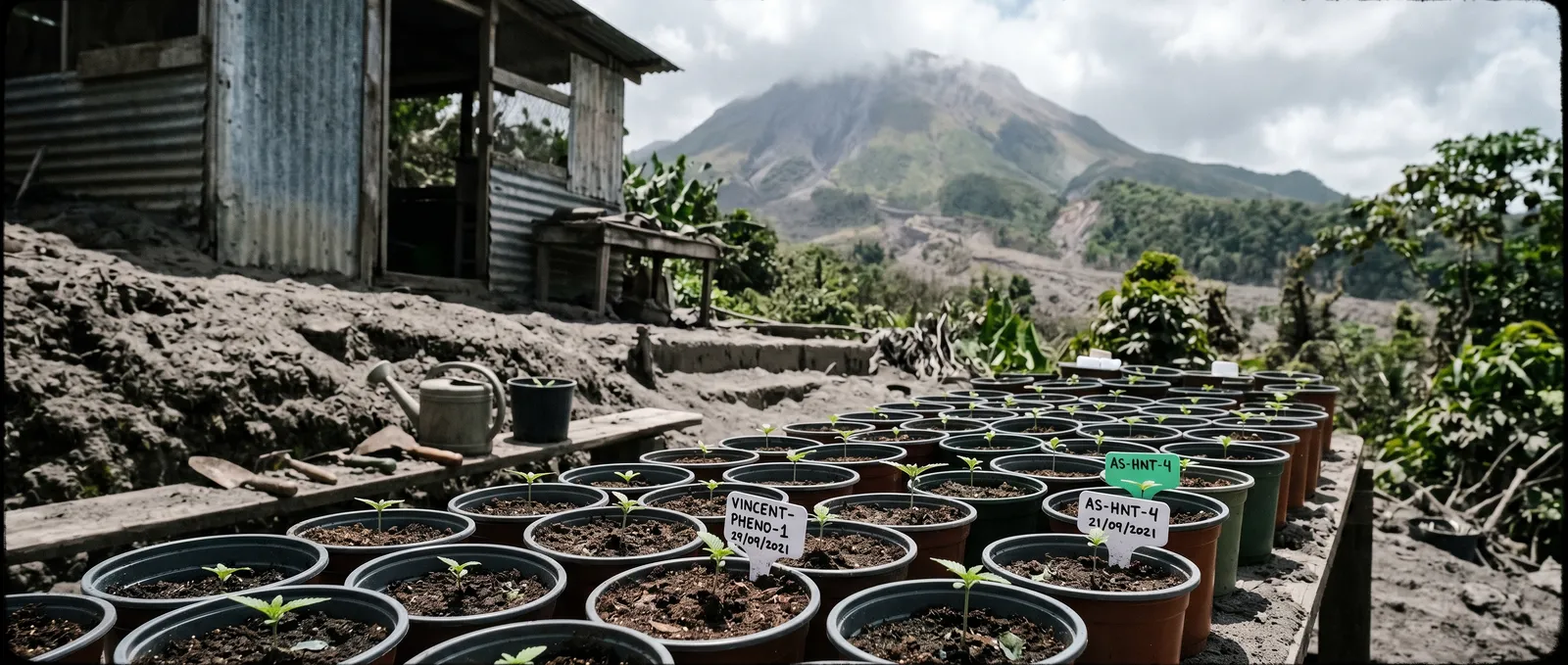
Saint Vincent Pheno Hunt: A Landrace Survives a Volcano
The Saint Vincent pheno hunt documents Caribbean landrace sativa genetics rescued by Rastafarian farmers after La Soufrière erupted in 2021.