


.png)


Ever wondered why magic truffles remain legal in some places while magic mushrooms do not, even though they contain the same psychoactive compound? Many newcomers are surprised to learn that these two forms of psychedelics aren’t entirely separate substances but different structures produced by the same fungus.
Whether you’re beginning your exploration or just curious about the distinctions, this guide breaks down everything you need to know.
What Are Magic Truffles?
Magic truffles are the sclerotia of certain Psilocybe fungi—dense, hardened masses of mycelium that grow underground when conditions aren’t right for producing mushrooms.1 They look more like small, knobbly stones than anything resembling a cap or stem. Inside, however, they contain psilocybin, the same psychoactive compound found in magic mushrooms, and the body converts it into psilocin.2
Sclerotia act as nutrient reserves, allowing the organism to survive periods of stress. When environmental factors like light, humidity, and airflow aren’t ideal for fruiting, the fungus instead invests energy in forming these compact underground structures. Because sclerotia can be harvested without requiring the fungus to “fruit,” they became the foundation of the legal Dutch truffle market.
Several cultivated truffle varieties have gained recognition:
- Mexicana: often described as mild, bright, and uplifting
- Atlantis: known for a rich, imaginative, and sometimes visual depth
- Hollandia: often reported as more intense, clearer, and stronger
These categories aren’t scientific but reflect widely shared user descriptions. Over time, they’ve shaped much of the distinct culture and identity surrounding truffles.
Why Are Magic Truffles Called “Philosopher’s Stones”?
The nickname “Philosopher’s Stones” originated in the Netherlands, where early Tampanensis sclerotia were known for calm, thoughtful, introspective trips. Many users described the experience as contemplative, less visually overwhelming, and more insight-focused. Whether the name accurately reflected effects or was simply clever marketing, it became part of truffle culture and remains widely used.
It’s not a scientific designation, and experiences vary widely, but the term highlights the longstanding association between truffles and more grounded, reflective psychedelic states.
Are Magic Truffles and Magic Mushrooms Made From the Same Fungus?
Yes. Both truffles and mushrooms can be produced by the same Psilocybe species, including Psilocybe cubensis, Psilocybe semilanceata (Liberty Caps), and Psilocybe azurescens. The difference isn’t the organism itself but the structure it produces under certain environmental conditions.
Magic mushrooms are the fruiting bodies: stems, caps, and gills packed with spores that grow above ground. Magic truffles, by contrast, remain underground and form compact clusters resembling stones. Despite structural differences, both contain psilocybin and related tryptamines.3
Research shows that psilocybin alters functional connectivity across brain networks, including areas involved in perception, emotion, and the Default Mode Network.345 These findings apply regardless of whether psilocybin comes from mushrooms or truffles.
Key Differences Between Magic Truffles and Magic Mushrooms
Although truffles and mushrooms originate from the same organism, they differ in appearance, cultivation requirements, potency by weight, availability, and legal status. Mushrooms generally contain less water and deliver more psilocybin per gram when dried.6 Truffles are sold fresh, contain far more moisture, and therefore require higher gram doses to produce comparable effects.
Legally, truffles stand apart due to the way sclerotia are classified in certain countries. In the Netherlands, fresh mushrooms were banned in 2008, but sclerotia were not included in the legislation, allowing them to remain legal in smartshops.7 The UK treats all psilocybin-containing fungi the same, regardless of form.8 In the US, psilocybin remains federally classified as Schedule I, though Oregon and Colorado have introduced regulated systems for therapeutic or adult access.91011
| Category | Magic truffles (sclerotia) | Magic mushrooms (fruiting bodies) |
|---|---|---|
| Structure | Underground mycelium reserves | Above-ground stems, caps, gills |
| Psilocybin content | Lower potency per gram fresh (high moisture content) | Often higher potency per gram when dried |
| Onset profile | Often described as slower and more gradual (varies by individual) | Often reported as faster and more abrupt (varies by individual) |
| Cultivation | Does not require fruiting conditions | Requires specific conditions to fruit |
| Legality (NL) | Legally sold in smartshops; mushrooms banned since 2008 | Fresh mushrooms banned since 2008 |
| Legality (UK) | Any psilocybin-containing fungi falls under drug law | Same |
| Legality (US) | Federally Schedule I; regulated programmes in Oregon & Colorado | Same federal status; local reforms vary |
| Common strains | Mexicana, Atlantis, Hollandia | Cubensis, Semilanceata, Azurescens |
What Effects Can You Expect From Magic Truffles Compared to Magic Mushrooms?
Truffles and mushrooms produce chemically identical psychedelic effects. People often describe changes in mood, enhanced sensory perception, increased introspection, visual alterations, and a distorted sense of time. However, the come-up can feel different. For an overview of the main effects of magic truffles, including common mood and sensory shifts.
Because truffles digest more slowly, many users describe the come-up as smoother or more gradual. In contrast, dried mushrooms are more concentrated and may hit faster or feel more abrupt. At peak, both can produce vivid visuals, complex emotional layers, and deep introspection.35
Some people find that truffle sessions feel more grounded, while mushrooms can feel more expansive; however, these differences are subjective and depend heavily on dose, setting, and mindset. The myth that truffles are always “mild” is untrue: potent varieties like Hollandia can be extremely intense and challenging at higher doses.
Are Magic Mushrooms Stronger Than Magic Truffles?
Per gram, typically yes. When mushrooms are dried, they lose most of their water, concentrating their psilocybin content per weight.6 Truffles are sold fresh and contain far more moisture, meaning you need more grams to reach similar effects.
However, experience intensity depends on far more than weight alone: strain, individual sensitivity, mindset, environment, and potency variation all play significant roles. Even different batches of the same variety can vary noticeably.
Dosing Magic Truffles
Truffle dosing varies depending on the intention and experience level. People often start low to gauge sensitivity, especially because truffles can take longer to come up. Many plan for a full day, choose a calm and safe setting, and avoid alcohol or stimulants. These choices strongly influence how manageable and comfortable the experience feels. If you want practical prep tips and timing, see how to take magic truffles.
For guidance on freshness, storage, and dose ranges, see store and dose magic truffles.
Microdosing: Truffles vs Mushrooms
Microdosing, which involves taking very small, sub-perceptual amounts of psilocybin, has gained popularity. Truffles are commonly used in regions where mushrooms are illegal, because they are legal, fresh, and sold in standardised portions.
A microdose is only a fraction of a standard truffle quantity. Some individuals report subtle shifts in focus, mood, or creativity, but the scientific picture remains mixed. In recent placebo-controlled studies, expectation appears to play a major role, though results are not fully consistent.1213
People who microdose often follow structured schedules to reduce tolerance build-up and allow rest days.
Are Truffles Safer Than Mushrooms?
Truffles and mushrooms contain the same psychoactive compounds, so their risk profiles are similar. Physiological effects such as nausea, yawning, or temperature sensitivity are usually mild and temporary.2 Psychological effects—such as confusion, emotional overwhelm, and anxiety—can occur at higher doses or in stressful settings.
For a closer look at common adverse reactions and precautions, see risks and side effects.
If you’re concerned about dependence, read magic truffles and addiction before deciding.
Clinical safety guidelines emphasise pre-screening for individuals with personal or family histories of psychosis or bipolar disorder, as these groups may be more vulnerable to destabilising reactions.4 The safest experiences typically happen in:
- A calm, familiar environment
- With a supportive and trusted trip sitter
- Without mixing alcohol or stimulants
- With an honest check-in of your emotional and mental state
Legal factors also influence safety. In countries where truffles are regulated, dosing guidance and product consistency tend to be more reliable than mushrooms obtained informally.
Which One Is Right for You?
The choice between truffles and mushrooms often comes down to legal availability, desired onset profile, and experience level. Truffles appeal to many beginners seeking a smoother come-up and clearer legal framework. Mushrooms may suit those with more psychedelic experience or those seeking the traditional form, provided they understand the legal risks.
Whichever option you choose, understanding the differences can help you approach these substances more responsibly and respectfully.
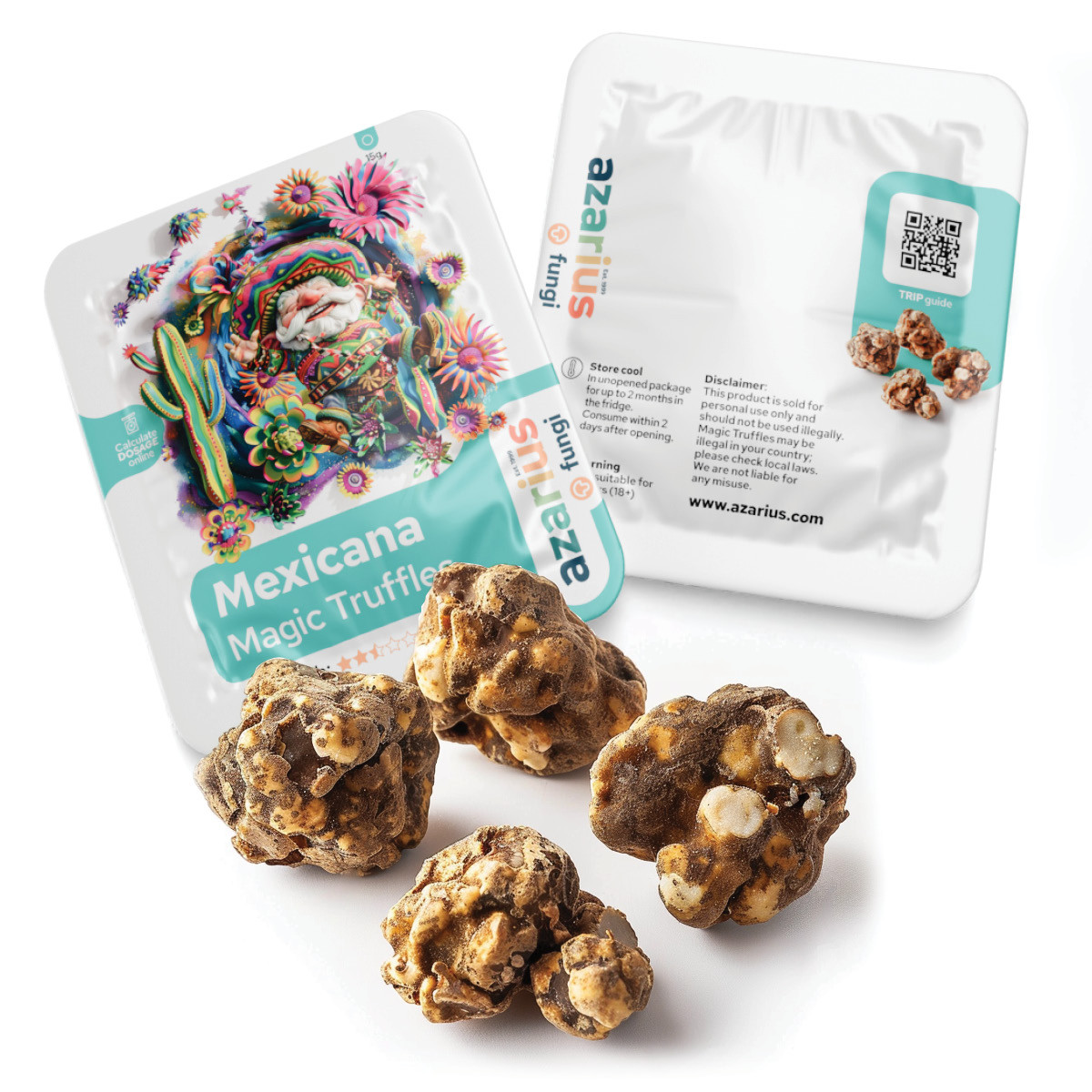
Mexicana
Azarius Magic Truffles (15g)References
- Passie T, Seifert J, Schneider U, Emrich HM. The pharmacology of psilocybin. Addiction Biology. 2002;7(4):357-364. doi:https://doi.org/10.1080/1355621021000005937 ↩︎
- Sclerotium | Fungal Structure, Spore Formation & Germination | Britannica. www.britannica.com. https://www.britannica.com/science/sclerotium ↩︎
- Carhart-Harris RL, Erritzoe D, Williams T, et al. Neural correlates of the psychedelic state as determined by fMRI studies with psilocybin. Proceedings of the National Academy of Sciences. 2012;109(6):2138-2143. doi:https://doi.org/10.1073/pnas.1119598109 ↩︎
- Johnson M, Richards W, Griffiths R. Human hallucinogen research: guidelines for safety. Journal of Psychopharmacology. 2008;22(6):603-620. doi:https://doi.org/10.1177/0269881108093587 ↩︎
- Mason NL, Kuypers KPC, Müller F, et al. Me, myself, bye: regional alterations in glutamate and the experience of ego dissolution with psilocybin. Neuropsychopharmacology. 2020;45(12):2003-2011. doi:https://doi.org/10.1038/s41386-020-0718-8 ↩︎
- Jayaraman S, Yadav B, Dalal RC, et al. Mushroom farming: A review Focusing on soil health, nutritional security and environmental sustainability. Farming system. 2024;2(3):100098-100098. doi:https://doi.org/10.1016/j.farsys.2024.100098 ↩︎
- Zijn paddo’s verboden? DRUGSinfo. Published August 22, 2025. Accessed December 1, 2025. https://www.drugsinfo.nl/paddos-truffels/zijn-paddos-verboden/ ↩︎
- EXPLANATORY MEMORANDUM to the MISUSE of DRUGS (AMENDMENT) (NO. 2) REGULATIONS 2005 the MISUSE of DRUGS (DESIGNATION) (AMENDMENT) ORDER 2005.; 2005. https://www.legislation.gov.uk/uksi/2005/1653/pdfs/uksiem20051653en.pdf ↩︎
- 21 CFR 1308.11 -- Schedule I. Ecfr.gov. Published 2025. Accessed December 1, 2025. https://www.ecfr.gov/current/title-21/chapter-II/part-1308/section-1308/section-1308.11 ↩︎
- Oregon Health Authority : Oregon Psilocybin Services : Prevention and Wellness : State of Oregon. www.oregon.gov. https://www.oregon.gov/oha/PH/PREVENTIONWELLNESS/Pages/Oregon-Psilocybin-Services.aspx ↩︎
- Natural Medicine Health Act - HOME | Division of Professions and Occupations. dpo.colorado.gov. https://dpo.colorado.gov/NaturalMedicine ↩︎
- Szigeti B, Kartner L, Blemings A, et al. Self-blinding citizen science to explore psychedelic microdosing. Baker CI, Shackman A, Perez Garcia-Romeu A, Hutten N, eds. eLife. 2021;10:e62878. doi:https://doi.org/10.7554/eLife.62878 ↩︎
- Cavanna F, Muller S, de la Fuente LA, et al. Microdosing with psilocybin mushrooms: A double-blind placebo-controlled study. Translational Psychiatry. 2022;12(307). doi:https://doi.org/10.1038/s41398-022-02039-0 ↩︎