


.png)


At its core, khat is a flowering shrub whose fresh leaves and shoots are traditionally chewed for their stimulating effects. This long-standing practice is closely tied to local social rituals, trade routes, and the highland regions where the plant grows best.
In this guide, we’ll explore khat’s history, how it’s used, what people report feeling, and the legal landscape—helping you separate cultural tradition from the myths that often surround khat chewing.
Quick Summary
What Is Khat?
Khat (Catha edulis) is an evergreen shrub native to parts of East Africa and the Arabian Peninsula. It’s best known for its fresh leaves, which are traditionally chewed for their stimulant effects.1
If you’re wondering what the khat plant looks like, picture a bushy shrub with slender branches, glossy green leaves, and small white-to-cream flowers. It’s often grown on terraced hillsides, and the leaves are typically harvested and used while still fresh.
The stimulating effects come down to chemistry. Khat leaves contain cathinone, a naturally occurring stimulant, along with related compounds that act on the nervous system. Because cathinone breaks down relatively quickly after harvest, fresh leaves are preferred.2
Most commonly, khat is consumed by slowly chewing a small bundle of leaves and shoots, with the chewed material held in the cheek so the active compounds can be absorbed through the mouth.
Is Khat Considered a Drug and Why?
Whether khat is considered a “drug” depends on how the term is defined. Botanically, it’s simply a plant. However, because chewing the leaves can produce noticeable stimulant effects, many health authorities and legal systems treat it as a psychoactive substance rather than a harmless herb.3
A common question is: What is the main active ingredient found in khat? The key compound is cathinone, which can affect mood, alertness, and appetite. Related alkaloids, such as cathine, may also contribute to the overall effects.
This pharmacology explains why khat is regulated in some countries—particularly where authorities are concerned about potential misuse, dependence, or broader public health impacts.
Historical and Geographical Origins
Khat has deep roots in the Horn of Africa and the southern Arabian Peninsula. Its cultivation is most often linked to highland areas of Ethiopia, with long-standing use also documented in Kenya and Yemen, where climate and elevation support slow, leafy growth.
Written references to khat use date back centuries. Over time, its popularity spread through travel, trade, and migration. As routes developed between inland farming regions and coastal towns, fresh bundles could be transported quickly—an important factor given that the stimulant compounds are strongest soon after harvest.
Which countries most commonly use khat? Traditionally, it’s most closely associated with Ethiopia, Kenya, and Yemen, and it remains culturally significant in neighbouring regions. Today, cultivation and distribution continue to evolve, shaped by local customs, market demand, and changing regulations.
Cultural Significance of Khat
For many communities, khat isn’t just a stimulant—it’s a social tradition with its own rhythm and etiquette. In places such as Yemen, Somalia, and Ethiopia, chewing sessions are often part of daily life, particularly in the late afternoon or early evening.4
These gatherings can be both practical and social in nature. People may meet to discuss politics, share news, conduct business, or unwind. In some contexts, khat has also played a role in religious or spiritual settings, where lengthy discussions, recitation, or reflection are central.
What stands out is the ritual itself. Fresh bundles are shared, guests settle in, and conversation flows—often filled with storytelling, humour, and debate. Understanding this cultural layer helps explain why khat use persists, even as attitudes and laws change elsewhere.
Are There Specific Cultural Rituals Associated With Consuming Khat?
Yes. While practices vary by region and community, khat sessions are typically structured rituals rather than casual snacking. Participants usually seek out the freshest leaves, gather in a dedicated space, and settle in for hours of chewing and conversation.
Common elements include sharing bundles among friends or guests, pairing khat with tea, coffee, or soft drinks, and maintaining a slow, steady pace to sustain stimulation. In some settings, there’s a clear host-and-guest dynamic, with etiquette focused on offering the best leaves first.
Equally important is the purpose of these gatherings. They may be used for exploring ideas, resolving disputes, storytelling, or marking social occasions—making the ritual as much about connection as consumption.
Effects of Khat on the Body and Mind
Because it contains cathinone, khat acts as a stimulant. Users commonly report feeling more alert, talkative, and energised during a chewing session. Some also notice reduced appetite and an increased sense of mental drive, which helps explain its social use during long conversations.
Cathinone is sometimes compared to amphetamines due to its broadly similar stimulant profile, but the two are not the same. Amphetamines are synthetic, generally more potent, and typically taken in measured doses. Cathinone, by contrast, is a naturally occurring compound found in fresh leaves, meaning its effects tend to build more gradually and vary depending on freshness, amount chewed, and individual sensitivity.
As with other stimulants, unwanted effects are possible. These may include restlessness, difficulty sleeping, or a jittery “come-down,” especially with heavier use or late-day sessions.
What Are the Main Physical Effects of Khat?
In the short term, khat is mainly associated with stimulant-like physical effects that develop gradually during a chewing session. Many users describe feeling more energised and awake, often alongside a reduced appetite.
Other reported effects include a faster heartbeat, a mild rise in blood pressure, dry mouth, and increased sweating. Because chewing can continue for hours, some people also experience jaw fatigue or mouth irritation.
As with many stimulants, the after-effects can be less pleasant. Restlessness, headaches, and trouble sleeping are commonly reported, particularly when khat is used late in the evening or in larger amounts.
What Does Khat Do to Your Brain?
Khat can produce a mentally “wired” state, marked by heightened alertness, faster thought patterns, and increased sociability or confidence. These effects reflect its stimulant action on brain pathways involved in focus and reward.
However, stimulation can tip into anxiety, irritability, or racing thoughts—especially during heavier or prolonged sessions. Sleep disruption is also common, which may affect mood and concentration the following day.
With regular use, some individuals may develop psychological dependence—not necessarily on the substance alone, but on the routine, social ritual, or perceived boost in energy. If someone feels unable to function without khat, it may be a sign to reassess use patterns and seek support if needed.5
Global Legal Status and Controversies
The legal status of khat varies widely and often reflects cultural context as much as its pharmacological properties. In parts of East Africa and the Arabian Peninsula, it’s tolerated or regulated as a traditional social plant. In many Western countries, however, it is treated as a controlled substance.
In the UK, khat is banned, and it is also prohibited at the federal level in the United States. Across the EU, laws differ by country, with several member states restricting or outlawing its possession and sale. These variations can create confusion for travellers and diaspora communities.6
Debate around khat tends to focus on public health and social impact. Concerns about dependence, mental health, and productivity are often weighed against arguments about cultural heritage and community cohesion. While the WHO has reviewed khat and noted potential risks, international scheduling has not been uniform, leaving individual governments to set their own policies.7
Understanding Khat’s Place in Modern Society
To understand khat’s role in modern society, it is helpful to hold two truths in mind: for many communities, it remains a long-standing social tradition; for regulators, it is a stimulant with potential downsides that may justify its restriction.
Context is key. The same behaviour can look very different depending on frequency, setting, individual health, and whether use is part of a structured cultural practice or a pattern that begins to interfere with sleep, mood, or daily responsibilities.
Research and policy discussions are still evolving, particularly regarding long-term effects, dependence, and the optimal balance between public health and cultural realities. Wherever you live, the safest approach is to stay informed, understand local laws, and treat any psychoactive plant with care.
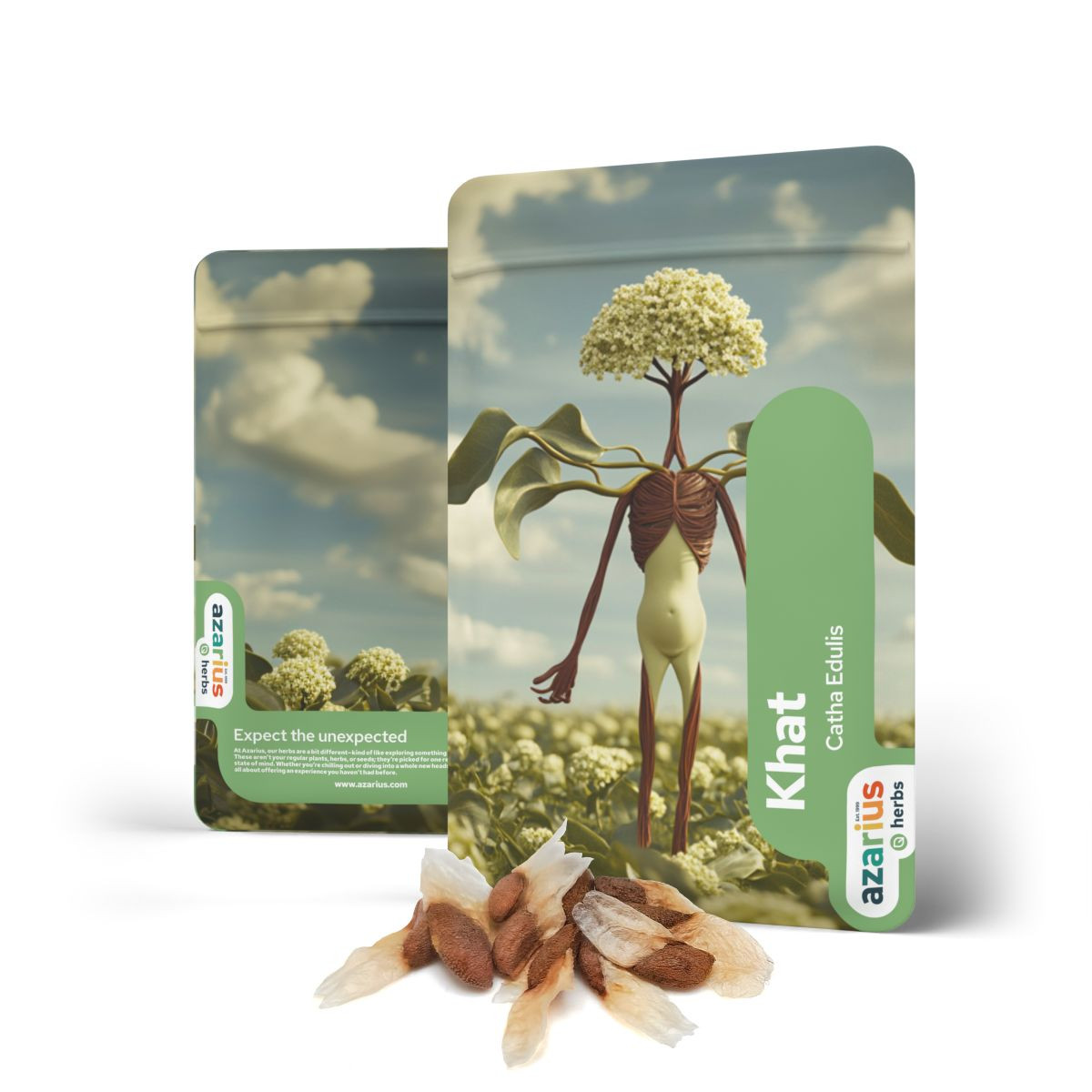
Khat Seeds
Khat Seeds (10x): A Natural Form of StimulationReferences
- Al-Juhaishi T, Al-Kindi S, Gehani A. Khat: A widely used drug of abuse in the Horn of Africa and the Arabian Peninsula: Review of literature. Qatar Medical Journal. 2012;2012(2):5. doi:https://doi.org/10.5339/qmj.2012.2.5 ↩︎
- Kalix P. Pharmacological properties of the stimulant khat. Pharmacology & Therapeutics. 1990;48(3):397-416. doi:https://doi.org/10.1016/0163-7258(90)90057-9 ↩︎
- World Health Organization. Assessment of khat (Catha edulis Forsk). WHO, 2006. Accessed January 9, 2026. https://iris.who.int/items/036ed5bd-e164-40b5-be71-ca05a8e90f75 ↩︎
- ANDERSON D, CARRIER N. KHAT IN COLONIAL KENYA: A HISTORY OF PROHIBITION AND CONTROL. The Journal of African History. 2009;50(3):377-397. doi:https://doi.org/10.1017/s0021853709990752 ↩︎
- Warfa N, Klein A, Bhui K, Leavey G, Craig T, Alfred Stansfeld S. Khat use and mental illness: A critical review. Social Science & Medicine. 2007;65(2):309-318. doi:https://doi.org/10.1016/j.socscimed.2007.04.038 ↩︎
- Khat use in Europe: update and policy implications | www.euda.europa.eu. Europa.eu. Published July 3, 2011. Accessed January 9, 2026. https://www.euda.europa.eu/news/2011/3_en ↩︎
- Rt H, Charles C, Mp. ADVISORY COUNCIL on the MISUSE of DRUGS Home Office, 2 Marsham Street, London SW1P 4DF.; 2005. https://assets.publishing.service.gov.uk/media/5a7b716fed915d429748f14e/KhatReport.pdf ↩︎