
This article discusses psychoactive substances intended for adults (18+). If you have a health condition or take medication, consult a doctor before use. Our age policy
Drying Cannabis Temp RH Time: Complete Grow Guide
Definition
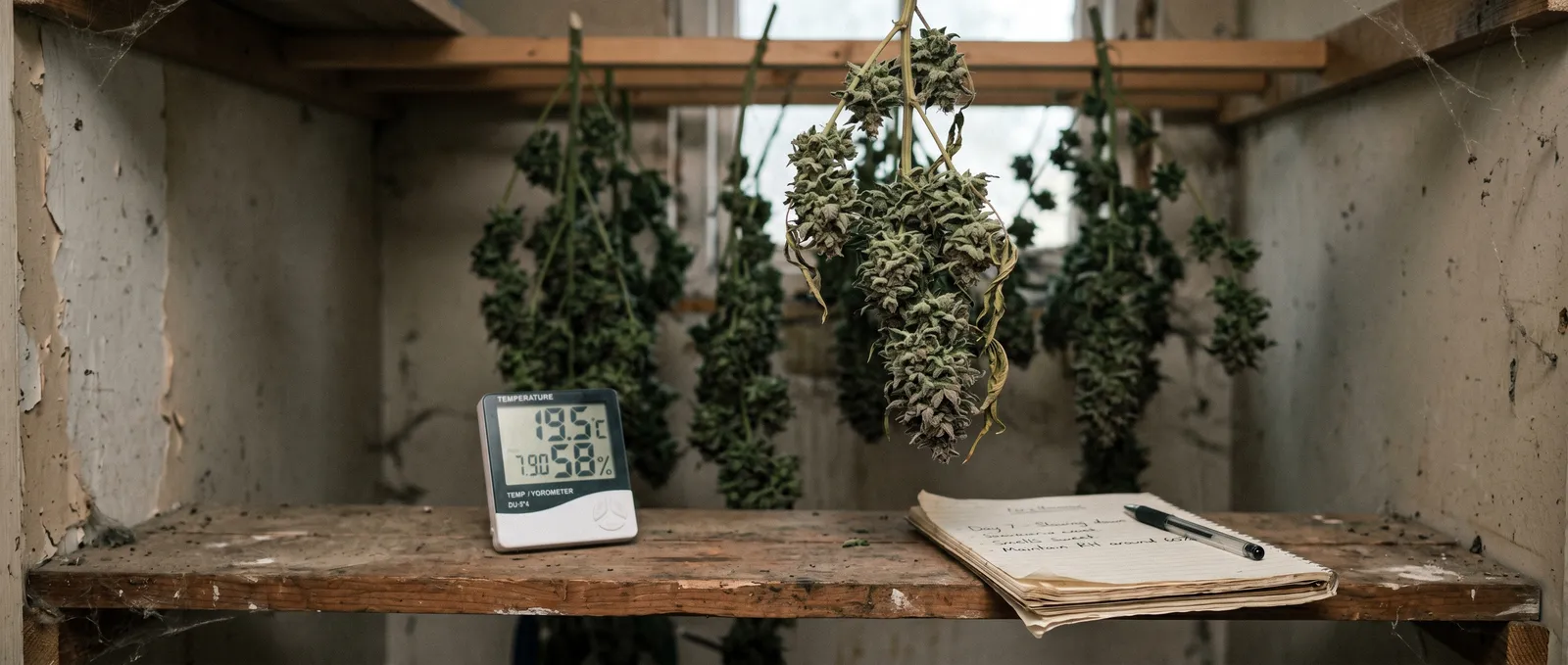
Drying cannabis temp RH time is the 10–14 day post-harvest framework where buds lose moisture under controlled conditions — typically 18–21°C and 55–60% relative humidity — to preserve cannabinoids and terpenes while preventing mould. Chen et al. (2023) showed drying above 21°C can reduce monoterpene content by ~30% versus 20°C drying.
This guide is educational. Azarius does not provide formal advice.
Drying cannabis temp RH time is a post-harvest framework that preserves terpenes and cannabinoids by holding buds at 18–21°C and 55–60% relative humidity for 10–14 days. Drying is the stage between harvest and cure where temperature, relative humidity (RH), and time determine whether your buds keep their terpenes or turn into hay. Get the numbers wrong on drying cannabis temp RH time and you'll undo months of tent work in ten days. Before you buy a dehumidifier or order sensors, it helps to understand what the numbers are actually doing.
Drying targets at a glance
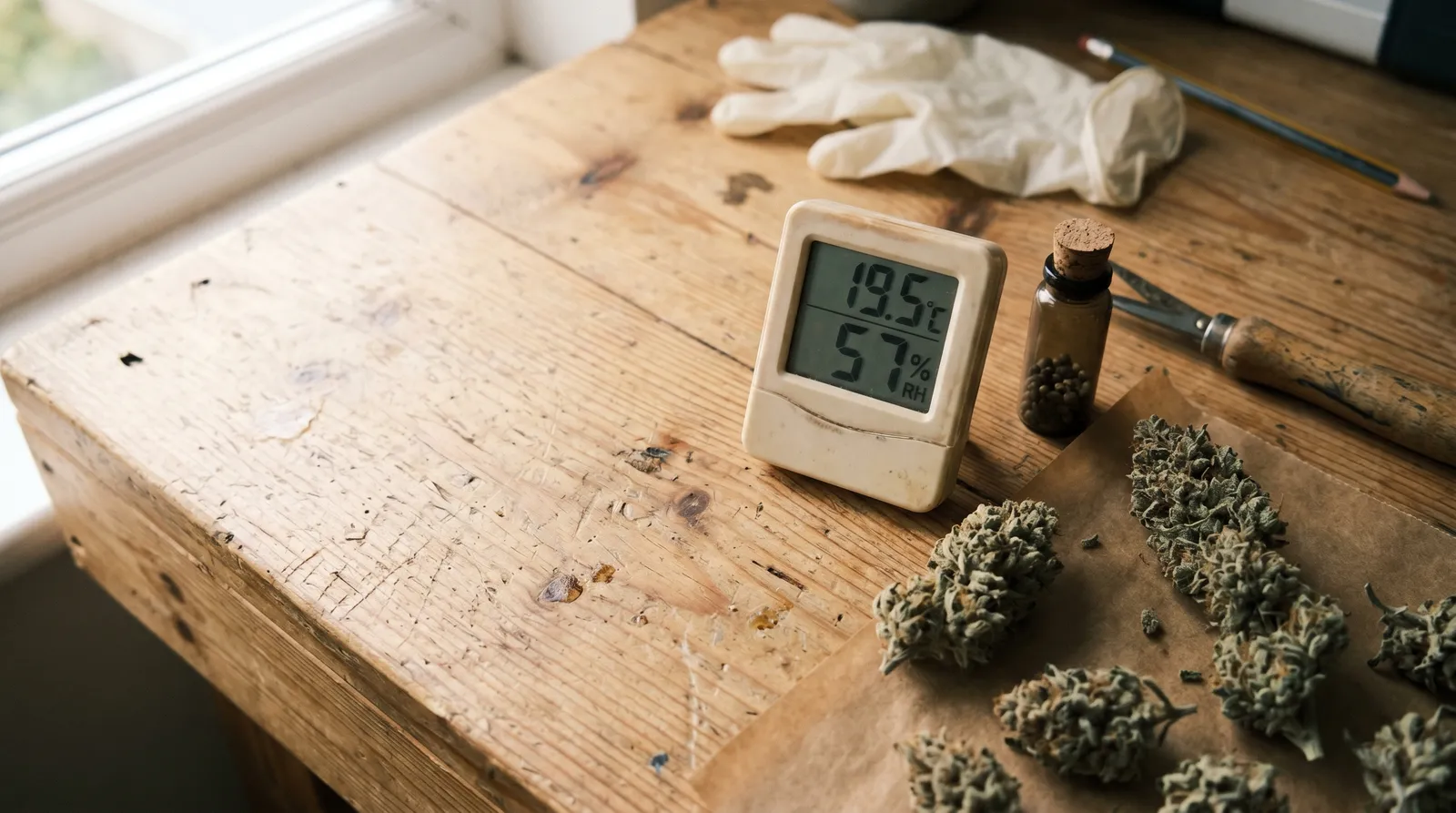
The ideal drying cannabis temp RH time target is 18–21°C, 55–60% RH, over 10–14 days. Published horticulture research and commercial drying protocols converge on that narrow band. Push harder on either lever and you lose terpenes, chlorophyll breakdown stalls, or you invite Botrytis cinerea.
| Parameter | Conventional range | "60/60" method | Low-and-slow |
|---|---|---|---|
| Temperature | 18–21°C (64–70°F) | 15.5°C (60°F) | 15–17°C (59–63°F) |
| Relative humidity | 55–60% | 60% | 58–62% |
| Airflow | Indirect, gentle | Indirect, gentle | Indirect, gentle |
| Duration | 10–14 days | 10–14 days | 14–21 days |
| Trim style | Wet or dry | Dry trim common | Dry trim common |
| End-point moisture | ~10–13% water content | ~10–13% | ~10–13% |
| Mould risk if exceeded | >65% RH at >24°C | >65% RH | >65% RH |
Why those numbers — the science under the hood
Temperature controls terpene retention and humidity controls the water gradient — both matter simultaneously in a drying room. Monoterpenes — the light, citrusy, piney ones like limonene and myrcene — have vapour pressures that climb sharply above about 21°C. A 2023 paper in Frontiers in Plant Science (Chen et al., 2023) found that drying at 30°C reduced total monoterpene content by roughly 30% compared with 20°C drying of the same cultivar, with no meaningful gain in cannabinoid preservation.
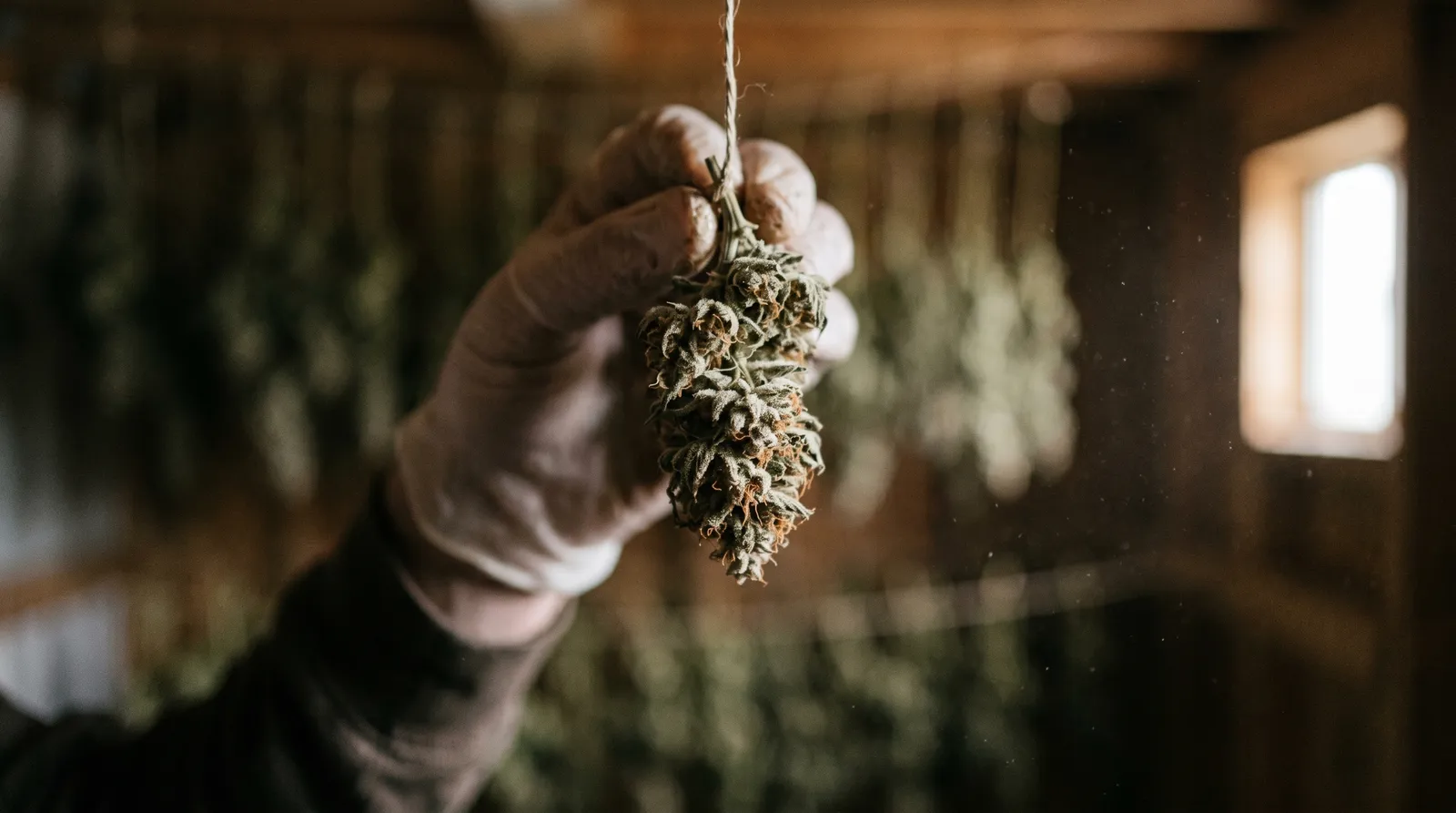
On the humidity side, water moves from bud to air along the gradient between internal moisture and ambient RH. Too dry an environment (below ~45% RH) and the outer surface of the bud dehydrates faster than the core — the classic "crispy outside, wet stem" result that forces you into a frantic rehydration rescue during cure. Too humid (above ~65%) and Botrytis has everything it needs: sugar-rich substrate, stagnant air, and moisture.
Gentle, indirect airflow matters as much as the setpoints. You want air moving through the room, not blasting directly onto buds. A small oscillating fan pointed at a wall, plus passive intake, gives even humidity without wind-burning the outer calyxes.
The 10-14 day timeline, day by day
Most dries finish in 10–14 days, with density and room conditions shifting the exact end point. As a working framework:
- Days 1-3: Surface water evaporates fast. RH in a closed room will spike — passive ventilation or a dehumidifier keeps you under 60%. Weight drops quickly; this is not "drying" in the meaningful sense yet.
- Days 4-8: The slow interior migration phase. This is where terpene and chlorophyll chemistry does its work. Temperature stability matters more than absolute value here.
- Days 9-14: Approaching end-point. The classic test: a small stem from a mid-sized bud should snap, not bend. If it bends, you're not there. If it shatters and the bud crumbles, you've overshot.
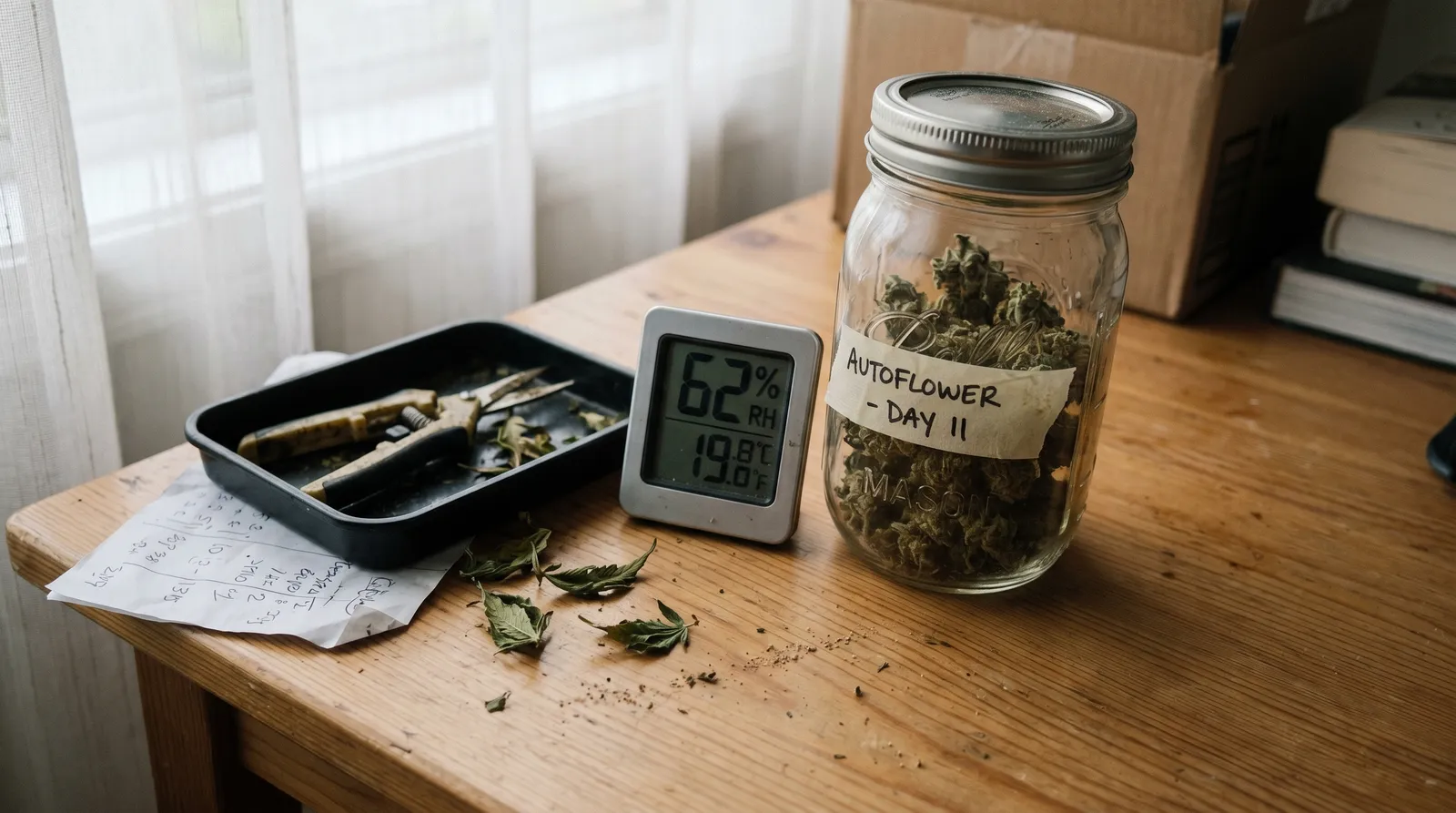
Autoflower buds tend to be smaller and looser, finishing 1–2 days earlier in the same room. Big, dense photoperiod colas from a SCROG can take a full 14 days or longer — and that's fine, as long as RH stays in band.
Measuring it properly
Accurate measurement needs at least two calibrated sensors placed at different heights in the drying room. A cheap digital hygrometer on the bench is not enough. Temperature and RH stratify in a drying room — the top of a hang rack can be 3°C warmer and 10% lower RH than the floor. One at canopy height, one near the hangs. Calibrate with the salt test (a saturated sodium chloride slurry sealed in a bag should read 75% RH at 20°C); cheap sensors drift by 5–8% out of the box. If you want to buy one piece of kit for this job, get a two-sensor datalogger rather than a better fan.
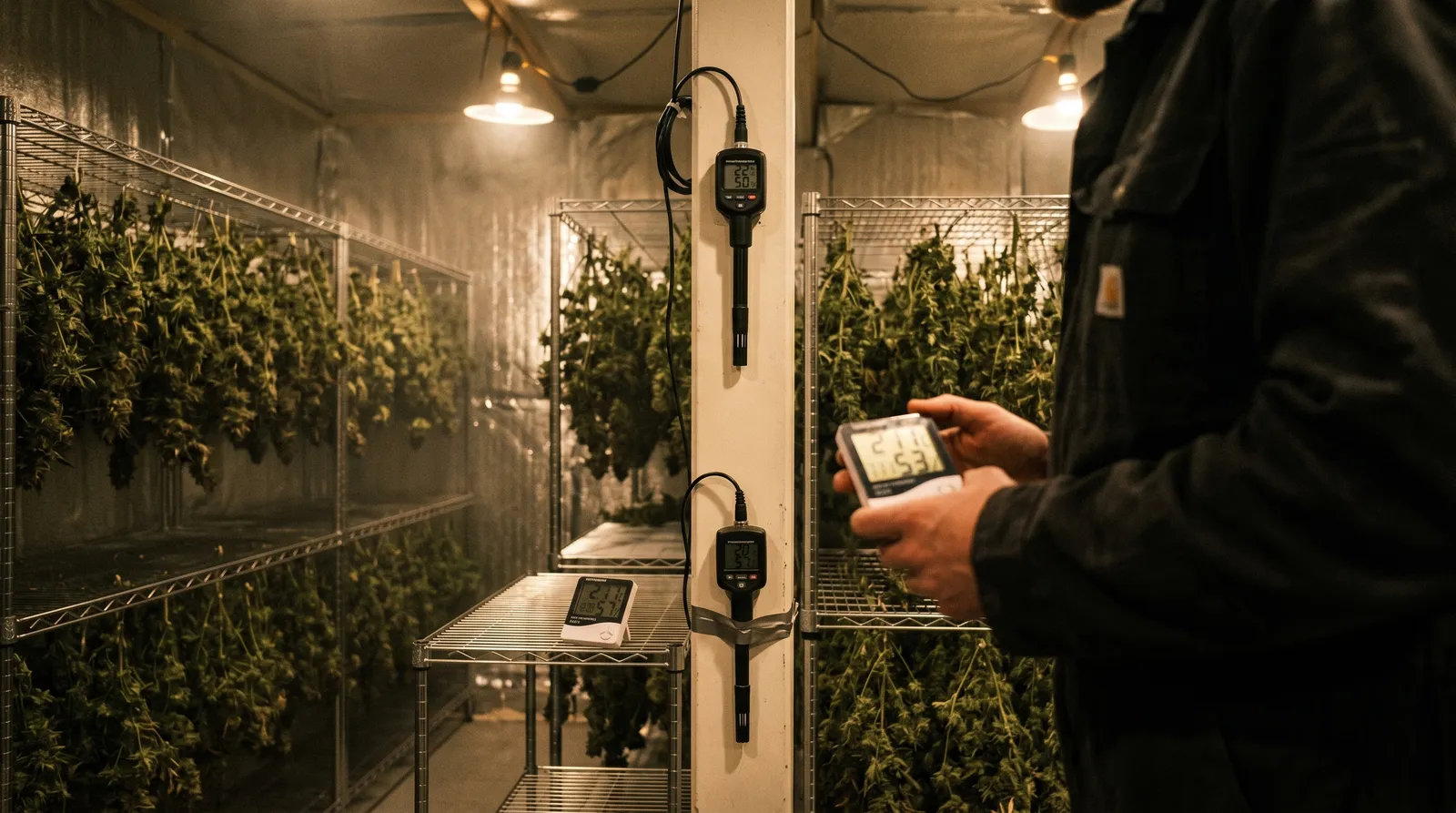
For anyone drying more than once or twice a year, a datalogger that records every 15 minutes tells you things a snapshot never will — like the 2am spike when your house heating kicked off and pushed the room to 24°C for three hours.
Conventional (18–21°C / 55–60% RH) is the easiest to hit in a home tent with a basic dehumidifier and finishes in 10–14 days. The 60/60 method (15.5°C / 60% RH) preserves volatiles slightly better but needs active cooling most European homes don't have. Low-and-slow (15–17°C / 58–62% RH over 14–21 days) gives the gentlest terpene curve but demands stable conditions for three weeks — one warm weekend can undo it. For most home growers, conventional wins on practicality; commercial rooms lean 60/60 because they can afford the HVAC.
Most of the published drying cannabis temp RH time research comes from commercial cultivation rooms, not four-plant home tents. The principles transfer, but the margin for error in a small tent is narrower — one warm afternoon with the tent zipped can undo a careful setup. Treat the numbers as a target, not a guarantee.
Where home grows go wrong
Most failed home dries trace back to five specific mistakes that cluster around temperature, humidity, and airflow control:
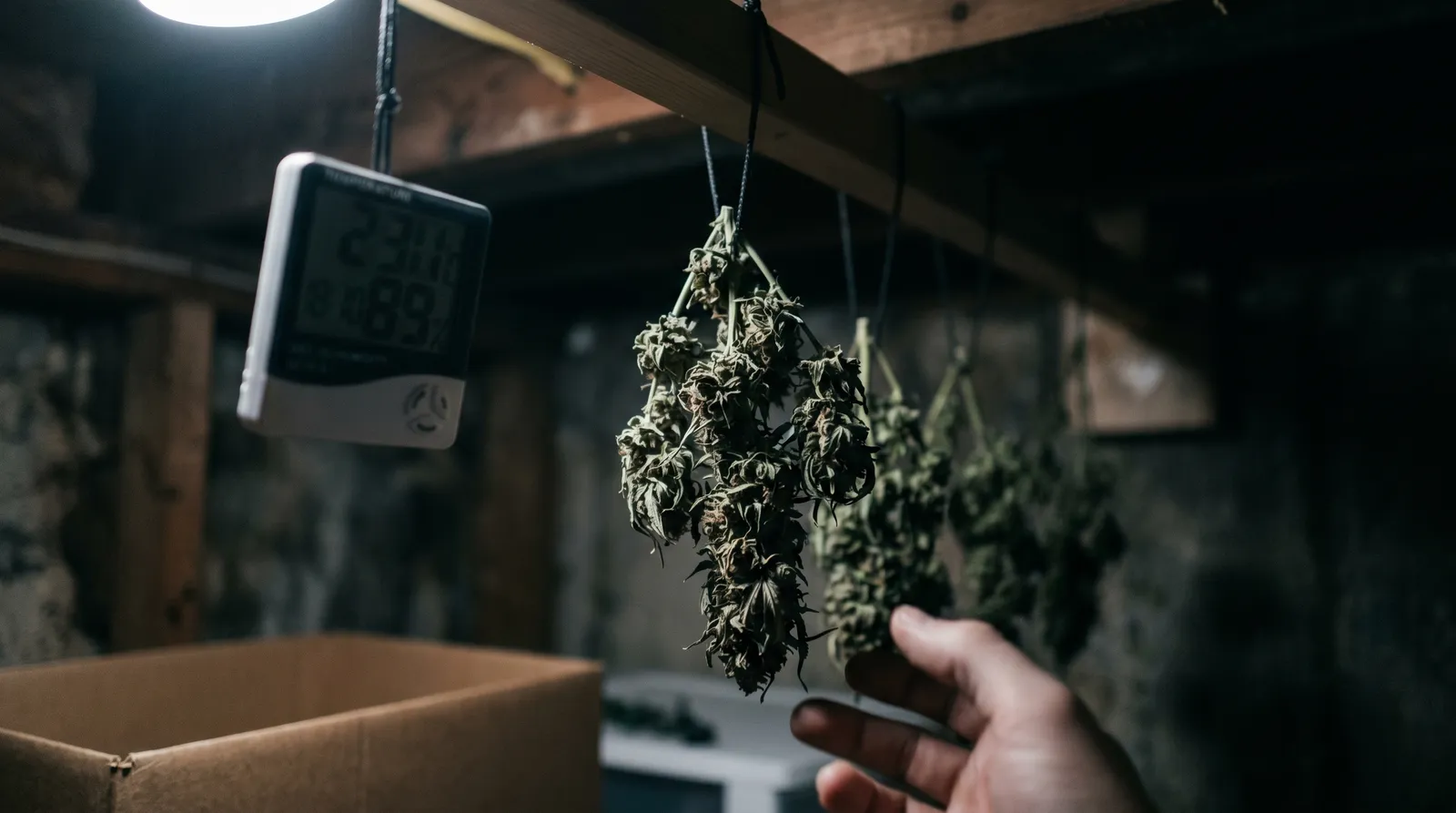
- Too warm, too dry. The classic "hay smell" is chlorophyll degradation products outpacing terpene retention. Caused by drying above 22°C or below 50% RH. Once it's there, cure won't fully fix it.
- Too humid, too cold. A cold basement at 15°C and 70% RH feels "gentle" but is exactly where Botrytis thrives. Bud rot during dry is a total loss — mouldy cannabis is a respiratory hazard and belongs in the bin, not the jar.
- Direct airflow. A fan pointed at the buds wind-burns the outer trichomes and dries surfaces while stems stay wet. Air movement yes, wind tunnel no.
- Trusting one hygrometer. Covered above. They lie.
- Rushing the transition to jars. If stems bend at all, you're not ready. Jarring wet buds creates anaerobic conditions and can produce ammonia off-gassing — the "burp the jar and wince" experience.
Rehydration is possible if you've overshot — a Boveda-style two-way humidity pack at 62% in a sealed jar will pull moisture back up over 48–72 hours. Growers who order these in bulk get them cheaper than single sachets. But rehydrated bud doesn't recover lost terpenes; it just softens up for smoother handling. Prevention is considerably cheaper than correction.
Wet trim vs dry trim — does it change the numbers?
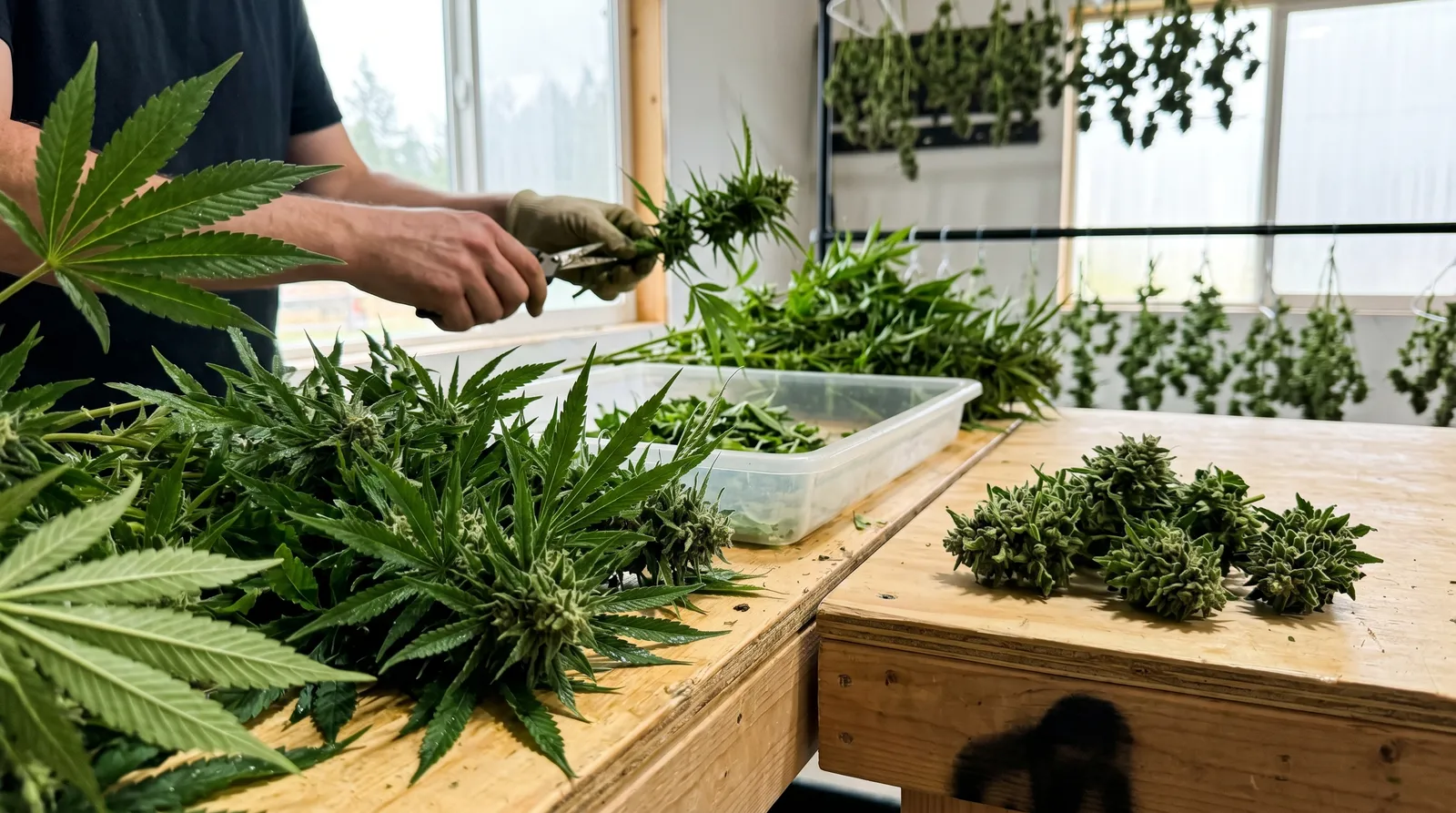
Trim style shifts the dry curve but not the temperature and humidity targets. Wet trimming (removing fan and sugar leaves immediately after harvest) speeds drying because you've stripped surface area carrying water. In a 19°C/58% room, wet-trimmed buds often hit end-point at day 8–10 rather than 11–14. Dry trimming (leaves on through the hang) slows the dry and gives a gentler moisture curve — many growers report better terpene retention, though the controlled data is thin. The Royal Queen Seeds grow guide and several commercial drying protocols note the tradeoff without strongly endorsing either; practical answer is that dry trim works better in rooms that run on the warm end of the range, because the leaves buffer the bud.
Curing — the jar stage that follows drying — has its own target band (58–62% RH, darker and cooler storage) and gets its own article in this cluster. The handover point between dry and cure is the single most-fumbled moment in a home grow. Get the drying cannabis temp RH time targets right and the cure mostly takes care of itself.
Legal notice: Cannabis cultivation laws vary by country and region and change frequently. This guide is educational. Before growing, verify current laws for your specific jurisdiction. Azarius does not provide legal advice.
Educational information only. Not medical or formal advice. Consult a qualified professional for guidance specific to your situation.
Last updated: April 2026
Frequently Asked Questions
8 questionsWhat's the ideal temperature and humidity for drying cannabis?
How long should cannabis dry before curing?
Can I dry cannabis faster by raising the temperature?
What's the 60/60 drying method?
Can I rehydrate cannabis that dried too fast?
Do I need a dehumidifier to dry cannabis properly?
How do I know when cannabis is done drying?
Does darkness matter when drying cannabis?
About this article


Luke Sholl has been writing about cannabis, cannabinoids, and the broader benefits of nature since 2011, and has personally grown cannabis in home grow tents for more than a decade. That first-hand cultivation experience
This wiki article was drafted with AI assistance and reviewed by Luke Sholl, External contributor since 2026. Editorial oversight by Adam Parsons.
Medical disclaimer. This content is for informational purposes only and does not constitute medical advice. Consult a qualified healthcare provider before use of any substance.
Last reviewed April 24, 2026
References
- [1]Chen, Y., et al. (2023). Effects of drying temperature on cannabinoid and terpene profiles in Cannabis sativa inflorescence. Frontiers in Plant Science.
- [2]Challa, S. K. R., et al. (2021). Drying kinetics and quality of cannabis: conventional vs controlled-environment drying. MDPI Processes.
- [3]Royal Queen Seeds (2024). How Long Does It Take to Properly Dry Cannabis? Cannabis Grow Guide.
- [4]Addo, P. W., et al. (2022). Relative humidity control during post-harvest cannabis processing and its effect on secondary metabolites. Frontiers in Plant Science.
- [5]EMCDDA (2023). Cannabis cultivation in Europe: monitoring report. European Monitoring Centre for Drugs and Drug Addiction.
- [6]Beckley Foundation (2022). Cannabis policy and horticulture briefing.
Related Articles
Cannabis Hermaphrodite: Identify, Prevent, Act
A cannabis hermaphrodite is a female plant that develops male pollen sacs or banana-shaped anthers (nanners), self-pollinating and seeding your harvest.
DIY Cannabis Fertilizer: Homemade Nutrient Guide
DIY cannabis fertilizer guide: compost, teas, banana ferments and feed schedules, with safety notes and cited research for home growers.
What To Do With Male Cannabis Plants: 6 Practical Uses
What to do with male cannabis plants: identify, isolate, breed, extract, or compost. A practical 6-step guide with sourcing and safety notes.
When To Harvest Cannabis Trichomes: A Grower's Guide
Deciding when to harvest cannabis trichomes means reading the resin glands on your calyxes under 60x–100x magnification and cutting when the milky-to-amber…
When To Flip Cannabis To 12/12: Timing The Switch
When to flip cannabis to 12/12 is a timing decision that switches photoperiod plants to 12 hours light and 12 hours dark to trigger flowering via florigen…
Watering Cannabis Frequency Volume Runoff: Full Guide
Watering cannabis frequency volume runoff is the feedback loop between how often you irrigate, how much you apply, and what drains from the pot.
VPD for Cannabis: Targets by Growth Stage
VPD for cannabis is the kilopascal gap between the moisture the air holds and its saturation point, controlling how fast plants transpire.
Topping vs FIMing Cannabis: Which Training Cut Wins?
Topping vs FIMing cannabis is a pair of high-stress training cuts that break apical dominance to produce more main colas.
Photoperiod vs Autoflower Cannabis: Key Differences
Photoperiod vs autoflower cannabis is a genetics choice: photoperiod strains flower when light cycles shift to 12 hours dark, while autoflowers — crosses…