
This article discusses psychoactive substances intended for adults (18+). If you have a health condition or take medication, consult a doctor before use. Our age policy
Topping vs FIMing Cannabis: Which Training Cut Wins?
Definition
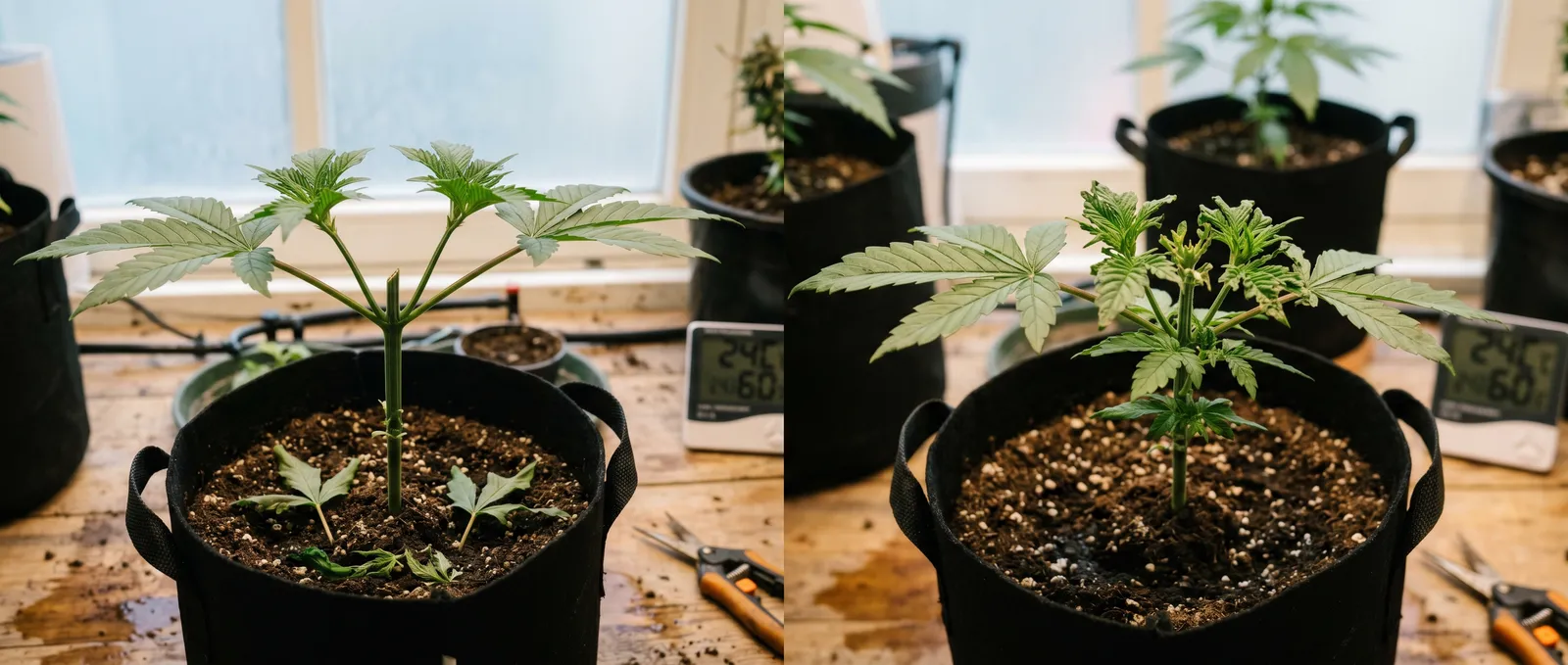
Topping vs FIMing cannabis is a pair of high-stress training cuts that break apical dominance to produce more main colas. Topping removes the entire growth tip for 2 symmetrical leaders; FIMing removes roughly 75% for 3–5 uneven shoots. Plant training raises yield per watt by widening the canopy under light (Chandra et al., 2017).
Topping vs FIMing cannabis is a pair of high-stress training cuts that break apical dominance to produce more main colas from a single stem. Both are done with the same pair of scissors, both are veg-phase interventions, and both end up being the first real training decision every photoperiod grower makes — but the cut itself, the timing tolerance, and the plant's response diverge enough that picking the wrong one for your setup can cost you a week of recovery or a wonky canopy. This guide compares topping vs FIMing cannabis head-to-head so you can pick the technique that actually fits your tent, your genetics, and your patience. Adult use only — home cultivation content, written for growers aged 18+.
This guide is educational content about cannabis cultivation techniques. Always verify current rules for your jurisdiction before you buy seeds, order equipment, or get a grow underway. Azarius does not provide formal advice.
Comparison at a glance
Topping produces 2 symmetrical colas from a clean cut; FIMing produces 3–5 uneven shoots from a ragged partial cut. That's the core difference, and the table below unpacks the rest.
| Dimension | Topping | FIMing |
|---|---|---|
| What you cut | Entire top node, clean through the stem above a lower node | Roughly 75% of the newest growth tip, leaving ragged tissue behind |
| New main colas | 2 (symmetrical, predictable) | 3–5 (often uneven) |
| Stress level | Moderate — clean wound, clear signal | Lower in theory, but the ragged cut can invite secondary dieback |
| Recovery window | 7–10 days before new growth takes off | 3–7 days, but uneven shoot vigour |
| Precision required | High — wrong node = wasted veg time | Low — "F*** I Missed" is literally the origin story |
| Best for | SCROG, main-lining, symmetrical manifolds | Bushy, wide canopies without a trellis |
| Timing (photoperiod) | Node 4–6, veg only | Node 3–5, veg only |
| Autoflower suitability | Risky — limited recovery time | Marginally safer, still not recommended for most autos |
| Canopy outcome | Even, two dominant colas (or 4/8 after repeat topping) | Wider, bushier, less uniform |
What topping actually does
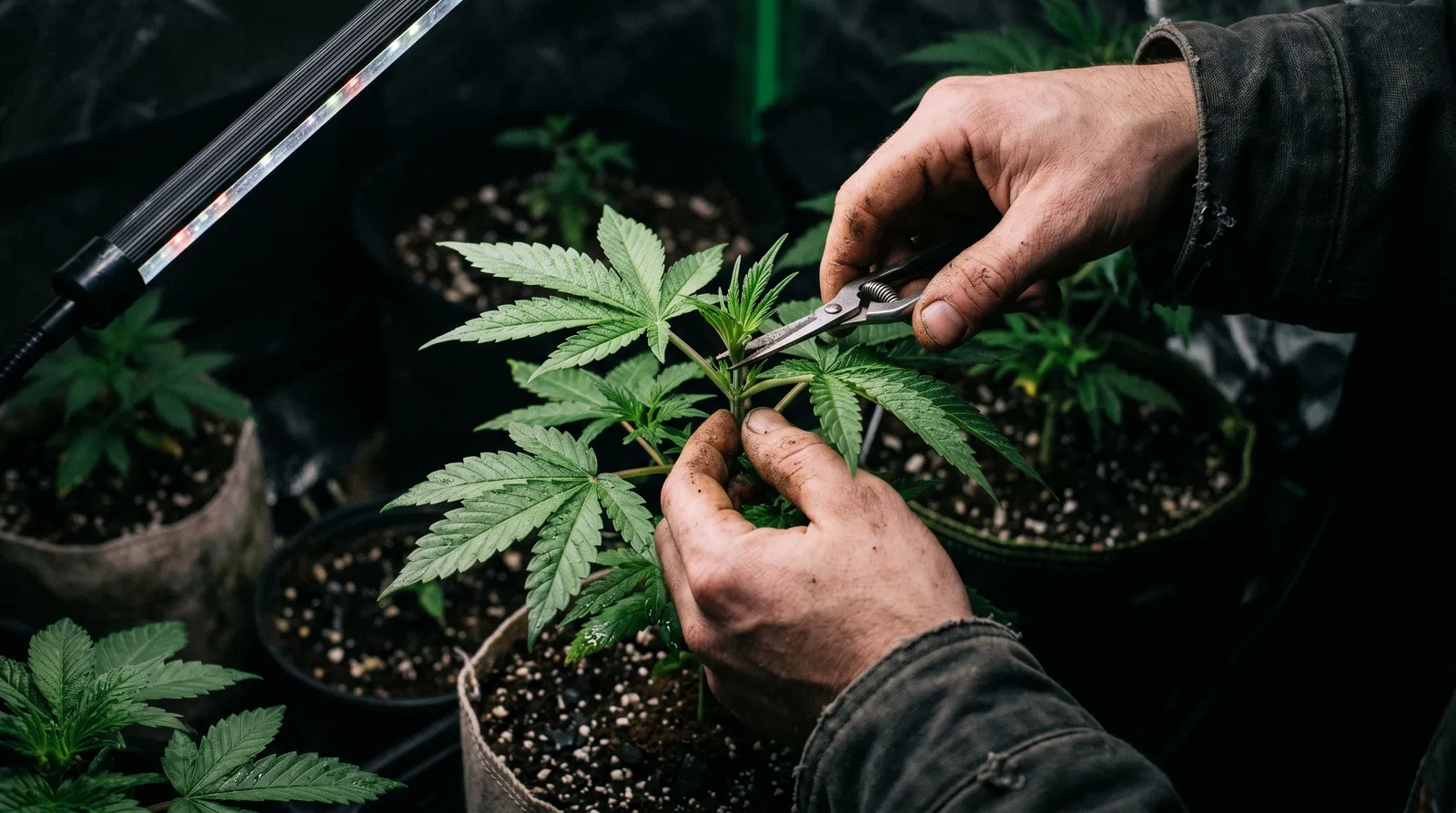
Topping removes the entire apical meristem with a single clean cut above a lower node, forcing two symmetrical shoots to take over as new main colas. You take sharp, sterile scissors and cut straight through the stem — most growers target the space above node 4, 5, or 6 depending on how much height they want to save. The plant loses its auxin-driven hormonal signal telling the lower branches to stay subordinate. Two shoots at the node below the cut then race for dominance, and because they're symmetrical, you end up with a Y-shaped plant that responds beautifully to further training.
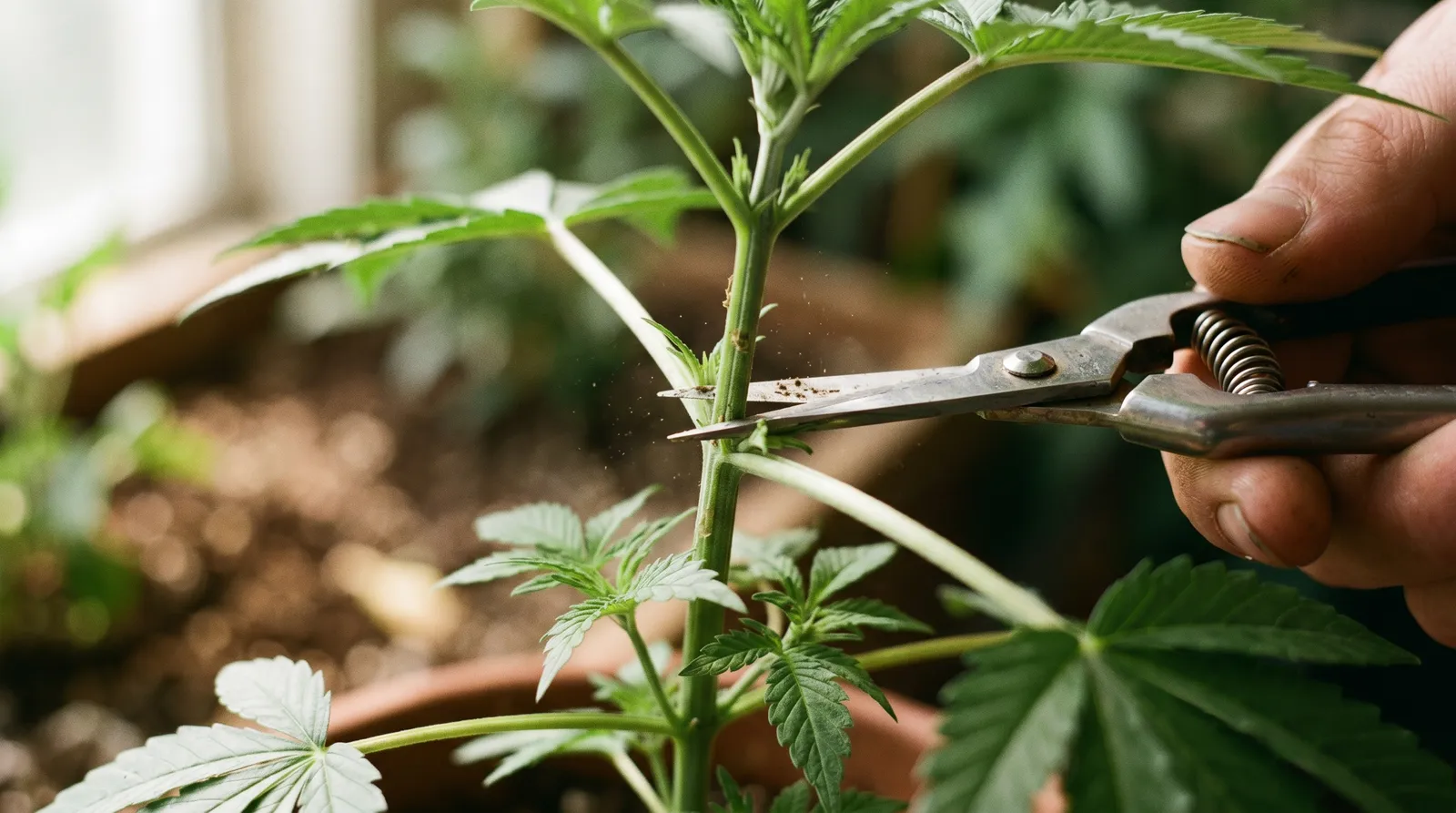
This predictability is why topping is the backbone of main-lining and manifold builds. If you want a plant that turns into 4, 8, or 16 even colas under a SCROG net, you need a cut you can replicate. Topping gives you that. The trade-off is the recovery — in our own tent, a photoperiod Sensi Seeds Northern Lights topped at node 5 typically sits still for about a week before the two new leaders visibly lengthen. Under a Fluence-class LED at around 500 PPFD, veg growth rates recover by day 8–10.
What FIMing actually does
FIMing removes only about 75% of the newest growth tip, leaving damaged meristem tissue that regenerates as 3–5 new shoots instead of 2. The name comes from "F*** I Missed" — the technique was reportedly born when a grower tried to top a plant, botched the cut, and noticed that four colas came back instead of two. You pinch or snip roughly three-quarters of the newest tip, leaving a small fragment of meristem behind. Because you haven't fully removed the growing point, the plant can produce three, four, or sometimes five new shoots from the damaged node rather than the clean pair topping delivers.
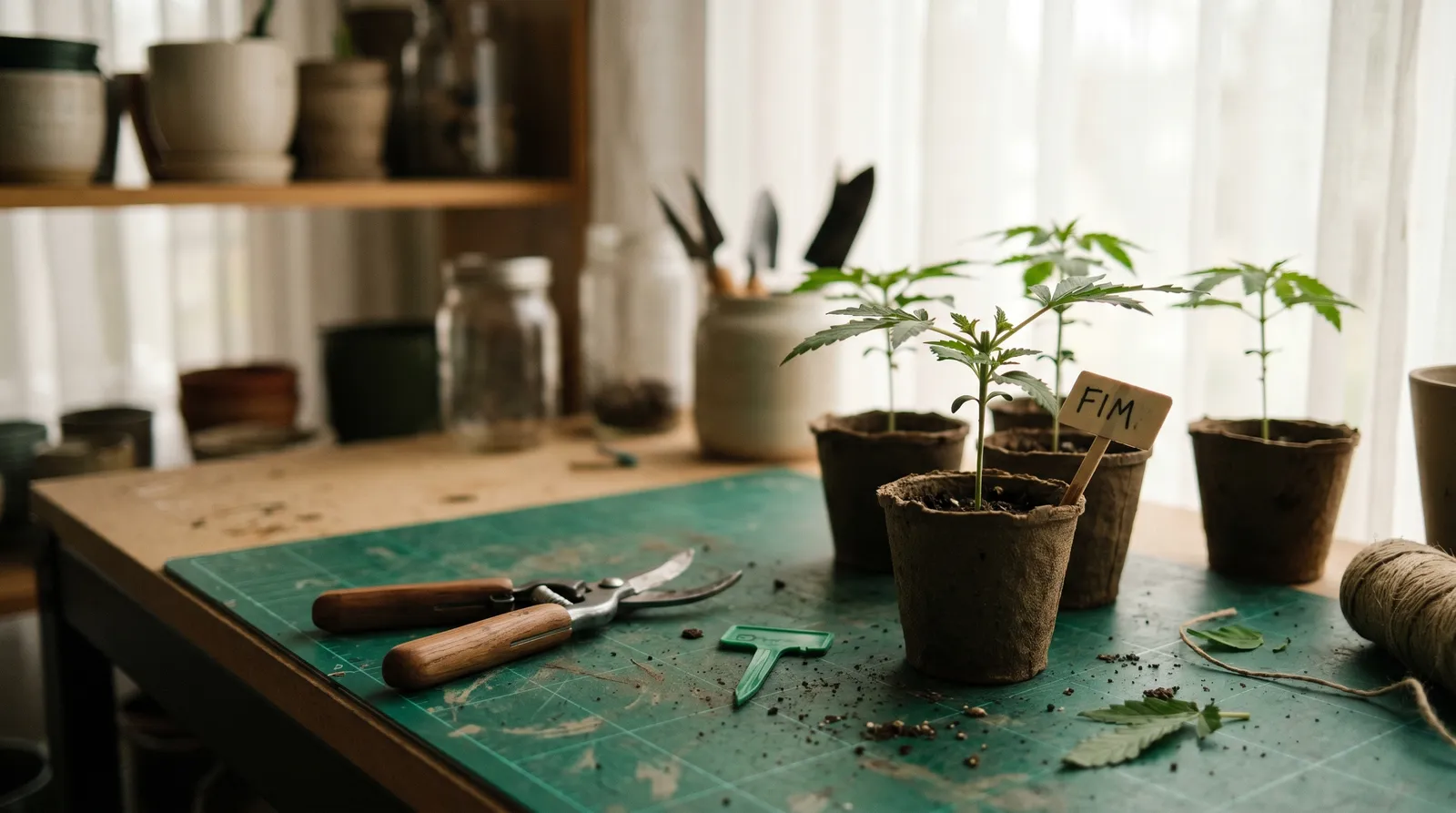
The appeal is obvious: more colas from one cut. The catch is that those colas rarely come in evenly. You'll often see two strong shoots and two or three weaker ones, which makes a uniform canopy harder to engineer. Honestly, after running both techniques across a dozen grows, I still find the FIM result harder to predict — some plants throw four perfect tips, others give you one dominant shoot and three runts. FIMing also leaves torn, ragged tissue rather than a clean wound, so secondary dieback and minor infection risk are slightly higher — nothing serious on a healthy plant, but worth flagging if your humidity runs hot.
When to use which
Top when symmetry matters; FIM when shoot count matters. If you're running a SCROG, main-line, or any training system where geometry counts, top. The predictable 2-cola response is what you need to build a repeatable structure. Growers chasing 8 or 16 even colas through sequential topping rely on this symmetry — FIMing throws the geometry off by the second round.
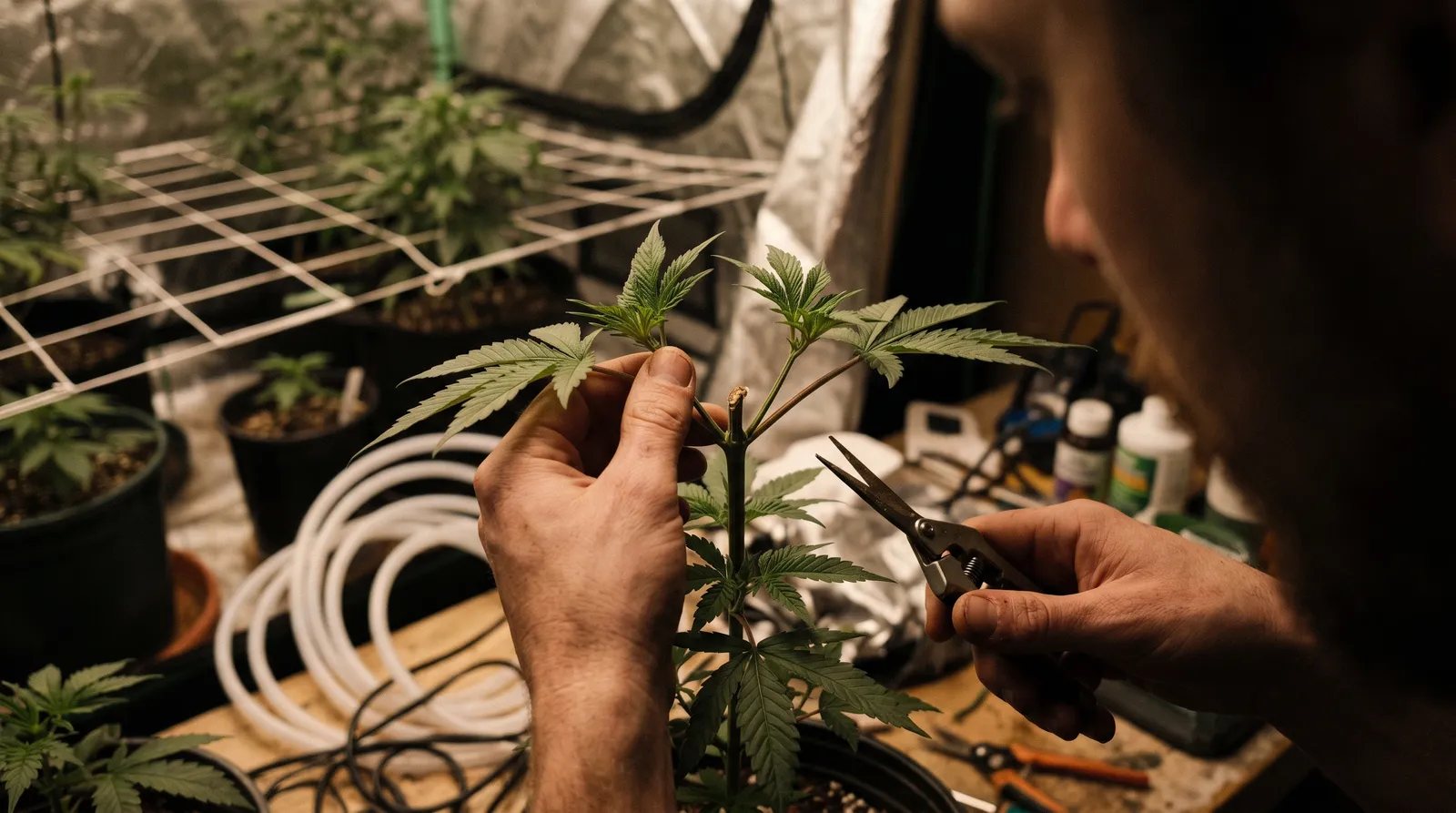
If you've got vertical headroom, no trellis, and just want a bushier plant with more bud sites without a second cut, FIM. It's also the forgiving option for newer growers who aren't yet confident identifying the exact node to cut above — the technique tolerates imprecision by design.
On autoflowers, neither technique is a first choice. Autoflowering genetics (Dutch Passion's Auto Blueberry, Royal Queen Seeds' Quick One, etc.) flower by age rather than photoperiod, typically finishing seed-to-harvest in 9–11 weeks. That compressed timeline leaves little room for recovery — a week of stalled growth after topping can cost you meaningful flower development. If you must train an auto, LST (low-stress training, bending branches rather than cutting them) is the safer call. Some experienced growers do FIM robust auto genetics at node 3, but the risk-reward rarely beats tying down.
Timing and technique
Both cuts belong in the vegetative phase only, ideally between node 3 and node 6 depending on technique. Once a photoperiod plant is flipped to 12/12 and stretch begins, the hormonal window for this kind of intervention has closed — topping in flower just costs you a cola and stresses the plant during the stage where it should be putting energy into bud development.
For photoperiod plants, the practical timing is:
- Topping: Wait until the plant has 4–6 true nodes. Cut above node 4 or 5 with sterile, sharp scissors — blunt blades crush stem tissue and extend recovery. Keep the plant in veg for at least another 10–14 days after topping to let the two new leaders establish before flipping.
- FIMing: Slightly earlier — node 3–5 works. Pinch or snip roughly three-quarters of the newest tip. You're aiming to damage the meristem, not remove it cleanly.
Environment matters more than most beginner guides admit. Stressing a plant already fighting heat, nutrient deficiency, or pH swing compounds the problem. Target veg VPD around 0.8–1.1 kPa, keep medium pH steady (6.0–6.5 in soil, 5.8–6.2 in coco), and only cut when the plant is visibly healthy. A stressed topping is a botched topping.
Recovery and what to expect
Topping recovery runs 7–10 days of visible stillness; FIMing recovery runs 3–7 days but produces uneven shoot vigour. After topping, the plant is redirecting hormones and energy to the two lateral shoots below the cut. Growth resumes, and within two to three weeks the two new leaders will be visibly dominant, with the plant taking on a Y-shape. This is your cue to either top again (for main-lining) or start bending under a net (for SCROG).
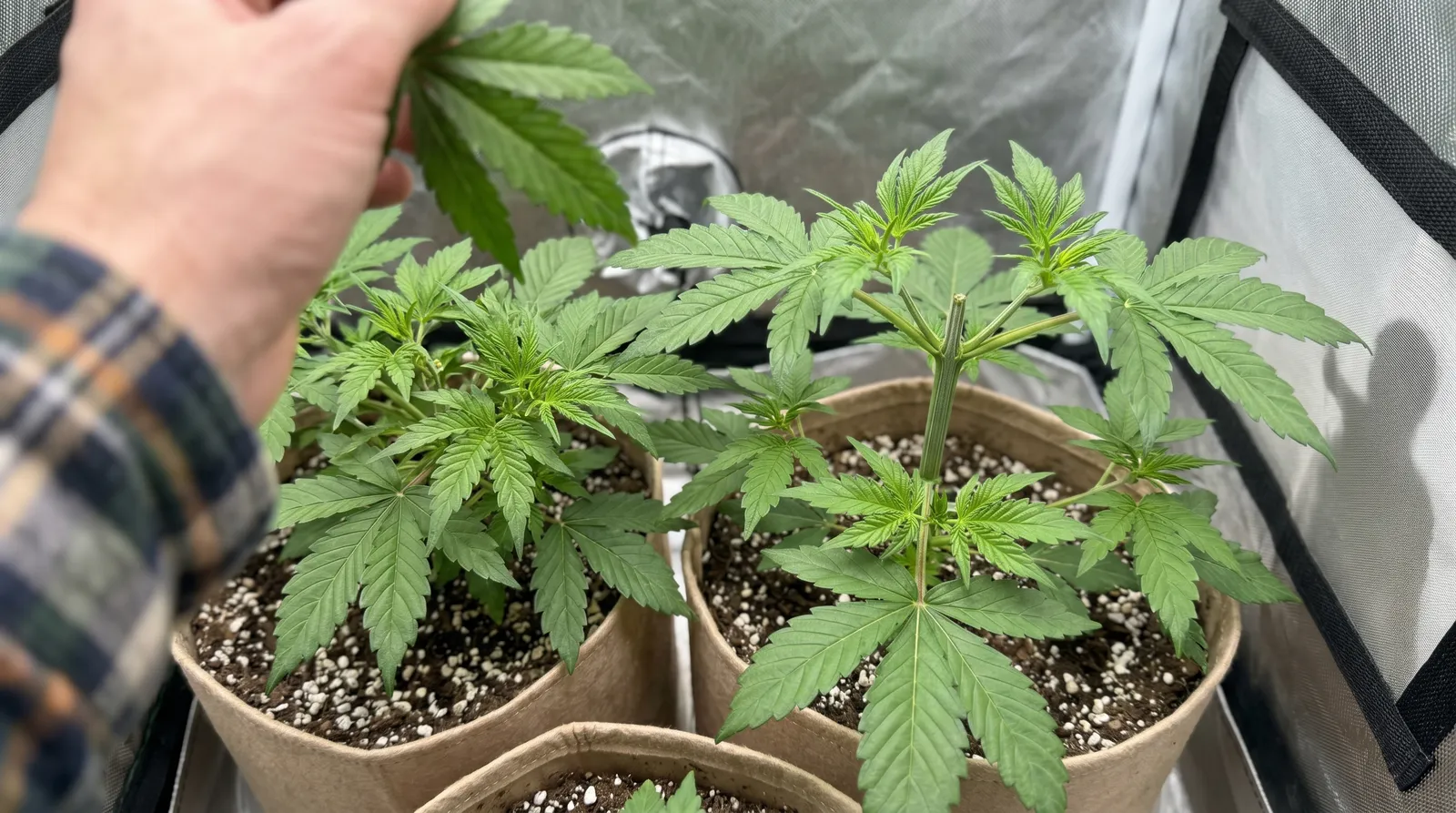
After FIMing, recovery is faster — sometimes visible shoot elongation within 3–5 days — but less tidy. You'll often see 3–5 new tips at the damaged node, and some will outpace others. Many growers follow up with light LST to pull the stronger shoots outward and let the weaker ones catch sunlight they'd otherwise be shaded from.
The absolute yield bump from either technique depends heavily on light, genetics, and finish quality — grower reports range from modest (10–20%) to substantial, but controlled per-plant yield data is thin enough that specific percentage claims should be treated with scepticism. What's consistent across horticultural literature is that plant training raises yield per watt by increasing effective canopy area under the light, which is the real reason to do either (Chandra et al., 2017).
Common mistakes with both techniques
The most frequent failure across both techniques is cutting a stressed or underdeveloped plant — recovery is what determines success, not the cut itself. The errors we see most often in either camp:
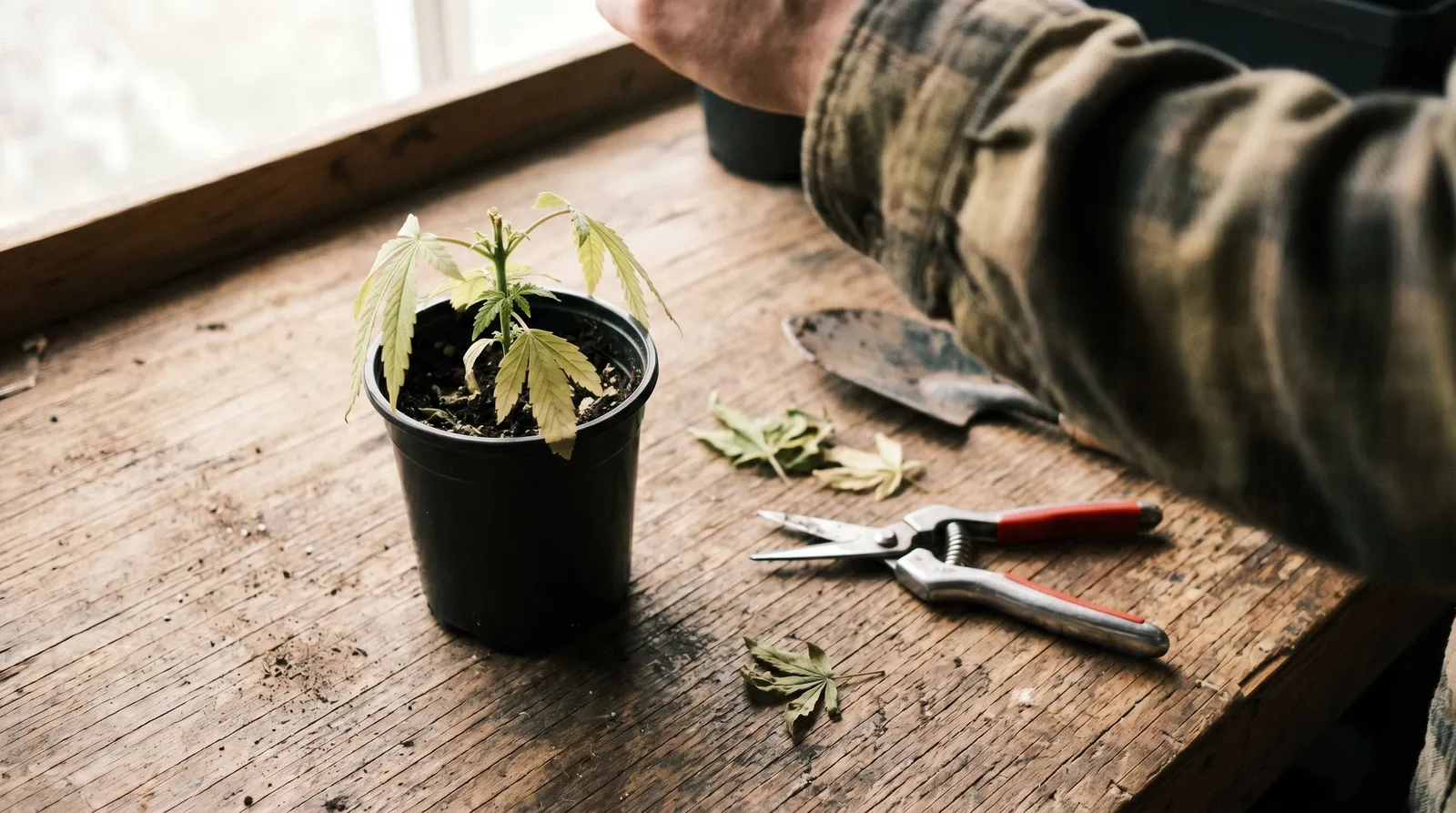
- Cutting too early. A seedling with only 2–3 nodes doesn't have the root mass or foliage to recover well. Wait for node 4 minimum.
- Cutting too late. Topping a photoperiod plant the week before flip compresses recovery into the stretch phase. Give it 10–14 days.
- Dirty blades. Wipe scissors with isopropyl alcohol. Stem wounds are entry points for pathogens, and botrytis doesn't care how good your genetics are.
- Training stressed plants. Yellow leaves, pH lockout, pest pressure — fix the underlying issue first. The cut is the easy part; the recovery is what matters.
- Topping autos out of habit. Photoperiod instincts don't transfer. With autos, LST first, FIM only if the plant is vigorous and on schedule.
One technique people conflate with both: lollipopping (removing lower growth to concentrate energy on the canopy). That's a separate defoliation call made later in veg or early flower, not a substitute for topping or FIMing.
The verdict
Topping wins on predictability and structural training compatibility; FIMing wins on forgiveness and higher shoot count. If you're running a SCROG or main-lining, top. If you want a wider, bushier plant and don't care about geometry, FIM. Both beat leaving the plant untrained under a single light, which wastes canopy edge. Neither is a shortcut around bad environment, poor genetics, or impatient flipping — they're multipliers on an already-healthy grow.
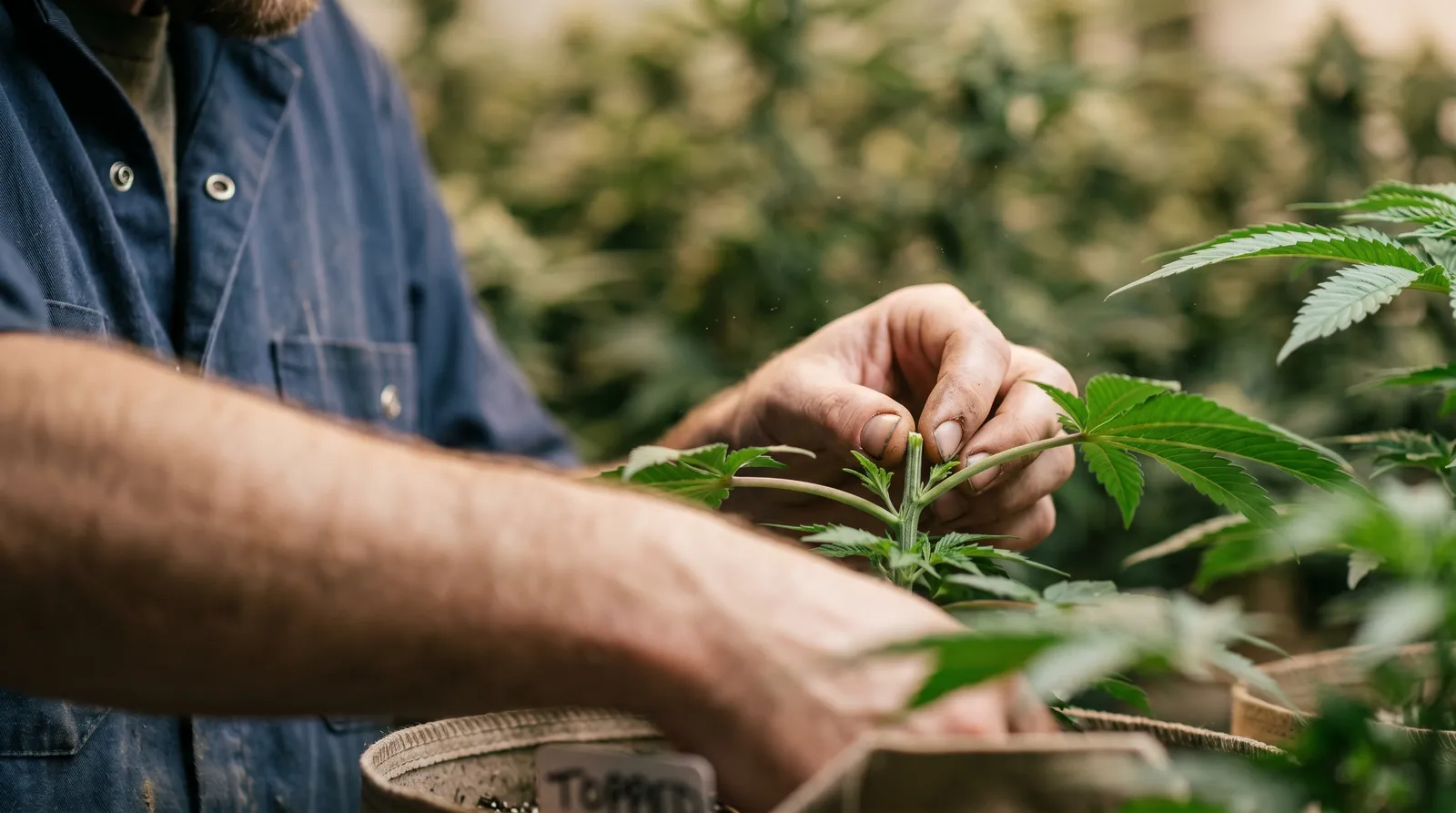
If you're new and unsure which to try first, FIM a robust photoperiod variety before you order a full SCROG net or buy fancier training gear. The cut is harder to botch, the recovery is quicker, and if it goes wrong you've still got a viable plant.
Legal notice: Cannabis cultivation laws vary by country and region and change frequently. This guide is educational. Before growing, verify current laws for your specific jurisdiction. Azarius does not provide legal advice.
Disclaimer: This article is educational content for adults aged 18+ interested in home cannabis cultivation techniques. It is not medical, horticultural, or formal advice. Growing conditions, genetics, and outcomes vary — verify information against multiple sources before making decisions that affect your grow, your health, or your household. Azarius does not provide formal advice and accepts no responsibility for decisions made based on this content.
Last updated: April 2026
Frequently Asked Questions
8 questionsCan you top and FIM the same plant?
Should I top or FIM an autoflower?
How long after topping before I can flip to flower?
Does FIMing actually produce more yield than topping?
What tools do I need to top or FIM cannabis?
Will topping stress my plant too much?
How many nodes should my plant have before I FIM it?
Can I top or FIM a plant that's already been LST'd?
About this article


Luke Sholl has been writing about cannabis, cannabinoids, and the broader benefits of nature since 2011, and has personally grown cannabis in home grow tents for more than a decade. That first-hand cultivation experience
This wiki article was drafted with AI assistance and reviewed by Luke Sholl, External contributor since 2026. Editorial oversight by Adam Parsons.
Medical disclaimer. This content is for informational purposes only and does not constitute medical advice. Consult a qualified healthcare provider before use of any substance.
Last reviewed April 24, 2026
References (6)
- [1]Chandra, S., Lata, H., ElSohly, M. A., Walker, L. A., & Potter, D. (2017). Cannabis cultivation: Methodological issues for obtaining medical-grade product. Epilepsy & Behavior, 70, 302–312.
- [2]Caplan, D., Dixon, M., & Zheng, Y. (2017). Optimal rate of organic fertilizer during the vegetative-stage for cannabis grown in two coir-based substrates. HortScience, 52(9), 1307–1312.
- [3]Danziger, N., & Bernstein, N. (2021). Plant architecture manipulation increases cannabis yield. Industrial Crops and Products, 167, 113528.
- [4]EMCDDA cannabis cultivation and policy briefings (European Monitoring Centre for Drugs and Drug Addiction, accessed 2026).
- [5]Beckley Foundation research archive on cannabis cultivation and policy (accessed 2026).
- [6]Royal Queen Seeds cultivation archive (breeder documentation on topping and FIMing, accessed 2026).
Related Articles
Cannabis Hermaphrodite: Identify, Prevent, Act
A cannabis hermaphrodite is a female plant that develops male pollen sacs or banana-shaped anthers (nanners), self-pollinating and seeding your harvest.
DIY Cannabis Fertilizer: Homemade Nutrient Guide
DIY cannabis fertilizer guide: compost, teas, banana ferments and feed schedules, with safety notes and cited research for home growers.
What To Do With Male Cannabis Plants: 6 Practical Uses
What to do with male cannabis plants: identify, isolate, breed, extract, or compost. A practical 6-step guide with sourcing and safety notes.
Mushroom Grow Kit Temperature & Humidity: Full Setup Guide
A temperature humidity control grow kit is the small set of climate tools — hygrometer, heat mat, humidifier or perlite tray — that keeps a mushroom fruiting…
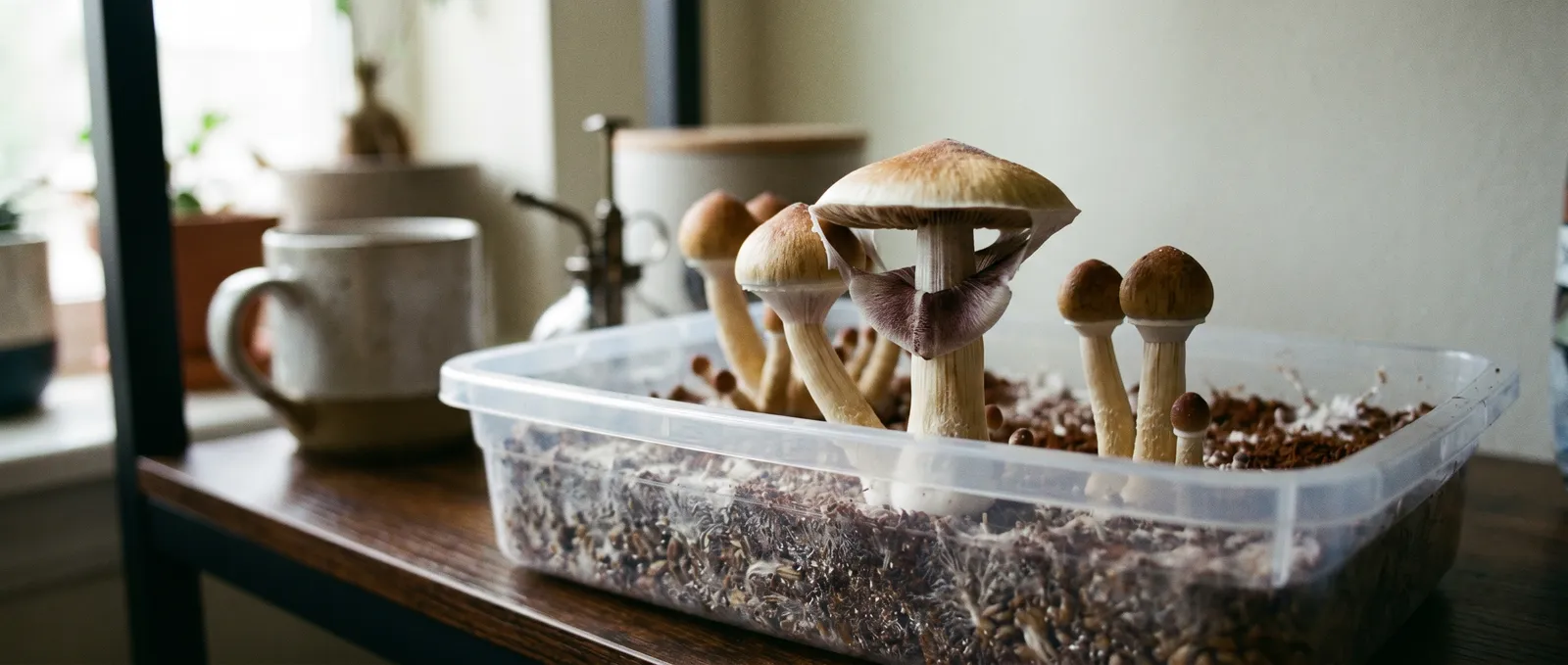
When to Harvest Mushrooms: Veil Break Timing Explained
Harvest timing veil break is a cultivation technique that uses the tearing of the partial veil on maturing Psilocybe cubensis to mark peak alkaloid content.
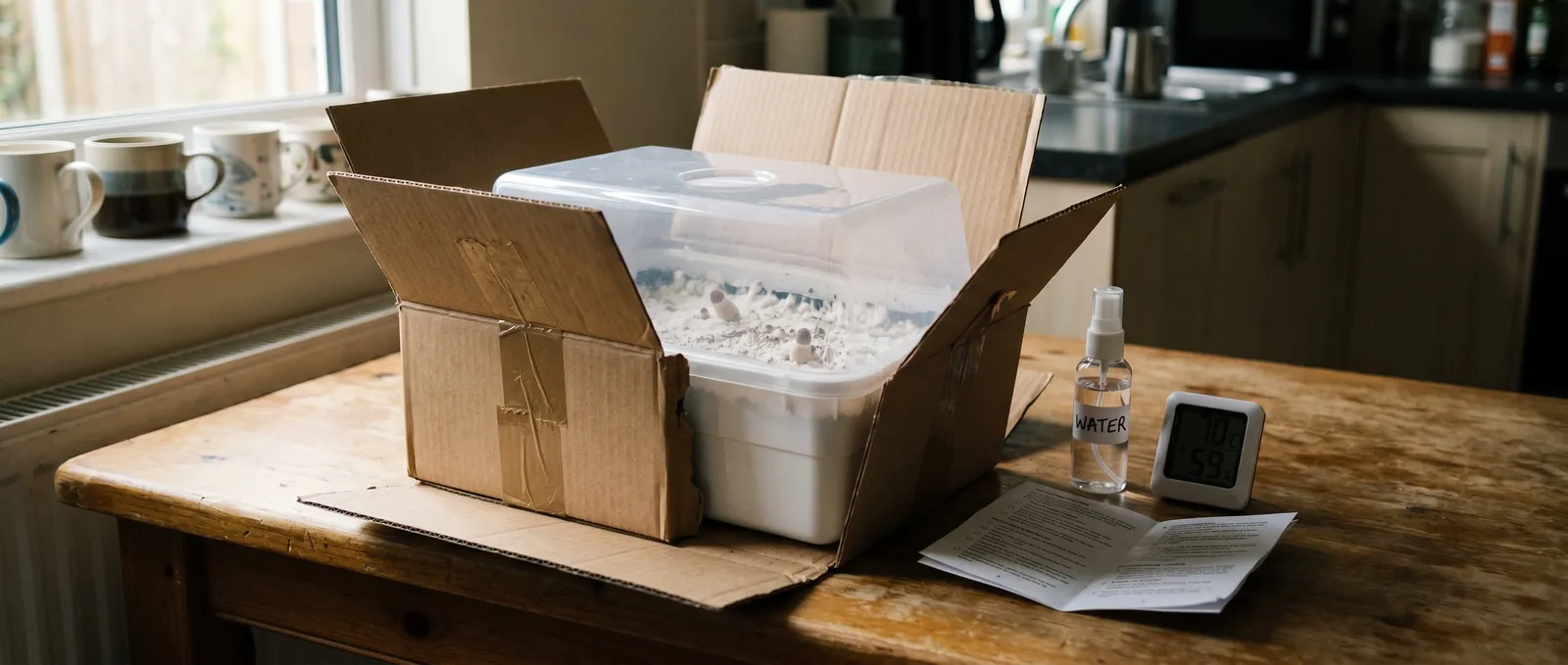
First Grow Checklist: What You Need for Mushroom Kits
A first grow checklist is the short list of supplies and environmental conditions needed to run a home psilocybin mushroom kit from inoculated substrate to…
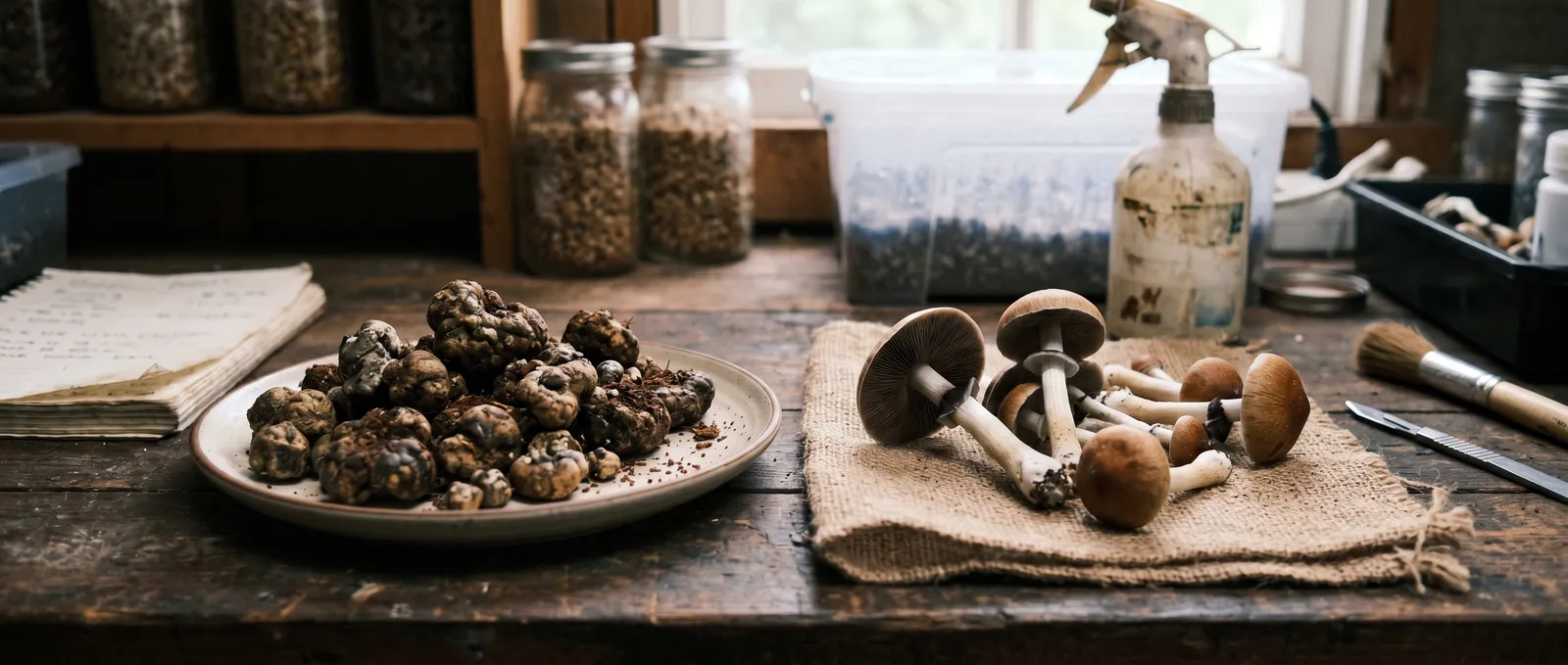
Sclerotia vs Fruit Bodies: Cultivation Comparison
Sclerotia and fruit bodies are two different life stages of Psilocybe fungi: sclerotia are hardened underground mycelial storage bodies (the 'magic…
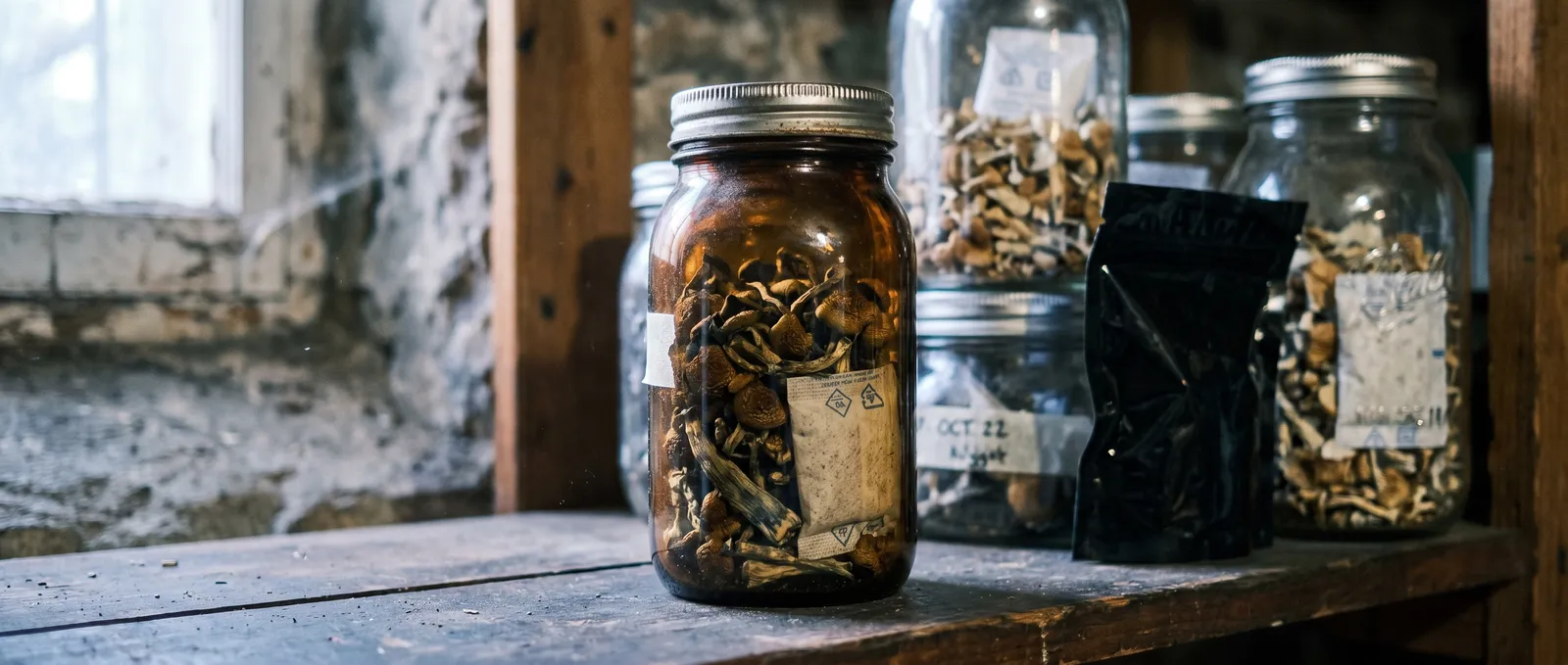
Storing Dried Mushrooms Long Term: Full Guide
Storing dried mushrooms long term means keeping well-dried Psilocybe fruit bodies in airtight, opaque containers with desiccant, cool and dark, to slow…
Drying Mushrooms Air Desiccant Oven: Methods Compared
Drying mushrooms air desiccant oven refers to the three home methods for reducing fresh fruit bodies from ~90% water to cracker-dry (<5%). Gotvaldová et al.