
This article discusses psychoactive substances intended for adults (18+). If you have a health condition or take medication, consult a doctor before use. Our age policy
DIY Cannabis Fertilizer: Homemade Nutrient Guide
Definition
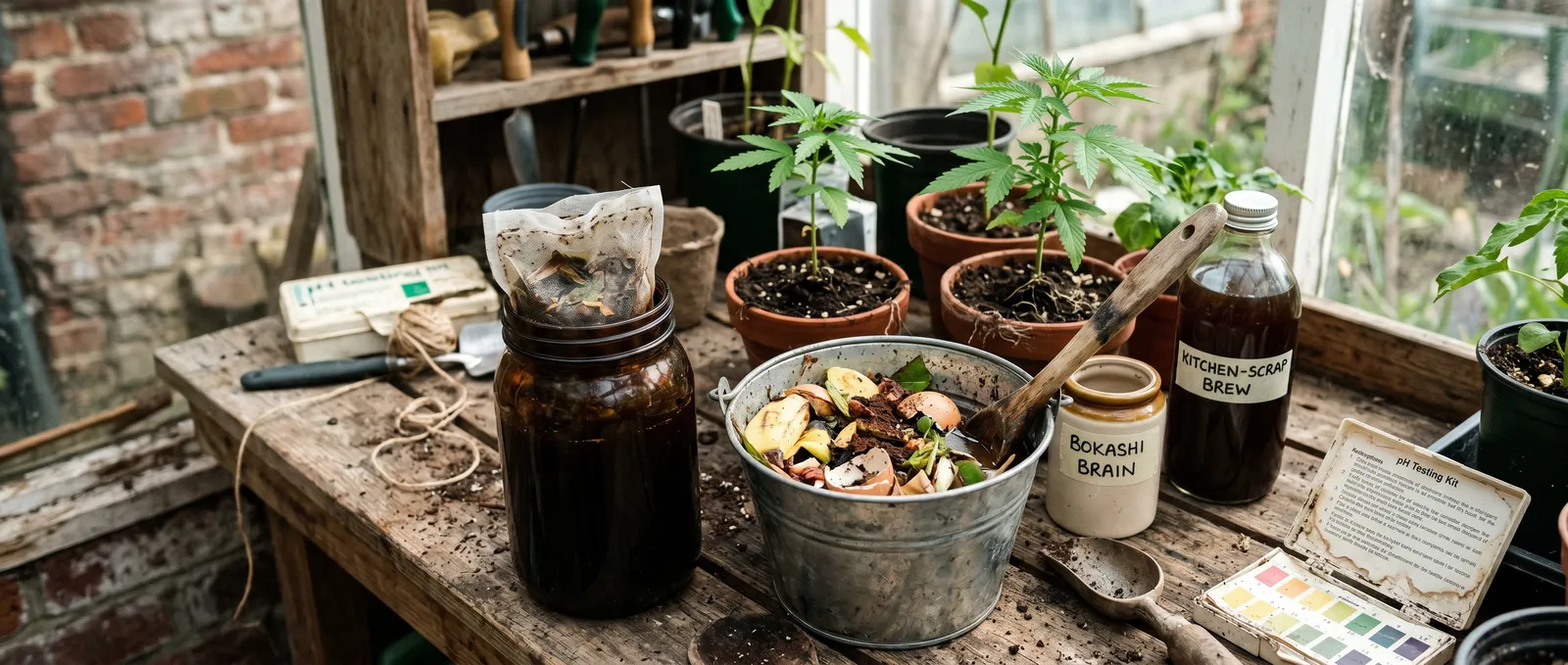
DIY cannabis fertilizer is a homemade nutrient mix — compost, aerated teas, bokashi or kitchen-scrap brews — that supplies the NPK ratios cannabis needs across veg and flower, with organic amendments shown to match or exceed mineral fertilisers for cannabinoid yield (Sicignano et al., 2024).
What is DIY cannabis fertilizer?
DIY cannabis fertilizer is a homemade nutrient mix — compost, teas, bokashi, or kitchen-scrap brews — that feeds cannabis plants the nitrogen, phosphorus and potassium (NPK) they need across veg and flower. Sicignano et al. (2024) found organic amendments outperformed mineral fertilisers for cannabinoid yield in hemp trials. This guide is written for adults aged 18 and over.
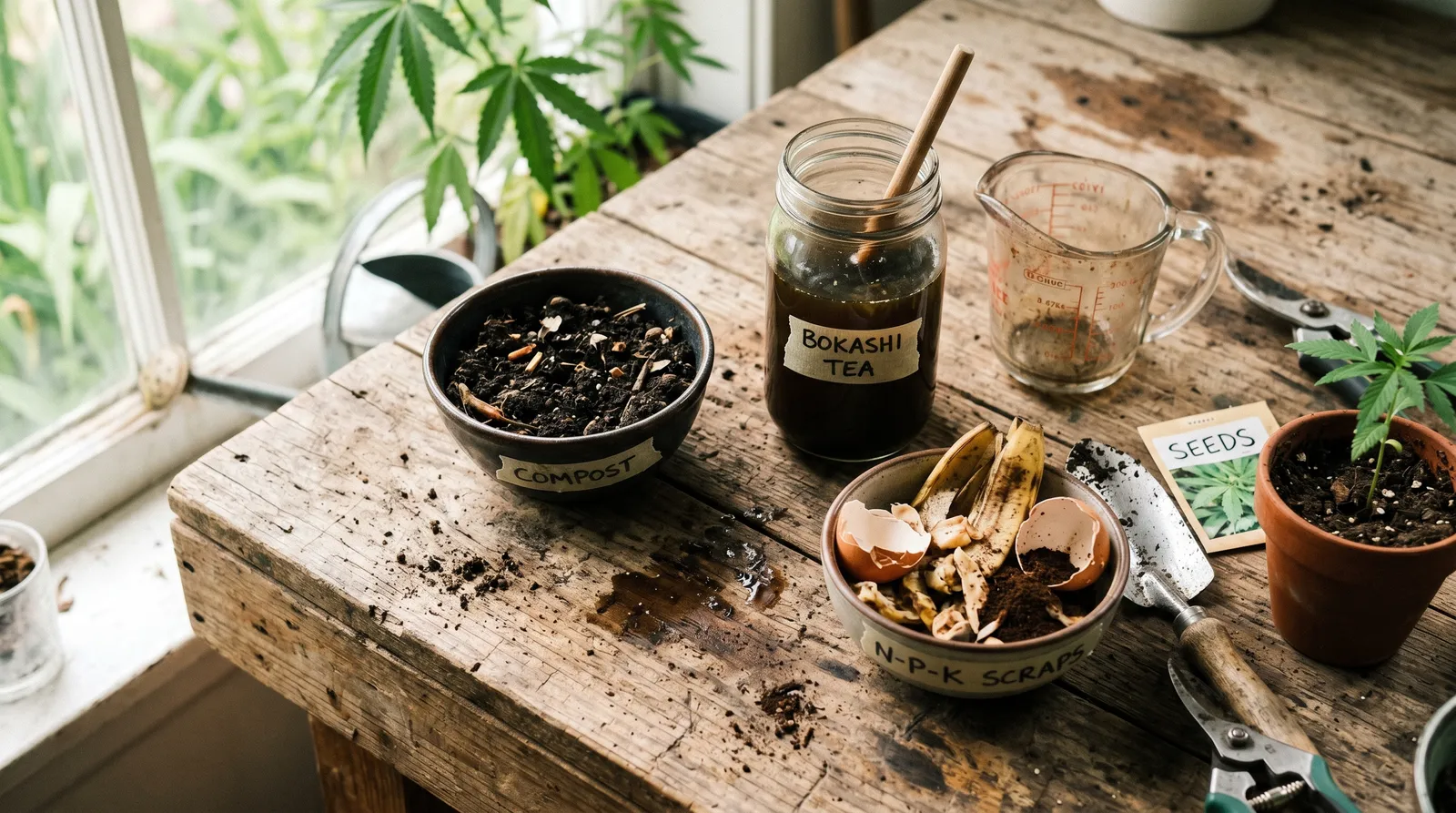
18+ only Growing your own nutrients means you know exactly what's going onto the roots — no mystery salts, no heavy-metal contamination, no overpriced bottles with fancy labels. The tradeoff: it takes planning, some patience, and a willingness to let a bucket of banana peels sit in the corner of your shed for three weeks.
Key facts
- Cannabis needs roughly a 3-1-2 NPK ratio in vegetative growth and 1-3-2 in flower (Caplan et al., 2017).
- Compost teas can carry 10^6–10^9 beneficial microbes per ml when brewed aerobically for 24-36 hours (Ingham, 2005).
- Banana peels contain ~42% potassium on a dry-weight basis — useful in bloom, useless in veg (USDA FoodData Central).
- Worm castings hold around 1-0.5-1 NPK but add humic acids, enzymes and microbial biomass (Arancon et al., 2004).
- Organic inputs release nutrients slowly via microbial mineralisation — pH swings and nutrient burn are far less common than with synthetic salts (Sicignano et al., 2024).
- Homemade fertilisers are not sterile. Anaerobic brews can harbour pathogens if the lid stays on too long.
Commercial disclosure
Azarius sells cannabis-related products and has a commercial interest in this topic. Our editorial process includes independent pharmacological and horticultural review to mitigate commercial bias. This article does not promote any specific nutrient brand.
Before you start: what not to feed cannabis
Not every kitchen scrap belongs near a root zone. Meat, dairy, oils and cooked food attract pests and go anaerobic fast. Citrus and onion skins can drop compost pH below 5.5 and stall microbial activity (Rynk et al., 1992). Dog and cat faeces carry pathogens that survive cold-composting. Walnut leaves contain juglone, which is allelopathic to cannabis.
Skip any plant material that's been sprayed with glyphosate, neonicotinoids, or persistent herbicides like aminopyralid — they survive composting and will cripple your plants. If you can't vouch for the source, leave it out.
Step 1 — Build a base compost
Compost is the backbone. Everything else is seasoning. Aim for a carbon-to-nitrogen ratio of around 25-30:1 — roughly two parts browns (dried leaves, straw, cardboard) to one part greens (vegetable scraps, coffee grounds, fresh grass clippings) by volume.
- Layer browns and greens in a bin, tumbler or open pile. Minimum working volume: around 1 m³ for decent thermal mass.
- Moisten to the consistency of a wrung-out sponge — roughly 50-60% moisture.
- Turn every 7-10 days. A thermophilic pile will hit 55-65°C in the first fortnight, killing most weed seeds and pathogens (Rynk et al., 1992).
- Finished compost smells like forest floor, not ammonia or vinegar. Expect 3-6 months for a cold pile, 6-8 weeks for a well-managed hot pile.
A handful mixed into the top 10 cm of potting soil per plant gives a slow-release base. Leafwell (2023) and multiple organic growers' guides converge on the same principle: if your compost is right, half your work is done.
Step 2 — Brew an aerobic compost tea
Compost tea is how you deliver the microbial side of compost in liquid form. It's not a nutrient solution per se — it's a microbial inoculant that improves nutrient cycling in the root zone (Ingham, 2005).
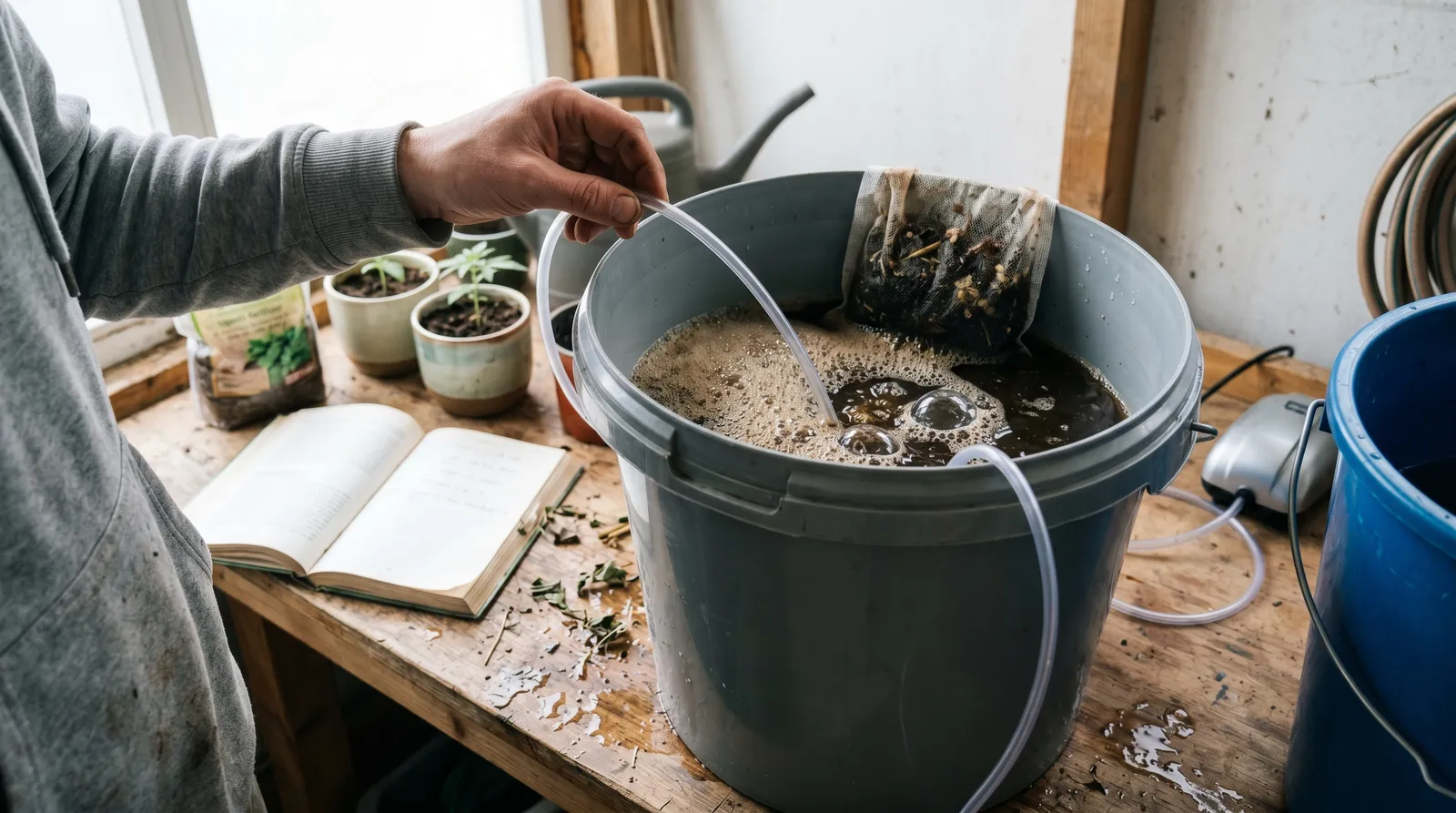
- Fill a 10-20 litre bucket with dechlorinated water. Tap water sits uncovered for 24 hours, or aerate with an air pump for 30 minutes to drive off chlorine.
- Add 1-2 cups finished compost or worm castings in a mesh bag.
- Feed the microbes: 1 tablespoon unsulphured blackstrap molasses per 4 L of water.
- Aerate continuously with an aquarium pump and air stone for 24-36 hours. Temperature 18-24°C.
- Use within 4 hours of switching the pump off. After that, oxygen drops and the biology goes anaerobic — which is when bad actors like E. coli can bloom.
Apply as a soil drench at around 1:4 dilution, or as a foliar spray at 1:10 in early veg. Skip foliar sprays once flowers form — wet buds invite botrytis.
Step 3 — Potassium boosters for flower
Once flowering kicks in, cannabis swings its appetite toward potassium and phosphorus. This is where banana peels, wood ash and kelp come in.
Banana peel ferment (FPJ-style):
- Chop banana peels into small pieces.
- Weigh the peels and mix with an equal weight of brown sugar.
- Massage until juices release.
- Pack into a clean jar, cover with breathable cloth, and let ferment at room temperature for 7-14 days.
- Strain. Dilute 1:500 to 1:1000 with water. Apply weekly during weeks 3-6 of flower.
Wood ash: hardwood ash is ~5-7% potassium and strongly alkaline (pH 10-12). Use sparingly — a tablespoon per plant scratched into the top inch of soil, never more. Overdoing it will lock out iron and manganese.
Kelp meal: 1-2 tablespoons worked into the soil at transplant gives slow-release K plus trace minerals and natural cytokinins. Seaweed extract at 5 ml/L works as a foliar in veg.
Step 4 — Nitrogen for vegetative growth
Veg wants nitrogen. The usable homemade sources, ranked by how fast they release:
| Input | Approx NPK | Release speed | Notes |
|---|---|---|---|
| Worm castings | 1-0-0 to 2-1-1 | Slow | Topdress 1-2 cm layer monthly |
| Alfalfa meal | 3-1-2 | Moderate | 2 tbsp per gallon of soil at mix-in |
| Fish hydrolysate | 4-1-1 | Fast | 5 ml/L, every 7-10 days in veg |
| Urine (1:10-1:20) | ~11-1-2 | Fast | Fresh, healthy donor, diluted, veg only |
| Blood meal | 12-0-0 | Moderate | Tsp per plant, can burn if overdone |
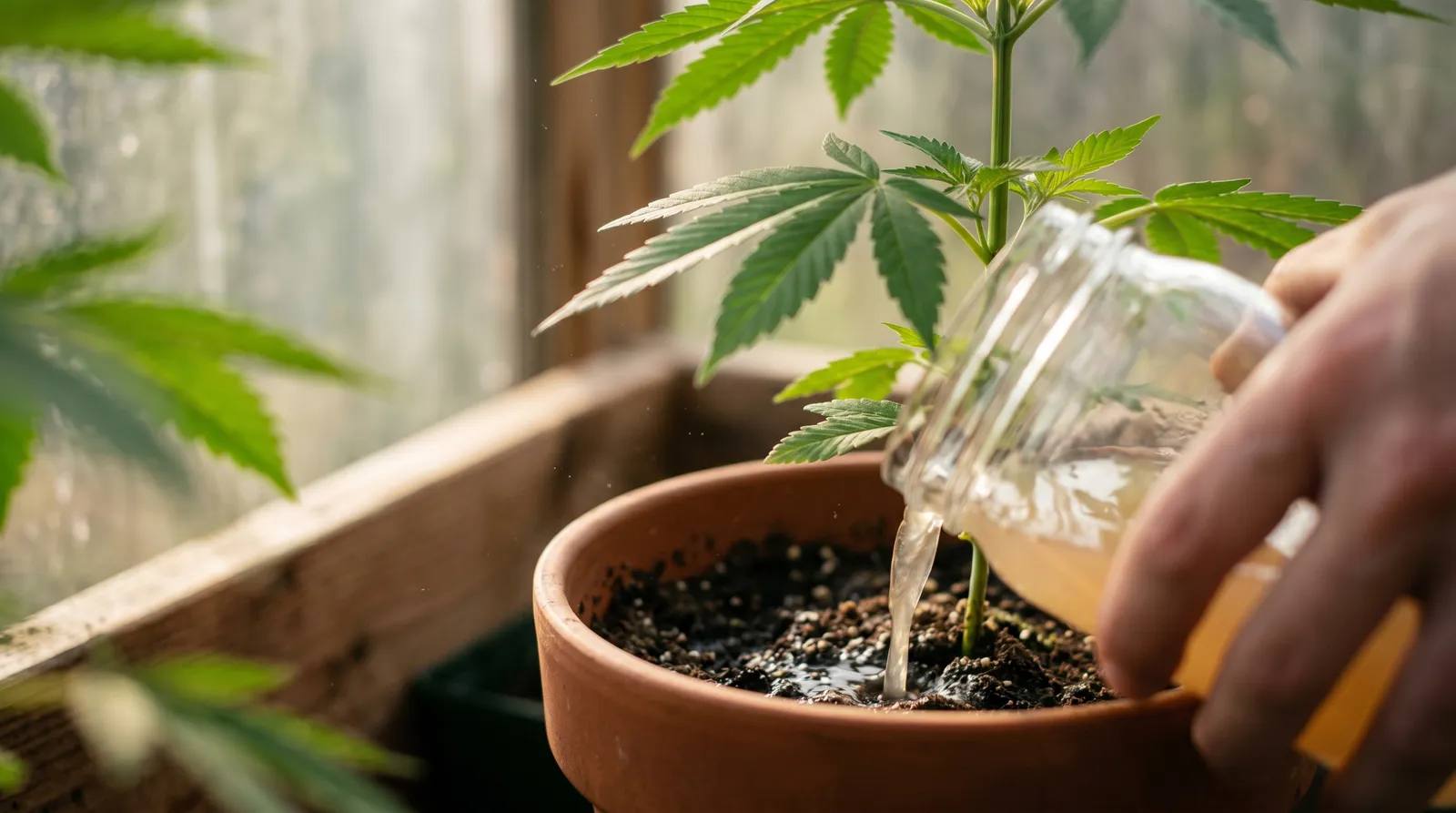
Urine sounds mad until you read the soil-science literature. Viskari et al. (2018) found diluted human urine matched mineral fertiliser performance in leafy crops. Stick to 1:10-1:20 dilution, apply only in veg, and never in the final 4 weeks before harvest — nobody wants that terpene profile.
Step 5 — Calcium, magnesium and trace minerals
Cannabis is a calcium-hungry plant, especially in flower. Deficiencies show up as rust spots on middle-age leaves and twisted new growth.
- Eggshell tea: bake clean shells at 180°C for 10 minutes, grind to powder, steep 1 tablespoon in 1 L of warm water with a splash of vinegar for 24 hours. Dilute 1:5 before applying.
- Dolomite lime: 1 tablespoon per gallon of potting mix at the start gives slow-release Ca and Mg plus buffers pH around 6.5.
- Epsom salts (magnesium sulphate): ½ teaspoon per 4 L of water, foliar-sprayed, corrects acute Mg deficiency within days.
- Rock dust / basalt: a tablespoon per gallon of soil supplies silicon and trace minerals that microbial activity slowly makes plant-available.
Sample feed schedule
| Stage | Week | Primary feed | Frequency |
|---|---|---|---|
| Seedling | 1-2 | Plain water, compost in soil | As needed |
| Early veg | 3-4 | Compost tea 1:4 drench | Every 7-10 days |
| Late veg | 5-6 | Alfalfa/fish feed + castings topdress | Weekly |
| Early flower | 7-8 | Kelp + eggshell tea | Weekly |
| Mid flower | 9-10 | Banana ferment 1:500 | Weekly |
| Late flower / flush | 11-12 | Plain dechlorinated water | As needed |
This is a starting framework, not a prescription. Genetics, pot size, light intensity and substrate all shift the numbers. Watch the plant — it talks more honestly than any schedule.
Troubleshooting common mistakes
- Nutrient burn from "organic" feeds: rare but possible with fresh manure, fish hydrolysate or undiluted urine. Burn tips that crisp brown = back off for a week and flush.
- Smelly compost tea: rotten-egg or vinegar smell means the brew went anaerobic. Dump it, clean the bucket, start over with stronger aeration.
- pH drift: organic soils buffer well, but repeated molasses-heavy teas can drop pH into the low 5s. Test runoff occasionally with a cheap meter.
- Fungus gnats: usually a sign of too-wet soil plus undecomposed organic matter on the surface. Let the top 2 cm dry between waterings and topdress with dry worm castings.
- Slow early growth: organic nitrogen needs microbial activity and soil temps above 15°C to mineralise. If your room is cold, the plants are just waiting.
Safety and contamination risks
Homemade doesn't mean harmless. The main hazards:
Pathogenic microbes: anaerobic brews and cold-composted manures can carry E. coli, Salmonella and Listeria. Hot compost above 55°C for at least 3 consecutive days kills most of these (Rynk et al., 1992). If your pile never heats, don't use it on anything you plan to smoke or eat. Compost teas must stay aerobic — dump any brew with off-smells.
Heavy metals: urban compost and biochar from unknown wood sources can carry cadmium, lead and arsenic that cannabis is particularly efficient at accumulating (Linger et al., 2002). Don't compost pressure-treated wood, painted material, or dryer lint.
Herbicide carryover: aminopyralid and clopyralid residues in horse manure and straw survive composting and destroy cannabis crops at parts-per-billion levels. If you're bringing in manure, ask what the animal was eating and whether the pasture was sprayed. When in doubt, pot up a bean seedling in the finished compost — beans are hypersensitive and will warn you before you kill a crop.
Smoke quality: cannabis concentrates what's in its root zone into smokable flower. Lovelock et al. (2019) flagged contaminant transfer as a real concern in unregulated grows. That's why the pre-harvest flush with plain water matters — it pushes soluble residues out before dry.
Interaction with synthetic products: organic and synthetic nutrients don't "fight" chemically, but bottled salts can hammer the soil microbiome the organic approach depends on. If you're going organic, commit — don't pepper it with hydro boosters.
Related reading on Azarius Wiki
For related guidance, see our articles on cannabis nutrient deficiencies, organic soil mixes, and choosing between soil and hydroponic setups.
References
- Sicignano, M., Beleggia, R., del Piano, L., et al. (2024). Organic versus mineral fertilisation in industrial hemp: effects on yield and cannabinoid profile. PMC.
- Caplan, D., Dixon, M., & Zheng, Y. (2017). Optimal rate of organic fertiliser during the vegetative-stage for cannabis grown in two coir-based substrates. HortScience, 52(9), 1307-1312.
- Ingham, E. R. (2005). The Compost Tea Brewing Manual. Soil Foodweb Institute.
- Arancon, N. Q., Edwards, C. A., Bierman, P., et al. (2004). Effects of vermicomposts on growth and marketable fruits of field-grown tomatoes, peppers and strawberries. Pedobiologia, 48(5-6), 731-738.
- Rynk, R., van de Kamp, M., Willson, G. B., et al. (1992). On-Farm Composting Handbook. NRAES-54, Cornell University.
- Viskari, E. L., Grobler, G., Karimäki, K., et al. (2018). Nitrogen recovery with source separation of human urine — preliminary results of its fertiliser potential and use in agriculture. Frontiers in Sustainable Food Systems, 2, 32.
- Linger, P., Müssig, J., Fischer, H., & Kobert, J. (2002). Industrial hemp (Cannabis sativa L.) growing on heavy metal contaminated soil: fibre quality and phytoremediation potential. Industrial Crops and Products, 16(1), 33-42.
- Lovelock, C. E., et al. (2019). Contaminant risks in cannabis cultivation. Environmental Science & Technology Letters.
- Canadian Food Inspection Agency (2023). Fertilizers and Supplements Regulatory Framework. inspection.canada.ca.
- USDA FoodData Central. Banana peel composition data. ars.usda.gov.
Last updated: April 2026
Frequently Asked Questions
8 questionsCan I make cannabis fertilizer entirely from kitchen scraps?
How long does homemade compost tea last?
Is banana peel water actually good for cannabis?
Can I use urine as cannabis fertilizer?
What's the difference between organic and synthetic cannabis nutrients?
Why does my homemade compost smell like ammonia?
Can I make cannabis fertilizer from kitchen scraps?
What's the difference between organic and synthetic cannabis fertilizers?
About this article


Luke Sholl has been writing about cannabis, cannabinoids, and the broader benefits of nature since 2011, and has personally grown cannabis in home grow tents for more than a decade. That first-hand cultivation experience
This wiki article was drafted with AI assistance and reviewed by Luke Sholl, External contributor since 2026. Editorial oversight by Adam Parsons.
Medical disclaimer. This content is for informational purposes only and does not constitute medical advice. Consult a qualified healthcare provider before use of any substance.
Last reviewed April 26, 2026
Related Articles
Cannabis Hermaphrodite: Identify, Prevent, Act
A cannabis hermaphrodite is a female plant that develops male pollen sacs or banana-shaped anthers (nanners), self-pollinating and seeding your harvest.
What To Do With Male Cannabis Plants: 6 Practical Uses
What to do with male cannabis plants: identify, isolate, breed, extract, or compost. A practical 6-step guide with sourcing and safety notes.
Mushroom Grow Kit Temperature & Humidity: Full Setup Guide
A temperature humidity control grow kit is the small set of climate tools — hygrometer, heat mat, humidifier or perlite tray — that keeps a mushroom fruiting…
When to Harvest Mushrooms: Veil Break Timing Explained
Harvest timing veil break is a cultivation technique that uses the tearing of the partial veil on maturing Psilocybe cubensis to mark peak alkaloid content.
First Grow Checklist: What You Need for Mushroom Kits
A first grow checklist is the short list of supplies and environmental conditions needed to run a home psilocybin mushroom kit from inoculated substrate to…
Sclerotia vs Fruit Bodies: Cultivation Comparison
Sclerotia and fruit bodies are two different life stages of Psilocybe fungi: sclerotia are hardened underground mycelial storage bodies (the 'magic…
Storing Dried Mushrooms Long Term: Full Guide
Storing dried mushrooms long term means keeping well-dried Psilocybe fruit bodies in airtight, opaque containers with desiccant, cool and dark, to slow…
Drying Mushrooms Air Desiccant Oven: Methods Compared
Drying mushrooms air desiccant oven refers to the three home methods for reducing fresh fruit bodies from ~90% water to cracker-dry (<5%). Gotvaldová et al.
Grow Kit vs Ready 2 Grow Bag: Which to Pick
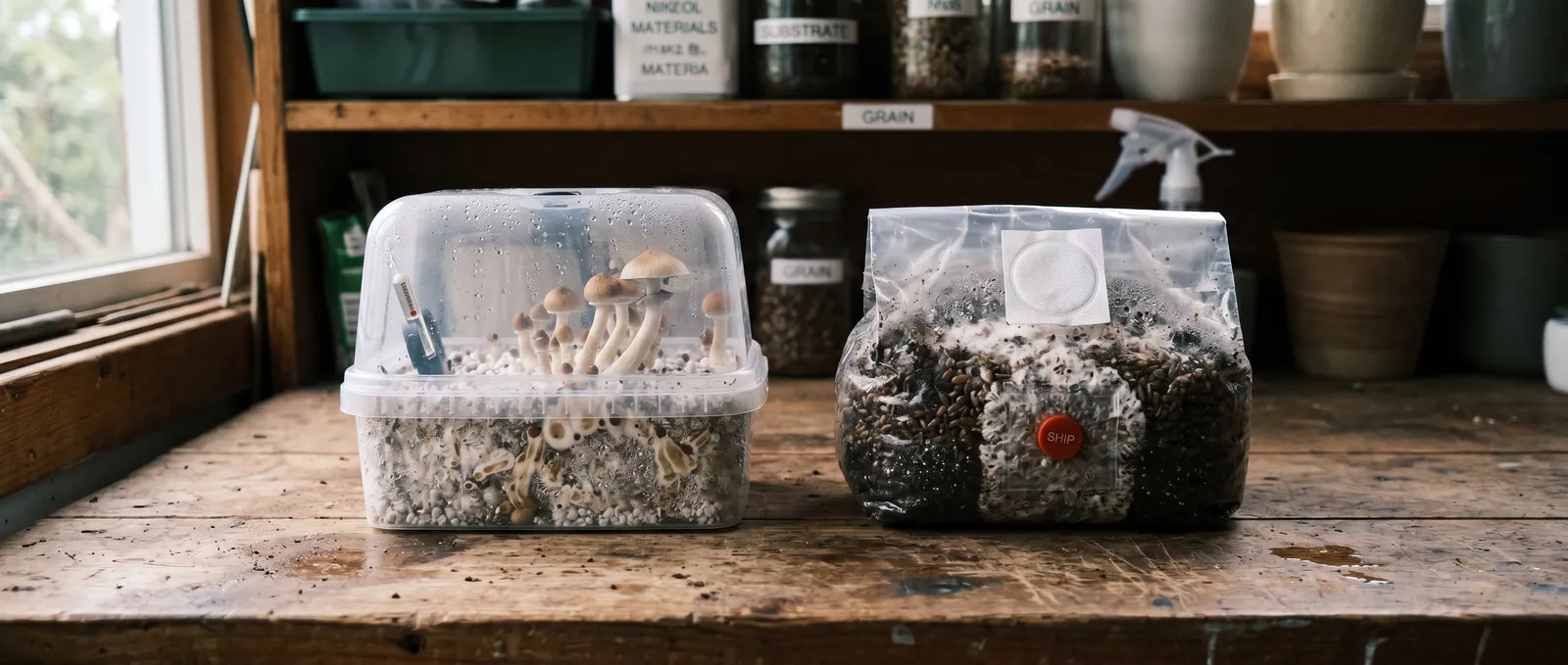
The grow kit vs Ready 2 Grow Bag choice compares two Psilocybe cubensis home-cultivation formats: a tub with rye substrate and casing layer designed for…