
Psychedelics and Predictive Processing: Sam Harris Explained
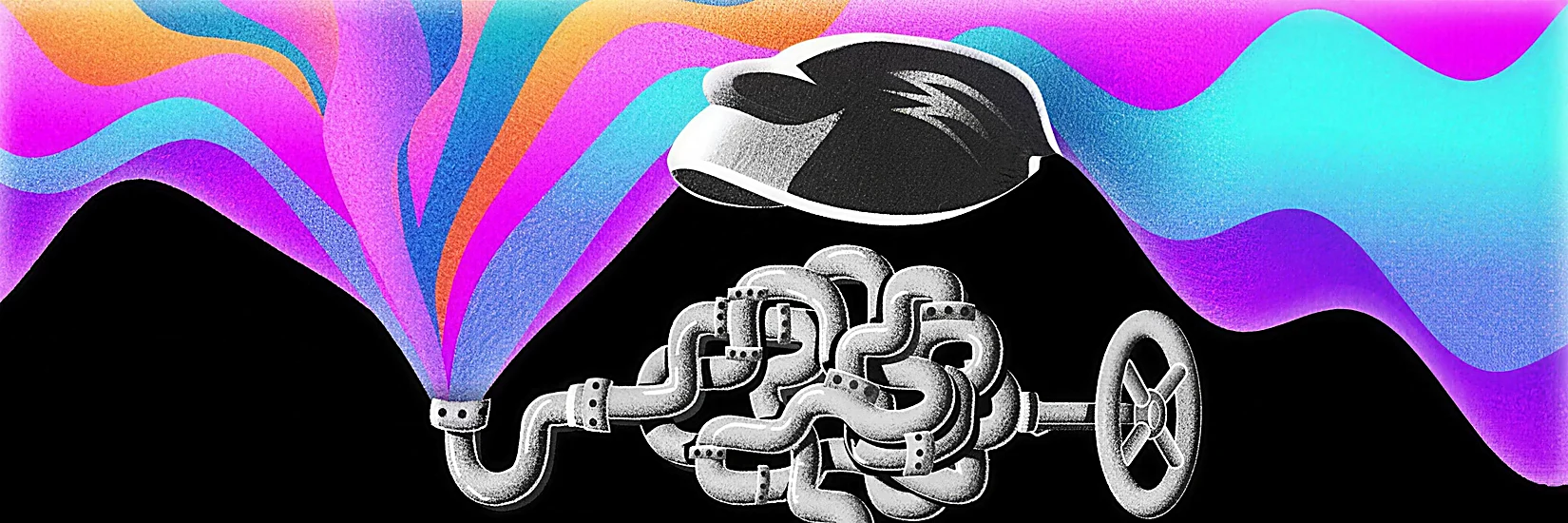
Sam Harris's short film Psychedelics Don't Distort Reality — They Reveal How Your Brain Constructs It is one of the clearest 20-minute explainers we've seen on why modern neuroscience keeps circling back to psilocybin, LSD and DMT. The thesis is simple and unsettling: your everyday experience of the world is already a hallucination. Psychedelics don't add distortion on top of a clean signal. They loosen the machinery that was building the picture in the first place.
For anyone interested in mindfulness, consciousness research or ethnobotanicals, this is worth the watch before you read another Reddit trip report. Harris pulls together predictive processing, the entropic brain hypothesis, Johns Hopkins research and 60s counterculture history into one throughline. Below we unpack the science, name the researchers, and add the harm-reduction context the video assumes you already have.
Video: Psychedelics Don't Distort Reality — They Reveal How Your Brain Constructs It, from the Sam Harris YouTube channel.
The predictive brain: perception as a controlled hallucination
The core idea Harris borrows from cognitive neuroscience is that perception is not passive reception. Your brain is locked in the dark, silent vault of your skull. It never touches the world directly. What it has are electrical signals from the senses and a lifetime of prior models about what those signals usually mean.
This is the field of predictive processing. Neuroscientist Karl Friston formalised it as the Free Energy Principle: any self-organising system that persists over time has to minimise prediction error. Your brain constantly generates a best guess about what's out there, compares it to incoming sensory data, and updates the guess when the two don't match. Most of what you "see" is the guess. The sensory input mostly acts as a correction signal.
Neuroscientist Anil Seth gave this its most quotable label: perception is a kind of controlled hallucination. The word "controlled" is doing heavy lifting. Ordinary experience is a hallucination that's tightly constrained by sensory data and by rigid priors built up over decades. Dreams are hallucinations without the sensory tether. And psychedelic states, as we'll see, sit somewhere in between — sensory input still arrives, but the priors that normally lock the picture into place get relaxed.
Top-down vs bottom-up
- Top-down: expectations, beliefs, prior models. What your brain thinks should be there.
- Bottom-up: raw sensory signals from eyes, ears, skin, gut.
- Ordinary perception: top-down dominates, bottom-up corrects at the edges.
- Psychedelic perception: top-down loosens, bottom-up gets amplified and reinterpreted.
The entropic brain and the REBUS model: why psychedelics feel revelatory
If perception is a controlled hallucination, psychedelics turn down the "controlled" part. That's the short version of Robin Carhart-Harris's research, which Harris walks through in the video.
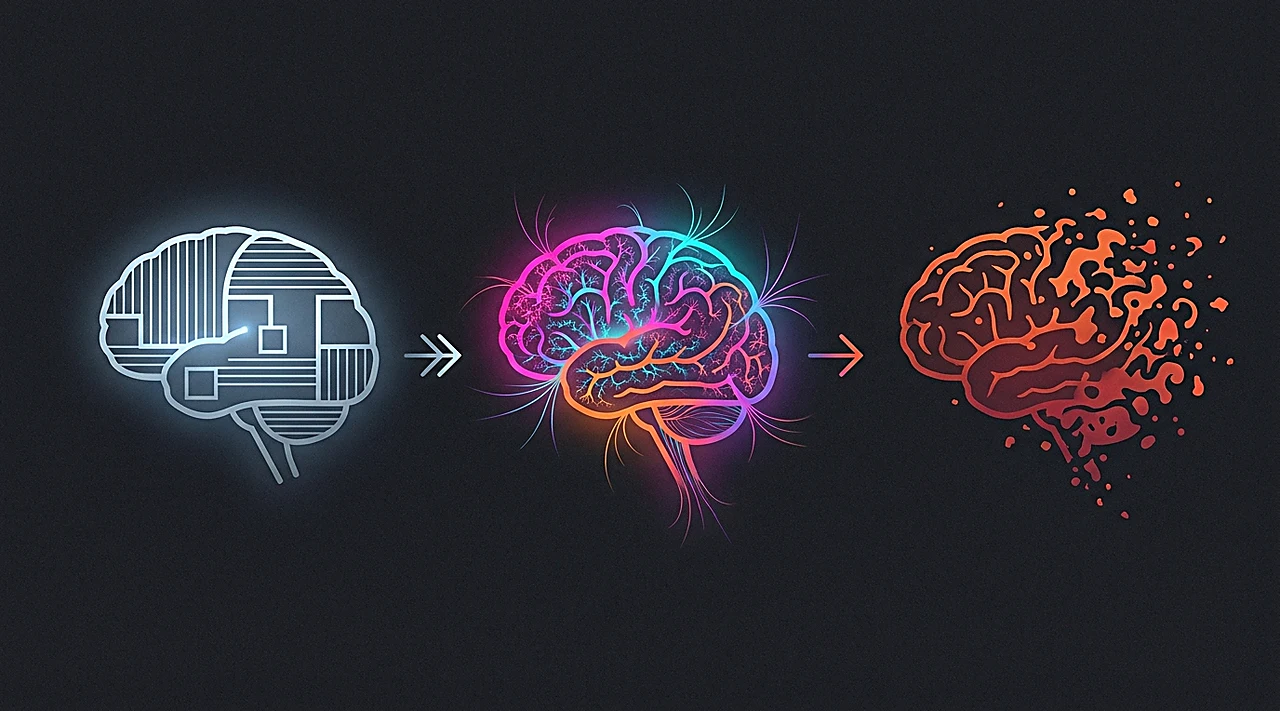
Carhart-Harris's Entropic Brain Hypothesis (2014) proposed that the richness of a conscious state can be indexed by the entropy of brain activity. Normal waking consciousness sits in a fairly low-entropy, orderly regime. Psychedelic states push the brain toward higher entropy — closer to criticality, the sweet spot between rigid order and total chaos where systems become maximally flexible.
The follow-up framework, REBUS (Relaxed Beliefs Under Psychedelics), spells out the mechanism: psilocybin and LSD reduce the precision — the confidence weighting — of high-level prior beliefs. The rigid narrative ego, largely mediated by the Default Mode Network, loses its grip. Information that was normally suppressed as "noise" now reaches consciousness. Buried memories, unfamiliar perspectives, and repressed emotional material can surface.
Ordinary vs psychedelic perception under predictive processing
| Feature | Ordinary waking state | Psychedelic state |
|---|---|---|
| Weight of prior beliefs | High — priors dominate | Reduced — priors relaxed |
| Default Mode Network | Coherent, central | Disintegrated, less dominant |
| Brain entropy | Low, orderly | High, closer to criticality |
| Sense of self | Stable narrative ego | Softened or dissolved |
| Novel associations | Filtered out | Amplified |
This framework also explains why rigid mental patterns — chronic rumination, addictive loops, the mental grooves clinicians call canalization — are so hard to shift by willpower alone. They're deep, high-precision priors. Psychedelics have been researched in clinical settings precisely because they seem to temporarily flatten those grooves, giving the brain a window to lay down different tracks. The clinical work at institutions like Johns Hopkins and Imperial College London is exploring this, not curing anything on demand.
Lessons from the 1960s counterculture: history as harm reduction
Harris grounds the science in history. Aldous Huxley's 1954 book The Doors of Perception introduced the "reducing valve" metaphor — the idea that the brain filters a much richer reality down to a manageable trickle, and that mescaline briefly opens the valve. Long before that, the Eleusinian Mysteries of ancient Greece appear to have used a psychoactive brew (kykeon) inside a highly structured ritual container that ran for nearly two thousand years without becoming a public health problem.
Then came the 1960s. Timothy Leary and the Harvard Psilocybin Project turned a laboratory tool into a mass cultural movement in under a decade. Container gone, framework gone, integration mostly absent. The backlash that followed shut down formal research for a generation.
The lesson isn't "psychedelics are dangerous." The lesson is that dissolving the ego without a framework to hold the experience is where people get hurt. Modern explorers have inherited the tools the 60s lacked: sober sitters, integration circles, decades of accumulated trip-report literature, and clear guidance on set and setting. Use them. If you're going in alone, read our solo tripping guide first, and know what a rough comedown can look like so it doesn't blindside you.
Roland Griffiths, mystical experience and acceptance
The late Roland Griffiths ran the psilocybin research programme at Johns Hopkins for over two decades. His team's key measurement tool was the Mystical Experience Questionnaire (MEQ), which scores subjective reports along dimensions like:

- Sense of unity and interconnectedness
- Transcendence of time and space
- Ineffability — the difficulty of putting the experience into words
- Deep positive mood, awe, reverence
- A noetic quality — the felt sense of encountering something more real than ordinary reality
What Griffiths found, and what he discussed publicly after his own stage-4 cancer diagnosis, is that people who score high on the MEQ during a session tend to report lasting shifts in outlook — more gratitude, less fear of death, a softer relationship to the story they've been telling about themselves. Griffiths spoke openly about how his spiritual practice and his research shaped how he faced his own mortality. Watching him talk about that, calmly, is one of the more moving segments in Harris's video.
Worth naming clearly: these are subjective reports and clinical research findings, not a promise. Nobody at Johns Hopkins is claiming psilocybin cures anything. What the work does suggest is that the felt sense of unity is not just a nice side effect. It correlates with the durable psychological changes participants describe.
Beyond the trip: meditation and integration
Ram Dass — Richard Alpert, Leary's Harvard collaborator turned meditation teacher — said it plainly: psychedelics show you the possibility, but they don't let you become the possibility. You get a glimpse. Six or eight hours later, the doors close.
That's why integration matters. A psychedelic session is a data set. What you do with it in the weeks and months that follow is what turns insight into change. In practice this usually means some combination of journaling, talking with a trusted friend or therapist, and a contemplative practice — most often meditation.
Meditation and psychedelics work on overlapping machinery. Advanced meditators show reduced Default Mode Network activity, higher entropy in certain brain measures, and reports of unity or selflessness that look phenomenologically similar to a strong psilocybin experience. The difference is that meditation is slow, sober, and repeatable. You build the capacity to rest in open awareness without needing a molecule to unlock the door each time.
For people using low doses as part of an ongoing practice rather than as peak experiences, our microdosing category and the broader psychedelics wiki are useful starting points. If you're curious about the substances themselves, we've stocked magic truffles, magic mushrooms and grow kits since 1999 — for adults exploring this responsibly.
Key takeaways: what Sam Harris's film actually shows
The headline insight is this: psychedelics don't paint fake colours onto a real world. They reveal that the "real world" you normally experience is itself an active construction, assembled moment to moment by a brain making its best guess. Loosen the machinery and the construction becomes visible.
- Perception is prediction. Friston's Free Energy Principle and Seth's "controlled hallucination" reframe consciousness as a modelling process, not a video feed.
- Psychedelics relax priors. Carhart-Harris's REBUS and entropic brain work explain why the experience feels revelatory: high-level beliefs lose their precision, entropy rises, buried material surfaces.
- History matters. Eleusis lasted two millennia inside a container. The 60s collapsed in a decade without one. Set, setting and integration are non-negotiable.
- Mystical experiences correlate with change. Griffiths' work at Johns Hopkins measured this rigorously with the MEQ.
- The molecule is the door, not the room. Ram Dass's point still holds. Practice is what turns a glimpse into a life.
Frequently Asked Questions
8 questionsWhat is predictive processing in simple terms?
What is the REBUS model of psychedelics?
What does ego dissolution mean?
Is ordinary perception really a hallucination?
What did Roland Griffiths study at Johns Hopkins?
Why are set and setting so important?
Can meditation replace psychedelics?
What is the entropic brain hypothesis?
About this article


Adam Parsons is an external cannabis and psychedelics writer and editor who contributes to Azarius's wiki as both author and reviewer. On the writing side, he authors Azarius's kratom and kanna clusters, drawing on exten
This blog article was drafted with AI assistance and reviewed by Adam Parsons, External contributor. Editorial oversight by Joshua Askew.
Last reviewed August 13, 2026
Related Articles

Sclerotia Formation: Why Magic Truffles Grow Underground
How sclerotia formation evolved as a fungal survival strategy — and what it means for truffle potency, structure, and storage.

Kratom Effects on the Brain: What Hamilton Morris Found
Hamilton Morris's VICE film tested kratom effects on the brain. Here's the pharmacology, the nucleus accumbens finding, and the real story behind the…

Psilocybin and the Brain: What the Science Actually Shows
Psilocybin and the brain: how psilocin binds to serotonin 2A receptors, quiets the default mode network, and what the clinical research actually…

Cannabis Combustion Chemistry: What 900°C Does to THC
Cannabis combustion chemistry explained: how 900°C creates formaldehyde, benzene and CO from cannabinoids, and how vaporising and edibles avoid it.