
This article discusses psychoactive substances intended for adults (18+). If you have a health condition or take medication, consult a doctor before use. Our age policy
San Pedro vs Bolivian Torch Identification
Definition
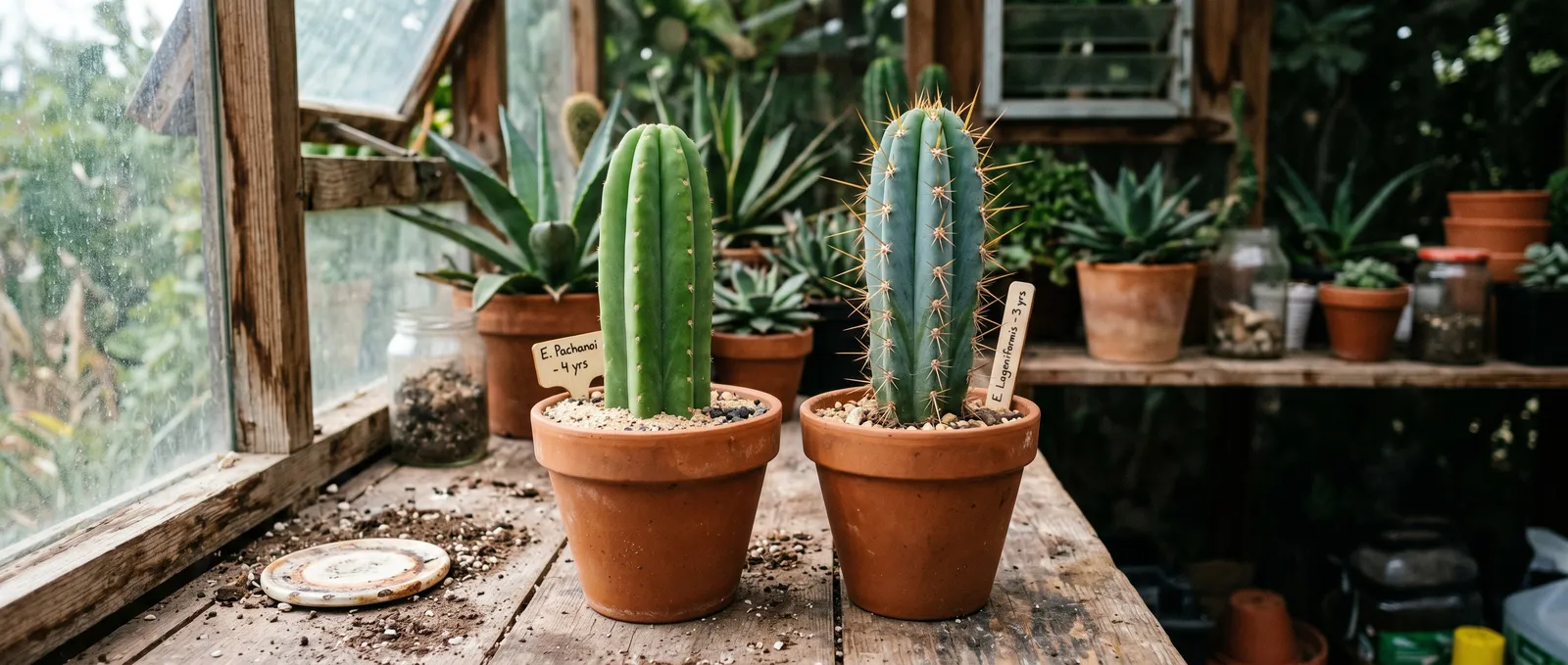
San Pedro vs Bolivian Torch identification is a comparative method that helps growers and collectors distinguish two closely related columnar cacti — Trichocereus pachanoi and Trichocereus bridgesii — that both contain mescaline and are easily confused. Telling them apart requires checking spines, rib count, and skin texture, features that Anderson (2001) documented as the primary morphological distinctions between the two species.
18+ only — this guide covers mescaline-containing cacti and is written for adults.
San Pedro vs Bolivian Torch identification is a comparative method that helps growers and collectors distinguish two closely related columnar cacti — Trichocereus pachanoi and Trichocereus bridgesii — that both contain mescaline and look nearly identical at first glance. Both are tall, green, columnar cacti now reclassified under Echinopsis by some taxonomists, though the old names persist in horticulture. Once you know what to look for — rib count, spine length, areole spacing, growth habit — telling them apart becomes second nature. This article breaks down the visual and morphological differences so you can confidently identify what's growing in your pot, whether you plan to buy San Pedro cuttings or buy Bolivian Torch cuttings from a specialist supplier like Azarius.
Side-by-Side Comparison
The most reliable way to distinguish these two species is to compare multiple morphological features at once, as shown in the table below.
| Feature | San Pedro (Trichocereus pachanoi) | Bolivian Torch (Trichocereus bridgesii) |
|---|---|---|
| Rib count | Typically 6–8, most commonly 7 | Typically 4–8, most commonly 5–6 |
| Rib profile | Rounded, broadly spaced | Narrower, more sharply defined |
| Spine length | Short (often under 10 mm) or nearly absent | Long (20–60 mm), honey-coloured to brown |
| Spines per areole | 0–3 small spines, often just nubs | 1–4 prominent spines, usually 1 long central spine |
| Areole spacing | Roughly 2–3 cm apart | Roughly 3–5 cm apart |
| Areole colour | White to light tan, fuzzy | Tan to dark brown, less woolly |
| Skin colour | Mid-green to blue-green, often with a waxy bloom | Darker green, sometimes grey-green, less waxy |
| Column diameter | 8–15 cm typical | 6–12 cm typical (slightly thinner) |
| Branching habit | Branches freely from the base, forming clusters | Branches less freely; tends to grow taller before branching |
| Growth rate | Fast — up to 30 cm/year in good conditions | Moderate — roughly 15–25 cm/year |
| Native range | Ecuador, Peru (2,000–3,000 m elevation) | Bolivia, southern Peru (2,500–3,000 m) |
| Flower colour | White, 19–24 cm across, nocturnal | White, 15–20 cm across, nocturnal |
| Common mescaline content (dried skin) | 0.1–2.4% (highly variable) | 0.5–2.8% (generally higher average) |
Rib Count and Profile — The First Thing to Check
San Pedro almost always has 6 to 8 ribs, with 7 being the textbook number, while Bolivian Torch tends toward fewer ribs — 4 to 6 is common. Count the ribs. It sounds almost too simple, but rib count is the single fastest way to narrow down your identification. Specimens with 5 ribs show up regularly in Bolivian Torch populations.
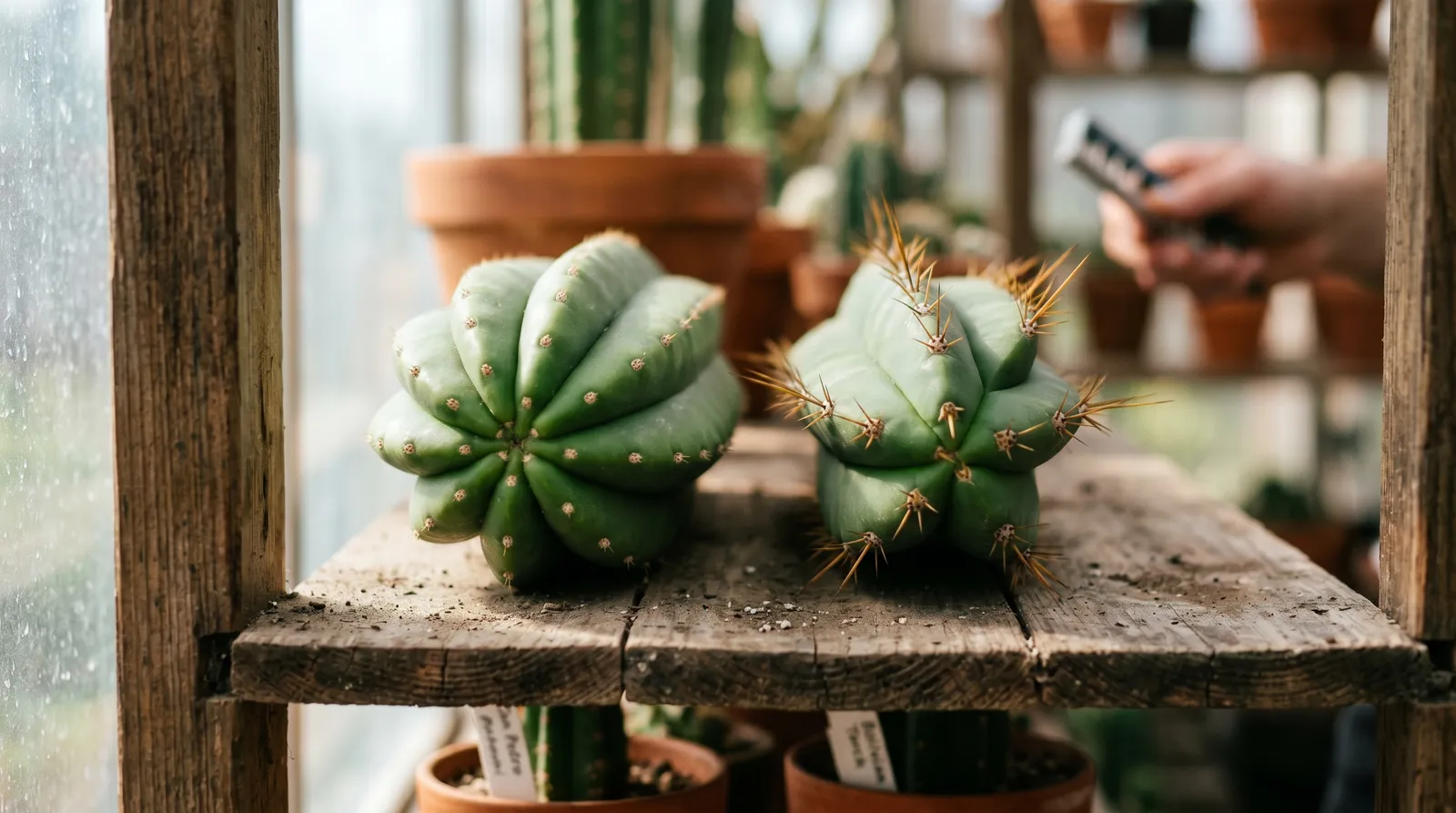
Beyond the count, look at the rib shape in cross-section. San Pedro ribs are rounded and broadly spaced, giving the column a softer, more cylindrical silhouette. Bolivian Torch ribs are narrower and more sharply defined, with deeper grooves between them. If you slice a column horizontally (or just look down from the top), San Pedro's cross-section looks like a soft-edged star; Bolivian Torch looks more angular, with more pronounced valleys.
One complication: rib count can shift along the length of a single column. A San Pedro cutting might show 6 ribs at the base and 8 higher up. Juvenile growth sometimes has fewer ribs than mature growth. So treat rib count as a strong indicator, not a definitive ID on its own.
Spines — The Clearest Giveaway
Spine length is the single most reliable visual difference between the two species. If you can only check one feature, check the spines. This is where the two species diverge most obviously.
San Pedro is sometimes called the "nearly spineless" Trichocereus. Many specimens have tiny nubs — 1 to 3 mm — or no visible spines at all, just bare areoles with a bit of fuzz. When spines do appear, they're short (under 10 mm), pale, and don't look particularly threatening. You can run your hand along a San Pedro column without drawing blood, which is not something you'd want to try with most columnar cacti.
Bolivian Torch, by contrast, earns its common name. The spines are long — typically 20 to 60 mm — and often a warm honey or amber colour that darkens to brown with age. Most areoles produce one distinctly longer central spine that juts outward, sometimes nearly perpendicular to the column. According to Anderson (2001) in The Cactus Family, T. bridgesii spines can exceed 6 cm on mature specimens, making them unmistakable once you've seen both species side by side.
A word of caution: the cultivar known as "PC" (Predominant Cultivar), which is the most widely sold "San Pedro" in garden centres worldwide, can have slightly longer spines than wild-type T. pachanoi. PC spines sometimes reach 15–20 mm. Even so, they're still noticeably shorter and less robust than Bolivian Torch spines, and they tend to be lighter in colour — pale yellow to white rather than amber-brown.
Skin Colour and Texture
San Pedro tends toward a brighter blue-green with a powdery waxy bloom, while Bolivian Torch runs darker green and more matte. Both species are green, obviously. But the shade and surface texture differ in ways that become apparent once you've handled a few specimens.
San Pedro's glaucous coating gives it a slightly frosted appearance. This bloom rubs off when you handle the cactus, leaving a shinier green underneath. The blue-green colour is especially pronounced in younger growth and freshly rooted cuttings.
Bolivian Torch runs darker — a deeper green, sometimes verging on grey-green, with less of that waxy bloom. The skin surface can look slightly rougher or more matte compared to San Pedro's smoother, waxier finish. Under strong sun, Bolivian Torch may develop a slight purplish tinge at the tips, though this also happens with stressed San Pedro specimens, so colour alone isn't diagnostic.
The "V-shaped notch" above each areole is another subtle marker. Both species have a small indentation above the areole where the rib dips slightly. On Bolivian Torch, this notch tends to be more pronounced and sharply defined. On San Pedro, it's shallower. This is a fine detail — you'll need a well-hydrated, actively growing specimen to see it clearly.
Growth Habit and Size
San Pedro grows faster and branches more freely than Bolivian Torch, which tends to stay as a single tall column for longer. In favourable conditions (warm climate, decent soil, regular watering during the growing season), San Pedro can add 20–30 cm of height per year. It branches freely from the base, often producing multiple columns that form dense clusters over time. A mature San Pedro in the ground in its native Andes can reach 3–6 metres tall with a dozen or more columns.
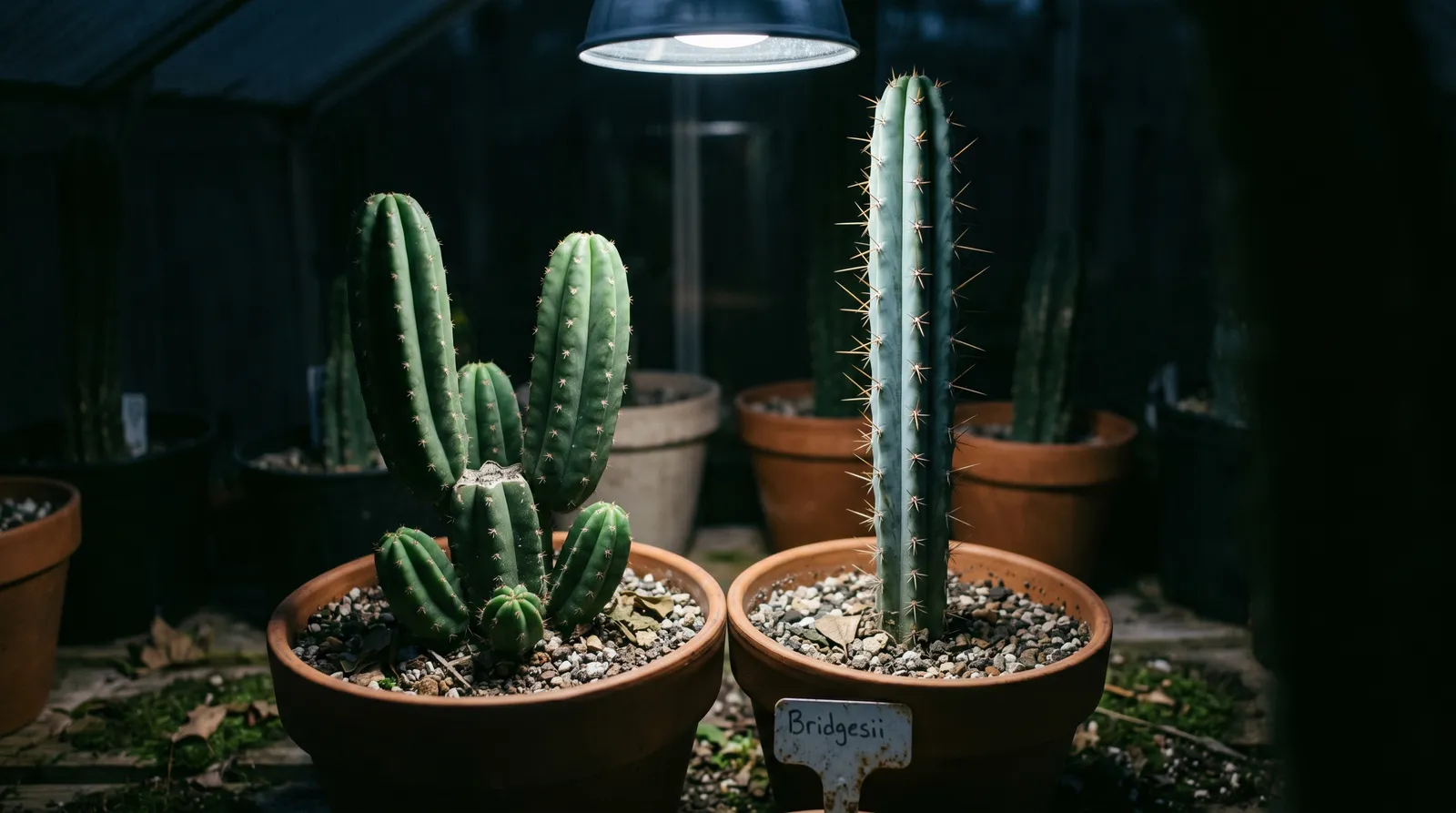
Bolivian Torch grows somewhat more slowly — roughly 15–25 cm per year under similar conditions — and tends to put more energy into vertical growth before branching. A young Bolivian Torch is more likely to be a single tall column, while a San Pedro of the same age might already have 2 or 3 offshoots at the base. Bolivian Torch columns also tend to be slightly thinner in diameter (6–12 cm vs 8–15 cm for San Pedro), giving the plant a more slender, upright look.
Trujillo et al. (2013) documented wild T. bridgesii populations in the Bolivian Yungas region growing at elevations between 2,500 and 3,000 metres, often on rocky slopes with relatively poor soil — conditions that may explain the species' slower growth rate compared to T. pachanoi, which thrives in slightly richer Andean valley soils.
Flowers and Fruit — Helpful but Seasonal
San Pedro flowers are typically 19–24 cm in diameter, while Bolivian Torch flowers are slightly smaller at 15–20 cm. Both species produce large, white, nocturnal flowers — spectacular when they appear, but not always available as an identification tool since most cultivated specimens take years to flower, and blooming depends on age, stress, and light cycles.
San Pedro flowers have a slightly funnel-shaped profile and a strong, sweet fragrance. Bolivian Torch flowers tend to have a more tubular shape before opening fully. The outer petals of Bolivian Torch flowers sometimes show a faint greenish or brownish tint, while San Pedro flowers are more purely white.
Fruit differences exist but are subtle and rarely useful for home identification. Both produce green, oblong fruit that splits open when ripe to reveal black seeds in white pulp.
Common Misidentifications
The most frequent misidentification involves confusing genuine T. pachanoi with non-active lookalikes, not with Bolivian Torch. The toothpick cactus (Stetsonia coryne) is frequently mislabelled as San Pedro. The giveaway: S. coryne has long, dark, rigid spines arranged in a distinctive radial pattern, and its areoles are much more widely spaced. If the spines look like actual toothpicks — stiff, dark, evenly radiating — it's not San Pedro.
Peruvian Torch (T. peruvianus) is the third member of the mescaline cactus group and sits somewhere between the other two visually. Its spines are highly variable — ranging from 10 mm to over 40 mm — which means some Peruvian Torch specimens can look like spiny San Pedro, and others resemble short-spined Bolivian Torch. Rib count (typically 6–9) and the overall "chunkier" column diameter of Peruvian Torch help distinguish it. For a deeper comparison, see the Azarius wiki article on Peruvian Torch identification. If you want to get all three species for hands-on comparison, the Azarius smartshop stocks San Pedro cuttings, Bolivian Torch cuttings, and Peruvian Torch cuttings — having them side by side is genuinely the fastest way to learn. You can also order peyote seeds from the cactus and succulents category on Azarius for a broader reference collection.
Hybridisation adds another layer of difficulty. Trichocereus species hybridise readily, both in the wild and in cultivation. A plant sold as "San Pedro" might carry T. bridgesii genetics, producing intermediate features — moderate spines, ambiguous rib counts. Schultes and Hofmann (1992) noted in Plants of the Gods that Andean communities have cultivated these cacti for at least 3,000 years, and centuries of human selection have blurred species boundaries in some lineages. When a specimen doesn't fit neatly into either category, hybridisation is the most likely explanation — though confirming it requires genetic testing, which isn't exactly practical for most growers. We're honest about this limitation: no visual guide, including this one, can give you 100% certainty with suspected hybrids.
What About the "PC" (Predominant Cultivar)?
The PC San Pedro deserves its own mention because it accounts for the vast majority of commercially available San Pedro cuttings. It grows faster than most named clones, has slightly longer spines than wild-type T. pachanoi, and some growers argue it may actually be a stabilised hybrid rather than pure pachanoi. If you buy San Pedro cuttings online or from a garden centre, there's a strong chance you're getting PC. It's still clearly distinguishable from Bolivian Torch by its shorter, paler spines and typically higher rib count.
Mescaline Content — What the Research Says
Bolivian Torch generally contains a higher average concentration of mescaline in its dried skin than San Pedro, though both species show wide variability. Published analyses by Ogunbodede et al. (2010) found mescaline concentrations ranging from 0.1% to 2.4% in dried T. pachanoi skin and 0.5% to 2.8% in dried T. bridgesii skin. These figures overlap considerably, meaning a high-potency San Pedro specimen can exceed a low-potency Bolivian Torch specimen.
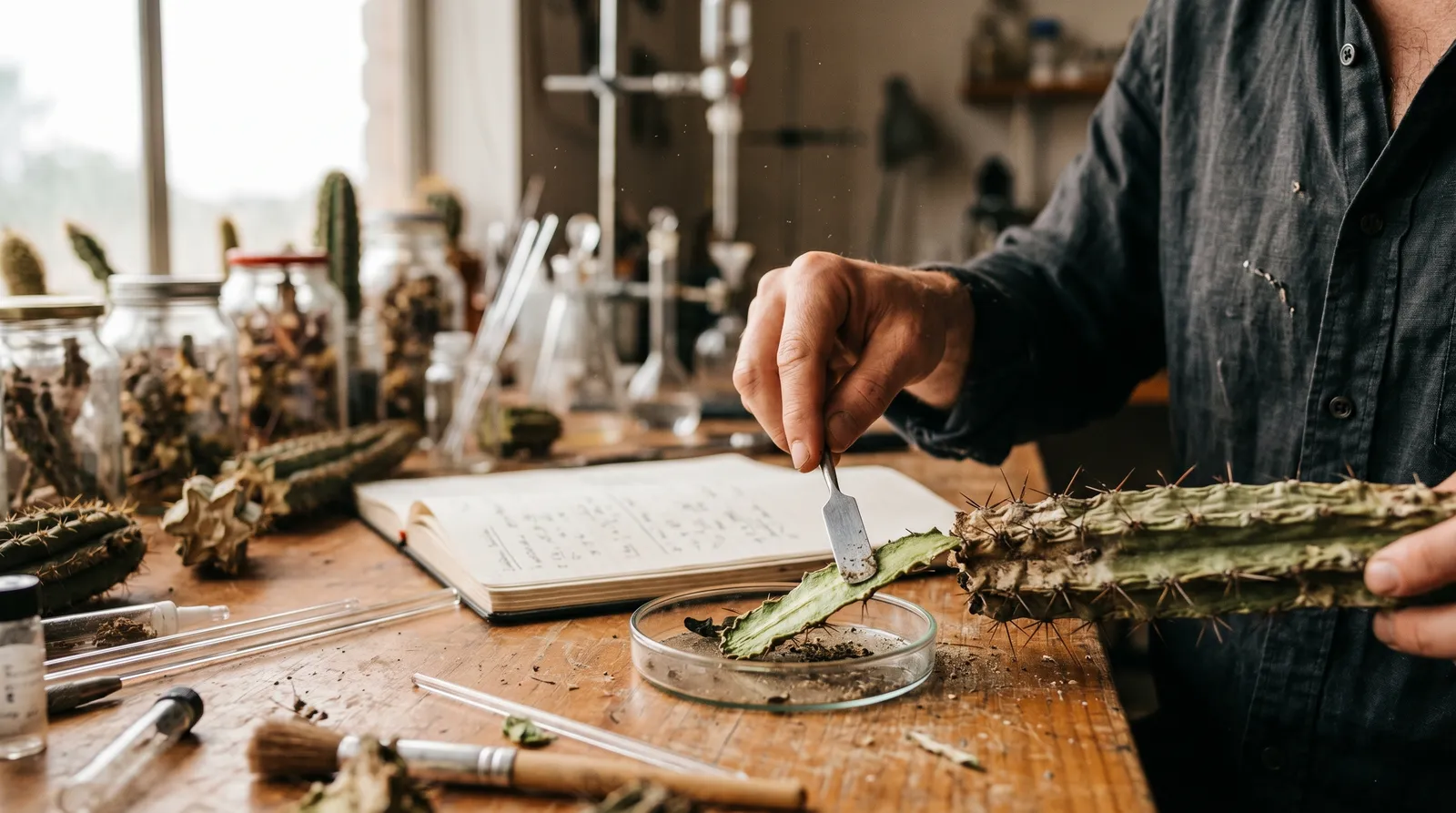
Several factors influence mescaline concentration beyond species identity: growing conditions, age of the cutting, light exposure, water stress, and the specific part of the column sampled. Outer green skin contains far more mescaline than the white inner flesh. The EMCDDA has noted that natural variability in plant-derived psychoactive substances makes dose prediction unreliable, which is one reason why harm-reduction organisations like the Beckley Foundation emphasise caution with any plant-based psychedelic. We cannot stress this enough: published concentration ranges are averages from laboratory analyses, not dosing guides.
Quick Field Checklist
Run through these four checks in order for the fastest identification in front of a live specimen:
- Spines: Nearly absent or under 10 mm = likely San Pedro. Over 20 mm with a prominent central spine = likely Bolivian Torch.
- Rib count: 7 ribs is classic San Pedro. 5 ribs is classic Bolivian Torch. 6 ribs = check other features.
- Skin colour: Blue-green with a waxy bloom = San Pedro. Darker green, more matte = Bolivian Torch.
- Column diameter: Thick and chunky (10+ cm) = leans San Pedro. Slender (under 10 cm) = leans Bolivian Torch.
If three out of four point the same way, you've got a reliable identification. If the features are mixed, you may be looking at a hybrid or a less common cultivar — and that's genuinely fine. The plant doesn't care what you call it.
Where to Buy San Pedro and Bolivian Torch Cuttings
If you want to study these species hands-on, you can buy both San Pedro cuttings and Bolivian Torch cuttings from the Azarius smartshop. Having both species growing side by side is the single best way to internalise the differences described above. The cactus and succulents category on Azarius also includes Peruvian Torch cuttings and peyote seeds for those building a broader reference collection. You can order year-round, though spring shipments root fastest. Check the Azarius blog for seasonal growing guides that pair well with this identification article.
Last updated: April 2026
Frequently Asked Questions
8 questionsHow many ribs does a San Pedro cactus have compared to Bolivian Torch?
What is the easiest way to tell San Pedro and Bolivian Torch apart?
Can San Pedro and Bolivian Torch hybridise?
What colour are Bolivian Torch spines?
How do I avoid confusing San Pedro with a toothpick cactus?
Where can I buy San Pedro and Bolivian Torch cuttings?
Does Bolivian Torch contain more mescaline than San Pedro?
How fast does San Pedro grow compared to Bolivian Torch?
About this article


Joshua Askew serves as Editorial Director for Azarius wiki content. He is Managing Director at Yuqo, a content agency specialising in cannabis, psychedelics and ethnobotanical editorial work across multiple languages. Th
This wiki article was drafted with AI assistance and reviewed by Joshua Askew, Managing Director at Yuqo. Editorial oversight by Adam Parsons.
Medical disclaimer. This content is for informational purposes only and does not constitute medical advice. Consult a qualified healthcare provider before use of any substance.
Last reviewed April 24, 2026
References (6)
- [1]Anderson, E.F. (2001). The Cactus Family. Timber Press.
- [2]Schultes, R.E. & Hofmann, A. (1992). Plants of the Gods: Their Sacred, Healing, and Hallucinogenic Powers. Healing Arts Press.
- [3]Trujillo, J.M. et al. (2013). Distribution and ethnobotany of Trichocereus bridgesii in the Bolivian Yungas. Economic Botany, 67(4), 347–358.
- [4]Ogunbodede, O. et al. (2010). New mescaline concentrations from 14 taxa/cultivars of Echinopsis spp. (Cactaceae) ("San Pedro") and their relevance to shamanic practice. Journal of Ethnopharmacology, 131(2), 356–362.
- [5]EMCDDA (2015). New psychoactive substances in Europe: An update from the EU Early Warning System. European Monitoring Centre for Drugs and Drug Addiction, Lisbon.
- [6]Beckley Foundation (2021). Psychedelic Research and Drug Policy. Policy briefing series. beckleyfoundation.org.
Related Articles
Hawaiian Baby Woodrose Sourcing
Hawaiian baby woodrose sourcing is a practice that covers how to obtain quality Argyreia nervosa seeds — a vine whose seeds contain LSA (lysergic acid amide).
LSA Legal Status in Europe
LSA (lysergic acid amide, or ergine) occupies a legal grey zone across Europe — rarely scheduled as a compound, yet subject to varied NPS legislation that…
Ololiuqui Mazatec Tradition: Ceremonial Seeds of the Sierra Mazateca
Ololiuqui — the seeds of Turbina corymbosa — played a specific ceremonial role among the Mazatec people of Oaxaca, distinct from their better-known use of…
Morning Glory LSA Plants Family
Morning glory LSA plants family is a group of Convolvulaceae vines whose seeds contain d-lysergic acid amide (ergine), a naturally occurring tryptamine first…
Hawaiian Baby Woodrose Plant Botany
Argyreia nervosa, commonly called Hawaiian baby woodrose, is a perennial climbing vine native to the Indian subcontinent, not Hawai'i.
Magic Truffle Quality Indicators
Magic truffle quality indicators are the measurable and sensory characteristics — psilocybin content, texture, aroma, packaging integrity, and storage…
Mescaline Cactus Market Observations
Mescaline cactus market observations is a research and retail term that describes the shifting patterns in sourcing, species selection, and consumption of…
Growing Mescaline Cacti as Ornamental Plants
Growing mescaline cacti ornamental is a horticultural practice that involves cultivating species like San Pedro, Peruvian Torch, and peyote for their…
Commercial Magic Truffle Cultivation
Commercial magic truffle cultivation is a large-scale agricultural process that produces psilocybin-containing sclerotia in climate-controlled indoor…