
This article discusses psychoactive substances intended for adults (18+). If you have a health condition or take medication, consult a doctor before use. Our age policy
Commercial Magic Truffle Cultivation
Definition
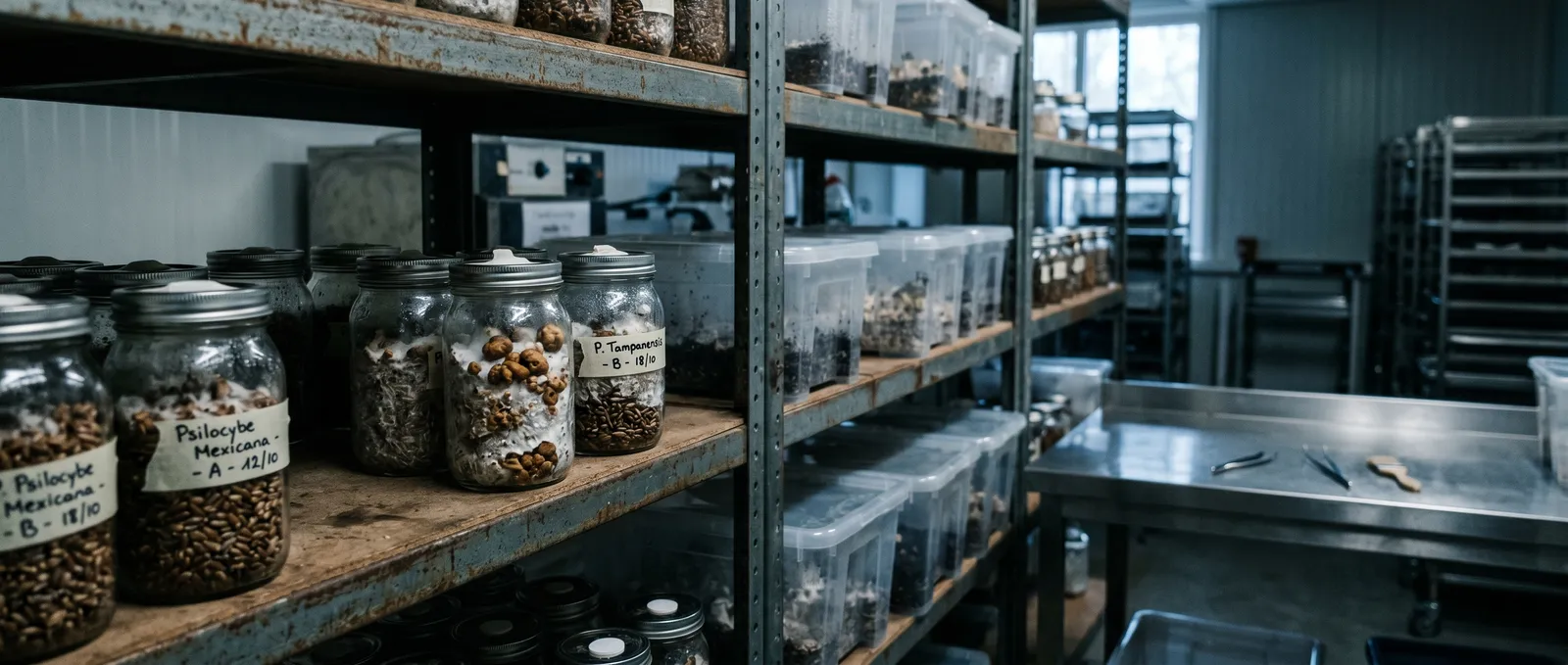
Commercial magic truffle cultivation is a large-scale agricultural process that produces psilocybin-containing sclerotia in climate-controlled indoor facilities at volumes sufficient to supply smartshops, research institutions, and licensed retailers. Gotvaldová et al. (2022) found psilocybin concentrations in commercial sclerotia ranging from roughly 0.3% to 1.8% dry weight, highlighting the biological variability that makes standardisation one of the industry's core challenges.
18+ only
Commercial magic truffle cultivation is a large-scale agricultural process that produces psilocybin-containing sclerotia — dense underground masses formed by certain Psilocybe species — in climate-controlled indoor facilities at volumes sufficient to supply smartshops, research institutions, and licensed retailers. Unlike mushroom fruiting bodies, sclerotia grow entirely within the substrate, which makes the process less visible but no less technical. This guide is written for adults interested in understanding how professional truffle farms in the Netherlands operate, from spawn production through to packaging. The information below covers adult-use products and applies to adult physiology; the substance is not appropriate for people under 18.
What Are Sclerotia and Why Grow Them Commercially?
Sclerotia are compact masses of hardened mycelium that certain fungi produce as a survival mechanism — essentially a nutrient reserve the organism can draw on when conditions turn hostile. Not all Psilocybe species form them. The ones that do — primarily Psilocybe tampanensis, Psilocybe mexicana, and Psilocybe galindoi — have become the backbone of the Dutch truffle market. According to Guzman (1983), P. tampanensis was first collected in Tampa, Florida, in 1977 and is one of relatively few species confirmed to produce both fruit bodies and sclerotia containing psilocybin and psilocin.
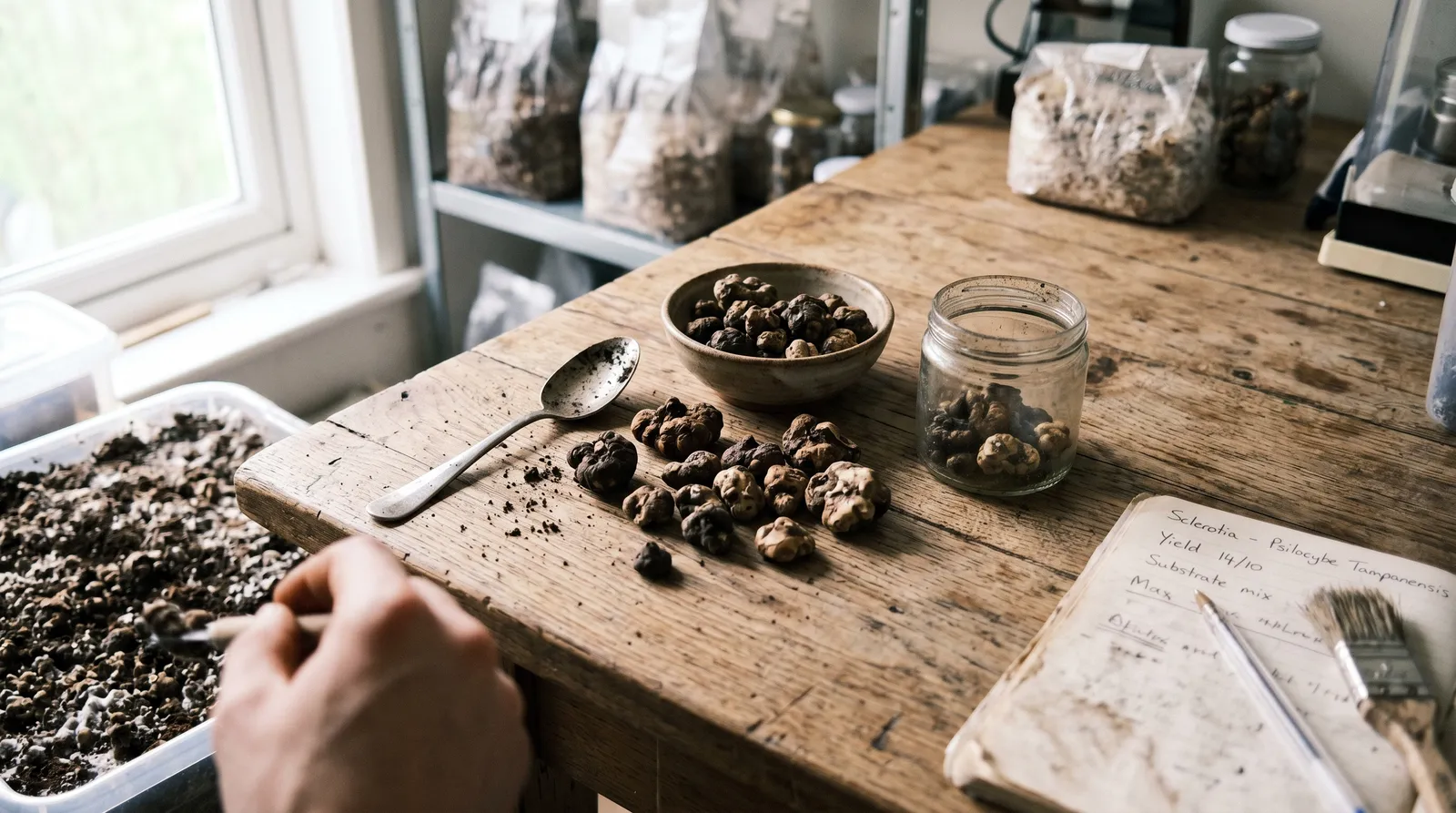
Why sclerotia rather than mushrooms? The short answer is regulatory. Following the 2008 Dutch reclassification of dried and fresh psilocybin mushrooms, sclerotia remained in a separate category and continued to be sold through licensed smartshops. That gap turned commercial magic truffle cultivation into a genuine industry. Estimates from the Trimbos Institute's 2021 National Drug Monitor suggest that the Dutch truffle market generates tens of millions of euros annually, with dozens of commercial farms operating in climate-controlled facilities across the country. The European Monitoring Centre for Drugs and Drug Addiction (EMCDDA) has noted the Netherlands' unique position as the only EU member state where psilocybin sclerotia are openly sold through regulated retail channels.
Step 1 — Strain Selection and Mother Cultures
Strain selection is the foundation of every commercial magic truffle cultivation operation. Farms maintain libraries of mother cultures — living mycelium on agar plates or in liquid culture — that have been selected over years for sclerotia density, psilocybin content, colonisation speed, and contamination resistance. The three workhorses are P. tampanensis, P. mexicana, and P. galindoi (sometimes marketed as "ATL-7" or "Atlantis"). Each produces sclerotia with distinct characteristics: P. mexicana tends to form smaller, harder nodules; P. tampanensis yields larger, softer masses with a slightly nutty taste when fresh.
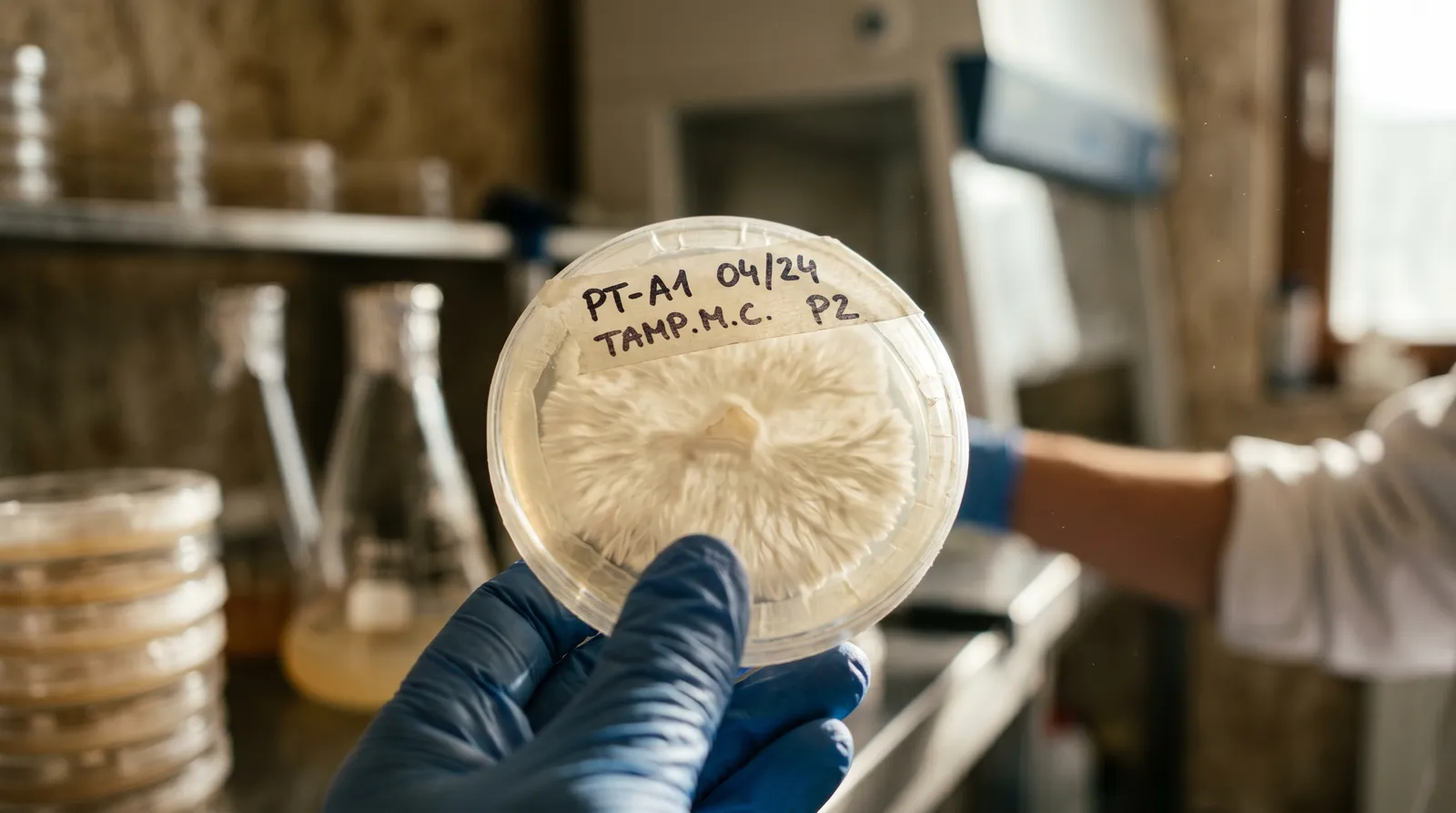
Maintaining genetic consistency across batches of thousands of jars is a real challenge. Farms typically subculture from master plates no more than five to seven generations before returning to stored stock — repeated transfers can introduce senescence or genetic drift, reducing yields. Some operations use cryogenic storage (liquid nitrogen or −80°C freezers) to preserve original isolates indefinitely, though the equipment cost puts this out of reach for smaller producers.
Step 2 — Substrate Preparation and Sterilisation
The standard commercial substrate is whole rye grain, sometimes supplemented with vermiculite or brown rice flour. Proper substrate preparation is the single most important controllable variable in commercial magic truffle cultivation. Rye is preferred because its kernel size provides good air exchange within the jar, the starch content feeds rapid colonisation, and it is cheap in bulk.
Preparation follows a tight protocol:
- Hydration — Rye grain is soaked for 12–24 hours, then simmered until kernels are swollen but not split. Target moisture content sits around 50–55% by weight.
- Draining and drying — Excess surface moisture is removed. Wet grain clumps together and creates anaerobic pockets where bacteria thrive.
- Jarring — Grain is loaded into autoclavable polypropylene containers (typically 1–1.5 litre jars or filter-patch bags). Commercial operations fill thousands per batch.
- Sterilisation — Containers are autoclaved at 121°C and 15 psi for 60–90 minutes. This is non-negotiable. Inadequate sterilisation is the single most common cause of batch loss. Industrial farms use large horizontal autoclaves that can process hundreds of jars per cycle.
The entire process takes place in cleanroom or semi-cleanroom conditions. Staff wear gloves, hairnets, and sometimes full gowns. Air handling systems with HEPA filtration keep ambient spore counts low — a contamination rate above 2–3% per batch is considered unacceptable in professional settings.
Step 3 — Inoculation and Incubation
Inoculation is the step where sterilised substrate meets living mycelium. Once cooled, sterilised jars are inoculated with grain spawn or liquid culture in front of a laminar flow hood. The volume of inoculant matters: too little and colonisation is slow, giving contaminants a window; too much and you waste expensive spawn. A ratio of roughly 5–10% spawn to substrate by volume is typical.
Inoculated jars then move to incubation rooms held at 21–25°C in complete darkness. Sclerotia formation does not require a light cycle, fruiting trigger, or fresh air exchange — the mycelium does all its work sealed inside the jar. This is one reason truffle cultivation scales so well: you stack jars on shelving racks in a dark, temperature-controlled room and wait.
The wait is substantial. Full colonisation of the grain takes 2–4 weeks, but sclerotia formation continues for another 8–12 weeks after that. Total incubation from inoculation to harvest typically runs 10–16 weeks depending on species and strain. P. galindoi tends to be faster; P. tampanensis slower but often higher-yielding by weight. Gotvaldová et al. (2022) analysed psilocybin and psilocin content in commercially available sclerotia and found significant variation between species and even between batches of the same species — a reminder that alkaloid content is influenced by genetics, substrate, and incubation conditions in ways that are not fully predictable.
Step 4 — Harvest, Cleaning, and Quality Control
Harvesting is entirely manual in most commercial magic truffle cultivation facilities. It means breaking open each jar, separating the sclerotia from the spent grain, and cleaning off residual substrate by hand or with gentle water rinsing. There is no machine that reliably sorts sclerotia from grain without damaging them. A single jar typically yields 30–80 grams of fresh sclerotia, depending on species, strain, and incubation time.
Quality control at a professional farm involves several checks:
| QC Check | Method | Acceptable Standard |
|---|---|---|
| Visual inspection | Manual examination for firmness, colour, mould | No soft spots, no Trichoderma (green mould), no off-colours |
| Weight and grading | Sorting by size, weighing into retail portions | Commonly 10g or 15g packs within ±0.5g tolerance |
| Alkaloid testing | Third-party HPLC analysis of psilocybin and psilocin | Gotvaldová et al. (2022): 0.3%–1.8% psilocybin dry weight typical |
| Microbial screening | Swab cultures or plate counts | No pathogenic bacteria; total count below food-grade thresholds |
Fresh sclerotia are vacuum-sealed in food-grade packaging and stored at 2–4°C. Shelf life under proper refrigeration is roughly 6–8 weeks, though some degradation of psilocin (the less stable of the two main alkaloids) begins within the first month. Stamets (1996) noted that psilocin is more susceptible to oxidation than psilocybin, which may partly explain why older truffles sometimes feel subjectively weaker even when total alkaloid content appears stable on paper.
How Commercial Truffles Compare to Grow Kits
Ready-to-eat truffles and home grow kits serve different audiences. If you want to buy magic truffles for immediate use, pre-packaged fresh sclerotia from a professional farm offer convenience, tested potency, and consistent refrigeration. Products like the Psilocybe Hollandia Truffles or the Psilocybe Tampanensis Truffles available through Azarius arrive vacuum-sealed and ready to consume. By contrast, a magic mushroom grow kit — such as the Mondo Grow Kit or the Fresh Mushrooms XP Grow Kit — lets you cultivate fruiting bodies at home, which is a different process entirely (mushroom fruiting requires fresh air exchange, humidity, and light triggers that sclerotia production does not). We honestly cannot tell you which is "better" — it depends on whether you value convenience or the experience of growing something yourself.
Scaling Up — The Economics and Logistics
Running a commercial truffle operation requires six-figure capital investment before a single truffle reaches a shop shelf. Climate control alone (maintaining 21–25°C across thousands of square metres, year-round, in the Dutch climate) represents a major energy cost. Add autoclave capacity, cleanroom infrastructure, HEPA filtration, cold-chain logistics, staff, and laboratory testing, and the barrier to entry is substantial.
Yield economics are straightforward but unforgiving. If a jar costs roughly €1.50–2.00 in materials (grain, jar, spawn, energy for sterilisation) and produces 50g of fresh sclerotia after 12 weeks of incubation, you need high throughput and low contamination rates to stay profitable. A contamination spike from a faulty autoclave cycle or a breach in cleanroom protocol can wipe out weeks of production. The 2023 annual report from the Dutch Food and Consumer Product Safety Authority (NVWA) noted that truffle farms are subject to the same food-safety inspections as other food producers, including checks on hygiene, labelling, and traceability — reinforcing that this is a regulated food-production chain, not a grey-market operation.
Logistics after harvest are equally demanding. Fresh sclerotia need unbroken cold-chain transport from farm to retailer. Most Dutch truffle farms ship refrigerated, with deliveries to smartshops happening multiple times per week during peak season. Azarius, which produces the ten own-brand truffle varieties sold through its shop, runs this cycle continuously to keep stock fresh. Customers who order magic truffles online through Azarius receive them in insulated packaging to maintain the cold chain during transit.
Common Challenges in Commercial Production
Contamination remains the number-one enemy. Trichoderma, Penicillium, and bacterial endospores (especially Bacillus species that survive inadequate autoclaving) can devastate batches. Professional farms mitigate this with rigorous sterilisation protocols, positive-pressure cleanrooms, and staff training — but zero contamination is an aspiration, not a reality.
Consistency is the second challenge. Customers expect a 15g pack of "Hollandia" to feel roughly the same every time. But biological systems do not work like pharmaceutical manufacturing. Alkaloid content varies with genetics, substrate batch, incubation temperature, and even the position of the jar on the shelf (temperature gradients in large incubation rooms are real). Standardisation efforts — tighter genetic control, more frequent HPLC testing, narrower incubation parameters — are ongoing across the industry, but perfect batch-to-batch consistency remains elusive.
Energy costs have become increasingly significant. Climate control, autoclaving, and refrigeration are all energy-intensive. Several Dutch farms have begun investing in solar panels and heat-recovery systems, though the industry as a whole has not published aggregated sustainability data. A Beckley Foundation report on psilocybin supply chains (2023) noted that environmental footprint data for commercial magic truffle cultivation remains sparse, identifying it as a gap in the emerging psychedelic-industry literature.
What to Look for When You Buy Magic Truffles
The most important things to check are packaging date, vacuum seal integrity, species labelling, and storage temperature. Knowing how commercial magic truffle cultivation works helps you make better choices as a consumer. When you buy magic truffles from a smartshop or order them from an online retailer like Azarius, check the following:
- Packaging date — Fresh sclerotia should have a clear production or packaging date. Avoid anything older than six weeks.
- Vacuum seal integrity — The pack should be tight with no air pockets. A puffy pack suggests gas-producing bacterial activity.
- Species labelling — Reputable sellers specify the Psilocybe species. Vague names without species information are a red flag.
- Storage temperature — Truffles should be displayed in a refrigerated case, not on a room-temperature shelf.
- Retailer reputation — Established smartshops like Azarius source from farms with documented QC processes, including HPLC testing.
For those interested in the cultivation side rather than the consumption side, Azarius also stocks a range of cultivation supplies including substrate jars, spore syringes, and the Supa Gro 100% Mycelium Kit. These products are designed for mushroom fruiting bodies rather than sclerotia, but the underlying sterile technique principles overlap considerably.
Species Comparison for Commercial Magic Truffle Cultivation
The three main species used in commercial magic truffle cultivation each have distinct production profiles. The table below summarises key differences that farms consider when planning production cycles.
| Characteristic | P. tampanensis | P. mexicana | P. galindoi |
|---|---|---|---|
| Sclerotia size | Large, soft masses | Smaller, harder nodules | Medium, moderate density |
| Typical incubation time | 12–16 weeks | 10–14 weeks | 10–12 weeks |
| Yield per jar (fresh) | 50–80g | 30–50g | 40–60g |
| Flavour profile (fresh) | Slightly nutty, mild | Earthy, slightly bitter | Sour, tangy |
| Psilocybin range (dry wt) | 0.4%–1.2% | 0.3%–0.8% | 0.5%–1.8% |
| Colonisation speed | Moderate | Moderate | Fast |
Data ranges are approximate and drawn from Gotvaldová et al. (2022) and internal industry observations. Actual results vary with genetics, substrate, and incubation conditions.
Last updated: April 2026
Frequently Asked Questions
8 questionsHow long does it take to grow magic truffles commercially?
What substrate do commercial truffle farms use?
How do truffle farms test psilocybin content?
What is the biggest risk in commercial truffle production?
How are fresh magic truffles stored after harvest?
What should I look for when I buy magic truffles?
Can magic truffles be grown at home the same way commercial farms do it?
Why are magic truffles legal in the Netherlands but mushrooms are not?
About this article


Adam Parsons is an external cannabis and psychedelics writer and editor who contributes to Azarius's wiki as both author and reviewer. On the writing side, he authors Azarius's kratom and kanna clusters, drawing on exten
This wiki article was drafted with AI assistance and reviewed by Adam Parsons, External contributor. Editorial oversight by Joshua Askew.
Medical disclaimer. This content is for informational purposes only and does not constitute medical advice. Consult a qualified healthcare provider before use of any substance.
Last reviewed April 24, 2026
References (7)
- [1]Gotvaldová, K., Hájková, K., Borovička, J., Jurok, R., Cihlářová, P., & Kuchař, M. (2022). Stability of psilocybin and its four analogs in the biomass of the psychotropic mushroom Psilocybe cubensis. Drug Testing and Analysis, 14(2), 303–312.
- [2]Guzman, G. (1983). The Genus Psilocybe. Beihefte zur Nova Hedwigia, 74. J. Cramer, Vaduz.
- [3]Stamets, P. (1996). Psilocybin Mushrooms of the World. Ten Speed Press, Berkeley.
- [4]Trimbos Institute (2021). National Drug Monitor: Annual Report 2021. Utrecht, Netherlands.
- [5]NVWA (2023). Annual Report 2023: Food Safety Inspections. Dutch Food and Consumer Product Safety Authority, The Hague.
- [6]European Monitoring Centre for Drugs and Drug Addiction (EMCDDA) (2022). European Drug Report 2022: Trends and Developments. Publications Office of the European Union, Luxembourg.
- [7]Beckley Foundation (2023). Psilocybin Supply Chains: Regulatory and Environmental Considerations. Oxford, UK.
Related Articles
Hawaiian Baby Woodrose Sourcing
Hawaiian baby woodrose sourcing is a practice that covers how to obtain quality Argyreia nervosa seeds — a vine whose seeds contain LSA (lysergic acid amide).
LSA Legal Status in Europe
LSA (lysergic acid amide, or ergine) occupies a legal grey zone across Europe — rarely scheduled as a compound, yet subject to varied NPS legislation that…
Ololiuqui Mazatec Tradition: Ceremonial Seeds of the Sierra Mazateca
Ololiuqui — the seeds of Turbina corymbosa — played a specific ceremonial role among the Mazatec people of Oaxaca, distinct from their better-known use of…
Morning Glory LSA Plants Family
Morning glory LSA plants family is a group of Convolvulaceae vines whose seeds contain d-lysergic acid amide (ergine), a naturally occurring tryptamine first…
Hawaiian Baby Woodrose Plant Botany
Argyreia nervosa, commonly called Hawaiian baby woodrose, is a perennial climbing vine native to the Indian subcontinent, not Hawai'i.
Magic Truffle Quality Indicators
Magic truffle quality indicators are the measurable and sensory characteristics — psilocybin content, texture, aroma, packaging integrity, and storage…
Mescaline Cactus Market Observations
Mescaline cactus market observations is a research and retail term that describes the shifting patterns in sourcing, species selection, and consumption of…
Growing Mescaline Cacti as Ornamental Plants
Growing mescaline cacti ornamental is a horticultural practice that involves cultivating species like San Pedro, Peruvian Torch, and peyote for their…
Huachuma Andean Tradition
The huachuma Andean tradition is a ceremonial healing lineage centred on the San Pedro cactus (Echinopsis pachanoi) that has been documented across at least…