
This article discusses psychoactive substances intended for adults (18+). If you have a health condition or take medication, consult a doctor before use. Our age policy
Herbal Smoking Blends Traditional Ingredients — Full Guide
Definition
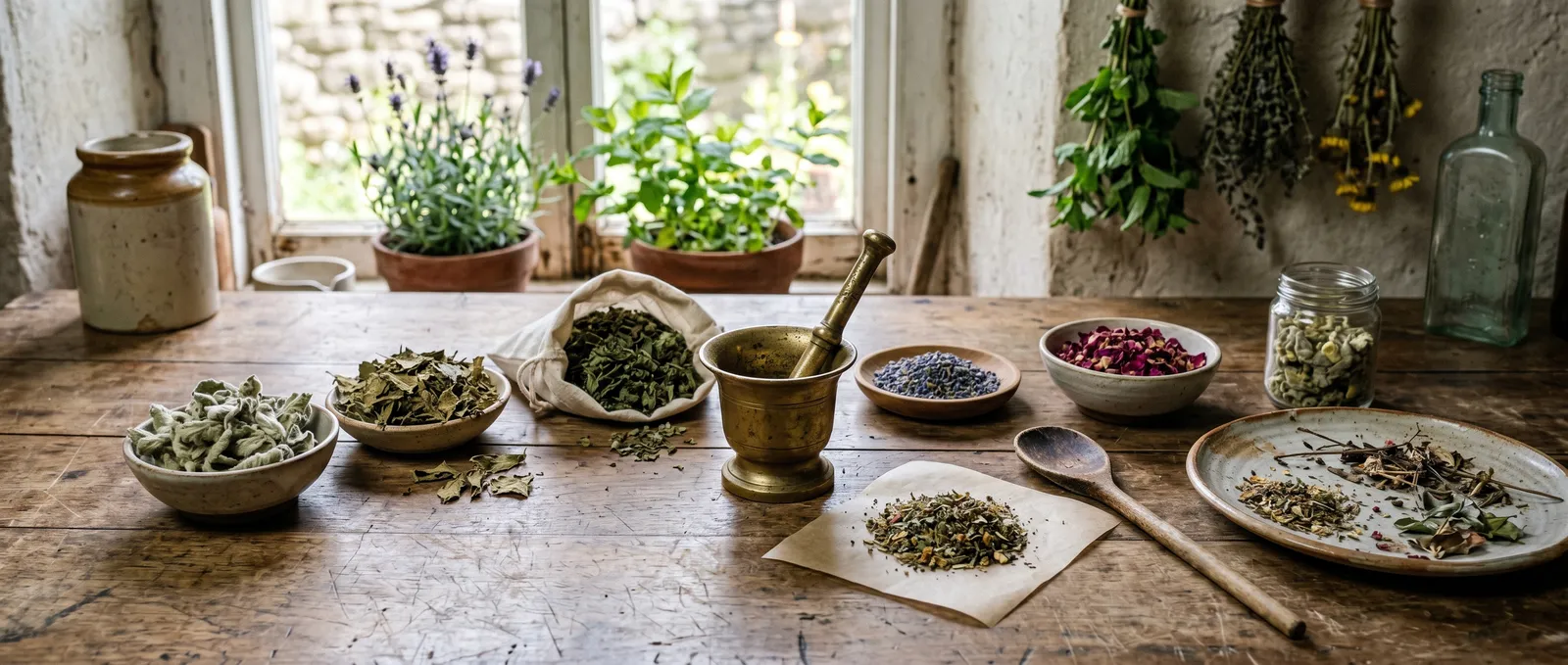
Herbal smoking blends traditional ingredients is a category of tobacco-free dried botanicals — typically a mullein base, character herbs like damiana or wild dagga, and aromatic accents — combined in a tradition far older than commercial tobacco. Rickert et al. (2005) confirmed that herbal cigarettes still produce tar and particulate matter comparable to tobacco, making respiratory risk the critical safety consideration.
Traditional Smoking-Blend Ingredients at a Glance
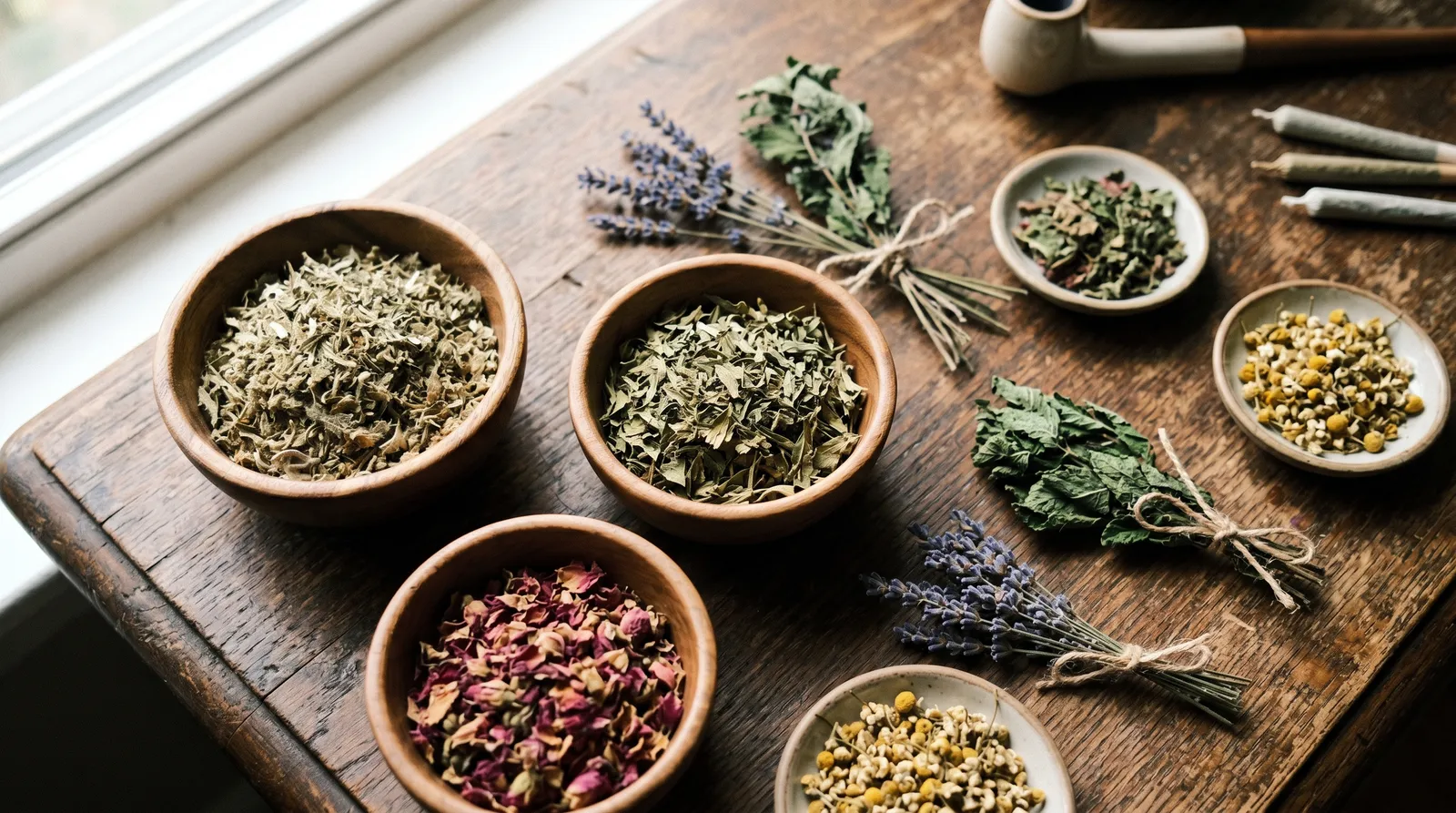
Herbal smoking blends traditional ingredients form a toolkit of tobacco-free botanicals that give blenders control over flavour, body, and burn rate. The reference table below maps each common herb to its role, origin culture, and relevant phytochemical notes — a starting point for anyone exploring this tradition or looking to buy a ready-made blend from a smartshop.
| Herb | Binomial | Traditional Smoking-Blend Role | Source Culture | Note |
|---|---|---|---|---|
| Mullein | Verbascum thapsus L. | Base herb — smooth, light smoke; bulk filler | European folk herbalism (documented from at least the 16th century) | Produces a notably mild, almost flavourless smoke; most commonly used as the structural backbone of a blend |
| Damiana | Turnera diffusa Willd. ex Schult. | Flavour and body — mildly resinous, warm taste | Indigenous communities of central Mexico and the Yucatán Peninsula; noted by Spanish missionaries in the 17th century | Contains the flavonoid apigenin and the terpenoid damianin; traditionally brewed as tea or smoked |
| Mugwort | Artemisia vulgaris L. | Aromatic modifier — slightly bitter, sage-like | European, Chinese, and Japanese traditional medicine; burned as moxa in East Asian practice for centuries | Contains thujone and camphor; Asteraceae family — cross-reactive with ragweed allergies |
| Wild dagga | Leonotis leonurus (L.) R.Br. | Character herb — peppery, resinous flavour | Khoikhoi and other southern African communities; smoked or brewed traditionally | Contains leonurine; flowers are the part traditionally smoked, not leaves |
| Passionflower | Passiflora incarnata L. | Accent herb — mild, hay-like flavour | Cherokee and other southeastern North American peoples; documented by Hernando de Soto's expedition (1540s) | Contains chrysin and other flavonoids; traditionally prepared as tea, occasionally smoked in blends |
| Lavender | Lavandula angustifolia Mill. | Aromatic accent — floral, cooling | Mediterranean folk use; cultivated since Roman antiquity | Contains linalool and linalyl acetate; use sparingly — concentrated lavender smoke can be harsh |
| Rose petals | Rosa spp. | Aromatic accent — sweet, floral finish | Persian and Ottoman smoking traditions; rose tobacco blends date to at least the 18th century | Primarily aesthetic and aromatic; burns quickly, best mixed with a slow-burning base |
| Lemon balm | Melissa officinalis L. | Flavour accent — bright, citrus note | European monastic gardens from the 9th century onward (Charlemagne's Capitulare de villis) | Contains rosmarinic acid and citronellal; best added dried and finely crumbled |
Every entry above is framed as traditional use, not a therapeutic claim. The phytochemical compounds listed are descriptive identifiers — naming what is present in the plant, not asserting what it does in a smoking blend.
What Are Herbal Smoking Blends?
Herbal smoking blends are tobacco-free mixtures of dried botanicals — a category of traditional ingredients that is far older than commercial tobacco itself. The tradition predates tobacco's arrival in Europe: Rätsch's Encyclopedia of Psychoactive Plants (2005) catalogues dozens of cultures across five continents that smoked local herbs — for ritual, for flavour, or simply because the plants were there and fire was easy. When tobacco (Nicotiana tabacum) conquered global trade in the 16th and 17th centuries, many of those older blends faded from common use. The current revival is largely driven by people looking for a tobacco-free option that still offers the ritual of rolling and smoking.
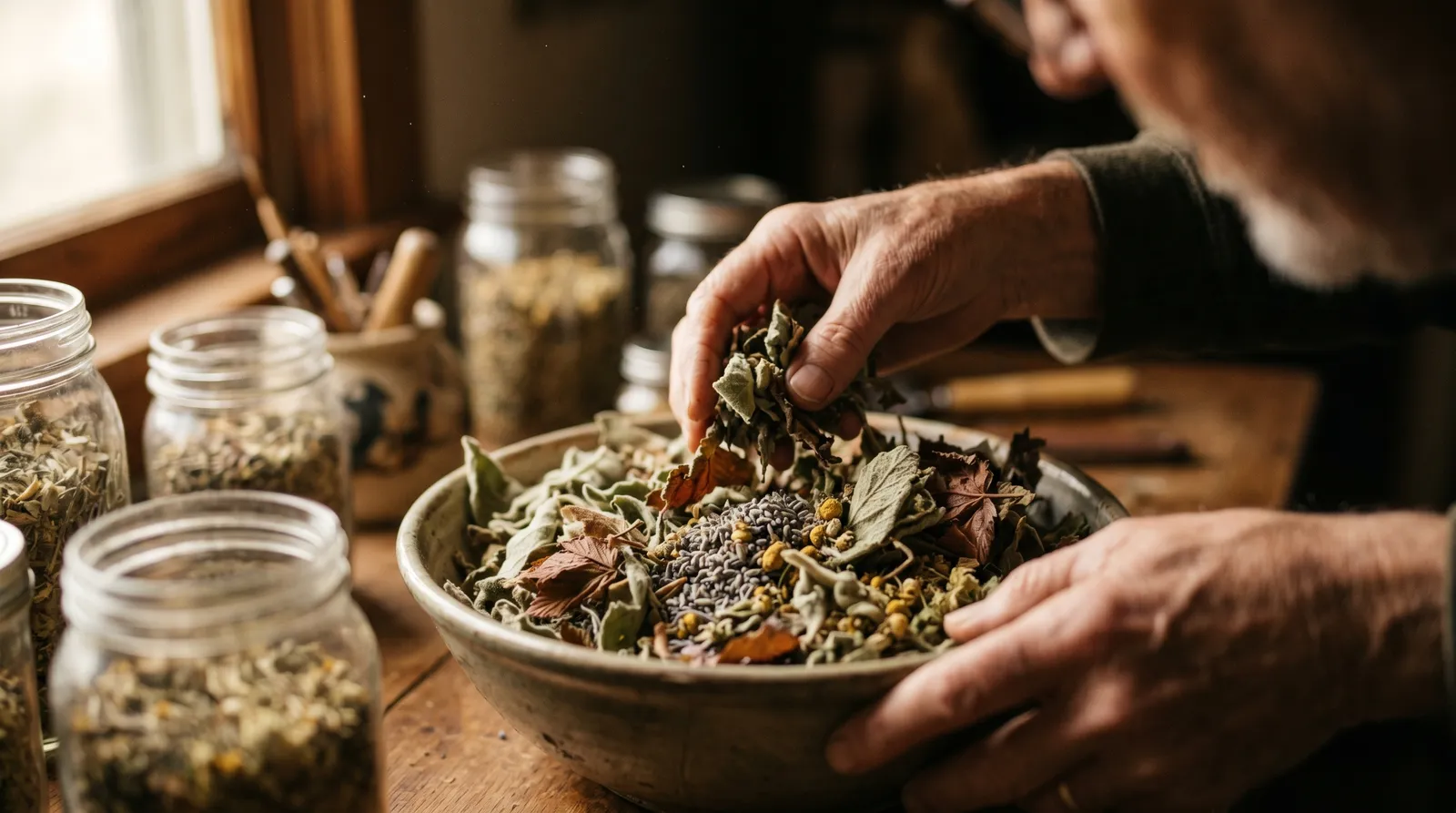
A typical blend follows a three-tier structure: a base herb for volume and smooth combustion, one or two character herbs for flavour and body, and a scattering of aromatic accents. The table above maps each common ingredient to its traditional role. Getting the ratio right is the whole game — too much accent herb and the smoke becomes perfume-thick; too little and you are basically smoking hay.
Base Herbs: The Foundation of Any Blend
Mullein is the single most common base herb in herbal smoking blends, and for good reason. Its broad, fuzzy leaves (Verbascum thapsus) dry to a light, fluffy texture that burns evenly and produces a mild, almost tasteless smoke. The plant has a long ethnobotanical record: Dioscorides mentioned it in De Materia Medica (1st century CE), and Appalachian folk herbalists used mullein-leaf rolls into the 20th century (Crellin and Philpott, 1990). A base herb should account for roughly 40–60% of the total blend by weight — enough to carry the other ingredients without overwhelming them.
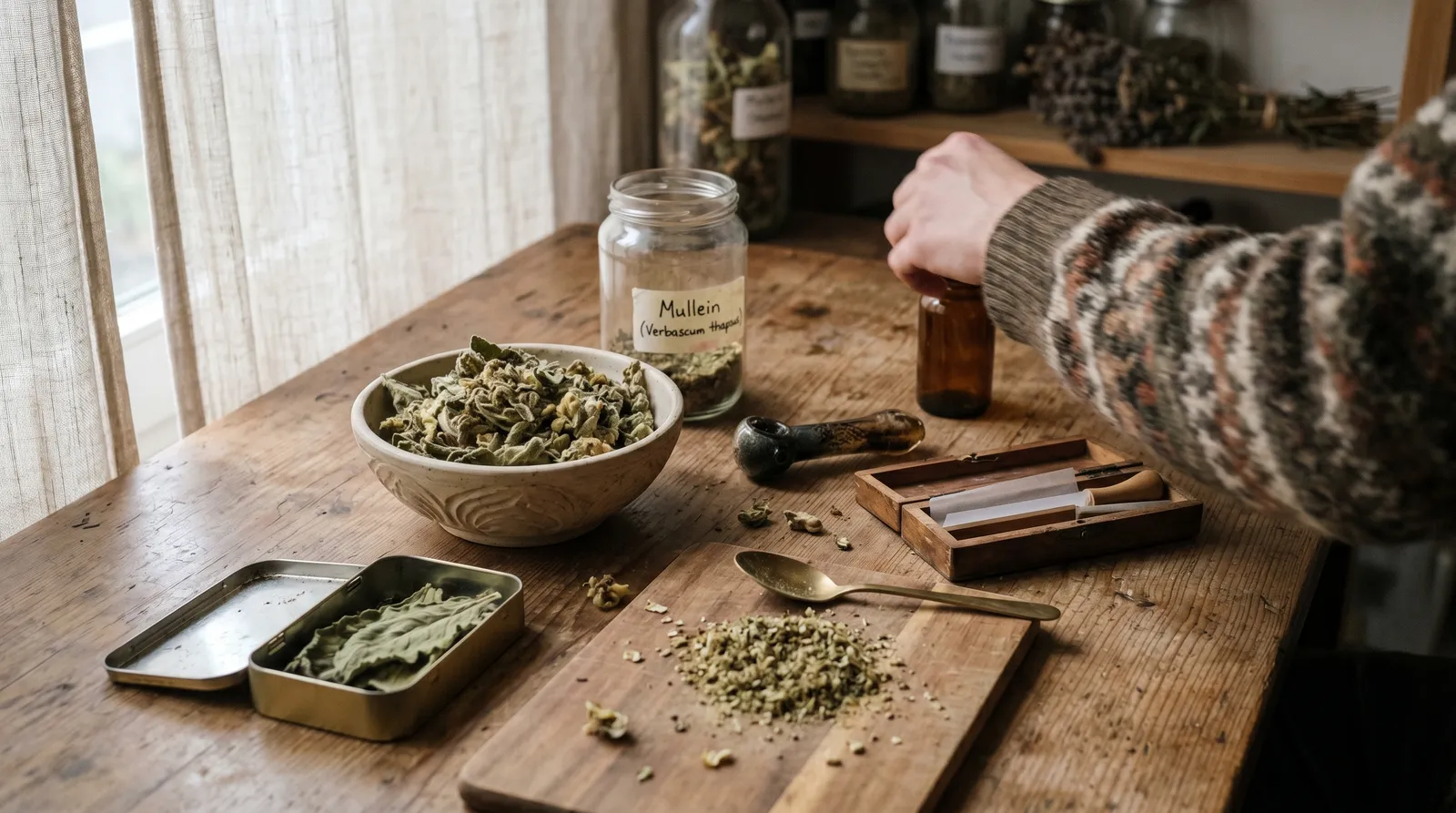
Some blenders substitute dried raspberry leaf (Rubus idaeus) or coltsfoot (Tussilago farfara) as a base, though coltsfoot contains pyrrolizidine alkaloids and is restricted in several EU countries as a result. Mullein carries no such concern, which is one reason it dominates the base-herb role in commercial blends. If you want to buy mullein leaf for blending, look for whole dried leaves rather than pre-powdered stock — the coarser cut holds a roll together far better.
Character Herbs: Flavour and Body
Damiana is the most widely recognised character herb among herbal smoking blends traditional ingredients. Spanish missionaries in 17th-century Mexico documented indigenous communities brewing and smoking the leaves of Turnera diffusa. Its resinous, slightly sweet flavour gives a blend warmth and depth. The phytochemistry includes the flavonoid apigenin, the terpenoid damianin, and a volatile oil profile heavy in 1,8-cineole and p-cymene (Zhao et al., 2007). None of that necessarily translates to a noticeable effect when combusted — the peer-reviewed evidence on smoked damiana is essentially non-existent, which is worth being upfront about.
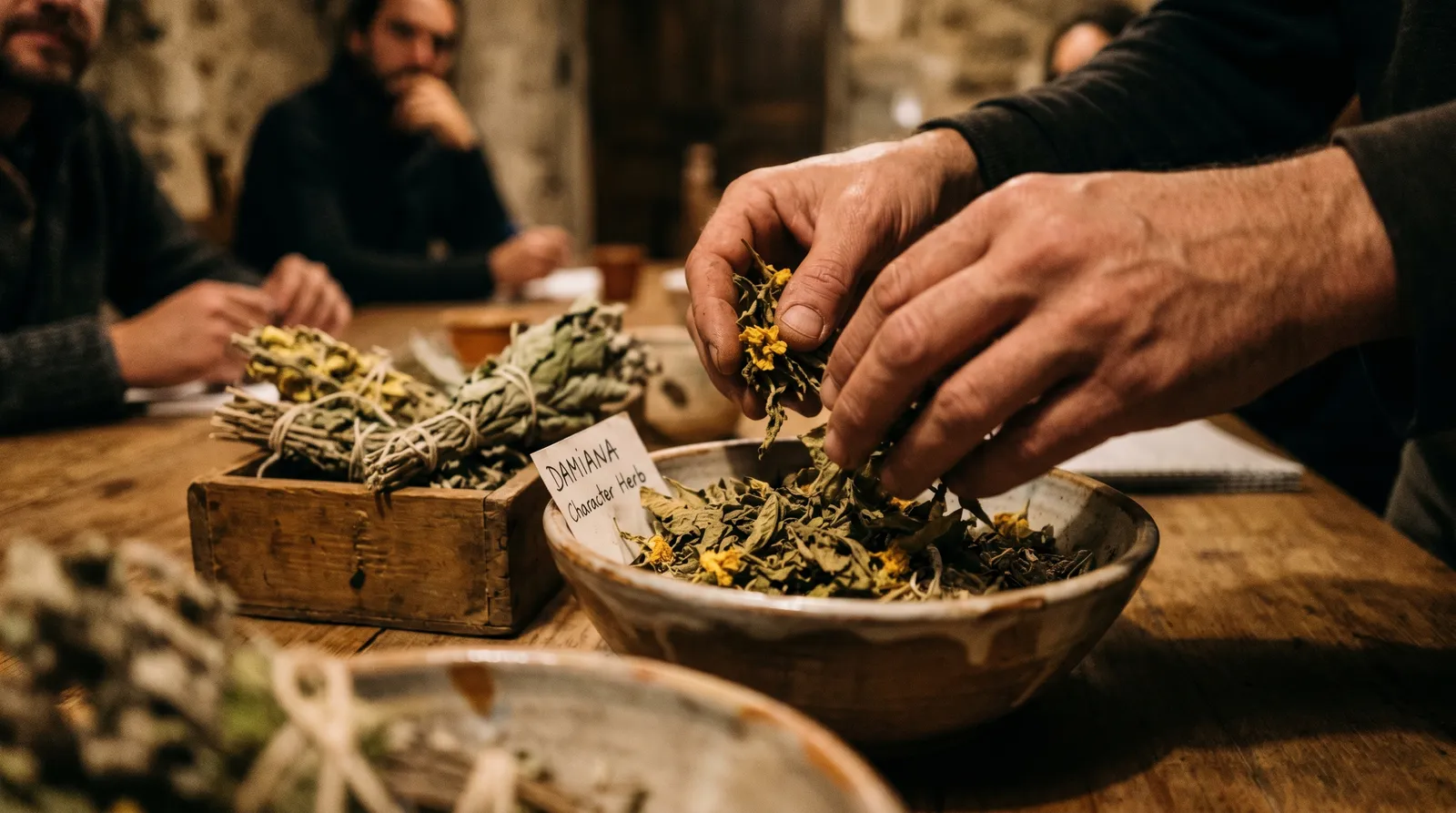
Wild dagga (Leonotis leonurus) is the other major character herb, traditionally smoked by Khoikhoi communities in southern Africa. The flowers — not the leaves — are the part with the highest concentration of leonurine, a labdane diterpenoid identified in phytochemical analyses (Mazimba, 2015). The smoke is peppery, resinous, and thicker than damiana's. A little goes a long way: 15–25% of a blend by weight is a common starting point in traditional recipes.
Mugwort (Artemisia vulgaris) straddles the line between character herb and aromatic accent. It adds a bitter, sage-adjacent flavour and a distinctly aromatic smoke. Mugwort has deep roots in European, Chinese, and Japanese tradition — it is the herb burned as moxa in traditional East Asian practice. The plant contains thujone and camphor among its volatile oils (Bora and Sharma, 2011). It belongs to the Asteraceae (daisy) family, which matters for allergy reasons covered in the safety section below.
Aromatic Accents: The Finishing Touch
Accent herbs make up the smallest fraction of a blend — typically 5–15% — but they define its personality. Lavender (Lavandula angustifolia) contributes linalool and linalyl acetate, the same compounds responsible for its famous scent. A pinch rounds off harsher notes; too much makes the smoke cloying and can irritate the throat. Rose petals (Rosa spp.) burn fast and sweet, adding a floral finish that Persian and Ottoman smoking cultures prized in their tobacco blends from at least the 18th century.
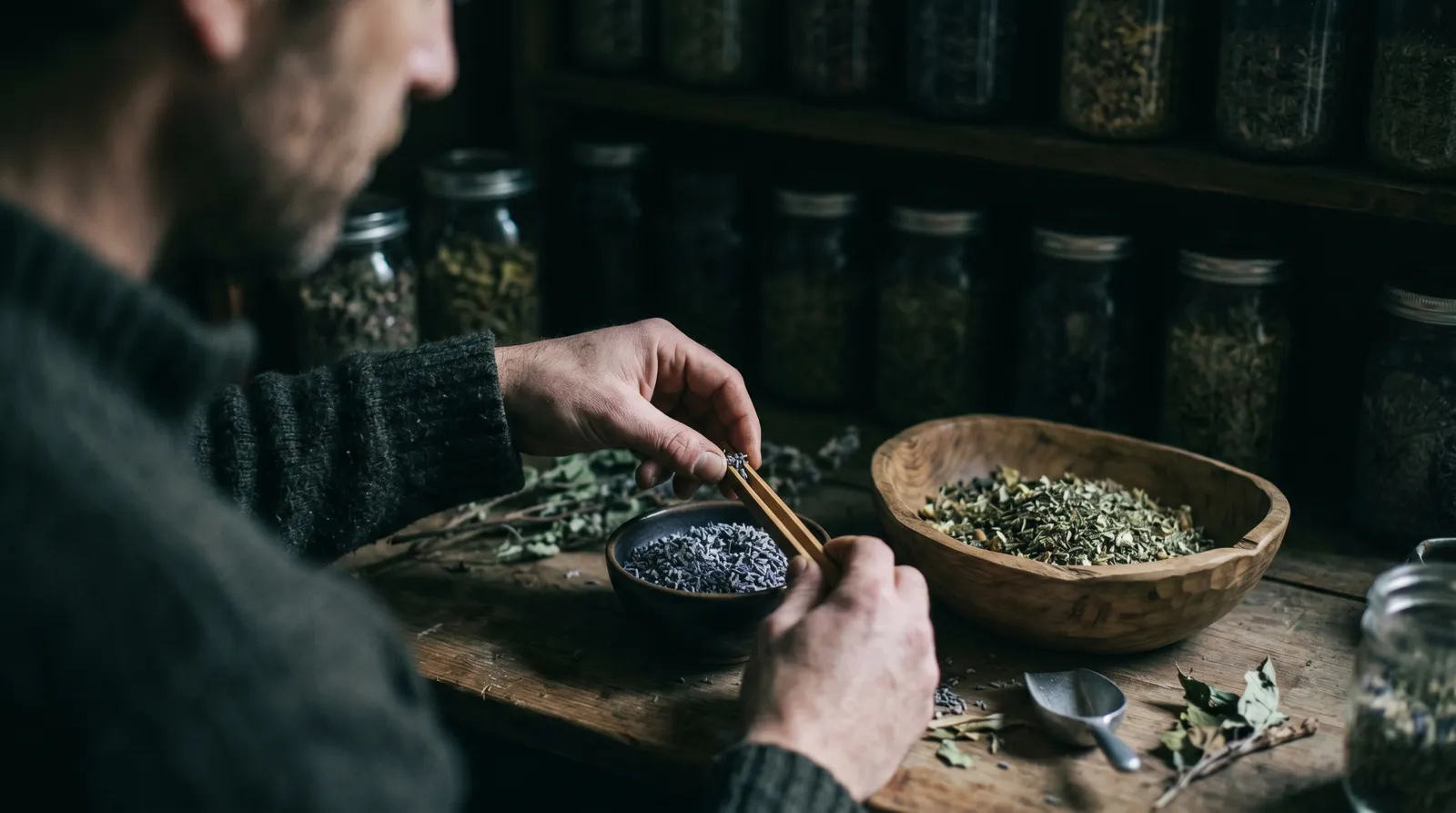
Passionflower (Passiflora incarnata) dried leaves have a mild, hay-like quality that sits quietly in a blend — useful for adding volume without competing with stronger flavours. Lemon balm (Melissa officinalis) brings a bright citrus note from its rosmarinic acid and citronellal content. Both work best crumbled fine and mixed thoroughly through the base, rather than layered on top.
Blending Ratios and Preparation
The standard starting ratio is roughly 50% base, 30% character herb, and 10–15% accent — though traditional blends vary enormously by region and personal preference. A common framework from ethnobotanical literature and long-standing smartshop practice looks like this:
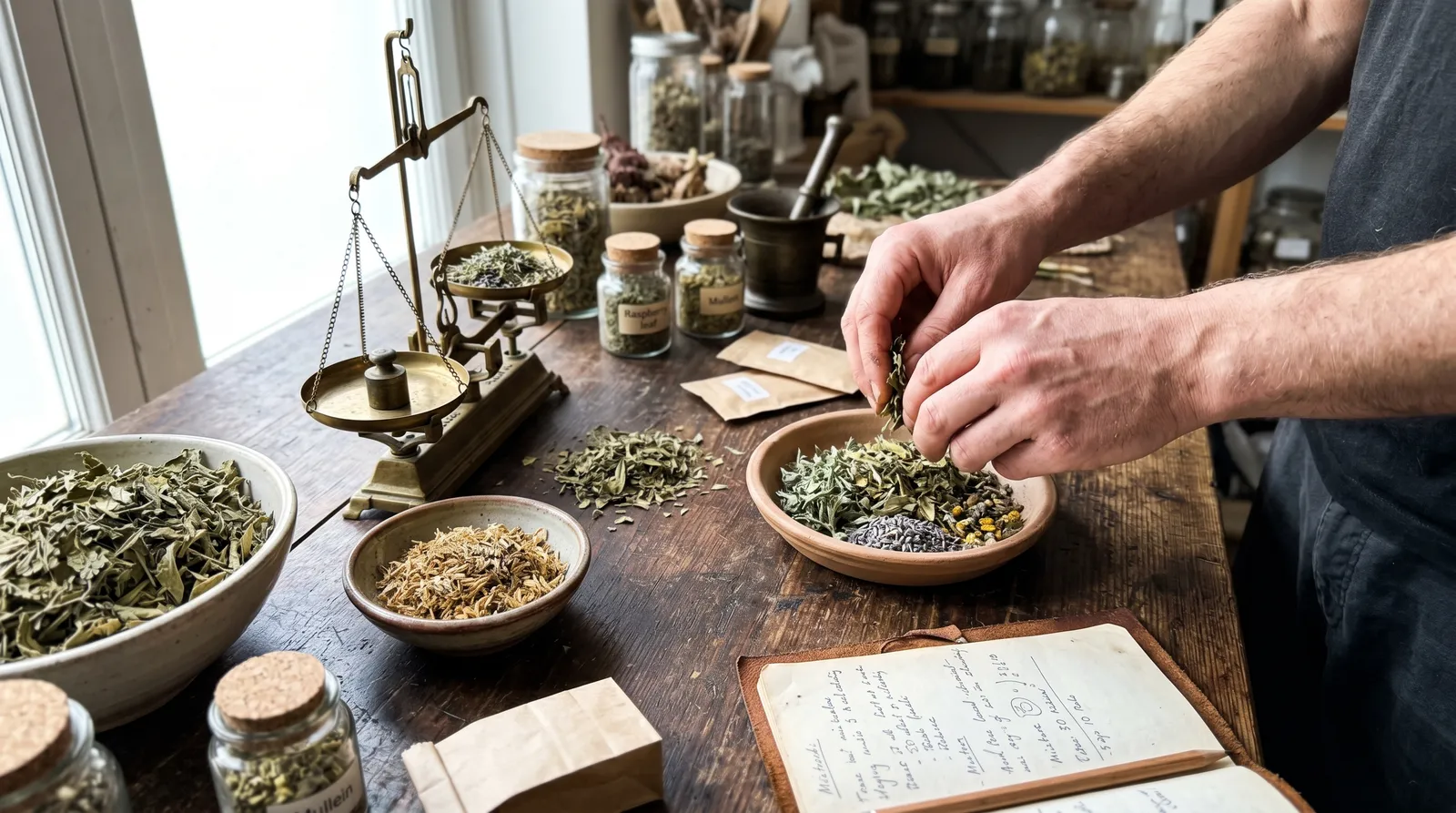
- Base (mullein or similar): 40–60% of total weight
- Character herb (damiana, wild dagga, mugwort): 25–40%
- Aromatic accents (lavender, rose, lemon balm, passionflower): 5–15%
Dryness matters. Herbs that are too damp will not combust properly; herbs that are bone-dry crumble to dust and burn too hot. The sweet spot is similar to rolling tobacco — slightly springy when pinched, not crunchy. Storing blended herbs in an airtight jar with a small humidity pack keeps them at a usable moisture level for weeks.
Herbal Blends vs. Tobacco vs. Dry-Herb Vaporisation
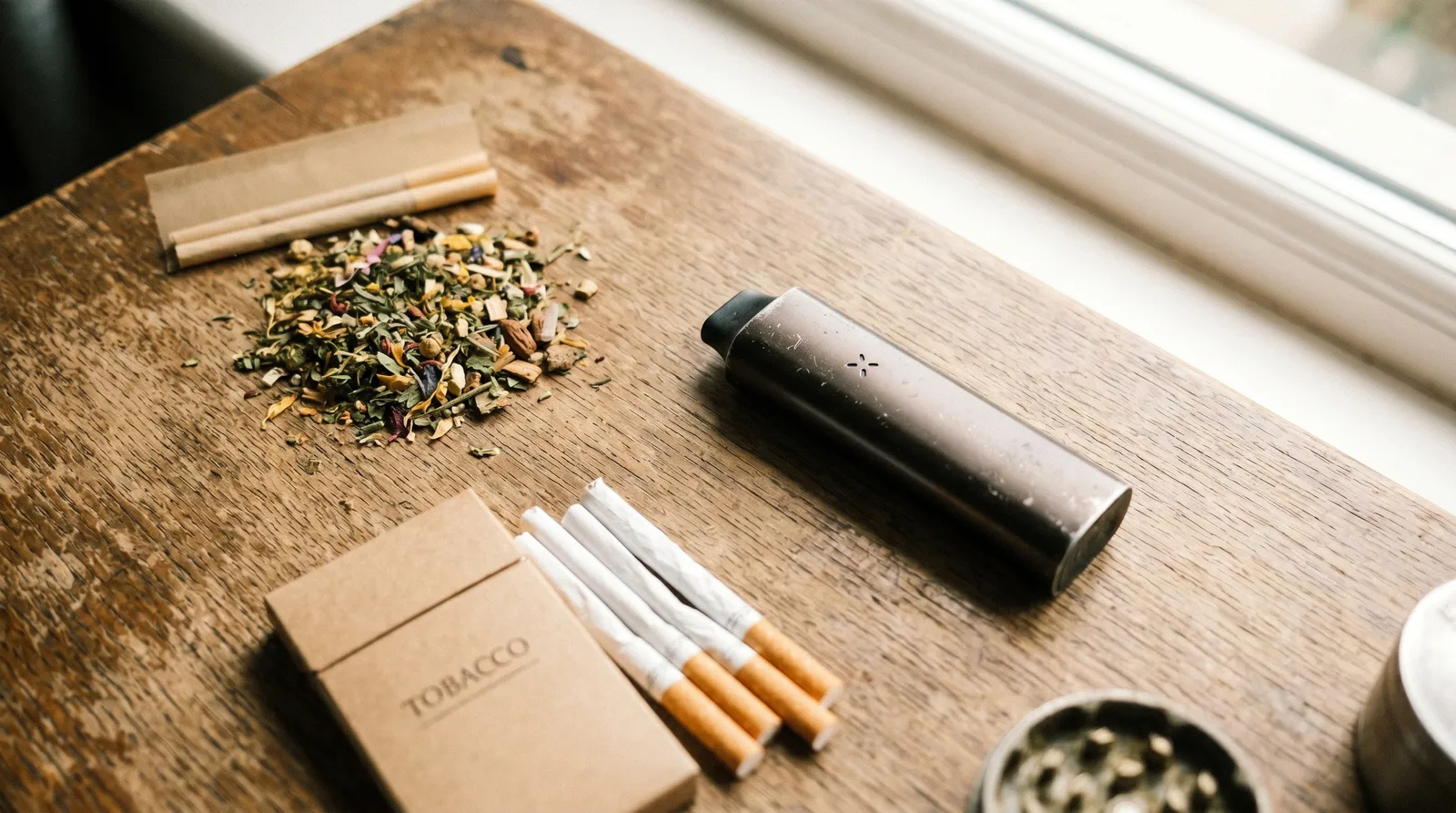
Herbal smoking blends sit between two other options — tobacco and dry-herb vaporisation — and understanding the trade-offs matters. Tobacco delivers nicotine, which is addictive; herbal blends remove that variable entirely but keep the combustion ritual intact. Vaporisation at 180–200°C reduces combustion byproducts compared to open flame, but requires hardware and a different technique. The table below summarises the practical differences:
| Factor | Herbal Smoking Blend | Tobacco Cigarette | Dry-Herb Vaporiser |
|---|---|---|---|
| Nicotine | None | Present (addictive) | Depends on material |
| Combustion byproducts | Yes — tar, CO, particulates | Yes — comparable levels (Rickert et al., 2005) | Reduced but not eliminated |
| Ritual / rolling experience | Identical to hand-rolled cigarette | Identical | Different — device-based |
| Flavour range | Wide — depends on blend | Narrow — tobacco-dominant | Wide — temperature-tuneable |
| Equipment needed | Papers or pipe only | Papers or pre-rolled | Vaporiser device (€30–€250+) |
For people who enjoy the hand-rolling ritual but want to step away from nicotine, herbal blends are the most direct substitute. For those prioritising harm reduction above all else, a quality dry-herb vaporiser is the better tool — though it changes the experience considerably.
Building Your First Blend: A Practical Walkthrough
Start with three ingredients, not eight. A first blend of 50% mullein, 35% damiana, and 15% lavender teaches you the basics of texture, burn rate, and flavour balance before you add complexity. Weigh ingredients on a kitchen scale — eyeballing by volume is unreliable because mullein is far fluffier than damiana leaf.
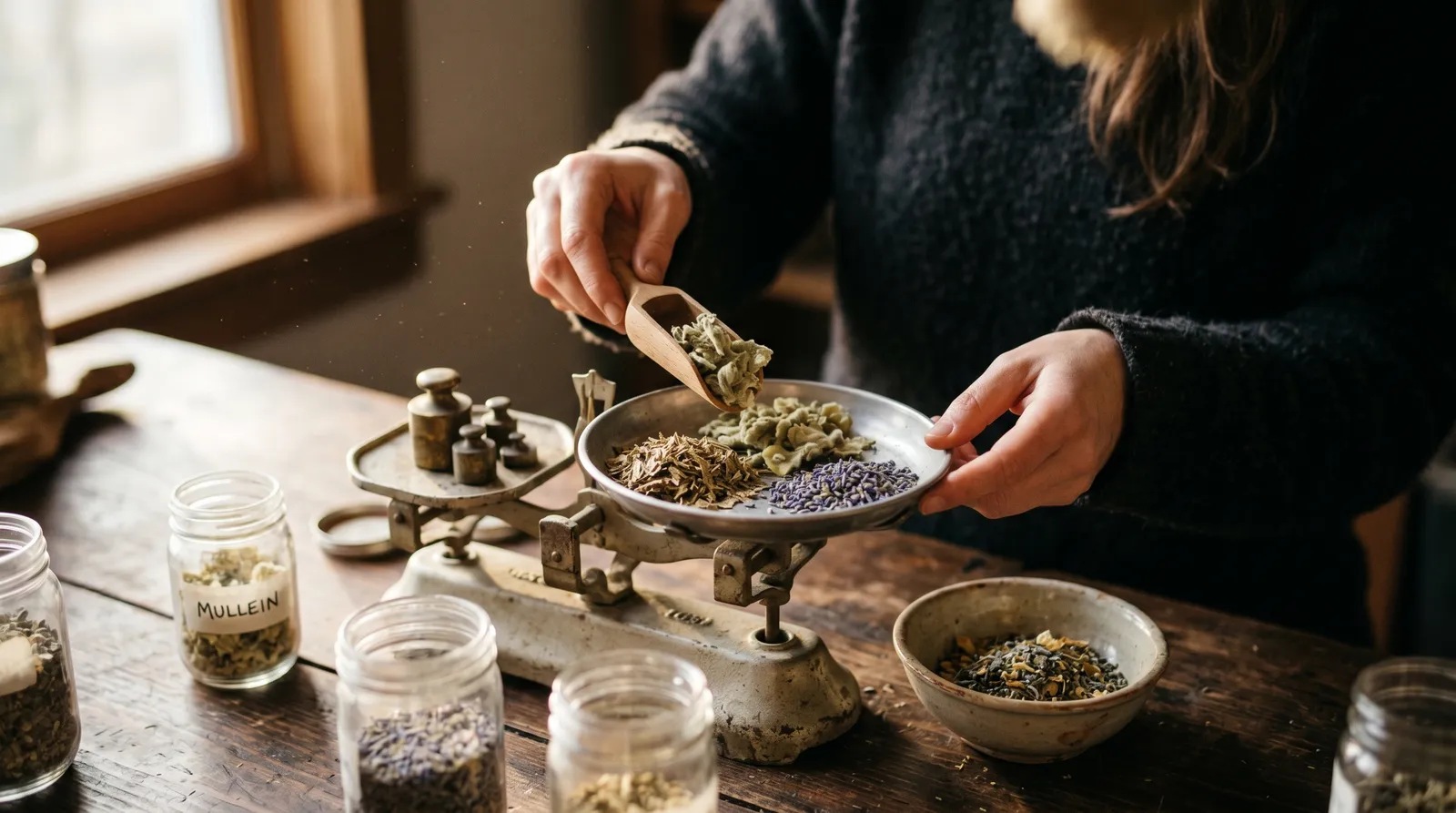
Crumble the mullein by hand to a coarse, ribbon-like texture. Rub the damiana between your palms until it breaks into small, even pieces — not powder. Pinch the lavender buds apart and scatter them through the mix. Toss everything gently in a bowl, the way you would a salad, until the accent herb is distributed throughout rather than clumped in one spot.
Roll a thin test cigarette and smoke half of it slowly. Pay attention to three things: does it stay lit without constant relighting (combustion), does the flavour balance feel right (character), and does the smoke feel smooth or scratchy (harshness). Adjust from there — more mullein if it is too strong, more damiana if it is too bland, less lavender if it is perfume-heavy.
Safety and Respiratory Risk
Combustion of any plant material produces tar, carbon monoxide, and fine particulate matter — herbal smoking blends are no exception. Anyone with respiratory conditions, asthma, or pollen allergies (mugwort, ragweed, Asteraceae cross-sensitivity) should not use smoking blends.
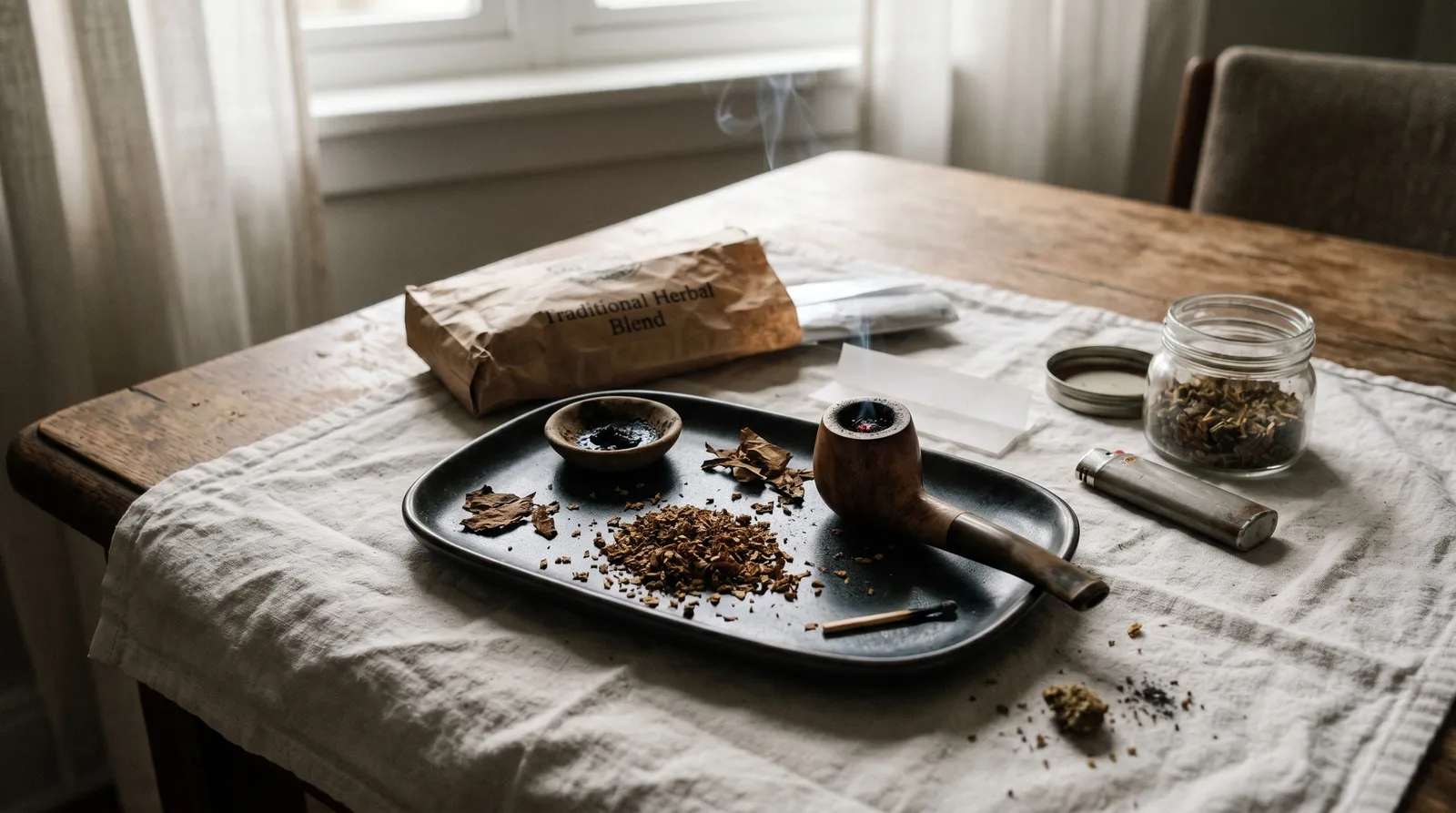
This point deserves emphasis because "tobacco-free" is sometimes misread as "harmless." A 2005 analysis by Rickert et al. found that herbal cigarettes produced tar, carbon monoxide, and particulate matter at levels comparable to conventional tobacco cigarettes. The absence of nicotine removes the addictive component, but the combustion chemistry does not change simply because the plant material is different. Inhaling smoke — any smoke — introduces polycyclic aromatic hydrocarbons and fine particulate matter into the lungs.
Mugwort specifically is a known allergen for anyone sensitive to ragweed, chrysanthemum, marigold, or other Asteraceae-family plants. Cross-reactivity is well documented (Lombardero et al., 2004). If you have a known daisy-family allergy, mugwort should be excluded from any blend entirely.
Dry-herb vaporisation at lower temperatures (around 180–200°C) reduces — but does not eliminate — combustion byproducts. It is a harm-reduction step, not a safety guarantee.
What the Research Actually Says
The honest picture is that peer-reviewed research on smoked herbal blends is thin. Most phytochemical studies on damiana, mugwort, wild dagga, and passionflower examine water or ethanol extracts — teas and tinctures — not combusted smoke. Whether the compounds identified in those extracts (apigenin in damiana, chrysin in passionflower, leonurine in wild dagga) survive combustion in meaningful quantities is largely unstudied. A 2007 phytochemical profile of Turnera diffusa (Zhao et al., 2007) characterised the volatile oil composition, but that work was done on the raw plant material, not on smoke condensate.
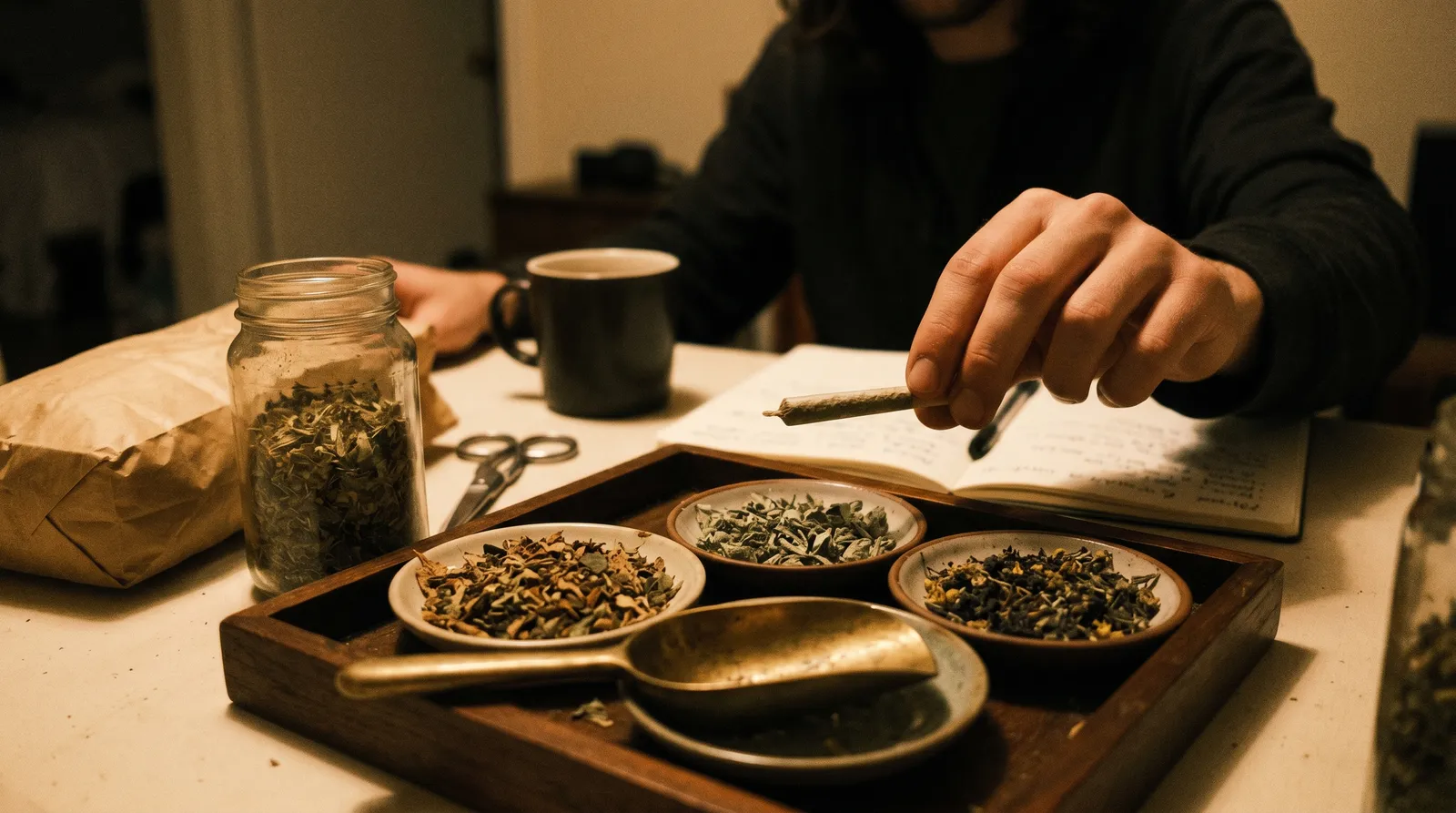
What we can say with confidence is that the traditional use of these plants in smoking form is well documented across multiple cultures and centuries. What we cannot say is that smoking them produces specific pharmacological effects in a reliable, dose-dependent way. Anyone claiming otherwise is outrunning the evidence.
This article is consumer education, not medical advice. Traditional and ceremonial uses are described for cultural and historical context. Botanicals can interact with medications and are not a substitute for professional care. If you are pregnant, nursing, taking prescription medication, or managing a health condition, consult a qualified healthcare practitioner before use.
References
- Bora, K.S. and Sharma, A. (2011). "The genus Artemisia: a review." Pharmaceutical Biology, 49(1), pp. 101–109.
- Crellin, J.K. and Philpott, J. (1990). A Reference Guide to Medicinal Plants: Herbal Medicine Past and Present. Duke University Press.
- Lombardero, M. et al. (2004). "Cross-reactivity among Artemisia species." Allergy, 59(1), pp. 69–76.
- Mazimba, O. (2015). "Leonotis leonurus: a herbal medicine review." Journal of Pharmacognosy and Phytochemistry, 3(6), pp. 74–82.
- Rätsch, C. (2005). The Encyclopedia of Psychoactive Plants. Park Street Press.
- Rickert, W.S. et al. (2005). "Mainstream smoke chemistry of herbal cigarettes." Regulatory Toxicology and Pharmacology, 42(3), pp. 289–296.
- Zhao, J. et al. (2007). "Phytochemical investigation of Turnera diffusa." Journal of Ethnopharmacology, 110(1), pp. 140–153.
Last updated: April 2026
Frequently Asked Questions
9 questionsDo herbal smoking blends produce tar like tobacco cigarettes?
What is the best base herb for a tobacco-free smoking blend?
Can you smoke mugwort if you have hay fever or ragweed allergy?
Is there scientific evidence that smoked damiana has effects?
What ratio of herbs should a smoking blend use?
Is vaporising herbal blends safer than smoking them?
Where can I buy herbal smoking blend ingredients?
How should I store a herbal smoking blend?
Can I mix herbal smoking blends with cannabis?
About this article


Adam Parsons is an external cannabis and psychedelics writer and editor who contributes to Azarius's wiki as both author and reviewer. On the writing side, he authors Azarius's kratom and kanna clusters, drawing on exten
This wiki article was drafted with AI assistance and reviewed by Adam Parsons, External contributor. Editorial oversight by Joshua Askew.
Medical disclaimer. This content is for informational purposes only and does not constitute medical advice. Consult a qualified healthcare provider before use of any substance.
Last reviewed April 26, 2026
Related Articles
Blue Lotus vs Kanna: Effects & Safety
Blue lotus vs kanna compared — Nymphaea caerulea's aporphine profile against Sceletium tortuosum's mesembrine chemistry, with interaction warnings.

Lotus Clinical Research Overview
What does lotus clinical research actually show? A critical review of Nymphaea caerulea and Nelumbo nucifera pharmacology, preclinical data, and…
Kanna South Africa To West History
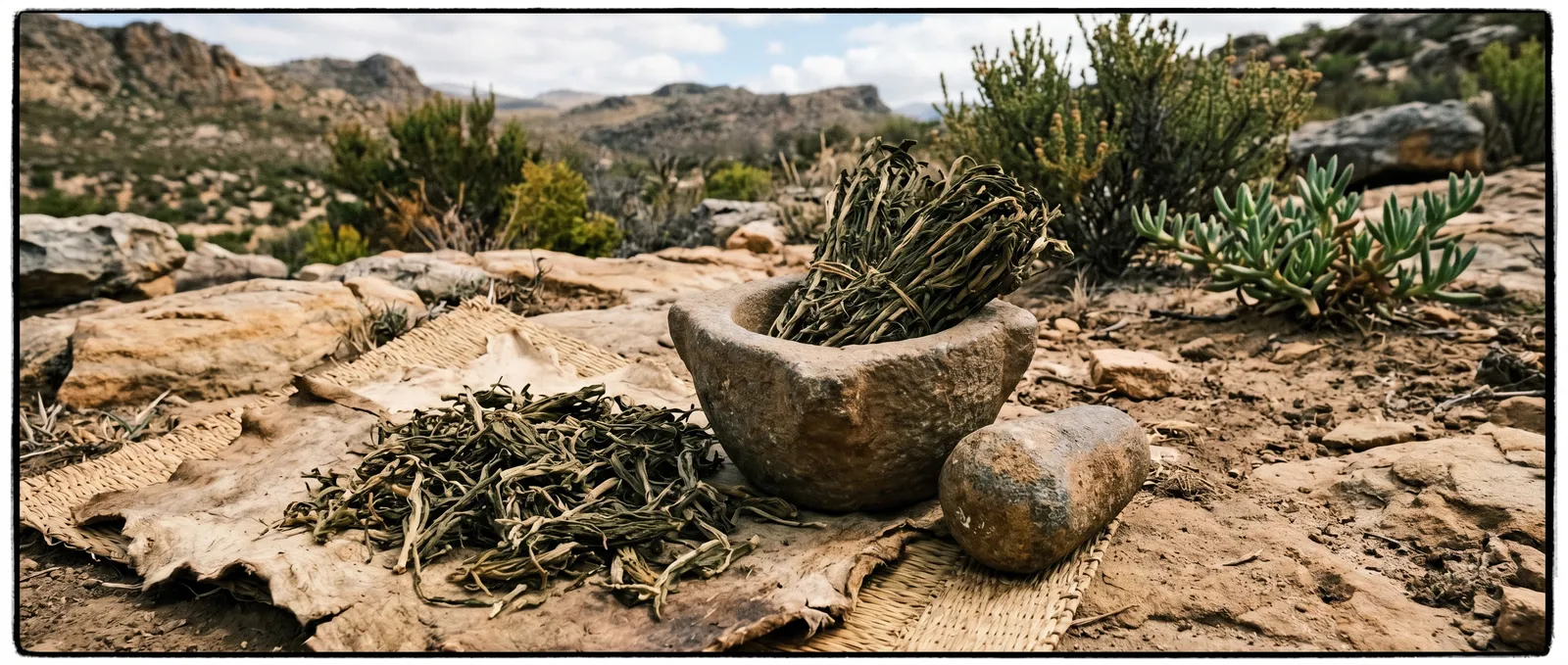
Sceletium tortuosum was used by San and Khoekhoe communities in southern Africa for centuries before European colonists first documented it in the 1660s.
Sceletium Tortuosum Plant
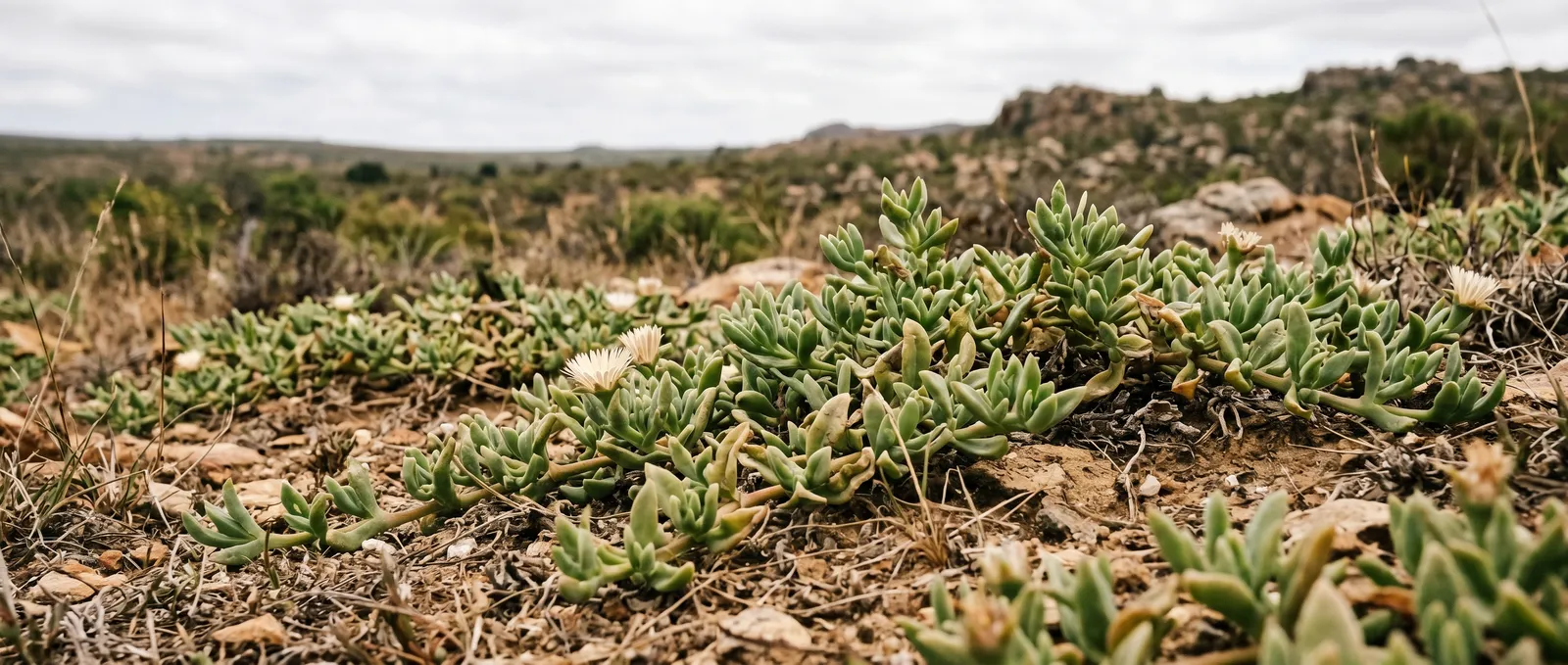
Learn about the sceletium tortuosum plant: botany, alkaloids, fermentation, safety warnings, and where to buy kanna.
Kanna Pharmacokinetics Explained
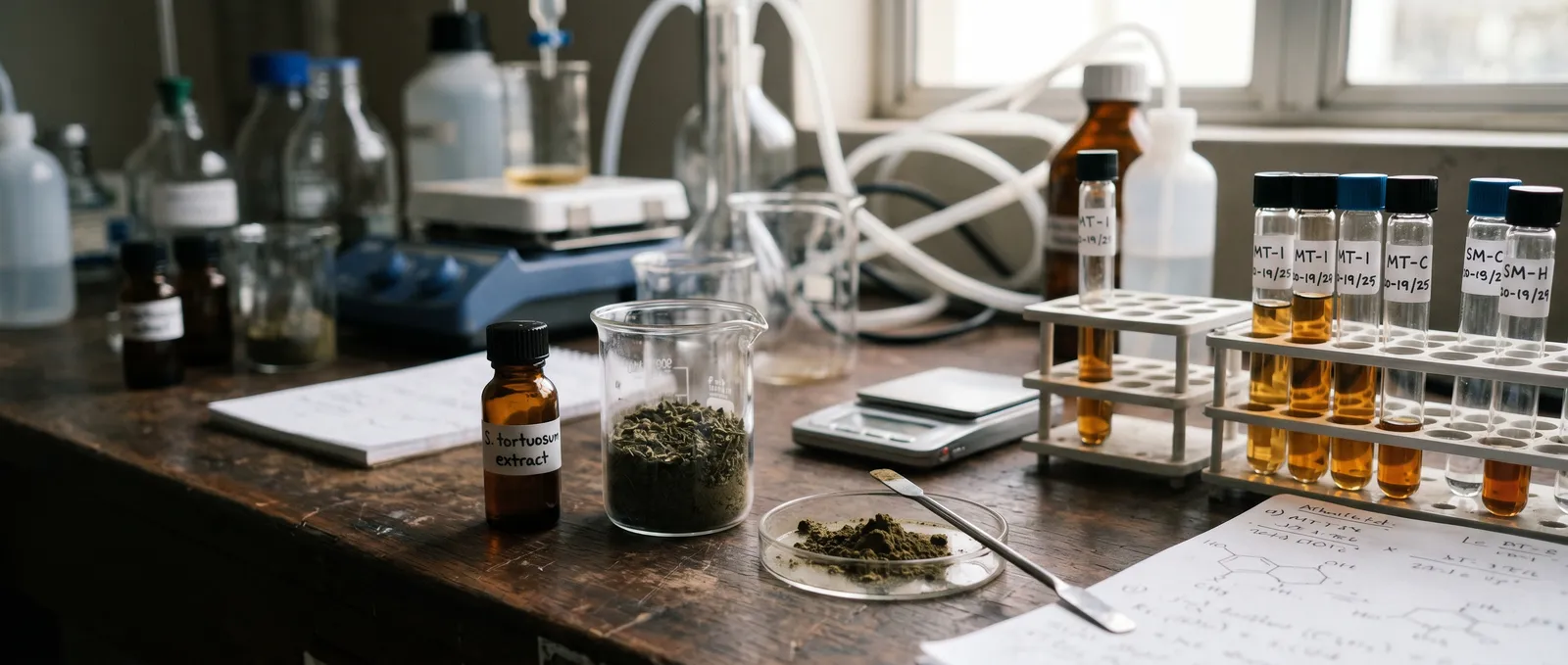
Complete guide to kanna pharmacokinetics: how Sceletium tortuosum alkaloids are absorbed, metabolised via CYP2D6, and eliminated.

Kanna Chemistry: Sceletium Alkaloids Explained
Kanna chemistry explained: mesembrine, mesembrenone, their mechanisms, how fermentation and extraction change alkaloid profiles, and why it matters…
Rapé Shamanic Snuff Guide: How to Use It Safely
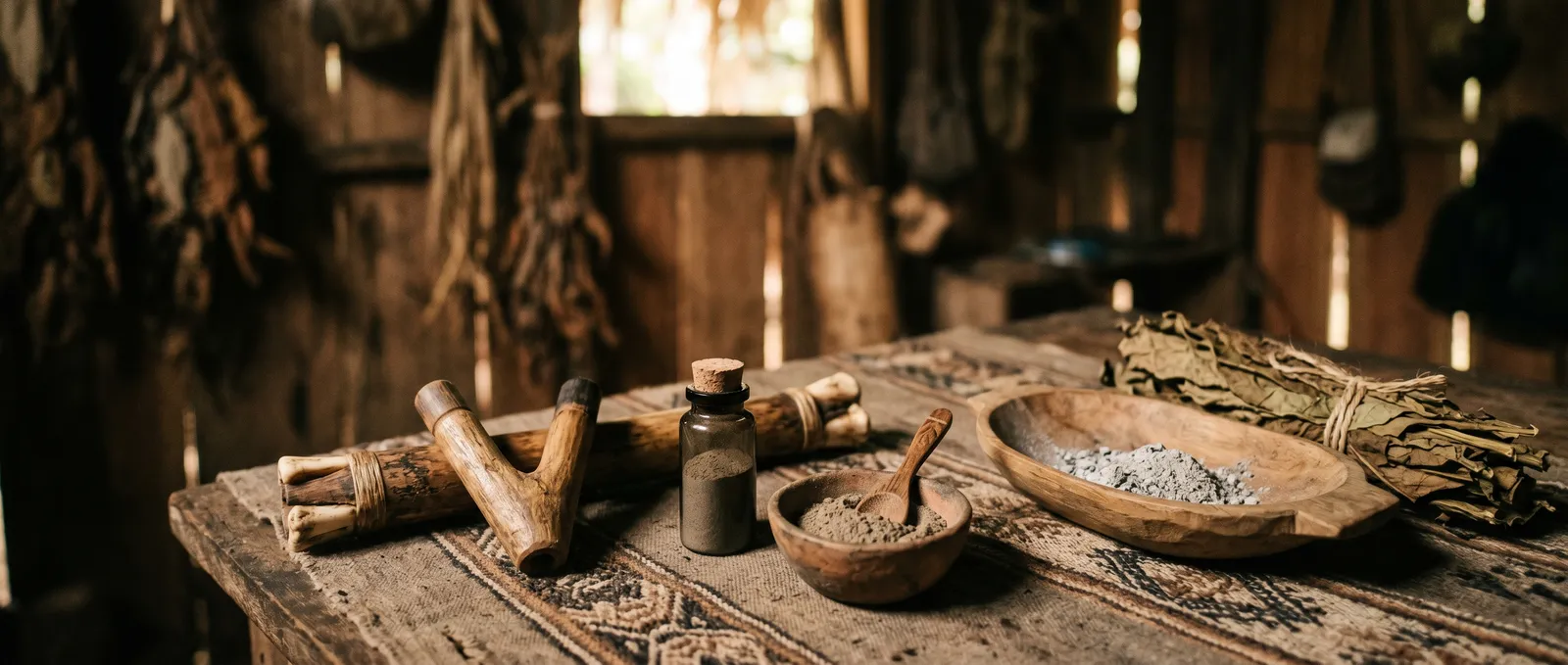
A practical rapé shamanic snuff guide covering dose, kuripe technique, effects, nicotine safety, interactions and Amazonian tradition.
White Sage Salvia Apiana Cultural Smudging Guide
Salvia apiana is a non-psychoactive shrub native to southern California's coastal sage scrub, burned as ceremonial incense in Indigenous North American…
Mulungu Erythrina Traditional Amazonian Use — Bark, Alkaloids & Research
Erythrina mulungu is a Brazilian legume tree whose bark has been brewed as a calming decoction in rural folk medicine for generations.