
This article discusses psychoactive substances intended for adults (18+). If you have a health condition or take medication, consult a doctor before use. Our age policy
Kanna Plant vs Extracts
Definition
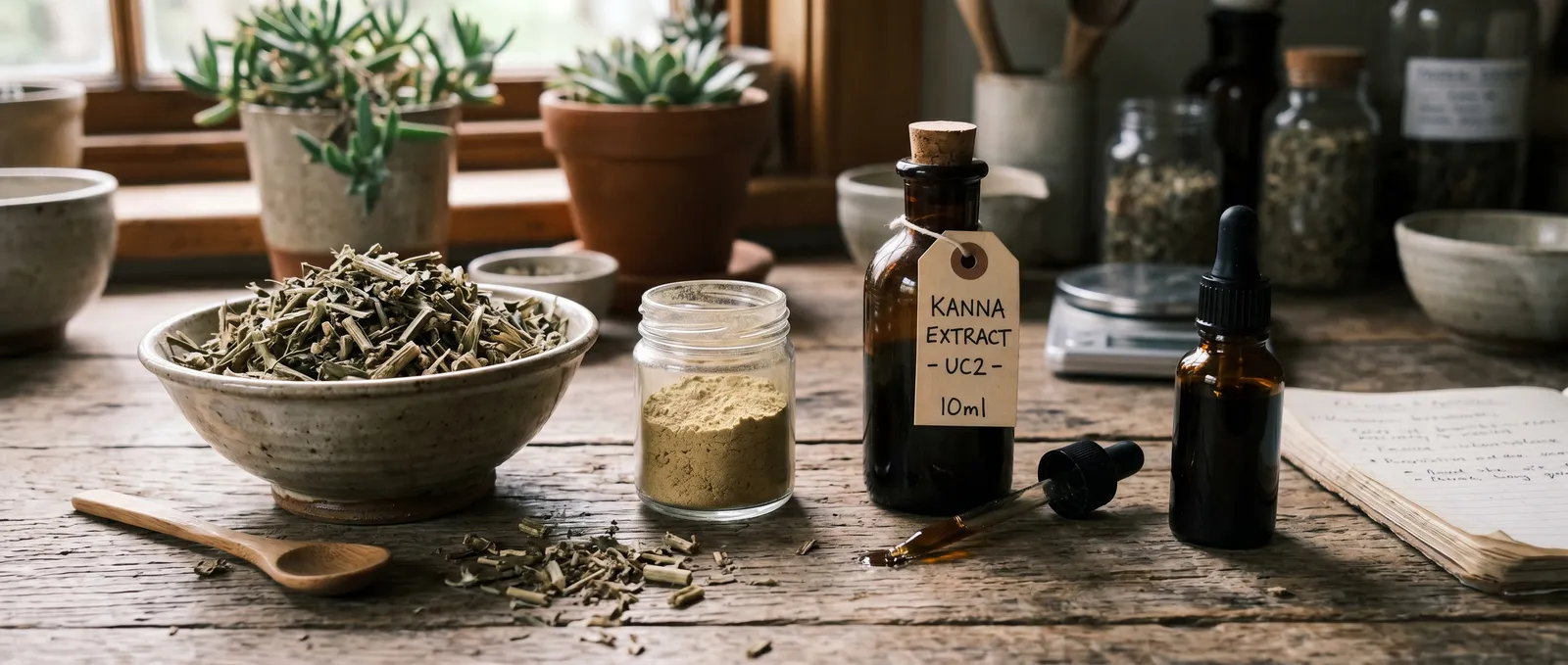
Kanna plant vs extracts is a comparison that centres on one key variable: alkaloid concentration per gram. Kanna (Sceletium tortuosum) is a succulent plant native to South Africa that is available as dried plant material — often fermented in the traditional Khoisan style — or as concentrated extracts that pack the same alkaloids into far smaller doses. Terburg et al. (2013) demonstrated anxiolytic-like effects for a specific standardised extract, but those findings don't automatically apply to all forms. The two differ meaningfully in potency, alkaloid ratios, dosing, and serotonergic interaction risk.
Kanna plant vs extracts is a comparison every buyer should understand before choosing a Sceletium tortuosum product. Kanna is a succulent plant native to South Africa that has been used for centuries by the Khoisan peoples for its mood-altering properties. When you buy kanna, it comes in two broad forms: dried plant material (often fermented in the traditional Khoisan style) and concentrated extracts that pack the same alkaloids into a much smaller amount. The difference between kanna plant vs extracts isn't just about convenience. It affects potency, onset, duration, the alkaloid profile you're actually ingesting, and how seriously you need to take serotonergic interaction risks. This article breaks down exactly what separates whole kanna plant from kanna extract, so you can understand what you're working with before you order.
Adult audience (18+). The dosing ranges and effects described in this article apply to adult physiology. This content is not intended for minors.
Disclaimer: This article is for informational purposes only and does not constitute medical advice. Kanna has serotonergic activity and may interact dangerously with prescription medications including SSRIs, SNRIs, and MAOIs. Do not use kanna as a substitute for professional medical treatment. If you are taking any medication, consult a qualified healthcare professional before using any kanna product. The information below reflects the current state of published research, which remains limited.
Comparison at a Glance
The core difference between kanna plant material and kanna extracts is alkaloid concentration per gram, which cascades into differences in dosing, onset, and risk profile.
| Dimension | Dried Plant Material (Fermented / Unfermented) | Concentrated Extract |
|---|---|---|
| Alkaloid concentration | Typically 0.3–1.5% total mesembrine-type alkaloids depending on strain and preparation | Standardised extracts concentrate alkaloids to defined levels; a 10:1 extract contains roughly ten times the alkaloid density per gram |
| Typical reported range | 200 mg – 1 g+ of dried material (varies widely by preparation) according to user reports | 25–150 mg for concentrated extracts according to user reports (varies by extraction ratio and standardisation) |
| Alkaloid profile | Full spectrum — mesembrine, mesembrenone, mesembrenol, and other minor alkaloids in natural ratios; fermentation shifts these ratios | Often enriched for mesembrine specifically; ratio of secondary alkaloids depends on extraction method |
| Onset (sublingual) | Some users report 15–30 minutes | Some users report 5–20 minutes |
| Duration | Users commonly report 1–3 hours | Users commonly report 1–2 hours, sometimes shorter but more pronounced |
| Route flexibility | Chewing, tea, sublingual, smoking (traditional) | Sublingual, oral capsule, insufflation, vaporisation |
| Serotonergic interaction risk | Present — applies to all kanna forms | Heightened — concentrated alkaloid load means greater serotonergic activity per unit weight |
| Batch consistency | Variable — alkaloid content depends on growing conditions, harvest timing, fermentation process | More consistent when standardised; non-standardised extracts can still vary significantly |
| Clinical research base | No controlled clinical trials on raw plant material | Published trials exist for one specific standardised extract — results do not automatically transfer to other extracts |
That table gives you the shape of the kanna plant vs extracts comparison. Now let's unpack what actually matters when deciding which form to get.
What Are You Actually Getting?
Dried kanna plant material contains the full suite of Sceletium alkaloids at their natural concentrations, while extracts concentrate those same alkaloids into a fraction of the weight. This single fact drives every other difference between the two forms.
Dried kanna plant material — particularly when prepared in the traditional fermented style (kougoed) — contains mesembrine, mesembrenone, and mesembrenol as the principal alkaloids, with their relative proportions varying by species, growing conditions, and critically, whether the material has been fermented. Smith et al. (2011) documented these variations in detail. Traditional Khoisan preparation involves bruising the aerial parts of the plant and allowing them to ferment over several days, which modifies the alkaloid ratios and reduces oxalate content. Fermented and unfermented plant material are genuinely different products, even though they come from the same plant.
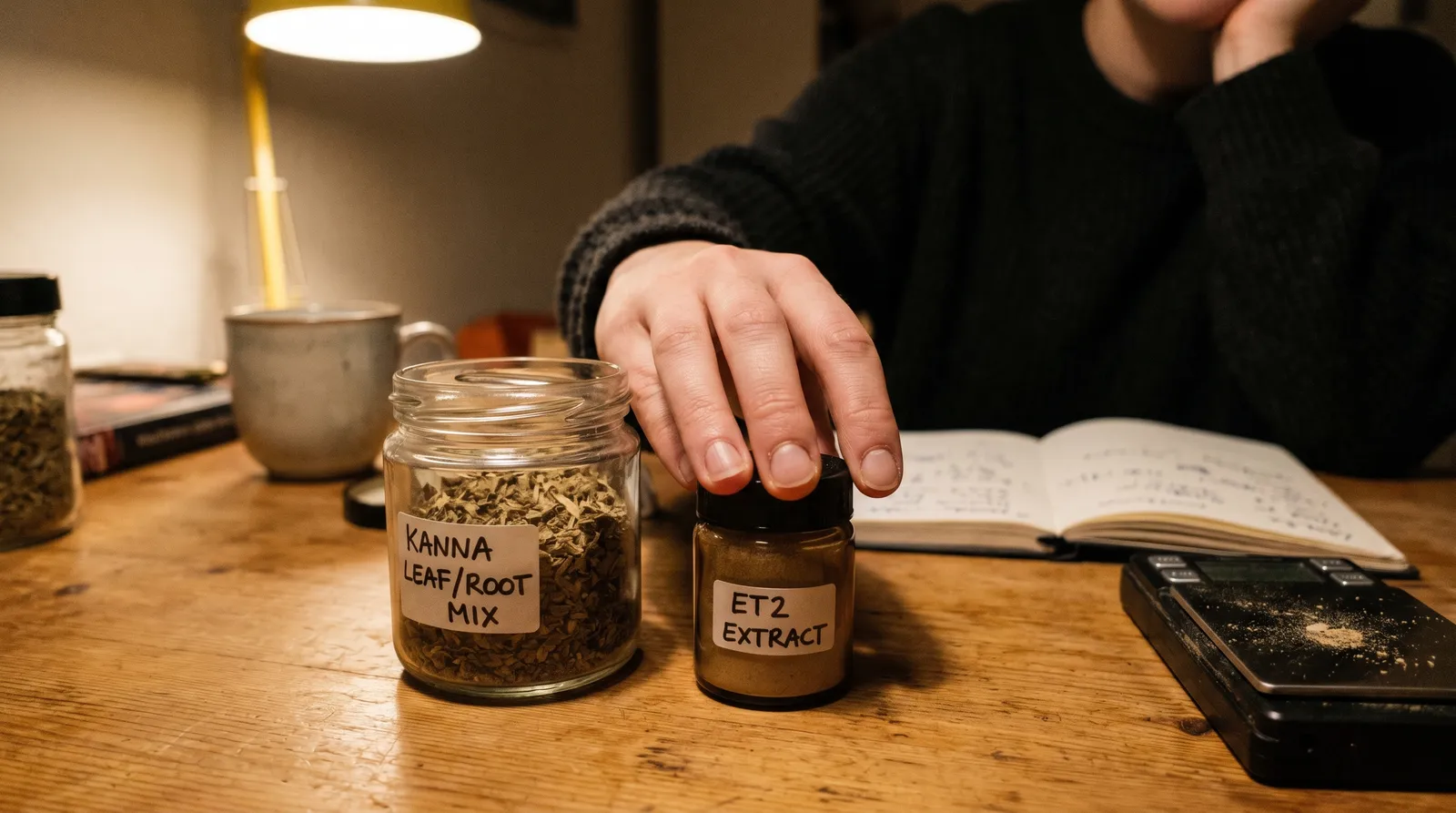
Extracts, by contrast, are produced by concentrating these alkaloids through various chemical or physical processes. A "10:1 extract" means, roughly, that ten grams of plant material were reduced to one gram of extract — so the alkaloid content per gram is substantially higher. Some extracts are further standardised to contain a specific percentage of mesembrine. This standardisation matters enormously, because it's the only way to get a reasonably predictable alkaloid amount from one batch to the next.
Here's the critical distinction most sources gloss over: not all extracts are the same. The clinical trials that have generated the most-cited data on kanna's effects on mood and anxiety used a specific standardised preparation with a defined alkaloid profile. Those results apply to that preparation. A non-standardised 10:1 extract from a different source, made with a different process, may have a completely different ratio of mesembrine to mesembrenone to mesembrenol — and therefore a different effect profile. Treating all kanna extracts as interchangeable is a mistake.
Alkaloid Profiles and Why They Matter
The three principal Sceletium alkaloids have different proposed mechanisms of action, which means the ratio in your kanna product likely shapes the character of the experience.
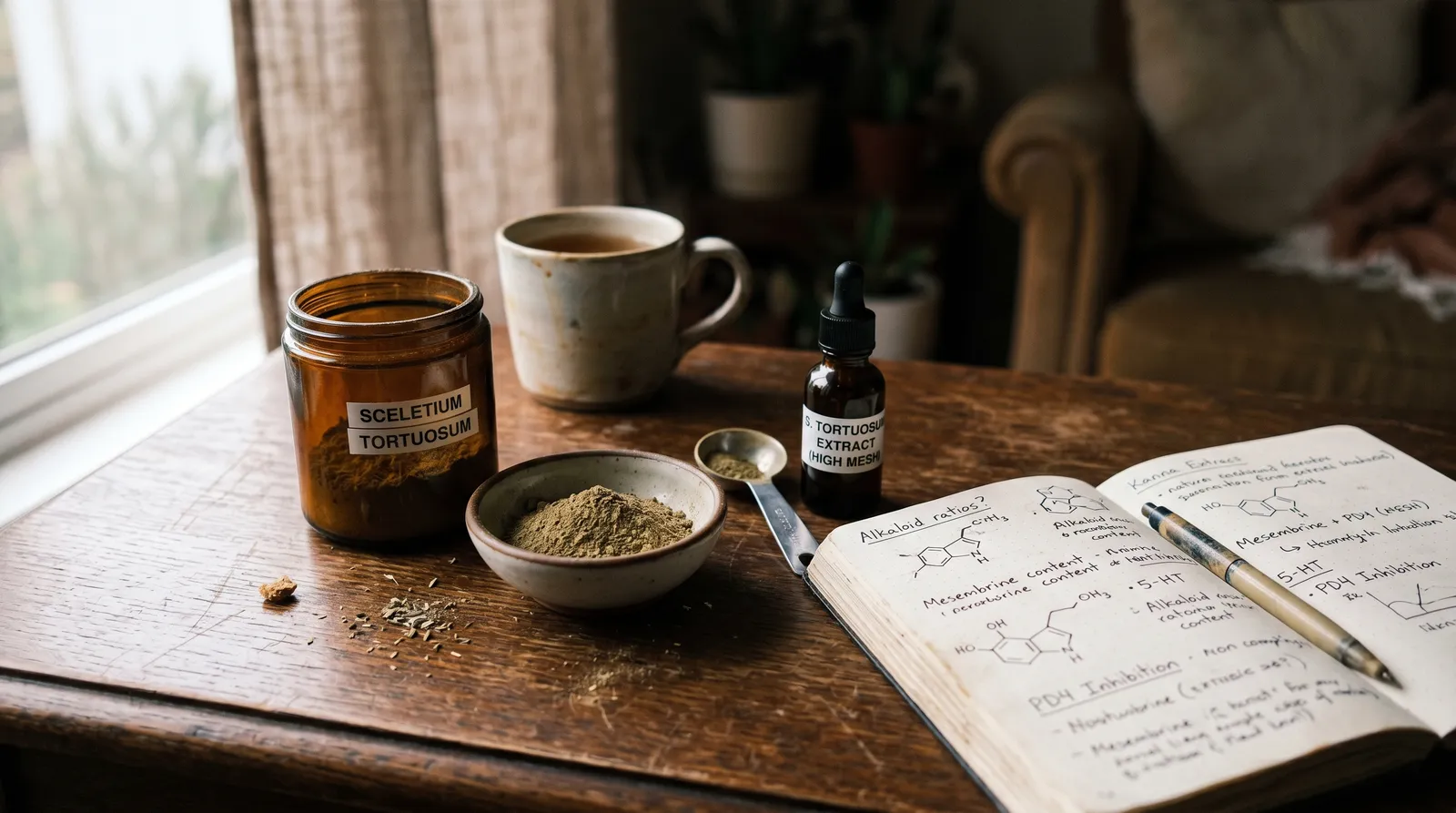
In-vitro research suggests that mesembrine acts primarily as a serotonin reuptake inhibitor, while mesembrenone appears to have stronger PDE4 (phosphodiesterase-4) inhibitory activity (Harvey et al., 2011). The relative contribution of each mechanism in living humans isn't settled — this is contested territory in the pharmacology — but the implication is straightforward: the ratio of alkaloids in what you consume likely influences the character of the effects.
Fermented kanna plant material tends to have a different mesembrine-to-mesembrenone ratio compared to unfermented material. Extracts standardised for high mesembrine content will skew the profile further. Some users report that whole fermented plant material produces a broader, gentler experience compared to high-mesembrine extracts, which they describe as more focused and sharper in onset. This is anecdotal — no controlled study has directly compared subjective effects of fermented plant versus standardised extract in the same participants — but it's consistent enough across user reports to be worth noting.
We should be honest about a limitation here: the pharmacology of kanna's alkaloid interactions in vivo is poorly understood. Most mechanistic data comes from in-vitro assays, which don't necessarily predict what happens in a living human body with first-pass metabolism, variable absorption, and individual differences in enzyme activity. Anyone claiming to know exactly how the alkaloid ratio translates to subjective experience is outrunning the evidence.
What Users Report About Amounts
User-reported amounts for kanna plant material and kanna extracts occupy completely different concentration ranges, and confusing them is the single most common mistake new users make when they first buy kanna.
For dried fermented kanna plant material, user reports commonly reference amounts in the range of 200 mg to 1 g or more, depending on the alkaloid content of that specific batch (which, without lab testing, you won't know precisely). For concentrated kanna extracts, the amounts users report drop dramatically — typically 25–150 mg, depending on the extraction ratio and standardisation. Clinical studies on the specific standardised extract used amounts measured in milligrams, not grams. Individual responses vary widely, and these figures reflect community reports rather than clinical recommendations.
The challenge with non-standardised material — whether plant or extract — is that you're estimating. The mesembrine content of Sceletium tortuosum plant material can vary by a factor of five or more depending on the cultivar, harvest conditions, and processing method. With a standardised extract, at least you have a stated alkaloid percentage to work from. With raw plant material, you're relying on the supplier's consistency and your own experience with that particular batch. This variability is a genuine limitation that no amount of careful sourcing fully eliminates — even analytical labs report batch-to-batch variation in Sceletium alkaloid content.
Routes of Use and How Form Affects Them
The form of kanna you choose directly determines which routes of administration are practical, and route in turn affects how quickly and intensely the alkaloids reach your system.
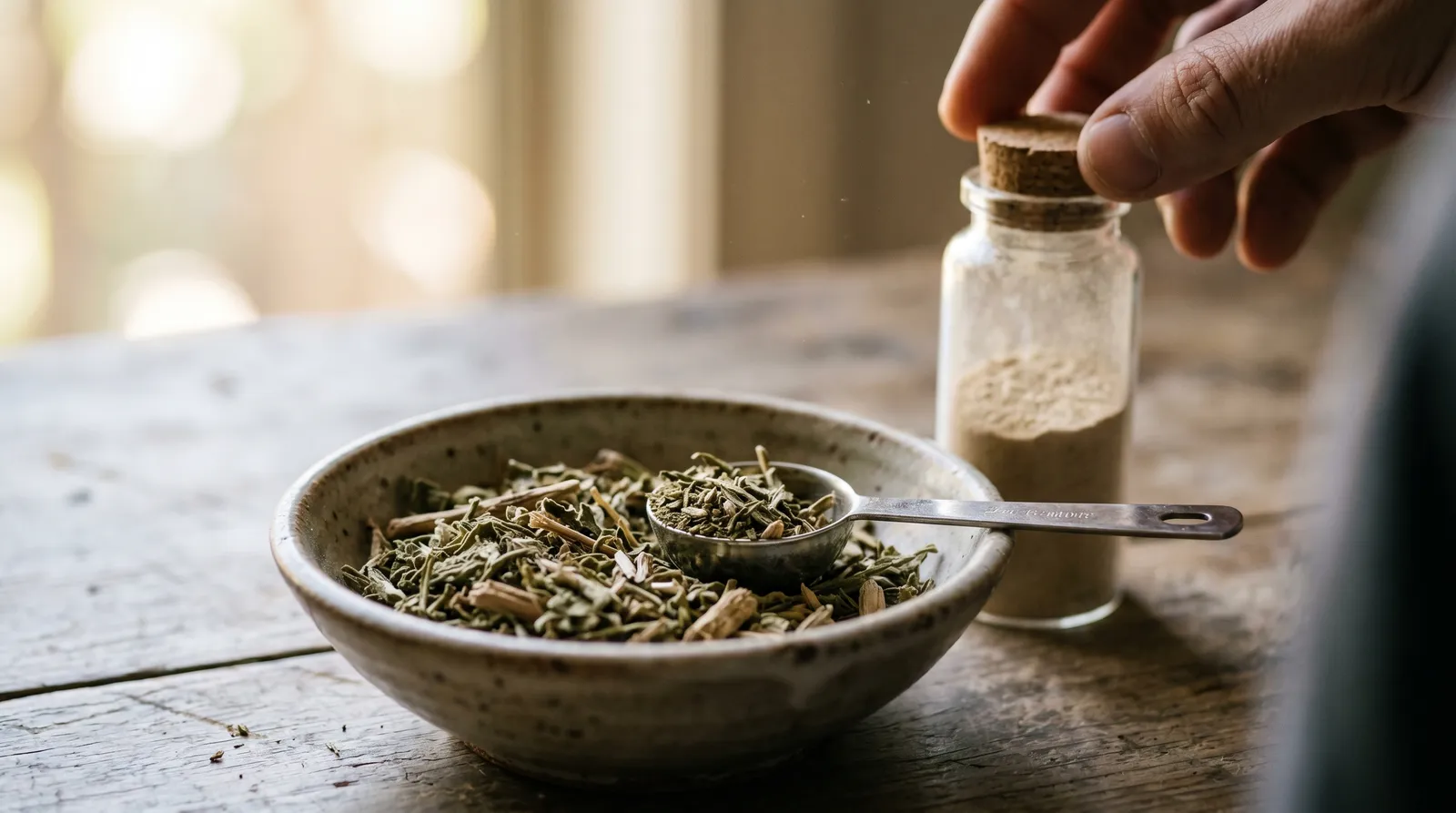
Dried kanna plant material lends itself to chewing (the traditional method), brewing as a tea, or sublingual use — holding it under the tongue for absorption through the oral mucosa. Smoking dried Sceletium is also documented in traditional Khoisan practice.
Kanna extracts open up additional options. The concentrated powder dissolves more readily for sublingual use and can be placed in capsules for oral ingestion. Some users vaporise extracts, though published pharmacokinetic data on inhaled Sceletium alkaloids is essentially absent — onset via this route is reported by users as very rapid (within minutes), but you're working without a safety net of research data.
Route matters pharmacologically. Sublingual and inhaled routes bypass first-pass liver metabolism, meaning more of the active alkaloids reach systemic circulation more quickly. This is relevant for both kanna plant material and kanna extracts, but the practical consequence is more pronounced with extracts: a sublingual amount of concentrated extract delivers a larger alkaloid load faster than the same weight of plant material taken the same way. Users who are accustomed to chewing dried kanna and then switch to sublingual extract need to account for this difference — the experience will not be comparable at equal weights.
Serotonergic Risk: Applies to Both, but Not Equally
Every form of kanna carries serotonergic activity, and this is the most important safety consideration regardless of whether you choose plant material or extract.
Mesembrine's proposed mechanism as a serotonin reuptake inhibitor means that combining any kanna product with SSRIs, SNRIs, MAOIs, tricyclic antidepressants, or other serotonergic substances (including 5-HTP, St John's Wort, MDMA, and classical psychedelics) creates a risk of serotonin syndrome — a rare but potentially serious condition involving agitation, hyperthermia, rapid heart rate, and in severe cases, seizures. The EMCDDA has noted the serotonergic properties of Sceletium alkaloids in its risk assessments of novel psychoactive substances. Anyone taking antidepressants should not use kanna without medical supervision.
The serotonergic interaction concern applies with greater weight to concentrated kanna extracts. The reasoning is simple: extracts deliver more mesembrine per unit weight. A sublingual amount of a 50x extract puts substantially more serotonin reuptake inhibitor into your system than the same weight of dried plant material. If you're combining kanna with anything that touches the serotonin system — and this includes recent SSRI discontinuation, since active metabolites can persist for weeks, particularly with fluoxetine — the risk scales with the alkaloid load.
For a complete breakdown of specific substances to avoid, see the dedicated kanna interactions and safety article in the Azarius encyclopedia.
What Does the Clinical Research Actually Cover?
Published clinical data on kanna is limited to one specific standardised extract preparation, and those findings cannot be generalised to all kanna products.
Terburg et al. (2013) reported that this preparation reduced amygdala reactivity to threat-related stimuli in a small sample, suggesting anxiolytic-like effects. Other trials on the same preparation have reported effects on mood-related outcomes. These findings are genuinely interesting, but they come with a critical caveat that most popular sources ignore.
The research was conducted on one specific standardised preparation with a defined alkaloid profile. Those results do not automatically transfer to dried kanna plant material, to non-standardised kanna extracts, or even to differently standardised extracts. The alkaloid ratios, bioavailability, and response curves may all differ. Treating a clinical trial on one preparation as evidence for all kanna products is like citing a study on espresso and applying the conclusions to green tea — they both contain caffeine, but they're not the same thing.
For raw plant material specifically, there are no published controlled clinical trials. The traditional use of kougoed by the Khoisan peoples of southern Africa is well-documented ethnobotanically (Smith et al., 1996), providing centuries of observational evidence, but observational tradition and controlled clinical data are different categories of evidence and should be treated as such.
Consistency and What You Can Control
Standardised kanna extracts offer better batch-to-batch consistency than raw plant material, but "standardised" only means as much as the manufacturer's quality control allows.
If an extract states a specific mesembrine percentage, you have a reference point — assuming the manufacturer's quality control is reliable. Kanna plant material, even from the same supplier, can vary from harvest to harvest. Fermentation adds another variable: duration, temperature, and technique all influence the final alkaloid profile.
That said, "standardised" only means what the label says it means. A standardised extract from a reputable source with third-party testing is a different proposition from an extract that merely claims a concentration ratio without verification. The extract market for botanicals generally is plagued by inconsistent labelling — a problem not unique to kanna but worth being aware of.
With plant material, what you lose in precision you may gain in the full-spectrum alkaloid profile. Whether that matters subjectively is something users disagree about, and the science isn't there to settle the argument yet.
Kanna Plant vs Extracts Compared to Other Botanicals
The kanna plant vs extracts distinction mirrors a pattern seen across many ethnobotanical products, and comparing how other plants handle the same trade-off can be instructive.
Kratom offers a useful parallel: whole kratom leaf contains a broad spectrum of alkaloids at relatively low concentrations, while kratom extracts concentrate mitragynine into far smaller amounts — and the mistakes people make with kratom extracts are remarkably similar to those made with kanna extracts. The same pattern holds for blue lotus, where dried flowers and concentrated extracts require entirely different approaches. In each case, the extract is not simply "more of the same" — the concentration process changes the alkaloid ratios and therefore the character of the experience. Understanding this pattern across botanicals helps frame why the kanna plant vs extracts question isn't just about strength but about what you're actually consuming. If you're exploring this category more broadly, products like kratom leaf, blue lotus flowers, and other ethnobotanical preparations in the Azarius smartshop catalogue follow the same whole-plant-versus-extract logic. Customers who want to get a broader sense of the herbs category will find related options alongside kanna in the Azarius herbs section.
Which Form Suits What?
Neither form is objectively "better" — the right choice depends on your priorities around precision, alkaloid spectrum, and intended route of use.
Dried kanna plant material — particularly fermented kougoed — connects to the traditional preparation method and provides the full alkaloid spectrum. It's less concentrated, meaning there's more margin in either direction, and it lends itself to slower-onset methods like chewing or tea. Users who prefer a gentler, more gradual experience often gravitate here.
Kanna extracts suit users who want a more defined, predictable alkaloid amount in a smaller quantity of material. They're more practical for sublingual use or capsules, and standardised versions offer the closest approximation to what was actually tested in clinical research — though "closest approximation" is not "identical to," and that distinction matters.
Whichever form you choose, the same safety principles apply: start conservatively with a new batch or product, especially if you have no prior experience with that specific preparation; never combine with serotonergic substances; and give adequate time for onset before reconsidering. If you want to get kanna and try both forms side by side, ordering a small quantity of each is a reasonable approach — many of our customers do exactly that.
Related Products
The Sceletium range we carry includes both traditional fermented kanna plant material and concentrated kanna extracts at various ratios, so you can choose the form that fits your preference. If you're looking to buy kanna, we recommend starting with a lower-concentration extract or the fermented shredded plant to get a sense of your individual response before exploring higher-concentration options. Related products worth exploring include Kanna Fermented Shredded, Kanna ET2 Extract, Kanna UC Extract, and Kanna UC2 Extract. Customers interested in the broader ethnobotanical category may also want to explore kratom products, blue lotus, and other mood-supporting herbs available in the Azarius smartshop and herbs catalogue.
Frequently Asked Questions
Is kanna extract stronger than dried kanna plant material?
Gram for gram, yes. Extracts concentrate Sceletium alkaloids — primarily mesembrine — so effective amounts are measured in milligrams rather than the hundreds of milligrams or grams typical for dried plant material. A 10:1 extract contains roughly ten times the alkaloid density per gram. This means errors carry more consequence with extracts.
Does fermented kanna have a different alkaloid profile than unfermented?
Yes. Traditional fermentation modifies the ratio of mesembrine to mesembrenone and reduces oxalate content. The two are genuinely different products even though they come from the same plant. Some users report the fermented material produces a broader, gentler effect, though no controlled study has directly compared subjective experiences.
Can I use clinical kanna research to guide my experience with raw plant material?
Not directly. Published clinical trials used a specific standardised 25:1 extract with a defined alkaloid profile. Raw plant material has variable alkaloid content and a different alkaloid ratio. Applying extract-based research figures to plant material — or vice versa — risks either underestimating or significantly overestimating the alkaloid load you encounter.
Is the serotonin syndrome risk the same for kanna plant and extracts?
The risk exists with both forms, but extracts deliver more mesembrine per unit weight, meaning greater serotonergic activity. The interaction concern — particularly with SSRIs, SNRIs, MAOIs, and other serotonergic substances — applies with greater weight to concentrated extracts.
Why do different kanna extracts produce different effects?
Extraction methods and standardisation targets vary between manufacturers. One extract may be enriched for mesembrine while another retains more mesembrenone, which has different proposed mechanisms (PDE4 inhibition versus serotonin reuptake inhibition). Without standardisation to a specific alkaloid profile, two "10:1 extracts" can differ substantially.
Where can I buy kanna plant material or extracts?
Azarius carries both traditional fermented kanna plant material and concentrated kanna extracts at various ratios. When choosing where to buy, look for suppliers who provide clear information about extraction ratios, standardisation, and ideally third-party testing. Starting with a lower-concentration product is advisable if you are new to kanna.
How should I store kanna after I order it?
Both dried kanna plant material and kanna extracts should be stored in a cool, dry place away from direct sunlight. Airtight containers help preserve alkaloid content over time. Fermented plant material is relatively shelf-stable due to reduced moisture content from the fermentation process, while extracts are similarly stable when kept sealed. Avoid humid environments, as moisture can degrade both forms.
Last updated: April 2026
References
- Harvey, A. L., Young, P., Darien, M. A., & Gericke, N. (2011). Pharmacological actions of the South African medicinal and functional food plant Sceletium tortuosum and its principal alkaloids. Journal of Ethnopharmacology, 137(3), 1124–1129.
- Smith, M. T., Crouch, N. R., Gericke, N., & Hirst, M. (1996). Psychoactive constituents of the genus Sceletium N.E.Br. and other Mesembryanthemaceae: a review. Journal of Ethnopharmacology, 50(3), 119–130.
- Smith, M. T., Field, C. R., Crouch, N. R., & Hirst, M. (2011). The distribution of mesembrine alkaloids in selected taxa of the Mesembryanthemaceae and their modification in the Sceletium derived 'kougoed.' Pharmaceutical Biology, 36(3), 173–179.
- Terburg, D., Syal, S., Rosenberger, L. A., Heany, S., Phillips, N., Gericke, N., ... van Honk, J. (2013). Acute effects of Sceletium tortuosum (Zembrin), a dual 5-HT reuptake and PDE4 inhibitor, in the human amygdala and its connection to the hypothalamus. Neuropsychopharmacology, 38(13), 2708–2716.
- EMCDDA (European Monitoring Centre for Drugs and Drug Addiction). Risk assessment of new psychoactive substances — operating guidelines. Available at emcdda.europa.eu.
Frequently Asked Questions
10 questionsIs kanna extract stronger than dried kanna plant material?
Does fermented kanna have a different alkaloid profile than unfermented?
Can I use clinical kanna research to guide dosing with raw plant material?
Is the serotonin syndrome risk the same for kanna plant and extracts?
Why do different kanna extracts produce different effects?
Where can I buy kanna plant material or extracts?
How do I choose between sublingual and oral use for kanna plant material versus extracts?
Does kanna extract last shorter than whole kanna plant material?
Can I make my own kanna extract from raw plant material at home?
Does kanna plant material or extract work better when combined with other herbs?
About this article


Adam Parsons is an external cannabis and psychedelics writer and editor who contributes to Azarius's wiki as both author and reviewer. On the writing side, he authors Azarius's kratom and kanna clusters, drawing on exten
This wiki article was drafted with AI assistance and reviewed by Adam Parsons, External contributor. Editorial oversight by Joshua Askew.
Medical disclaimer. This content is for informational purposes only and does not constitute medical advice. Consult a qualified healthcare provider before use of any substance.
Last reviewed April 24, 2026
References (5)
- [1]Harvey, A. L., Young, P., Darien, M. A., & Gericke, N. (2011). Pharmacological actions of the South African medicinal and functional food plant Sceletium tortuosum and its principal alkaloids. Journal of Ethnopharmacology , 137(3), 1124–1129. DOI: 10.1016/j.jep.2011.07.035
- [2]Smith, M. T., Crouch, N. R., Gericke, N., & Hirst, M. (1996). Psychoactive constituents of the genus Sceletium N.E.Br. and other Mesembryanthemaceae: a review. Journal of Ethnopharmacology , 50(3), 119–130. DOI: 10.1016/0378-8741(95)01342-3
- [3]Smith, M. T., Field, C. R., Crouch, N. R., & Hirst, M. (2011). The distribution of mesembrine alkaloids in selected taxa of the Mesembryanthemaceae and their modification in the Sceletium derived 'kougoed.' Pharmaceutical Biology , 36(3), 173–179.
- [4]Terburg, D., Syal, S., Rosenberger, L. A., Heany, S., Phillips, N., Gericke, N., ... van Honk, J. (2013). Acute effects of Sceletium tortuosum (Zembrin), a dual 5-HT reuptake and PDE4 inhibitor, in the human amygdala and its connection to the hypothalamus. Neuropsychopharmacology , 38(13), 2708–2716. DOI: 10.1038/npp.2013.183
- [5]EMCDDA (European Monitoring Centre for Drugs and Drug Addiction). Risk assessment of new psychoactive substances — operating guidelines. Available at emcdda.europa.eu.
Related Articles
Blue Lotus vs Kanna: Effects & Safety
Blue lotus vs kanna compared — Nymphaea caerulea's aporphine profile against Sceletium tortuosum's mesembrine chemistry, with interaction warnings.
Lotus Clinical Research Overview
What does lotus clinical research actually show? A critical review of Nymphaea caerulea and Nelumbo nucifera pharmacology, preclinical data, and…
Kanna South Africa To West History
Sceletium tortuosum was used by San and Khoekhoe communities in southern Africa for centuries before European colonists first documented it in the 1660s.
Sceletium Tortuosum Plant
Learn about the sceletium tortuosum plant: botany, alkaloids, fermentation, safety warnings, and where to buy kanna.
Kanna Pharmacokinetics Explained
Complete guide to kanna pharmacokinetics: how Sceletium tortuosum alkaloids are absorbed, metabolised via CYP2D6, and eliminated.
Kanna Chemistry: Sceletium Alkaloids Explained
Kanna chemistry explained: mesembrine, mesembrenone, their mechanisms, how fermentation and extraction change alkaloid profiles, and why it matters…
Rapé Shamanic Snuff Guide: How to Use It Safely
A practical rapé shamanic snuff guide covering dose, kuripe technique, effects, nicotine safety, interactions and Amazonian tradition.
White Sage Salvia Apiana Cultural Smudging Guide
Salvia apiana is a non-psychoactive shrub native to southern California's coastal sage scrub, burned as ceremonial incense in Indigenous North American…
Mulungu Erythrina Traditional Amazonian Use — Bark, Alkaloids & Research
Erythrina mulungu is a Brazilian legume tree whose bark has been brewed as a calming decoction in rural folk medicine for generations.