
This article discusses psychoactive substances intended for adults (18+). If you have a health condition or take medication, consult a doctor before use. Our age policy
Nymphaea Caerulea Egyptian History: The Blue Lotus Flower on Every Wall
Definition
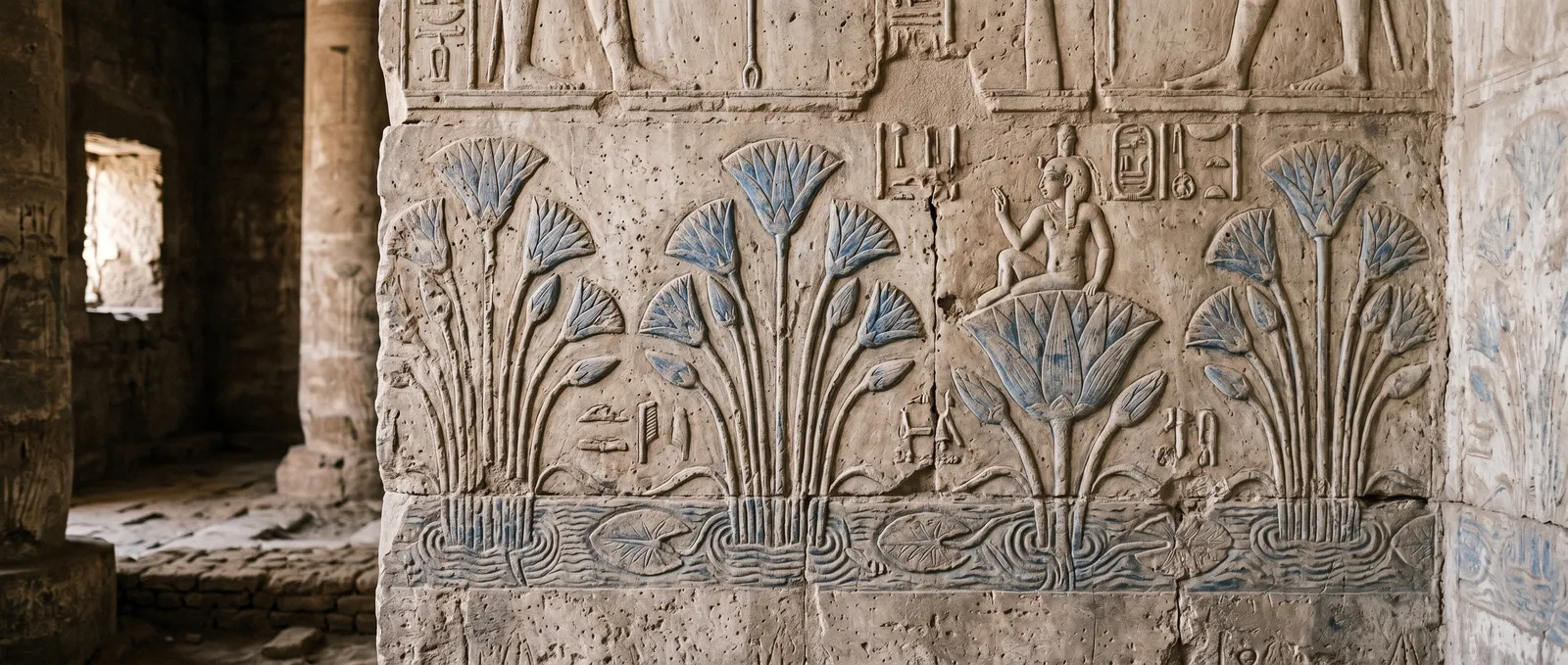
Nymphaea caerulea — the blue water lily commonly called blue lotus — is one of the most frequently depicted plants in ancient Egyptian art, appearing in tomb paintings, temple carvings, and funerary garlands across roughly three millennia. Emboden (1978) proposed that its presence alongside other psychoactive plants in banquet scenes indicates deliberate narcotic use, a hypothesis supported by the flower's aporphine alkaloid content but not yet confirmed by direct archaeological evidence.
Nymphaea caerulea Egyptian history is a story that spans roughly three thousand years of art, religion, and ritual. Nymphaea caerulea is a blue-flowered water lily in the family Nymphaeaceae that the ancient Egyptians depicted more frequently than almost any other plant. Commonly called blue lotus, it appears on tomb paintings, carved into temple columns, clutched in the hands of the dead, and floating in offering bowls beside bread and beer. The sheer volume of its representation across Egyptian visual culture is not accidental. This article unpacks what archaeology, ethnobotany, and phytochemistry can actually tell us about the role of Nymphaea caerulea in Egyptian civilisation — and where the evidence thins out.
Adult audience (18+). The dosing ranges and effects described in this article apply to adult physiology. This content is not intended for minors.
Nymphaea Caerulea Is a Water Lily, Not Technically a Lotus
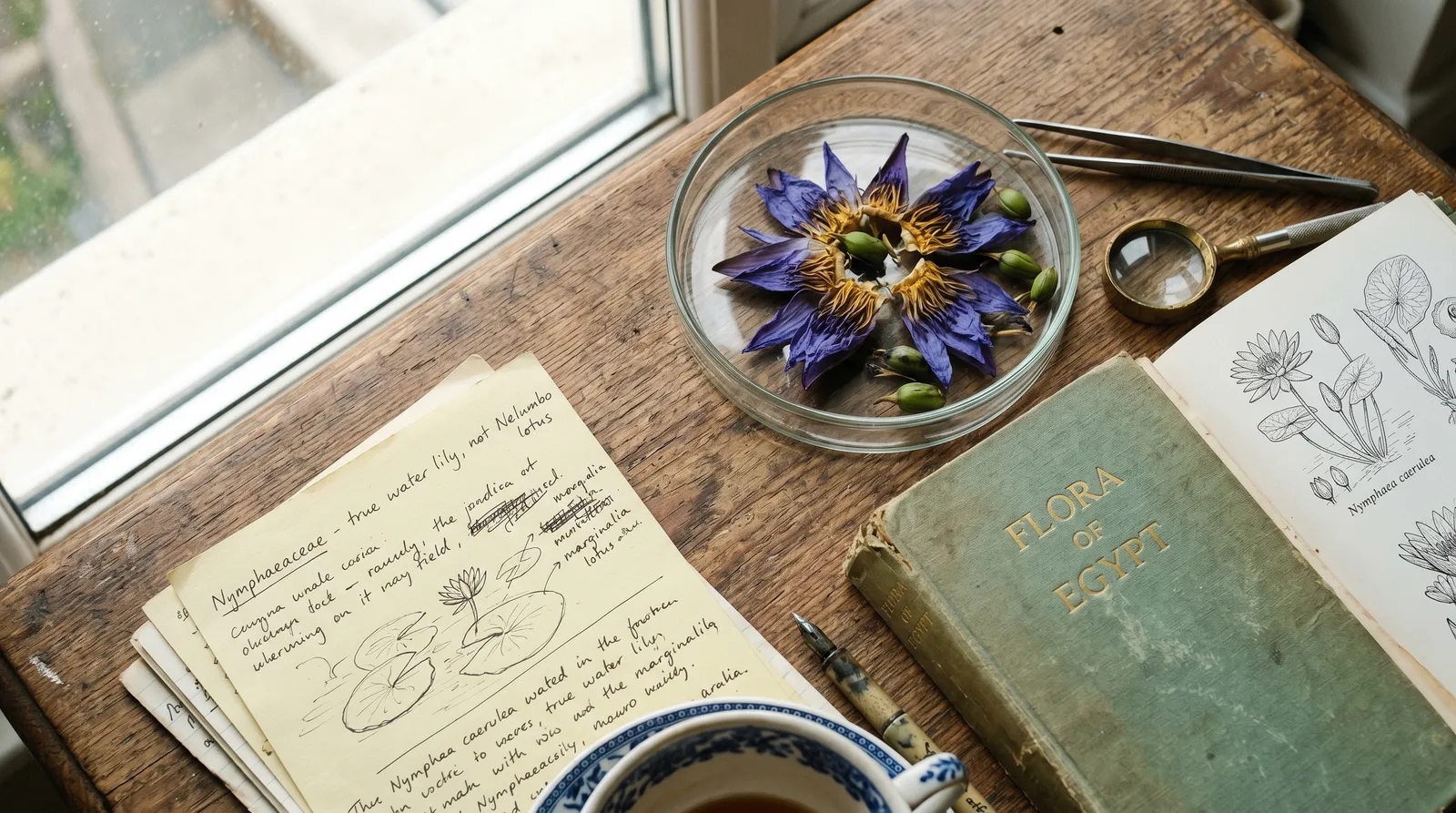
Nymphaea caerulea belongs to the family Nymphaeaceae — the true water lilies — and is not a lotus in the strict botanical sense. The common name "blue lotus" is botanically misleading. That label properly belongs to Nelumbo nucifera (the pink or sacred lotus), which sits in an entirely different plant family, Nelumbonaceae. The Egyptians themselves did not draw this taxonomic line, of course, but modern writers should. When this article says "blue lotus," it means Nymphaea caerulea and nothing else. The pink sacred lotus (Nelumbo nucifera) arrived in Egypt later — probably during the Late Period, around the 6th century BCE — and carries a different alkaloid profile. Mixing the two up is one of the most common errors in popular writing about nymphaea caerulea Egyptian history.
The Earliest Depictions Date to the Old Kingdom, Around 2686 BCE
The oldest confirmed artistic representations of Nymphaea caerulea in Egypt appear in Old Kingdom tomb reliefs dating to approximately 2686–2181 BCE. This makes the archaeological record for this flower one of the longest for any ritually significant plant. Though the flower's presence in the Nile Delta ecosystem predates dynastic civilisation by millennia, by the New Kingdom (1550–1070 BCE) the blue water lily had become one of the most frequently depicted plants in Egyptian iconography. According to Emboden (1978), Nymphaea caerulea appears in banquet scenes, funerary contexts, and mythological tableaux with a consistency that suggests symbolic meaning well beyond decoration.
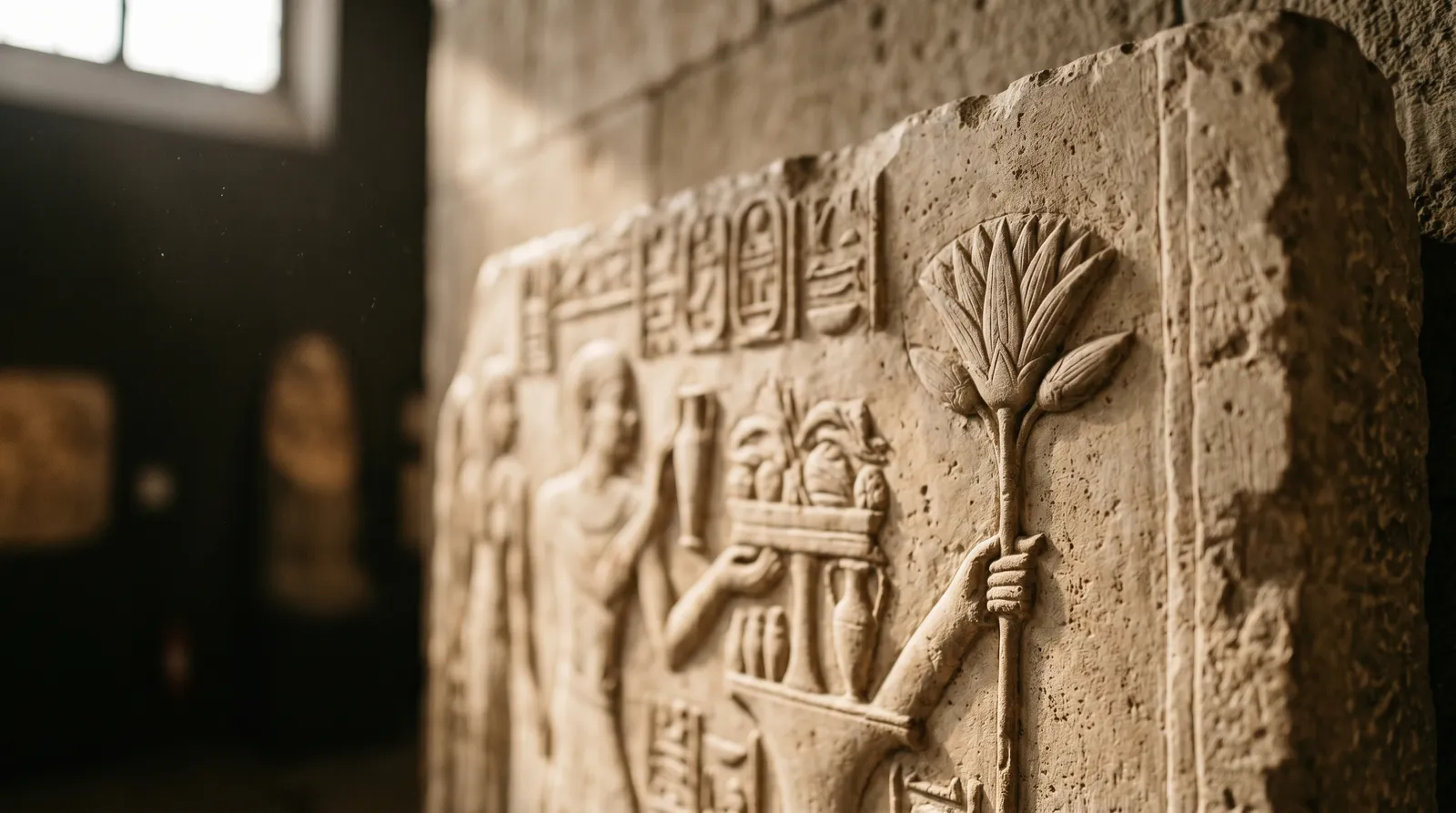
A few recurring motifs stand out. In banquet scenes from Theban tombs — the tomb of Nebamun (c. 1350 BCE) is probably the most reproduced example — guests are shown holding the flower to their noses, sometimes while servants pour wine. In funerary art, the deceased often clutches the bloom or wears it as a garland. The "Book of the Dead" papyri include spells referencing transformation into a lotus, and Chapter 81 specifically invokes the image of emerging from the flower — a rebirth metaphor tied to the daily opening and closing cycle of Nymphaea caerulea, which unfurls at dawn and closes at dusk.
The solar connection is hard to overstate. The Egyptian creation myth of Hermopolis describes the first sunrise emerging from a water lily floating on the primordial waters — the god Nefertem personified this association. Nymphaea caerulea was Nefertem's flower, and its daily rhythm of opening toward the sun and sinking beneath the water at night mapped neatly onto Egyptian cosmology: birth, death, and renewal.
No Surviving Egyptian Text Explicitly Describes Consuming Nymphaea Caerulea for Psychoactive Purposes
Direct written evidence for psychoactive consumption of Nymphaea caerulea in ancient Egypt does not exist in any surviving papyrus or inscription. The circumstantial evidence is substantial, but this is where popular accounts tend to outrun the archaeology. The idea that ancient Egyptians consumed Nymphaea caerulea for its psychoactive properties is plausible and has serious academic proponents, but it is not proven in the way that, say, Egyptian beer production is proven (we have the brewing residues, the tax records, the equipment).
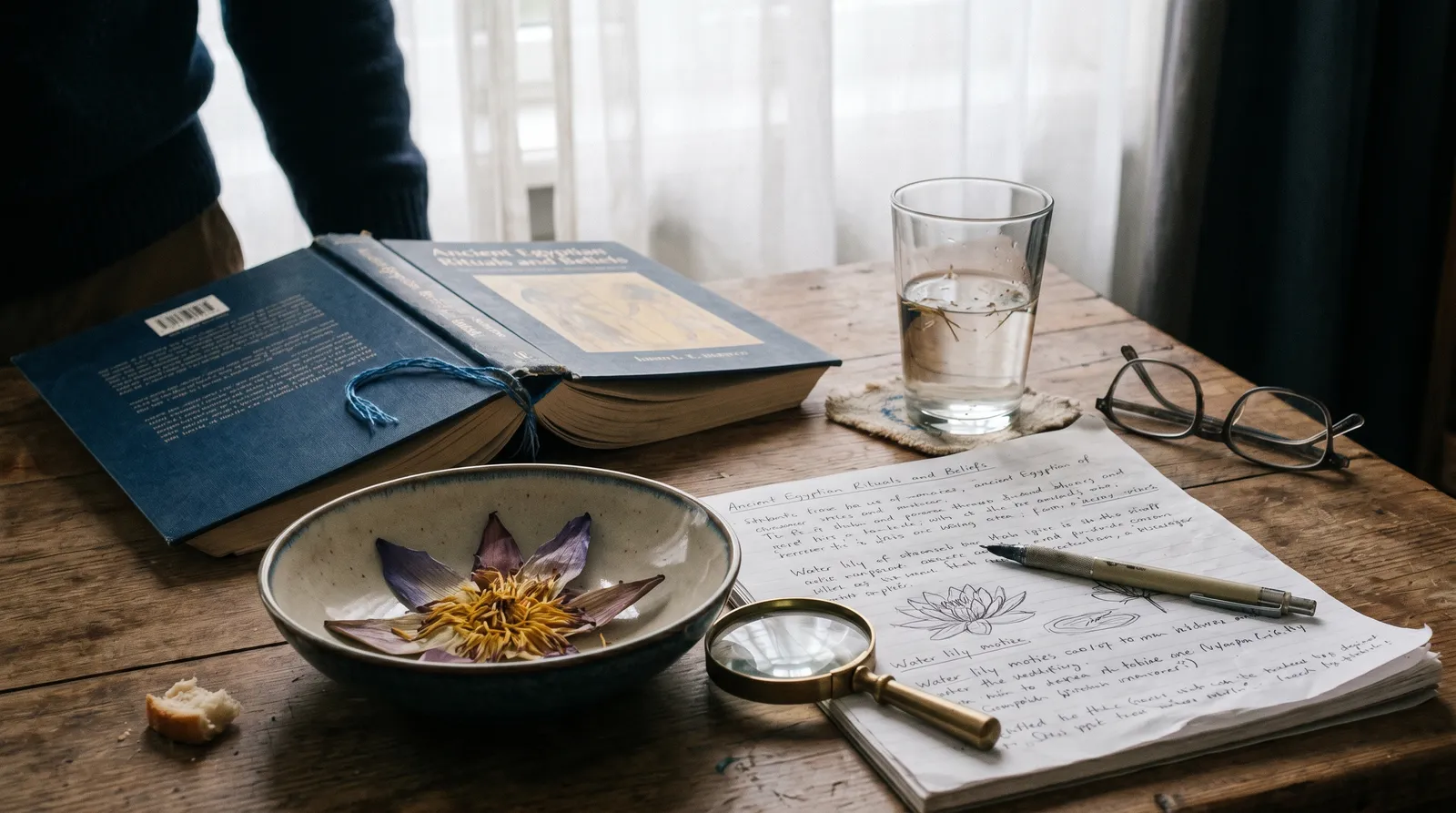
The strongest argument comes from Emboden's 1978 and 1981 papers, which proposed that the banquet scenes showing guests inhaling the flower — sometimes alongside mandrake fruit and poppy — depict deliberate narcotic use rather than simple floral appreciation. Emboden pointed out that the combination of Nymphaea caerulea with known psychoactive plants like Mandragora officinarum was unlikely to be coincidental. A later study by Merlin (2003) reinforced this reading, arguing that cross-cultural parallels between Egyptian and Mesoamerican use of Nymphaea species (the Maya used Nymphaea ampla, a related species in the same genus) pointed to independent discovery of the genus's psychoactive properties.
The counterargument is straightforward: the medical papyri — the Ebers Papyrus (c. 1550 BCE), the Edwin Smith Papyrus, the Hearst Papyrus — mention hundreds of plant preparations, but Nymphaea caerulea does not feature prominently as a drug in these texts in the way that opium poppy or castor oil does. Its presence is overwhelmingly visual and mythological rather than pharmacological in the surviving written record.
That said, absence of evidence is not evidence of absence. The Egyptians were not in the habit of writing down recreational practices for posterity, and the priestly class that managed temple rituals kept certain knowledge deliberately restricted. The wine-soaking hypothesis — that petals of Nymphaea caerulea were steeped in wine to extract the aporphine alkaloids — is consistent with the banquet iconography but remains speculative. No residue analysis of surviving Egyptian vessels has conclusively identified Nymphaea caerulea alkaloids, though the analytical chemistry required is only recently becoming sensitive enough to attempt it.
Nymphaea Caerulea Contains Aporphine Alkaloids With Documented Pharmacological Activity
Nymphaea caerulea contains aporphine alkaloids — principally nuciferine and the closely related compound apomorphine — which are pharmacologically active molecules with documented receptor-binding profiles. Apomorphine is a known dopamine-receptor agonist used in modern medicine for Parkinson's disease, and nuciferine has demonstrated affinity for dopamine D2 receptors in vitro (Agnihotri et al., 2008). The proposed mechanism behind the mild sedation and relaxation that modern users report is partial dopamine-receptor agonism, though human pharmacokinetic data for nuciferine from Nymphaea caerulea specifically remains limited.
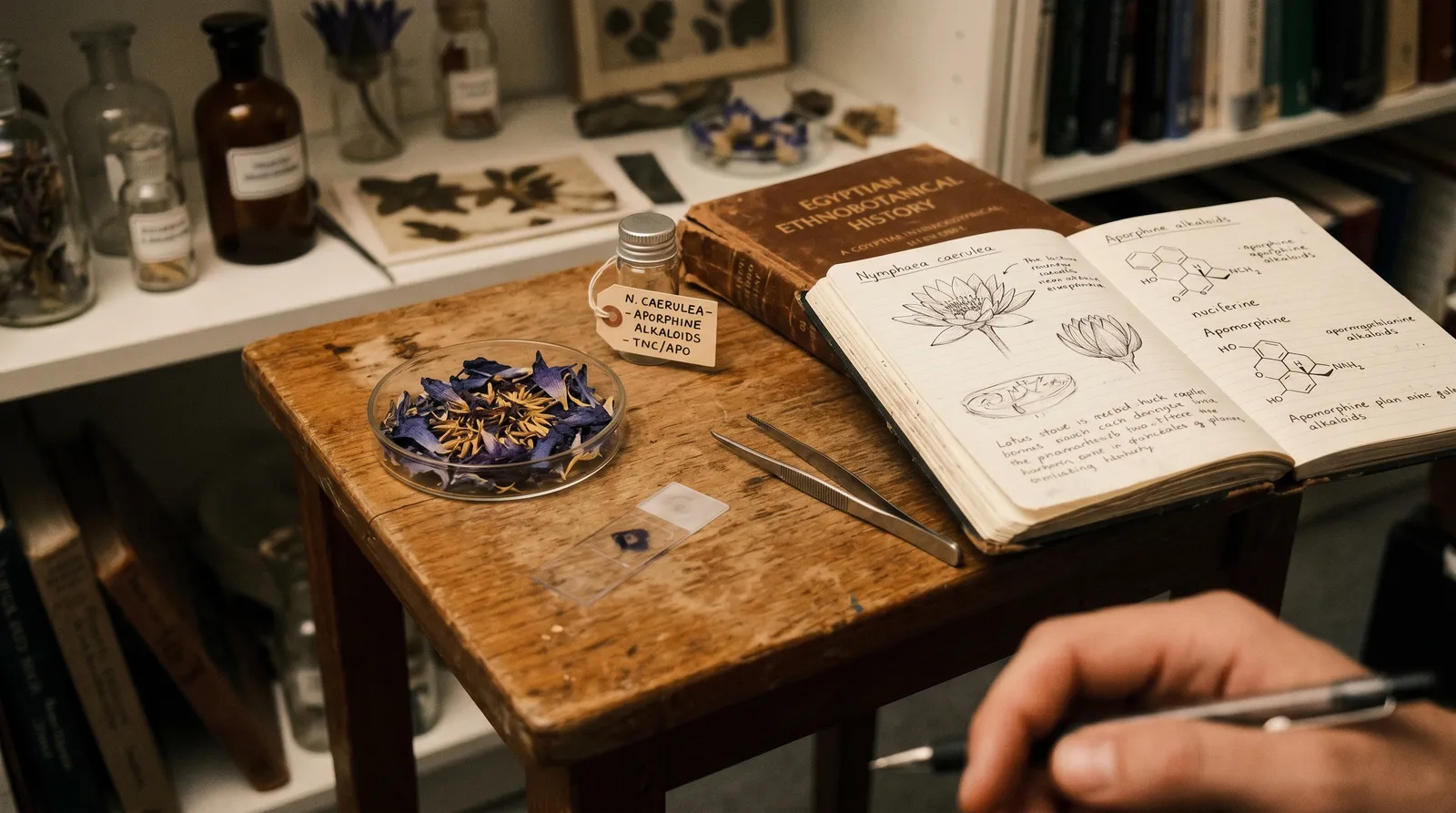
This chemistry is what gives the Emboden hypothesis its pharmacological legs. If you steep aporphine-containing petals in alcohol — as the wine-soaking theory suggests — you get a more efficient extraction than water alone. The resulting drink would deliver a mild sedative and potentially mildly calming dose, consistent with the dreamy, relaxed postures depicted in the tomb paintings. Whether the Egyptians understood this in chemical terms is irrelevant; they would have understood it in experiential terms, which is all that matters for ritual adoption.
It is worth flagging that the magnitude of these effects from plant material (as opposed to concentrated extracts) is modest. Nobody is suggesting that Nymphaea caerulea wine produced anything resembling the intensity of, say, opium. The proposed experience sits closer to a glass of wine with a mild herbal sedative layered on top — pleasant, calming, possibly dream-enhancing, but not incapacitating. Modern users report similar impressions from tea preparations, though controlled studies confirming dose-response curves for different preparation methods do not yet exist.
Nefertem Was the Egyptian God Whose Mythology Is Inseparable From Nymphaea Caerulea
Nefertem — whose name translates roughly as "he who is beautiful" — was the Egyptian deity who directly personified the blue water lily and its solar symbolism. Depicted as a young man with the blue water lily on his head, Nefertem's mythology is inseparable from Nymphaea caerulea. In the Pyramid Texts (the oldest religious writings in the world, dating to roughly 2400 BCE), the phrase "rise like Nefertem from the lotus" connects the flower directly to solar rebirth and the afterlife.
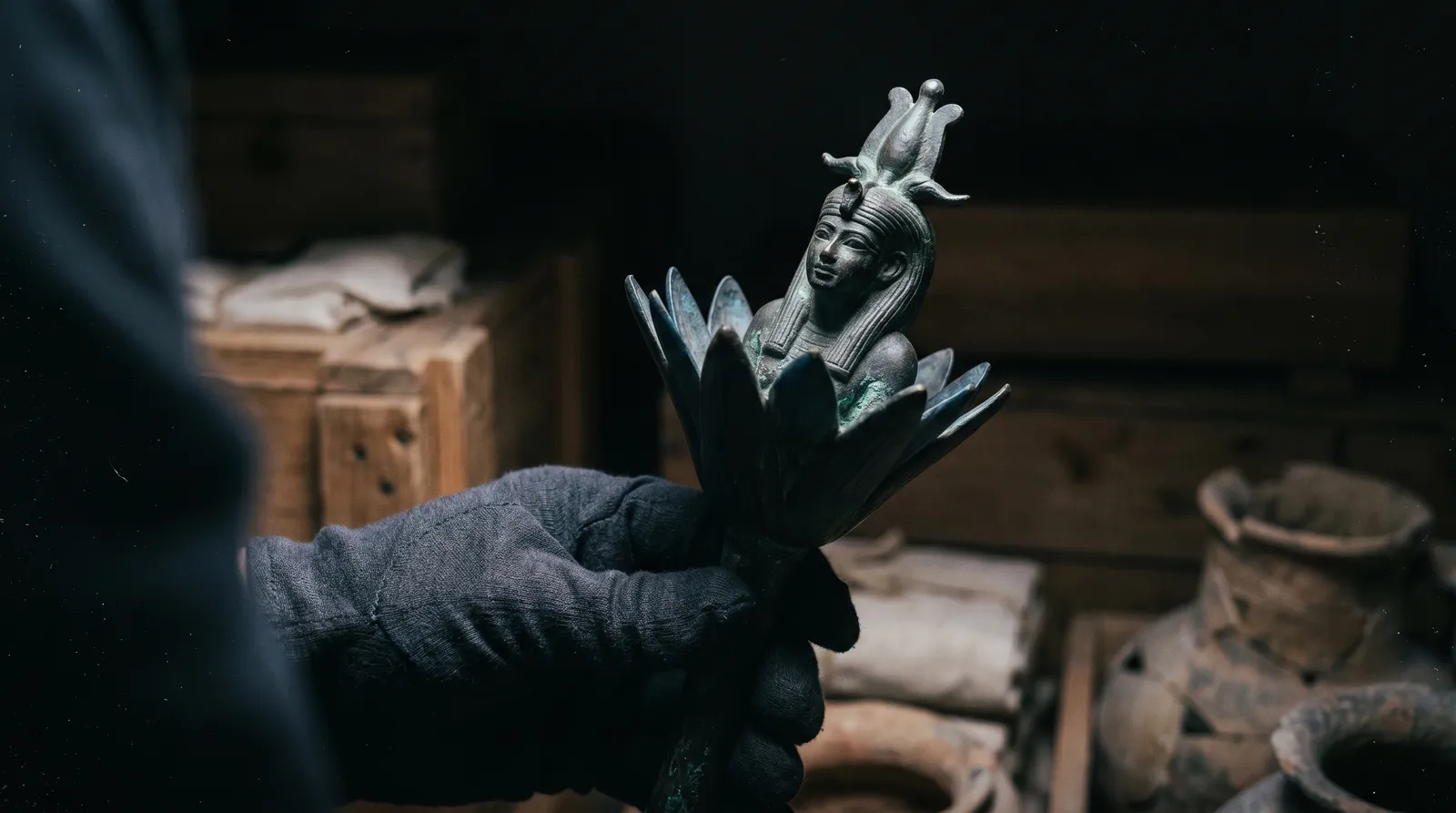
The daily behaviour of the plant reinforced this symbolism with an elegance that must have felt divinely designed. Nymphaea caerulea opens its petals at dawn, floats on the water's surface through the day, and closes and submerges as the sun sets. For a civilisation that structured its entire cosmology around the solar cycle — Ra's daily journey through the sky and the underworld — this plant was a living metaphor. The deceased, buried with lotus garlands or depicted emerging from the bloom, were symbolically promised the same cycle: death, submersion, and sunrise rebirth.
Dried Nymphaea caerulea garlands have been recovered from tombs, including famously from the burial of Ramesses II (d. 1213 BCE). Whether these garlands were purely symbolic, fragrant, or intended to accompany the deceased pharmacologically into the afterlife is — you guessed it — debated.
The Maya Independently Used a Closely Related Nymphaea Species in Strikingly Similar Ritual Contexts
Nymphaea ampla — a white-flowered species in the same genus as Nymphaea caerulea — appears in Maya iconography in ritual contexts that closely parallel Egyptian depictions. According to Merlin (2003), Maya iconography depicts water lilies emerging from the heads of supernatural figures, and the "water lily jaguar" motif appears on ceramics associated with elite ritual. The parallel is striking: two civilisations, separated by thousands of miles and with no known contact, independently adopted Nymphaea species as ritually significant plants. This does not prove psychoactive use in either culture, but it does suggest that something about these plants — their chemistry, their behaviour, or both — consistently attracted ceremonial attention. This cross-cultural thread is one of the more compelling chapters in the broader nymphaea caerulea Egyptian history discussion.
You Can Still Buy Dried Nymphaea Caerulea Petals Today From Specialist Suppliers
Dried Nymphaea caerulea petals and extracts are available to order from specialist ethnobotanical suppliers, including the Azarius smartshop, where you can buy dried blue lotus flowers and blue lotus extracts. Those who want to get a sense of what the Egyptians may have experienced typically prepare the petals as a tea or steep them in wine — the same method proposed by the wine-soaking hypothesis. If you are curious about trying it yourself, you can also explore related products in the Azarius herbs and seeds category or browse the ethnobotanicals wiki for background on other traditional plant preparations.
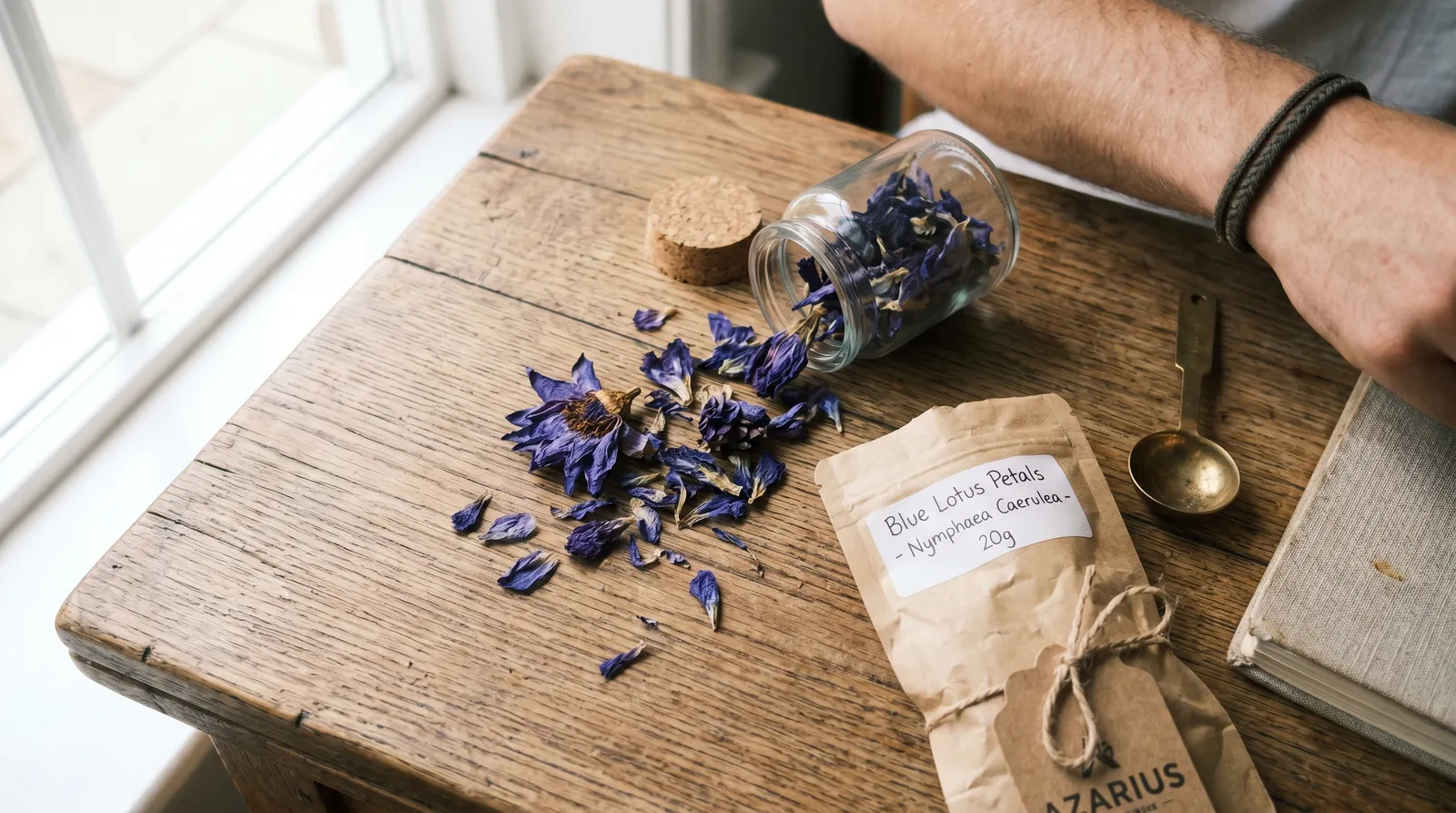
Compared to other ethnobotanical products available at Azarius — such as Kanna (Sceletium tortuosum), which acts primarily as a serotonin-reuptake inhibitor, or Kratom (Mitragyna speciosa), which binds opioid receptors — Nymphaea caerulea occupies a milder, more subtle end of the spectrum. Its character is most often described as gently relaxing, with some users reporting enhanced dream vividness. It is not a heavy-hitting psychoactive, and anyone expecting dramatic results from a cup of blue lotus tea will likely be disappointed. Honest expectation-setting matters. For those interested in dream-related botanicals, the Azarius blog features articles comparing blue lotus with other dream herbs like Calea zacatechichi and African dream root (Silene capensis).
| Plant | Primary alkaloids | Main mechanism | Reported intensity | Historical ritual use |
|---|---|---|---|---|
| Nymphaea caerulea (blue lotus) | Nuciferine, apomorphine | Dopamine-receptor agonism | Mild | Egyptian, possibly Maya-adjacent |
| Nymphaea ampla (Maya water lily) | Aporphine alkaloids | Dopamine-receptor agonism | Mild | Maya |
| Nelumbo nucifera (pink lotus) | Nuciferine, roemerine | Dopamine/serotonin modulation | Mild | Asian, later Egyptian |
| Kanna (Sceletium tortuosum) | Mesembrine | Serotonin-reuptake inhibition | Mild–moderate | South African Khoisan |
| Period | Approximate dates | Key evidence for Nymphaea caerulea |
|---|---|---|
| Old Kingdom | 2686–2181 BCE | Earliest depictions in tomb art; Pyramid Texts reference rising "like Nefertem from the lotus" |
| Middle Kingdom | 2055–1650 BCE | Continued presence in funerary iconography and temple decoration |
| New Kingdom | 1550–1070 BCE | Peak representation; Nebamun banquet scene (c. 1350 BCE); garlands in tomb of Ramesses II (d. 1213 BCE) |
| Late Period | 664–332 BCE | Nelumbo nucifera (pink lotus) arrives; both species depicted alongside each other |
Quick Preparation Notes for Dried Nymphaea Caerulea Petals
Most people who order dried Nymphaea caerulea petals prepare them in one of two ways: as a simple hot-water tea (steep 3–5 grams in just-boiled water for 10–15 minutes) or steeped in wine for several hours. The wine method extracts aporphine alkaloids more efficiently due to the alcohol content. Either way, the flavour is mild and slightly floral. Start with a low amount and see how you respond — individual sensitivity varies, and there is no standardised dosing backed by clinical data.
The Archaeological Record Is Rich in Imagery but Thin on Direct Pharmacological Proof
Three millennia of Egyptian visual culture confirm that Nymphaea caerulea held deep symbolic and religious significance. Direct pharmacological proof of its deliberate psychoactive use remains absent from the surviving record. We know the flower was symbolically central to Egyptian religion for at least two and a half millennia. We know it contains pharmacologically active aporphine alkaloids. We know it appears in banquet scenes alongside other psychoactive plants. We know that a related species was used in apparently similar ritual contexts by the Maya. What we do not have is a surviving Egyptian text that says "steep these petals in wine and drink for visions," nor vessel residue analysis confirming the practice.
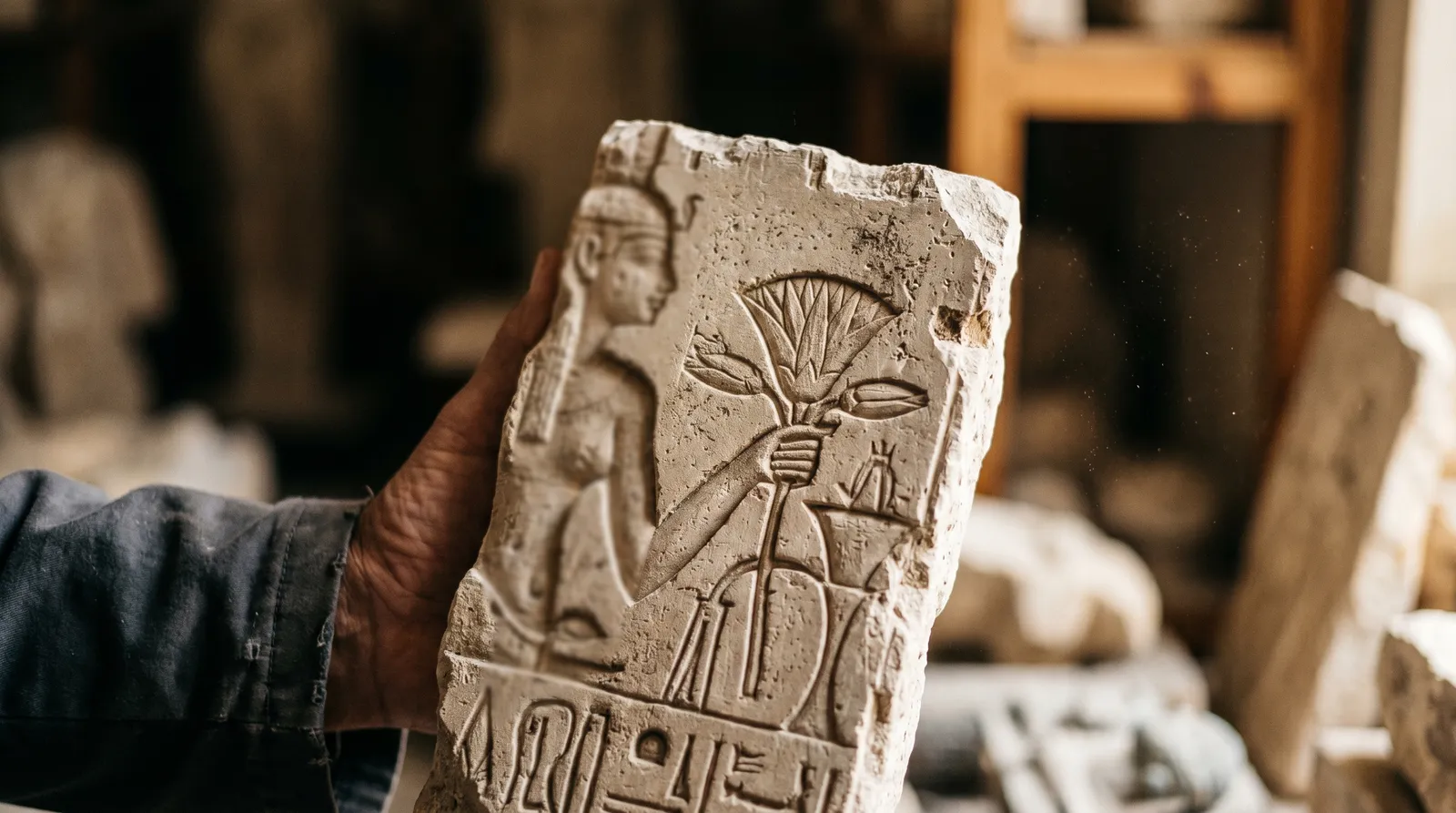
That gap may close as analytical techniques improve — or it may not. For now, the honest summary is this: the ceremonial and symbolic importance of Nymphaea caerulea to ancient Egypt is beyond question. Its deliberate use as a psychoactive preparation is a well-supported hypothesis with serious academic backing, but it has not crossed the line into established fact. Treating it as proven — as many popular sources do — overstates the evidence. Dismissing it entirely ignores a coherent body of iconographic, pharmacological, and cross-cultural data.
Last updated: April 2026
Frequently Asked Questions
10 questionsDid the ancient Egyptians use blue lotus as a drug?
Why does Nymphaea caerulea appear so often in Egyptian tomb art?
Is blue lotus the same plant the Maya used?
What is the wine-soaking hypothesis for Nymphaea caerulea?
When did Nelumbo nucifera (pink lotus) arrive in Egypt?
Can I buy Nymphaea caerulea dried petals today?
What alkaloids are found in Nymphaea caerulea and what do they do?
What is the solar symbolism of the blue lotus in Egyptian mythology?
Was blue lotus used in ancient Egyptian funerary rituals?
What is the difference between the Egyptian blue lotus and the white lotus?
About this article


Adam Parsons is an external cannabis and psychedelics writer and editor who contributes to Azarius's wiki as both author and reviewer. On the writing side, he authors Azarius's kratom and kanna clusters, drawing on exten
This wiki article was drafted with AI assistance and reviewed by Adam Parsons, External contributor. Editorial oversight by Joshua Askew.
Medical disclaimer. This content is for informational purposes only and does not constitute medical advice. Consult a qualified healthcare provider before use of any substance.
Last reviewed April 24, 2026
References (6)
- [1]Emboden, W.A. (1978). "The sacred narcotic lily of the Nile: Nymphaea caerulea ." Economic Botany , 32(4), 395–407. DOI: 10.1007/bf02907935
- [2]Emboden, W.A. (1981). "Transcultural use of narcotic water lilies in ancient Egyptian and Maya drug ritual." Journal of Ethnopharmacology , 3(1), 39–83. DOI: 10.1016/0378-8741(81)90013-1
- [3]Merlin, M.D. (2003). "Archaeological evidence for the tradition of psychoactive plant use in the Old World." Economic Botany , 57(3), 295–323. DOI: 10.1663/0013-0001(2003)057[0295:aeftto]2.0.co;2
- [4]Agnihotri, V.K. et al. (2008). "Constituents of Nelumbo nucifera leaves and their antimalarial and antifungal activity." Phytochemistry Letters , 1(2), 89–93. [Note: nuciferine receptor-binding data referenced in context of shared aporphine pharmacology with Nymphaea caerulea .] DOI: 10.1016/j.phytol.2008.03.003
- [5]EMCDDA (European Monitoring Centre for Drugs and Drug Addiction). Drug profiles and risk assessments for novel psychoactive substances.
- [6]Beckley Foundation. Research programme on traditional plant medicines and psychoactive substances.
Related Articles
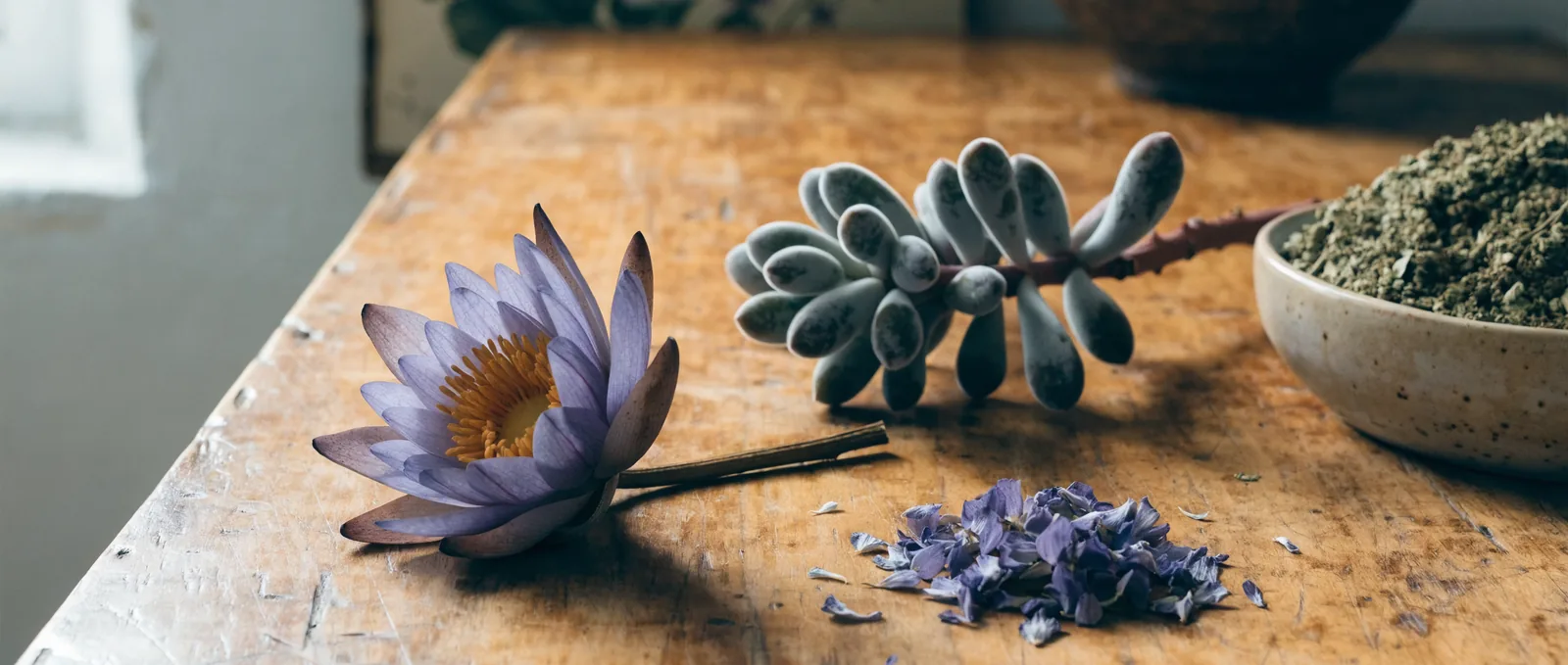
Blue Lotus vs Kanna: Effects & Safety
Blue lotus vs kanna compared — Nymphaea caerulea's aporphine profile against Sceletium tortuosum's mesembrine chemistry, with interaction warnings.

Lotus Clinical Research Overview
What does lotus clinical research actually show? A critical review of Nymphaea caerulea and Nelumbo nucifera pharmacology, preclinical data, and…
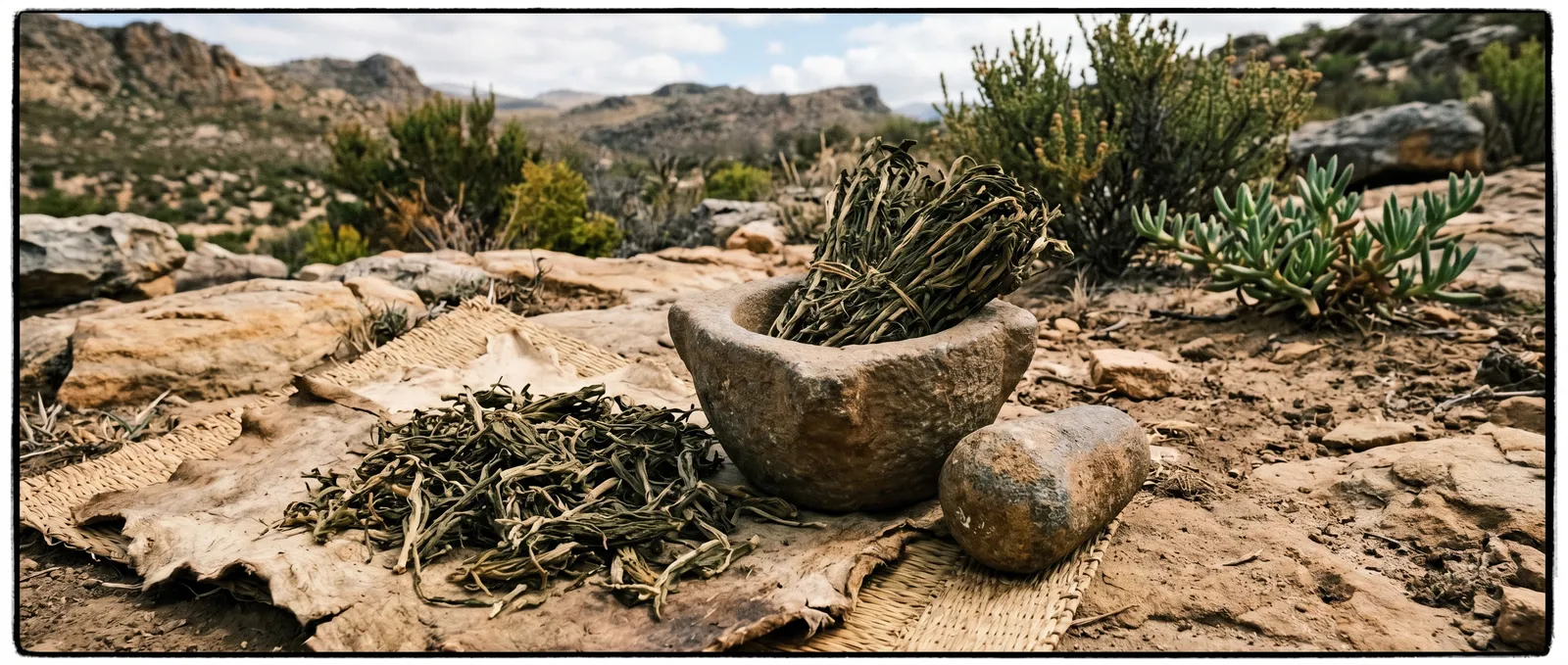
Kanna South Africa To West History
Sceletium tortuosum was used by San and Khoekhoe communities in southern Africa for centuries before European colonists first documented it in the 1660s.
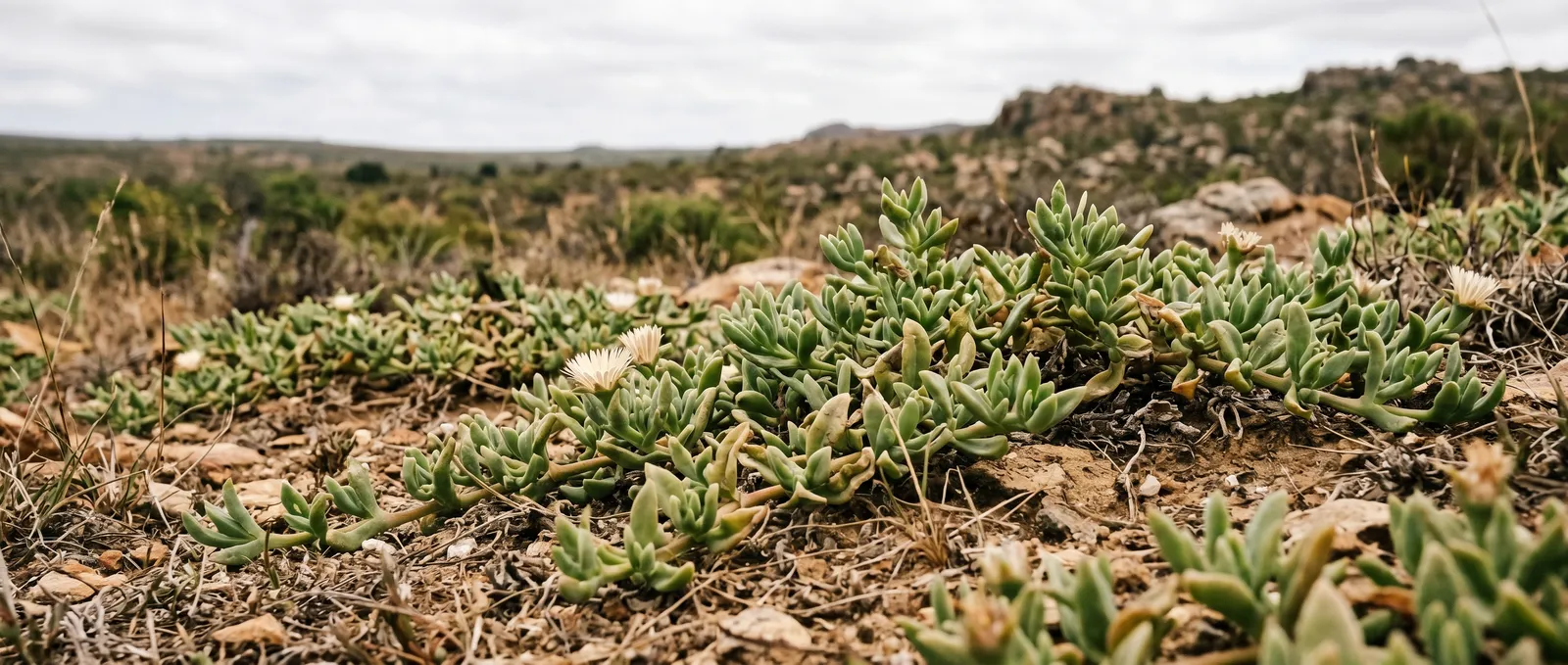
Sceletium Tortuosum Plant
Learn about the sceletium tortuosum plant: botany, alkaloids, fermentation, safety warnings, and where to buy kanna.

Kanna Pharmacokinetics Explained
Complete guide to kanna pharmacokinetics: how Sceletium tortuosum alkaloids are absorbed, metabolised via CYP2D6, and eliminated.

Kanna Chemistry: Sceletium Alkaloids Explained
Kanna chemistry explained: mesembrine, mesembrenone, their mechanisms, how fermentation and extraction change alkaloid profiles, and why it matters…
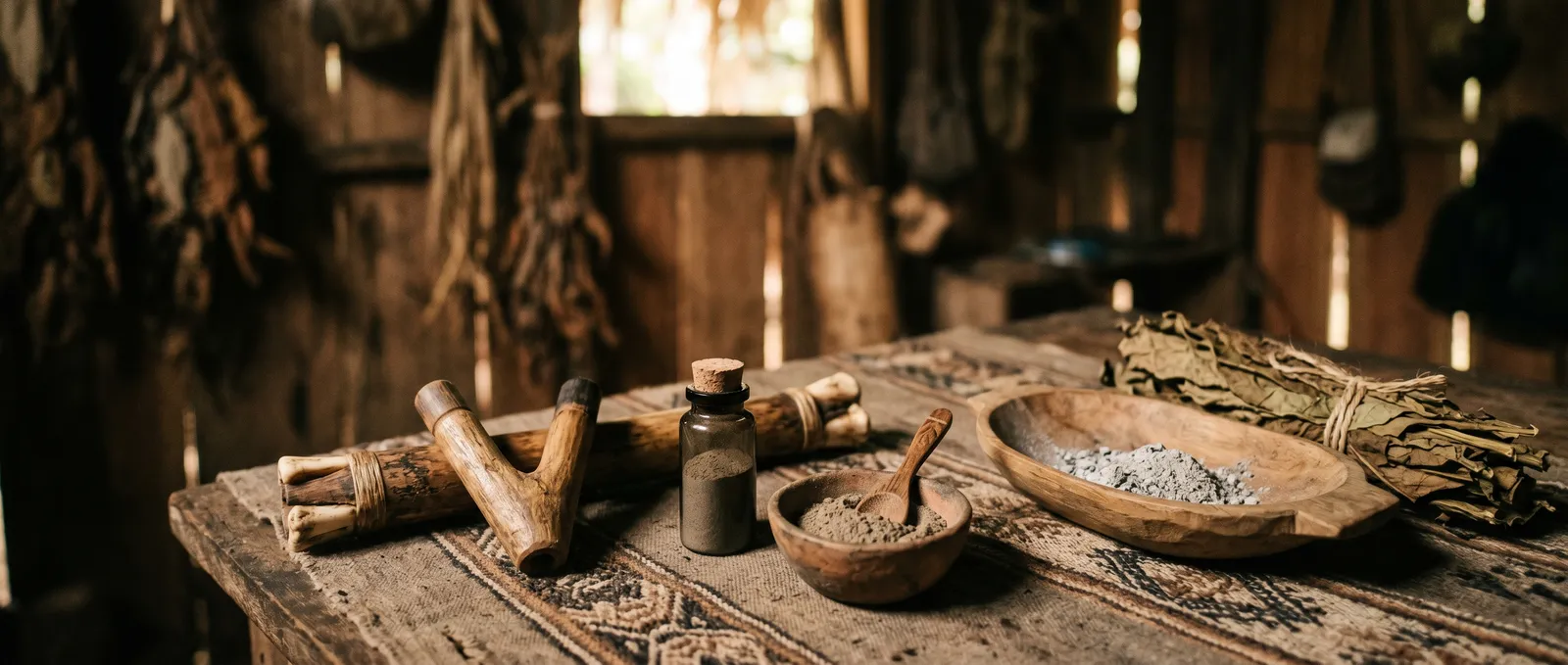
Rapé Shamanic Snuff Guide: How to Use It Safely
A practical rapé shamanic snuff guide covering dose, kuripe technique, effects, nicotine safety, interactions and Amazonian tradition.
White Sage Salvia Apiana Cultural Smudging Guide
Salvia apiana is a non-psychoactive shrub native to southern California's coastal sage scrub, burned as ceremonial incense in Indigenous North American…
Mulungu Erythrina Traditional Amazonian Use — Bark, Alkaloids & Research
Erythrina mulungu is a Brazilian legume tree whose bark has been brewed as a calming decoction in rural folk medicine for generations.