
This article discusses psychoactive substances intended for adults (18+). If you have a health condition or take medication, consult a doctor before use. Our age policy
Storing Dried Mushrooms Long Term: Full Guide
Definition
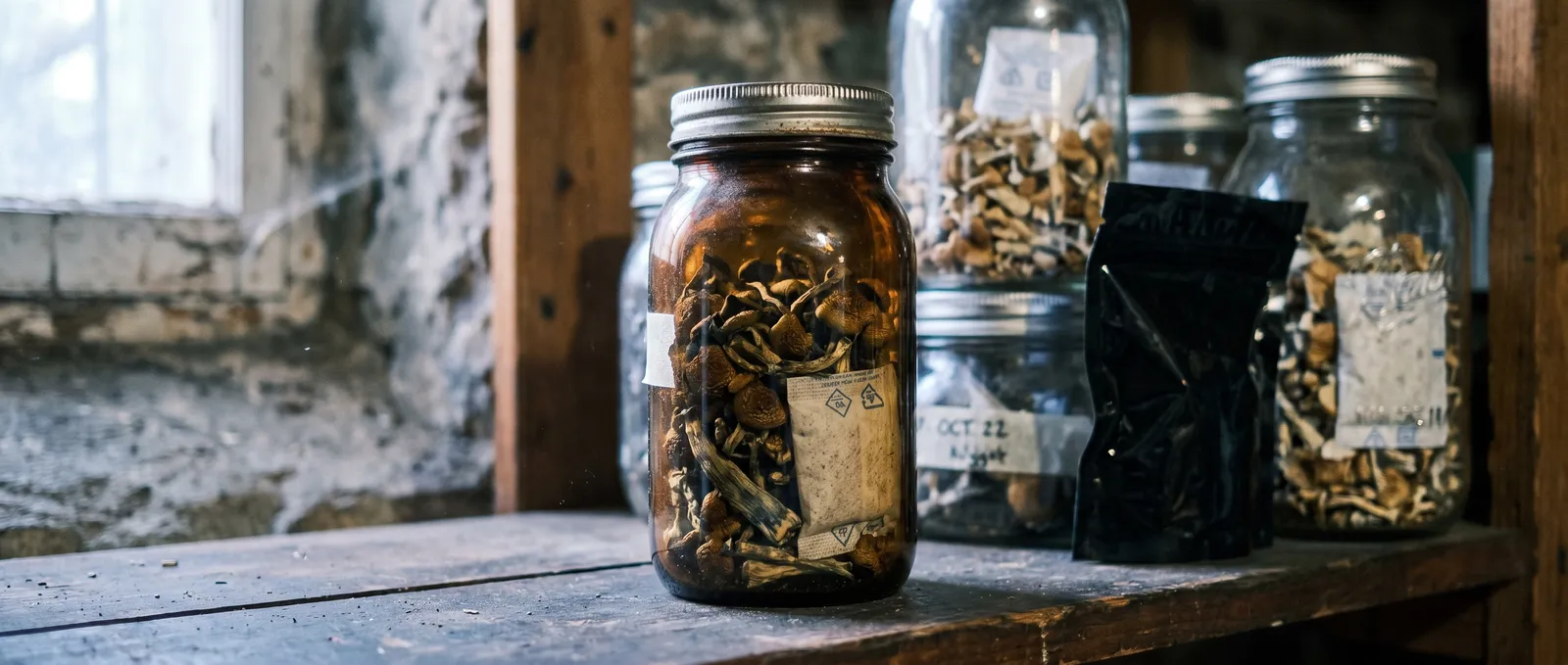
Storing dried mushrooms long term means keeping well-dried Psilocybe fruit bodies in airtight, opaque containers with desiccant, cool and dark, to slow oxidation and hydrolysis of psilocybin. Gotvaldová et al. (2021) found ~90% alkaloid retention after 12 months under cold, sealed, dark conditions.
Storing dried mushrooms long term is a preservation practice that keeps well-dried Psilocybe fruit bodies stable and potent for months to years by controlling moisture, oxygen, light, and heat. This guide is written for adults. The degradation chemistry and handling steps below assume adult physiology and adult responsibility for secure storage away from children and pets.
Psilocybin is not a robust molecule. It oxidises, it's light-sensitive, and it loves water. Get the fundamentals right — proper drying first, then low moisture, low light, low heat, low oxygen — and dried Psilocybe cubensis fruit bodies can hold most of their potency for a year or more. Get them wrong and you'll be chewing through twice the weight for half the effect by month three.
Why dried mushrooms degrade in the first place
Three reactions eat potency over time when storing dried mushrooms long term. Oxidation converts psilocin (the already-dephosphorylated, pharmacologically active molecule) into inactive blue-pigmented quinones — the same reaction behind bluing on fresh fruit bodies. Hydrolysis, driven by residual moisture, slowly cleaves the phosphate group off psilocybin. And heat accelerates both.
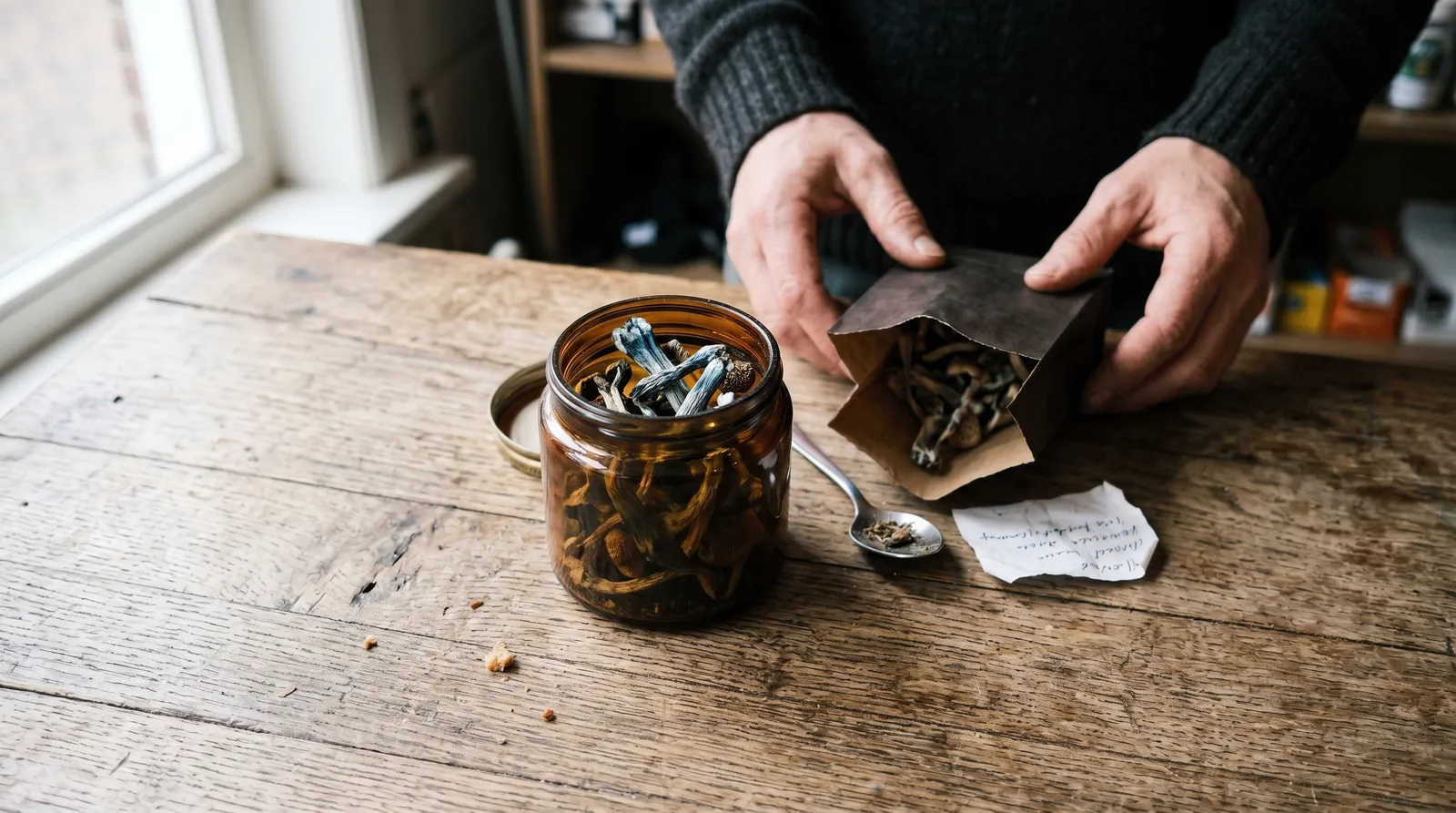
Gartz (1989) reported measurable psilocybin loss in improperly stored Psilocybe samples within weeks at room temperature with air exposure, while well-dried, sealed samples held stable far longer. A 2021 analytical study by Gotvaldová et al. tracked alkaloid content in dried cubensis and found that samples stored cold, dark, and sealed retained roughly 90% of initial psilocybin after 12 months, while samples kept at room temperature with light and air dropped considerably faster. The headline: your enemies are moisture, oxygen, light, and warmth, roughly in that order.
Step 1 — Dry them properly before you even think about storage
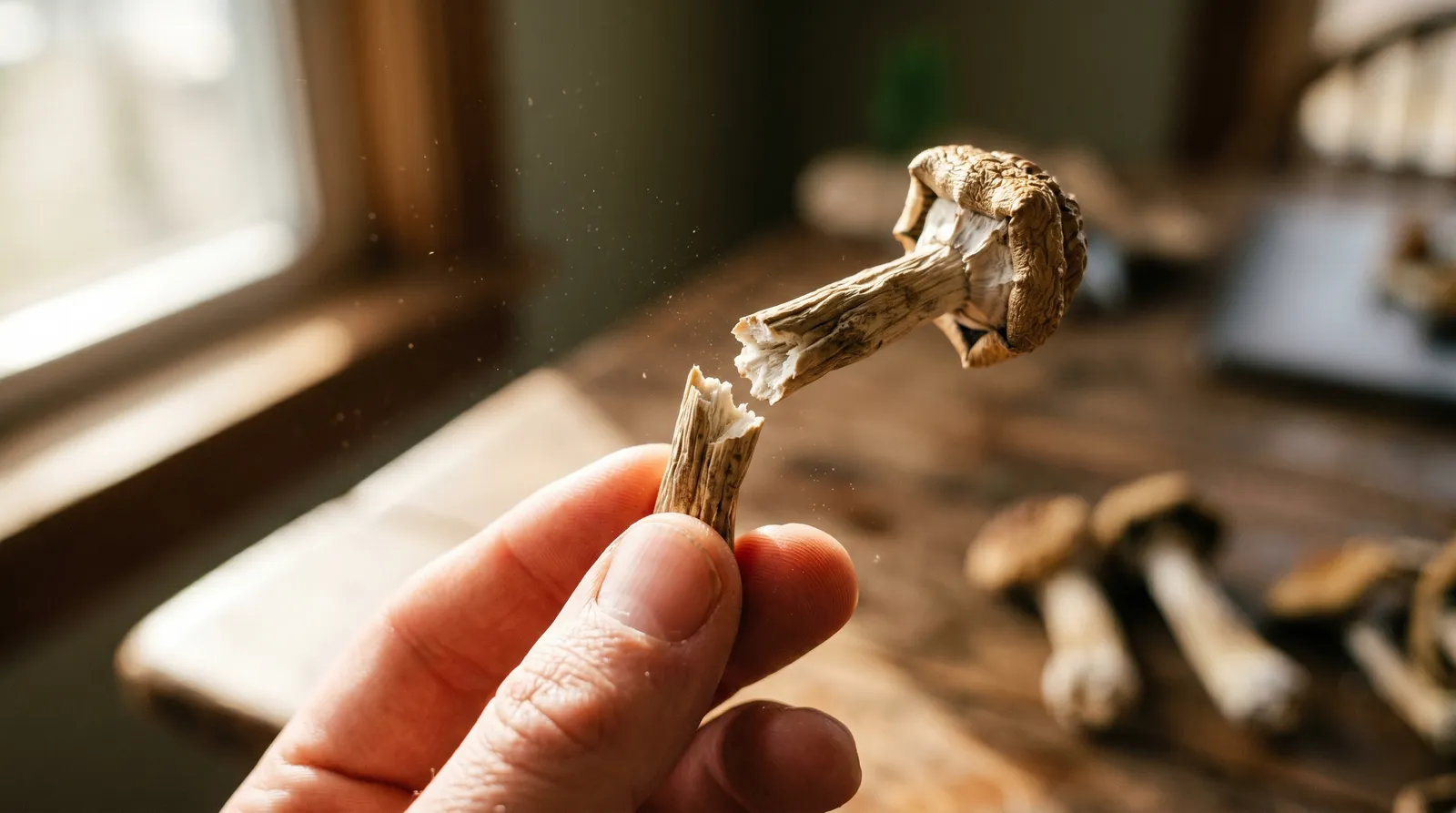
No storage method rescues under-dried mushrooms. The target is cracker-dry: caps snap cleanly, stems break with an audible click, no bend, no give. Anything softer than that means residual water is still bound in the tissue, and residual water is what fuels hydrolysis and mould regrowth in the jar.
The reliable method is a two-stage dry. First, air-dry on a mesh rack in front of a fan for 12–24 hours until the outside feels leathery. Then finish over desiccant — food-grade silica gel beads or anhydrous calcium chloride — in a sealed container for another 24–48 hours. The desiccant pulls the last 5–10% of internal moisture that a fan alone won't touch. Don't use a dehydrator above 40°C; higher temperatures don't improve the dry, they just degrade alkaloids on the way through.
A quick weight check: a fully dried Psilocybe cubensis fruit body weighs roughly 10% of its fresh wet weight. 100g of fresh Golden Teacher should land around 10g dry. If you're at 15g, they're not done.
Step 2 — Pick the right container
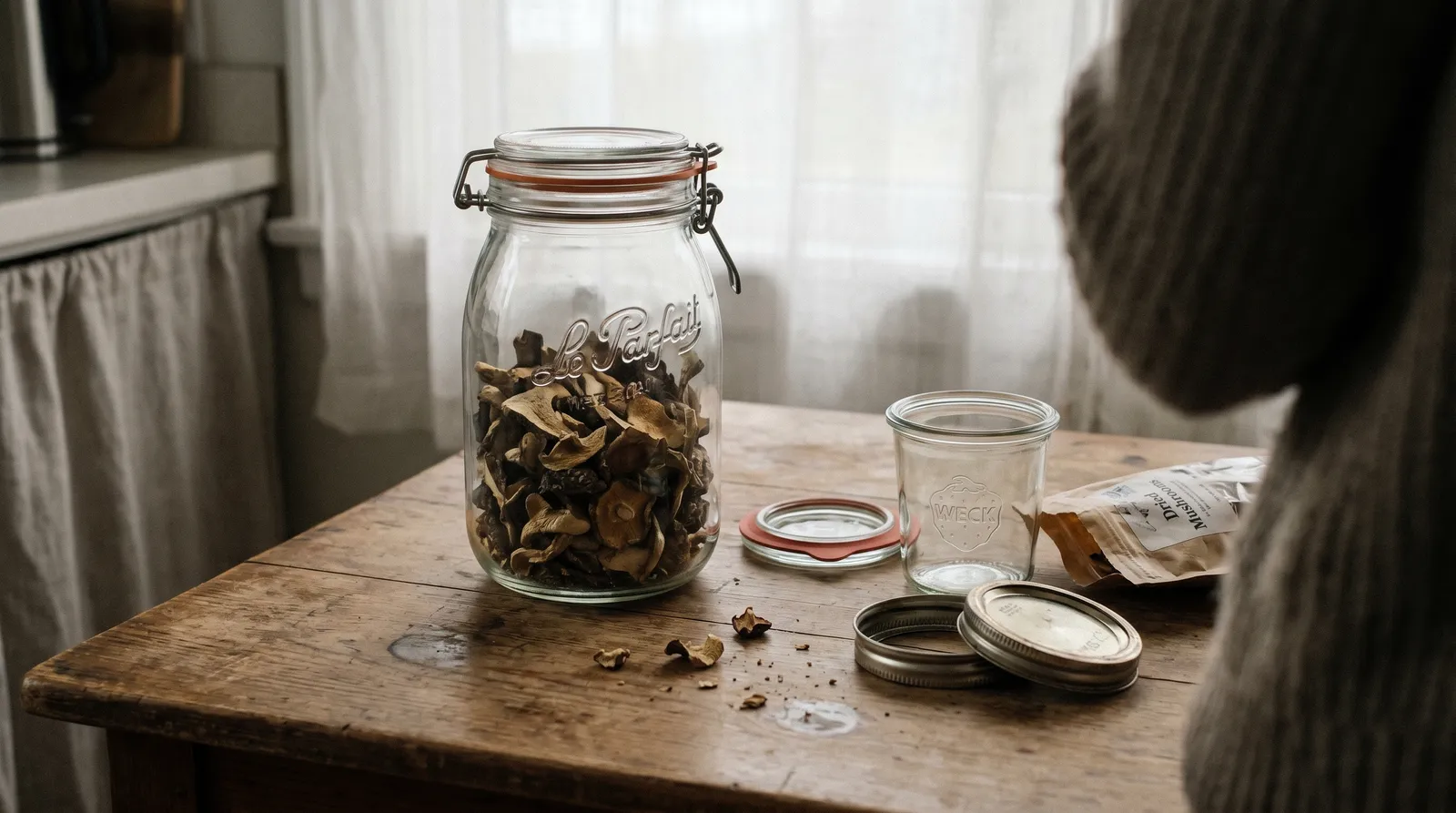
Glass jars with rubber-sealed lids are the workhorse container for storing dried mushrooms long term. Brands like Le Parfait, Weck, and Mason all work. Glass is inert, doesn't off-gas, blocks nothing you want blocked, and lets you eyeball contents without opening. Size the jar to the contents — less headspace means less oxygen sitting on top of your mushrooms.
Vacuum-sealed bags are arguably better for true long-term storage (6+ months) because they remove the oxygen entirely. A FoodSaver-style vacuum sealer with a mylar bag is the gold standard. Dried fruit bodies are brittle, so vacuum gently or pre-freeze briefly to avoid crushing them into powder. If you're storing ground material or capsules, vacuum-seal without hesitation — less surface area exposed, more stable product. If you buy a sealer, get one with a pulse function so you can stop before crushing the caps.
Avoid: thin zip-lock bags (permeable to moisture over months), paper envelopes (no moisture barrier), plastic food tubs (seals are rarely airtight), and anything you've previously stored food in that still smells of food.
Step 3 — Add a desiccant, skip the deoxygeniser debate
A food-grade silica gel packet (1–2g per 10g of dried material) dropped into the jar is the simplest, most effective humidity buffer. It absorbs any residual moisture and any humidity that sneaks in when you open the jar. Rechargeable silica packets with a colour indicator are worth the extra euros — when they turn pink, bake them at 120°C for two hours and they're ready again.
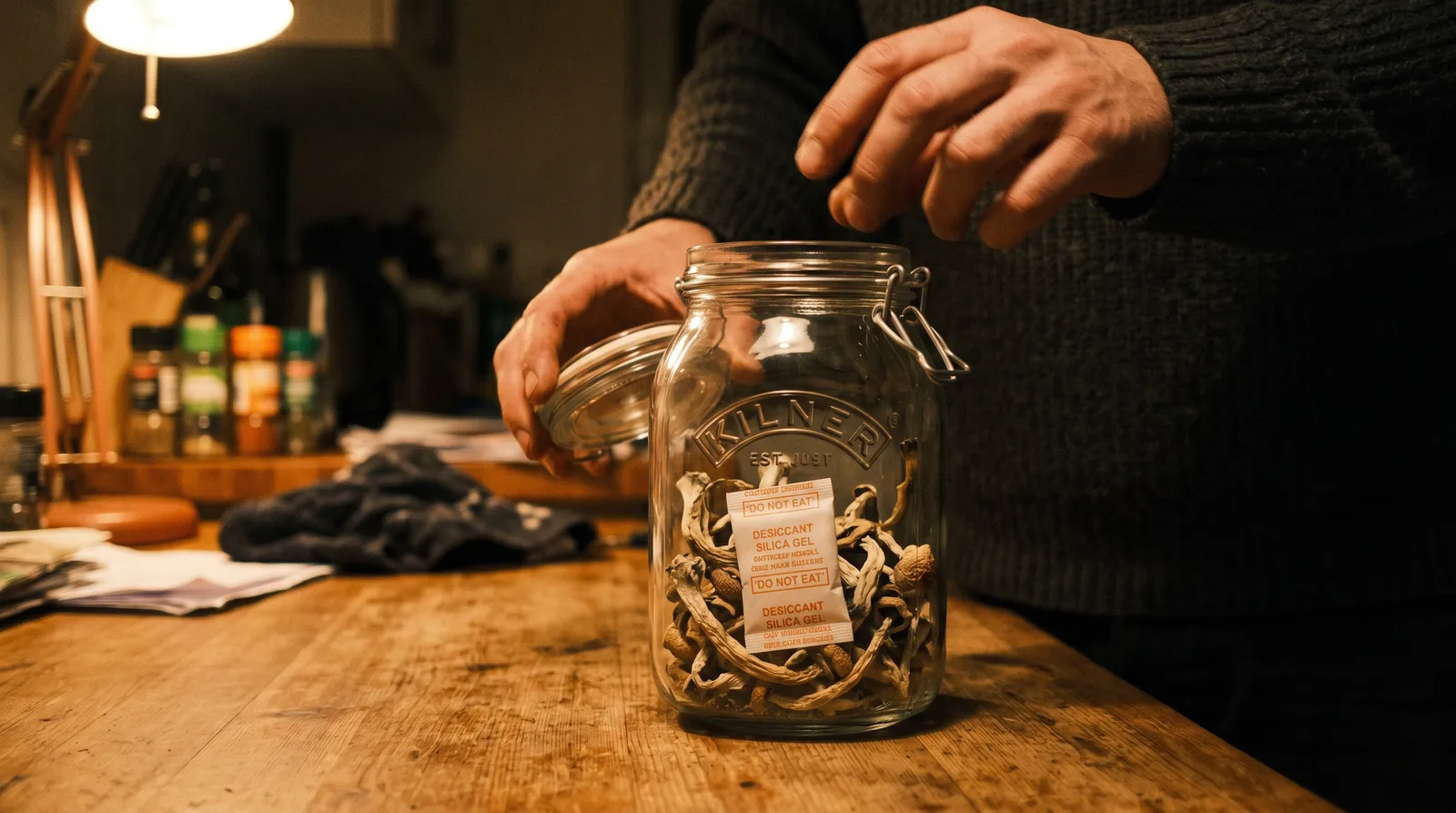
Oxygen absorbers (iron-based O2 scavengers) are sometimes recommended on cultivation forums. They do work, but they're single-use and they're overkill for anything under 6 months in a well-sealed jar. For a vacuum-sealed bag stored a year or more, an O2 absorber alongside the silica is belt-and-braces insurance. For a jar in a cupboard you'll open monthly, silica alone is fine.
Step 4 — Control temperature and light
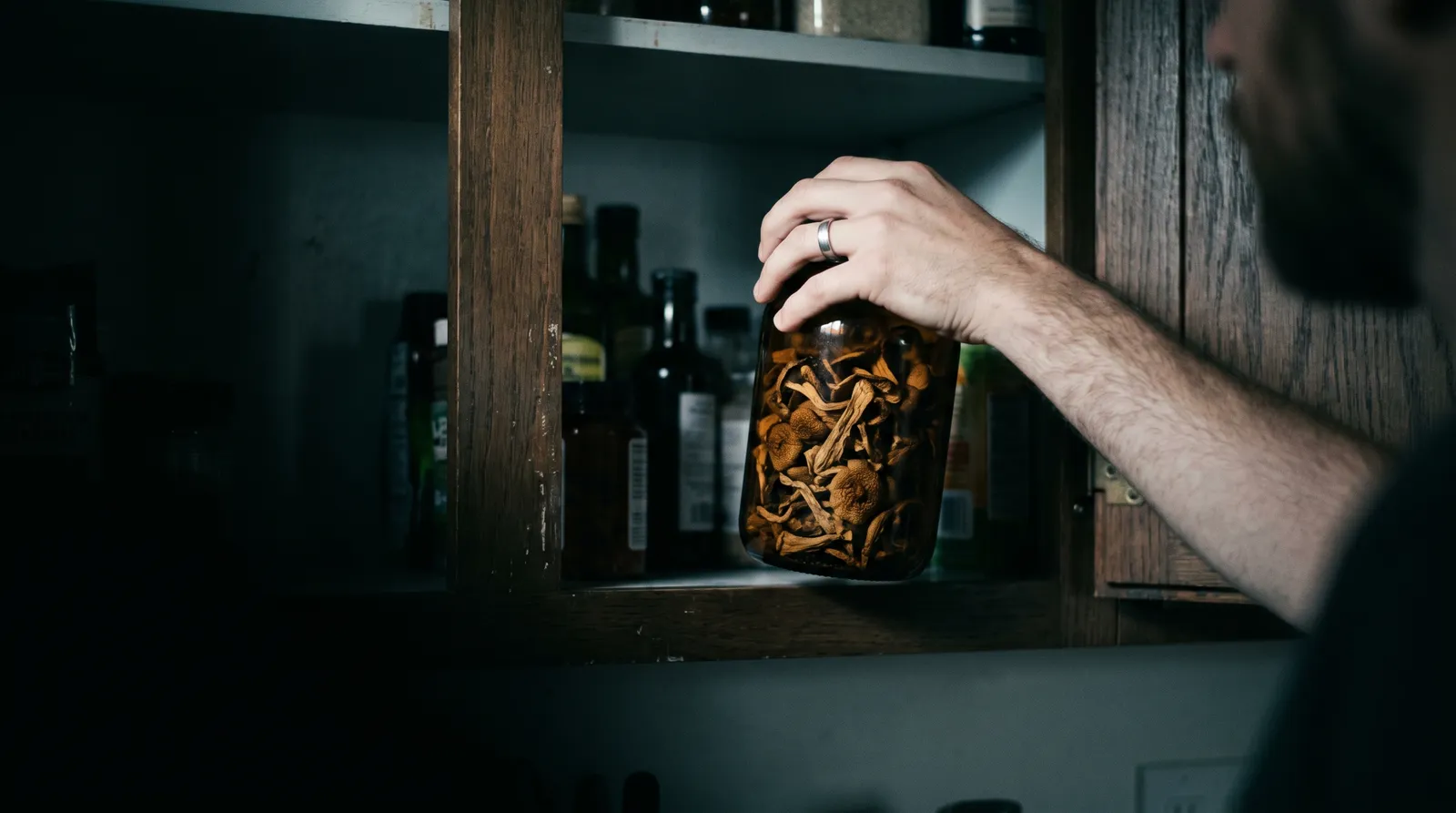
Cool, dark, and dry is the three-word rule for storing dried mushrooms long term. A cupboard at 15–20°C away from direct sun is adequate for stashes you'll finish within 6 months. For longer-term storage, the fridge (4°C) roughly doubles shelf life, and the freezer (-18°C or colder) pushes stable storage past the 2-year mark for well-dried, well-sealed material.
Two caveats on cold storage. First: fridges and freezers are humid environments. If your seal fails, you've just introduced moisture to mushrooms you spent two days drying. Double-bag or use a jar inside a vacuum bag. Second: let the container come fully to room temperature before opening. Condensation on cold mushrooms the moment warm air hits them will undo months of careful storage in ten seconds.
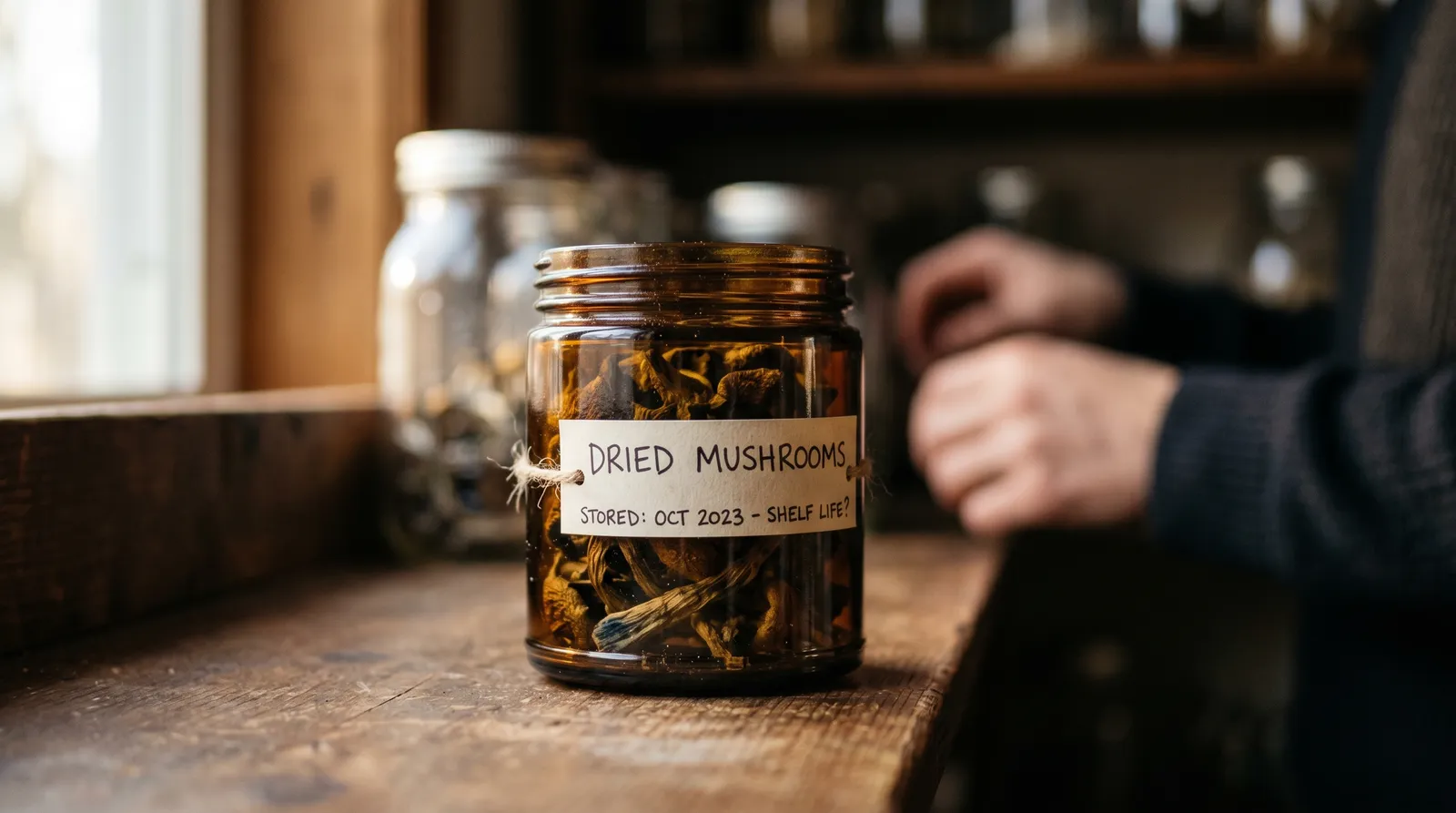
Light is the quiet killer. UV specifically degrades indole alkaloids, but visible light drives the same oxidation over longer timescales. Opaque containers, dark cupboards, or amber glass jars all work. Clear glass on a sunny shelf is the worst-case scenario.
Step 5 — Label, date, and lock up
Lock-up is non-negotiable when storing dried mushrooms long term. Dried mushrooms look indistinguishable from edible dried funghi to anyone who doesn't know what they're looking at — which includes every child, housemate, and pet in your home. A small key-locked box or a lock-fitted drawer, stored separately from food prep areas, solves the entire problem.
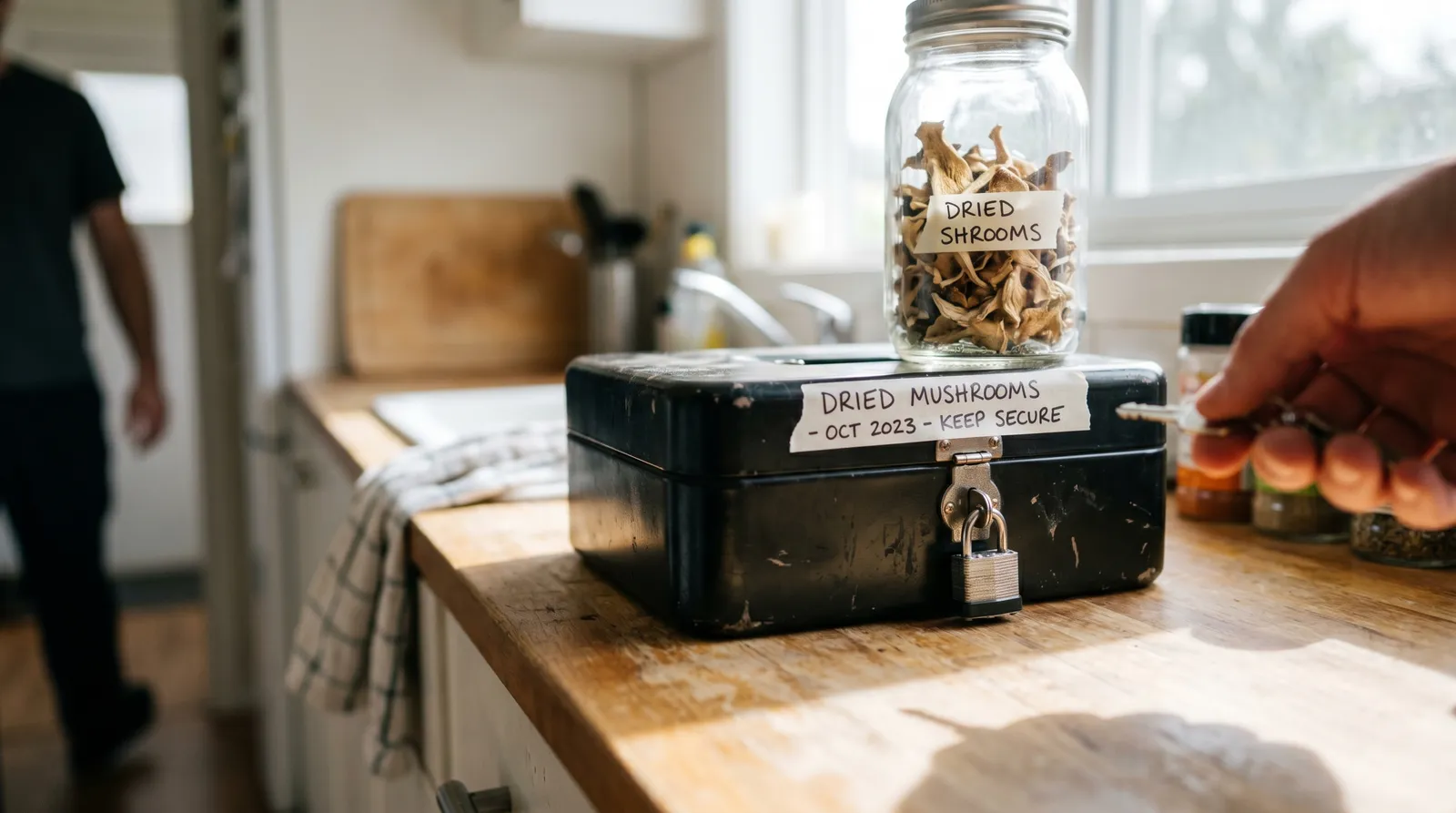
Label with strain, harvest date, and flush number. You will not remember in eight months whether that jar is first-flush Golden Teacher or third-flush McKennaii, and potency varies noticeably between flushes (later flushes generally lower). Knowing what you're working with matters when you're calibrating by weight.
Spotting a stash that's gone bad
Spoilage signs are obvious once you know them. Fuzzy growth of any colour — white, green, grey, pink — means mould has colonised residual moisture, and the jar goes in the bin. Not the compost, not "just the mouldy bits removed," the bin. Mycotoxins from storage moulds like Aspergillus don't belong in your body alongside psilocybin or anywhere else.
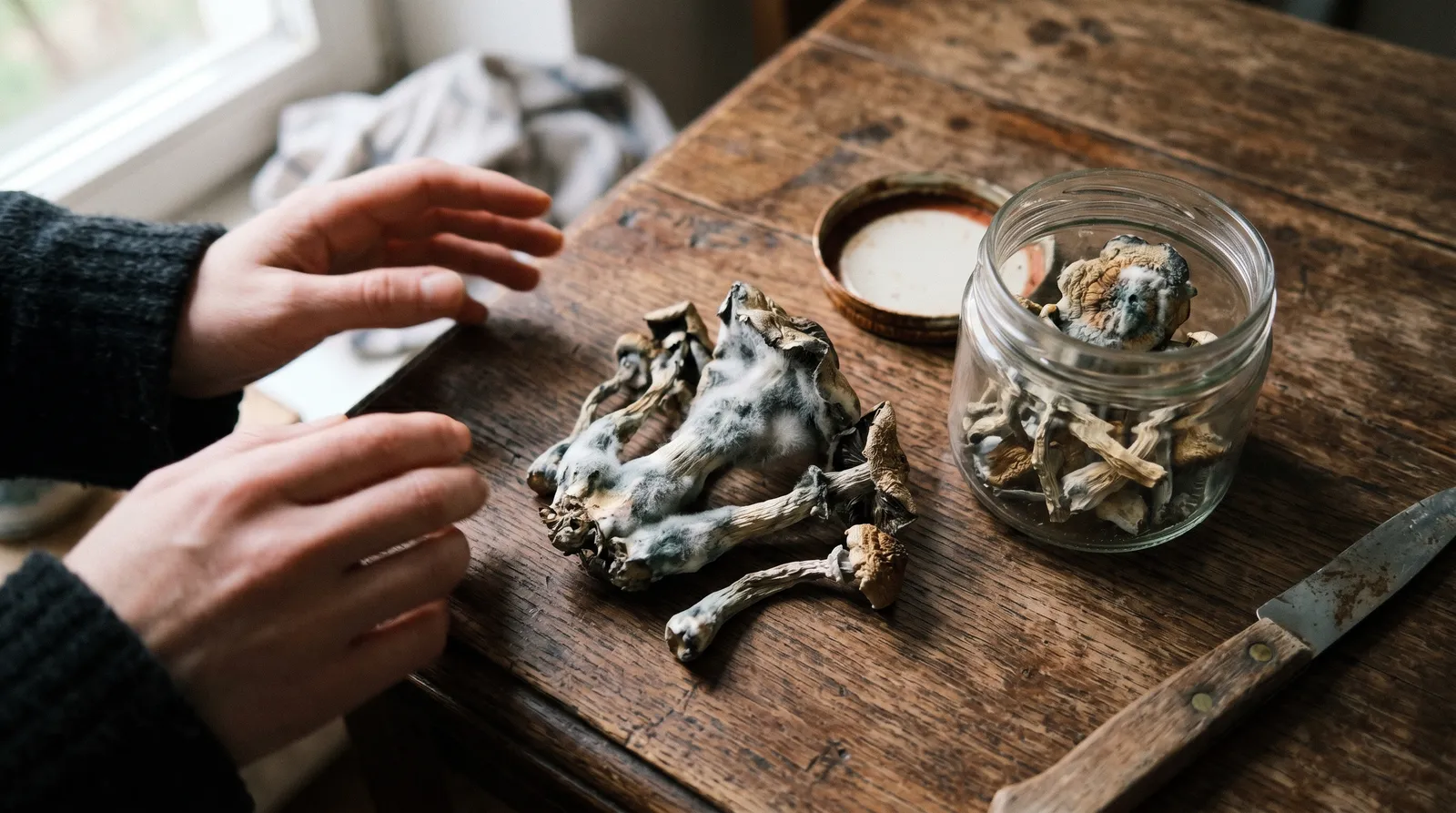
A sour, ammonia-like, or musty smell is bacterial contamination, again from moisture. Bin. Dark black-brown patches that weren't there at harvest suggest advanced oxidation or wet rot — potency is already compromised and the material may be harbouring more than just degraded alkaloids.
Normal bluing from handling during harvest is fine and doesn't indicate spoilage — that's psilocin oxidation that happened before drying, not rot. What you're looking for is new damage: new colours, new smells, new textures compared to how they looked going in.
Realistic shelf-life expectations
Expected shelf life depends directly on which storage method you choose. The table below summarises the ranges supported by combined literature and shop-floor experience:
| Method | Conditions | Useable shelf life | Expected potency retention |
|---|---|---|---|
| Cupboard | 15–20°C, dark, sealed glass + silica | 6–12 months | Gradual decline; ~70–85% at 12 months |
| Fridge | 4°C, vacuum-sealed bag, double-sealed | 12–18 months | ~85–90% at 12 months |
| Freezer | -18°C or colder, vacuum + desiccant | 2+ years | ~85–95% at 12 months (Gotvaldová et al. 2021) |
| Ground/capsules | Any of the above | Roughly half of whole-body figures | Faster decline due to surface area |
Compared with fresh sclerotia (fridge-only, shelf life measured in weeks), well-dried cubensis stored cold and sealed is in a different league — that's the core trade-off between the two product formats.
Ground powder and capsules degrade faster than whole fruit bodies because surface area is dramatically higher. If you grind, grind what you'll use within a month and keep the rest whole.
A brief note on interactions
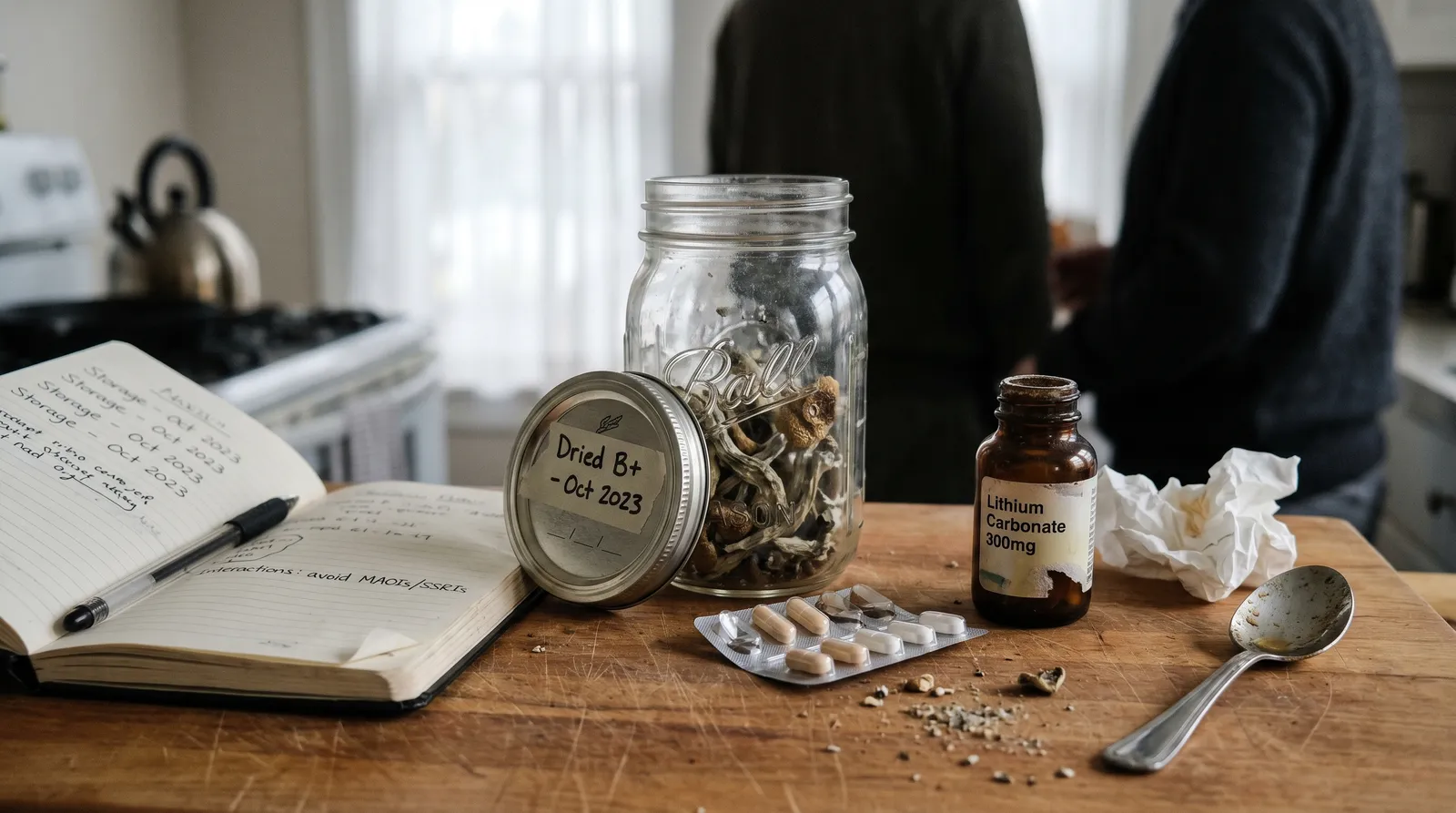
Storage doesn't change pharmacology, but it's worth a line: psilocybin should not be combined with MAOIs, SSRIs, or lithium. The dedicated interactions article on the psilocybin hub covers the mechanisms and risks in detail — consumption planning belongs there, not here.
Related products
For home growers finishing their first harvest, the Grow Kit format (Golden Teacher, McKennaii, B+, Cambodia, Mazatapec, Mexican, PES Amazonian, Treasure Coast) and Ready-2-Grow Bag format (APE, Enigma, Hillbilly Pumpkin, Jack Rabbit, Jedi Mind Fuck, Makilla Gorilla, MVP, plus Golden Teacher and McKennaii in R2G) both produce dryable cubensis fruit bodies that respond to the storage steps above. If you plan to buy a grow kit or order silica gel and vacuum bags alongside it, get everything ready before harvest day — drying starts immediately. Sclerotia from the Azarius range are typically stored fresh in the fridge rather than dried — different product, different rules.
Disclaimer: This article is provided for harm-reduction and educational purposes only. It is not medical advice. Cultivation and possession rules for Psilocybe species vary by jurisdiction. Always store mushrooms securely away from children and pets, and consult a qualified healthcare professional before using any psychoactive substance, especially if you have a personal or family history of psychiatric conditions or take prescription medication.
Last updated: April 2026
Frequently Asked Questions
8 questionsHow long do dried magic mushrooms stay potent?
Can you freeze dried mushrooms?
Do I need silica gel or oxygen absorbers?
How can I tell if stored mushrooms have gone bad?
Does grinding dried mushrooms affect shelf life?
Is the fridge or a cupboard better for dried mushrooms?
What temperature is best for storing dried mushrooms long term?
How dry do mushrooms need to be before long-term storage?
About this article


Adam Parsons is an external cannabis and psychedelics writer and editor who contributes to Azarius's wiki as both author and reviewer. On the writing side, he authors Azarius's kratom and kanna clusters, drawing on exten
This wiki article was drafted with AI assistance and reviewed by Adam Parsons, External contributor. Editorial oversight by Joshua Askew.
Medical disclaimer. This content is for informational purposes only and does not constitute medical advice. Consult a qualified healthcare provider before use of any substance.
Last reviewed April 25, 2026
References (1)
- [1]Gotvaldová, K., Hájková, K., Borovička, J., Jurok, R., Cihlářová, P., & Kuchař, M. (2021). Stability of psilocybin and its four analogs in the biomass of the psychotropic mushroom Psilocybe cubensis. Drug Testing and Analysis, 13(2), 439-446. DOI: 10.1002/dta.2950
Related Articles
Cannabis Hermaphrodite: Identify, Prevent, Act
A cannabis hermaphrodite is a female plant that develops male pollen sacs or banana-shaped anthers (nanners), self-pollinating and seeding your harvest.
DIY Cannabis Fertilizer: Homemade Nutrient Guide
DIY cannabis fertilizer guide: compost, teas, banana ferments and feed schedules, with safety notes and cited research for home growers.
What To Do With Male Cannabis Plants: 6 Practical Uses
What to do with male cannabis plants: identify, isolate, breed, extract, or compost. A practical 6-step guide with sourcing and safety notes.
Mushroom Grow Kit Temperature & Humidity: Full Setup Guide
A temperature humidity control grow kit is the small set of climate tools — hygrometer, heat mat, humidifier or perlite tray — that keeps a mushroom fruiting…
When to Harvest Mushrooms: Veil Break Timing Explained
Harvest timing veil break is a cultivation technique that uses the tearing of the partial veil on maturing Psilocybe cubensis to mark peak alkaloid content.
First Grow Checklist: What You Need for Mushroom Kits
A first grow checklist is the short list of supplies and environmental conditions needed to run a home psilocybin mushroom kit from inoculated substrate to…
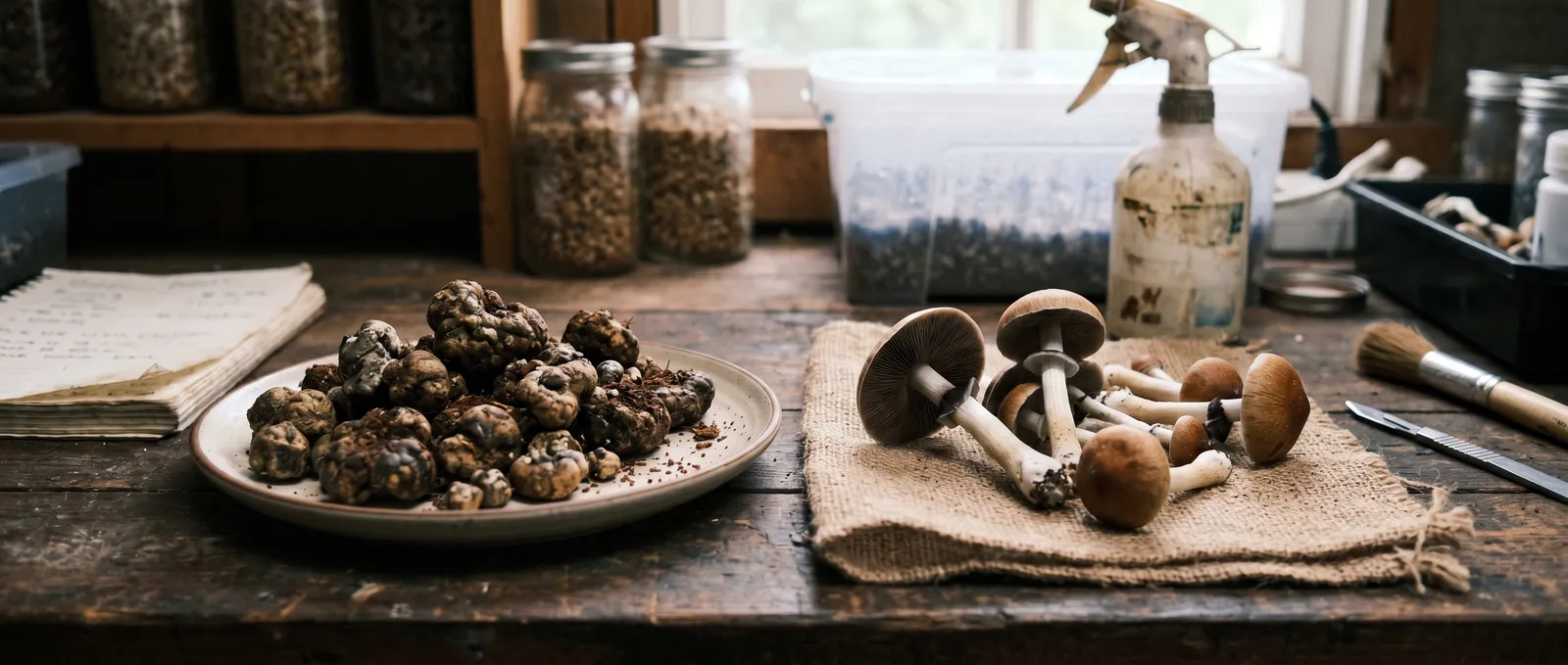
Sclerotia vs Fruit Bodies: Cultivation Comparison
Sclerotia and fruit bodies are two different life stages of Psilocybe fungi: sclerotia are hardened underground mycelial storage bodies (the 'magic…
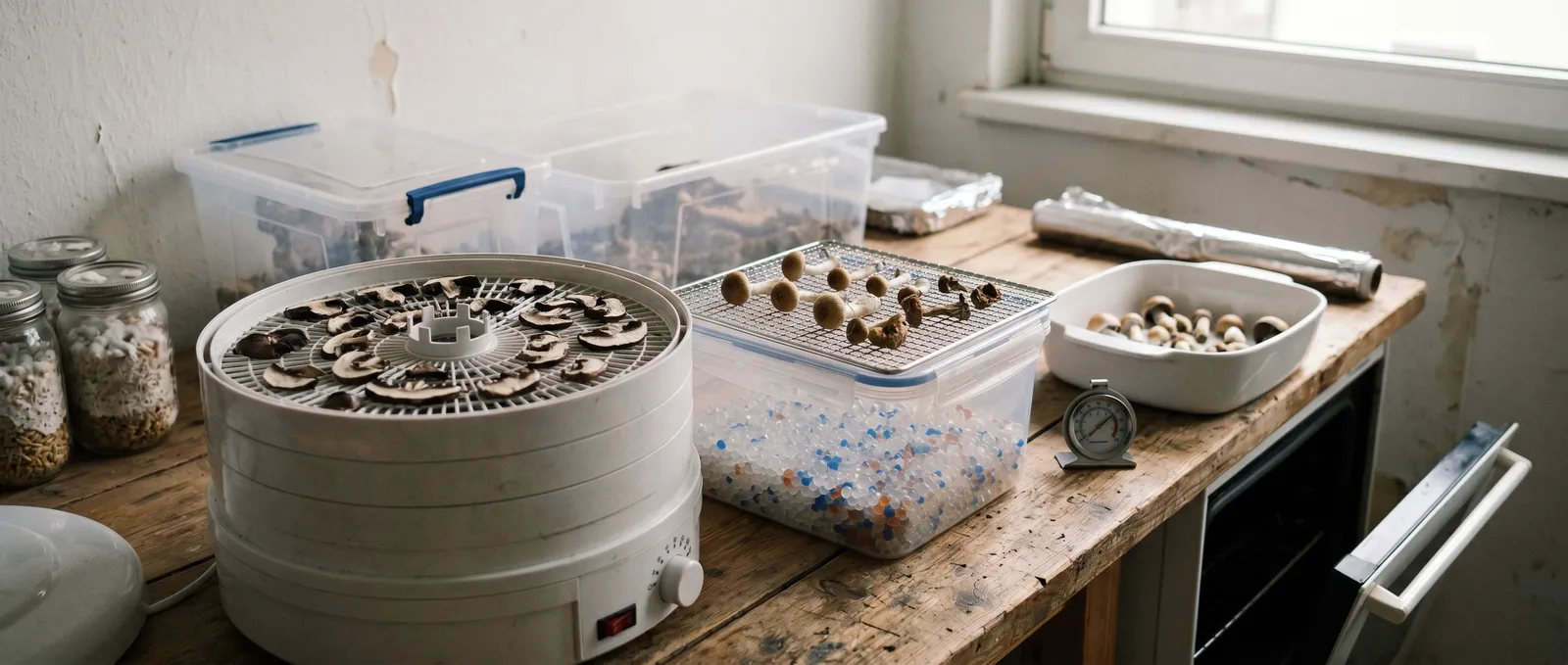
Drying Mushrooms Air Desiccant Oven: Methods Compared
Drying mushrooms air desiccant oven refers to the three home methods for reducing fresh fruit bodies from ~90% water to cracker-dry (<5%). Gotvaldová et al.
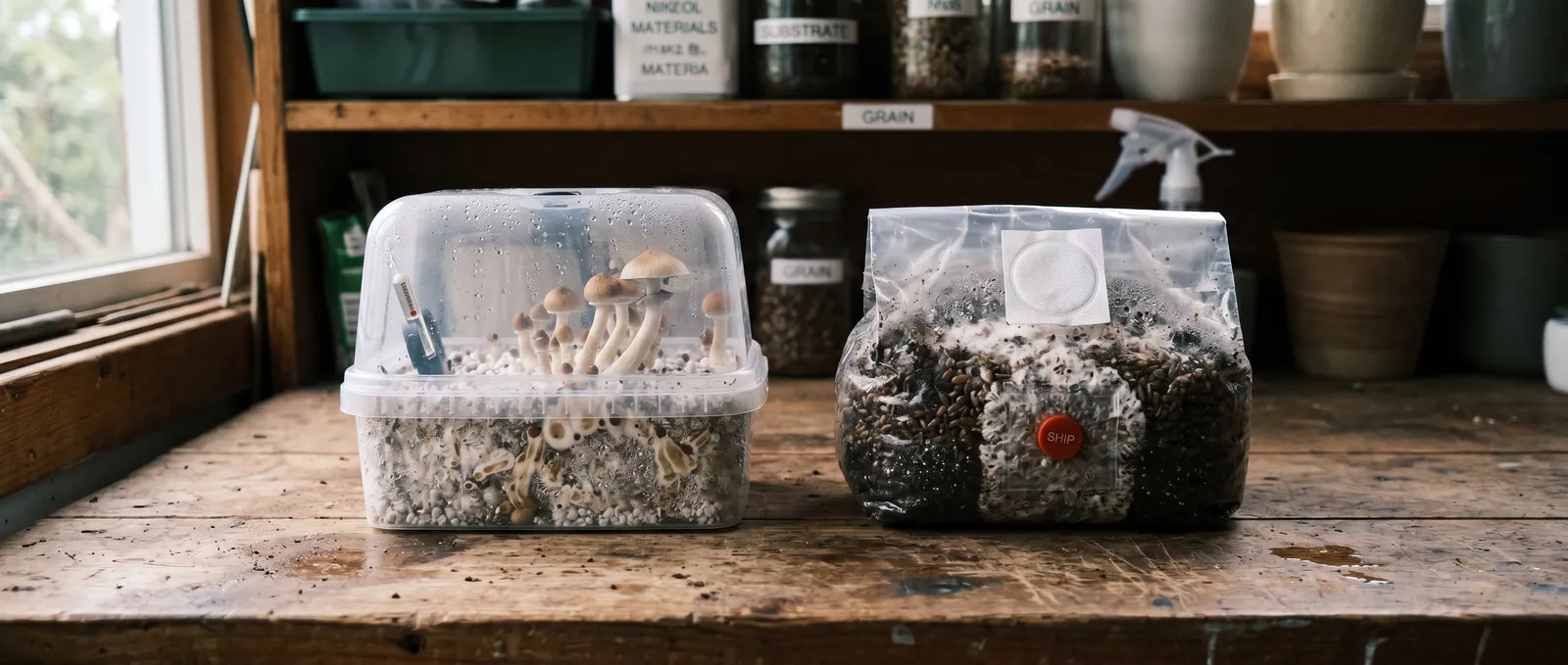
Grow Kit vs Ready 2 Grow Bag: Which to Pick
The grow kit vs Ready 2 Grow Bag choice compares two Psilocybe cubensis home-cultivation formats: a tub with rye substrate and casing layer designed for…