
This article discusses psychoactive substances intended for adults (18+). If you have a health condition or take medication, consult a doctor before use. Our age policy
Cannabis Vegetative Stage: A Grower's Step-by-Step Guide
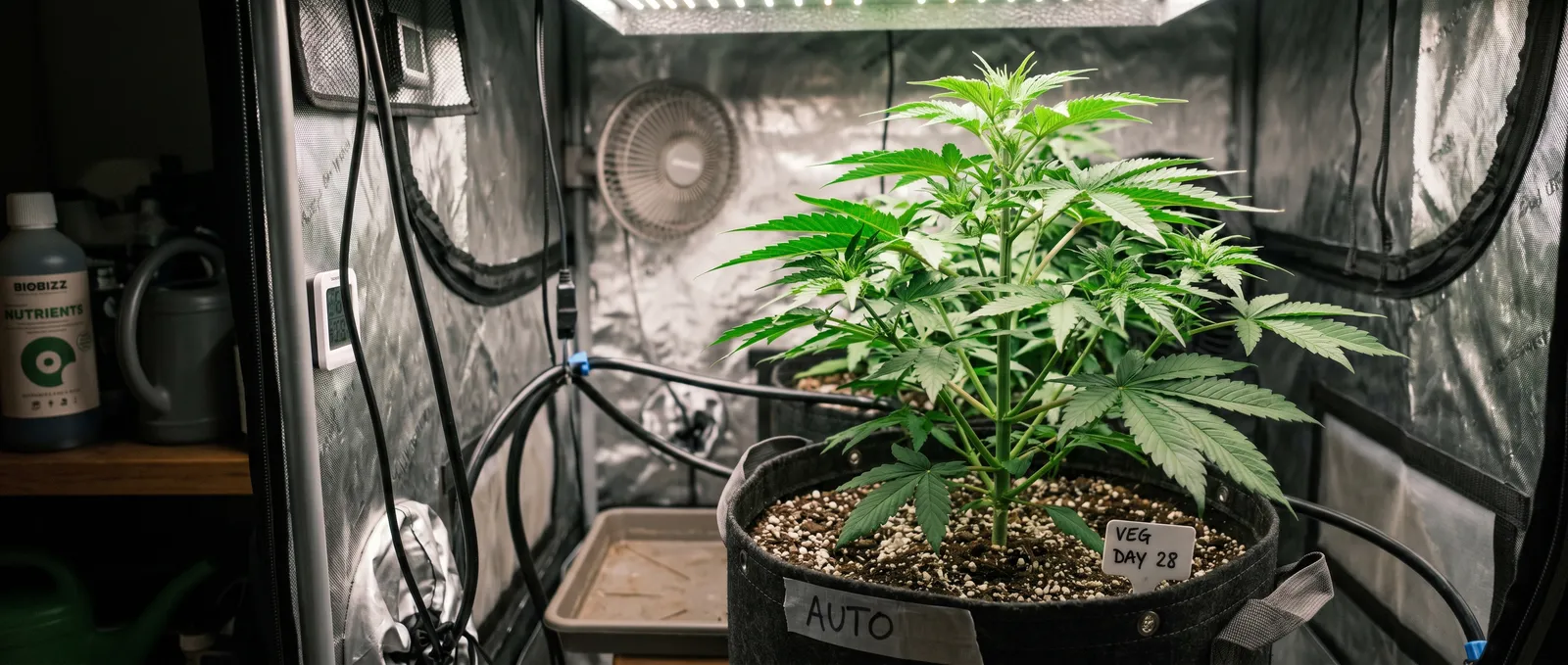
Definition
The cannabis vegetative stage is the leafy growth phase between seedling and flowering, when the plant builds stems, branches, and roots but no buds. For photoperiod genetics it typically runs 4-8 weeks under 18/6 lighting; autoflowers veg roughly 3-4 weeks before flipping on their own internal clock (Spitzer-Rimon et al., 2019).
The cannabis vegetative stage is the leafy growth phase that builds the frame your plant will later use to carry buds. 18+ only This guide is written for adult home growers who want to get veg right the first time — get it wrong and you're nursing a weak, stretchy plant for ten weeks trying to catch up.
Below is how we run the cannabis vegetative stage in our own tent — the numbers, the timing, the decisions you actually have to make. Rules on home cultivation differ by country and change often, so before you buy seeds and germinate anything, check the current rules where you live.
Step 1: Understand what veg actually is
Vegetative growth is the phase between seedling and flowering where the plant produces leaves, branches, and roots but no flowers. For photoperiod genetics, it ends when you flip the light cycle to 12 hours on / 12 hours off. For autoflowers, there's no flip — the plant starts flowering on its own internal clock, usually around week 3-4 from germination (Spitzer-Rimon et al., 2019).
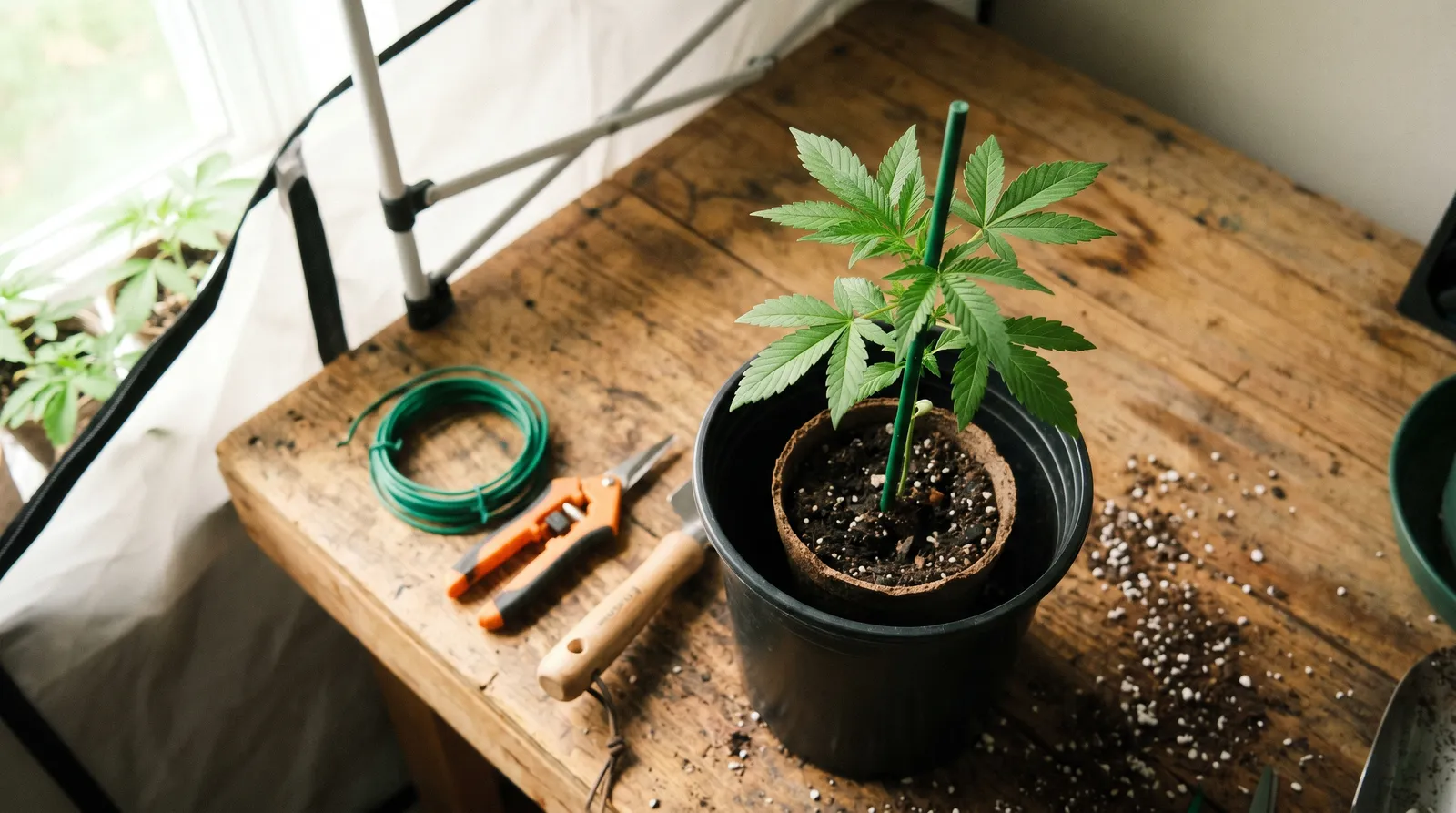
This structural distinction matters more than almost any other decision you'll make:
- Photoperiod plants stay in veg for as long as you keep them under 18+ hours of light. Typical home-grow veg: 4-8 weeks. Bigger plant, bigger yield, longer total cycle (roughly 14-20 weeks seed-to-harvest).
- Autoflowers veg for about 3-4 weeks whether you like it or not. Total cycle is 9-11 weeks seed-to-harvest. Less training tolerance, smaller plants, faster turnaround.
If you order autoflower genetics, steps 5 and 6 below (heavy training, extended veg) mostly don't apply to you — the plant will flower before you finish.
Step 2: Set the light cycle and intensity
Photoperiod plants in veg run on an 18/6 schedule: eighteen hours on, six off. Some growers use 20/4 or even 24/0; the research shows diminishing returns above 18 hours and better plant health with a dark period (Chandra et al., 2015). Autoflowers will tolerate anything from 18/6 to 24/0 — we run them at 18/6 because electricity costs money and the plants don't grow noticeably faster under more light.
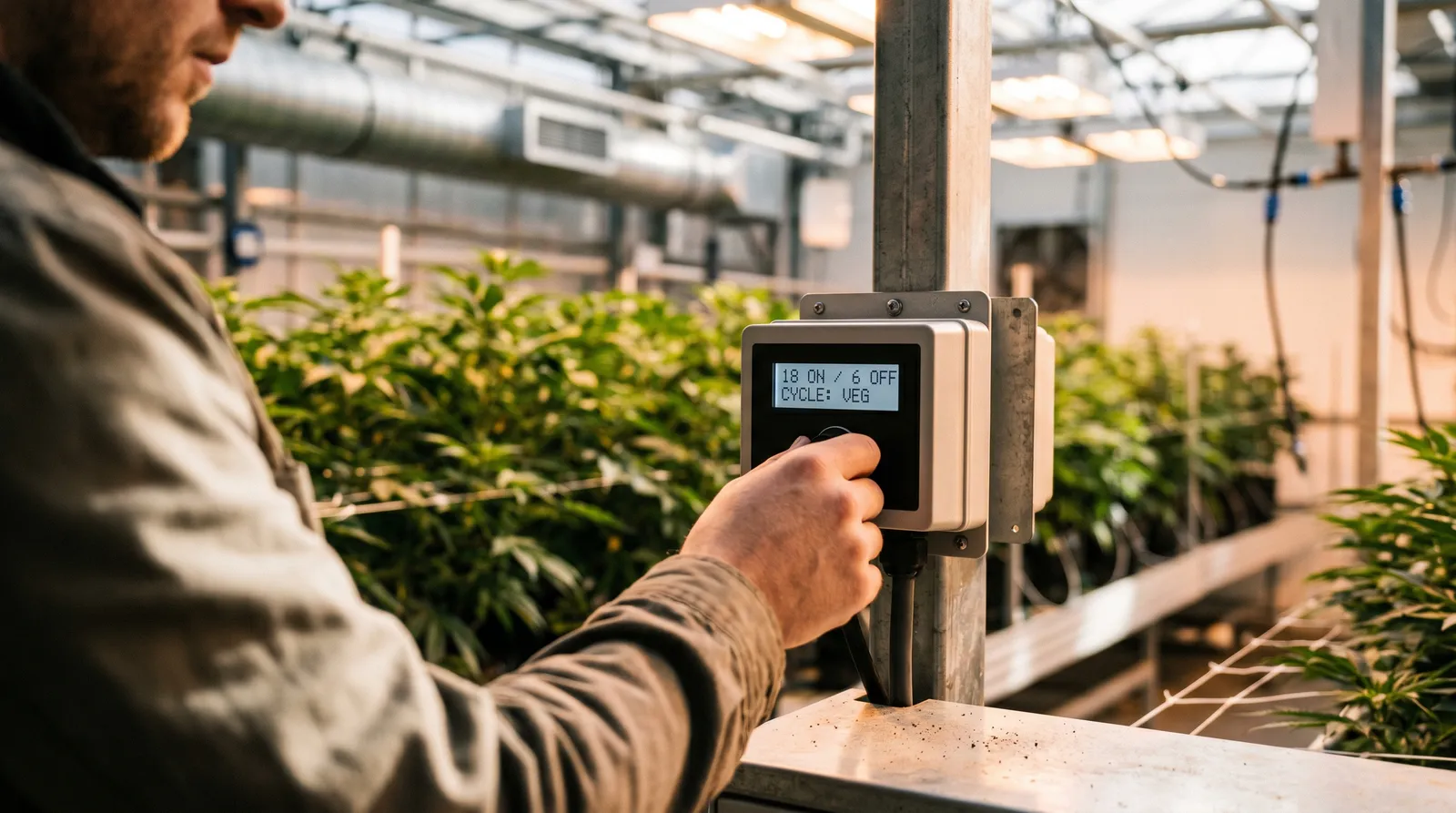
Intensity targets in veg:
| Stage | PPFD at canopy | DLI target |
|---|---|---|
| Seedlings (week 1-2) | 150-300 | ~12-17 mol/m²/day |
| Early veg (week 2-4) | 300-450 | ~18-25 mol/m²/day |
| Late veg (week 4+) | 400-600 | ~25-35 mol/m²/day |
Blasting a two-week-old seedling with 800 PPFD because your light does that on full is the single fastest way to bleach a plant. Dim the fixture or raise it.
Step 3: Dial in temperature, humidity, and airflow
Veg prefers warmer and more humid conditions than flower. Aim for:
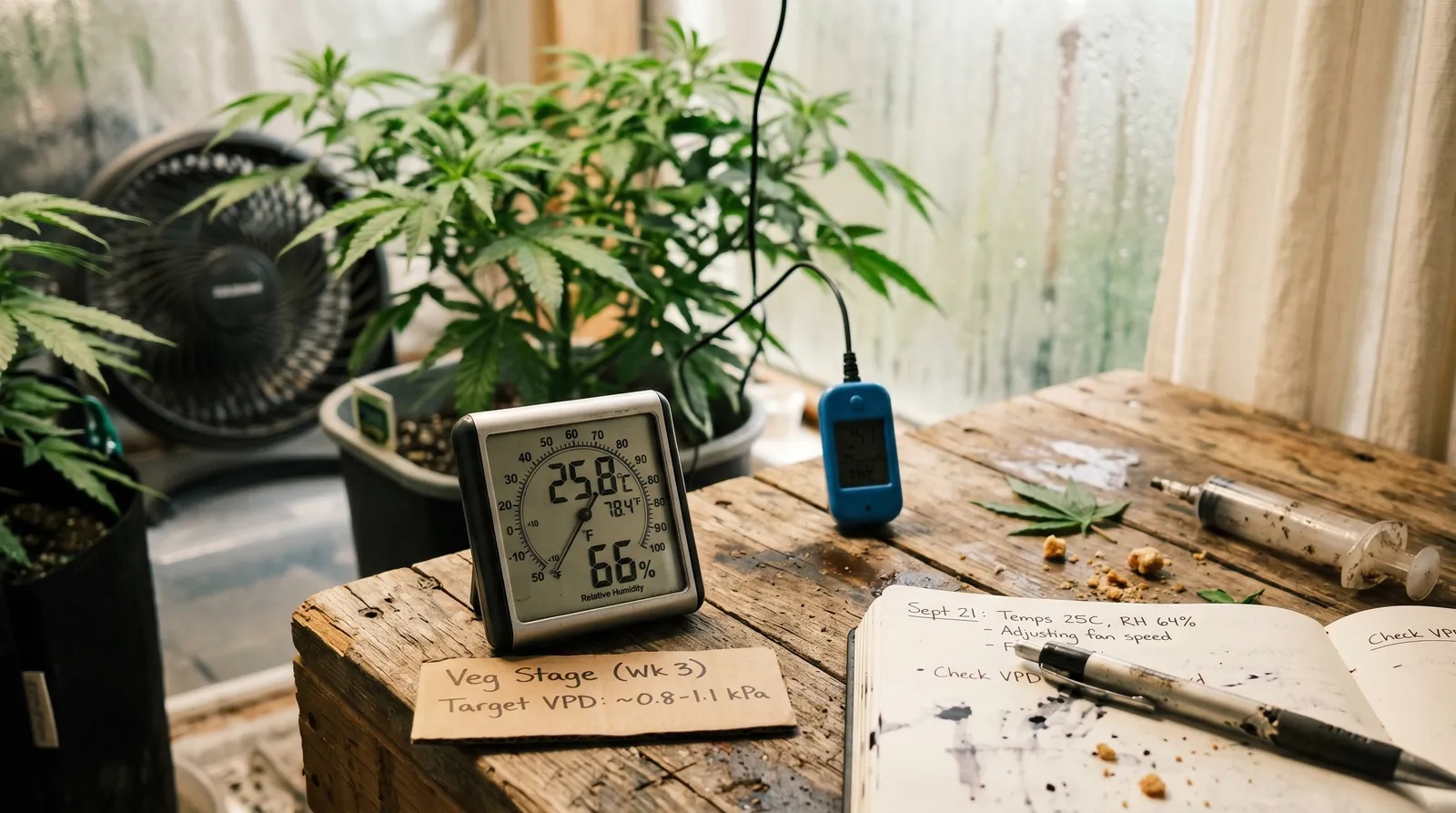
- Lights on: 22-28°C
- Lights off: 18-22°C (keep day-night difference under 8°C)
- Relative humidity: 60-70% for seedlings, 55-65% for established veg
- VPD target: 0.8-1.1 kPa
VPD (vapour pressure deficit) is the unified metric — it combines temperature and humidity into one number that tells you how hard the plant is transpiring. Free VPD charts are everywhere; tape one inside the tent.
Airflow matters as much as the numbers. You want leaves gently moving, not whipping. A weak oscillating clip fan is usually enough for a 80x80 or 100x100 tent alongside your extraction. Stagnant air is how you get powdery mildew and weak stems.
Step 4: Water and feed correctly for your medium
Watering schedules depend entirely on the medium — soil, coco, and hydro are completely different systems and the generic "water when the top inch is dry" advice fails on two of the three.
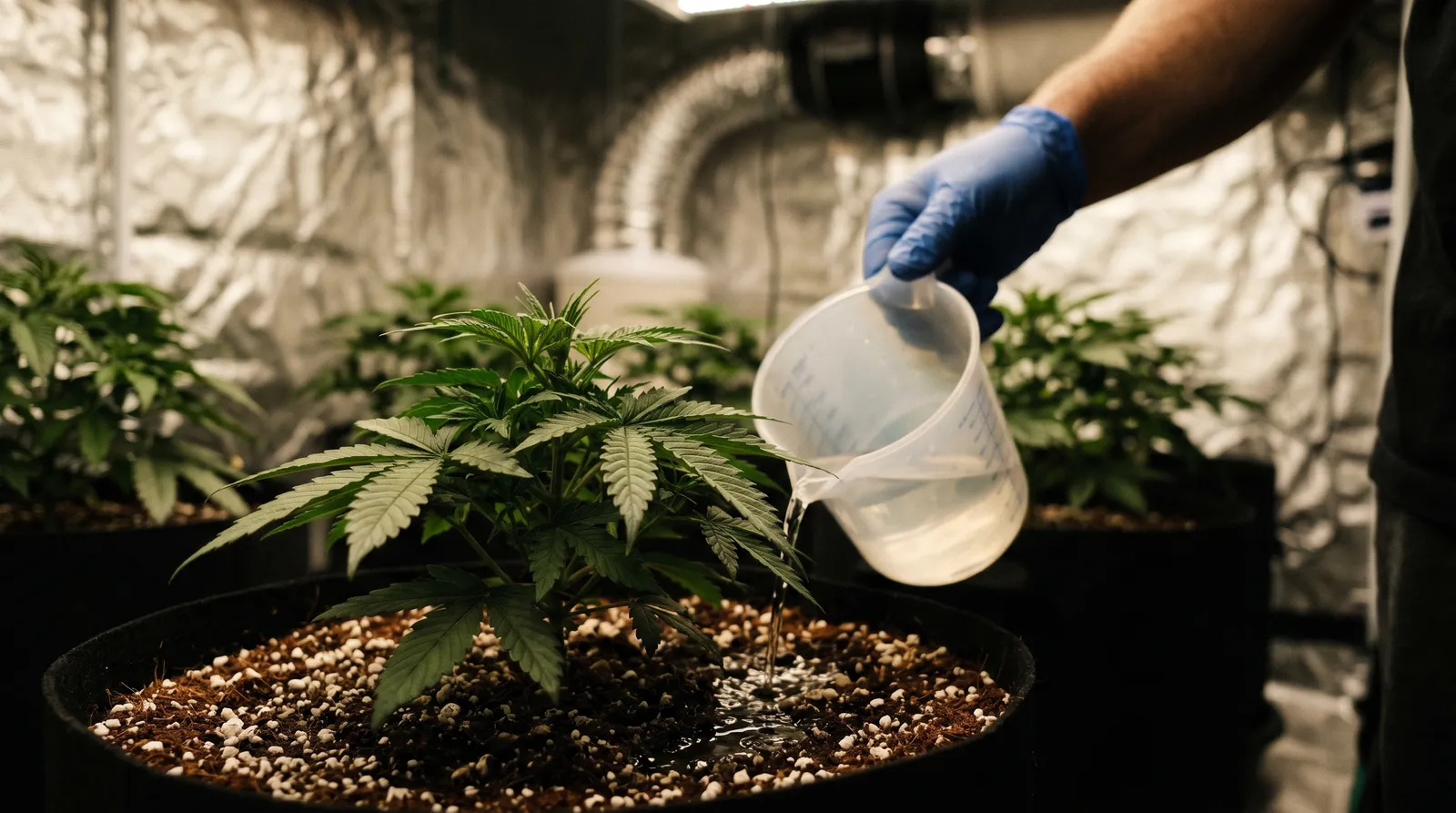
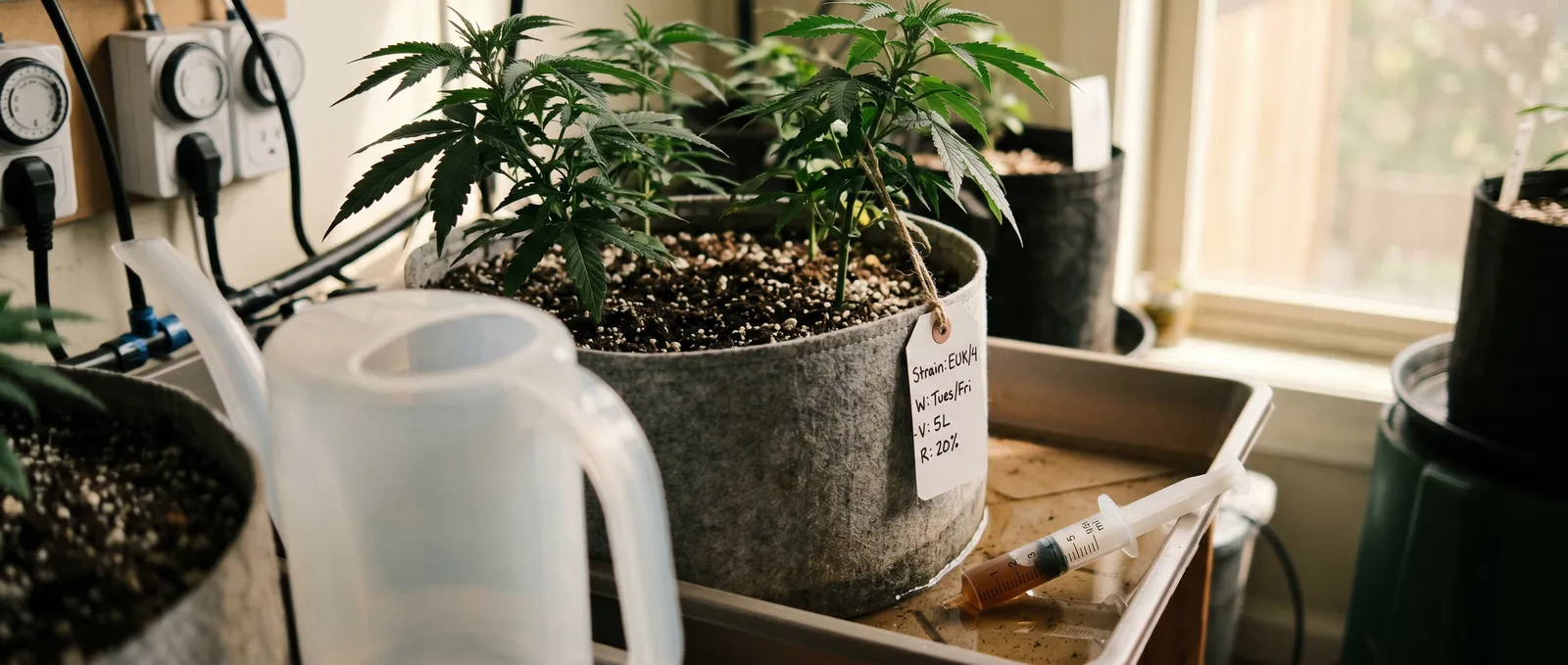
- Soil: Water when the pot feels noticeably lighter, roughly every 2-4 days once established. pH at the root zone: 6.2-6.8. Feed at half-strength for the first two weeks of veg, then work up.
- Coco coir: Treat it like hydro, not soil. Water daily (or multiple times daily in late veg) with nutrient solution every time — coco holds no nutrients on its own. pH: 5.8-6.2. EC: 1.2-1.8 in early veg, up to 2.0 late veg.
- Hydroponic (DWC, RDWC, NFT): Res temp under 20°C, EC 1.0-1.6 in veg, pH 5.5-6.0. Change or top up the reservoir weekly.
On the nutrient side: veg wants nitrogen. A typical veg N-P-K ratio sits around 3-1-2 or 4-2-3. Nutrient burn (brown crispy leaf tips) means you're feeding too strong — drop EC by 20%. Claw-shaped leaves that droop at the tips are the classic nitrogen-toxicity signal.
Over-watering kills more first grows than anything else. If the leaves are drooping and the pot is heavy, you've drowned the roots. Let it dry back.
Step 5: Train photoperiod plants while they're flexible
Training during the cannabis vegetative stage is where you shape the plant for yield. Once flowering starts, stems lignify and stop bending without snapping. Training increases canopy area and light penetration, which raises yield per watt more than almost any other single intervention.
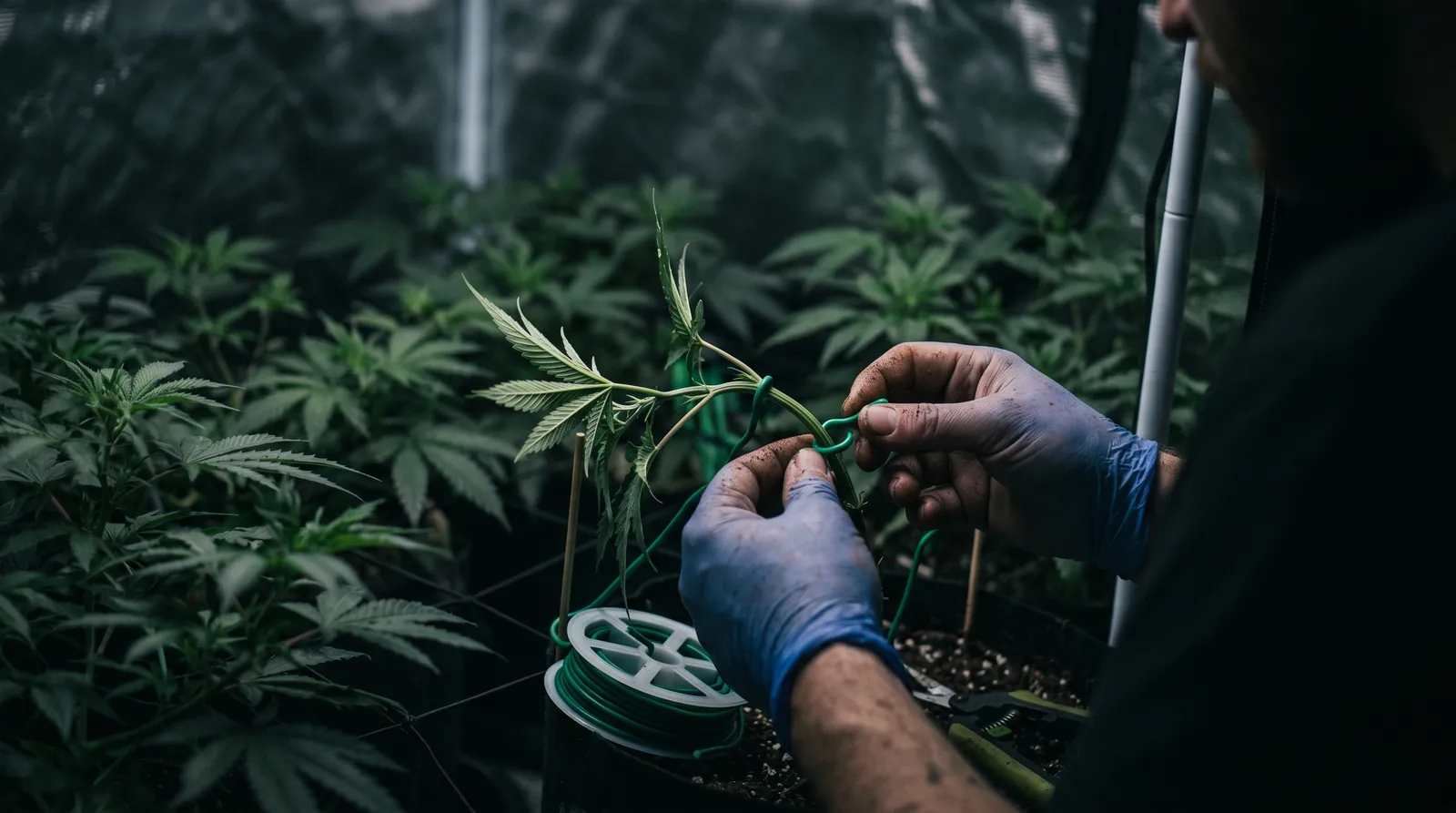
Main techniques:
- Low-Stress Training (LST): Bend the main stem sideways and tie it down when the plant has 4-6 nodes. Repeat on side branches. Lowest risk, works on almost every genetic.
- Topping: Cut the growing tip above the 5th or 6th node. The plant responds by producing two main colas instead of one. Top a second time a week later for four main colas.
- FIMing: Pinch out ~75% of the new growth tip instead of a clean cut. Can produce 3-4 new tops but results are less predictable than topping.
- SCROG (Screen of Green): Grow the plant under a horizontal net, weaving new growth through the squares to create a flat, even canopy. Excellent for small tent yields but needs a longer veg (6-8+ weeks).
Do not train autoflowers aggressively. A little LST is fine; topping an autoflower 3 weeks from germination is how you end up with a 20g plant.
The best single-plant yield we ever pulled from our 100x100 tent came from an 8-week veg of Royal Queen Seeds Critical under a 60x60 SCROG net, topped twice, and bent flat. It looked ridiculous — like a hedge in a box — right up until flower, when every bud site got equal light and the thing kept producing for 10 weeks. Compared to our untrained single-cola runs of the same genetic, the SCROG roughly doubled dry weight off the same wattage.
Honest limitation: every tent is different. Our numbers come from a 100x100 with a 320W LED in Amsterdam humidity — your mileage will vary with genetics, climate, and how obsessively you check on the plants.
Step 6: Know when to flip (or just wait)
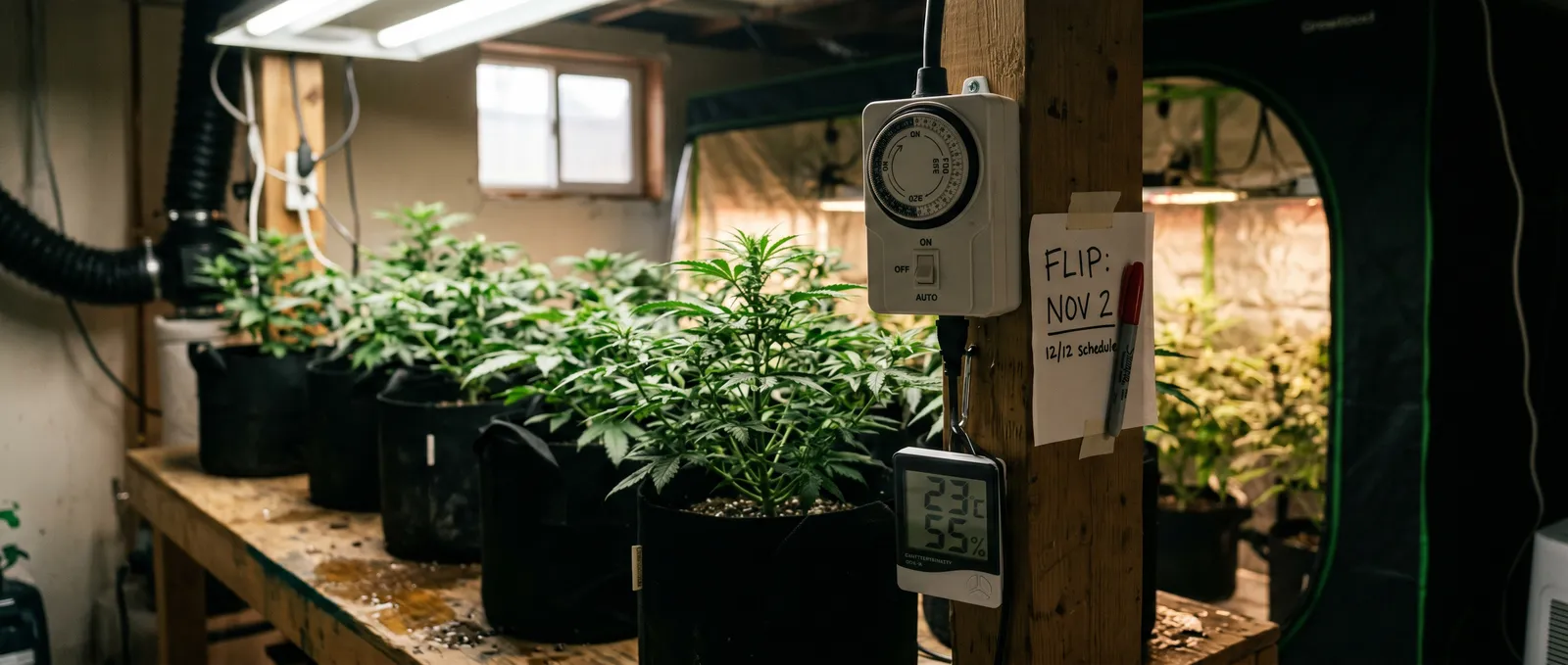
For photoperiod plants, flip to 12/12 when the plant occupies about half the vertical space you've got, because most strains roughly double in height during the 2-3 week flowering stretch. In a 1.8m tent with a 40cm-tall light, that means flipping at around 60-70cm.
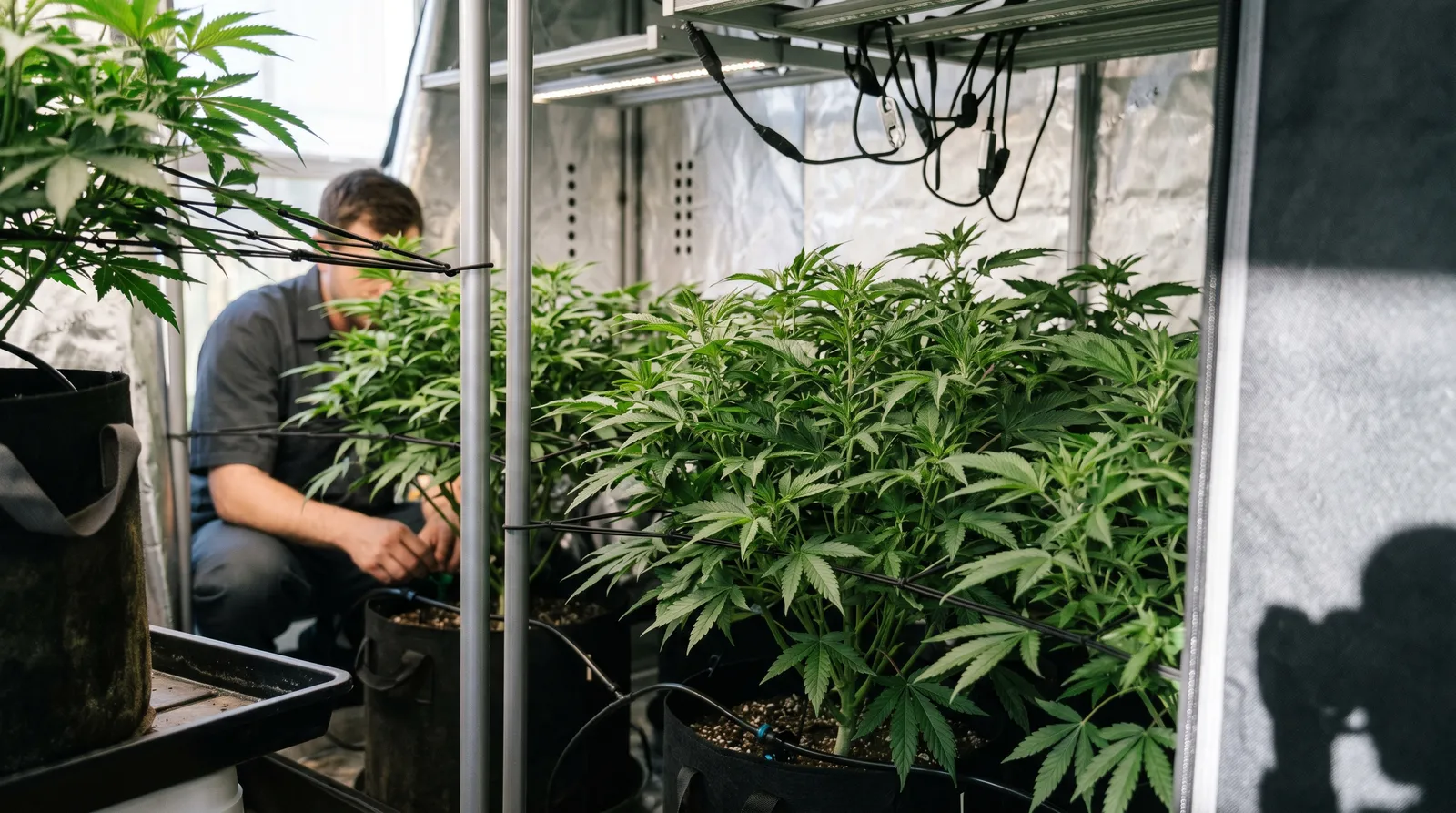
Flip too early and you'll leave yield on the table. Flip too late and you'll burn the top colas against the light. Indica-leaning genetics stretch less (1.5x); sativa-leaning and haze genetics can triple in height — scale your flip point accordingly.
For autoflowers, you don't flip. Keep the 18/6 running straight through flowering. Drop humidity gradually (to 40-50%) as buds form to reduce botrytis risk.
Common veg-stage mistakes
- Overfeeding seedlings. The seed carries its own nutrients for the first 7-10 days. Start at quarter-strength, not full.
- Light too close. Most modern LEDs want 40-60cm from a seedling, not 25cm.
- No airflow. Weak stems that can't support their own weight later.
- Topping too early. Wait for 5-6 true nodes minimum. Topping a 3-node plant stalls it for a week.
- Ignoring pH. A coco grow at pH 7.0 will lock out iron and calcium no matter how good your nutrients are.
Legal notice: Cannabis cultivation laws vary by country and region and change frequently. This guide is educational. Before growing, verify current laws for your specific jurisdiction. Azarius does not provide legal advice.
This guide is educational. Azarius does not provide formal advice.
Last updated: April 2026
Frequently Asked Questions
8 questionsHow long should the cannabis vegetative stage last?
What light schedule is best during veg?
What PPFD should I target in veg?
When should I start training my plant?
How often should I water during veg?
What nutrients does a plant need in veg?
What temperature and humidity should I maintain during veg?
How long does the vegetative stage last for autoflowers vs photoperiods?
About this article


Luke Sholl has been writing about cannabis, cannabinoids, and the broader benefits of nature since 2011, and has personally grown cannabis in home grow tents for more than a decade. That first-hand cultivation experience
This wiki article was drafted with AI assistance and reviewed by Luke Sholl, External contributor since 2026. Editorial oversight by Adam Parsons.
Medical disclaimer. This content is for informational purposes only and does not constitute medical advice. Consult a qualified healthcare provider before use of any substance.
Last reviewed April 24, 2026
References
- [1]Chandra, S., Lata, H., Khan, I. A., & ElSohly, M. A. (2015). Photosynthetic response of Cannabis sativa L. to variations in photosynthetic photon flux densities, temperature and CO2 conditions. Physiology and Molecular Biology of Plants, 14(4), 299-306.
- [2]Spitzer-Rimon, B., Duchin, S., Bernstein, N., & Kamenetsky, R. (2019). Architecture and Florogenesis in Female Cannabis sativa Plants. Frontiers in Plant Science, 10, 350.
- [3]Potter, D. J. (2014). A review of the cultivation and processing of cannabis for production of prescription medicines. Drug Testing and Analysis, 6(1-2), 31-38.
- [4]EMCDDA. (2024). Cannabis — the current situation in Europe. European Monitoring Centre for Drugs and Drug Addiction, Lisbon.
- [5]Beckley Foundation. (2022). Cannabis policy and cultivation research briefings. Beckley Foundation, Oxford.
Related Articles
Cannabis Hermaphrodite: Identify, Prevent, Act
A cannabis hermaphrodite is a female plant that develops male pollen sacs or banana-shaped anthers (nanners), self-pollinating and seeding your harvest.
DIY Cannabis Fertilizer: Homemade Nutrient Guide
DIY cannabis fertilizer guide: compost, teas, banana ferments and feed schedules, with safety notes and cited research for home growers.
What To Do With Male Cannabis Plants: 6 Practical Uses
What to do with male cannabis plants: identify, isolate, breed, extract, or compost. A practical 6-step guide with sourcing and safety notes.
When To Harvest Cannabis Trichomes: A Grower's Guide
Deciding when to harvest cannabis trichomes means reading the resin glands on your calyxes under 60x–100x magnification and cutting when the milky-to-amber…
When To Flip Cannabis To 12/12: Timing The Switch
When to flip cannabis to 12/12 is a timing decision that switches photoperiod plants to 12 hours light and 12 hours dark to trigger flowering via florigen…
Watering Cannabis Frequency Volume Runoff: Full Guide
Watering cannabis frequency volume runoff is the feedback loop between how often you irrigate, how much you apply, and what drains from the pot.