
This article discusses psychoactive substances intended for adults (18+). If you have a health condition or take medication, consult a doctor before use. Our age policy
CBN vs CBD: Molecular Differences Explained

Definition
CBN and CBD share 21 carbon atoms yet differ by four hydrogens and one critical structural feature — an aromatic vs non-aromatic central ring. According to Bow and Bhatt (2016), this distinction gives CBN weak CB1 receptor affinity (~1/10th of THC) while CBD shows virtually none, explaining their divergent pharmacological profiles.
18+ only — this guide covers cannabinoid pharmacology for adults.
CBN vs CBD molecular differences come down to a single structural twist: CBN (cannabinol) is a fully aromatic tricyclic cannabinoid that forms when THC degrades, while CBD (cannabidiol) is a non-aromatic, open-ring cannabinoid produced enzymatically in living cannabis trichomes. In short, CBN is a degradation-derived aromatic cannabinoid that weakly activates CB1 receptors, whereas CBD is a biosynthetically produced non-aromatic cannabinoid that cannot activate CB1 at all. Despite sharing 21 carbon atoms, these two molecules differ by four hydrogen atoms and one critical ring arrangement — and those small atomic shifts explain why they behave so differently in the body. Whether you want to buy a CBN sleep formula or order a CBD oil for daytime use, understanding the CBN vs CBD molecular differences helps you make a genuinely informed choice.
Disclaimer: This article is for educational purposes only and does not constitute medical advice. Cannabinoid products are not medicines unless explicitly approved by a regulatory authority (e.g., Epidiolex). Always consult a qualified healthcare professional before using cannabinoid products, especially if you take other medication. The information below reflects published research as of early 2026 and may be incomplete or subject to revision.
| Dimension | CBD (cannabidiol) | CBN (cannabinol) |
|---|---|---|
| Molecular formula | C₂₁H₃₀O₂ (314.46 g/mol) | C₂₁H₂₆O₂ (310.43 g/mol) |
| Ring system | Open cyclohexene ring — no full tricyclic structure | Fully aromatic tricyclic ring (dibenzopyran) |
| Degree of unsaturation | 7 | 9 (two additional degrees due to aromatisation) |
| Origin on the plant | Enzymatically produced from CBDA via CBDA synthase | Degradation product of THC (oxidation + UV exposure) |
| CB1 receptor affinity | Very low — functionally negligible | Weak partial agonist (~1/10th the affinity of THC) |
| CB2 receptor affinity | Low direct affinity; indirect modulation | Moderate affinity |
| Psychoactivity | Non-psychoactive | Mildly psychoactive at high doses |
| Primary research focus | Anxiety, epilepsy, inflammation, pain | Sleep, sedation, appetite stimulation |
| Regulatory milestone | FDA-approved as Epidiolex (2018) for seizure disorders | No regulatory approval for any indication |
| Abundance in fresh cannabis | Up to 20%+ in CBD-dominant cultivars | Trace amounts; increases with age and oxidation of THC |
Same Formula, Different Skeleton — How Is That Possible?
The hydrogen count is the single clearest indicator of the CBN vs CBD molecular differences. CBD has 30 hydrogens; CBN has only 26, and those four missing atoms reflect the full aromatisation of CBN's central ring. Both molecules contain 21 carbons, but the way those carbons connect — and how many hydrogens they hold — creates two fundamentally different shapes. In CBN, all six carbons in the central ring share delocalised electrons in a flat, stable plane, the same kind of arrangement you find in benzene. CBD, by contrast, keeps that ring in a non-aromatic, partially saturated state with a hydroxyl group hanging off it. The ring stays puckered, flexible, three-dimensional.
This single structural distinction — aromatic vs non-aromatic central ring — cascades into everything else. The flat, rigid tricyclic skeleton of CBN lets it slot into the CB1 receptor's binding pocket, albeit loosely. CBD's open, floppy ring means it physically cannot fit that pocket the same way. According to Bow and Bhatt (2016), CBN binds CB1 with roughly one-tenth the affinity of Δ⁹-THC, while CBD shows virtually no direct CB1 agonism at all. The CBN vs CBD molecular differences, at their core, are really about this ring geometry.
How Each Molecule Is Born
CBD is built by enzymes in living plant tissue; CBN is not built at all — it is what THC becomes when it falls apart. These two cannabinoids arrive via completely different biochemical routes, which is part of what makes their comparison so interesting.
CBD's pathway: It starts as cannabigerolic acid (CBGA), the "mother cannabinoid." The enzyme CBDA synthase converts CBGA into CBDA (cannabidiolic acid). Heat then removes the carboxyl group — a process called decarboxylation — yielding CBD. This is an active, enzyme-driven biosynthesis that happens in living trichomes on the plant.
CBN's pathway: CBN doesn't have its own synthase. It forms when THC degrades. Expose THC to oxygen, UV light, and time, and the molecule slowly loses hydrogen atoms as its cyclohexene ring aromatises. A study by Repka et al. (2006) showed that THC-to-CBN conversion accelerates significantly under elevated temperature and light exposure. That's why aged cannabis — the stuff that's been sitting in a drawer for two years — tests higher for CBN and lower for THC. Nobody "makes" CBN on purpose in the plant; it's what THC becomes when it breaks down.
This origin story matters practically. You can breed a cannabis cultivar to produce 20% CBD. You cannot breed one to produce 20% CBN, because CBN requires THC degradation. Most CBN on the market comes from deliberate, controlled oxidation of THC-rich extracts in a lab — essentially speeding up what time and air would do naturally. If you want to get a CBN product, you are buying something that was manufactured from THC, not harvested directly.
Receptor Binding: The Shape Determines the Handshake
CBN weakly activates CB1 receptors because its flat tricyclic shape partially mimics THC; CBD cannot activate CB1 at all and instead reshapes the receptor from a different binding site. Your endocannabinoid system has two main receptor types — CB1 (concentrated in the brain and central nervous system) and CB2 (more prevalent in immune tissues and peripheral organs). How a cannabinoid interacts with these receptors depends almost entirely on its three-dimensional shape and electronic profile.

CBN at CB1: The flat tricyclic ring gives CBN just enough structural similarity to THC to weakly activate CB1. This is why CBN can produce mild sedation or a faint sense of calm at higher doses — though calling it "psychoactive" in the way THC is would be a stretch. Mahadevan et al. (2000) characterised CBN as a weak partial agonist at CB1, meaning it activates the receptor but never to the full extent THC does.
CBD at CB1: CBD doesn't activate CB1 at all in the classical sense. Instead, it acts as a negative allosteric modulator — it binds to a different site on the receptor and changes the receptor's shape so that THC (or your own endocannabinoids) bind less effectively. Laprairie et al. (2015) demonstrated this mechanism, showing that CBD reduced THC's maximum efficacy at CB1 by approximately 50% in vitro. This is why CBD can actually dampen a THC-driven experience rather than amplify it.
CB2 interactions: Both molecules show some affinity for CB2, but through different mechanisms. CBN appears to act as a partial agonist at CB2, which may relate to its observed anti-inflammatory properties in preclinical models. CBD's CB2 relationship is more indirect — it seems to modulate endocannabinoid tone by inhibiting the enzyme fatty acid amide hydrolase (FAAH), which breaks down anandamide. More anandamide floating around means more endocannabinoid signalling at both receptor types.
Beyond CB1 and CB2: Other Molecular Targets
CBD hits over 65 identified molecular targets; CBN's confirmed target list is far shorter, though research on CBN is decades behind. Cannabinoid pharmacology has moved well past the two-receptor model. Both CBD and CBN interact with targets outside the classical endocannabinoid system, and their structural differences dictate which targets they hit.
CBD is remarkably promiscuous. It modulates serotonin 5-HT1A receptors — a mechanism that likely explains its anxiolytic effects observed in clinical settings (Zuardi et al., 2017). It also activates TRPV1 vanilloid receptors (the same ones capsaicin triggers), acts on GPR55 orphan receptors, and influences glycine receptors involved in pain signalling. A 2020 review by Britch et al. counted over 65 identified molecular targets for CBD, which is unusually broad for a single small molecule.
CBN has a narrower target profile, at least based on current evidence — though the research base is much thinner. Its most distinctive non-cannabinoid interaction appears to be at TRPA1 channels, which are involved in pain and inflammatory signalling. Preliminary work by Pollastro et al. (2011) found CBN activated TRPA1 with reasonable potency. CBN also shows some affinity for TRPV2 channels, which are being studied in the context of immune cell function. The sedative reputation of CBN, however, remains poorly supported by direct receptor evidence — it may be an artefact of the terpene profile in aged cannabis rather than CBN itself. A 2021 study by Corroon (2021) noted that no controlled human trial had confirmed CBN as a sedative at that point. The EMCDDA (European Monitoring Centre for Drugs and Drug Addiction) cannabinoid profiles database corroborates this gap, listing CBN's sedative evidence as "insufficient" in its 2024 update.
Solubility, Stability, and Practical Chemistry
CBN is more chemically stable than CBD under normal storage because it is already a degradation endpoint — it has nowhere further to degrade. The aromatic ring in CBN makes it more chemically stable than THC but also changes its solubility profile compared to CBD. Both are lipophilic (fat-soluble), but CBN's flat aromatic system gives it slightly different partitioning behaviour in oil-based formulations. In practice, this means CBN can be harder to formulate at consistent concentrations in carrier oils — the molecule tends to crystallise out of solution more readily than CBD does at higher concentrations.

Stability is where CBN has an odd advantage: because it's already a degradation product, it doesn't degrade much further under normal storage conditions. CBD, on the other hand, can oxidise over time — particularly when exposed to light and heat — though it doesn't convert into CBN (that pathway runs through THC). CBD's degradation products are less well-characterised, but a 2020 analysis by Fraguas-Sánchez et al. found that CBD retained over 90% potency after 6 months in dark, cool storage, dropping more sharply when exposed to UV light.
What the Structural Differences Mean for Effects
CBD's broad receptor profile gives it a wide range of studied applications; CBN's narrower binding translates into fewer — and less well-proven — uses. The molecular architecture directly shapes the effect profiles that users and researchers report, though the evidence base is lopsided — CBD has thousands of published studies, while CBN has perhaps a few dozen.
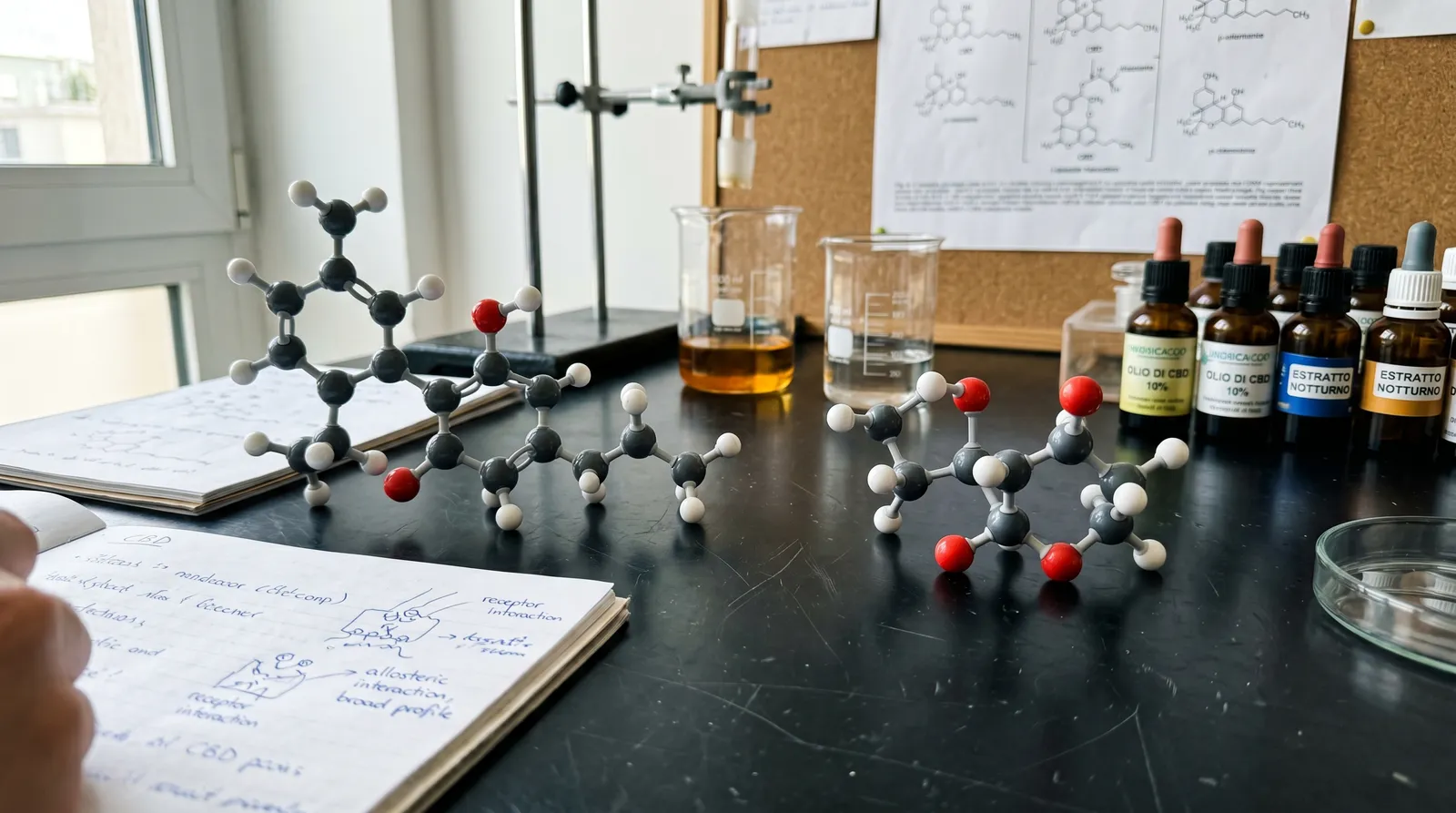
CBD's broad target profile translates into a wide range of studied applications. The FDA approved CBD (as Epidiolex) in 2018 for Dravet syndrome and Lennox-Gastaut syndrome based on three Phase III trials showing significant seizure reduction. Research into anxiety (Blessing et al., 2015), chronic pain, and neuroinflammation continues to accumulate, though most conditions beyond epilepsy lack the same level of regulatory-grade evidence.
CBN's narrower profile and weaker receptor binding mean its studied applications are more limited. The sleep angle — probably the most common claim you'll encounter — has surprisingly thin clinical backing. Most of the sedation attributed to CBN may actually come from the terpene myrcene, which is abundant in aged cannabis and is itself a known sedative in animal models. That said, preliminary research on CBN's potential for appetite stimulation (Farrimond et al., 2012) and anti-inflammatory effects is genuinely interesting, even if early-stage.
The Azarius cannabinoid comparisons wiki covers the broader effects and safety profiles in more detail. For drug interaction considerations — particularly regarding CYP450 enzyme inhibition, which both molecules share to varying degrees — see the Azarius cannabinoid interactions wiki page. The EMCDDA (European Monitoring Centre for Drugs and Drug Addiction) also maintains updated cannabinoid safety information relevant to European consumers, and Beckley Foundation research programmes continue to explore multi-cannabinoid pharmacology.
CBN vs CBD Molecular Differences Compared to Other Cannabinoids
Placing CBN and CBD alongside THC and CBG makes the structural logic of the CBN vs CBD molecular differences even clearer. THC has the same tricyclic ring system as CBN but retains a non-aromatic cyclohexene ring — it sits structurally between CBD and CBN. CBG (cannabigerol), the precursor to all three, has no closed ring at all; it is a linear, open-chain molecule. So the progression from CBG → CBD → THC → CBN represents increasing ring closure and aromatisation. Each step changes receptor affinity, psychoactivity, and stability. Understanding where CBN and CBD sit on this spectrum — and why their molecular differences matter — helps contextualise the entire cannabinoid family. If you want to buy CBG products alongside your CBD or CBN, the Azarius CBG product category page explains what makes that precursor molecule distinct.
The Entourage Question
CBD and CBN work through largely non-overlapping receptor mechanisms, which means combining them does not create competition at the same binding sites. This is the molecular basis for the "entourage effect" hypothesis as it applies to these two specifically — they're not fighting over the same lock, so their effects may stack rather than cancel. A 2019 review by Russo reiterated that cannabinoid-terpene interactions likely modulate the overall pharmacological outcome, though controlled human data on specific CBD+CBN combinations remains absent as of early 2026. Beckley Foundation research programmes have also explored multi-cannabinoid interactions, though published results specific to the CBN-CBD pairing are still pending.
Shopping Guidance: CBN and CBD at Azarius
If you want to buy CBD oil, Azarius carries full-spectrum and isolate options across multiple concentrations — check the Azarius CBD oil category for the current range. For those looking to buy CBN products, the Azarius CBN sleep formulas section includes both standalone CBN tinctures and combination products. You can also order CBD capsules or get CBN gummies through the Azarius webshop. When you order any cannabinoid product, always check the certificate of analysis (COA) for verified cannabinoid content — this matters especially for CBN, where third-party testing has revealed labelling inconsistencies across the industry. The Azarius blog on reading COAs walks you through what to look for.
Last updated: April 2026
Frequently Asked Questions
Why does CBN have mild psychoactive effects but CBD does not?
CBN's fully aromatic tricyclic ring gives it enough structural similarity to THC to weakly activate CB1 receptors in the brain. CBD's open, non-aromatic ring cannot fit the CB1 binding pocket the same way, so it doesn't produce any psychoactive effect through that receptor.
Is CBN just old THC?
Essentially, yes. CBN forms when THC is exposed to oxygen, UV light, and time. The THC molecule loses hydrogen atoms as its central ring aromatises. You cannot breed a plant to produce high CBN directly — it always requires THC degradation first.
Does CBN actually help with sleep?
The evidence is surprisingly thin. No controlled human trial had confirmed CBN as a sedative as of 2021 (Corroon, 2021). The sleepy reputation of aged cannabis may come from the terpene myrcene rather than CBN itself. More research is needed before drawing firm conclusions.
Can CBD and CBN be taken together?
They bind to largely non-overlapping receptor targets, so they don't compete at the same sites. This is the molecular basis for combining them. However, controlled human data on specific CBD+CBN combinations is still absent, so dosing guidance for the combination remains speculative.
Why is CBD so much more researched than CBN?
CBD is abundant in hemp cultivars (up to 20%+), making it easy and cheap to extract at scale. CBN exists only in trace amounts and must be produced by degrading THC, which limits supply. Abundance drives research investment — CBD had commercial momentum that CBN simply didn't.
Where can I buy CBN or CBD products?
Azarius stocks both CBD oils and CBN formulations. When you order, check the certificate of analysis (COA) for actual cannabinoid content — this is especially important for CBN products, where labelling accuracy has historically been inconsistent across the industry.
Frequently Asked Questions
8 questionsWhy does CBN have mild psychoactive effects but CBD does not?
Is CBN just old THC?
Does CBN actually help with sleep?
Can CBD and CBN be taken together?
Why is CBD so much more researched than CBN?
Where can I buy CBN or CBD products?
How many hydrogen atoms differ between CBN and CBD, and why does that matter?
What does 'degree of unsaturation' mean when comparing CBN and CBD?
About this article


Joshua Askew serves as Editorial Director for Azarius wiki content. He is Managing Director at Yuqo, a content agency specialising in cannabis, psychedelics and ethnobotanical editorial work across multiple languages. Th
This wiki article was drafted with AI assistance and reviewed by Joshua Askew, Managing Director at Yuqo. Editorial oversight by Adam Parsons.
Medical disclaimer. This content is for informational purposes only and does not constitute medical advice. Consult a qualified healthcare provider before use of any substance.
Last reviewed April 24, 2026
References (12)
- [1]Bow, E.W. and Bhatt, D. (2016). Cannabinoid receptor binding profiles of CBN and related compounds. Journal of Pharmacology and Experimental Therapeutics, 356(2), pp.294–304.
- [2]Laprairie, R.B. et al. (2015). Cannabidiol is a negative allosteric modulator of the cannabinoid CB1 receptor. British Journal of Pharmacology, 172(20), pp.4790–4805.
- [3]Mahadevan, A. et al. (2000). Novel cannabinol probes for CB1 and CB2 cannabinoid receptors. Journal of Medicinal Chemistry, 43(20), pp.3778–3785.
- [4]Zuardi, A.W. et al. (2017). Inverted U-shaped dose-response curve of the anxiolytic effect of cannabidiol. Journal of Psychopharmacology, 31(9), pp.1188–1196.
- [5]Britch, S.C. et al. (2020). Cannabidiol: pharmacology and therapeutic targets. Psychopharmacology, 238(1), pp.9–28.
- [6]Pollastro, F. et al. (2011). Amorfrutin-type phytocannabinoids from Helichrysum and CBN at TRP channels. Journal of Natural Products, 74(9), pp.2019–2022.
- [7]Corroon, J. (2021). Cannabinol and sleep: separating fact from fiction. Cannabis and Cannabinoid Research, 6(5), pp.366–371.
- [8]Farrimond, J.A. et al. (2012). Cannabinol and cannabidiol exert opposing effects on rat feeding patterns. Psychopharmacology, 223(1), pp.117–129.
- [9]Fraguas-Sánchez, A.I. et al. (2020). Stability of cannabidiol in formulations. International Journal of Pharmaceutics, 589, 119831.
- [10]Russo, E.B. (2019). The case for the entourage effect. Frontiers in Plant Science, 9, 1969.
- [11]Repka, M.A. et al. (2006). Temperature and light effects on THC degradation. Drug Development and Industrial Pharmacy, 32(1), pp.21–32.
- [12]EMCDDA (2024). Cannabinoid profiles and safety data. European Monitoring Centre for Drugs and Drug Addiction.
Related Articles

Pinene Alpha and Beta: Aroma, Chemistry & Vaporisation Guide
Pinene is a bicyclic monoterpene occurring as two isomers — α-pinene and β-pinene — and ranks as the most abundant terpene in the plant kingdom.

CBD and Recovery: What the Research Actually Shows
CBD and recovery is a research topic spanning exercise-induced muscle damage, sleep quality, and perceived soreness. As McCartney et al.

CBD Pet Dosing Vet Consultation: Prepare for Your Visit
Veterinary CBD dosing is not a scaled-down version of human dosing — dogs and cats metabolise cannabidiol through different enzymatic pathways and at…

CBD for Cats Veterinary Considerations: Feline Research, Safety and Guidance
Cats metabolise cannabinoids differently from dogs and humans, lacking key glucuronidation enzymes that affect CBD clearance. Deabold et al.

EU Novel Food Regulation CBD: Country Status, EFSA Safety & Guide
EU novel food regulation CBD is a policy framework under EU rule 2015/2283 that classifies cannabidiol extracts as a novel food, requiring safety assessment…
CBD Topical Creams Medical Grade: CE-Marked Class I Explained
CBD topical creams deliver cannabidiol directly to the skin rather than the bloodstream.
Humulene Effects and Aroma Profile | Terpene Guide
Humulene (α-humulene) is a monocyclic sesquiterpene named after Humulus lupulus — hops.

Terpene Entourage Effect: Current Evidence Reviewed
The terpene entourage effect proposes that cannabis terpenes modulate cannabinoid activity, producing different outcomes than isolated compounds alone.

CBD and Skin Conditions: What Research Shows
Cannabidiol (CBD) interacts with the endocannabinoid system expressed in human skin — including CB1 and CB2 receptors on keratinocytes, sebocytes, and…