
Buy more, pay less
Erlenmeyer Flask for Mushroom Growing
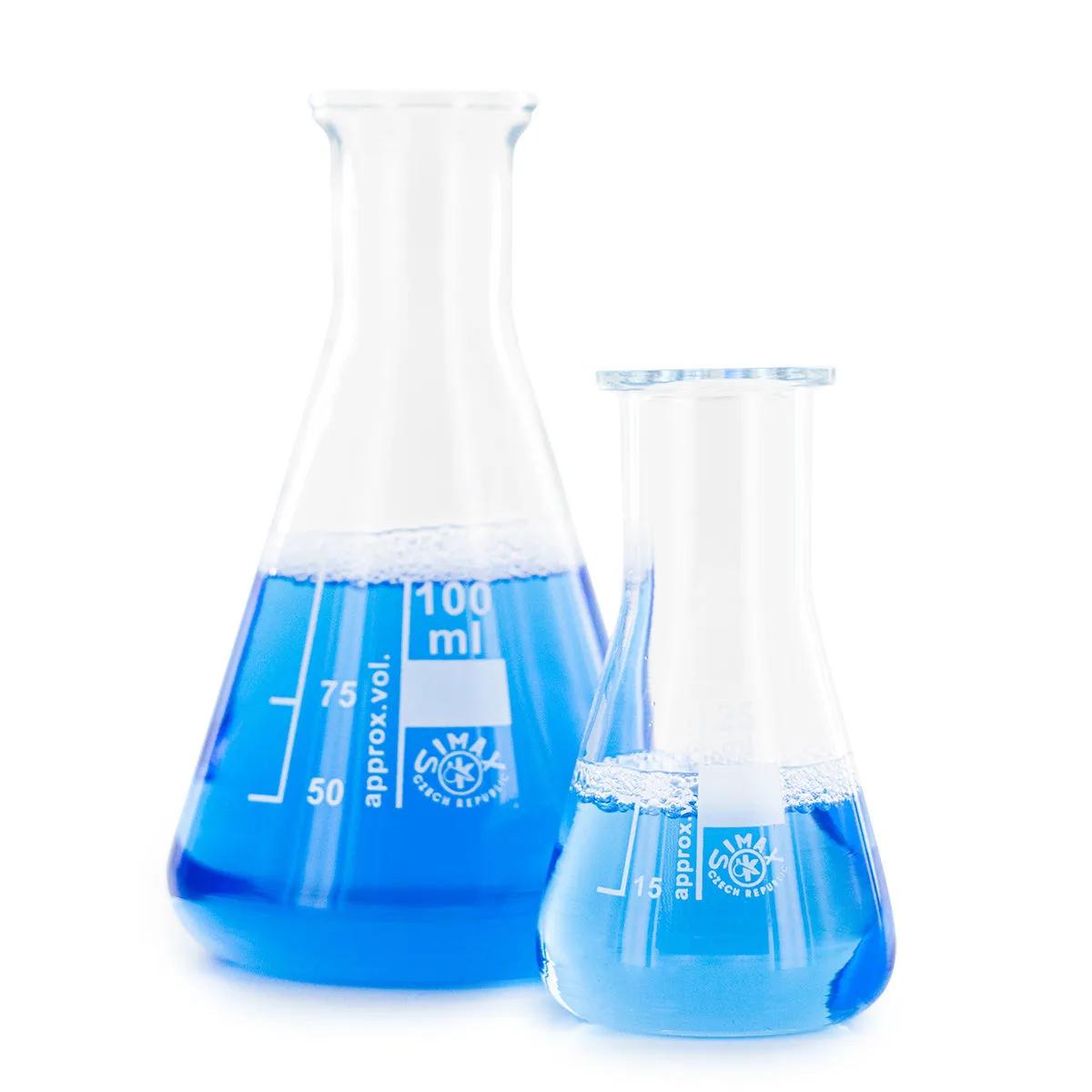
An Erlenmeyer flask is a conical borosilicate glass vessel with a narrow neck — the single most useful piece of labware for anyone making spore syringes or pouring agar plates at home. The tapered design lets you swirl liquids without splashing, while the restricted opening acts as a natural barrier against airborne contaminants. Available in four sizes: 25 ml, 100 ml, 250 ml, and 500 ml.
Which Size Do You Need?
| Size | Best use | SKU |
|---|---|---|
| 25 ml | Small agar pours, storing tiny volumes of sterile water | SH0002 |
| 100 ml | Making 1–2 spore syringes at a time, small-batch agar media | SH0003 |
| 250 ml | Preparing agar for multiple plates in one go, medium liquid cultures | SMGS0005 |
| 500 ml | Bulk sterile water prep, larger liquid culture work, grain soak water | SMGS0006 |
If you're just starting out with spore syringes, the 250 ml is the sweet spot — big enough to fill several syringes from one sterilisation run, small enough to fit in a standard pressure cooker without awkward stacking. We'd pick that one nine times out of ten.
Why You Need an Erlenmeyer Flask
The narrow neck is the whole point. When you sterilise water or agar media in a regular jar or beaker, every millimetre of open surface is an invitation for mould spores and bacteria floating around your kitchen. An Erlenmeyer flask funnels that opening down to roughly 30–40% of the base diameter. Cover it with a piece of aluminium foil before autoclaving and you've got a near-sterile vessel the moment it comes out of the pressure cooker.
We've seen growers lose entire batches to contamination that started in their "sterilised" water — water they'd boiled in a saucepan and poured into an open container. That's not sterile technique; that's wishful thinking. A proper Erlenmeyer flask with a foil cap, run through a pressure cooker at 15 PSI for 15–20 minutes, gives you water you can actually trust. The conical shape also means the flask won't tip over easily on your work surface — the flat base and low centre of gravity keep it planted.
One honest limitation: borosilicate glass is tough, but it's still glass. Drop it on a tile floor and it's done. Handle it with dry hands (wet glass is slippery glass), and store it somewhere it won't roll off a shelf. If you're clumsy in the kitchen, that's not a reason to skip it — it's a reason to be a bit more careful.
Erlenmeyer Flask Specifications
| Specification | Detail |
|---|---|
| Material | Borosilicate glass |
| Available sizes | 25 ml, 100 ml, 250 ml, 500 ml |
| Shape | Conical body, flat base, narrow neck |
| Heat resistance | Autoclave / pressure cooker safe (up to 121 °C / 250 °F at 15 PSI) |
| Neck diameter (approx.) | 30–40% of base diameter, depending on size |
| Graduation marks | Yes — moulded into glass |
| Origin of design | Developed by Emil Erlenmeyer, 1860 |
| Primary use | Sterilising water for spore syringes, preparing agar media |
Complete your sterile workspace: pair the Erlenmeyer flask with a Still Air Box for inoculation work, and grab a pack of Spore Syringes to put that freshly sterilised water to use. If you're pouring agar, pick up some Pre-Mixed Agar Powder — it saves you weighing out malt extract and agar-agar separately.
How to Use an Erlenmeyer Flask for Mushroom Growing
- Fill the flask. Pour distilled or demineralised water into the Erlenmeyer flask. Leave at least 20% headspace — a 250 ml flask should hold no more than about 200 ml of water. For agar media, mix your agar powder and nutrient solution directly in the flask.
- Cap with aluminium foil. Tear off a square of foil large enough to cover the neck and fold down the sides by about 2–3 cm. Press it snugly around the rim. This keeps contaminants out during and after sterilisation while allowing steam to escape.
- Sterilise under pressure. Place the flask in your pressure cooker on a trivet or folded cloth (glass directly on metal can crack). Run at 15 PSI for 15–20 minutes. For agar, 20 minutes is safer — you want the agar fully dissolved and the liquid completely sterile.
- Cool before use. Let the pressure cooker depressurise naturally. Don't rush it. For spore syringes, let the water cool to room temperature before drawing it up — hot water kills spores. For agar, let it cool to about 50–55 °C (still warm to the touch but not scalding) before pouring into petri dishes.
- Work in still air. When you remove the foil cap to pour or draw up water, do it inside a Still Air Box or in front of a laminar flow hood. The flask's narrow neck buys you time, but it's not a substitute for clean technique.
Erlenmeyer Flask vs. Mason Jar: What's the Difference?
You can sterilise water in a mason jar — we're not going to pretend otherwise. But the wide mouth on a mason jar is a contamination magnet. Every time you crack that lid, you're exposing the full diameter of the opening to whatever's floating in the air. An Erlenmeyer flask's neck is a fraction of that width, which means far less surface area for contaminants to land on. The conical shape also lets you swirl agar media to keep it mixed without needing a stir bar or spoon (which would be another contamination vector).
Mason jars do have one advantage: they're cheap and you probably already own some. But if you're doing this more than once or twice, the Erlenmeyer flask pays for itself the first time it saves a batch from going green. Think of it as the difference between "it'll probably be fine" and "I know it's clean."
Frequently Asked Questions
Can I put an Erlenmeyer flask directly on a gas flame or hotplate?
Borosilicate glass handles direct heat, yes. Use a wire gauze or ceramic pad between the flask and flame for even heat distribution. For mushroom growing, though, you'll almost always use a pressure cooker rather than open flame — it's the pressure that gets you to true sterilisation temperatures of 121 °C.
Why is the narrow neck of an Erlenmeyer flask better for sterile work?
Airborne contaminants settle by gravity. A narrow neck means less open surface area for mould spores and bacteria to fall into. Combined with a foil cap, it creates a barrier that a wide-mouth jar simply can't match. Less exposure equals fewer failed batches.
Which Erlenmeyer flask size is best for making spore syringes?
The 250 ml. It holds enough sterile water for 8–10 syringes (at roughly 10–12 ml each) while still fitting comfortably inside most standard pressure cookers. The 100 ml works if you're only making one or two syringes at a time.
Can I microwave an Erlenmeyer flask to sterilise water?
No. Microwaving heats unevenly and doesn't reach the sustained 121 °C needed for proper sterilisation. You need a pressure cooker at 15 PSI for 15–20 minutes. There's no shortcut here — underpressure sterilisation is the only method that reliably kills all contaminants.
How do I clean an Erlenmeyer flask after using it for agar?
Fill it with hot water and let it soak for 30 minutes — agar dissolves easily in heat. A bottle brush helps reach the bottom. Avoid abrasive scrubbers; scratches in the glass create hiding spots for bacteria. Rinse with distilled water before your next use.
Do I need a different flask for agar and for sterile water?
Not strictly, but having two is convenient. Agar residue can be stubborn if you don't clean immediately, and cross-contamination between batches is a real risk if you rush the cleaning. At this price point, grabbing a 100 ml for syringes and a 250 ml for agar is the practical move.
Will the graduation marks on the flask be accurate enough for agar recipes?
For mushroom cultivation, yes — you're not doing analytical chemistry. The moulded markings give you a rough volume within about 5% accuracy. That's more than good enough for mixing agar media, where the ratio of water to powder is forgiving within a reasonable range.
Last updated: April 2026
Related products
Medical disclaimer. This content is for informational purposes only and does not constitute medical advice. Consult a qualified healthcare provider before use of any substance.