
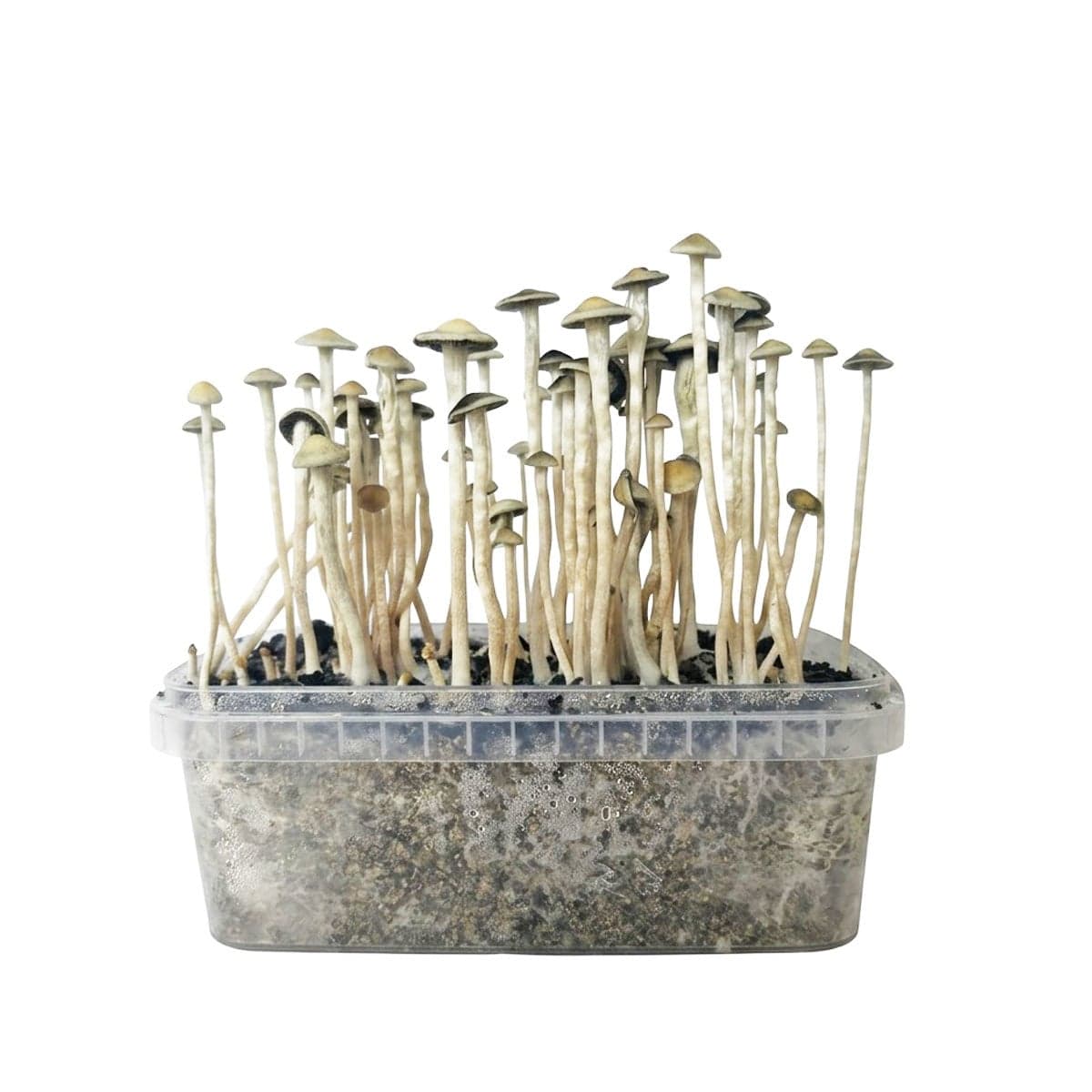
The Copelandia Weza grow kit is a ready-to-fruit mushroom kit that gives you a fully colonised 1200ml block of horse dung substrate with Panaeolus cyanescens mycelium, a cup of topsoil for casing and a grow bag. Weza is known as The Heavyweight: the sturdiest build in its breeder's range of Copelandia lines. This page is written for adults aged 18 and over, and the kit is meant for growers who have fruited a kit before.
What Is the Copelandia Weza Grow Kit?
Weza is a line of Panaeolus cyanescens, the species growers still call Copelandia, that its breeder rates as the stoutest of all his Copelandia lines: thicker stems and flatter caps than any of the others. Most Copelandia looks like it might snap if you breathe on it: long, thin stems and small caps. Weza is built differently, and you can see it in the photo: fewer stems than a crowded strain like Man in Black, but each one noticeably thicker, with wider, flatter caps on top.
That build is practical as well as good-looking. Thicker stems stand up better in the bag, are easier to grip at the base, and survive a less-than-perfect harvest. The block is the same 1200ml horse dung substrate as our other Copelandia kits, with the earthy, farmyard smell you'd expect when you open the bag.
Copelandia Weza Grow Kit Specifications
| Species | Panaeolus cyanescens (Copelandia) |
| Strain | Weza, "The Heavyweight" |
| Block | 1200ml, horse dung, fully colonised |
| In the box | Colonised block, grow bag and a cup of casing topsoil |
| Temperature | 21–26°C |
| Humidity until pinning | 95–100% |
| Humidity while fruiting | 90–95% |
| First pins | 6–11 days after setup |
| Harvest | 5–7 days after pinning |
| Flushes | Several; later flushes are smaller |
| Difficulty | For experienced growers |
| SKU | SH0279 |
A fine-mist spray bottle and a small heat mat help you hold the 21–26°C and high humidity a Copelandia block needs, from the first flush to the last.
Where Does Copelandia Weza Come From?
Honestly, nobody knows for sure. The print came in 2024 with a label reading "Weza, South Africa", and without collector's notes, site details or photos. So treat South Africa as the name on the label, not a confirmed wild origin. What is certain is what happened next: the line now runs through a Dutch selection programme, and that is where this kit comes from.
How to Grow the Copelandia Weza Grow Kit
Setup takes about ten minutes, and the first pins appear 6 to 11 days later at 21–26°C. Have a plant mister, tap or mineral water, and a light place that never gets direct sun.
- Wash your hands with soap and water, or wear gloves. A dung block forgives less than a grain kit.
- Check that the block is firm and white with mycelium, with no green or black spots.
- Spread the cup of topsoil loosely over the top as a casing layer and place the kit in the grow bag. This separate casing step is what sets Copelandia kits apart from most cubensis kits.
- Wet the topsoil thoroughly, stopping short of soaking it, mist the inner walls of the bag, leave enough fresh air in it and close it with a paperclip.
- Once or twice a day, spray the casing and the inside of the bag, then squeeze the bag to refresh the air.
- When pins appear, take the kit out, mist the inner walls of the bag, refresh the air and put the kit back. Keep the spray off the mushrooms themselves.
- Harvest 5–7 days after pinning, 24 to 36 hours after the caps start dropping black spores. Tip each mushroom sideways until its stem breaks off at the base; Weza's thicker stems make this easier than with most Copelandia.
Copelandia Weza Flushes: What to Expect
A Weza block gives several flushes, with the later ones smaller than the first. That is normal as the block tires, not a sign that something went wrong.
After each harvest, give the topsoil a heavy soaking from about 10cm away. Some standing water in the kit, 1–2cm, does no harm; tip it out 1–2 days later. If a flush comes up slowly or small, remove those mushrooms and fill the kit with about 2cm of water; within 1–2 days the next flush usually comes up fuller.
| What you see | Likely cause | What to do |
|---|---|---|
| No pins after 11 days | Room below 21°C, or casing too dry | Move somewhere warmer, mist more evenly |
| Smaller fruits on later flushes | Normal as the block tires | Nothing; keep conditions steady |
| Blue marks on the stems | Bruising where touched, normal for cyanescens | Nothing; handle by the base |
| Green or black patches | Contamination | Keep the bag closed and your hands clean |
Our verdict: steady warmth and a casing that never dries out matter more for later flushes than anything else you can do.
Weza vs Other Copelandia Grow Kits
All Copelandia grow kits we carry are Panaeolus cyanescens on the same 1200ml horse dung block, grown the same way. The strain is the difference.
| Weza | Man in Black | Blue Spring Red Spore | Hawaiian / Florida | |
|---|---|---|---|---|
| Known for | Thick stems, flat caps | Dense clusters of white, slender fruits | Reddish-orange spores, blue mycelium | Classic named varieties |
| Handling | Easiest, sturdy stems | Careful, crowded clusters | Standard | Standard |
| Origin | Labelled "Weza, South Africa", Dutch-selected | Unknown, Dutch collection since 2024 | Unknown, selected Dutch line | Hawaii / Florida, USA |
The verdict: the best Copelandia grow kit for a grower who has wrestled with fragile stems before is Weza, for its thicker stems, its flatter caps and an easier harvest. Choose Man in Black for a crowded tub of white fruits, Blue Spring Red Spore for colour, and Hawaiian or Florida for the classics.
One honest limitation: sturdy as it is, Weza is still a casing kit on dung substrate at 21–26°C. We've been answering grow questions since 1999, and a first-time grower does better starting with cubensis.
Frequently Asked Questions
Why is Copelandia Weza called The Heavyweight?
Because of its build: thicker stems and flatter caps than its breeder's other Copelandia lines.
Is Weza from South Africa?
The print was labelled "Weza, South Africa" when it arrived in 2024, without notes or photos to confirm it. Today it's a Dutch-selected line.
How do I grow a Copelandia Weza grow kit?
Case the block with the topsoil, put it in the grow bag, and spray the casing and bag once or twice a day at 21–26°C. Pins appear after 6–11 days.
How many flushes can I expect?
Several. The first is usually the biggest, and later flushes get smaller as the block tires.
Is the Weza kit good for a first grow?
Its sturdy mushrooms are easier to handle than most Copelandia, but it's still a casing kit on dung substrate. Grow a cubensis kit first.
Last updated: November 2026
Related products
Medical disclaimer. This content is for informational purposes only and does not constitute medical advice. Consult a qualified healthcare provider before use of any substance.