
This article discusses psychoactive substances intended for adults (18+). If you have a health condition or take medication, consult a doctor before use. Our age policy
Kratom Metabolism and Duration

Definition
Kratom metabolism and duration is a pharmacokinetic topic that describes how the liver processes mitragynine — primarily through CYP3A4 and CYP2D6 enzymes — into active metabolites including 7-hydroxymitragynine. This metabolic pathway shapes onset, peak, and duration of effects, and explains why drug interactions and individual genetics produce such variable timelines.
Kratom metabolism and duration is a pharmacokinetic topic that describes how the liver processes the alkaloids in Mitragyna speciosa — primarily mitragynine through CYP3A4 and CYP2D6 enzymes — into active metabolites including 7-hydroxymitragynine, shaping how long effects last, how quickly they onset, and why the same amount can hit differently on different days. Understanding kratom metabolism and duration matters for timing, safety, and recognising why drug interactions with kratom carry real risk.
Adult audience (18+). The ranges and effects described in this article apply to adult physiology. This content is not intended for minors.
What Happens After You Swallow Kratom
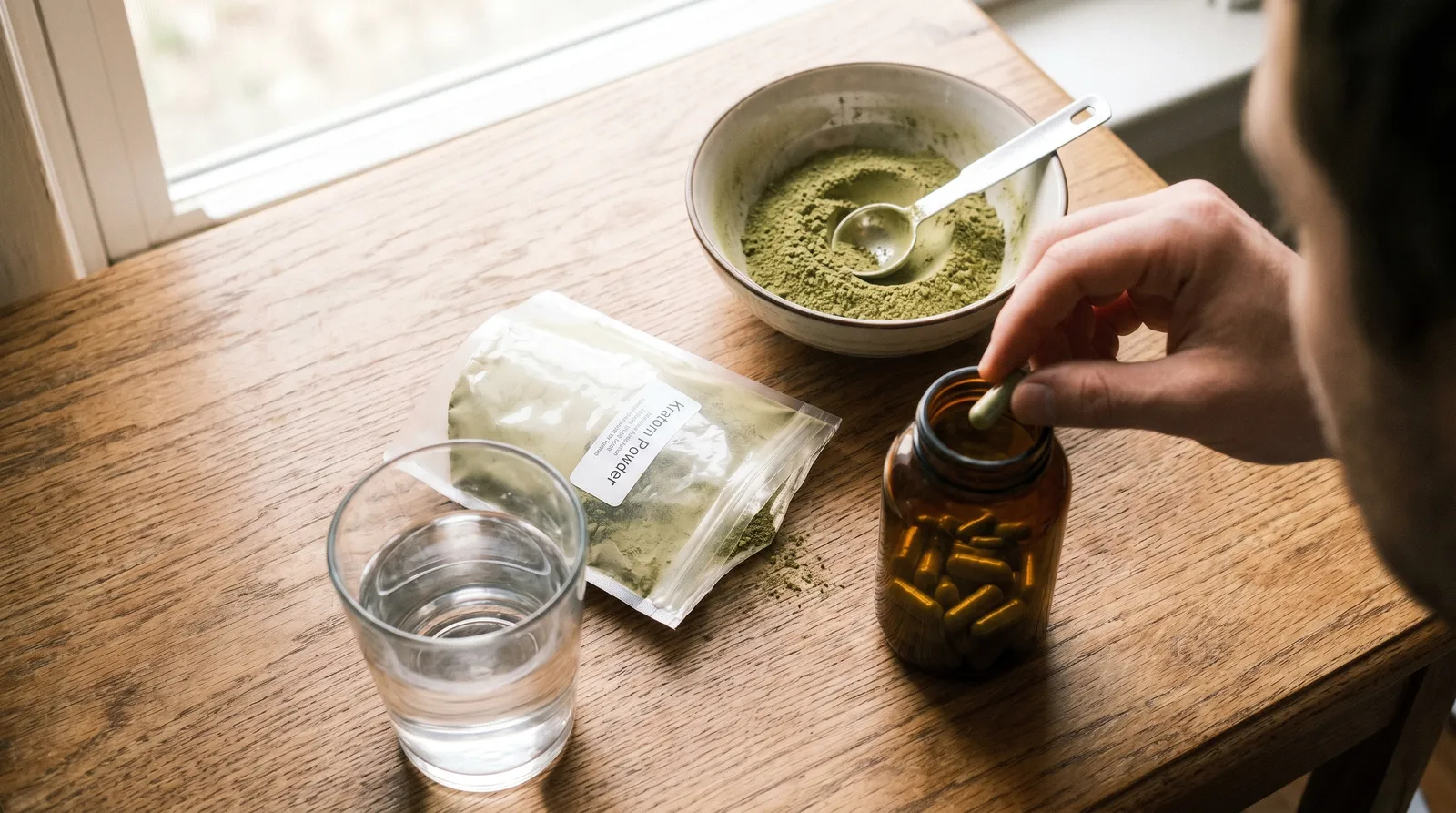
Mitragynine undergoes extensive first-pass hepatic metabolism primarily through CYP3A4, with CYP2D6 playing a secondary but significant role. Kratom is almost always consumed orally — powder, capsules, or extract. Once it reaches your stomach and small intestine, mitragynine and the other indole alkaloids are absorbed into the bloodstream and transported to the liver. This is where things get pharmacologically interesting.
According to Kamble et al. (2019), CYP3A4 is responsible for the majority of mitragynine's phase I metabolism, producing several hydroxylated and dehydrogenated metabolites. One of these metabolic products is 7-hydroxymitragynine — which, despite being present in raw leaf at very low concentrations (typically under 2% of total alkaloid content), is a substantially more potent mu-opioid receptor agonist than mitragynine itself (Kruegel et al., 2016). So your liver is actually converting a weaker compound into a stronger one. This is sometimes called metabolic bioactivation, and it has real implications for how kratom's effects unfold over time.
The CYP2D6 pathway adds a layer of individual variability. Around 6–10% of Europeans are CYP2D6 poor metabolisers, meaning they process certain substrates more slowly (Gaedigk et al., 2017). Whether this translates to meaningfully different kratom experiences hasn't been studied in a controlled way, but the enzymatic groundwork suggests it could — and it's one reason why two people taking the same amount can report quite different timelines. European drug monitoring bodies have flagged kratom as a substance of interest partly because of this metabolic unpredictability across populations.
Onset, Peak, and Duration
Kratom effects typically begin within 15–45 minutes of oral ingestion of leaf powder, peak at 1–2 hours, and last a total of 3–6 hours based on available survey and pharmacokinetic data. These figures come largely from survey data and a small number of pharmacokinetic studies, so treat them as approximate ranges rather than precise values. Understanding kratom metabolism and duration at this level helps set realistic expectations for first-time users.
| Parameter | Leaf Powder (oral) | Extract (oral) |
|---|---|---|
| Onset | 15–45 minutes | 10–30 minutes |
| Peak effects | 1–2 hours | 0.5–1.5 hours |
| Total duration | 3–6 hours | 2–5 hours |
| Mitragynine elimination half-life | Approximately 23 hours (Trakulsrichai et al., 2015) — though this figure comes from a single small-sample study of chronic Thai users, so the real range across occasional users and different product forms may differ considerably | |
A few things jump out from that table. First, the reported elimination half-life of around 23 hours — documented by Trakulsrichai et al. (2015) in a study of 10 chronic kratom users in Thailand — is surprisingly long. That means mitragynine is still circulating at roughly half its peak plasma concentration a full day later. For daily users, this implies accumulation: each session stacks on residual alkaloid levels from the day before. This likely contributes to the tolerance escalation that daily users commonly report.
Second, extracts behave differently from leaf powder. Extracts concentrate mitragynine and 7-hydroxymitragynine relative to plain leaf, which changes the pharmacological profile in ways that go beyond simply "stronger kratom." Onset tends to be faster, peak effects more pronounced, and — critically — the tolerance and dependence trajectory accelerates. In any form, understanding which product type you're getting matters enormously. Figures for leaf are not interchangeable with figures for extracts. If you see someone quoting a gram amount without specifying the product form, that number is functionally meaningless.
Comparing Leaf Powder and Extract Timelines
Leaf powder produces a gradual ramp-up with a broad, moderate peak, while extracts compress the entire timeline into a faster onset, sharper peak, and steeper decline. The difference between leaf powder and extract is not just potency — it produces a fundamentally different pharmacokinetic curve. For users of kratom extracts expecting a simply "stronger" version of leaf, this compressed curve is often the source of unexpectedly intense experiences. We honestly do not have enough controlled human data to give precise conversion ratios between leaf and extract — anyone claiming otherwise is extrapolating beyond the evidence. People who buy kratom leaf powder from the Azarius catalogue and later switch to extracts should treat them as entirely separate products with distinct timing profiles.
Why Duration Varies So Much
Individual variation in kratom metabolism and duration is driven primarily by CYP enzyme genetics, stomach contents, product form, amount consumed, and tolerance status. Ask five kratom users how long their session lasts and you'll get five different answers. Some of this is subjective perception, but there are concrete pharmacological reasons for the variability:
- CYP enzyme activity: As noted above, genetic polymorphisms in CYP3A4 and CYP2D6 affect how quickly mitragynine is metabolised. Anything that inhibits these enzymes — grapefruit juice (CYP3A4), fluoxetine or paroxetine (CYP2D6), ketoconazole (CYP3A4) — can slow metabolism and extend both duration and intensity. Methanolic kratom extracts have themselves been shown to inhibit CYP2D6 by approximately 90% and CYP3A at around 50% at 20 μg/ml in vitro (Hanapi et al., 2013). This means kratom partially inhibits its own metabolic pathway, which could contribute to non-linear response curves at higher amounts.
- Stomach contents: A full stomach delays absorption. Taking kratom after a heavy meal can push onset back by 30 minutes or more and flatten the peak — spreading the same alkaloid load over a longer, gentler curve.
- Product form: Capsules dissolve slower than loose powder. Extracts hit faster than either. Resin and enhanced products introduce additional variables. Each form has its own absorption profile. Those looking to get kratom capsules versus powder should factor in this absorption difference.
- Amount consumed: Survey data from Grundmann (2017) — a cross-sectional study of over 8,000 kratom users — found that lower amounts of leaf powder were associated with stimulant-like effects of shorter duration, while higher amounts produced longer-lasting opioid-like effects. This shift in character likely reflects different receptor engagement profiles at different plasma concentrations.
- Tolerance: Tolerance develops rapidly with consecutive daily use. Regular users often report that effects become shorter and weaker within a week of daily use — a pattern consistent with mu-opioid receptor downregulation.
The Metabolite Question
A significant portion of kratom's opioid-like effects likely originates from hepatic conversion of mitragynine to 7-hydroxymitragynine rather than from the parent compound alone. Kruegel et al. (2016) demonstrated that 7-hydroxymitragynine has roughly 13-fold higher binding affinity at mu-opioid receptors compared to mitragynine. If a meaningful portion of 7-hydroxymitragynine in the body is generated through hepatic conversion of mitragynine rather than absorbed directly from the plant material, then the liver is doing real pharmacological work — and the "experience" of kratom is partly a metabolic event, not just an absorption event.
This also means that anything affecting liver function — pre-existing liver conditions, concurrent hepatotoxic medications, alcohol use — could alter not just how long kratom lasts, but what it actually does. The case reports of hepatotoxicity associated with kratom use (Kapp et al., 2011; among others) remain mechanistically unclear, but the heavy hepatic metabolism of mitragynine makes the liver a site of particular pharmacological relevance. This is one of the most important aspects of kratom metabolism and duration that users tend to overlook.
How Kratom Compares to Other Ethnobotanicals
Kratom's metabolic profile is unusually complex compared to many other ethnobotanical products available in the Azarius catalogue, including kanna and blue lotus. Kanna (Sceletium tortuosum), for instance, has a much shorter duration of action and a simpler metabolic pathway — mesembrine is its primary active alkaloid and does not undergo the same kind of bioactivation into a more potent metabolite. Those who order kanna from Azarius and also use kratom should understand that the two are not pharmacologically comparable despite both being plant-based. Blue Lotus (Nymphaea caerulea) similarly lacks the CYP-mediated conversion step that makes kratom's pharmacokinetics so variable. For anyone coming to kratom after experience with gentler ethnobotanicals, this metabolic complexity is worth understanding: kratom is not pharmacologically comparable to most herbal products, and its interaction potential is substantially higher. The Azarius Encyclopaedia wiki section on Kanna and Blue Lotus covers the pharmacology of these related plants in more detail.
Detection and Elimination
Mitragynine is not detected by standard workplace drug panels and requires specialised LC-MS/MS testing for identification. Standard screens typically test for opiates, amphetamines, cannabinoids, benzodiazepines, and cocaine metabolites. Metabolism studies by Philipp et al. (2009) identified multiple urinary metabolites of mitragynine in both rat and human urine, with phase I and phase II (glucuronidated) metabolites detectable for several days after use in chronic consumers.
Given the approximately 23-hour half-life reported by Trakulsrichai et al. (2015), full elimination of a single instance of use would theoretically take 5–6 days (roughly five half-lives). For daily users with accumulated levels, clearance after cessation could take longer — though controlled data on this specific question remains thin.
Interactions That Affect Metabolism
CYP3A4 and CYP2D6 inhibitors represent the most pharmacologically relevant interaction risk with kratom. Because mitragynine metabolism runs through these pathways, any substance that significantly inhibits or induces these enzymes can alter kratom's duration and intensity. Co-consuming kratom with CYP3A4 inhibitors like clarithromycin or ketoconazole, or CYP2D6 inhibitors like fluoxetine, paroxetine, or bupropion, may result in elevated and prolonged mitragynine plasma levels. Combining kratom with other opioids, benzodiazepines, alcohol, or MAOIs carries serious risk. For a complete breakdown, see the dedicated Kratom Drug Interactions and Safety article in the Azarius Encyclopaedia. For broader context on how kratom metabolism and duration compares across ethnobotanicals in the catalogue, the Azarius Encyclopaedia wiki section on Kanna and Blue Lotus covers related plants and their pharmacology.
What We Still Do Not Know
The pharmacokinetic evidence base for kratom remains genuinely incomplete, and honest acknowledgement of these gaps matters more than false precision. The 23-hour half-life figure comes from a single study of 10 chronic users in Thailand — we do not know whether occasional users, European users, or people using different product forms would show the same value. No controlled human study has measured the rate of hepatic conversion of mitragynine to 7-hydroxymitragynine in vivo. The interaction between kratom alkaloids and CYP enzymes has been studied in vitro but not systematically in living humans. European drug monitoring bodies and Beckley Foundation have both noted the need for more rigorous pharmacokinetic research on kratom in European populations. Anyone who claims precise, universal pharmacokinetic parameters for kratom is overstating the evidence base.
Practical Timing Considerations
Most users report that the stimulant-like character of lower amounts peaks within the first 60–90 minutes and fades within three hours, while the sedative-like character associated with higher amounts can linger for four to six hours. These timelines are self-reported averages, not clinical measurements, but they align broadly with the pharmacokinetic data available. People who buy kratom from the Azarius catalogue often ask our staff about timing relative to meals, sleep, and daily routines — and the honest answer is that individual variation makes universal scheduling advice unreliable. Keeping a personal log of timing and effects is far more useful than following someone else's schedule.
Choosing the Right Product Form
The product form you choose directly shapes the metabolic timeline you experience. Leaf powder, capsules, and extracts each deliver mitragynine at different rates, which means the onset, peak, and total duration described throughout this article shift depending on what you actually consume. Customers who order kratom capsules from Azarius should expect a slightly delayed onset compared to loose powder — typically an extra 10–20 minutes — because the capsule shell needs to dissolve before absorption begins. Extracts, on the other hand, compress the entire curve as described above. We genuinely cannot tell you which form is "best" because that depends entirely on your personal preferences and how your body handles the alkaloids. What we can say is that understanding these pharmacokinetic differences before you buy kratom products helps you make a more informed choice.
Frequently Asked Questions
How long does mitragynine stay in your system?
Based on a small pharmacokinetic study by Trakulsrichai et al. (2015), mitragynine has an elimination half-life of approximately 23 hours. Full elimination of a single instance of use theoretically takes 5–6 days. Chronic daily users may retain detectable metabolites for longer due to accumulation.

Does kratom show up on a standard drug test?
No. Standard workplace drug panels do not screen for mitragynine or other kratom alkaloids. Detection requires specialised testing such as LC-MS/MS, which is not part of routine screening.
Why does kratom hit faster on an empty stomach?
An empty stomach accelerates absorption, producing a quicker onset and sharper peak. A full stomach delays absorption, spreading the same alkaloid load over a longer but flatter curve, which can feel like a longer but milder experience.
Does grapefruit juice affect kratom duration?
Potentially, yes. Grapefruit juice inhibits CYP3A4, the primary enzyme responsible for mitragynine metabolism. This could slow clearance and extend both duration and intensity of effects, though no controlled human study has tested this interaction specifically with kratom.
Why do kratom extracts feel different from leaf powder?
Extracts concentrate mitragynine and 7-hydroxymitragynine relative to plain leaf, changing the pharmacological profile. Onset is faster, peak effects are more intense, and the overall duration curve is compressed. They should be treated as pharmacologically distinct from leaf, not simply as stronger versions of the same thing.
How does kratom metabolism and duration compare to kanna?
Kratom has a substantially more complex metabolic profile than kanna. Mitragynine undergoes bioactivation into the more potent 7-hydroxymitragynine via CYP3A4, whereas kanna's primary alkaloid mesembrine follows a simpler metabolic pathway without producing a more potent active metabolite. Kratom's effects also last considerably longer, with a reported half-life of around 23 hours compared to kanna's much shorter duration.
Can I buy kratom leaf and extract from Azarius?
Yes. Azarius stocks both kratom leaf powder and kratom extracts. Because the pharmacokinetic profiles differ substantially between these product forms, choosing between them is not simply a matter of preference but of understanding how each form affects onset, peak, and duration.
Does tolerance affect kratom duration?
Yes. Regular daily users commonly report that both the intensity and duration of effects diminish within one to two weeks of consecutive use, consistent with mu-opioid receptor downregulation. Tolerance resets vary individually, but most users report partial restoration after several days of abstinence.
Medical consultation note: If you have a health condition, take prescription medication, or are pregnant or breastfeeding, consult a qualified healthcare provider before using any psychoactive substance. Drug interactions are substance- and concentration-dependent, and the information in this article is for educational reference only — it does not replace personalised medical advice.
Last updated: April 2026
Frequently Asked Questions
10 questionsHow long does mitragynine stay in your system?
Does kratom show up on a standard drug test?
Why does kratom hit faster on an empty stomach?
Does grapefruit juice affect kratom duration?
Why do kratom extracts feel different from leaf powder?
How does kratom metabolism and duration compare to kanna?
Can CYP2D6 genetic differences change how long kratom lasts?
What does it mean that the liver converts mitragynine into a stronger compound?
Does tolerance to kratom build up quickly with daily use?
Why do the effects of kratom sometimes feel stronger the second time in a day?
About this article


Adam Parsons is an external cannabis and psychedelics writer and editor who contributes to Azarius's wiki as both author and reviewer. On the writing side, he authors Azarius's kratom and kanna clusters, drawing on exten
This wiki article was drafted with AI assistance and reviewed by Adam Parsons, External contributor. Editorial oversight by Joshua Askew.
Medical disclaimer. This content is for informational purposes only and does not constitute medical advice. Consult a qualified healthcare provider before use of any substance.
Last reviewed April 24, 2026
References (9)
- [1]Beckley Foundation (2021). Policy Position on Kratom Research Priorities.
- [2]Gaedigk, A. et al. (2017). The Pharmacogene Variation Consortium: Ten Years of Progress. Clinical Pharmacology & Therapeutics , 101(2), 297–308.
- [3]Grundmann, O. (2017). Patterns of Kratom Use and Health Impact in the US — Results from an Online Survey. Drug and Alcohol Dependence , 176, 63–70. DOI: 10.1016/j.drugalcdep.2017.03.007
- [4]Hanapi, N.A. et al. (2013). Inhibition of human cytochrome P450 enzyme activities in vitro by mitragynine and kratom extract. Journal of Ethnopharmacology , 146(1), 250–256.
- [5]Kamble, S.H. et al. (2019). Metabolism of a Kratom Alkaloid Metabolite in Human Plasma and Identification of Its Major Metabolic Pathways. AAPS Journal , 21(6), 97.
- [6]Kapp, F.G. et al. (2011). Intrahepatic cholestasis following abuse of powdered kratom ( Mitragyna speciosa ). Journal of Medical Toxicology , 7(3), 227–231. DOI: 10.1007/s13181-011-0155-5
- [7]Kruegel, A.C. et al. (2016). Synthetic and Receptor Signaling Explorations of the Mitragyna Alkaloids. Journal of the American Chemical Society , 138(21), 6754–6764. DOI: 10.1021/jacs.6b00360
- [8]Philipp, A.A. et al. (2009). Metabolism studies of the Kratom alkaloids mitraciliatine and isopaynantheine, diastereomers of the main alkaloids mitragynine and paynantheine. Journal of Mass Spectrometry , 44(8), 1249–1261.
- [9]Trakulsrichai, S. et al. (2015). Pharmacokinetics of Mitragynine in Man. Drug Design, Development and Therapy , 9, 2421–2429.
Related Articles

Blue Lotus vs Kanna: Effects & Safety
Blue lotus vs kanna compared — Nymphaea caerulea's aporphine profile against Sceletium tortuosum's mesembrine chemistry, with interaction warnings.
Lotus Clinical Research Overview
What does lotus clinical research actually show? A critical review of Nymphaea caerulea and Nelumbo nucifera pharmacology, preclinical data, and…

Kanna South Africa To West History
Sceletium tortuosum was used by San and Khoekhoe communities in southern Africa for centuries before European colonists first documented it in the 1660s.
Sceletium Tortuosum Plant
Learn about the sceletium tortuosum plant: botany, alkaloids, fermentation, safety warnings, and where to buy kanna.
Kanna Pharmacokinetics Explained
Complete guide to kanna pharmacokinetics: how Sceletium tortuosum alkaloids are absorbed, metabolised via CYP2D6, and eliminated.
Kanna Chemistry: Sceletium Alkaloids Explained
Kanna chemistry explained: mesembrine, mesembrenone, their mechanisms, how fermentation and extraction change alkaloid profiles, and why it matters…

Rapé Shamanic Snuff Guide: How to Use It Safely
A practical rapé shamanic snuff guide covering dose, kuripe technique, effects, nicotine safety, interactions and Amazonian tradition.

White Sage Salvia Apiana Cultural Smudging Guide
Salvia apiana is a non-psychoactive shrub native to southern California's coastal sage scrub, burned as ceremonial incense in Indigenous North American…

Mulungu Erythrina Traditional Amazonian Use — Bark, Alkaloids & Research
Erythrina mulungu is a Brazilian legume tree whose bark has been brewed as a calming decoction in rural folk medicine for generations.