
This article discusses psychoactive substances intended for adults (18+). If you have a health condition or take medication, consult a doctor before use. Our age policy
Kanna vs Kratom
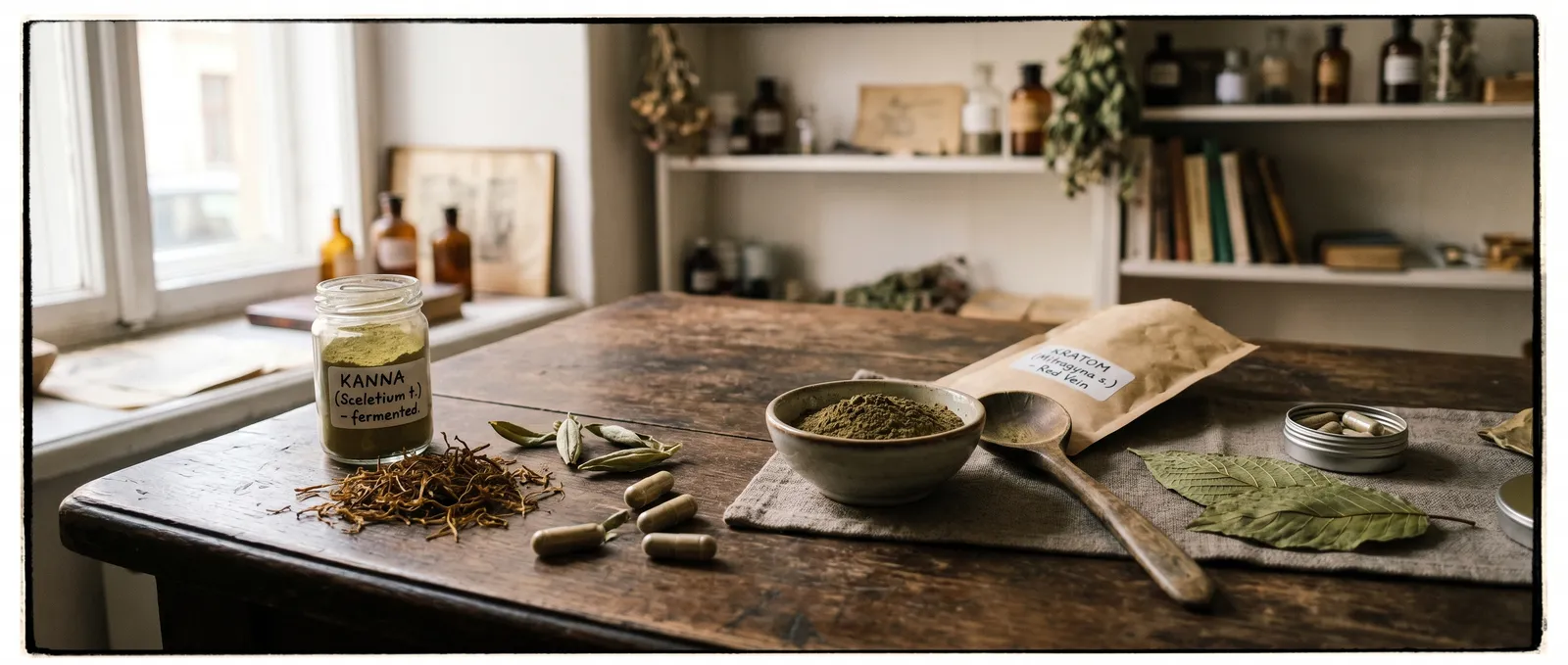
Definition
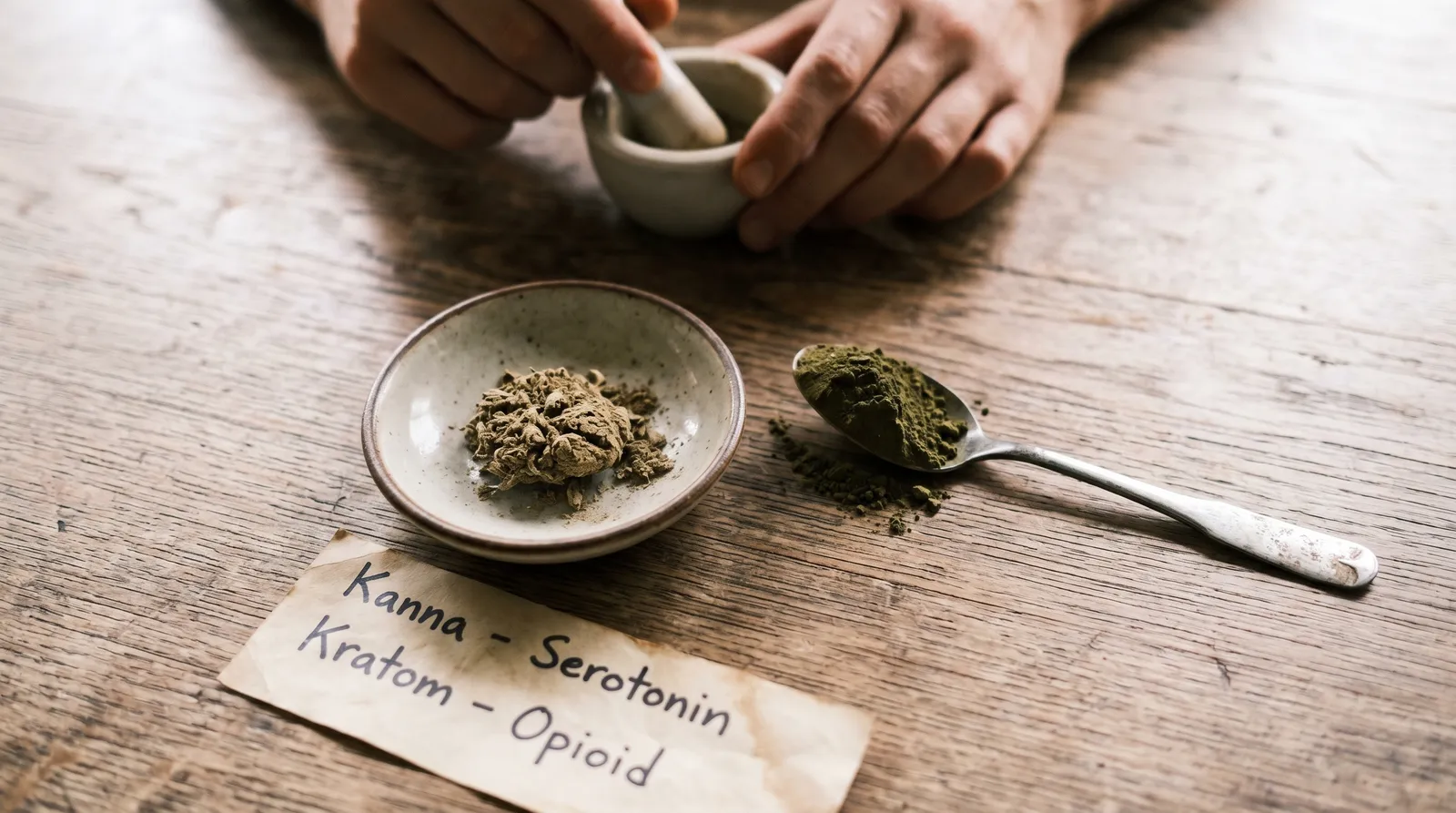
Kanna (Sceletium tortuosum) and kratom (Mitragyna speciosa) are both psychoactive botanicals, but they act on fundamentally different receptor systems — serotonin for kanna, opioid for kratom (Kruegel & Grundt, 2018). This means their effects, risk profiles, and dependence potential have almost nothing in common despite both being marketed as herbal mood-lifters.
Kanna (Sceletium tortuosum) and kratom (Mitragyna speciosa) both sit in the broad category of psychoactive botanicals, but they share almost nothing in terms of pharmacology, risk profile, or subjective experience. Kanna is a southern African succulent whose alkaloids interact primarily with the serotonin system, while kratom is a Southeast Asian tree in the coffee family whose principal alkaloid, mitragynine, binds opioid receptors. Comparing kanna vs kratom is a bit like comparing a cappuccino to a glass of wine — both alter how you feel, but the mechanisms and consequences are worlds apart. If you want to buy kanna after reading this comparison, Azarius carries a full range of kanna products including fermented plant material and concentrated extracts.
Adult audience (18+). The dosing ranges and effects described in this article apply to adult physiology. This content is not intended for minors.
| Dimension | Kanna (Sceletium tortuosum) | Kratom (Mitragyna speciosa) |
|---|---|---|
| Plant family | Aizoaceae (ice-plant family) | Rubiaceae (coffee family) |
| Key alkaloids | Mesembrine, mesembrenone, mesembrenol | Mitragynine, 7-hydroxymitragynine |
| Primary mechanism (proposed) | Serotonin reuptake inhibition; PDE4 inhibition also proposed — relative contribution in humans not settled | Partial agonism at mu-opioid receptors; adrenergic and serotonergic activity also reported (Kruegel & Grundt, 2018) |
| Traditional use region | Southern Africa (San and Khoekhoe peoples) | Southeast Asia (Thailand, Malaysia, Indonesia) |
| Traditional preparation | Fermented aerial parts chewed or made into tea | Fresh leaves chewed; dried leaf brewed as tea |
| Reported onset (oral) | 20–60 min (plant material); faster sublingual | 15–30 min (Prozialeck et al., 2012) |
| Reported duration | 1–3 hours (varies widely by form and route) | 3–6 hours |
| Physical dependence potential | Not established in published literature | Well-documented; withdrawal syndrome described (Singh et al., 2016) |
| Key interaction risk | Serotonergic drugs (SSRIs, MAOIs, SNRIs) | Opioids, benzodiazepines, CYP3A4/2D6 substrates |
| Clinical trial evidence | Small trials on a specific standardised extract only | No completed randomised controlled trials as of 2025 |
How they work: serotonin vs opioid pathways
The single most important difference between kanna and kratom is the receptor system each one targets, and this drives almost everything else — the effects people describe, the risks they carry, and the way dependence does or doesn't develop (Harvey et al., 2011; Kruegel & Grundt, 2018).
Kanna's principal alkaloid, mesembrine, has demonstrated serotonin reuptake inhibition in vitro (Harvey et al., 2011). A second proposed mechanism — inhibition of the enzyme PDE4 — has also been reported in cell-based assays, but the relative contribution of each pathway in a living human brain remains an open question. What this means in practice is that kanna's serotonergic activity is real enough to matter pharmacologically: combining it with SSRIs, SNRIs, MAOIs, tricyclic antidepressants, or other serotonergic substances (including 5-HTP, St John's Wort, and MDMA) risks serotonin syndrome, a rare but potentially serious condition involving agitation, hyperthermia, and neuromuscular instability. This is not a theoretical footnote — it is the primary safety concern with kanna.
Kratom operates on an entirely different receptor system. Mitragynine and its more potent metabolite 7-hydroxymitragynine act as partial agonists at the mu-opioid receptor (Kruegel & Grundt, 2018). At lower doses, adrenergic stimulation tends to dominate — users describe something closer to strong coffee than to an opiate. At higher doses, the opioid-receptor activity becomes more prominent, and the experience shifts toward sedation and what some users describe as warmth or pain relief. This dose-dependent duality is one of kratom's defining characteristics, and also one of its risks: the same receptor system that produces those calming effects is the one responsible for physical dependence with repeated use. When weighing kanna vs kratom on mechanism alone, the distinction between serotonergic and opioidergic activity is the single fact that matters most.
What people report feeling
Kanna and kratom produce subjectively different experiences that reflect their distinct pharmacology, with kanna leaning toward subtle emotional shifts and kratom toward physically felt stimulation or sedation depending on dose.
User reports for kanna cluster around mild mood lift, a sense of calm, and — at higher doses or with insufflated extracts — a brief, noticeable shift in headspace that some describe as mildly stimulating and others as gently sedating. The variability is significant, and it maps partly onto the form used: fermented plant material tends to produce subtler effects than concentrated extracts, which deliver a higher alkaloid load per milligram. Some users report very little at all on their first attempt, particularly with plant material chewed or brewed as tea. Published pharmacokinetic data in humans is limited, so onset and duration figures carry wide error bars.
Kratom reports are more polarised and more dose-dependent. According to a survey of 8,049 kratom users published by Grundmann (2017), the most commonly reported effects were increased energy (87%), improved mood (78%), and pain relief (66%). At doses above roughly 5g of dried leaf, sedation and what users call "the nod" become more common. The survey also found that 68% of respondents who used kratom daily for more than six months experienced withdrawal symptoms upon cessation — a figure that underlines the dependence risk in a way that kanna simply does not parallel.
One honest limitation worth flagging: most of what we know about subjective effects for both plants comes from self-reported surveys and forum posts, not controlled laboratory settings. Self-report data is useful but inherently noisy — expectation, set, setting, and product variability all introduce confounds that no survey can fully control for.
Dependence and withdrawal
Kratom carries a well-documented risk of physical dependence; kanna does not have comparable evidence of dependence in the published literature (Singh et al., 2016).
Kratom produces physical dependence through the same basic mechanism as classical opioids: repeated mu-receptor activation leads to neuroadaptation, tolerance, and a withdrawal syndrome upon cessation. Singh et al. (2016) described kratom withdrawal symptoms including muscle aches, insomnia, irritability, nausea, and — in heavy long-term users — symptoms comparable to moderate opioid withdrawal. The timeline is generally 1–3 days of acute symptoms, tapering over a week or two, though psychological cravings can persist longer. None of this means kratom is "as dangerous as heroin" — the partial-agonist pharmacology and ceiling effect of mitragynine make the comparison imprecise — but the dependence potential is real, documented, and relevant to anyone considering regular use.
Kanna has no comparable dependence literature. There are no published case reports of a kanna withdrawal syndrome, no animal models demonstrating physical dependence, and no survey data quantifying the issue. That absence of evidence is not the same as evidence of absence — long-term daily kanna use simply hasn't been studied in any rigorous way. What can be said is that the serotonergic mechanism does not produce the same kind of rapid physical dependence that opioid-receptor agonism does. Some users report that kanna's subjective effects diminish with daily use (tolerance), but whether cessation after prolonged use produces rebound symptoms is an open question with no published answer. This is one of the clearest points of divergence in the kanna vs kratom comparison: one has a documented withdrawal syndrome, the other simply hasn't been studied enough to say.
Safety profiles compared
Both plants carry real safety concerns, but the nature and severity of those concerns differ substantially due to their distinct pharmacology (Post et al., 2019; Harvey et al., 2011).
Kratom's safety record is more extensively documented, partly because more people use it and partly because it has attracted more regulatory scrutiny. A retrospective analysis of US poison-centre data by Post et al. (2019) identified 2,312 kratom exposure calls between 2011 and 2018, with outcomes ranging from minor effects (tachycardia, agitation) to serious events including seizures and respiratory depression — almost always in the context of polysubstance use. Hepatotoxicity has been reported in case series, though establishing causality is complicated by co-ingestants. The critical drug interactions for kratom involve other central nervous system depressants: combining kratom with opioids, benzodiazepines, or alcohol increases the risk of respiratory depression significantly.
Kanna's safety data is thinner. The small clinical trials conducted on a specific standardised extract reported no serious adverse events at the doses studied, but those trials involved short durations, small sample sizes, and a single proprietary preparation — not the range of plant material and non-standardised extracts that most users actually encounter. The primary safety concern, as noted above, is the serotonergic interaction risk. Anyone taking SSRIs, SNRIs, MAOIs, tricyclic antidepressants, or other serotonergic substances should not combine them with kanna. This applies with greater weight to concentrated extracts, which deliver substantially more mesembrine per dose than raw plant material. Anyone currently on antidepressant medication should consult a qualified clinician before using kanna.
A secondary consideration: extracts and plant material are not interchangeable. Kanna extracts concentrate the Sceletium alkaloids relative to fermented or unfermented plant material, meaning effective doses for extracts are much smaller. Treating an extract dose as if it were a plant-material dose — or the reverse — is a recipe for either underwhelming results or an unexpectedly intense experience.
An honest limitation worth noting here: the kanna safety literature is overwhelmingly based on a single standardised extract (Zembrin) used in short-term trials. Extrapolating those safety findings to the full range of non-standardised kanna products on the market — fermented cuttings, home-made teas, high-concentration extracts — involves assumptions that haven't been tested. The safety profile of the specific extract studied may not map neatly onto every kanna product you can order.
Traditional use and cultural context
Both kanna and kratom have deep ethnobotanical roots, but in very different cultures and for very different purposes (Smith et al., 1996; Suwanlert, 1975).
Kanna use among the San and Khoekhoe peoples of southern Africa is documented in colonial-era accounts dating to the 17th century, though oral tradition places it much earlier. The traditional preparation — bruising and fermenting the aerial parts of the plant to produce kougoed — modifies the alkaloid profile, notably altering the ratio of mesembrine to mesembrenone and reducing oxalate content. Fermented kougoed was chewed, smoked, or made into tea, typically in social or ceremonial contexts (Smith et al., 1996).
Kratom has been used in Thailand, Malaysia, and Indonesia for centuries, primarily by manual labourers who chewed fresh leaves to combat fatigue and manage pain during long working days. Suwanlert (1975) described Thai kratom use patterns in a field study, noting that habitual users typically consumed 10–60 fresh leaves per day and that withdrawal symptoms were recognised locally. The cultural context is worth noting: traditional kratom use involved fresh leaves with a different alkaloid profile and bioavailability than the dried, powdered leaf that dominates Western markets today.
Kanna vs kratom in modern use
In contemporary Western markets, the way people encounter kanna vs kratom has diverged sharply from traditional patterns. Kanna is most commonly sold as fermented cuttings, powdered plant material, or concentrated extracts — products you can order from specialist shops like Azarius. Kratom typically arrives as dried, ground leaf powder or in capsule form. Both have moved far from their indigenous contexts, and that shift in preparation method changes the pharmacological picture in ways that traditional-use data cannot fully predict.
Which one, and for whom?
The right choice between kanna and kratom depends entirely on what you're looking for and what risks you're willing to accept — they are genuinely different substances for genuinely different situations, and framing one as "better" than the other misses the point.
Kanna suits people looking for a mild, serotonergic shift — something in the neighbourhood of a subtle mood adjustment rather than a pronounced body effect. The risk profile is lower in most respects, but the serotonergic interaction concern is load-bearing: if you take any antidepressant medication, kanna is not a casual addition to your routine. The evidence base is thin, the experience is subtle (especially with plant material), and expectations calibrated by kratom or other more overtly psychoactive botanicals will likely overshoot. If you want to get started with kanna, fermented cuttings or a mild extract are reasonable first choices — you can buy kanna extract or order kanna fermented cuttings from Azarius to try both forms. The Azarius kanna category page lists all currently available options.
Kratom offers a broader and more physically felt range of effects, from stimulation to sedation depending on dose. It also carries a meaningfully higher risk profile: documented physical dependence, withdrawal, hepatotoxicity signals, and dangerous interactions with other CNS depressants. For anyone considering regular use, the dependence data deserves serious attention — not as a scare tactic, but as a practical factor in deciding how and how often to use it.
Neither plant is a substitute for professional mental health care. If you're managing a diagnosed condition — depression, anxiety, chronic pain — a qualified clinician is the right starting point, not a botanical.
When weighing kanna vs kratom, it helps to think of them as entirely separate categories rather than two options on the same spectrum. The pharmacology is different, the risk profile is different, and the experience is different. The only thing they reliably share is a place in the "herbal mood-lifter" conversation — and that shared label obscures far more than it reveals.
Disclaimer: The information on this page is provided for educational purposes only and is not intended as medical advice, diagnosis, or treatment. Kanna and kratom are psychoactive substances with real pharmacological risks. Always consult a qualified healthcare professional before using any botanical supplement, especially if you take prescription medication or have a pre-existing health condition. Azarius does not make therapeutic claims about any product mentioned on this page.
Related products
If you're interested in exploring kanna vs kratom for yourself, Azarius carries a range of kanna products including fermented plant material and concentrated extracts. You can buy kanna extract, get kanna fermented cuttings, or order kanna UC2 extract to get started. Browse the Azarius kanna category to see what's currently available, and check the Azarius kanna wiki page for dosage guidance and preparation tips. The Azarius natural mood enhancers wiki page covers related botanicals that work through different mechanisms.
Further reading
For more background on the kanna vs kratom comparison and related topics, see the Azarius wiki pages on kanna (Sceletium tortuosum), natural mood enhancers, and the Azarius blog post on serotonergic herbs and safety. The Azarius smart shop category also carries related botanicals worth exploring alongside kanna, including other natural mood enhancers and herbal relaxants.
Last updated: April 2026
Frequently Asked Questions
9 questionsDoes kanna feel like kratom?
Can you combine kanna and kratom?
Is kanna addictive like kratom?
Which is stronger, kanna extract or kratom powder?
Do kanna and kratom have the same side effects?
Is kanna legal where kratom is banned?
Can you use kanna or kratom for opioid withdrawal?
How long does kanna last compared to kratom?
Can you take kanna and kratom on the same day?
About this article


Adam Parsons is an external cannabis and psychedelics writer and editor who contributes to Azarius's wiki as both author and reviewer. On the writing side, he authors Azarius's kratom and kanna clusters, drawing on exten
This wiki article was drafted with AI assistance and reviewed by Adam Parsons, External contributor. Editorial oversight by Joshua Askew.
Medical disclaimer. This content is for informational purposes only and does not constitute medical advice. Consult a qualified healthcare provider before use of any substance.
Last reviewed April 24, 2026
References (8)
- [1]Grundmann, O. (2017). Patterns of kratom use and health impact in the US — results from an online survey. Drug and Alcohol Dependence , 176, 63–70. DOI: 10.1016/j.drugalcdep.2017.03.007
- [2]Harvey, A. L., Young, P., Daniels, M. A., & Sáenz-de-Viteri, M. (2011). Pharmacological actions of the South African medicinal and functional food plant Sceletium tortuosum and its principal alkaloids. Journal of Ethnopharmacology , 137(3), 1124–1129. DOI: 10.1016/j.jep.2011.07.035
- [3]Kruegel, A. C., & Grundt, P. (2018). The medicinal chemistry and neuropharmacology of kratom: a preliminary discussion of a promising medicinal plant. ACS Chemical Neuroscience , 9(9), 2116–2130. DOI: 10.1016/j.neuropharm.2017.08.026
- [4]Post, S., Spiller, H. A., Casavant, M. J., & Chounthirath, T. (2019). Kratom exposures reported to United States poison control centers: 2011–2017. Clinical Toxicology , 57(10), 847–854. DOI: 10.1080/15563650.2019.1569236
- [5]Prozialeck, W. C., Jivan, J. K., & Andurkar, S. V. (2012). Pharmacology of kratom: an emerging botanical agent with stimulant, analgesic and opioid-like effects. Journal of the American Osteopathic Association , 112(12), 792–799.
- [6]Singh, D., Müller, C. P., & Vicknasingam, B. K. (2016). Kratom ( Mitragyna speciosa ) dependence, withdrawal symptoms and craving in regular users. Drug and Alcohol Dependence , 139, 132–137.
- [7]Smith, M. T., Crouch, N. R., Gericke, N., & Hirst, M. (1996). Psychoactive constituents of the genus Sceletium N.E.Br. and other Mesembryanthemaceae: a review. Journal of Ethnopharmacology , 50(3), 119–130. DOI: 10.1016/0378-8741(95)01342-3
- [8]Suwanlert, S. (1975). A study of kratom eaters in Thailand. Bulletin on Narcotics , 27(3), 21–27.
Related Articles
Blue Lotus vs Kanna: Effects & Safety
Blue lotus vs kanna compared — Nymphaea caerulea's aporphine profile against Sceletium tortuosum's mesembrine chemistry, with interaction warnings.
Lotus Clinical Research Overview
What does lotus clinical research actually show? A critical review of Nymphaea caerulea and Nelumbo nucifera pharmacology, preclinical data, and…
Kanna South Africa To West History
Sceletium tortuosum was used by San and Khoekhoe communities in southern Africa for centuries before European colonists first documented it in the 1660s.
Sceletium Tortuosum Plant
Learn about the sceletium tortuosum plant: botany, alkaloids, fermentation, safety warnings, and where to buy kanna.
Kanna Pharmacokinetics Explained
Complete guide to kanna pharmacokinetics: how Sceletium tortuosum alkaloids are absorbed, metabolised via CYP2D6, and eliminated.
Kanna Chemistry: Sceletium Alkaloids Explained
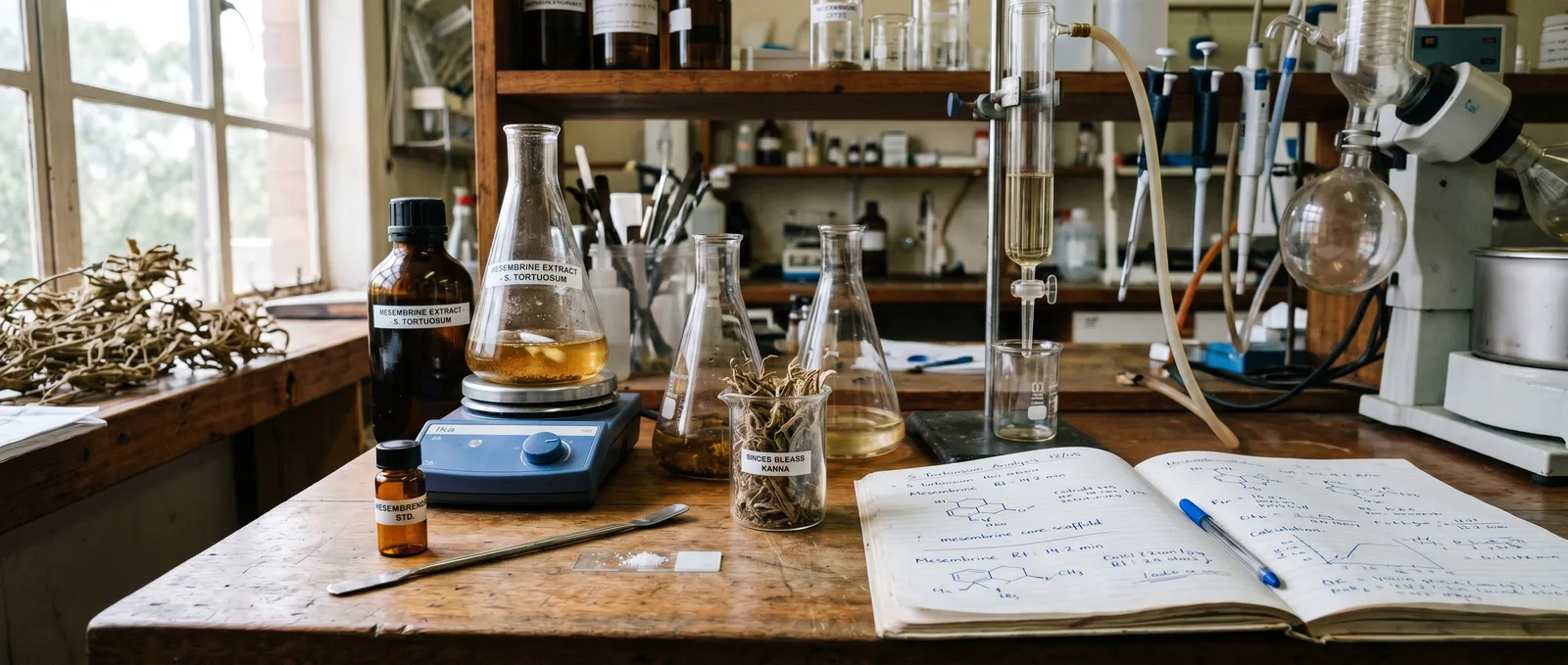
Kanna chemistry explained: mesembrine, mesembrenone, their mechanisms, how fermentation and extraction change alkaloid profiles, and why it matters…

Rapé Shamanic Snuff Guide: How to Use It Safely
A practical rapé shamanic snuff guide covering dose, kuripe technique, effects, nicotine safety, interactions and Amazonian tradition.
White Sage Salvia Apiana Cultural Smudging Guide
Salvia apiana is a non-psychoactive shrub native to southern California's coastal sage scrub, burned as ceremonial incense in Indigenous North American…
Mulungu Erythrina Traditional Amazonian Use — Bark, Alkaloids & Research
Erythrina mulungu is a Brazilian legume tree whose bark has been brewed as a calming decoction in rural folk medicine for generations.