
This article discusses psychoactive substances intended for adults (18+). If you have a health condition or take medication, consult a doctor before use. Our age policy
Kanna Effects

Definition
Kanna effects is a term describing the mood-lifting, anxiolytic, and mildly stimulating responses produced by Sceletium tortuosum, a succulent plant native to South Africa driven primarily by serotonin reuptake inhibition and possible PDE4 inhibition (Harvey et al., 2011). The experience varies substantially between fermented plant material and concentrated extracts, and between oral, sublingual, and insufflated routes of administration.
Kanna effects is a collective term for the mood-lifting, anxiolytic, and mildly stimulating responses produced by Sceletium tortuosum, a succulent plant native to South Africa that acts primarily through serotonin reuptake inhibition and possible PDE4 inhibition (Harvey et al., 2011). The experience varies considerably depending on whether you're using fermented plant material or a concentrated extract, the route of administration, and individual sensitivity. Understanding what kanna effects actually involve — and what they don't — requires separating anecdotal reports from the limited but growing body of clinical research.
Adult audience (18+). The dosing ranges and effects described in this article apply to adult physiology. This content is not intended for minors.
How Kanna Produces Its Effects
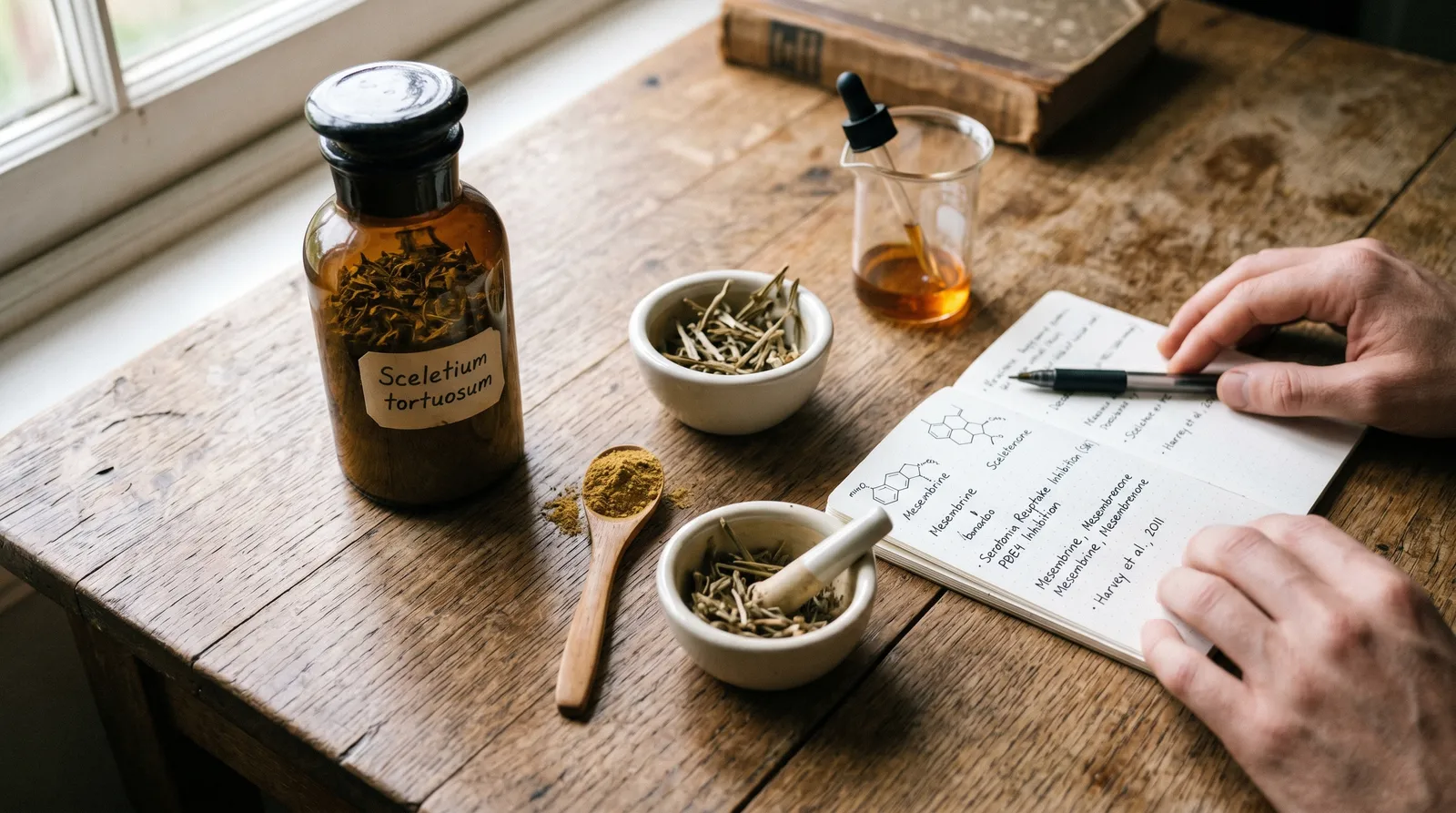
Kanna produces its effects primarily through serotonin reuptake inhibition and possible PDE4 inhibition, acting on clearly identified molecular targets in the central nervous system (Harvey et al., 2011). The principal active alkaloids in Sceletium tortuosum are mesembrine, mesembrenone, and mesembrenol. In-vitro studies have identified serotonin reuptake inhibition as a primary mechanism — mesembrine binds to the serotonin transporter and blocks reuptake, increasing serotonin availability in the synaptic cleft. This is the same basic mechanism targeted by pharmaceutical SSRIs, which is precisely why the interaction risk between kanna and serotonergic medications is so serious (more on that below).
A second proposed mechanism is phosphodiesterase-4 (PDE4) inhibition. Mesembrenone in particular shows affinity for PDE4, an enzyme involved in inflammatory signalling and cognitive processes (Loria et al., 2014). PDE4 inhibitors are used pharmaceutically for conditions ranging from COPD to psoriasis, and some researchers have speculated this pathway contributes to kanna's reported cognitive and mood effects. The relative contribution of serotonin reuptake inhibition versus PDE4 inhibition in a living human brain, though, remains unsettled. Most of the mechanistic data comes from cell cultures and animal models — not from human pharmacokinetic studies.
What this means in practice: kanna is pharmacologically active. It is not a vague "herbal supplement" with hand-wavy mechanisms. It acts on specific neurotransmitter systems, and that demands respect.
Reported Mood and Emotional Kanna Effects
The most consistently reported kanna effects centre on mood — a subtle but noticeable brightening of emotional tone, often accompanied by reduced social anxiety and increased sociability (Terburg et al., 2013). Some users describe it as taking the edge off social anxiety, making conversation feel easier without the cognitive blunting they associate with alcohol.
Clinical trials on a specific standardised extract have reported reductions in anxiety-related amygdala reactivity. A functional MRI study by Terburg et al. (2013) found that a single 25 mg dose of this standardised preparation reduced amygdala response to fearful faces in healthy volunteers. That's a genuinely interesting finding — but it applies to one specific extract at one specific dose in a small sample of healthy people, not to kanna plant material in general or to the full range of preparations available.
A separate randomised, double-blind, placebo-controlled trial using the same standardised extract at 25 mg daily for three weeks reported improvements in cognitive flexibility and executive function, alongside reduced anxiety (Chiu et al., 2014). Again, these results are specific to that preparation and dose — transferring them onto a cup of kougoed tea or a different extract concentration is not scientifically justified.
What users report outside clinical settings is broader and messier. Some describe gentle contentment. Others notice increased empathy or emotional warmth. A minority report very little at all, particularly with lower-potency plant material. The variability is real, and it tracks with the wide differences in alkaloid content between preparations.
Honest limitation: We'd love to tell you exactly what kanna effects to expect, but the truth is that alkaloid content varies enormously between batches, suppliers, and preparation methods. Two products labelled "kanna extract" can produce meaningfully different experiences. No one — including us — can guarantee a specific outcome from a specific product.
Physical and Cognitive Effects
Physical kanna effects are generally milder than the mood effects, typically presenting as mild stimulation at lower doses and relaxation at higher doses (Chiu et al., 2014). These effects are noticeable and dose-dependent. Users commonly report:
- Mild stimulation at lower doses — increased alertness, a slight energy lift, sometimes described as comparable to a strong cup of tea rather than coffee.
- Relaxation and sedation at higher doses — the character shifts, with some users describing heaviness in the limbs, drowsiness, and a desire to sit still.
- Appetite suppression — some users notice reduced hunger, particularly with sublingual or insufflated use. This is anecdotal and not established in controlled studies.
- Mild nausea — reported occasionally, especially on an empty stomach or with higher amounts of plant material.
- Headache — a minority of users report mild headaches, sometimes during onset, sometimes afterward. Frequency data from controlled settings is limited.
On the cognitive side, some users describe improved focus and mental clarity, particularly at lower amounts. The Chiu et al. (2014) study mentioned above did measure cognitive outcomes and found improvements in a cognitive flexibility task — but again, this was a specific standardised extract, not general plant material, and the sample was small.
Route of Administration Matters
Route of administration is the single biggest variable controlling onset speed, intensity, and duration of kanna effects — insufflated kanna hits within minutes and fades fast, while oral use produces a gentler arc lasting up to four hours. Published human pharmacokinetic data is thin, so much of what follows draws on consistent user reports rather than clinical measurement.
| Route | Typical onset | Typical duration | Character |
|---|---|---|---|
| Oral (chewed or swallowed) | 30–90 minutes | 2–4 hours | Gradual, gentler, longer plateau |
| Sublingual (held under tongue) | 10–30 minutes | 1–3 hours | Faster onset, more pronounced peak |
| Insufflated (nasal) | 5–15 minutes | 30–90 minutes | Rapid, intense, shorter duration |
| Tea infusion | 30–60 minutes | 2–3 hours | Mild, diffuse, traditional method |
These are approximate ranges drawn from user reports — individual variation is wide, and controlled pharmacokinetic studies across routes haven't been published. Insufflation produces the fastest and most intense onset but also the shortest duration, and it can be quite harsh on nasal membranes. Sublingual use is a middle ground that many experienced users prefer for its balance of speed and duration.
Plant Material Versus Extract
Fermented plant material and concentrated extract produce substantially different kanna effects in both intensity and character — extract is far more potent per milligram and demands smaller, more precise amounts. The distinction between these forms is the single most important variable in predicting your experience. Fermented plant material (traditional kougoed) contains the full spectrum of Sceletium alkaloids at their natural concentrations, which are relatively low. Extracts concentrate these alkaloids — a 10:1 extract contains roughly ten times the alkaloid density of an equivalent weight of plant material, and stronger concentrations exist.
The practical consequences are straightforward. With plant material, you're working with larger amounts (hundreds of milligrams to grams) and the onset is typically gentler. With concentrated extracts, effective amounts are much smaller (tens of milligrams), the onset can be more abrupt, and the serotonergic activity is proportionally stronger. This means the interaction risk with serotonergic medications also scales upward with extract potency — a point that matters enormously for safety.
Fermentation itself changes the alkaloid profile. Traditional kougoed preparation involves bruising and fermenting the aerial parts of the plant over several days, which reduces oxalate content and alters the ratio of mesembrine to mesembrenone. Fermented material and unfermented material are not interchangeable, and neither maps neatly onto a standardised extract.
Choosing Between Forms
If you want to get kanna plant material for a traditional experience, Kanna Fermented Shredded is the most popular starting point. For those who prefer a concentrated preparation, you can order kanna extract in several strengths — Kanna UC2 Extract offers a mid-range potency, while Kanna Extreme Extract is suited to experienced users who already know their sensitivity. Starting with the mildest form and working upward is always the safer approach.
Kanna Effects Compared to Other Mood Herbs
Kanna occupies a distinct pharmacological niche among mood-supporting herbs — it is more acutely mood-lifting than valerian, far milder than kratom, and faster-acting than St John's Wort. Compared to valerian, kanna is less purely sedating and more mood-lifting at lower amounts. Compared to kratom, kanna is far milder and acts on entirely different receptor systems — kanna has no identified opioid receptor activity. Compared to St John's Wort, kanna has a faster onset but shorter duration per use, and the two should never be combined due to overlapping serotonergic mechanisms. Each has a different profile, and lumping them together as "mood herbs" obscures important pharmacological differences.
Those interested in exploring the broader field of natural mood support can browse the mood herbs and relaxation herbs categories in the Azarius smartshop. Products like Happy Caps and the Herbal Spirit blend offer different approaches to mood support that don't involve serotonin reuptake inhibition, making them worth comparing if kanna's mechanism concerns you. The Azarius Encyclopedia wiki article on Sceletium tortuosum provides deeper botanical background, and the blog post on natural mood support covers complementary approaches.
Honest limitation: Comparisons between kanna and other mood herbs are inherently imprecise. Each plant contains a different cocktail of active compounds acting on different receptor systems. Saying kanna is "like" valerian or kratom is a useful shorthand but pharmacologically misleading — treat these comparisons as rough orientation, not equivalence.
What Kanna Does Not Do
Kanna does not produce psychedelic visuals, opioid-like sedation, or clinically validated antidepressant effects — it is a mild mood-supporting herb, not a replacement for professional mental health treatment. It does not produce visual distortions, ego dissolution, or altered states of consciousness in the way that psilocybin or LSD do. Some older sources describe kanna as "vision-inducing," likely reflecting historical accounts of Khoisan use in ritual contexts — but modern users almost universally describe the kanna effects experience as subtle and grounded, not hallucinatory.
Kanna is also not an opioid. It does not produce the warm, analgesic blanket associated with opioid receptor agonists. Some users report mild pain relief, but this is anecdotal and no opioid-receptor activity has been identified in pharmacological studies.
And — critically — kanna is not a clinically validated treatment for depression, anxiety disorders, or any other diagnosed mental health condition. The existing research does not demonstrate that kanna addresses clinical depression or anxiety as a proven therapy. Some users describe subjective benefits for their mood. Clinical evaluations on one specific standardised extract have reported measurable effects on anxiety-related brain activity and cognitive function (Terburg et al., 2013; Chiu et al., 2014). But these findings do not constitute evidence that kanna is a proven therapy for clinical conditions or that it replaces professional mental health care. Anyone managing a diagnosed condition with prescribed medication should speak with their prescribing clinician before considering kanna — particularly because of the serotonergic interaction risk.
Serotonergic Interaction Warning
Combining kanna with serotonergic medications risks serotonin syndrome, a rare but potentially life-threatening condition characterised by agitation, hyperthermia, and neuromuscular instability (Harvey et al., 2011). This is the single most critical safety point for kanna effects, and it applies regardless of form, route, or dose. Kanna has demonstrated serotonergic activity. Combining it with SSRIs, SNRIs, MAOIs, tricyclic antidepressants, or other serotonergic substances — including 5-HTP, St John's Wort, and MDMA — risks serotonin syndrome. Symptoms range from agitation and tremor to hyperthermia, seizures, and cardiovascular instability.
If you are currently taking any antidepressant medication, do not combine it with kanna. This includes the washout period after discontinuing an SSRI — pharmacologically active metabolites can persist for weeks, particularly with fluoxetine, which has a notably long half-life. For a detailed breakdown of specific interactions, see the dedicated article on kanna interactions and safety in the Azarius Encyclopedia.
Honest limitation: The interaction data between kanna and specific medications is mostly extrapolated from its known mechanism rather than from dedicated drug-interaction trials. We err on the side of caution because the theoretical risk — serotonin syndrome — is severe. Absence of reported cases does not mean absence of risk, especially with a substance that has limited pharmacovigilance data.
Duration, Tolerance, and Repeated Use
Kanna effects typically last between 30 minutes and 4 hours per session depending on route and form, and tolerance can develop with frequent daily use. Many users report that the first few experiences feel strongest, with a subtle reduction in peak intensity after several consecutive days of use. This pattern is consistent with serotonergic adaptation, though no formal tolerance studies have been published for kanna specifically.
Some experienced users cycle their kanna use — taking it a few days per week rather than daily — to maintain sensitivity. Others report that switching between routes (for example, alternating sublingual and oral) helps preserve the subjective experience. These are anecdotal strategies, not clinically validated protocols.
Where to Buy Kanna
You can buy kanna in several forms from the Azarius catalogue, including fermented plant material, concentrated extracts, and kanna-containing herbal blends. If you want to experience kanna effects for yourself, choosing the right starting point matters. For those new to kanna, starting with a lower-potency preparation — such as fermented plant material or a milder extract — is a sensible approach. You can order kanna extract or get kanna plant material and explore the differences yourself. Products like Kanna Extreme Extract and Kanna Fermented Shredded are popular starting points, while the Kanna UC2 Extract offers a mid-range potency for those who want something between raw plant material and the strongest concentrations. Those interested in broader herbal mood support may also want to explore the mood herbs and relaxation herbs categories in the Azarius smartshop, and the Azarius Encyclopedia wiki article on Sceletium tortuosum provides deeper botanical background.

Honest limitation: We sell kanna and we genuinely believe in its value as a mood-supporting herb — but we can't predict your individual response. Body chemistry, medication status, and even recent food intake all influence the outcome. Start conservatively, pay attention to how you feel, and don't chase a specific effect described in someone else's report.
Last updated: April 2026

Frequently Asked Questions
9 questionsDoes kanna feel like an SSRI?
Is kanna stimulating or sedating?
How long do kanna effects last?
Are kanna effects stronger with extracts than with plant material?
Can kanna cause negative side effects?
Can you mix kanna with SSRIs or other serotonergic medications?
What is the role of PDE4 inhibition in kanna's effects?
Does kanna build tolerance with daily use?
How quickly do kanna effects kick in?
About this article


Adam Parsons is an external cannabis and psychedelics writer and editor who contributes to Azarius's wiki as both author and reviewer. On the writing side, he authors Azarius's kratom and kanna clusters, drawing on exten
This wiki article was drafted with AI assistance and reviewed by Adam Parsons, External contributor. Editorial oversight by Joshua Askew.
Medical disclaimer. This content is for informational purposes only and does not constitute medical advice. Consult a qualified healthcare provider before use of any substance.
Last reviewed April 24, 2026
References (4)
- [1]Harvey, A.L. et al. (2011). Pharmacological actions of the South African medicinal and functional food plant Sceletium tortuosum and its principal alkaloids. Journal of Ethnopharmacology , 137(3), 1124–1129. DOI: 10.1016/j.jep.2011.07.035
- [2]Loria, M.J. et al. (2014). Effects of Sceletium tortuosum in rats. Journal of Ethnopharmacology , 155(1), 731–735. DOI: 10.1016/j.jep.2014.06.007
- [3]Terburg, D. et al. (2013). Acute effects of Sceletium tortuosum (Zembrin), a dual 5-HT reuptake and PDE4 inhibitor, in the human amygdala and its connection to the hypothalamus. Neuropsychopharmacology , 38(13), 2708–2716. DOI: 10.1038/npp.2013.183
- [4]Chiu, S. et al. (2014). Proof-of-concept randomised controlled study of cognition effects of the proprietary extract Sceletium tortuosum (Zembrin) targeting phosphodiesterase-4 in cognitively healthy subjects. Evidence-Based Complementary and Alternative Medicine , 2014, 682014. DOI: 10.1155/2014/682014
Related Articles

Blue Lotus vs Kanna: Effects & Safety
Blue lotus vs kanna compared — Nymphaea caerulea's aporphine profile against Sceletium tortuosum's mesembrine chemistry, with interaction warnings.

Lotus Clinical Research Overview
What does lotus clinical research actually show? A critical review of Nymphaea caerulea and Nelumbo nucifera pharmacology, preclinical data, and…
Kanna South Africa To West History
Sceletium tortuosum was used by San and Khoekhoe communities in southern Africa for centuries before European colonists first documented it in the 1660s.

Sceletium Tortuosum Plant
Learn about the sceletium tortuosum plant: botany, alkaloids, fermentation, safety warnings, and where to buy kanna.
Kanna Pharmacokinetics Explained
Complete guide to kanna pharmacokinetics: how Sceletium tortuosum alkaloids are absorbed, metabolised via CYP2D6, and eliminated.

Kanna Chemistry: Sceletium Alkaloids Explained
Kanna chemistry explained: mesembrine, mesembrenone, their mechanisms, how fermentation and extraction change alkaloid profiles, and why it matters…

Rapé Shamanic Snuff Guide: How to Use It Safely
A practical rapé shamanic snuff guide covering dose, kuripe technique, effects, nicotine safety, interactions and Amazonian tradition.

White Sage Salvia Apiana Cultural Smudging Guide
Salvia apiana is a non-psychoactive shrub native to southern California's coastal sage scrub, burned as ceremonial incense in Indigenous North American…

Mulungu Erythrina Traditional Amazonian Use — Bark, Alkaloids & Research
Erythrina mulungu is a Brazilian legume tree whose bark has been brewed as a calming decoction in rural folk medicine for generations.