
This article discusses psychoactive substances intended for adults (18+). If you have a health condition or take medication, consult a doctor before use. Our age policy
Lotus Chemistry
Definition
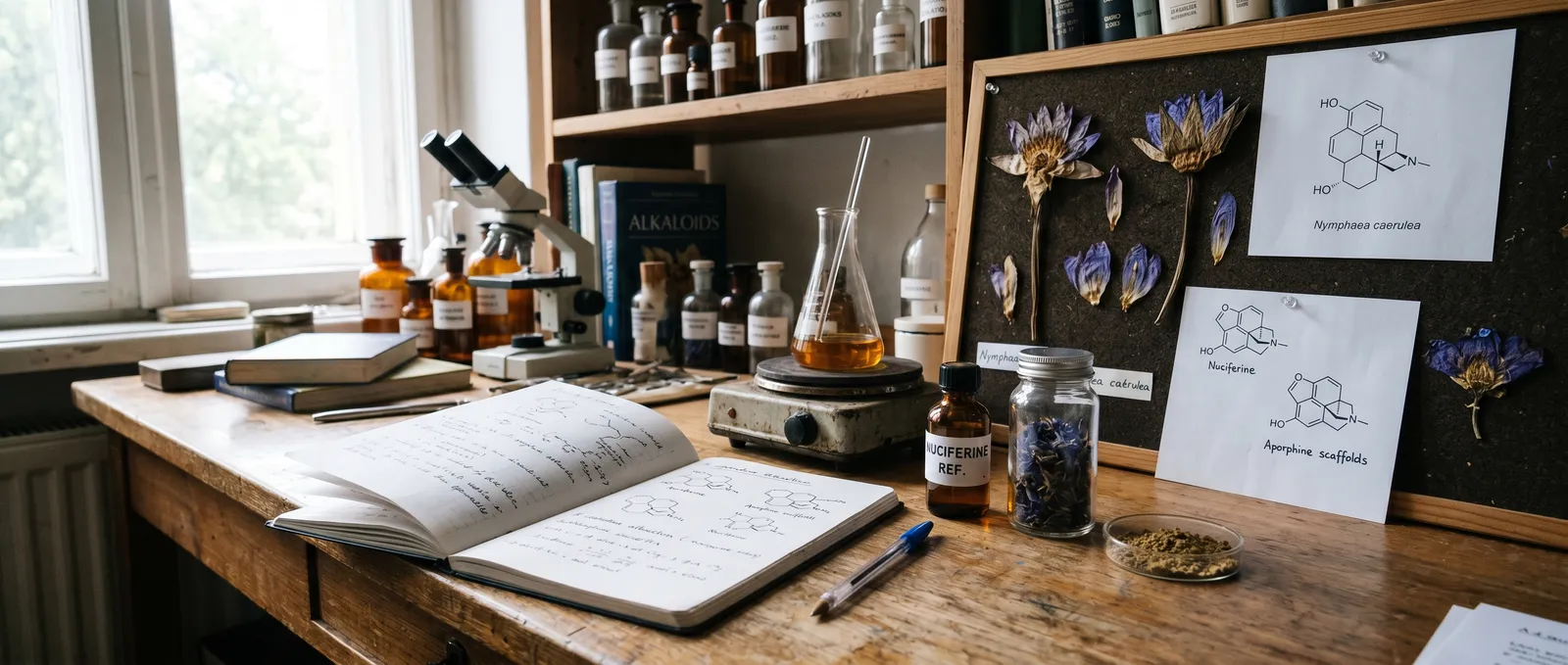
Lotus chemistry centres on aporphine alkaloids — principally nuciferine and apomorphine — in Nymphaea caerulea (blue lotus), and a mix of shared nuciferine plus bisbenzylisoquinoline alkaloids (liensinine, neferine, nelumbine) in Nelumbo nucifera (pink lotus). These two genera belong to separate botanical families with only partial chemical overlap (Neamtu et al., 2020). The distinction matters for both pharmacology and safety.
The chemistry behind lotus species centres on a family of compounds called aporphine alkaloids — nitrogen-containing molecules built around a distinctive four-ring scaffold. In Nymphaea caerulea (blue lotus), the two principal aporphines identified are nuciferine and apomorphine (Agrawala et al., 2013). Nelumbo nucifera (pink/sacred lotus), a plant from an entirely different botanical family, shares nuciferine but adds its own cast of bisbenzylisoquinoline alkaloids — liensinine, neferine, and nelumbine (Chen et al., 2013). Understanding which compounds belong to which species is the single most important thing about lotus chemistry, because the two genera are about as closely related as a horse and a seahorse.
Adult audience (18+). The dosing ranges and effects described in this article apply to adult physiology. This content is not intended for minors.
Disclaimer — this article is provided for educational and harm-reduction purposes only. It does not constitute medical advice. Lotus preparations are not approved medicines. If you take prescription medications or have a cardiovascular or psychiatric condition, consult a qualified healthcare professional before using any lotus product. Nothing here should be read as encouragement to self-treat any medical condition.
| Compound | Class | Found in Nymphaea caerulea (Blue) | Found in Nymphaea ampla (White) | Found in Nelumbo nucifera (Pink) | Proposed primary activity |
|---|---|---|---|---|---|
| Nuciferine | Aporphine alkaloid | Yes — flower, leaf | Yes — characterised in flower tissue | Yes — leaf, seed embryo | Dopamine receptor modulation (D2 antagonism / partial agonism); serotonin receptor affinity |
| Apomorphine | Aporphine alkaloid | Yes — flower | Reported but less characterised | Not typically reported | Non-selective dopamine agonist (D1/D2) |
| Nornuciferine | Aporphine alkaloid | Yes | Reported | Yes | Dopamine and serotonin receptor affinity; less studied than nuciferine |
| Liensinine | Bisbenzylisoquinoline | No | No | Yes — seed embryo | Calcium channel and potassium channel activity; antiarrhythmic properties observed in vitro |
| Neferine | Bisbenzylisoquinoline | No | No | Yes — seed embryo | Calcium channel blocking; sedative effects in animal models |
| Nelumbine | Bisbenzylisoquinoline | No | No | Yes — rhizome, seed | Poorly characterised; early data suggest smooth-muscle relaxation |
| Flavonoids (quercetin, kaempferol glycosides) | Polyphenol | Yes — petals | Yes — petals | Yes — leaf, petal | Antioxidant activity; not psychoactive at dietary levels |
| Phytosterols (beta-sitosterol) | Steroid | Reported | Reported | Yes — rhizome, leaf | No known psychoactive role; general plant constituent |
The Aporphine Scaffold — Why It Matters for Lotus Chemistry
Aporphines are a subclass of isoquinoline alkaloids defined by a tetracyclic ring system that docks into monoamine receptors in the brain. Picture a basic isoquinoline ring system — two fused six-membered rings containing one nitrogen atom — and then bolt on two more rings. That tetracyclic skeleton is the aporphine backbone, and it is the structural reason these molecules interact with monoamine receptors. The nitrogen atom and the hydroxyl groups hanging off the scaffold are what let nuciferine and apomorphine dock into dopamine and serotonin receptor binding sites (Neamtu et al., 2020).
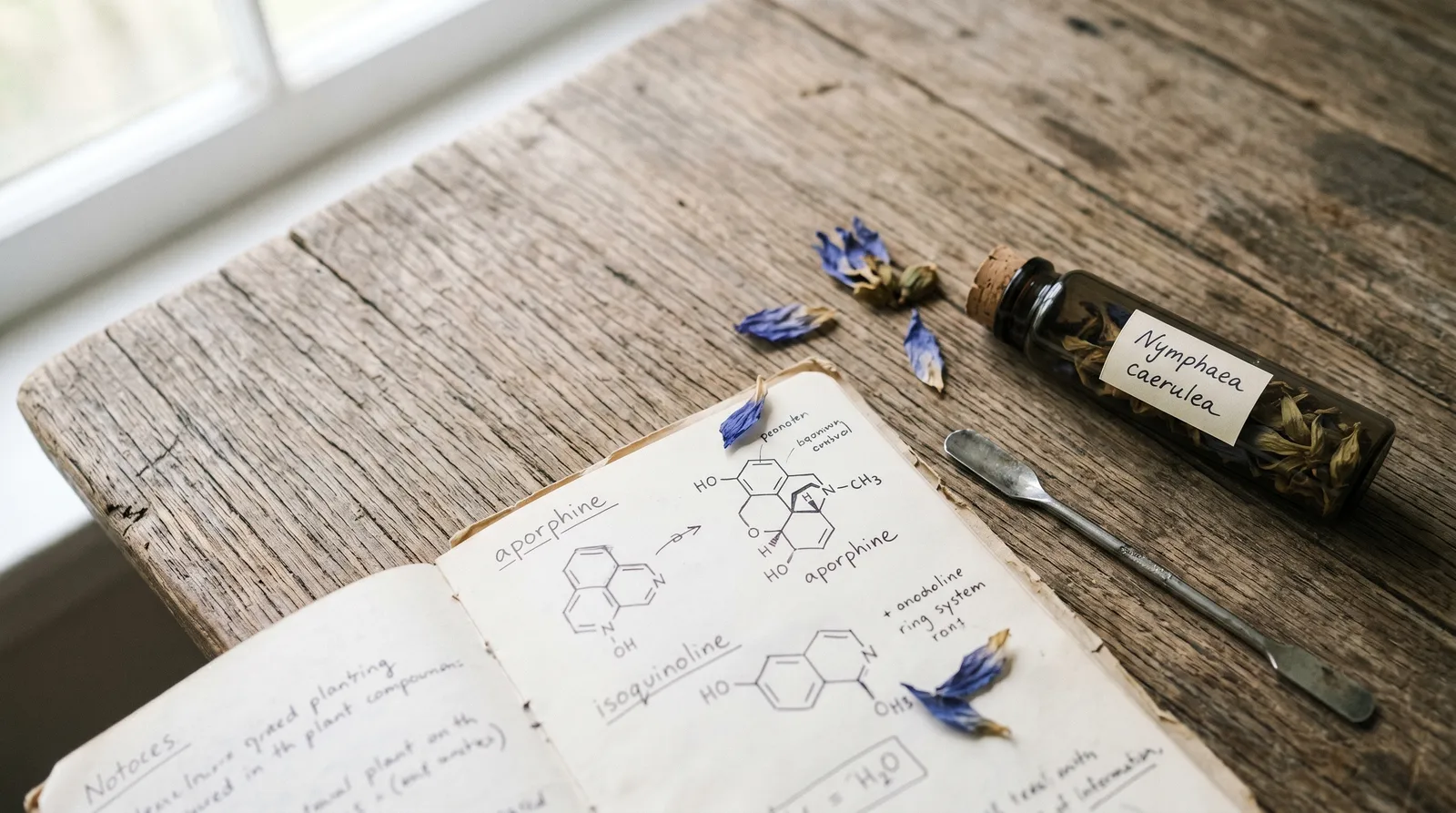
In Nymphaea caerulea (blue lotus), nuciferine is the most abundant aporphine. According to Agrawala et al. (2013), nuciferine and apomorphine are the principal pharmacologically active alkaloids identified in the flower. Apomorphine itself is well-known in clinical pharmacology — it's used as a dopamine agonist in Parkinson's disease treatment — but the concentrations present in blue lotus flower material are far lower than a therapeutic dose of the pharmaceutical drug. That said, the presence of even small amounts is pharmacologically meaningful, particularly in concentrated extracts where aporphine levels are substantially higher than in dried petals. This distinction in lotus chemistry between raw flower and extract is something anyone looking to buy blue lotus should understand before choosing a form.
For Nymphaea ampla (white lotus), the alkaloid profile overlaps with its blue cousin — nuciferine and nornuciferine have been identified — but the research base is thinner. Most published analytical chemistry on Nymphaea species focuses on N. caerulea, so treating the two species as chemically identical would be an assumption, not a fact.
Nelumbo: Different Genus, Different Lotus Chemistry
Nelumbo nucifera produces bisbenzylisoquinoline alkaloids — liensinine, neferine, and nelumbine — that are entirely absent from Nymphaea species, making its lotus chemistry fundamentally distinct despite the shared presence of nuciferine. Nelumbo nucifera (pink/sacred lotus) belongs to the family Nelumbonaceae — a completely separate lineage from the Nymphaeaceae water lilies. The chemical overlap is real but limited: nuciferine appears in both genera. Beyond that shared molecule, Nelumbo nucifera produces a distinctive set of bisbenzylisoquinoline alkaloids — liensinine, neferine, and nelumbine — that are absent from the Nymphaea species (Chen et al., 2013).
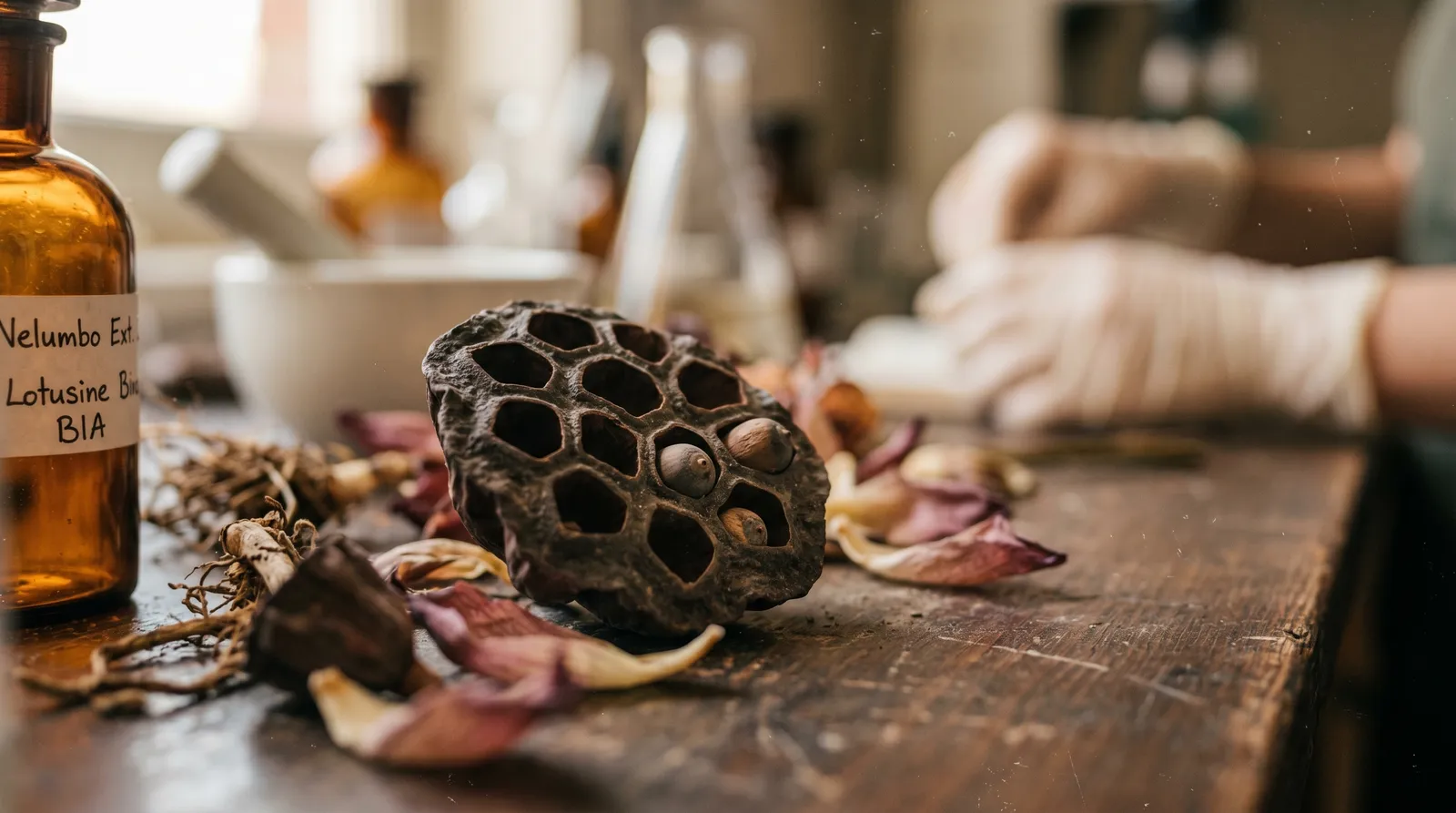
These bisbenzylisoquinolines are structurally different from aporphines. They consist of two isoquinoline units linked by ether bridges, forming large, flexible molecules that interact with ion channels rather than monoamine receptors. Neferine, for instance, has demonstrated calcium-channel-blocking activity in isolated cardiac tissue preparations (Qian, 2002). Liensinine shows similar ion-channel effects. This gives Nelumbo nucifera a cardiovascular pharmacology profile that is mechanistically distinct from the dopaminergic activity of Nymphaea caerulea, even though both genera contain nuciferine.
The practical upshot: when someone says "lotus alkaloids," you need to ask which lotus. The blue flower's lotus chemistry is dominated by dopamine-receptor-active aporphines. The pink flower's lotus chemistry adds ion-channel-active bisbenzylisoquinolines on top of the shared nuciferine. Mixing up the two is like confusing caffeine with theobromine because both come from plants you can drink — related, yes, but not the same pharmacological story.
Nuciferine — The Shared Thread in Lotus Chemistry
Nuciferine is the single compound that bridges both lotus genera, acting on dopamine D2, serotonin 5-HT2A/2C, and adrenergic receptors in vitro. It deserves its own section because it is the one compound that bridges both genera. In Nymphaea caerulea (blue lotus), it is the dominant alkaloid by mass in dried flower tissue. In Nelumbo nucifera (pink lotus), it concentrates in the leaf and seed embryo (Chen et al., 2013).

Pharmacologically, nuciferine has shown affinity for multiple receptor types in vitro. Neamtu et al. (2020) characterised it as interacting with dopamine D2 receptors, serotonin 5-HT2A and 5-HT2C receptors, and adrenergic receptors. Whether it acts as an agonist, partial agonist, or antagonist at each site appears to be receptor-subtype-dependent — the picture is genuinely complicated, and human pharmacokinetic data remain limited. What the in-vitro work does establish is that nuciferine is not pharmacologically inert: it binds to the same receptor families targeted by antipsychotics, certain antidepressants, and Parkinson's medications.
This receptor profile is the mechanistic basis for the mild sedation, dream-enhancement, and relaxation that users report from both Nymphaea and Nelumbo preparations. It is also the reason that interactions with dopaminergic medications (levodopa, pramipexole, ropinirole, pharmaceutical apomorphine), dopamine-receptor-active antiemetics (metoclopramide, domperidone), and MAOIs are a genuine concern. Anyone taking cardiovascular medications — especially antihypertensives — should also be aware that aporphine alkaloids can lower blood pressure, and the additive effect is not well characterised in humans.
A 2019 study on Nelumbo nucifera leaf alkaloids found potent inhibition of the CYP2D6 liver enzyme (Ye et al., 2019). CYP2D6 metabolises a long list of pharmaceuticals — codeine, tramadol, many antidepressants, beta-blockers. If the lotus alkaloids slow that enzyme down, co-administered drugs could accumulate to higher-than-expected plasma levels. This is a drug-interaction mechanism that has nothing to do with receptor binding and everything to do with how your liver processes other compounds. The finding applies specifically to Nelumbo nucifera leaf extract; whether Nymphaea caerulea flower preparations produce the same CYP2D6 inhibition has not been established.
Plant Material Versus Extracts — Concentration Changes Everything
Dried petals contain aporphine alkaloids at fractions of a percent by dry weight, while concentrated extracts can deliver ten to twenty times that alkaloid load per gram. Dried petals of Nymphaea caerulea contain aporphine alkaloids at relatively low concentrations — typically fractions of a percent by dry weight, though exact figures vary with growing conditions, harvest timing, and drying method. A cup of blue lotus tea brewed from a few grams of shredded petals delivers a modest alkaloid dose.
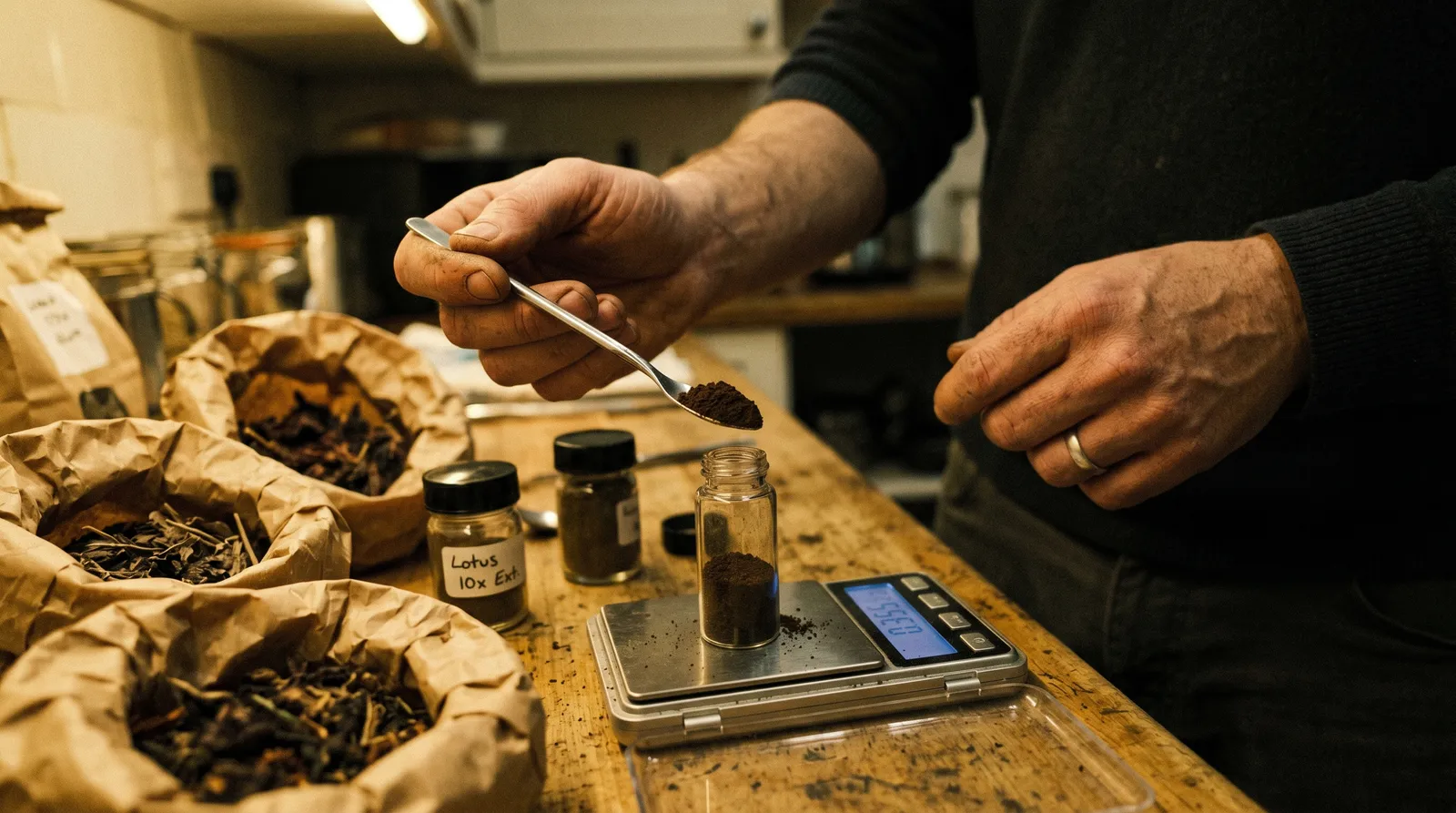
Extracts — dried, liquid, or resin — concentrate these alkaloids by removing bulk plant material. A 10:1 or 20:1 extract packs the alkaloid content of ten or twenty times its weight in raw petals into a much smaller mass. This means extract doses are not interchangeable with petal doses, and the cardiovascular and dopaminergic interaction concerns apply with greater weight to concentrated preparations. Dose-response data comparing routes (tea, smoking, sublingual extract) are thin — no controlled human studies have mapped these curves, so the practical guidance comes from user reports rather than clinical pharmacology. If you want to buy blue lotus or order any lotus extract, understanding this concentration difference in lotus chemistry is essential before choosing a form.
How Lotus Chemistry Compares to Other Sedative Botanicals
Lotus alkaloids work through dopamine and serotonin receptor binding, which is mechanistically distinct from the GABAergic action of valerian, the opioid-receptor activity of kratom, or the CB1 affinity of cannabis. Valerian root, for instance, enhances GABA signalling — a completely different neurotransmitter system — producing sedation through inhibitory tone rather than monoamine modulation. Kratom's mitragynine targets mu-opioid receptors, giving it an analgesic dimension that lotus chemistry lacks entirely. Passionflower operates partly through GABA-A receptor modulation as well, making it pharmacologically closer to valerian than to any lotus species.
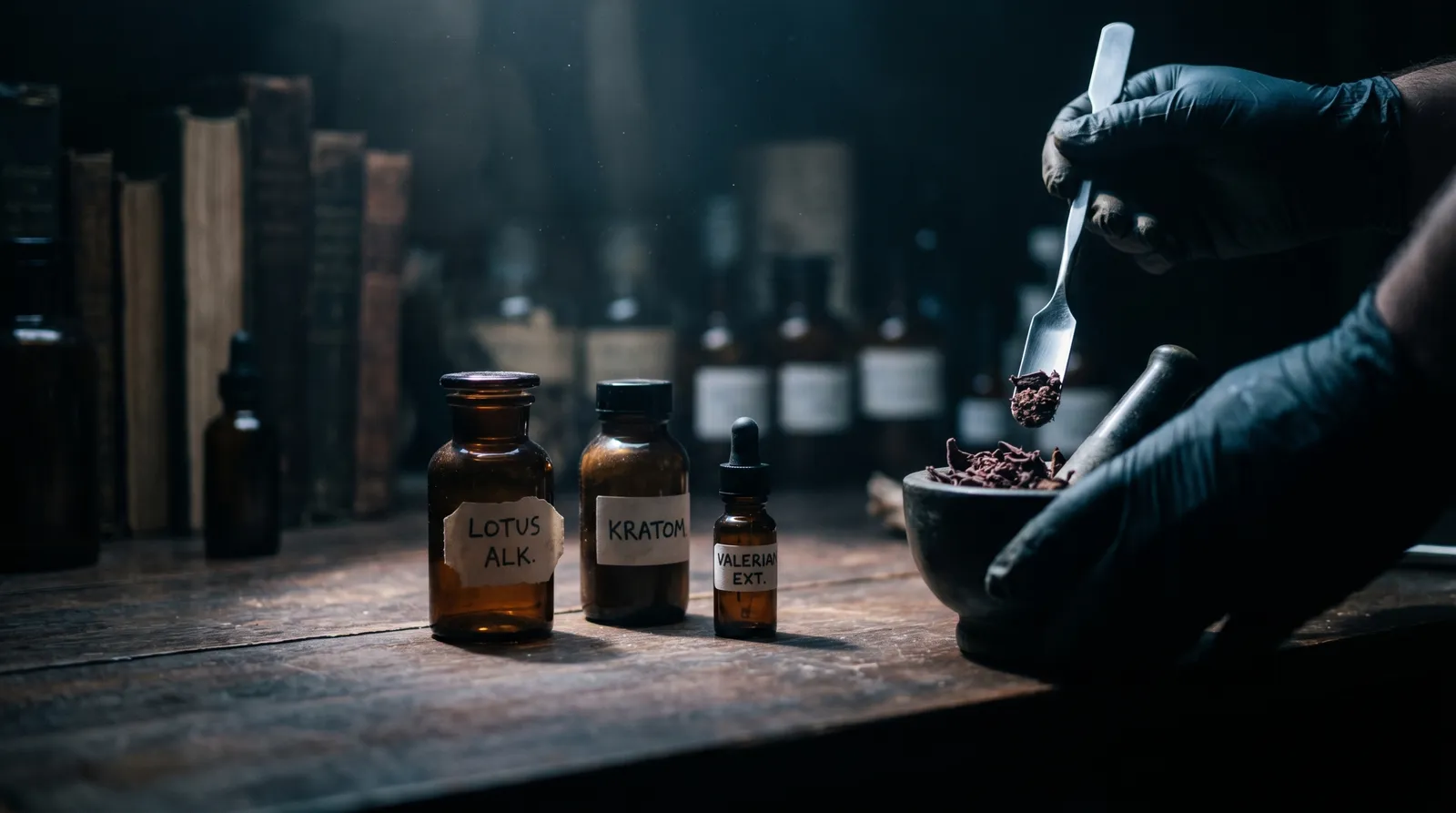
This comparison matters practically: combining lotus with GABAergic herbs or substances (alcohol, benzodiazepines, valerian) layers sedation from two independent mechanisms, and the interaction is unpredictable because it has never been studied in humans. The EMCDDA has noted the general challenge of assessing novel psychoactive botanicals where controlled human data are absent, and lotus preparations fall squarely into that category.
Non-Alkaloid Constituents in Lotus Chemistry
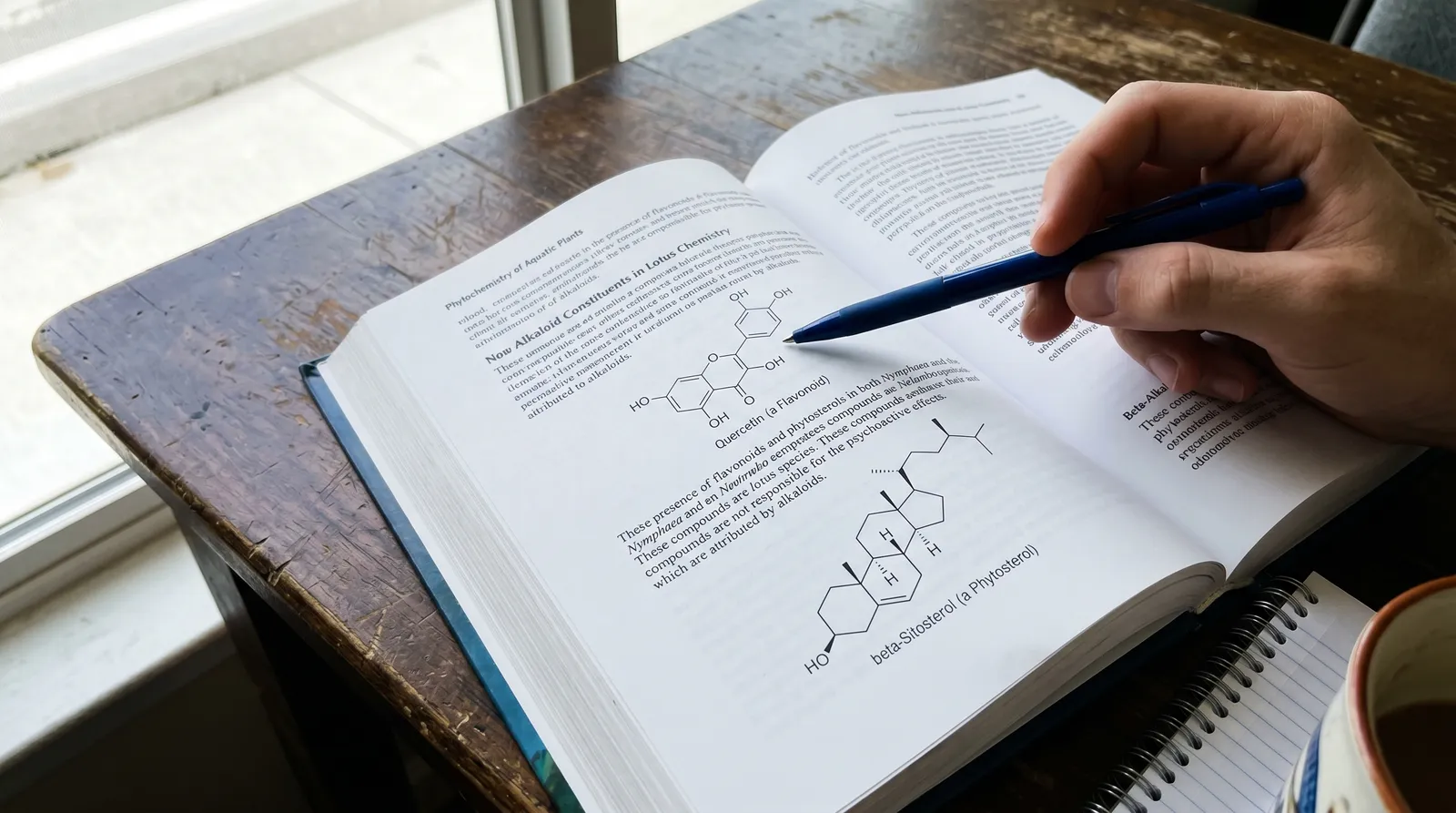
Flavonoids and phytosterols are present in both Nymphaea and Nelumbo species but are not responsible for the psychoactive effects — the alkaloids carry that load. Both Nymphaea and Nelumbo species contain flavonoids — quercetin, kaempferol, and their glycosides — alongside phytosterols like beta-sitosterol and various tannins. These compounds contribute antioxidant activity in vitro but are not responsible for the psychoactive or sedative effects users associate with lotus preparations. They are standard plant polyphenols, present in dozens of common foods and herbs. Mentioning them is useful for a complete chemical picture, but attributing lotus's distinctive effects to flavonoids would be misleading — the aporphines and bisbenzylisoquinolines are doing the pharmacological heavy lifting.
Gaps in the Evidence — What Lotus Chemistry Still Cannot Tell Us
Human pharmacokinetic data for nuciferine — absorption, distribution, metabolism, excretion — are essentially absent from the published literature, which is the single largest gap in lotus chemistry today. The receptor-binding data come from in-vitro assays and animal models, which do not always translate to human experience. Long-term safety data for chronic use of any lotus species do not exist in peer-reviewed form. And the interaction profile with cardiovascular and dopaminergic medications, while mechanistically plausible, has not been tested in controlled clinical settings — the caution is based on pharmacological reasoning, not on documented adverse events in trials.

For these reasons, driving or operating machinery within approximately four hours of using any Nymphaea or Nelumbo preparation is clearly inappropriate. The mild sedation that users report, combined with the dream-enhancement effect, makes impaired alertness a real possibility even if the subjective experience feels gentle.
Choosing a Lotus Product — What the Lotus Chemistry Tells You
The alkaloid profile of each lotus species should guide which product you buy, because Nymphaea and Nelumbo preparations are not interchangeable despite sharing the common name "lotus." If you are primarily interested in the dopaminergic and serotonergic effects associated with nuciferine and apomorphine, Nymphaea caerulea (blue lotus) products — dried petals, shredded flower, or concentrated extract — are the relevant category. Those curious about the additional bisbenzylisoquinoline pharmacology should look at Nelumbo nucifera preparations instead. The Azarius lotus category carries both species in several forms.
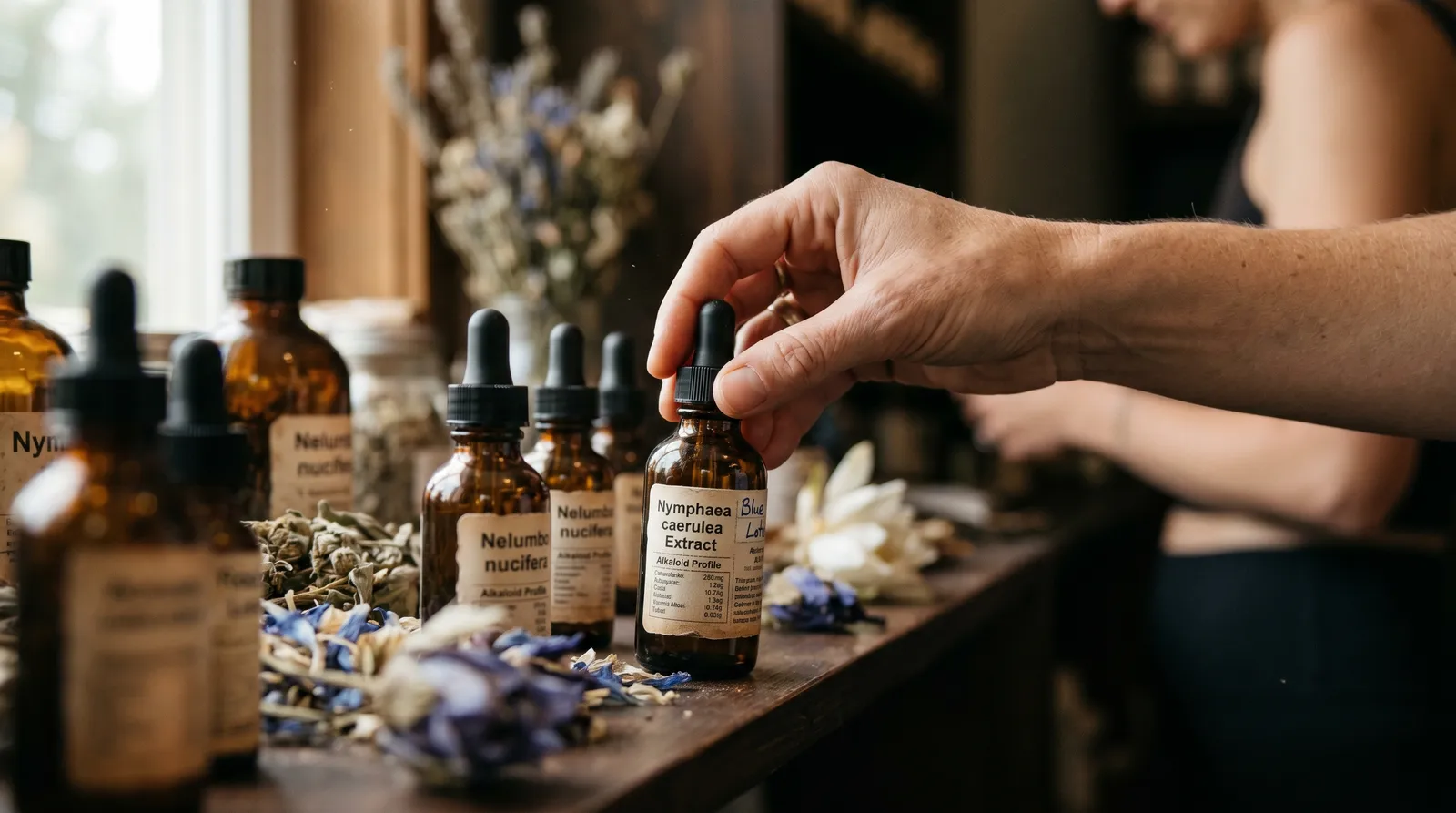
When you order lotus extract rather than dried petals, remember that the lotus chemistry is identical but the concentration is not. A 20:1 blue lotus extract delivers roughly twenty times the alkaloid load per gram compared to whole dried flower. Start with the smallest suggested amount and wait at least ninety minutes before considering more — the onset through oral ingestion is slower than most people expect. Those who want to get a lotus product for the first time are best served by plain dried petals brewed as tea, which offers the gentlest introduction to the alkaloid profile.
For a broader look at how these compounds translate into subjective effects, see the Lotus Effects article on the Azarius wiki. For interaction specifics, the Lotus Interactions article covers the dopaminergic and cardiovascular concerns in detail. Those looking to buy blue lotus petals or order lotus extract can find current options in the Azarius lotus category, where product descriptions note the extract ratio and suggested starting amounts.
Last updated: April 2026
Frequently Asked Questions
10 questionsWhat is the main psychoactive compound in blue lotus?
Does pink lotus contain the same alkaloids as blue lotus?
Why does lotus extract require different dosing than dried petals?
Can lotus alkaloids interact with liver enzymes?
Is nuciferine a dopamine agonist or antagonist?
How does lotus chemistry differ from valerian or kratom?
What are the bisbenzylisoquinoline alkaloids in pink lotus and what do they do?
What is the aporphine scaffold and why does it make lotus alkaloids psychoactive?
Does drying or aging lotus flowers affect their alkaloid content?
Are lotus alkaloids water-soluble or fat-soluble?
About this article


Adam Parsons is an external cannabis and psychedelics writer and editor who contributes to Azarius's wiki as both author and reviewer. On the writing side, he authors Azarius's kratom and kanna clusters, drawing on exten
This wiki article was drafted with AI assistance and reviewed by Adam Parsons, External contributor. Editorial oversight by Joshua Askew.
Medical disclaimer. This content is for informational purposes only and does not constitute medical advice. Consult a qualified healthcare provider before use of any substance.
Last reviewed April 24, 2026
References (6)
- [1]Agrawala, I.P., Achar, M.V.S. & Boradkar, R. (2013). Pharmacological activities of Nymphaea caerulea : a review. International Journal of Pharmacognosy , 1(1), pp. 10–15.
- [2]Chen, S., Fang, L., Xi, H., Guan, L., Fang, J., Liu, Y., Wu, B. & Li, S. (2013). Simultaneous qualitative assessment and quantitative analysis of flavonoids, saponins and alkaloids in the leaves of Nelumbo nucifera Gaertn. using HPLC-DAD-ESI-MS. Journal of Pharmaceutical and Biomedical Analysis , 77, pp. 169–176.
- [3]EMCDDA (2023). New psychoactive substances: challenges for European monitoring. European Monitoring Centre for Drugs and Drug Addiction, Lisbon.
- [4]Neamtu, A.A., Szoke-Kovacs, R., Mihok, E., Georgescu, C., Turcus, V., Olah, N.K. & Frum, A. (2020). Nuciferine — a multitarget phytochemical from Nelumbo nucifera . Plants , 9(12), p. 1749. DOI: 10.3390/antiox9111067
- [5]Qian, J.Q. (2002). Cardiovascular pharmacological effects of bisbenzylisoquinoline alkaloid derivatives. Acta Pharmacologica Sinica , 23(12), pp. 1086–1092.
- [6]Ye, L., Yang, X., Yang, Z., Gao, S., Yin, T., Liu, W., Wang, F., Hu, M. & Liu, Z. (2019). The role of efflux transporters on the transport of highly toxic aconitine, mesaconitine, hypaconitine, and their hydrolysates, as well as the inhibitory effect of Nelumbo nucifera leaf extract on CYP2D6. Frontiers in Pharmacology , 10, p. 1130.
Related Articles
Blue Lotus vs Kanna: Effects & Safety
Blue lotus vs kanna compared — Nymphaea caerulea's aporphine profile against Sceletium tortuosum's mesembrine chemistry, with interaction warnings.
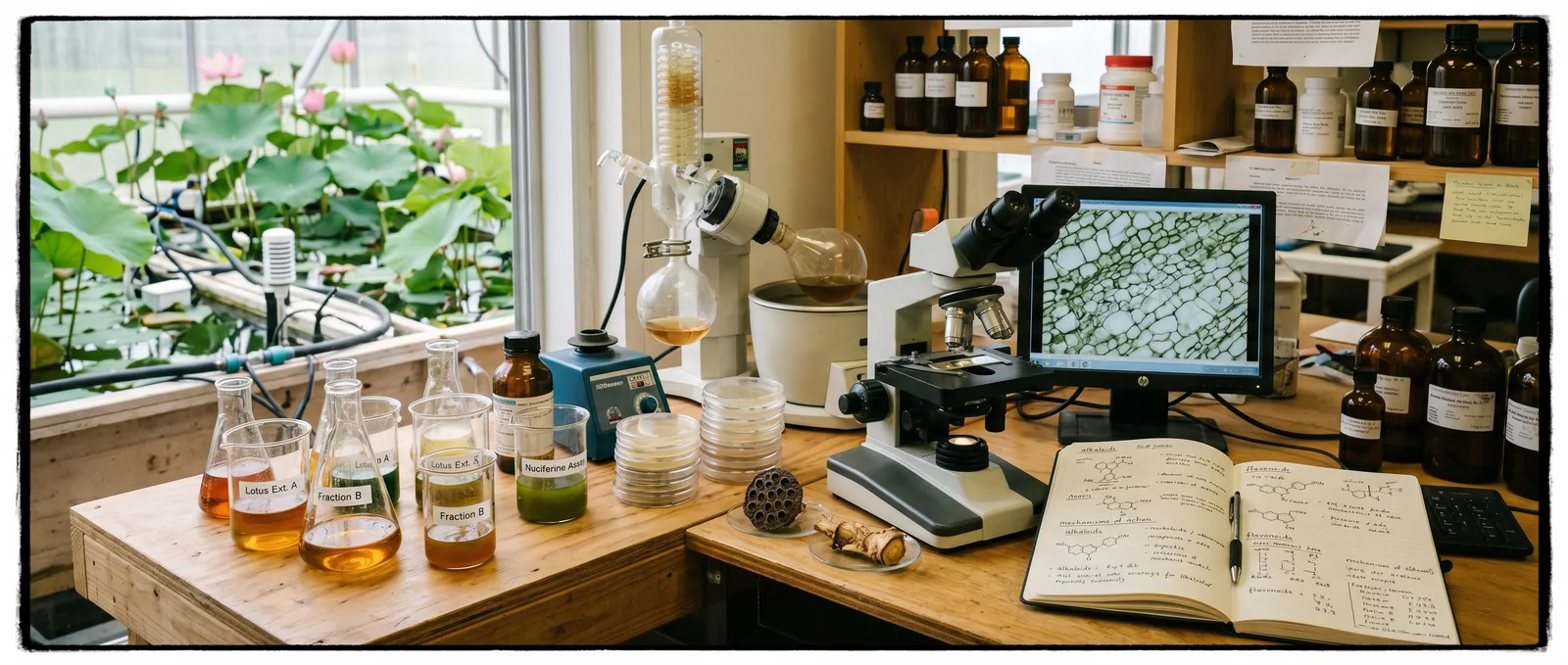
Lotus Clinical Research Overview
What does lotus clinical research actually show? A critical review of Nymphaea caerulea and Nelumbo nucifera pharmacology, preclinical data, and…
Kanna South Africa To West History
Sceletium tortuosum was used by San and Khoekhoe communities in southern Africa for centuries before European colonists first documented it in the 1660s.
Sceletium Tortuosum Plant
Learn about the sceletium tortuosum plant: botany, alkaloids, fermentation, safety warnings, and where to buy kanna.
Kanna Pharmacokinetics Explained
Complete guide to kanna pharmacokinetics: how Sceletium tortuosum alkaloids are absorbed, metabolised via CYP2D6, and eliminated.
Kanna Chemistry: Sceletium Alkaloids Explained
Kanna chemistry explained: mesembrine, mesembrenone, their mechanisms, how fermentation and extraction change alkaloid profiles, and why it matters…

Rapé Shamanic Snuff Guide: How to Use It Safely
A practical rapé shamanic snuff guide covering dose, kuripe technique, effects, nicotine safety, interactions and Amazonian tradition.
White Sage Salvia Apiana Cultural Smudging Guide
Salvia apiana is a non-psychoactive shrub native to southern California's coastal sage scrub, burned as ceremonial incense in Indigenous North American…

Mulungu Erythrina Traditional Amazonian Use — Bark, Alkaloids & Research
Erythrina mulungu is a Brazilian legume tree whose bark has been brewed as a calming decoction in rural folk medicine for generations.