
This article discusses psychoactive substances intended for adults (18+). If you have a health condition or take medication, consult a doctor before use. Our age policy
Mushroom Grow Kit for Beginners: Which to Pick
Definition
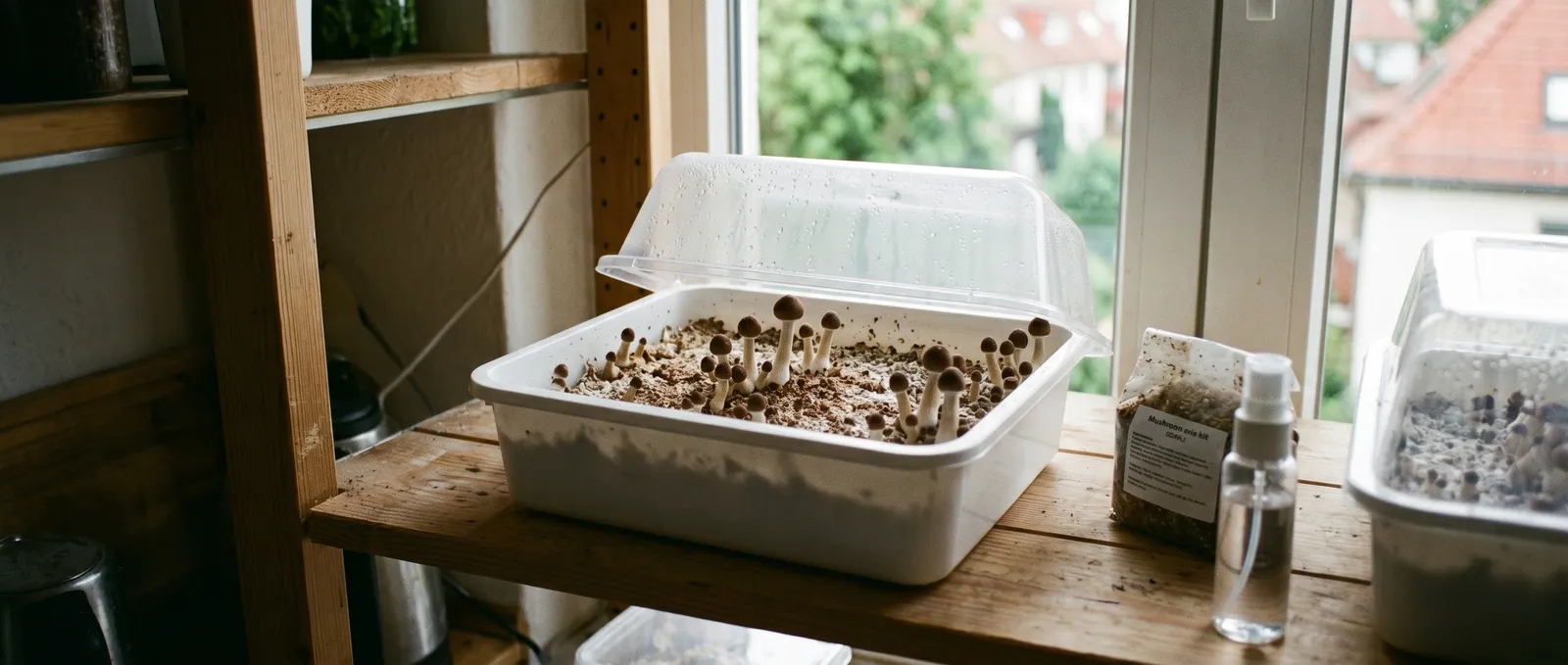
A mushroom grow kit for beginners is a pre-colonised Psilocybe cubensis substrate sold in either a plastic-tub Grow Kit format with a casing layer, or a sealed Ready-2-Grow Bag. Strain alkaloid content varies widely across flushes and genetics (Bigwood & Beug, 1982), so format choice and temperature control matter more than strain for a first grow.
A mushroom grow kit for beginners is a pre-colonised Psilocybe cubensis substrate that removes the sterile lab work and lets first-time growers fruit mushrooms in a cupboard. Picking your first kit comes down to two questions: how much hand-holding do you want, and which strain forgives rookie mistakes? This guide compares the two formats Azarius stocks — the classic Grow Kit and the sealed Ready-2-Grow Bag — across eight beginner-relevant dimensions, then points to the forgiving strains within each. Adult use only: cultivation output is a psilocybin-containing consumable, and the information below applies to adults.
Before you buy or order a mushroom grow kit for beginners, check the growing conditions you can realistically offer at home — temperature stability matters more than strain selection for a first grow.
Grow Kit vs Ready-2-Grow Bag at a glance
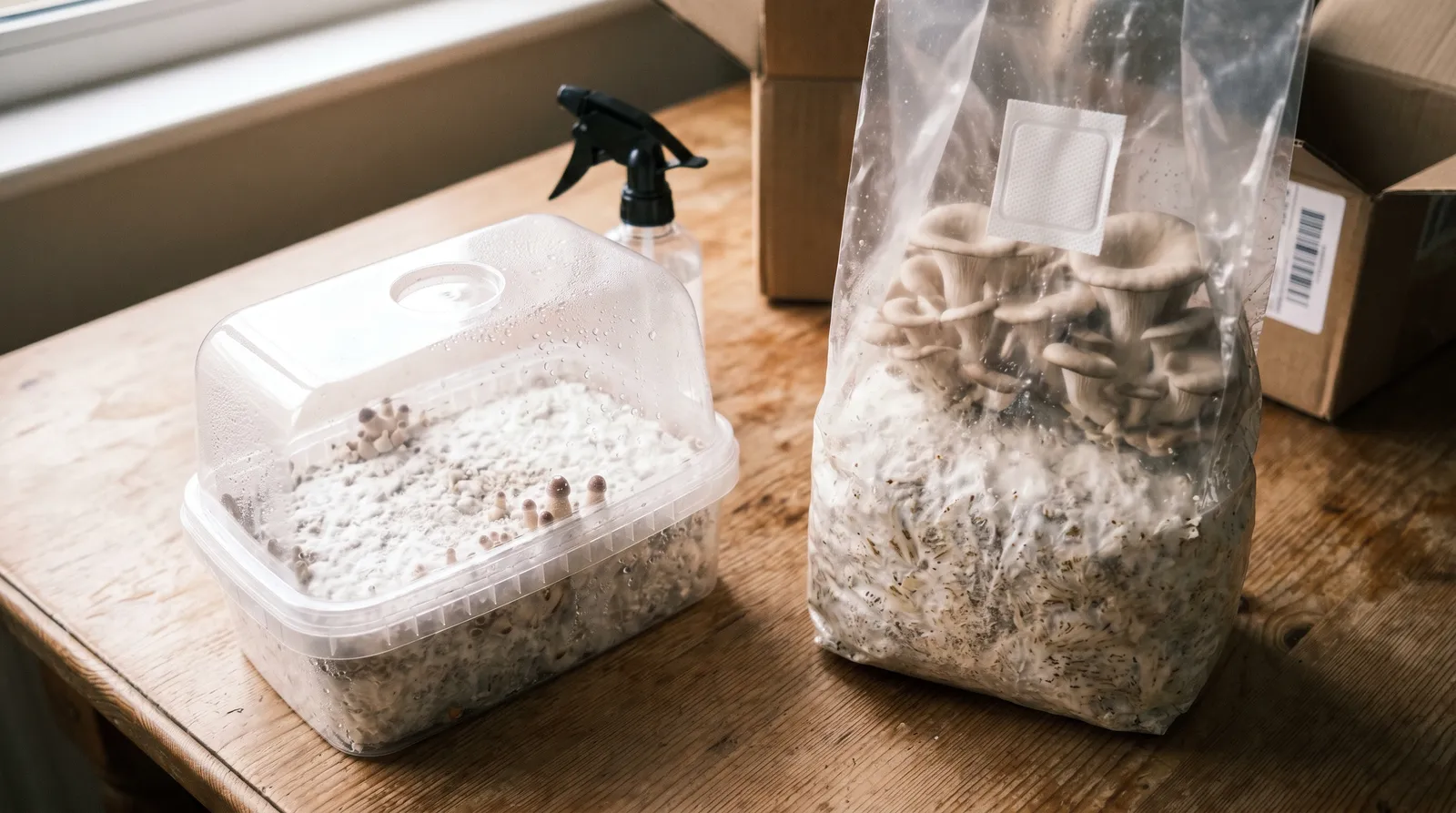
The Grow Kit is the traditional plastic-tub format with a perlite casing layer and a humidity bag, while the Ready-2-Grow Bag is a sealed 2 kg all-in-one with a single flush. Both solve the same problem — getting a fully colonised substrate to fruit in your cupboard — but they do it with very different trade-offs.
| Dimension | Grow Kit (plastic tub) | Ready-2-Grow Bag (R2G) |
|---|---|---|
| Assembly | Tub + filter bag + paperclips; soak before first flush | Sealed bag, cut the film, fruit inside |
| Flushes | 2–4 typical; yield tapers after flush 2 | One flush, single harvest cycle |
| Fresh air exchange | Manual — open and fan the bag 1–2× daily | Passive via the bag's filter patch |
| Temperature band | 22–24°C colonisation, 21–23°C fruiting | Similar, but the sealed bag buffers swings better |
| Humidity target | ~90% RH, maintained by misting the bag walls | Self-regulating inside the sealed film |
| Contamination risk | Higher after the first flush (bag is opened repeatedly) | Lower — the bag stays sealed until harvest |
| Cold shock | Overnight in the fridge before first flush | Not required — bag is designed to skip this step |
| Best for | Growers who want to learn the process and maximise yield | Growers who want the simplest possible first go |
What actually comes in each format
A Grow Kit ships as a transparent plastic tub of colonised rye-grain substrate topped with a perlite/vermiculite casing, plus a microporous filter bag and paperclips. You soak the tub under cold water for 12 hours (the cold shock that triggers pinning), drain, seal the bag, and set it somewhere around 21–23°C with indirect light. Mist the inside of the bag walls — never the casing itself — once or twice a day, and fan fresh air in for about 30 seconds each time.
The Ready-2-Grow Bag is a 2 kg sealed substrate bag with a built-in filter patch. There is no casing layer to protect, no paperclips, no soaking. You cut the plastic film at the marked line, fold the top, and wait. The R2G format is designed around a single synchronised flush — it gives up some total yield compared to a multi-flush kit, but it removes most of the steps where beginners mess up.
Which strain to pick as a first grow
Golden Teacher and Mexican are the two most beginner-forgiving strains across both formats, with broad temperature tolerance and consistent pinning behaviour. Strain matters less than format for beginners, but some strains genuinely tolerate rookie mistakes better. Within the Grow Kit format, B+ and Mazatapec are similarly forgiving. McKennaii is faster and more potent, but it pins aggressively and can be messy if your fresh air exchange is off.
In the R2G range, Golden Teacher is again the safe pick. Hillbilly Pumpkin and Jack Rabbit are beginner-friendly too. Skip the exotic genetics on a first grow — APE (Albino Penis Envy), Enigma and Jedi Mind Fuck are higher-potency strains with specific temperature and FAE needs that reward experience, not first-timers. Enigma in particular produces blobby, coral-shaped clusters rather than normal caps, which is interesting but harder to read for harvest timing.
Psilocybe cubensis alkaloid content varies widely across strains and flushes — Bigwood & Beug (1982) reported total psilocybin + psilocin ranging from ~0.17% to ~1.34% of dry weight across wild and cultivated samples, with strain and substrate as major variables.
Space, time, and temperature reality
Both formats need a dark cupboard, spare shelf, or corner of a room that stays between roughly 21°C and 24°C without wild swings. A bathroom works if it's not too humid; a kitchen doesn't — the cross-contamination risk from food prep is real, and spores travel further than people think. Trichoderma (bright green mould on the substrate or casing) and cobweb mould (fluffy grey-white, grows faster than mycelium) are the two most common killers; a pink slimy layer on the casing is bacterial contamination. Any of these and the kit goes in a sealed bag in the outside bin — don't try to salvage it.
Timeline-wise, from the moment you open the box to first harvest is usually 10–20 days. Grow Kits then go again: re-soak for 12 hours, drain, and a second flush pins within a week or two. Expect flush 2 to be smaller than flush 1, and flush 3 smaller still. R2G bags give you one bigger single event and then you're finished.
Yield expectations — honest numbers
A well-run Grow Kit typically produces 300–600 g fresh weight across the first two flushes, drying down to roughly 30–60 g (fresh cubensis is around 90% water, so divide fresh weight by ~10 for dry). The R2G bag format aims for a single larger flush in the same ballpark for total fresh weight, though yields vary significantly with your temperature stability, misting discipline, and strain — published flush-weight data for home formats is thin, so treat these as ranges reported by vendors rather than clinical numbers.
The yield ranges above come from vendor reports and forum aggregates, not controlled trials. We haven't seen a clinical dataset comparing Grow Kit vs R2G flush weights under matched conditions — if you want certainty, you won't get it here.
Handling, drying, and storage
Wash your hands and wipe the kit's outside with 70% isopropyl before any step that involves opening the bag, and wear gloves for harvest. Dried mushroom dust is a known respiratory irritant and sensitiser for repeat exposures — wear an FFP2 mask while breaking up dried caps and stems, especially if you're drying in the same room you sleep in.
Harvest just before the veil under the cap tears. Dry on a rack with a fan until snap-dry (stems break cleanly, not bend), then finish on silica gel desiccant in a sealed jar for 24–48 hours. Store dried mushrooms in airtight glass with desiccant, in a dark cupboard, locked away from children and pets — dried psilocybin mushrooms look almost identical to several edible species, and that's how accidental ingestions happen.
Psilocybin and psilocin also interact with serotonergic medications — MAOIs, SSRIs, and lithium are the important ones to know about. Consumption, dose, set and setting, and interaction details sit on the psilocybin hub, not in a cultivation guide.
The verdict for a first grow
For the simplest possible first experience, get a Ready-2-Grow Bag in Golden Teacher — it's the lowest-step-count option in the catalogue and the sealed format removes the two biggest beginner failure points (over-misting and contamination through repeated bag-opening). The trade-off is a single harvest instead of multiple flushes.
If you want to learn the process, get multiple flushes, and don't mind doing cold-shocks and misting properly: buy a Grow Kit in Golden Teacher or Mexican. You'll get more total mushrooms across 2–3 flushes, and you'll understand what's happening inside the tub — which is what you want before you try something like McKennaii or an R2G APE later.
Related Azarius grow kits
Azarius stocks eight strains in the Grow Kit format (B+, Cambodia, Golden Teacher, Mazatapec, McKennaii, Mexican, PES Amazonian, Treasure Coast) and nine in the Ready-2-Grow Bag format (APE, Enigma, Golden Teacher, Hillbilly Pumpkin, Jack Rabbit, Jedi Mind Fuck, Makilla Gorilla, McKennaii, MVP). For first grows, the Golden Teacher Grow Kit and the Ready-2-Grow Bag Golden Teacher are the two most requested by new customers.
Disclaimer: This article is for educational and harm-reduction purposes only. It is not medical advice. Psilocybin-containing mushrooms can interact with serotonergic medications (including MAOIs, SSRIs and lithium) and are not appropriate for people with a personal or family history of psychosis. Consult a qualified healthcare professional before making decisions that may affect your health. Azarius does not recommend misuse of any product.
Last updated: April 2026
Frequently Asked Questions
8 questionsWhich mushroom grow kit is easiest for absolute beginners?
How much do beginner kits actually yield?
How long does a first grow take?
What temperature and humidity does a grow kit need?
How do I spot contamination in a beginner kit?
Do I need a casing layer or sterile lab setup?
What is the difference between a Grow Kit and a Ready-2-Grow Bag for beginners?
Can I reuse or get a second flush from a Ready-2-Grow Bag?
About this article


Adam Parsons is an external cannabis and psychedelics writer and editor who contributes to Azarius's wiki as both author and reviewer. On the writing side, he authors Azarius's kratom and kanna clusters, drawing on exten
This wiki article was drafted with AI assistance and reviewed by Adam Parsons, External contributor. Editorial oversight by Joshua Askew.
Medical disclaimer. This content is for informational purposes only and does not constitute medical advice. Consult a qualified healthcare provider before use of any substance.
Last reviewed April 25, 2026
References (2)
- [1]Tsujikawa, K., Kanamori, T., Iwata, Y., Ohmae, Y., Sugita, R., Inoue, H., & Kishi, T. (2003). Morphological and chemical analysis of magic mushrooms in Japan. Forensic Science International, 138(1-3), 85-90. DOI: 10.1016/j.forsciint.2003.08.009
- [2]Stamets, P. (2000). Growing Gourmet and Medicinal Mushrooms (3rd ed.). Ten Speed Press, Berkeley, CA. Source
Related Articles
Cannabis Hermaphrodite: Identify, Prevent, Act
A cannabis hermaphrodite is a female plant that develops male pollen sacs or banana-shaped anthers (nanners), self-pollinating and seeding your harvest.
DIY Cannabis Fertilizer: Homemade Nutrient Guide
DIY cannabis fertilizer guide: compost, teas, banana ferments and feed schedules, with safety notes and cited research for home growers.
What To Do With Male Cannabis Plants: 6 Practical Uses
What to do with male cannabis plants: identify, isolate, breed, extract, or compost. A practical 6-step guide with sourcing and safety notes.
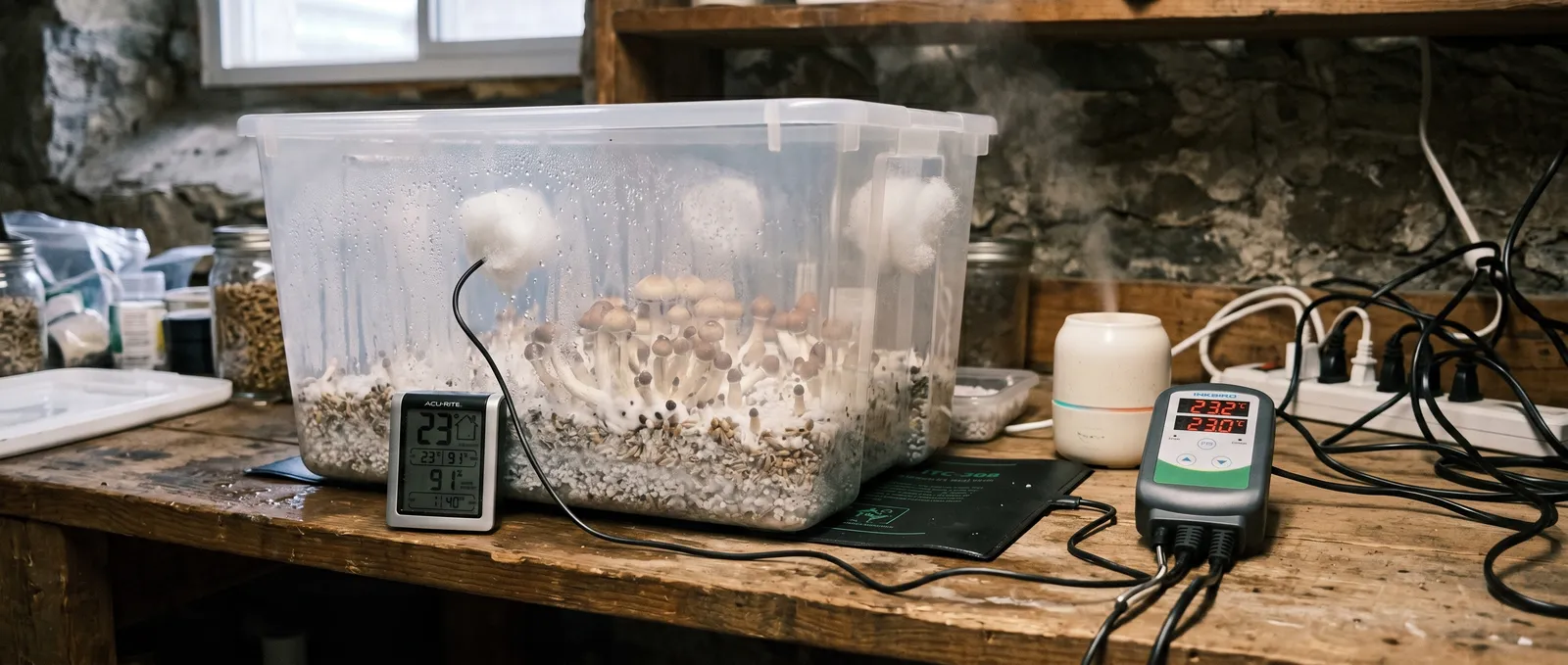
Mushroom Grow Kit Temperature & Humidity: Full Setup Guide
A temperature humidity control grow kit is the small set of climate tools — hygrometer, heat mat, humidifier or perlite tray — that keeps a mushroom fruiting…
When to Harvest Mushrooms: Veil Break Timing Explained
Harvest timing veil break is a cultivation technique that uses the tearing of the partial veil on maturing Psilocybe cubensis to mark peak alkaloid content.
First Grow Checklist: What You Need for Mushroom Kits
A first grow checklist is the short list of supplies and environmental conditions needed to run a home psilocybin mushroom kit from inoculated substrate to…
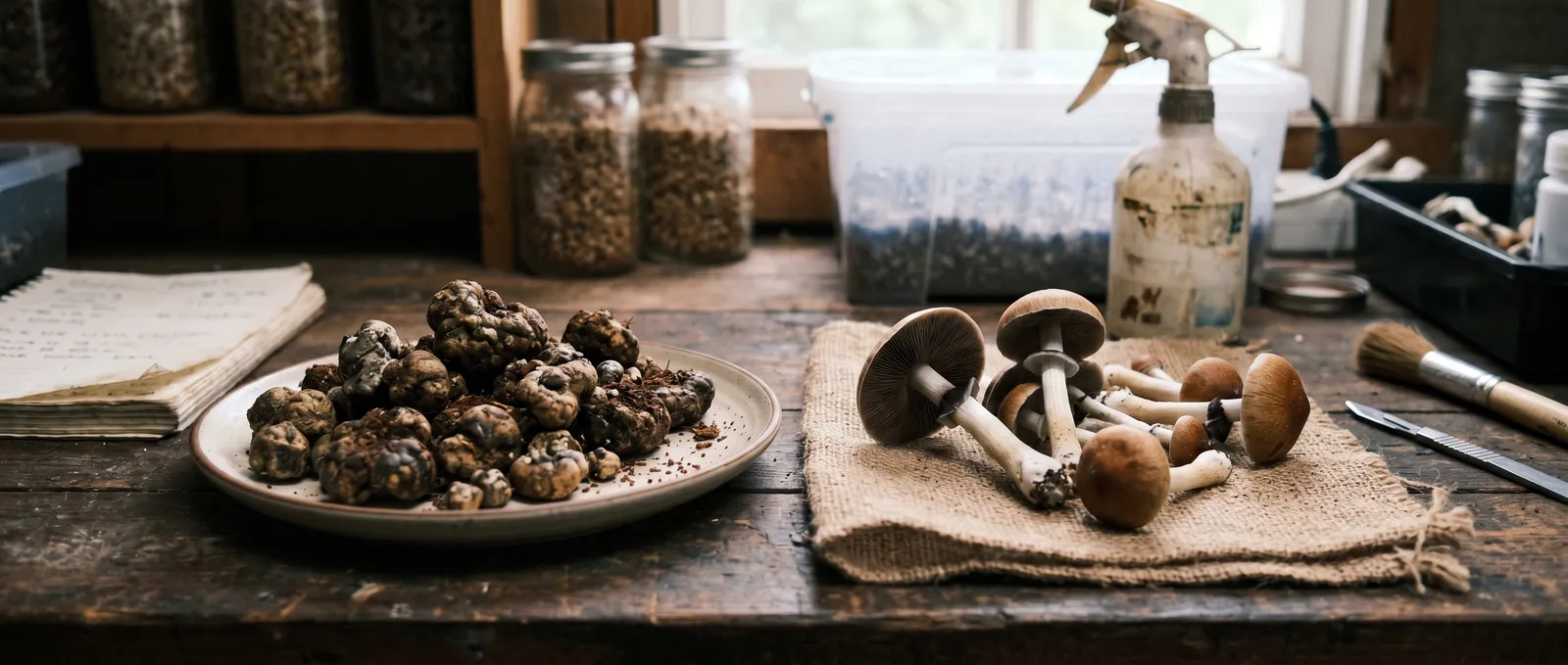
Sclerotia vs Fruit Bodies: Cultivation Comparison
Sclerotia and fruit bodies are two different life stages of Psilocybe fungi: sclerotia are hardened underground mycelial storage bodies (the 'magic…
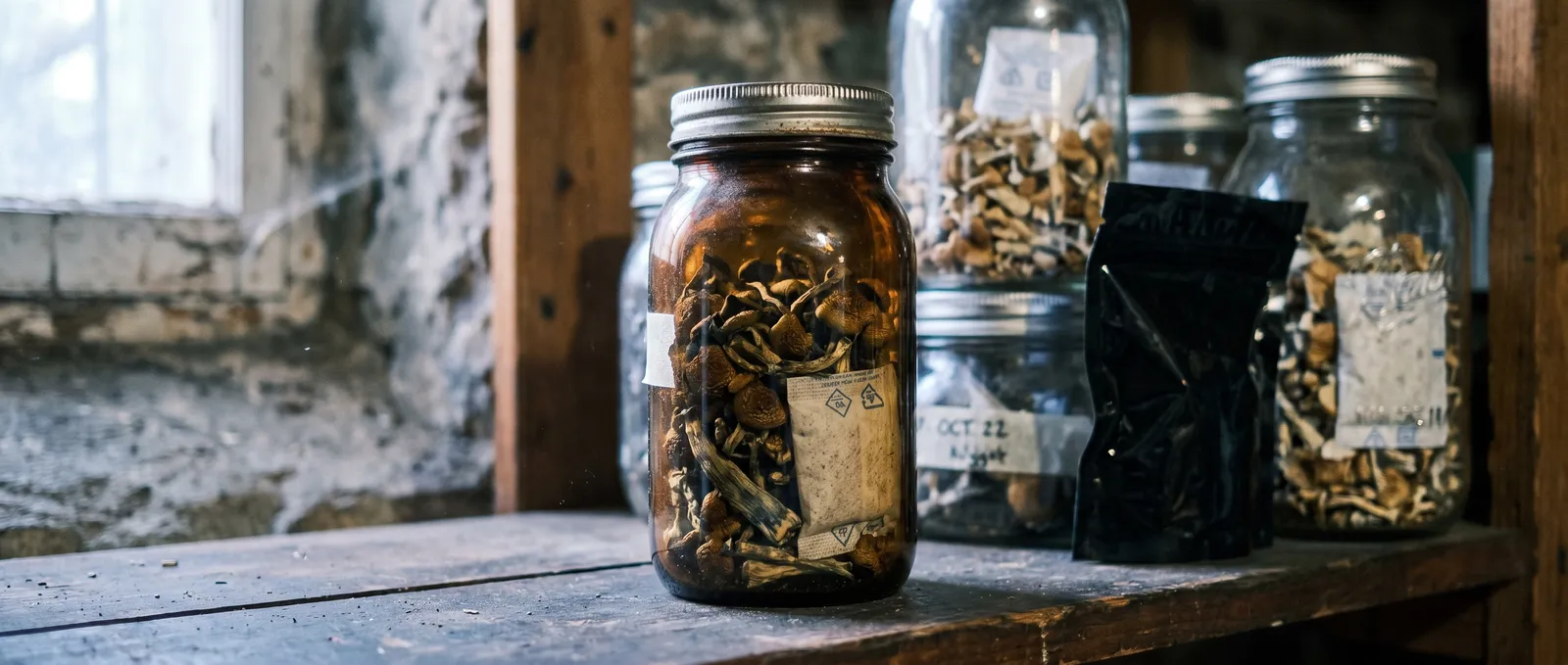
Storing Dried Mushrooms Long Term: Full Guide
Storing dried mushrooms long term means keeping well-dried Psilocybe fruit bodies in airtight, opaque containers with desiccant, cool and dark, to slow…
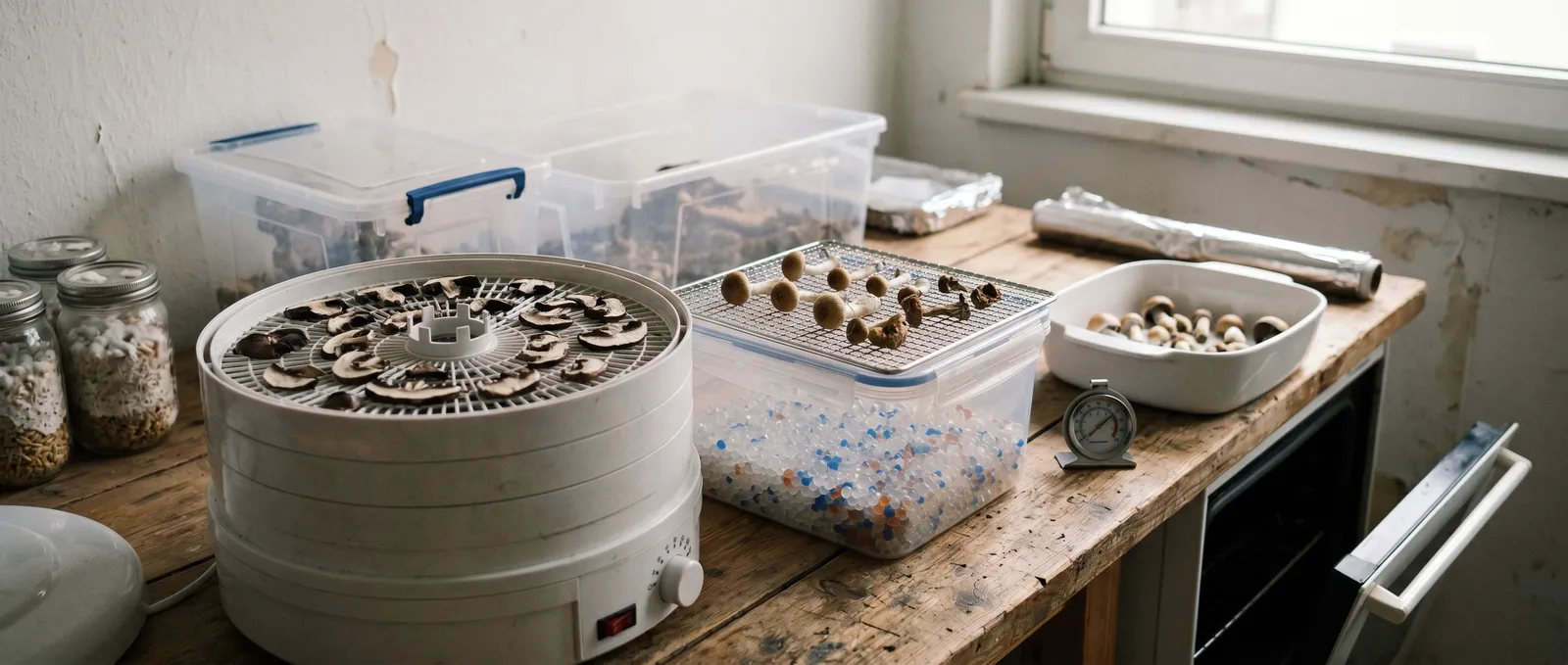
Drying Mushrooms Air Desiccant Oven: Methods Compared
Drying mushrooms air desiccant oven refers to the three home methods for reducing fresh fruit bodies from ~90% water to cracker-dry (<5%). Gotvaldová et al.