
This article discusses psychoactive substances intended for adults (18+). If you have a health condition or take medication, consult a doctor before use. Our age policy
McKennaii Grow Guide: Step-by-Step Cultivation
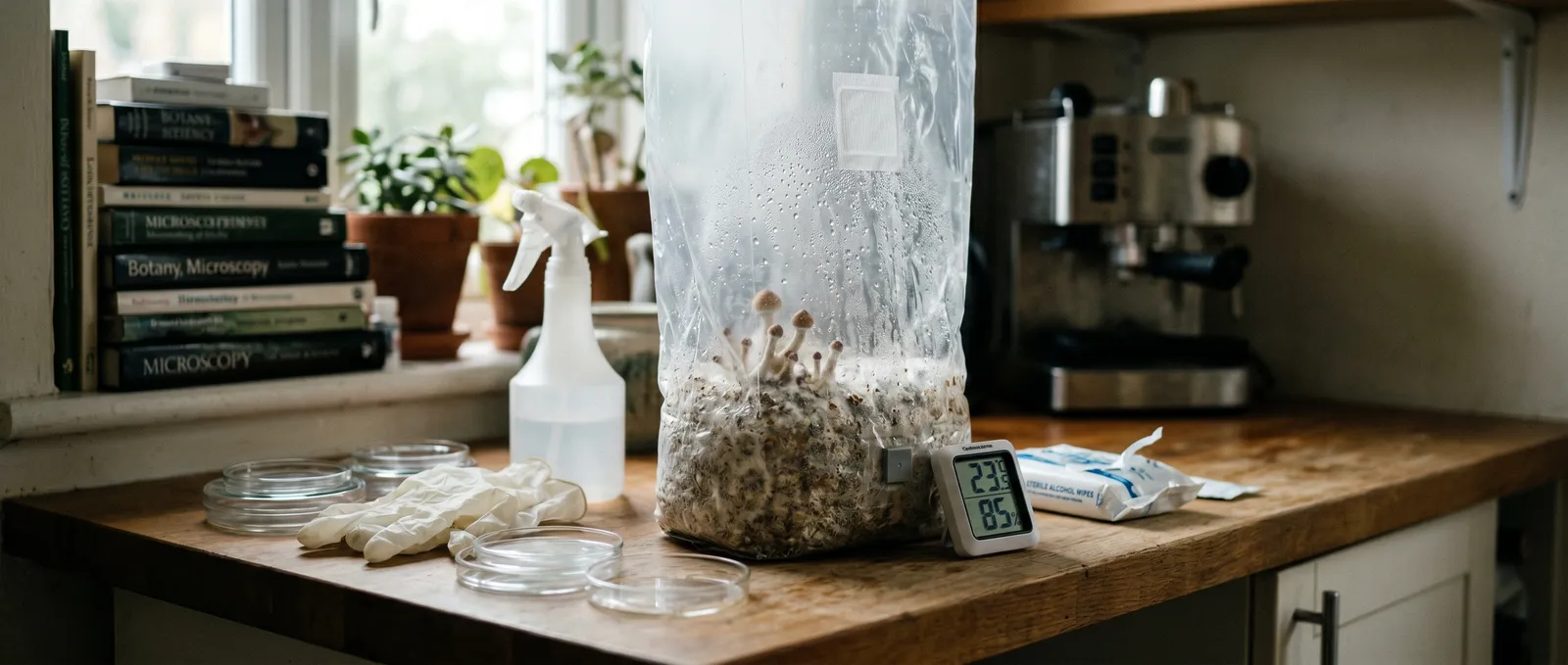
Definition
The McKennaii grow guide is a step-by-step protocol for fruiting the McKennaii strain of Psilocybe cubensis at home, covering cold shock, pinning at 21–23°C, misting, harvest at veil break, and drying to cracker-dry. McKennaii is slower and fussier than Golden Teacher but rewards tight conditions with dense, dark-capped flushes (Stamets, 1996).
This guide is written for adults. Cultivation techniques described below apply to adult home growers; psilocybin-producing fungi are not appropriate for people under 18.
The McKennaii grow guide is a step-by-step cultivation protocol that walks home growers through fruiting the McKennaii strain of Psilocybe cubensis from colonised kit to cracker-dry harvest. The McKennaii strain is one of the more demanding Psilocybe cubensis varieties to fruit reliably — it rewards patience with dense, caramel-capped flushes but punishes sloppy humidity and temperature management. This McKennaii grow guide walks through the full cycle from unboxing a colonised kit to drying the final harvest, with the specific numbers that separate a healthy first flush from a contaminated bag. Named after ethnobotanist Terence McKenna, this strain was selected in the late 1990s for visual potency and has sat in the Azarius catalogue in both Grow Kit and Ready-2-Grow Bag formats for years — growers who want to buy a kit can get either format from the Azarius mushroom grow kit range.
This McKennaii grow guide is educational. Growing conditions, supply availability and formal rules around psilocybin-producing species vary by country and change frequently — verify the situation in your own jurisdiction before you order a kit.
What makes McKennaii different to grow
McKennaii is slower to pin and fussier about temperature than most cubensis strains, typically taking 10–18 days from case-layer hydration to first pins rather than the 7–14 days a forgiving strain like B+ will give you (Stamets, 1996, Psilocybin Mushrooms of the World). It prefers the cooler end of the cubensis fruiting range (21–23°C air temp, not 24–25°C), and it's pickier about fresh air exchange — under-ventilated McKennaii produces long, spindly stems and small caps. Expect 2–3 flushes from a standard Grow Kit, with the first flush being the heaviest by dry weight.
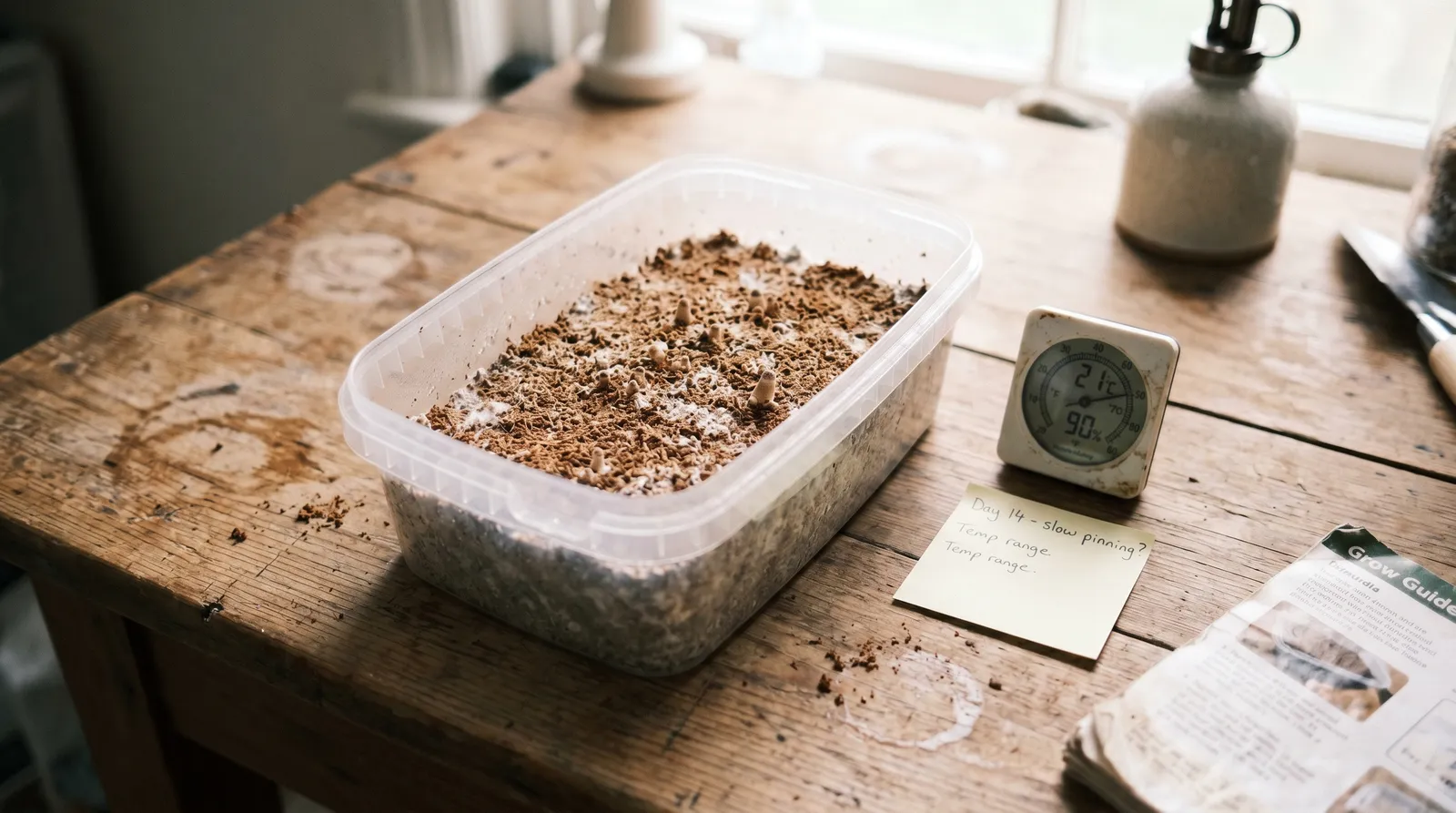
Caps come out dark mahogany when young, fading to caramel as they mature; stems are thick and white, often with a bluish bruise response when handled. That blue reaction is oxidising psilocin and is a visual confirmation you're working with the right strain.
McKennaii compared to other popular strains
| Strain | Pinning time | Ideal temp | Difficulty | Cap character |
|---|---|---|---|---|
| McKennaii | 10–18 days | 21–23°C | Demanding | Dense, dark mahogany → caramel |
| Golden Teacher | 7–14 days | 23–25°C | Forgiving | Golden, medium density |
| B+ | 7–14 days | 23–25°C | Forgiving | Light brown, large caps |
| Mexican | 7–12 days | 23–26°C | Very forgiving | Small, pale caramel |
Step 1 — Unbox and inspect the kit
Open the kit immediately on arrival and inspect it before doing anything else. You're looking for:
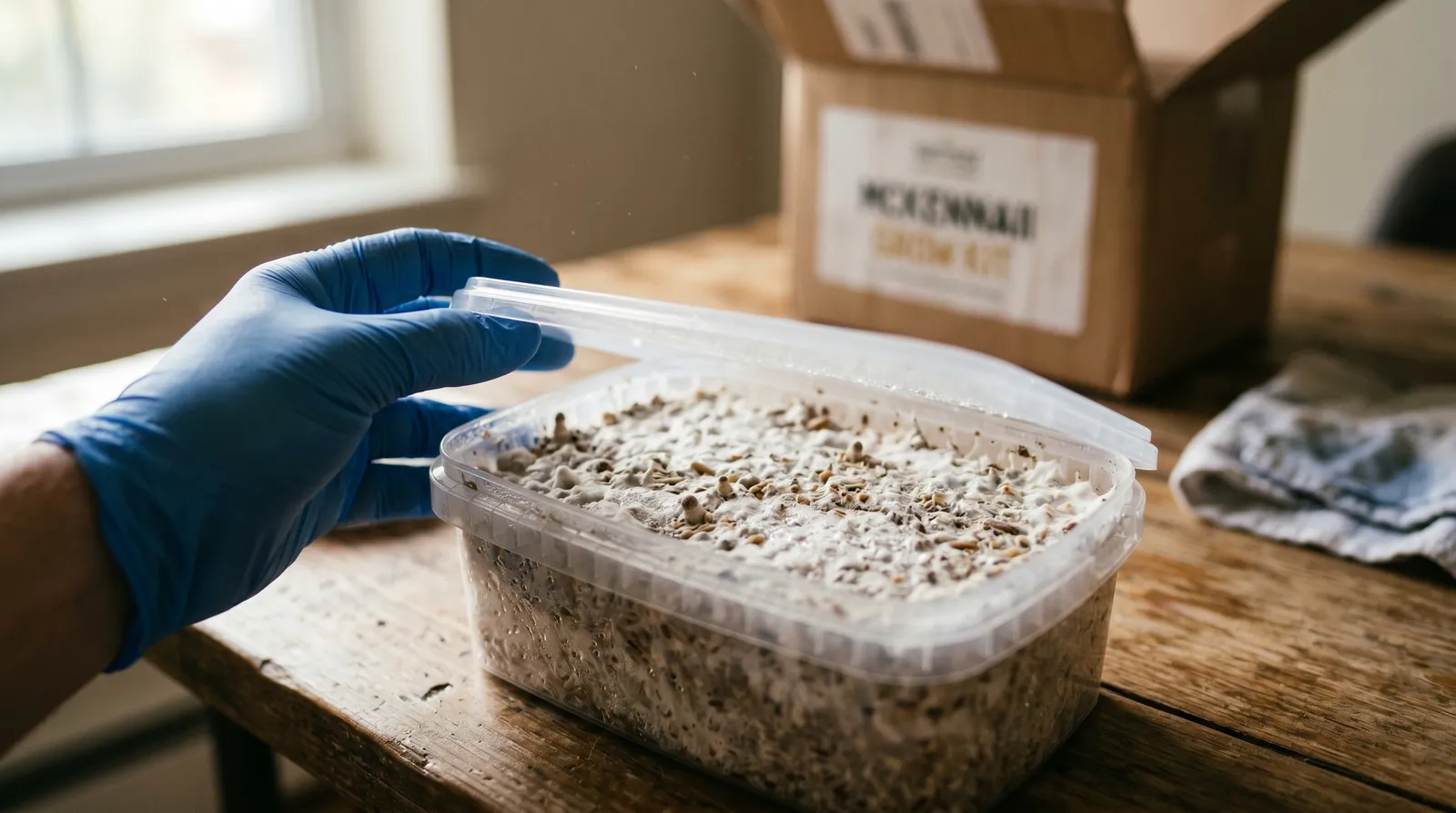
- Uniform white mycelium across the entire substrate surface and visible through the sides of the tub or bag. Small patches of bluish discolouration are bruising from shipping — harmless.
- No green, grey, pink, or black patches. Green (trichoderma) or cobweb-grey growth means reject the kit before you even start.
- No standing water pooled at the bottom of the tub. A tablespoon of condensation is fine; a puddle means wet rot risk.
- Intact filter patch on the grow bag, no tears.
If the kit looks healthy but you can't start immediately, store it in the fridge (2–4°C) for up to two weeks. Longer than that and viability drops noticeably.
Step 2 — Cold shock and hydrate
A distinct cold shock triggers primordia formation in McKennaii more reliably than room-temperature hydration. The protocol used by most European home growers, and the one documented in the grow kit manual (2019) and confirmed across Shroomery pinning threads:
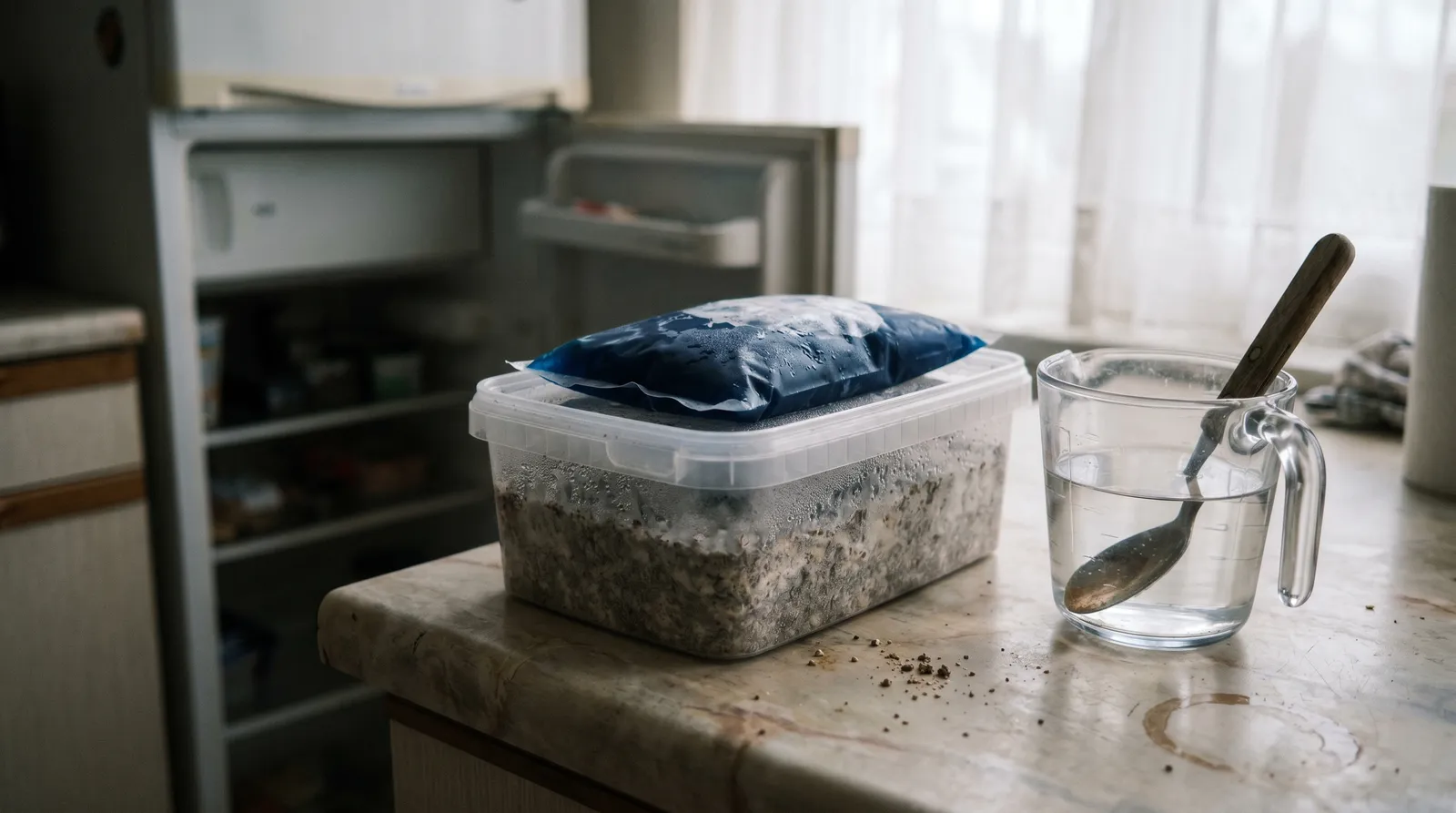
- Fill the tub or bag with cold tap water (roughly 5°C, straight from a cold tap — not ice-chilled).
- Close the lid or bag and leave it in the fridge for 12 hours.
- Drain completely. Tip the tub upside down for 30 seconds; every drop of standing water you leave behind is potential bacterial contamination down the line.
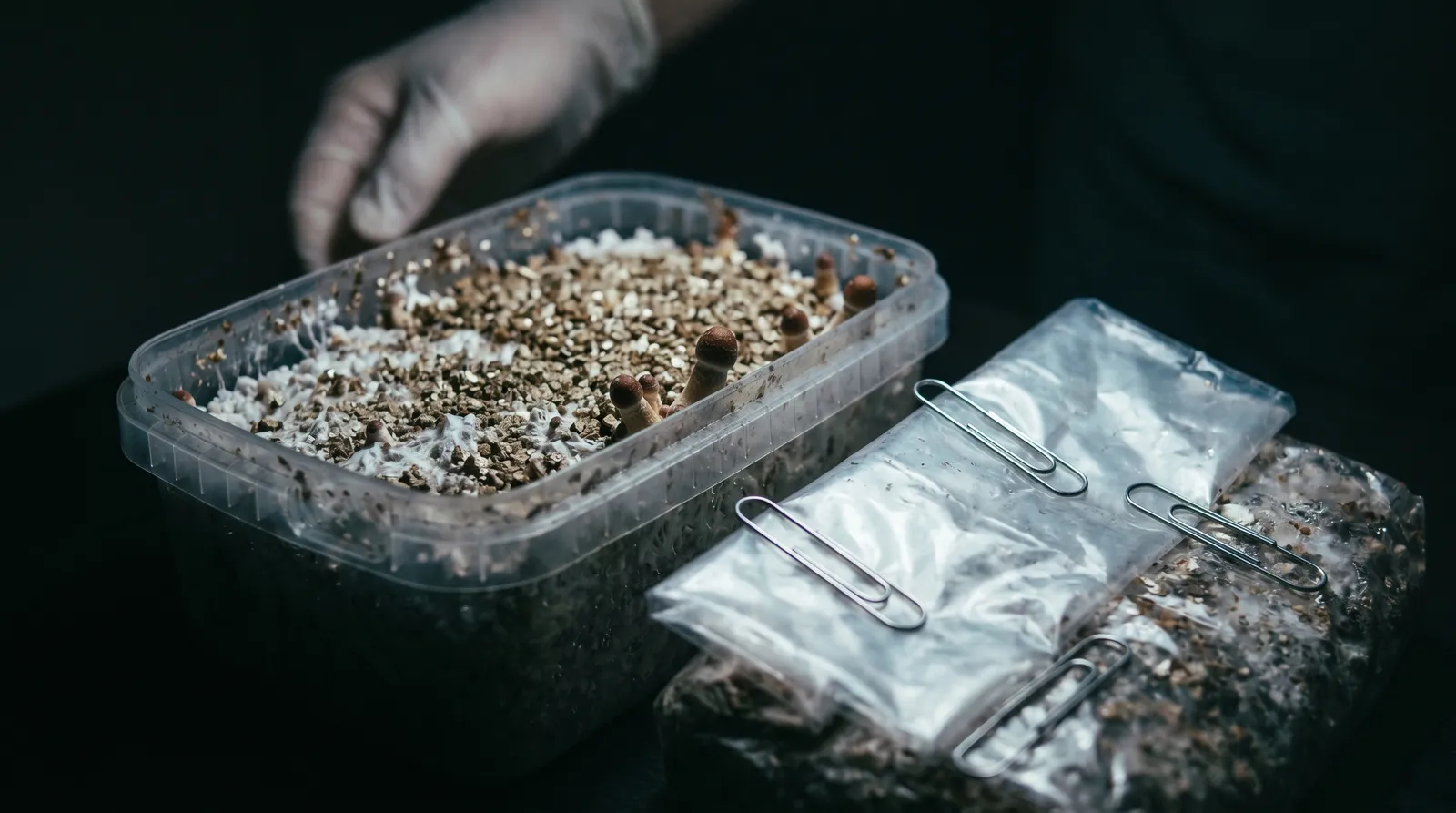
For the Grow Kit format (plastic tub with perlite/vermiculite casing): place the drained tub inside its grow bag, add about two tablespoons of fresh water to the bottom of the bag (not into the tub), and seal with the paperclips provided.
For the Ready-2-Grow Bag: the cold-shock step happens inside the sealed bag itself — follow the specific instructions on the product insert since the R2G format handles hydration differently.
Step 3 — Hold pinning conditions for 7–14 days
Pinning is where McKennaii earns its reputation for being fussy — tight environmental control is what separates a healthy flush from a failed one. Target conditions during pinning:
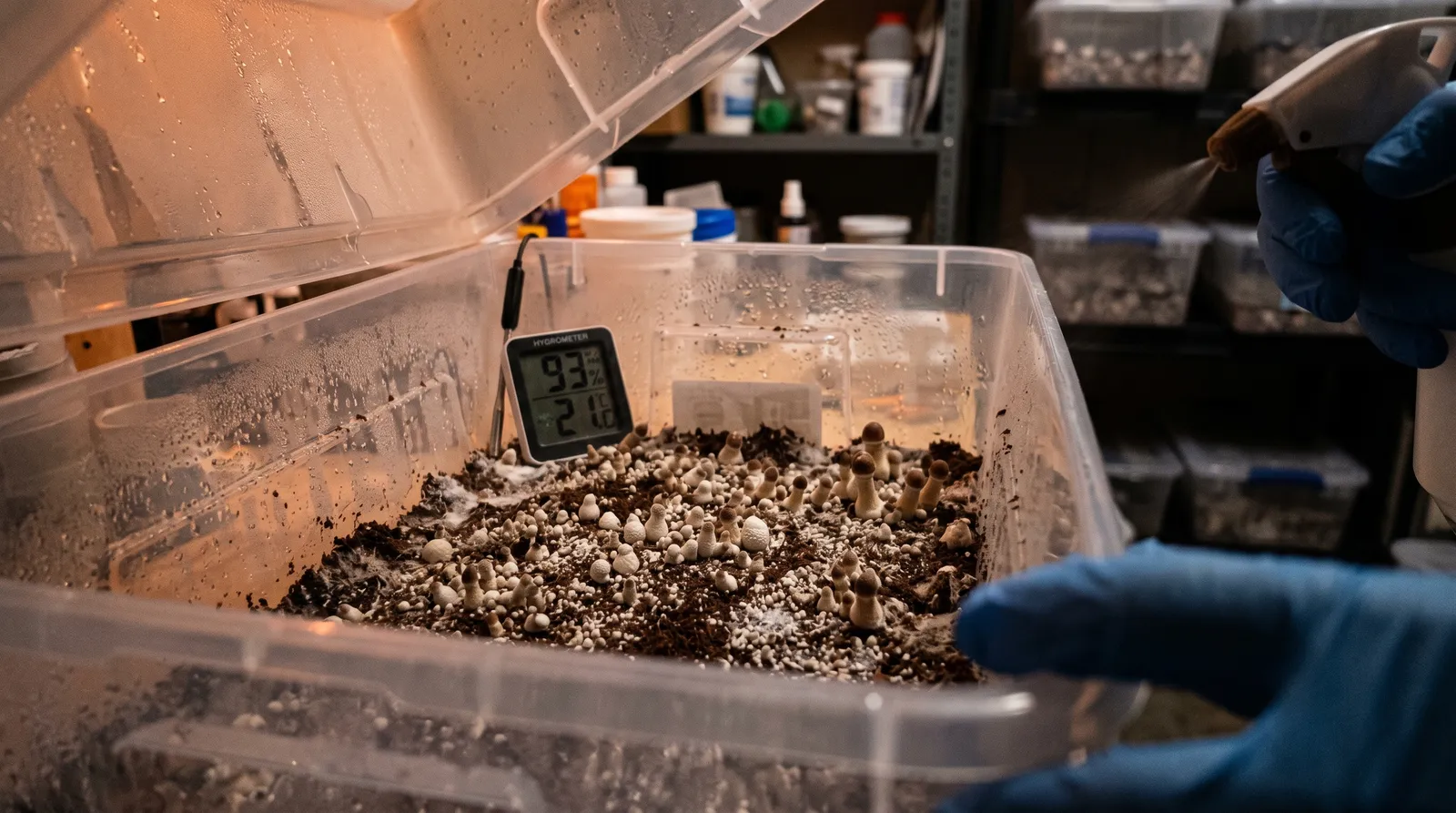
- Air temperature: 21–23°C. Above 24°C McKennaii will abort pins or fruit poorly. A simple digital thermometer-hygrometer on the shelf next to the kit is non-negotiable.
- Humidity: 90–95% RH inside the bag. The perlite layer plus two tablespoons of water handles this in the Grow Kit format.
- Light: Indirect daylight or a weak LED on a 12/12 timer. Not direct sun — fruiting is triggered by light signal, not intensity.
- Fresh air exchange (FAE): Open the bag and fan it twice a day for 10–15 seconds. Close and reseal.
Pins (tiny white bumps with darker tips) should appear within 7–14 days. If nothing happens by day 14, check temperature first — an overheated kit is the most common pinning failure. If temp is correct and mycelium still looks healthy, give it another week; McKennaii occasionally waits until day 18–20.
Step 4 — Fruiting and misting schedule
Once pins appear, the McKennaii grow guide shifts from pinning conditions to a fruiting routine, typically 5–7 days from pin to harvest. During this stage:
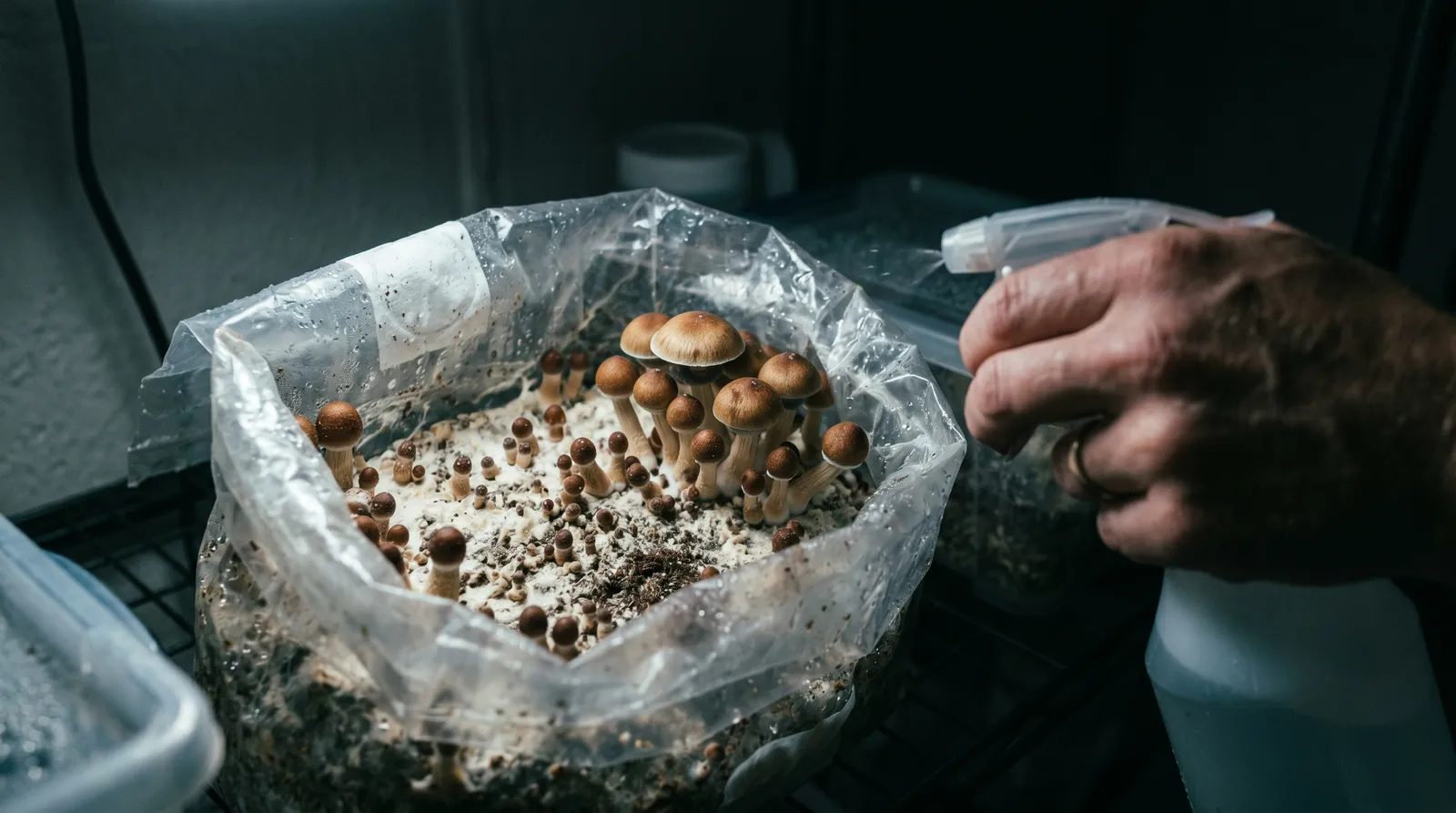
- Misting: Spray the inside walls of the grow bag (NOT the mushrooms themselves) with filtered or pre-boiled water twice a day. Direct misting of pins causes them to abort or develop brown bruising.
- FAE: Fan the bag for 15–20 seconds twice a day after misting. Under-ventilation during fruiting produces the classic "long stems, tiny caps" phenotype McKennaii is prone to.
- Temperature: Keep 21–23°C. Fluctuations above 25°C during fruiting cause cap cracking.
We won't pretend every McKennaii kit performs identically. Even in our own staff tests, first-flush dry weight has varied from 3g to 9g on kits bought in the same batch, same room, same protocol. Genetics drift, casing-layer moisture, and micro-temperature differences between shelves all contribute. Treat published yield ranges as ranges, not promises.
Step 5 — Harvest at veil break
The correct harvest moment for McKennaii is the day the veil under the cap starts to tear — not after, not "when they look ready." Specifically:
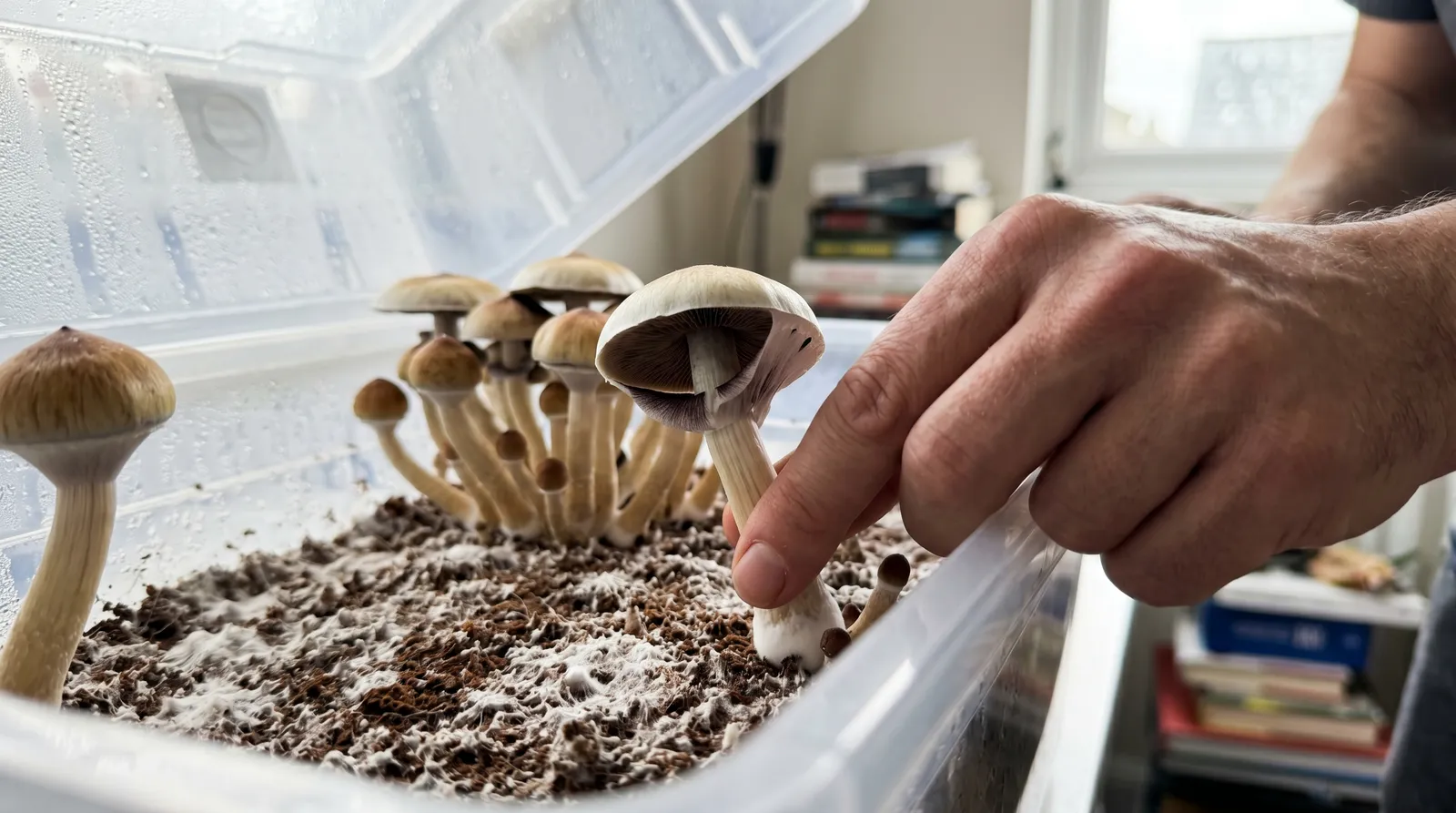
- Right time: The thin white veil connecting cap edge to stem is stretched and just beginning to tear. Caps are still slightly curled under at the edges.
- Too late: Veil fully torn, cap flat or upturned, gills dark purple-black and visibly dropping spores. Potency is still there, but the mushroom has spent energy on sporulation instead of biomass.
Harvesting technique: grip the stem base firmly between thumb and forefinger and twist gently until it releases from the casing layer. Don't pull straight up — you'll tear out substrate chunks and create holes for contaminants. Pick the entire flush in one session, including any tiny pins that haven't developed. Leftover pins rarely catch up and just rot on the next flush.
Expected yield: a standard 1200cc Grow Kit typically produces 30–80g wet on the first flush, which dries down to roughly 3–8g dried, depending on strain performance and conditions. The Ready-2-Grow Bag format is designed as one bag, one flush, and produces more per flush but doesn't reflush reliably.
Step 6 — Dunk and reflush (Grow Kit only)
Between flushes on a Grow Kit, repeat a shortened cold-shock cycle to rehydrate the substrate:
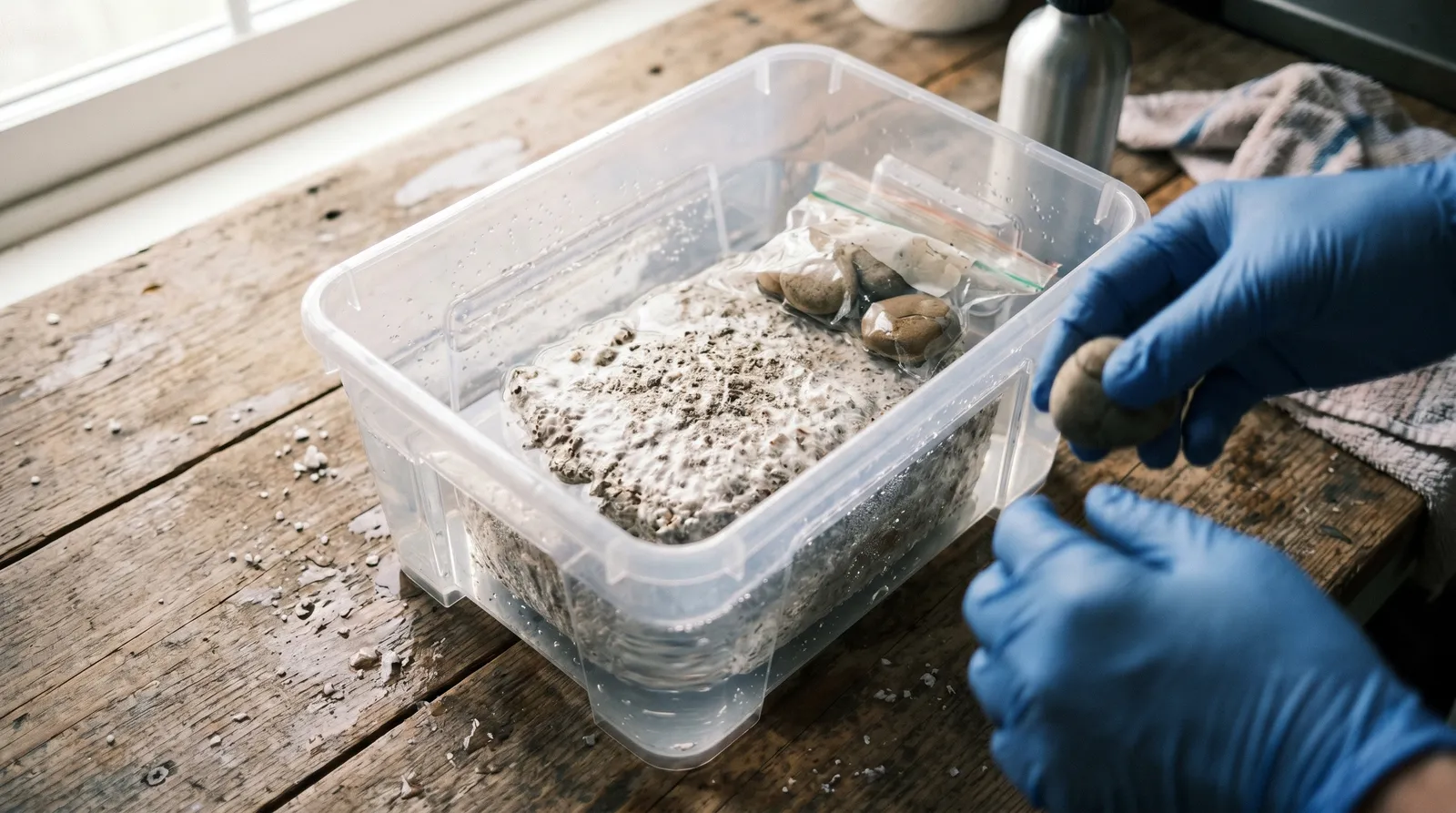
- Fill the tub with cold water again.
- Weight the substrate down (a clean ceramic plate works) to keep it submerged.
- Soak 12 hours in the fridge.
- Drain thoroughly — as before, no standing water.
- Return to the grow bag with fresh water in the bottom and resume the pinning/fruiting cycle.
Flush two typically arrives 10–14 days after the first harvest and yields 50–70% of the first flush. Flush three, if you get one, is usually small. Once you see green or pink patches — trichoderma or bacterial contamination — the run is over. Bag it, bin it, don't try to salvage.
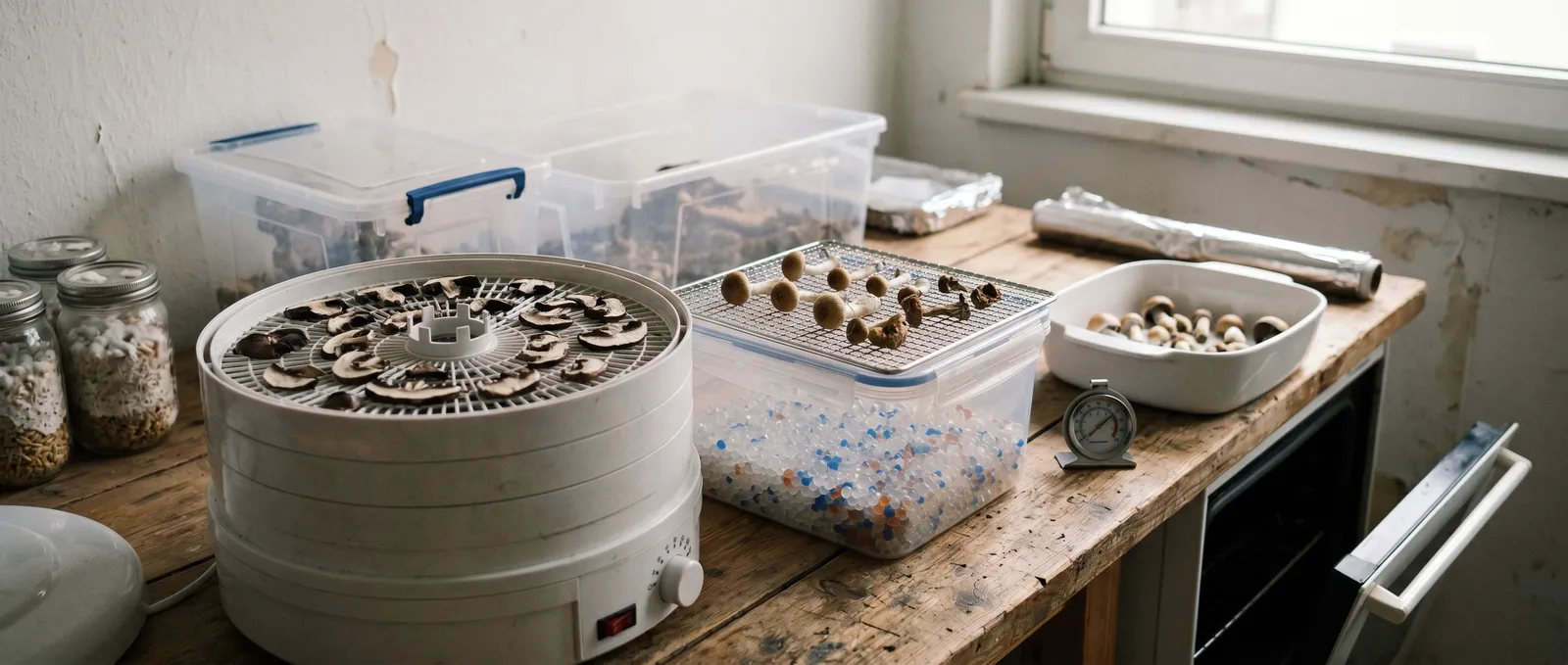
Step 7 — Dry to cracker-dry
Fresh mushrooms are roughly 90% water, and proper drying is what separates usable harvest from mould risk in storage (Bigwood & Beug, 1982, Journal of Ethnopharmacology).
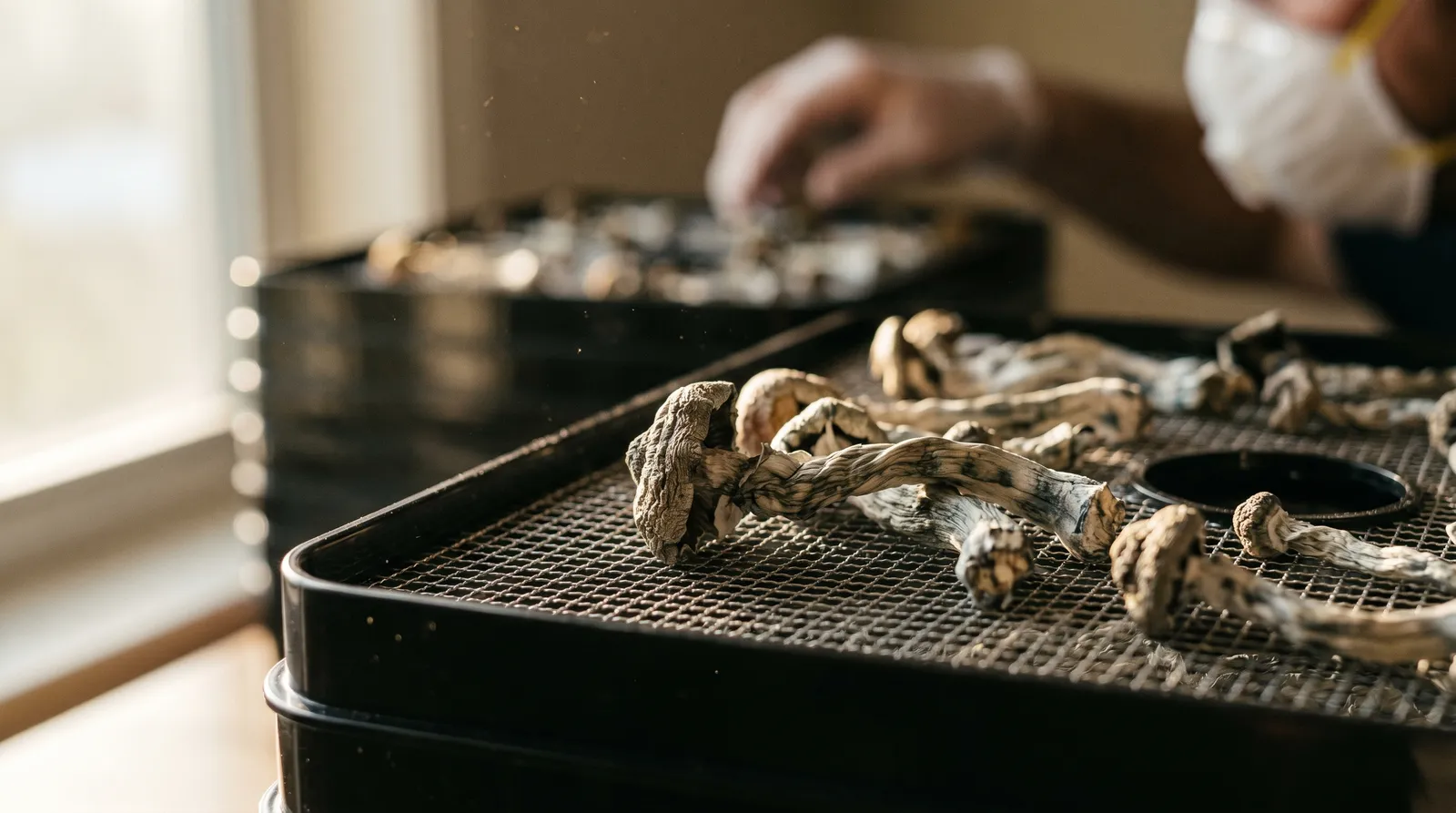
- Pre-dry: Lay mushrooms on a paper towel, out of direct sun, for 12–24 hours in a dry room (air-con or dehumidified). They'll become leathery but still bendy. This is not storage-ready.
- Final dry with desiccant: Place the pre-dried mushrooms on a wire rack inside a sealed container above a layer of silica gel or anhydrous calcium chloride. Leave 24–48 hours until mushrooms snap cleanly when bent (cracker-dry).
- Do not use: direct oven heat (degrades psilocybin above 50°C), microwave (uneven), or open-air drying in humid rooms.
Wear a dust mask during dry harvest and handling — mushroom spores and dried fragments are respiratory irritants, and some people develop sensitivity over repeated exposure.
Step 8 — Store airtight, dark, cool
Cracker-dry mushrooms keep well when kept away from their three enemies: moisture, light, and heat. Vacuum-sealed bags or airtight glass jars with a small silica sachet, kept in a dark cupboard at room temperature, retain potency for 6–12 months. Refrigeration extends that further; long-term freezer storage works if vacuum-sealed first (ice crystals damage fragile dried tissue if air is present).
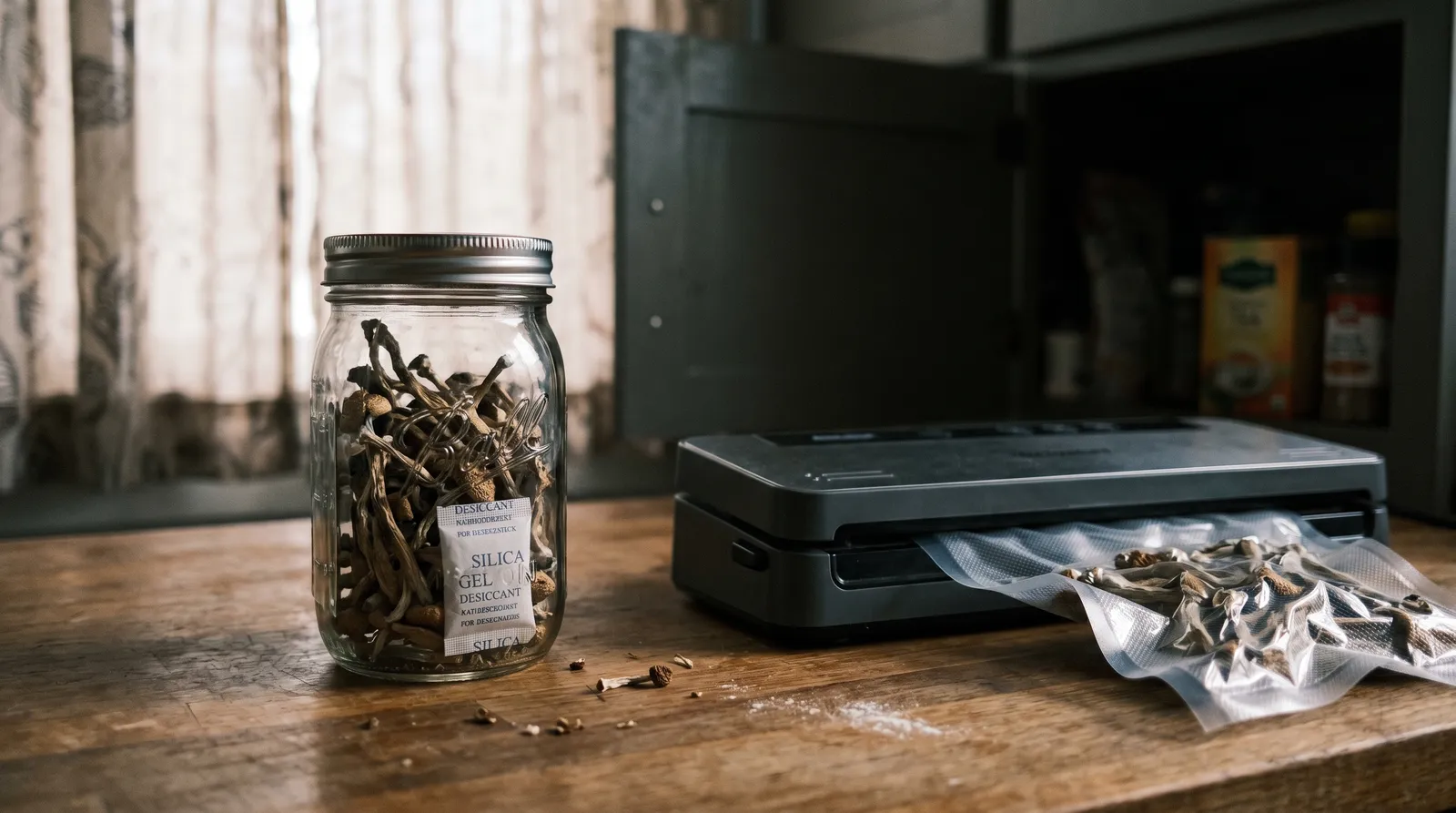
Stored dried mushrooms are visually indistinguishable from several edible species and some toxic ones — label the container clearly and store in a locked cupboard out of reach of children, pets, and houseguests who might mistake them for a snack.
Common mistakes that kill McKennaii flushes
Most failed McKennaii grows trace back to a small set of avoidable errors. The recurring offenders:
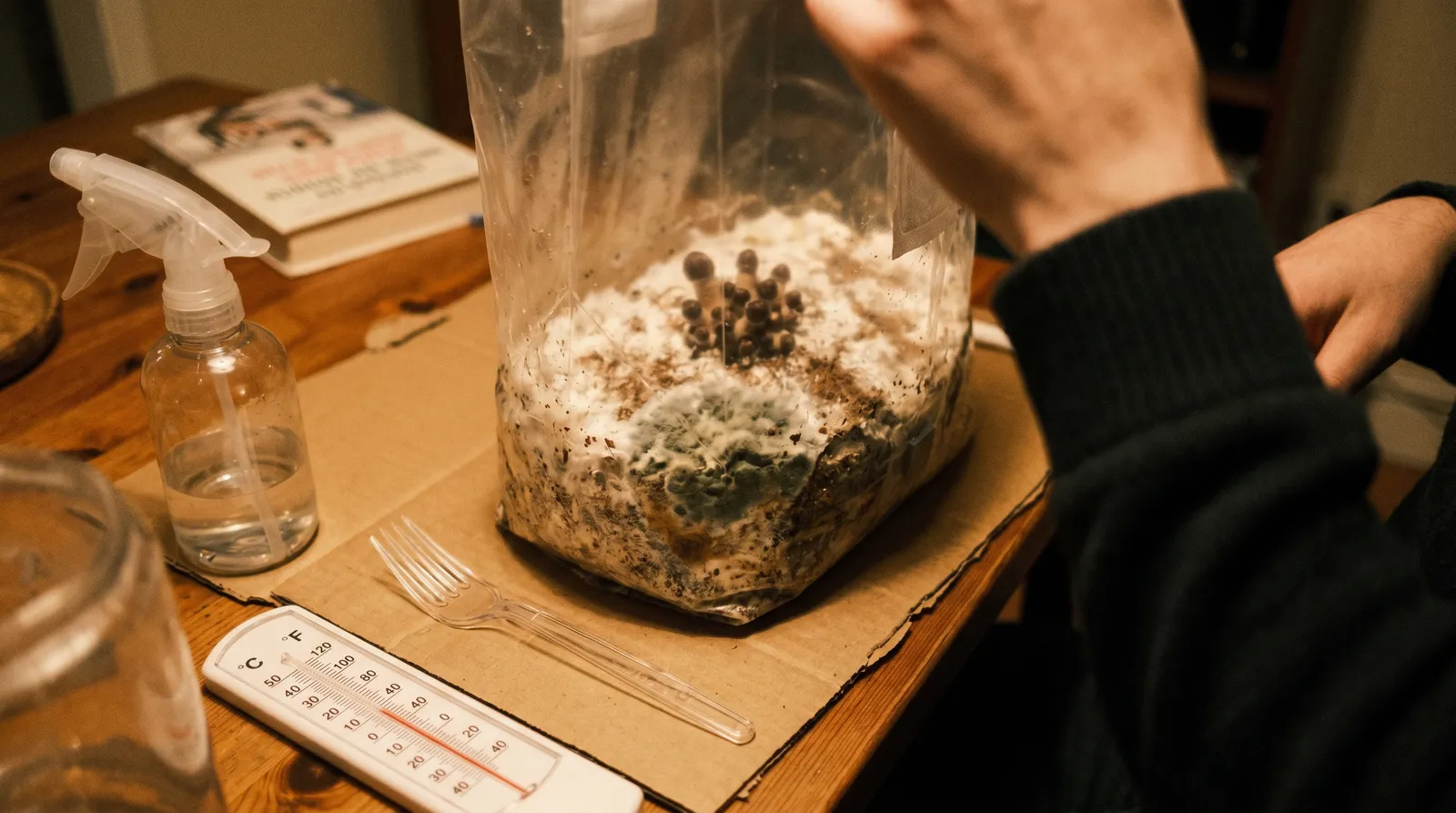
- Temperature above 24°C. The single biggest cause of pinning failure with this strain. A windowsill in summer is not a grow spot.
- Misting pins directly. Mist the bag walls, never the mushrooms.
- Skipping FAE. Leads to spindly stems and CO₂ suffocation.
- Harvesting too late. Spore drop onto adjacent pins contaminates future flushes.
- Reusing unsterilised tools. Between flushes, wipe anything touching the kit with 70% isopropyl alcohol.
- Salvaging contaminated kits. Green trichoderma or pink bacterial patches mean the whole substrate is compromised. No amount of spot-cleaning recovers it.
Consumption, dosing, and experience framing are covered on the psilocybin hub — this McKennaii grow guide stops at dried storage. Note briefly that psilocybin should not be combined with MAOIs, SSRIs, or lithium; the dedicated interactions article covers the specifics.
Azarius Mushroom Grow Kits
Growers who want to buy or order a McKennaii kit can get it in both Azarius cultivation formats — the Grow Kit (plastic-tub format with perlite/vermiculite casing layer, paperclips and grow bag included, designed for 2–3 flushes) and the Ready-2-Grow Bag (sealed 2kg all-in-one, one bag one flush, zero assembly). The Grow Kit suits growers who want to learn the dunk-and-reflush rhythm; the R2G bag suits first-timers who want the simplest possible path to harvest.
Educational content only. This McKennaii grow guide is not medical, professional or formal advice. Consult a qualified doctor before making decisions about psychoactive substances, and take responsibility for your own safety and choices.
Last updated: April 2026
Frequently Asked Questions
8 questionsWhy is my McKennaii kit not pinning after two weeks?
How many flushes can I expect from a McKennaii Grow Kit?
When exactly should I harvest McKennaii mushrooms?
What temperature does McKennaii need versus Golden Teacher?
Can I save a McKennaii kit with a small green patch?
How should I dry McKennaii mushrooms without losing potency?
Why are my McKennaii mushrooms growing tall and spindly with small caps?
Can I store a McKennaii grow kit in the fridge before starting?
About this article


Adam Parsons is an external cannabis and psychedelics writer and editor who contributes to Azarius's wiki as both author and reviewer. On the writing side, he authors Azarius's kratom and kanna clusters, drawing on exten
This wiki article was drafted with AI assistance and reviewed by Adam Parsons, External contributor. Editorial oversight by Joshua Askew.
Medical disclaimer. This content is for informational purposes only and does not constitute medical advice. Consult a qualified healthcare provider before use of any substance.
Last reviewed April 25, 2026
References (2)
- [1]Stamets, P. (1996). Psilocybin Mushrooms of the World: An Identification Guide. Ten Speed Press, Berkeley, CA. Source
- [2]Gotvaldová, K., Hájková, K., Borovička, J., Jurok, R., Cihlářová, P., & Kuchař, M. (2021). Stability of psilocybin and its four analogs in the biomass of the psychotropic mushroom Psilocybe cubensis. Drug Testing and Analysis, 13(2), 439-446. DOI: 10.1002/dta.2950
Related Articles
Cannabis Hermaphrodite: Identify, Prevent, Act
A cannabis hermaphrodite is a female plant that develops male pollen sacs or banana-shaped anthers (nanners), self-pollinating and seeding your harvest.
DIY Cannabis Fertilizer: Homemade Nutrient Guide
DIY cannabis fertilizer guide: compost, teas, banana ferments and feed schedules, with safety notes and cited research for home growers.
What To Do With Male Cannabis Plants: 6 Practical Uses
What to do with male cannabis plants: identify, isolate, breed, extract, or compost. A practical 6-step guide with sourcing and safety notes.
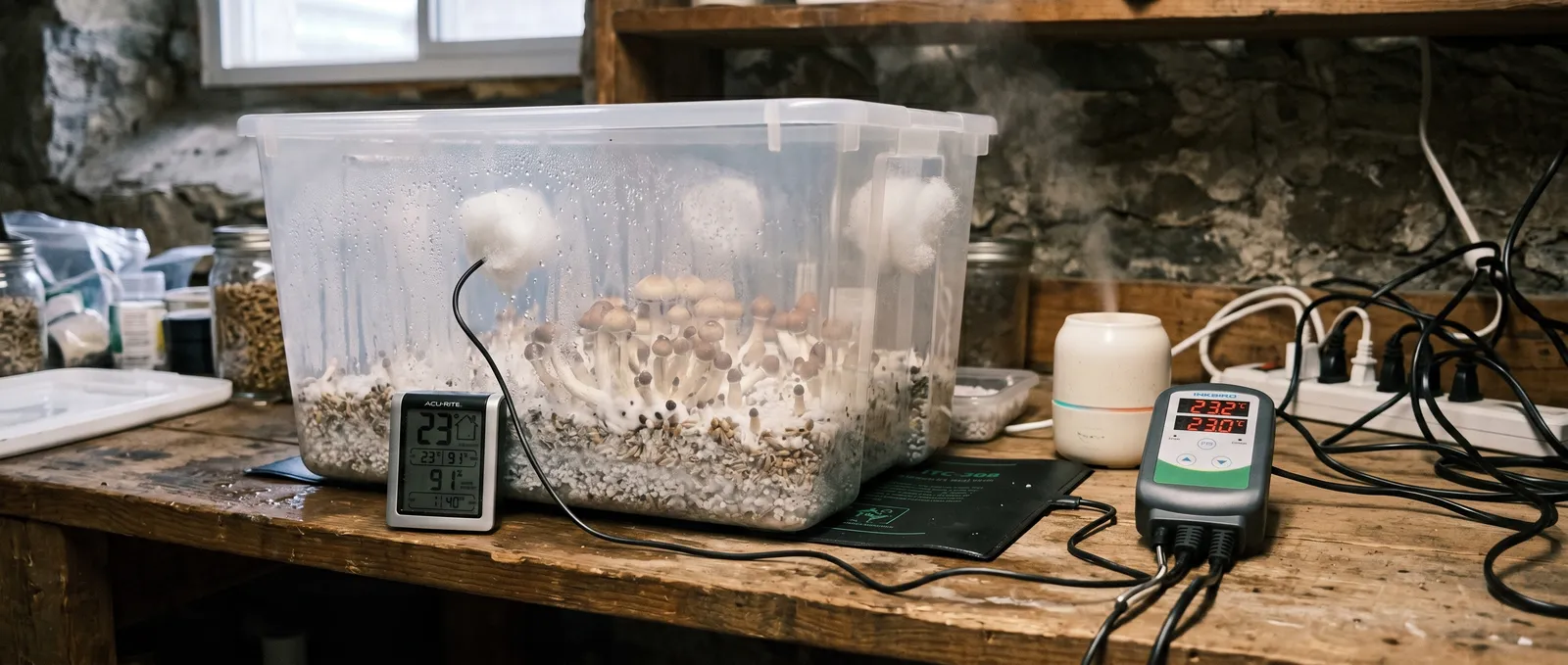
Mushroom Grow Kit Temperature & Humidity: Full Setup Guide
A temperature humidity control grow kit is the small set of climate tools — hygrometer, heat mat, humidifier or perlite tray — that keeps a mushroom fruiting…
When to Harvest Mushrooms: Veil Break Timing Explained
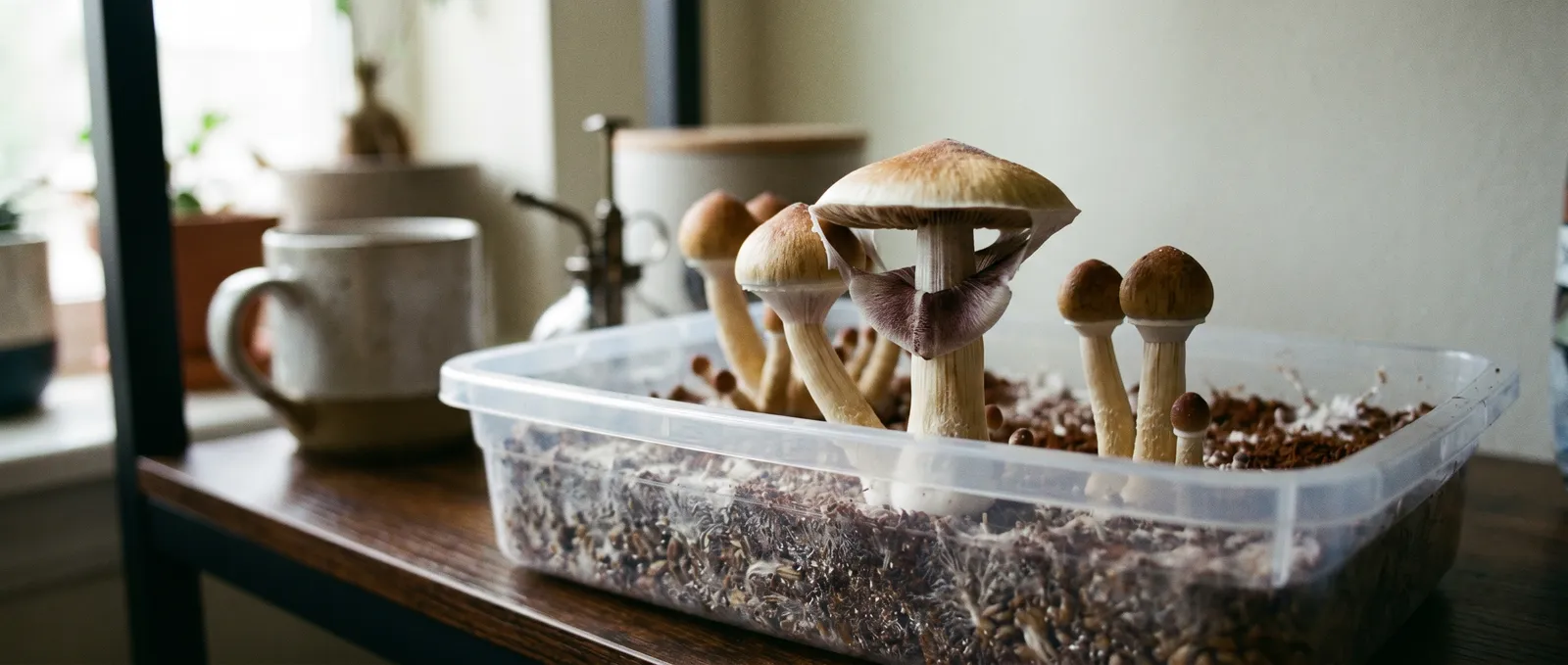
Harvest timing veil break is a cultivation technique that uses the tearing of the partial veil on maturing Psilocybe cubensis to mark peak alkaloid content.
First Grow Checklist: What You Need for Mushroom Kits
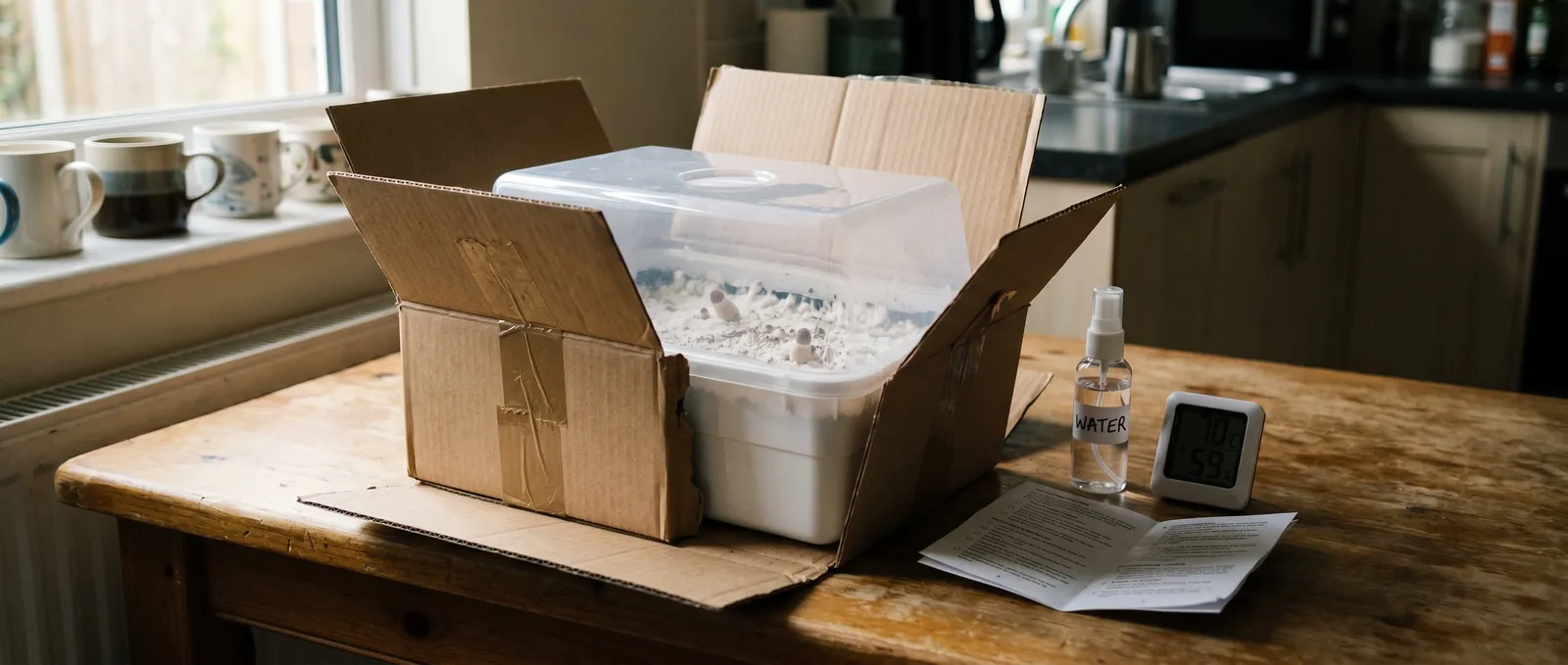
A first grow checklist is the short list of supplies and environmental conditions needed to run a home psilocybin mushroom kit from inoculated substrate to…
Sclerotia vs Fruit Bodies: Cultivation Comparison
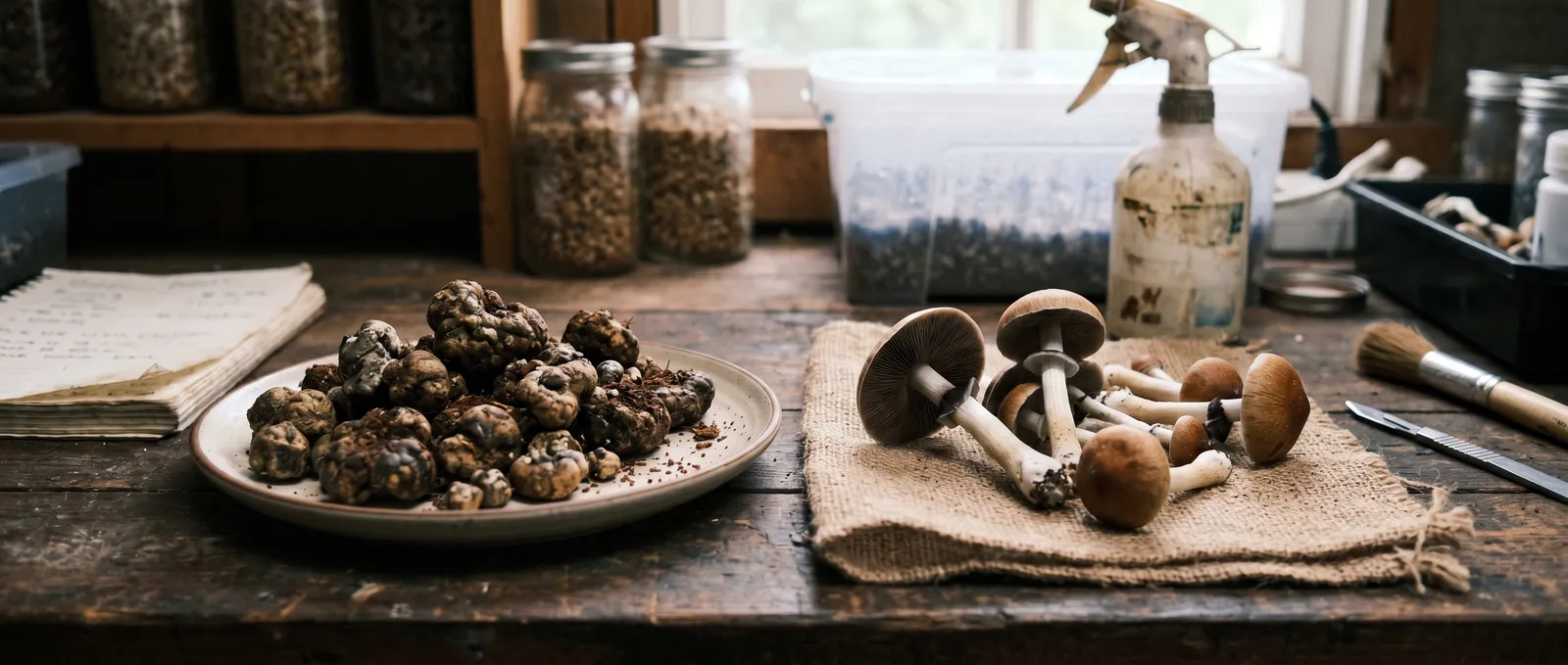
Sclerotia and fruit bodies are two different life stages of Psilocybe fungi: sclerotia are hardened underground mycelial storage bodies (the 'magic…
Storing Dried Mushrooms Long Term: Full Guide
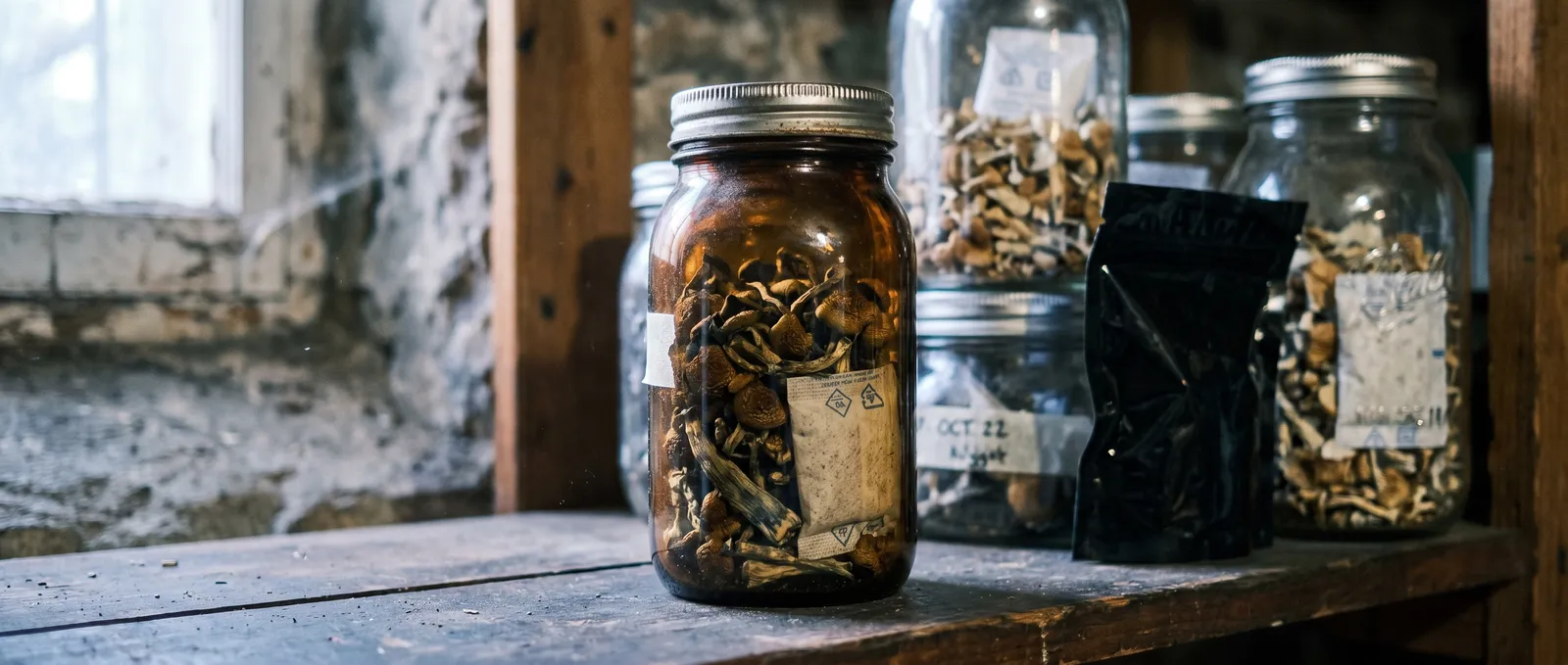
Storing dried mushrooms long term means keeping well-dried Psilocybe fruit bodies in airtight, opaque containers with desiccant, cool and dark, to slow…
Drying Mushrooms Air Desiccant Oven: Methods Compared
Drying mushrooms air desiccant oven refers to the three home methods for reducing fresh fruit bodies from ~90% water to cracker-dry (<5%). Gotvaldová et al.