
This article discusses psychoactive substances intended for adults (18+). If you have a health condition or take medication, consult a doctor before use. Our age policy
B+ Grow Guide: Step-by-Step Cubensis Cultivation
Definition
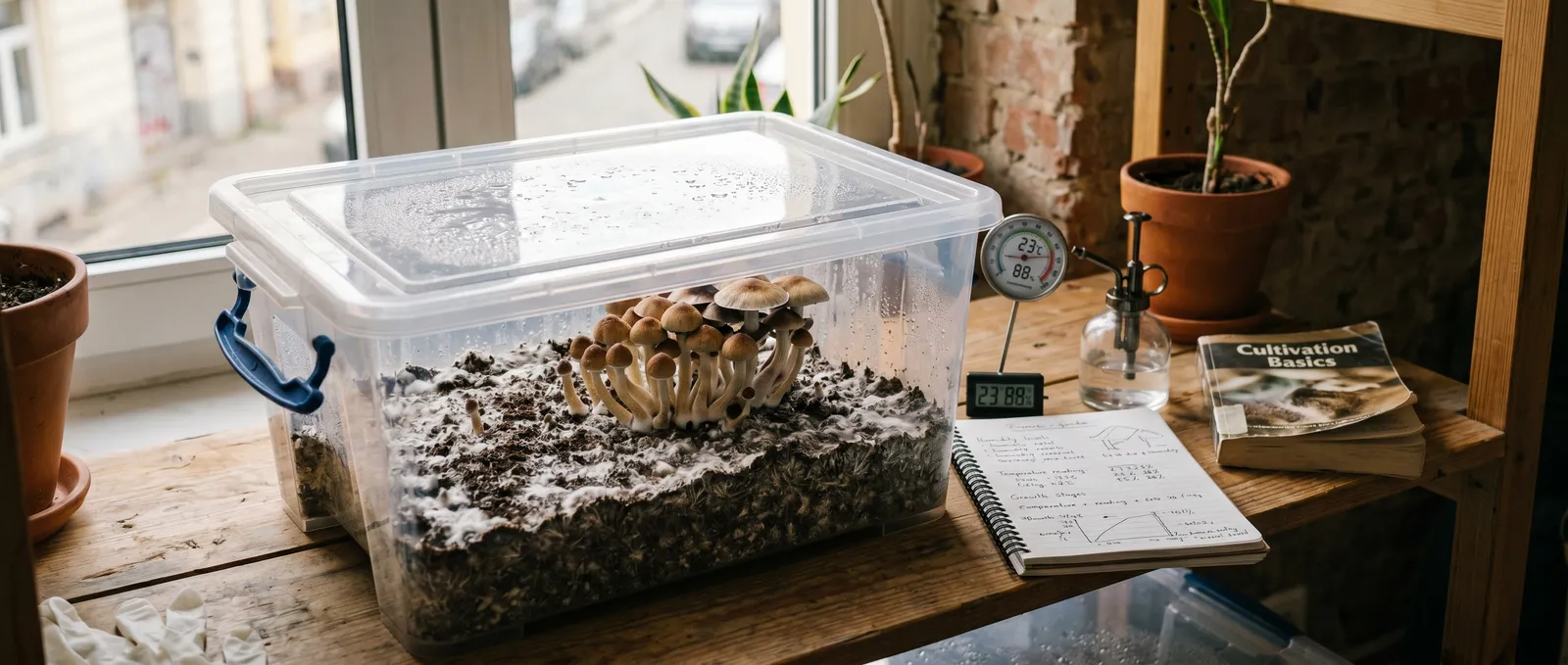
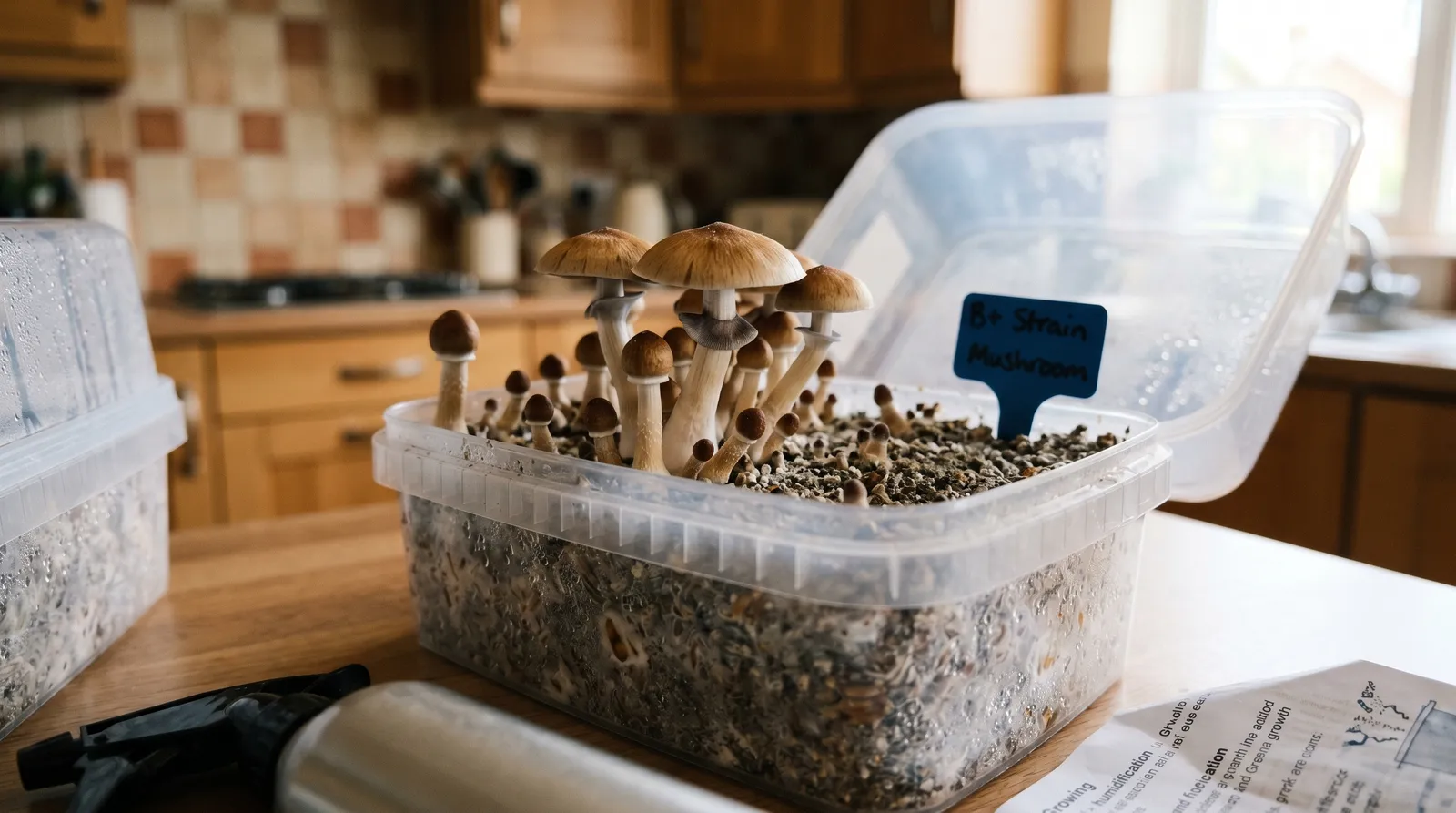
B+ (Be Positive) is a forgiving Psilocybe cubensis strain ideal for first-time growers, tolerating temperature swings that stall fussier varieties. Tsujikawa et al. (2003) measured cubensis psilocybin content at 0.37–1.30% dry weight, with B+ sitting mid-range — average potency paired with generous, reliable yields across multiple flushes.
Adult use only — this guide is written for adults aged 18 and over. Psilocybin cultivation rules vary dramatically by country and region and change frequently. This guide is educational and informational only. Azarius does not provide formal advice; readers are responsible for understanding the rules in their own jurisdiction before they buy a kit or begin growing.
The B Plus grow guide is a step-by-step cultivation walkthrough that helps first-time growers produce reliable flushes of Psilocybe cubensis B+ at home. The B+ strain (often written "B Plus" or "Be Positive") is one of the most forgiving cubensis varieties a beginner can work with. It tolerates temperature swings that would stall a fussier strain, throws out chunky caramel-coloured caps, and fruits reliably across multiple flushes. This B Plus grow guide walks through the specific numbers — temperature, humidity, fresh air exchange, timing — that separate a healthy cupboard-grown flush from a contaminated mess.
B+ is widely attributed to mycologist Mr. G in the late 1990s and has since become one of the most-sold cubensis strains in Europe, largely because it handles beginner mistakes that kill other strains (Stamets, 1996; Shroomery strain archive, 2021). Expect first pins 10–14 days after sealing a colonised cake, and 2–4 flushes spaced roughly a week apart.
What makes B+ different from other cubensis strains
B+ is the strain that forgives beginner errors. Where McKennaii sulks if the room dips below 21 °C and Treasure Coast throws wispy pins if humidity drops for a day, B+ keeps fruiting through minor neglect. The caps run large — 5 to 7 cm across on healthy specimens — with a pale-to-caramel colour that darkens at the veil.
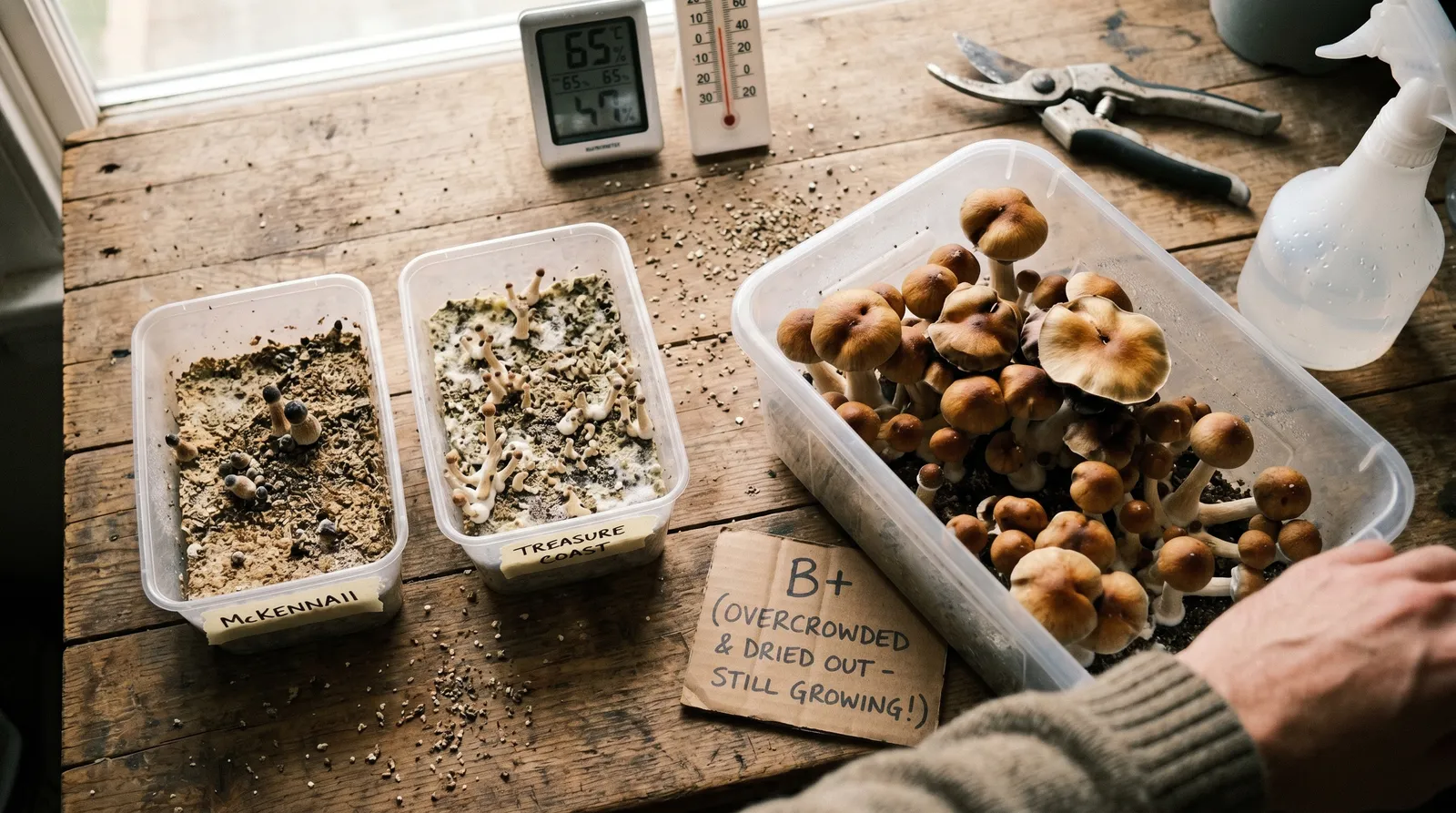
Alkaloid content sits in the middle of the cubensis range. Tsujikawa et al. (2003) measured psilocybin across multiple cubensis strains at 0.37–1.30% dry weight, with B+ landing around the middle of that band. That's meaningful: B+ is not a "weak" strain, despite the reputation. It's an average-potency strain whose generous yield and tolerant growth pattern make it ideal for learning the craft before moving on to more demanding varieties.
Step 1: Prepare your growing space
Pick a spot that stays between 22 and 24 °C day and night before you open the kit. A bedroom cupboard, a shelf in a spare room, or the top of a wardrobe all work — anywhere out of direct sunlight, away from radiators, and away from draughts from a window or door.
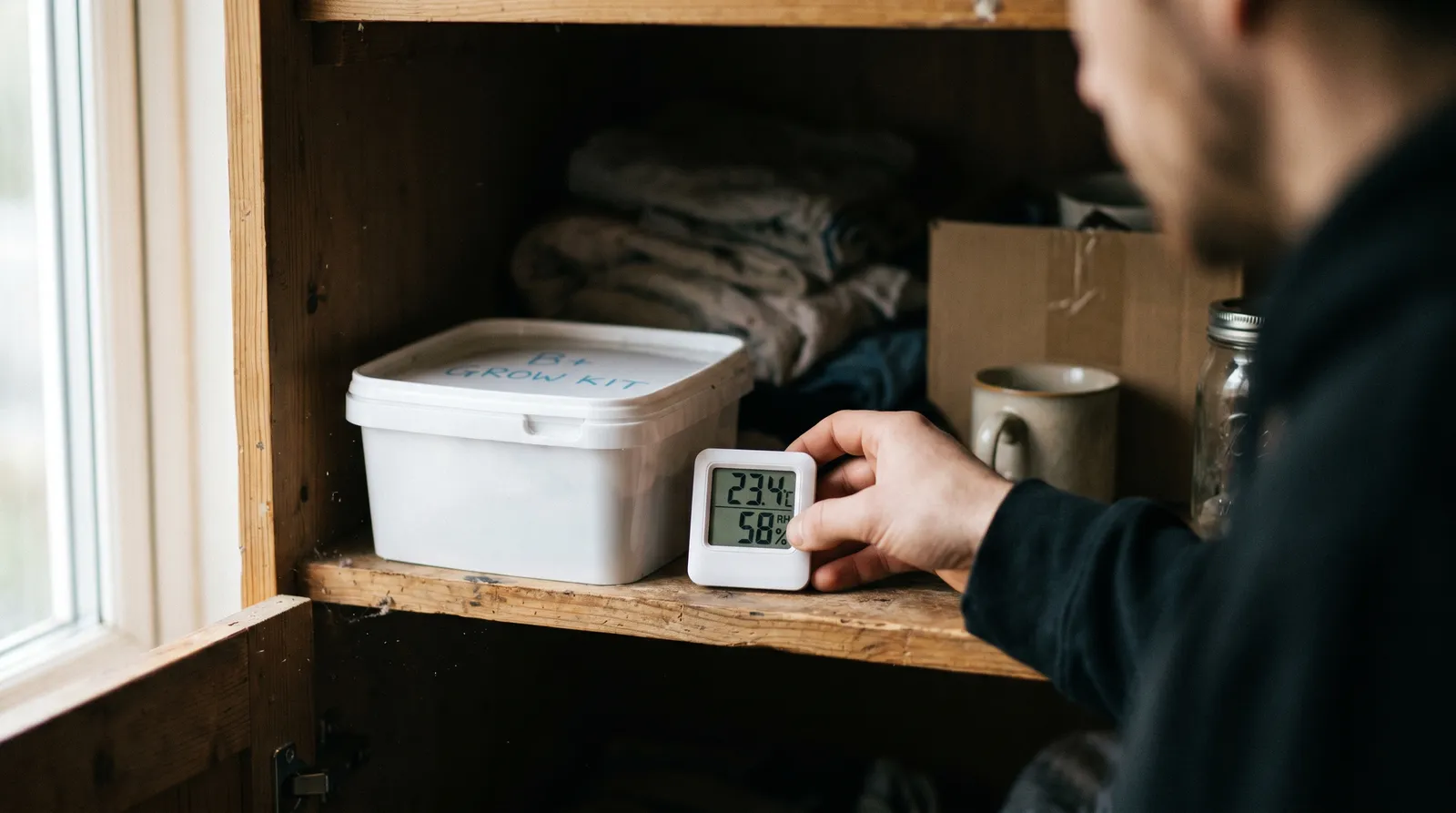
Surface prep: wipe the chosen surface with 70% isopropyl alcohol or a diluted bleach solution (10%). Spores and mould are everywhere in a normal home — the goal isn't a clinical cleanroom, it's reducing the bioload enough that B+ mycelium, which is already established in the kit, outpaces any invader that lands on the casing layer.
What you need on hand before you get started:
- Spray bottle with clean tap water (not distilled — the trace minerals help)
- Nitrile or latex gloves
- 70% isopropyl alcohol
- Paperclips (included with Grow Kit format)
- A thermometer/hygrometer — the cheap ones from any hardware shop are fine
Step 2: Cold-shock and seal the kit
A cold shock jumpstarts fruiting by mimicking autumn. Fill the grow bag's base with 200–300 ml of cold tap water, place the opened kit inside with the lid loose, and put the whole setup in the fridge for 12 hours. This simulates the autumn temperature drop that cubensis evolved to treat as a fruiting signal.
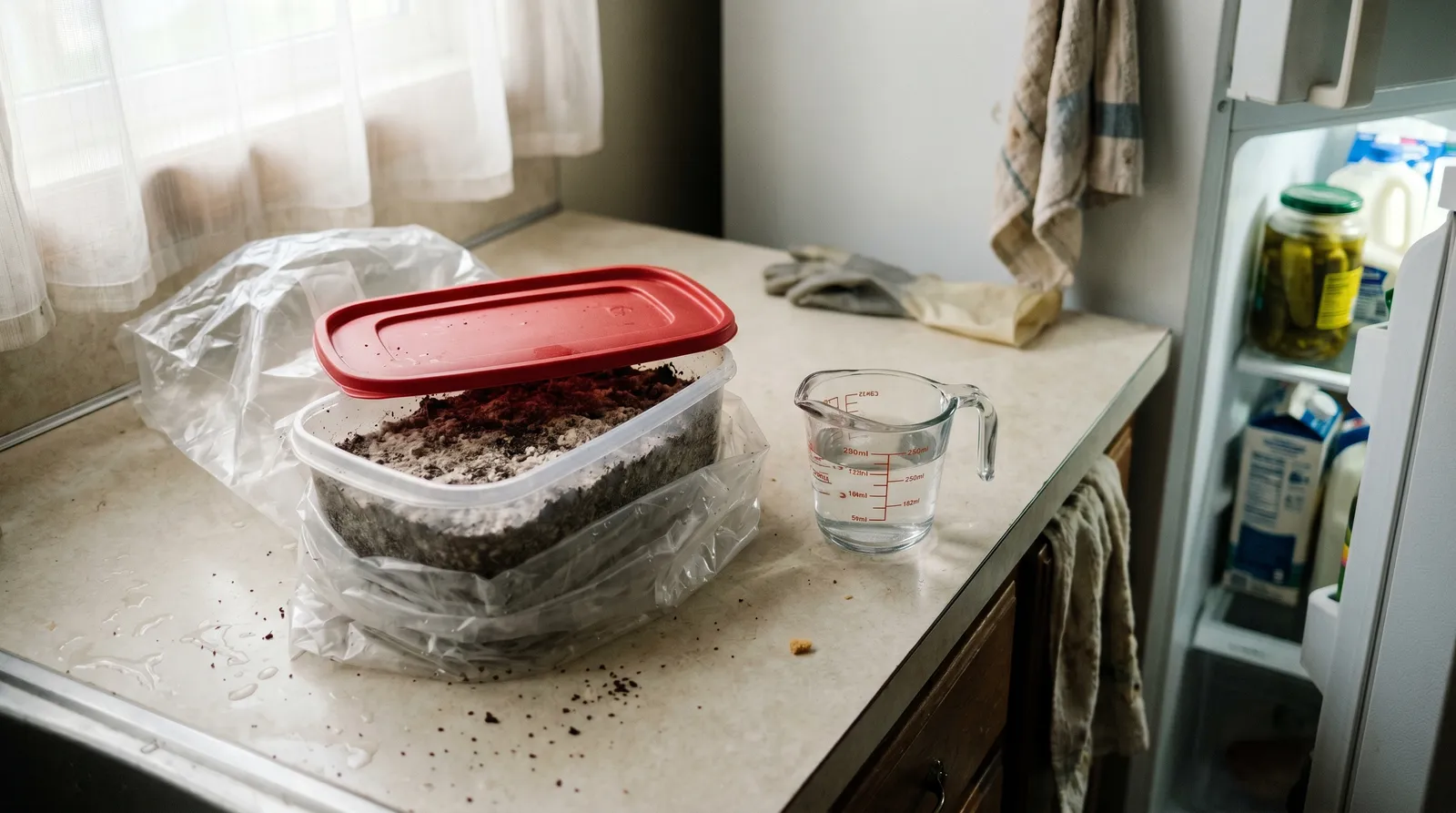
After 12 hours, pour out excess water, put the lid back on the cake, slide the kit into the plastic grow bag, and seal the top with two paperclips — leaving a small gap for gas exchange. Don't heat-seal, zip-tight, or otherwise fully close the bag. Mycelium needs oxygen in and CO₂ out.
Step 3: Hold temperature and humidity in the right band
The target numbers across the full grow are tight but achievable in any normal room:
| Phase | Temperature | Humidity | FAE (fresh air exchange) |
|---|---|---|---|
| Pinning (days 1–10) | 22–24 °C | 95–100% | 1× daily, flap the bag |
| Fruiting (days 10–18) | 22–24 °C | 90–95% | 2× daily, flap the bag |
| Between flushes | 22–24 °C | 90% | 1× daily |
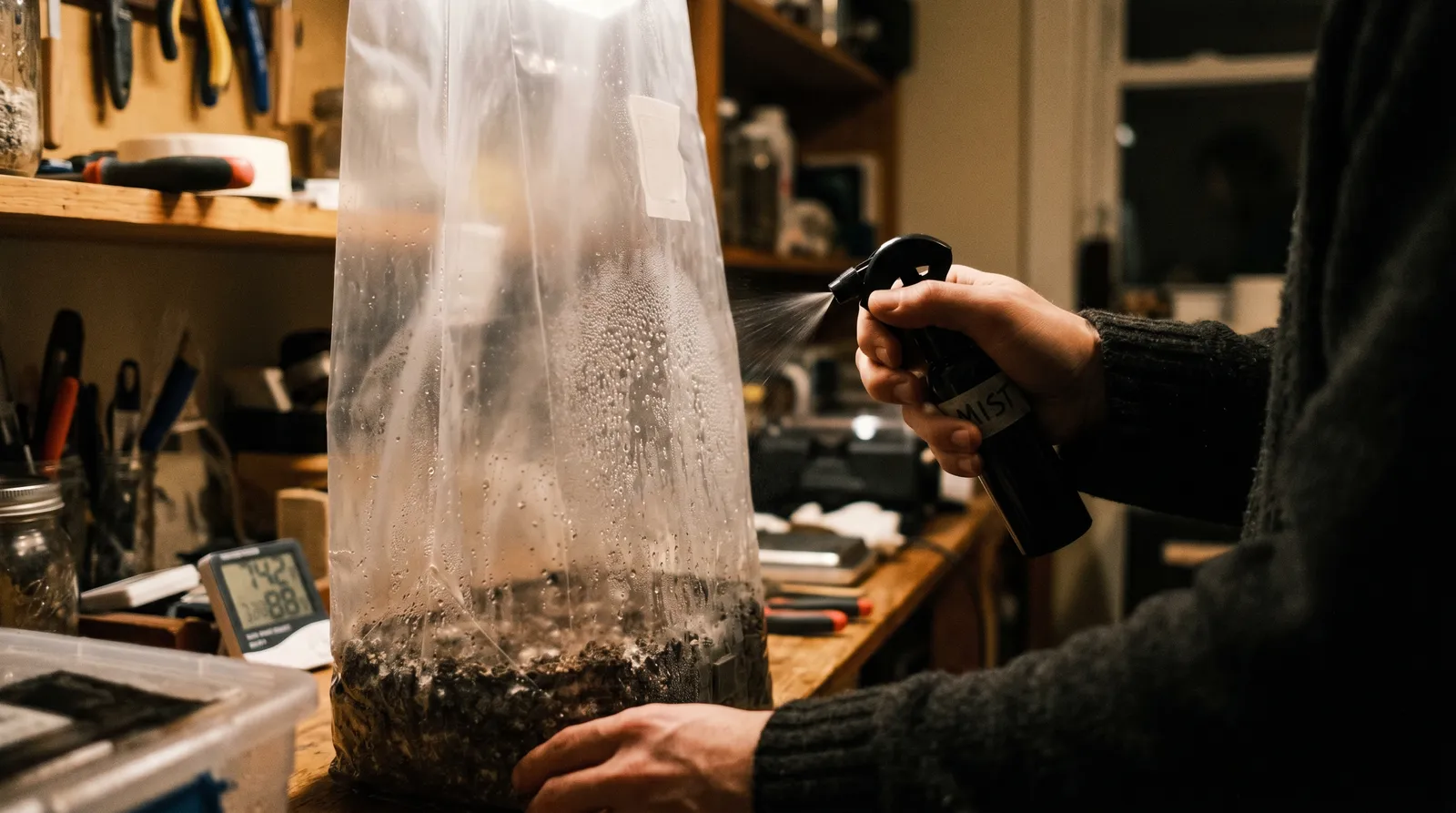
Mist the inside walls of the bag — never the cake itself — with a fine spray twice a day. The droplets should land on the plastic and run down; direct spraying of the casing layer drowns pinheads and invites bacterial rot. "Flapping" means opening the bag, waving it a few times to swap the CO₂-rich air inside for room air, and resealing with paperclips.
Temperatures below 20 °C slow mycelium to a crawl. Above 28 °C, you invite Trichoderma. If your room drifts cool in winter, a heat mat with a thermostat set to 23 °C solves it — but most European living rooms sit comfortably in the right band year-round.
Step 4: Recognise pinning and manage the first flush
Pinheads — tiny white dots that develop into dark brown tips — usually appear 7–14 days after sealing. Once pins show, resist the urge to intervene. Don't move the kit, don't change your misting schedule, don't open the bag more than the twice-daily flap.
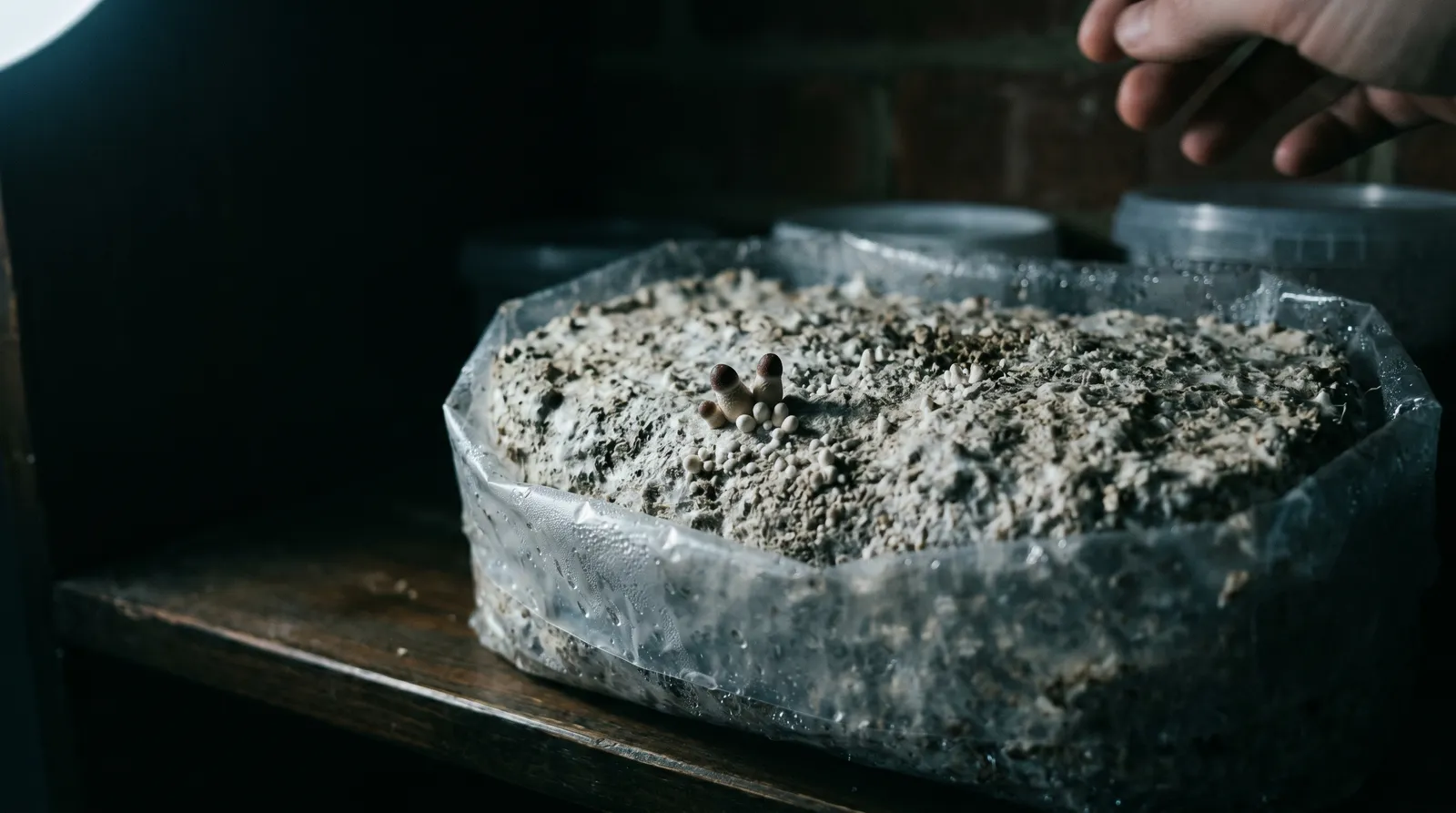
Pins grow into mature fruits over 5–7 days. Harvest the moment the veil under the cap tears — before the cap flattens and drops spores. Spore drop isn't dangerous, but it stains the casing purple-black and reduces the yield of the next flush.
To harvest: twist the fruit gently at the base while holding the casing layer steady. Pull — don't cut. Leaving stem fragments in the casing invites bacterial rot. Wash your hands and put on fresh gloves before each harvest session.
First-flush weight from a standard B+ Grow Kit typically lands around 30–60 grams wet, which reduces to roughly 3–6 grams dry (cubensis loses ~90% of its wet weight during drying, per Bigwood & Beug, 1982).
Step 5: Dunk, roll, and re-flush
Trigger a second flush by rehydrating the cake after the first harvest. After the first flush, the cake has given up water and nutrients. To order a second flush from the substrate:
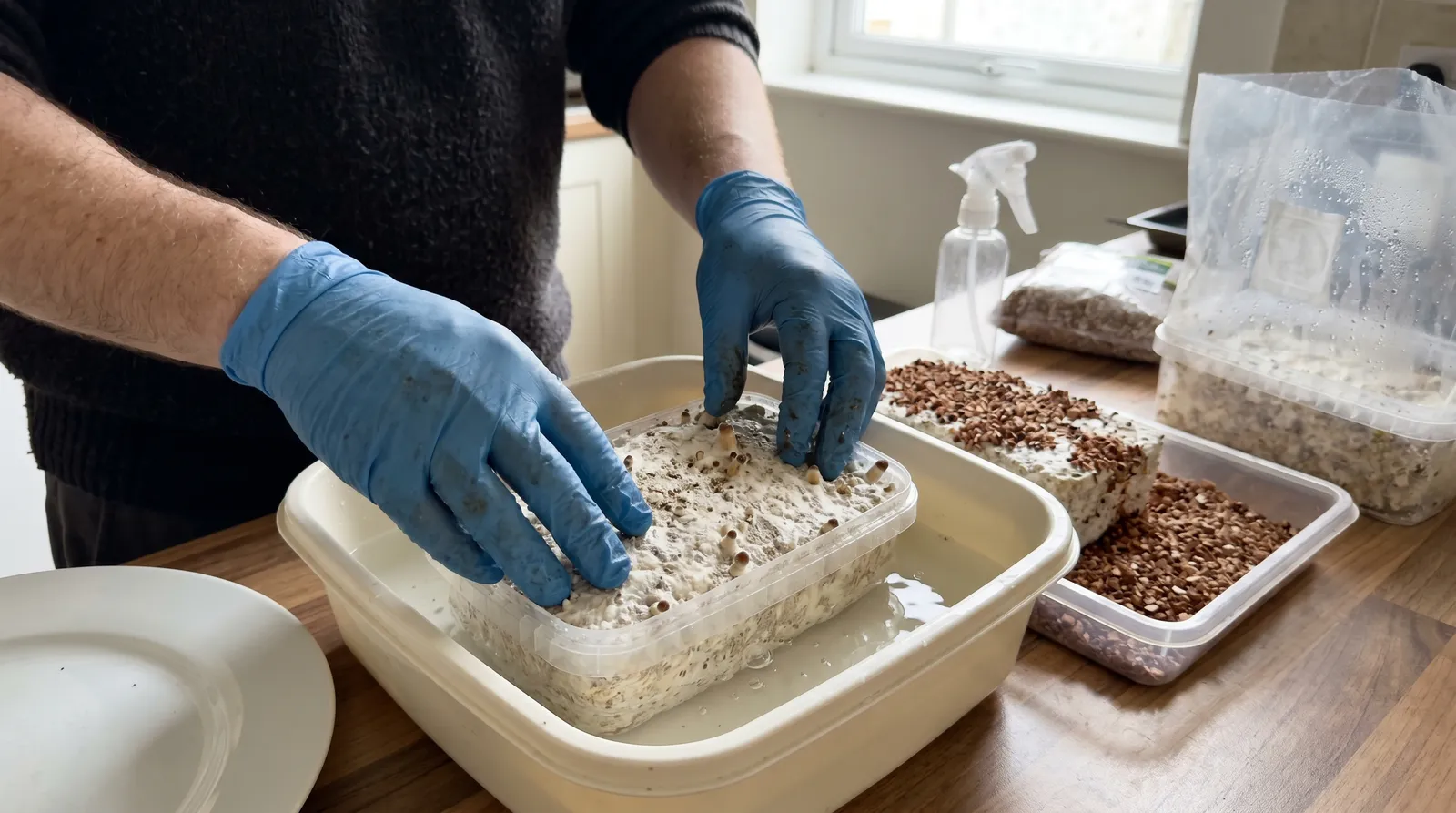
- Remove the cake from the kit tub.
- Fill the tub with cold tap water.
- Submerge the cake. It will float — weigh it down with a clean plate or small plastic bag filled with water.
- Leave in the fridge or a cold spot for 12 hours.
- Drain, return the cake to the tub, re-seal the bag with paperclips.
Pins usually reappear 7–10 days later. B+ reliably gives 2–4 flushes; yields drop with each cycle. By the fourth flush, you're typically looking at half the dry weight of the first.
Step 6: Dry the harvest properly
Fresh mushrooms are 90% water, so proper drying is essential. Drying matters for both storage stability and accurate dose-by-weight — wet and dry grams are not interchangeable.
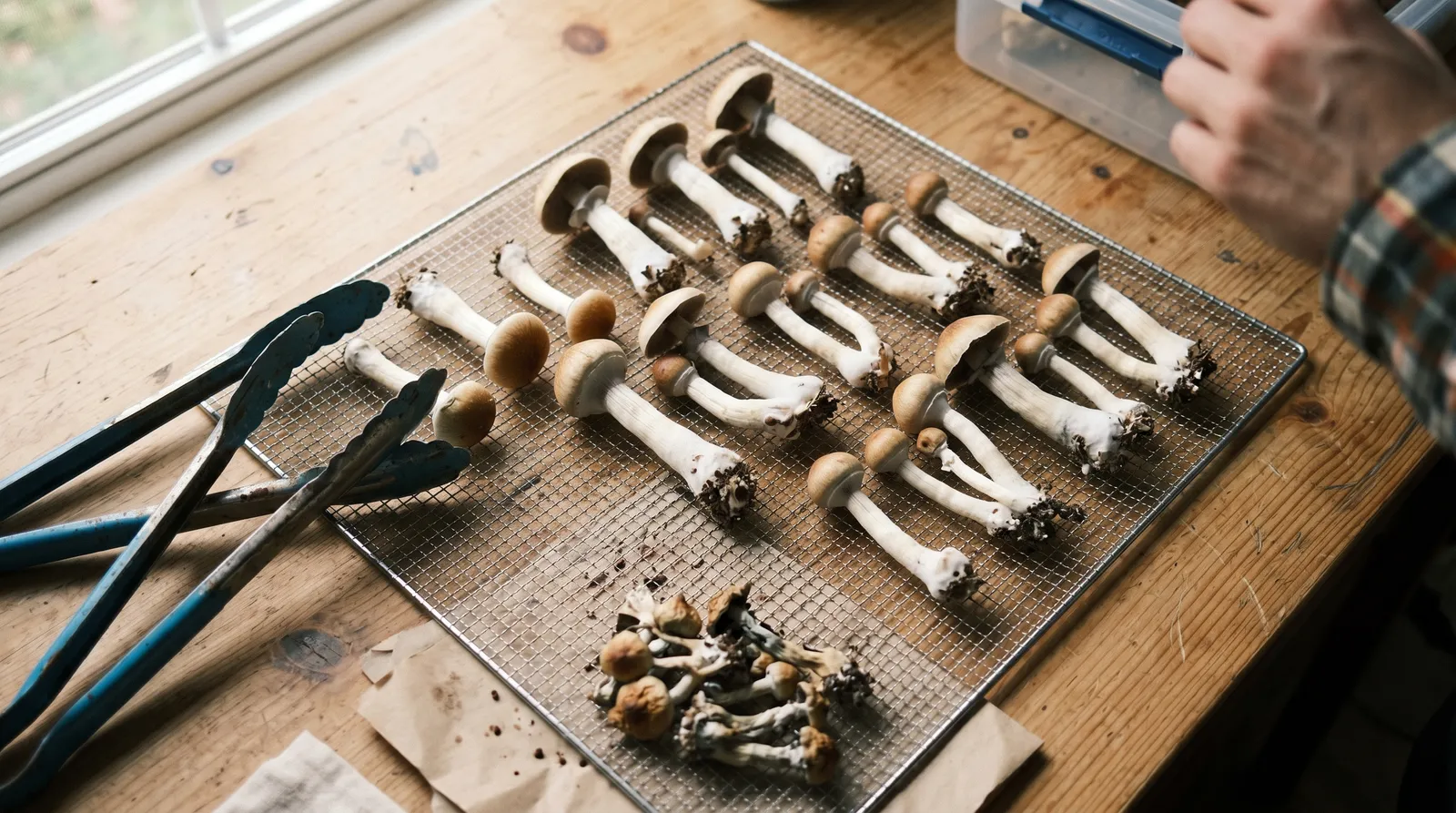
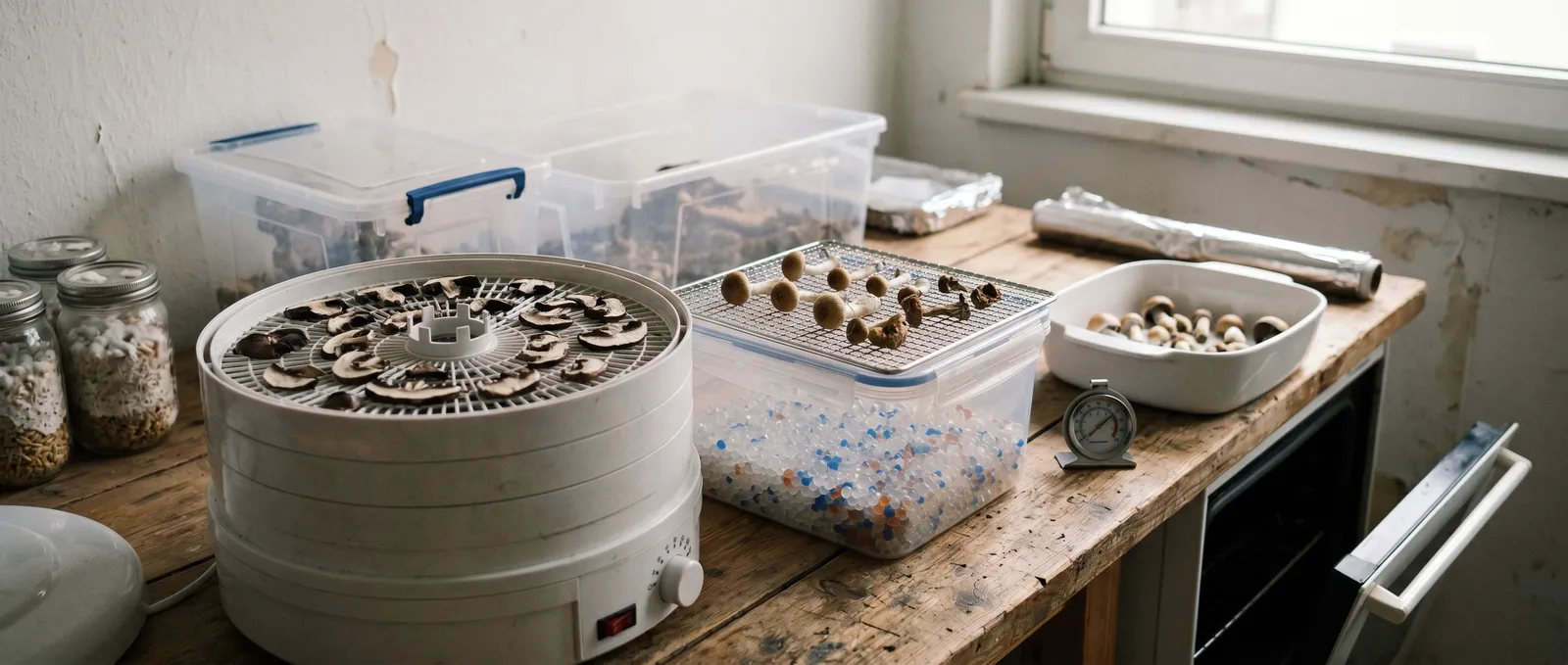
Stage one: air-dry on kitchen paper or a clean rack for 24 hours until the mushrooms are leathery. Stage two (the important one): place the leathery mushrooms in a sealed container alongside a food-safe desiccant (silica gel packets or anhydrous calcium chloride) for 24–48 hours until they snap cleanly rather than bend. Cracker-dry is the target.
Do not use an oven, hairdryer, or radiator. Heat above 50 °C degrades psilocybin measurably, and uneven drying traps moisture that grows mould in storage. Cracker-dry mushrooms in an airtight jar with fresh desiccant, kept in a cool dark cupboard, retain potency for 6–12 months based on cubensis stability data (Gartz, 1996) — though degradation rates vary with storage conditions.
Common problems and what to do
Most B+ failures fall into a handful of recognisable categories. Here's how to identify and respond to each:
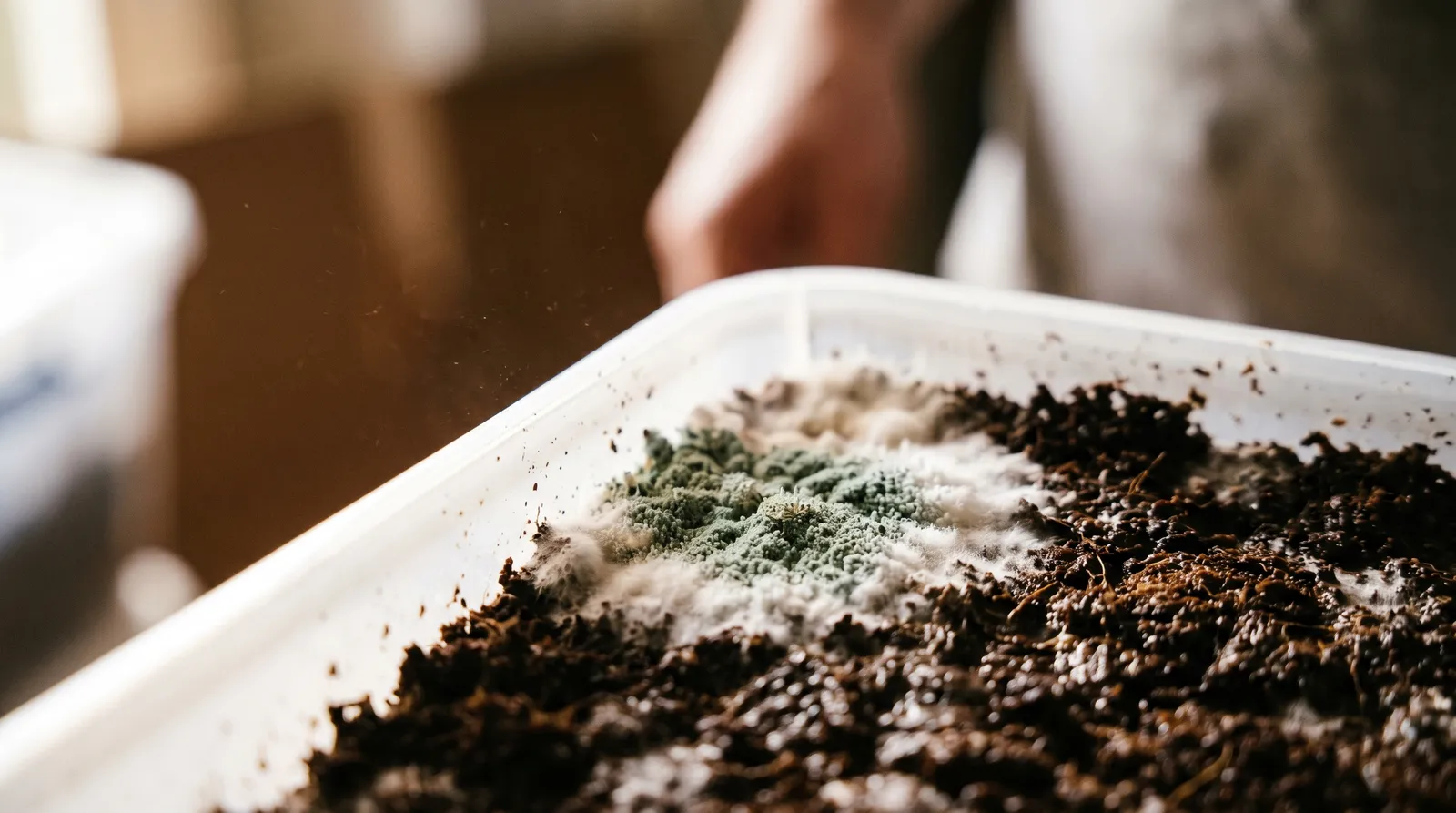
Green or blue-green patches on the casing: Trichoderma mould. It starts white and turns green within a day. Once green is visible, the kit is lost — bag it, bin it, wipe the whole area with alcohol. Don't try to cut it out; the spores are already through the substrate.
Thin cobwebby grey growth: Cobweb mould (Dactylium). Unlike trichoderma, early cobweb can sometimes be killed by a direct mist of 3% hydrogen peroxide. If it returns, toss the kit.
Wet, slimy, pink or yellow patches with a sour smell: bacterial contamination (often Pseudomonas). Toss immediately — this is the one contamination that can actually make you ill if ingested.
No pins after 14 days: temperature too low, humidity too low, or the cold shock didn't take. Re-dunk and re-seal, then hold strict 23 °C.
Aborts (small brown pins that stop growing): too much CO₂. Increase FAE to 3× daily.
Safety and consumption note
During harvest and especially during drying, mushroom spores and dust can trigger respiratory hypersensitivity in some growers. Harvest before veils tear to minimise spore release, and consider an FFP2/N95 mask if you're sensitive or breaking down larger batches.
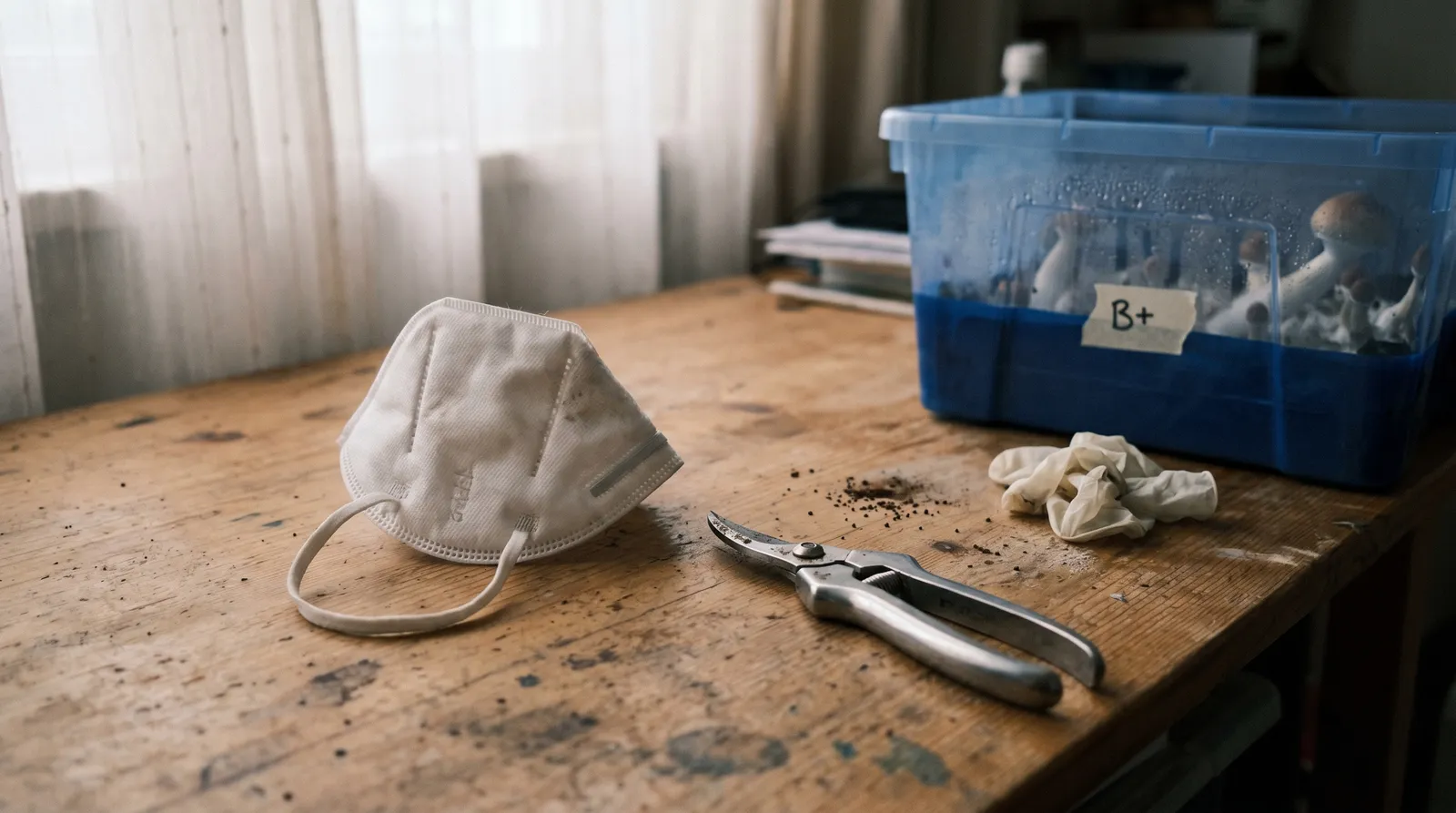
Dried cubensis looks remarkably like ordinary kitchen mushrooms. Store in a locked, labelled, child-proof and pet-proof container — this is non-negotiable in any household with kids or animals.
Psilocybin has documented interactions with SSRIs, MAOIs, lithium, and tramadol; combining psilocybin with lithium in particular has been linked to serotonergic and seizure risk in case reports (Nayak et al., 2021). Consumption, dosing, set and setting, and interactions are covered in depth on the main psilocybin hub — they are outside the scope of this cultivation guide.
Disclaimer
This article is provided for educational and harm-reduction purposes only. It is not medical, therapeutic, or formal advice. Psilocybin affects individuals differently and carries real risks, particularly for people with a personal or family history of psychosis, bipolar disorder, or cardiovascular conditions, and for those taking SSRIs, MAOIs, lithium, or tramadol. Consult a qualified healthcare professional before making decisions about your health. Azarius cannot be held responsible for actions taken on the basis of this content.
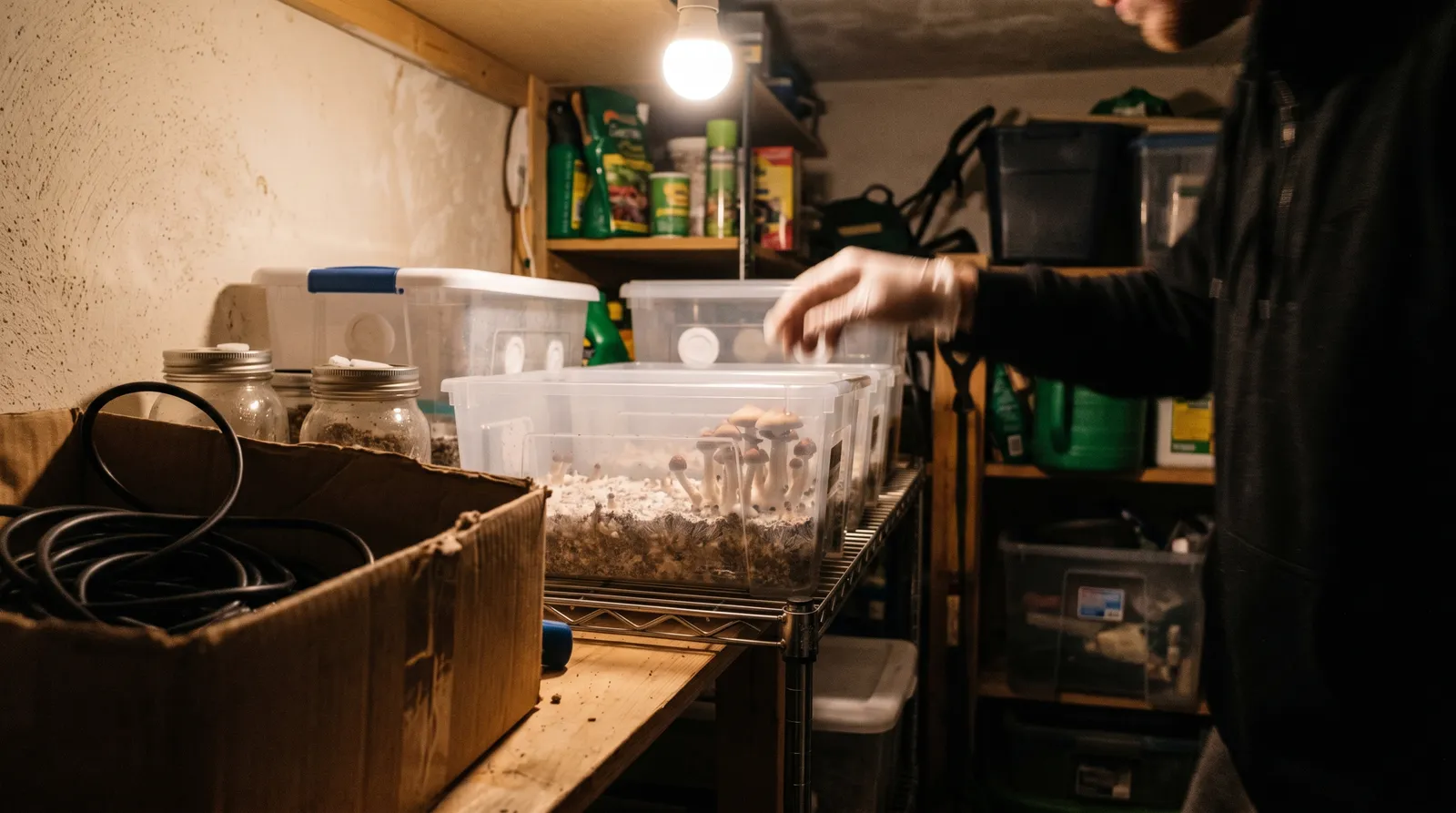
Azarius Mushroom Grow Kits
The B+ strain is available in the Grow Kit format (plastic-tub rye-grain substrate with a perlite/vermiculite casing layer) for customers who want to buy a complete all-in-one cultivation package. The Azarius range includes eight strains in this format — B+, Cambodia, Golden Teacher, Mazatapec, McKennaii, Mexican, PES Amazonian, and Treasure Coast — plus nine strains in the sealed Ready-2-Grow Bag format for growers who prefer to order zero-assembly options. For further reading, see the main Psilocybin Mushrooms hub and the Mushroom Cultivation category on the Azarius wiki and blog.
Last updated: April 2026
Frequently Asked Questions
8 questionsHow long does a B+ grow kit take from start to first harvest?
What temperature does B+ fruit best at?
Is B+ a good strain for beginners compared to Golden Teacher?
How many flushes can you expect from a B+ kit?
What does trichoderma contamination look like on a B+ kit?
How should dried B+ mushrooms be stored?
Do B+ mushrooms need light to fruit, and what kind of lighting is best?
How much fresh air exchange does a B+ grow kit need, and how do you prevent drying out?
About this article


Adam Parsons is an external cannabis and psychedelics writer and editor who contributes to Azarius's wiki as both author and reviewer. On the writing side, he authors Azarius's kratom and kanna clusters, drawing on exten
This wiki article was drafted with AI assistance and reviewed by Adam Parsons, External contributor. Editorial oversight by Joshua Askew.
Medical disclaimer. This content is for informational purposes only and does not constitute medical advice. Consult a qualified healthcare provider before use of any substance.
Last reviewed April 25, 2026
References (2)
- [1]Gartz, J. (1996). Extraction and analysis of indole derivatives from fungal biomass. Journal of Basic Microbiology, 36(1), 17-20. DOI: 10.1002/jobm.3620360104
- [2]Nayak, S. U., Davis, A. K., Griffiths, R. R., & Strain, E. C. (2021). Naturalistic use of psilocybin and behavior change. Journal of Psychopharmacology, 35(8), 994-1009. DOI: 10.1177/02698811211007267
Related Articles
Cannabis Hermaphrodite: Identify, Prevent, Act
A cannabis hermaphrodite is a female plant that develops male pollen sacs or banana-shaped anthers (nanners), self-pollinating and seeding your harvest.
DIY Cannabis Fertilizer: Homemade Nutrient Guide
DIY cannabis fertilizer guide: compost, teas, banana ferments and feed schedules, with safety notes and cited research for home growers.
What To Do With Male Cannabis Plants: 6 Practical Uses
What to do with male cannabis plants: identify, isolate, breed, extract, or compost. A practical 6-step guide with sourcing and safety notes.
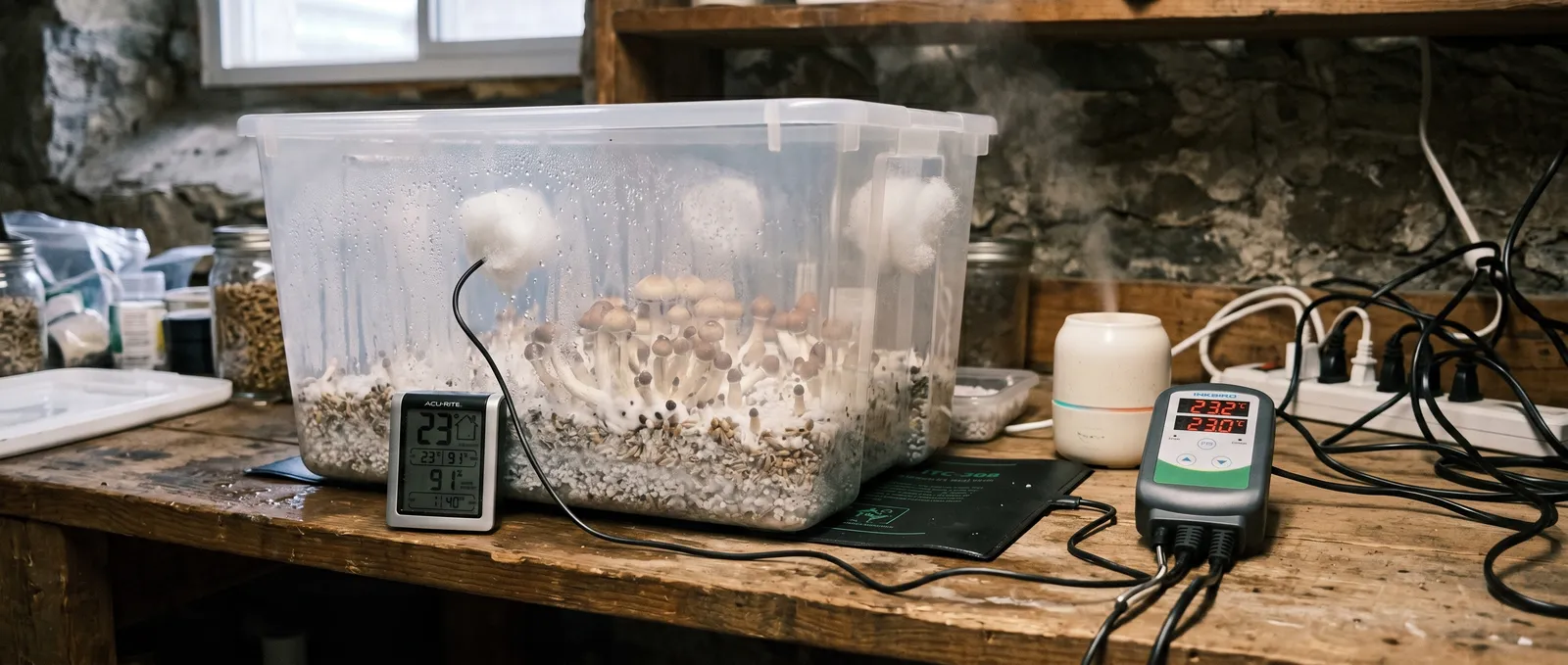
Mushroom Grow Kit Temperature & Humidity: Full Setup Guide
A temperature humidity control grow kit is the small set of climate tools — hygrometer, heat mat, humidifier or perlite tray — that keeps a mushroom fruiting…
When to Harvest Mushrooms: Veil Break Timing Explained
Harvest timing veil break is a cultivation technique that uses the tearing of the partial veil on maturing Psilocybe cubensis to mark peak alkaloid content.
First Grow Checklist: What You Need for Mushroom Kits
A first grow checklist is the short list of supplies and environmental conditions needed to run a home psilocybin mushroom kit from inoculated substrate to…
Sclerotia vs Fruit Bodies: Cultivation Comparison
Sclerotia and fruit bodies are two different life stages of Psilocybe fungi: sclerotia are hardened underground mycelial storage bodies (the 'magic…
Storing Dried Mushrooms Long Term: Full Guide
Storing dried mushrooms long term means keeping well-dried Psilocybe fruit bodies in airtight, opaque containers with desiccant, cool and dark, to slow…
Drying Mushrooms Air Desiccant Oven: Methods Compared
Drying mushrooms air desiccant oven refers to the three home methods for reducing fresh fruit bodies from ~90% water to cracker-dry (<5%). Gotvaldová et al.