
This article discusses psychoactive substances intended for adults (18+). If you have a health condition or take medication, consult a doctor before use. Our age policy
How to Grow Cannabis: A Step-by-Step Home Grower's Guide
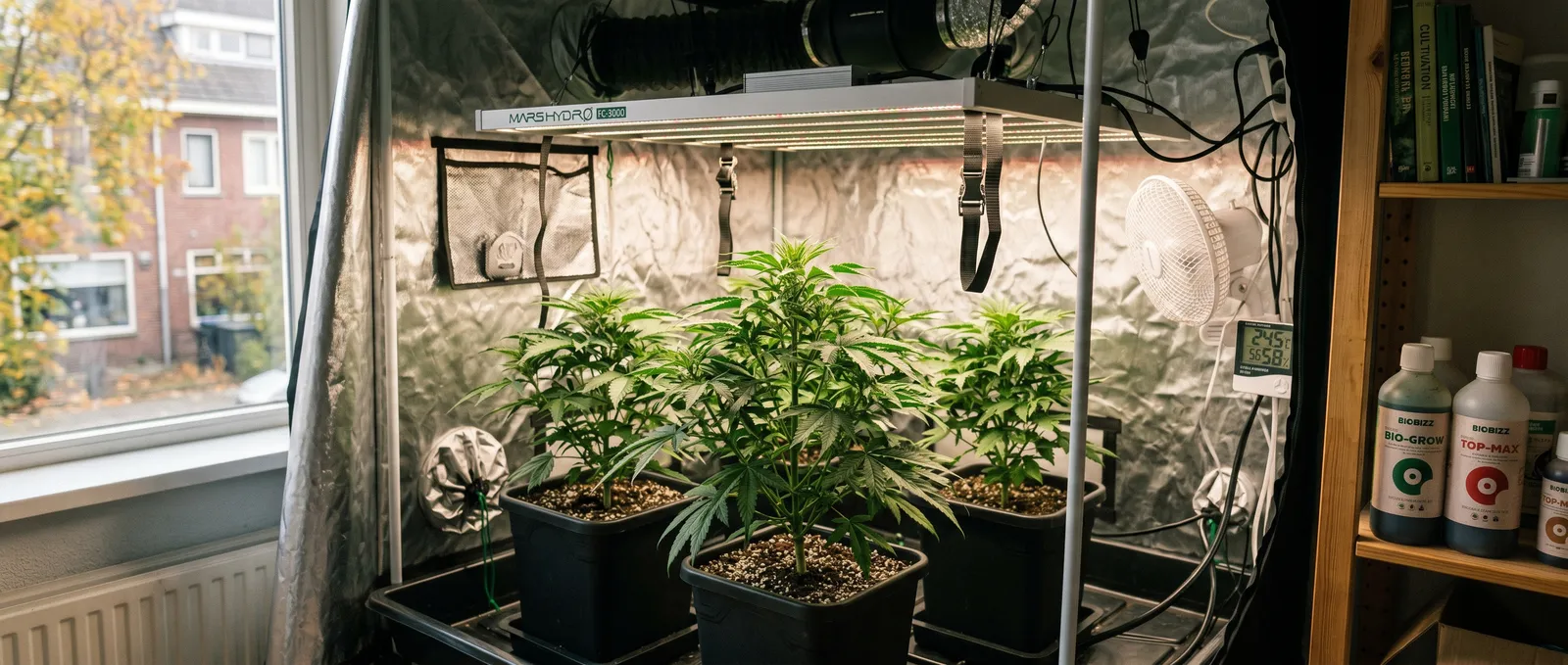
Definition
Learning how to grow cannabis at home means mastering four variables: genetics, light, environment (VPD 0.8–1.5 kPa), and feeding. Rodriguez-Morrison et al. (2021) showed cannabis yield scales with PPFD up to roughly 1,000 µmol/m²/s under indoor conditions — meaning equipment and technique, not luck, decide your harvest.
Cannabis cultivation laws vary by country and region and change frequently. This guide is educational. Before growing, verify current laws for your specific jurisdiction. Azarius does not provide legal advice.
This guide is written for adults aged 18 and over. Growing cannabis is a horticultural project — the sections below cover plant biology, equipment, and technique, not consumption, effects, or pharmacology. For anything cannabinoid-related, head to the cannabinoids hub.
Before you start: the legal bit and the honest bit
Home cultivation legality is all over the place in Europe. As of Q2 2026, Germany's Cannabisgesetz (CanG, in force since 1 April 2024) allows adults to grow up to three plants at home for personal use (Bundesministerium für Gesundheit, 2024). Malta permits up to four plants per household under Act No. LXVI of 2021. The Netherlands still treats home cultivation as a minor offence if plants are spotted and reported, despite its famously relaxed retail culture (EUDA, 2024). Most other EU countries prohibit it outright or allow only cannabis seeds as collectors' items. Verify your specific jurisdiction before germinating anything.
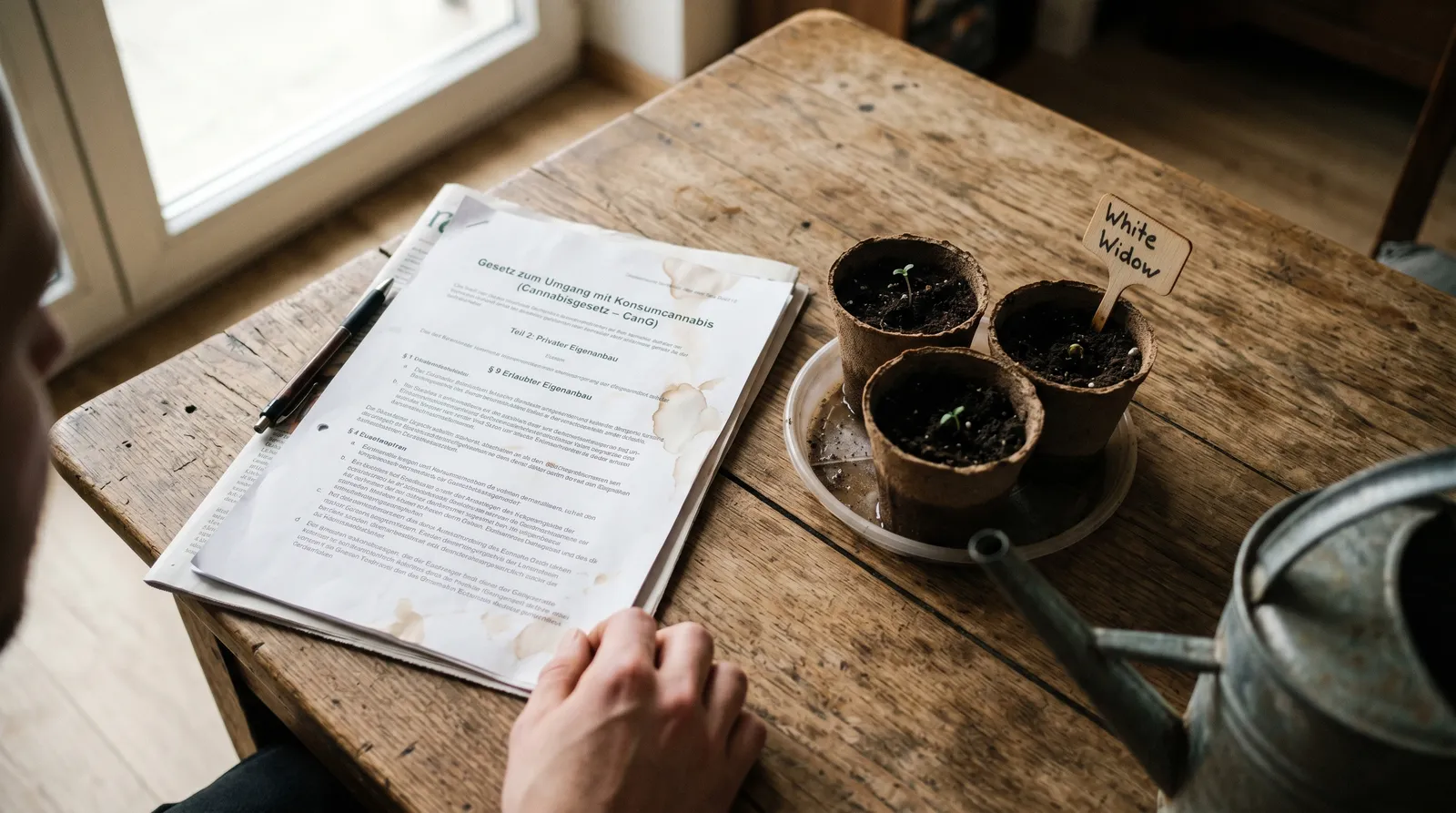
Now the honest bit: a first grow tends to produce less than you think and cost more than you planned. That's fine. The point of the first run is to learn your space — airflow dead zones, your tap water's pH, how your genetics actually behave. Plan for the second grow while you're running the first.
Step 1: Pick your genetics
Before lights, tents, or nutrients, pick the seed. This decision shapes everything else — cycle length, plant size, training options, even your electricity bill.
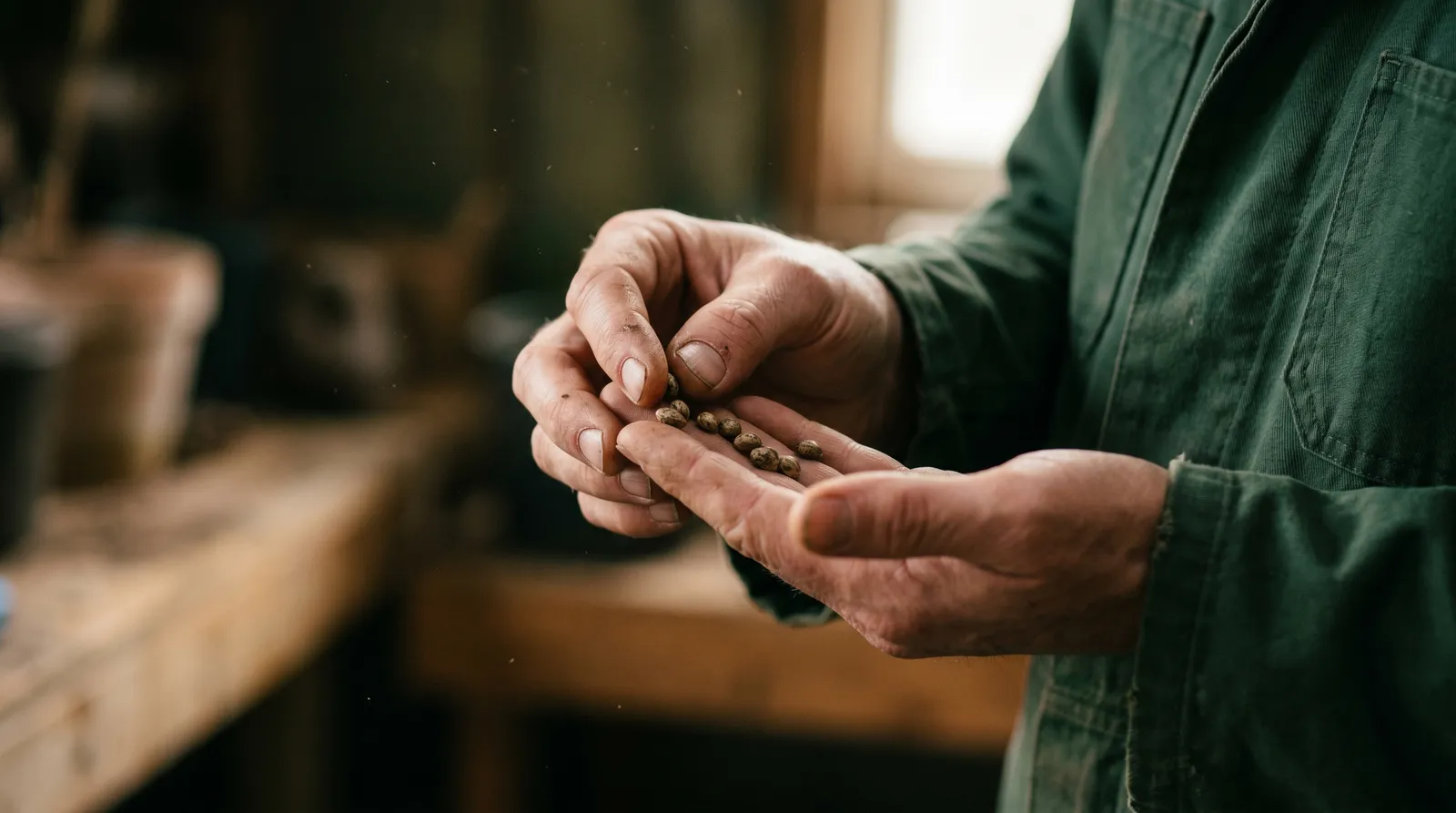
Feminised photoperiod seeds produce effectively 100% female plants and flower when you switch the light cycle from 18/6 to 12/12. Total cycle: roughly 12–16 weeks seed-to-harvest, depending on genetics and veg time. These are the workhorse of European home growing — Dutch Passion's Blueberry, Paradise Seeds Wappa, Royal Queen Seeds Northern Light are all solid beginner picks with breeder documentation you can actually trust.
Autoflowering seeds flower based on age, not light cycle, usually 9–11 weeks from germination to harvest. You keep lights on 18/6 or 20/4 the whole time. Smaller plants, forgiving of light leaks, but you can't clone them and training options are limited because there's no veg-to-flower switch. Good for short Northern European summers and small tents. Ministry of Cannabis Auto Mandarin Haze and Royal Queen Seeds Quick One are reliable autos.
Regular seeds produce roughly 50/50 males to females. Only worth it if you plan to breed. For a harvest grow, go feminised.
Ignore THC percentages on the seed packet for cultivation planning. They tell you little about how the plant grows, how much it stretches, or how it behaves in your tent. Read the breeder's flowering time, stretch factor, and height notes instead.
Step 2: Build your space
For indoor growing, a dedicated tent is non-negotiable. It gives you control over light, humidity, temperature, and smell. Minimum viable setup for 2–4 plants:
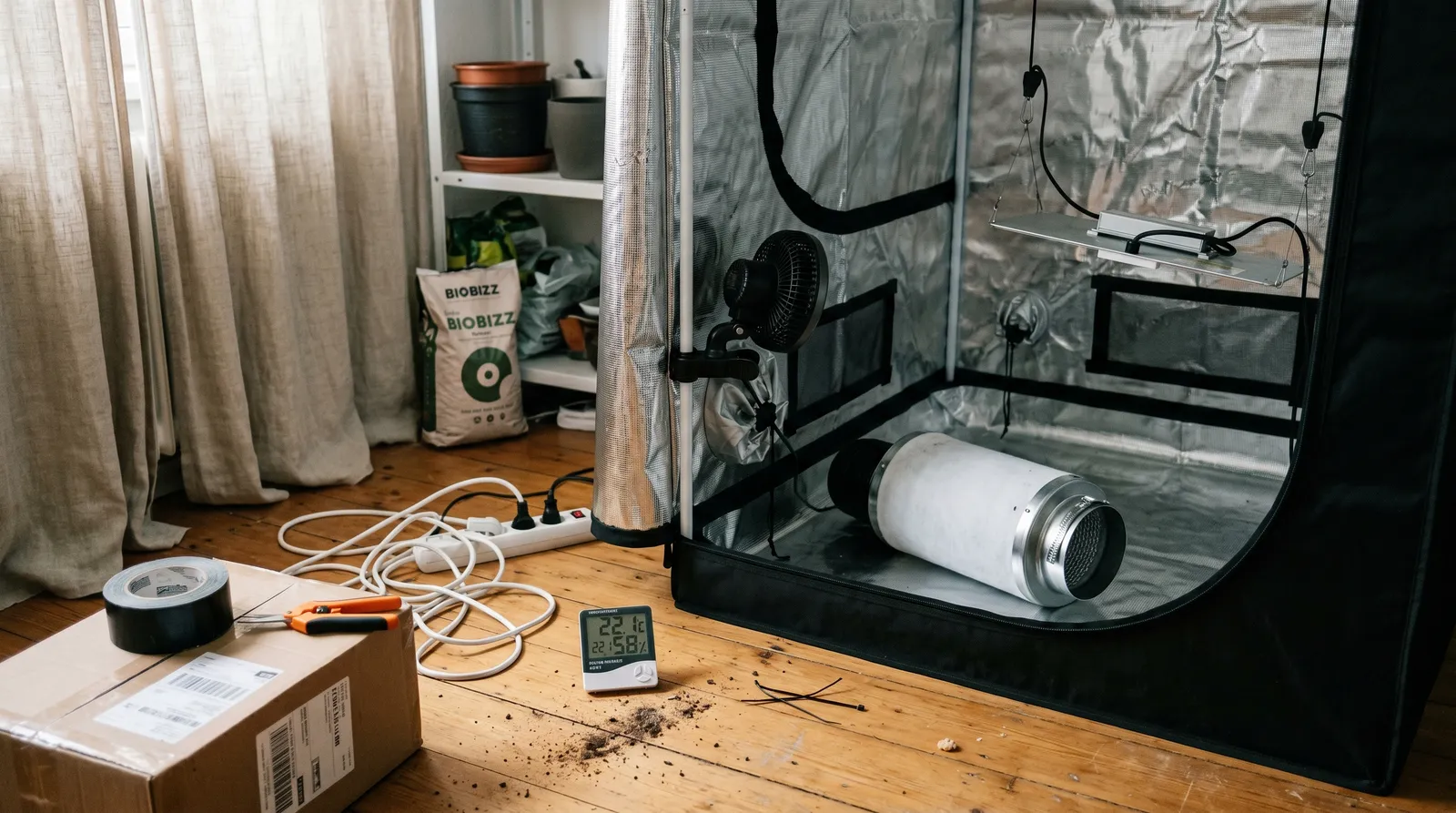
- Tent: 80×80×180cm fits 2–4 plants comfortably. 120×120 if you want 4 trained plants with space to work.
- Light: A modern LED board of 150–250W actual draw covers an 80×80 for both veg and flower. Aim for 400–600 PPFD during veg, 600–1,000 PPFD during flower. HPS still works but runs hotter and eats more electricity.
- Extraction: An inline fan rated for roughly 4× your tent volume per minute, paired with a carbon filter. For an 80×80×180 tent (~1.15m³), a fan moving 180–250 m³/h is the sweet spot. The carbon filter is not optional — it handles the smell that your neighbours and landlord will otherwise notice.
- Circulation fan: A small clip-on oscillating fan inside the tent. Stagnant air kills plants.
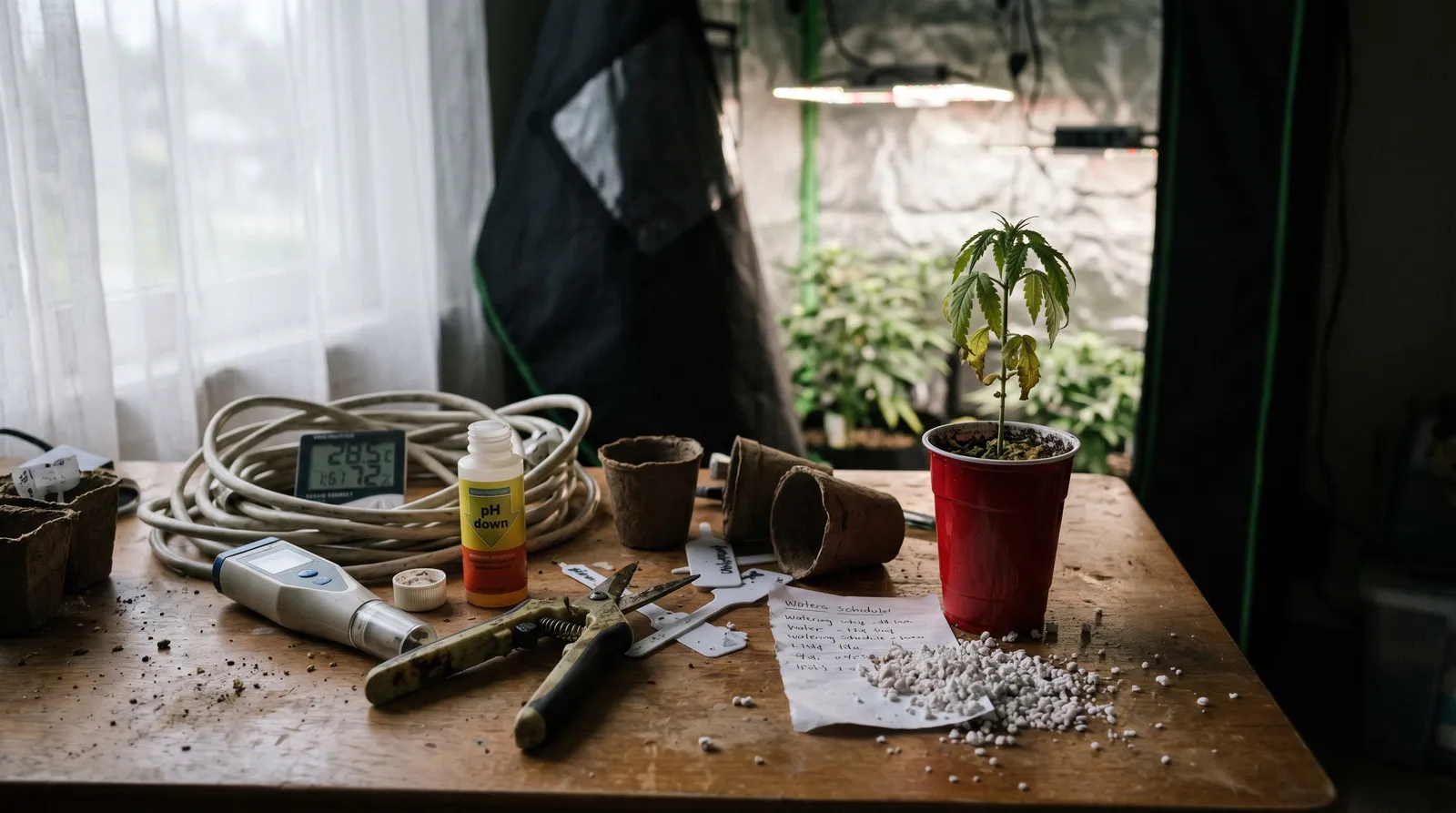
- Thermometer/hygrometer: Ideally one that logs min/max. You need to know what your tent does at 3am, not just when you check it.
Target environment: 22–26°C lights on, 18–22°C lights off, with VPD around 0.8–1.1 kPa in veg and 1.0–1.5 kPa in flower. VPD (vapour pressure deficit) is the unified humidity+temperature metric; any free VPD calculator app does the maths.
Step 3: Choose your medium
Soil, coco coir, and hydroponics all work. They are not interchangeable.
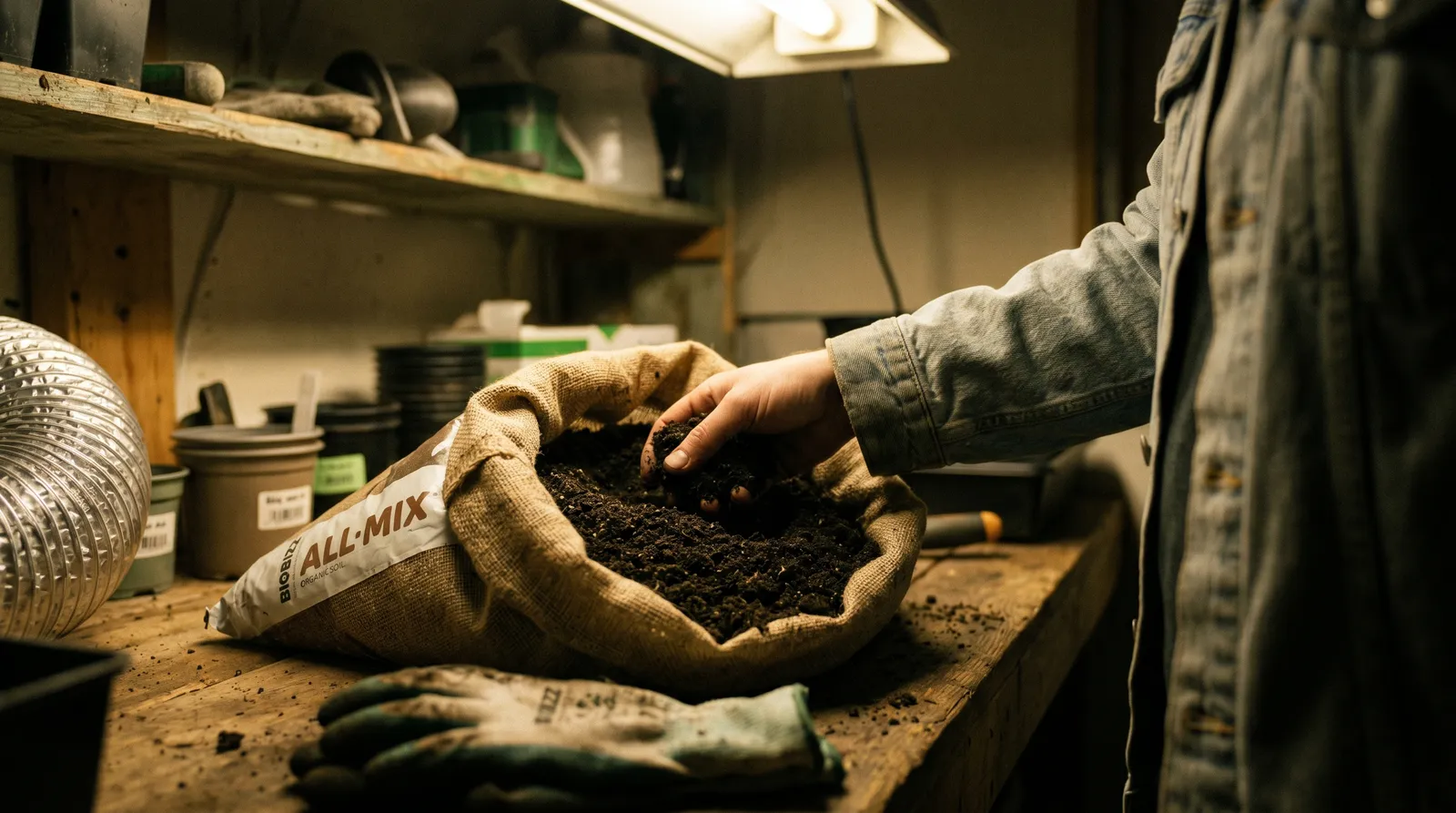
Soil is the most forgiving. A quality pre-amended organic soil (BioBizz All-Mix, Plagron Light-Mix if you want to feed earlier) holds water longer, buffers pH mistakes, and lets beginners water every 2–3 days without much fuss. Target pH 6.0–6.8 at the root zone.
Coco coir is inert — you feed every watering. Faster growth than soil, more control, but less room for error. Target pH 5.8–6.2, feed with coco-specific nutrients (CANNA Coco A+B, House & Garden Cocos A+B). Plants in coco dry out fast — daily watering in late flower is normal.
Hydroponics (DWC, RDWC, ebb-and-flow) is the fastest-growing, highest-yielding, and least forgiving option. pH swings can kill a plant in 48 hours. EC management matters. Not a first-grow medium unless you enjoy reading charts.
Pot size matters. In soil or coco, photoperiod plants need 15–25L final pots for a full cycle. Autoflowers do well in 11–15L fabric pots — and plant them directly in the final pot, because autos hate transplant stress.
Step 4: Germinate and seedling care
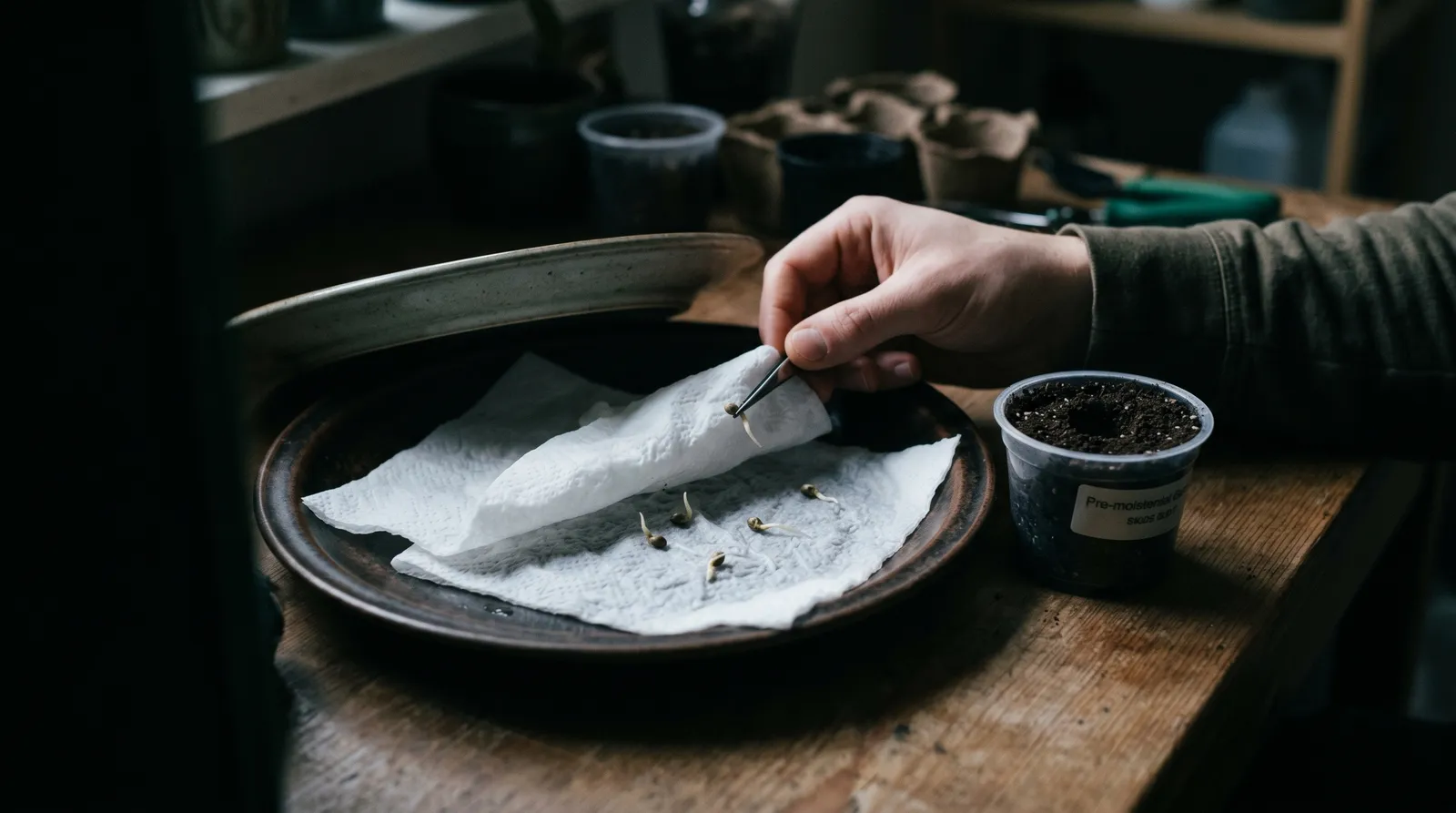
Germinate on a damp paper towel between two plates at around 22–24°C. Most seeds crack within 24–72 hours. As soon as the taproot is 3–5mm long, plant it 10–15mm deep in pre-moistened medium, taproot pointing down.
For the first 10–14 days, seedlings want:
- Humidity 65–75% (a humidity dome helps)
- Temperature 22–25°C
- Light at reduced intensity — 200–300 PPFD, roughly 30–40% on a dimmable LED
- No nutrients. The cotyledons feed the plant for the first 1–2 weeks, and pre-amended soil has enough to carry seedlings to week 3.
Water sparingly. More seedlings die from overwatering than anything else. Let the top 2cm of medium dry before watering again.
Step 5: Vegetative growth
Veg is where you build the plant's structure. Photoperiod plants stay in veg on 18/6 for as long as you want — typically 3–6 weeks from seedling stage. Autoflowers veg on the same schedule but you don't control when they flip; they just do, usually around week 3–4.
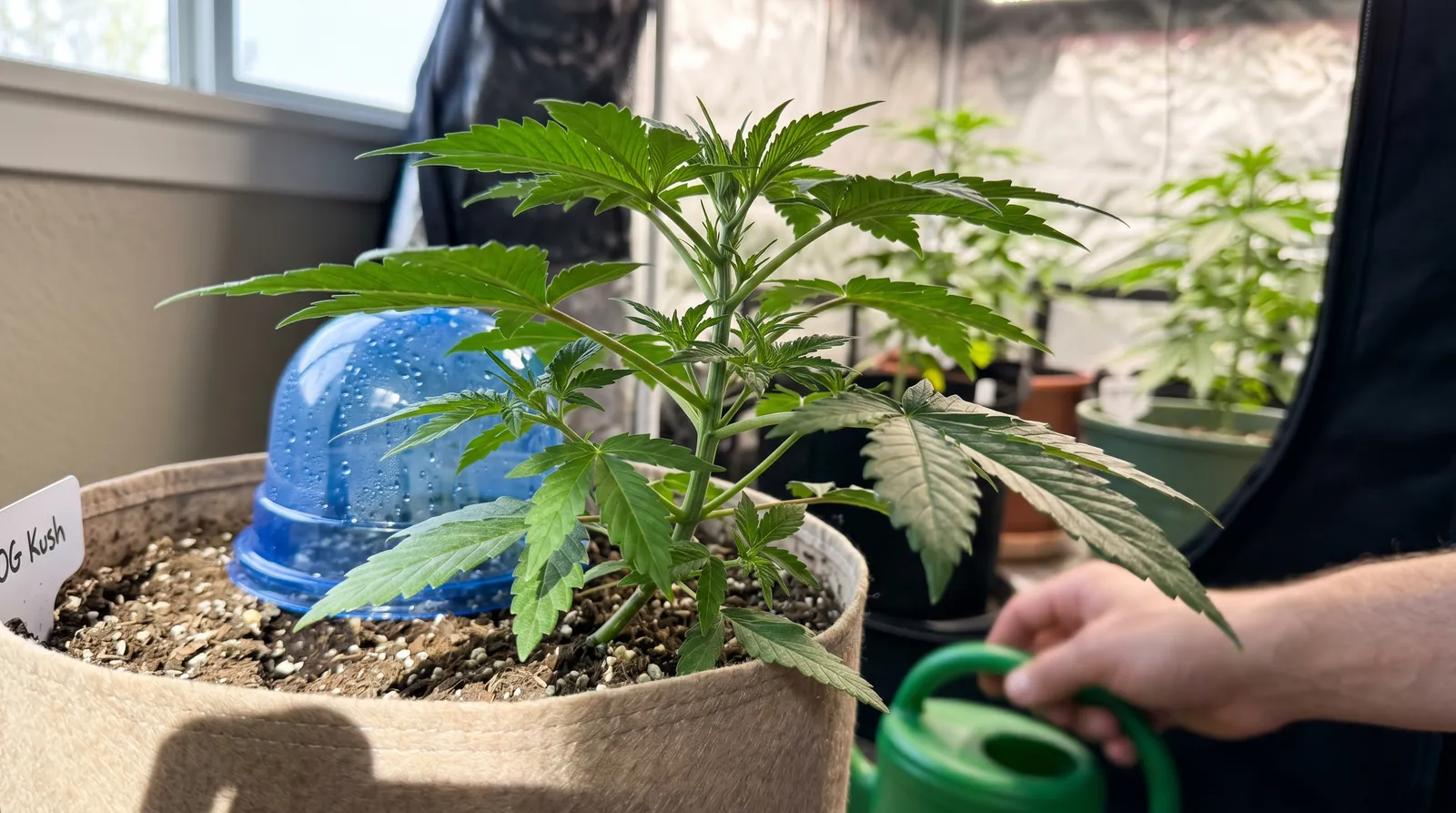
Feeding during veg is nitrogen-heavy. An N-P-K ratio around 3-1-2 is typical. Start at roughly 25% of bottle-label strength and work up based on plant response. Signs of overfeeding: claw-shaped leaf tips, dark green foliage, crispy burned tips. Signs of underfeeding: pale lower leaves, yellowing from the bottom up. EC target in coco/hydro during veg: 1.2–1.8 mS/cm.
Training starts in week 2–3 of veg. Options:
- Low-stress training (LST): Tie main stem and branches sideways to flatten the canopy. Low risk, big payoff. Do this on every grow.
- Topping: Cut the main stem above the 4th or 5th node. Plant splits into two main colas. Adds 7–10 days of recovery.
- FIMing: Pinch out ~75% of the top growth tip. Produces 4 new tops instead of 2, less predictable than topping.
- SCROG (screen of green): Horizontal net at canopy height, weave branches through. Best technique for maximising yield per watt in small tents.
Don't train autoflowers aggressively — they don't have time to recover. LST only, and gently.
Step 6: Flowering
For photoperiod plants, flip lights to 12/12. For autoflowers, the plant flips itself. Either way, the next 8–11 weeks decide your harvest.
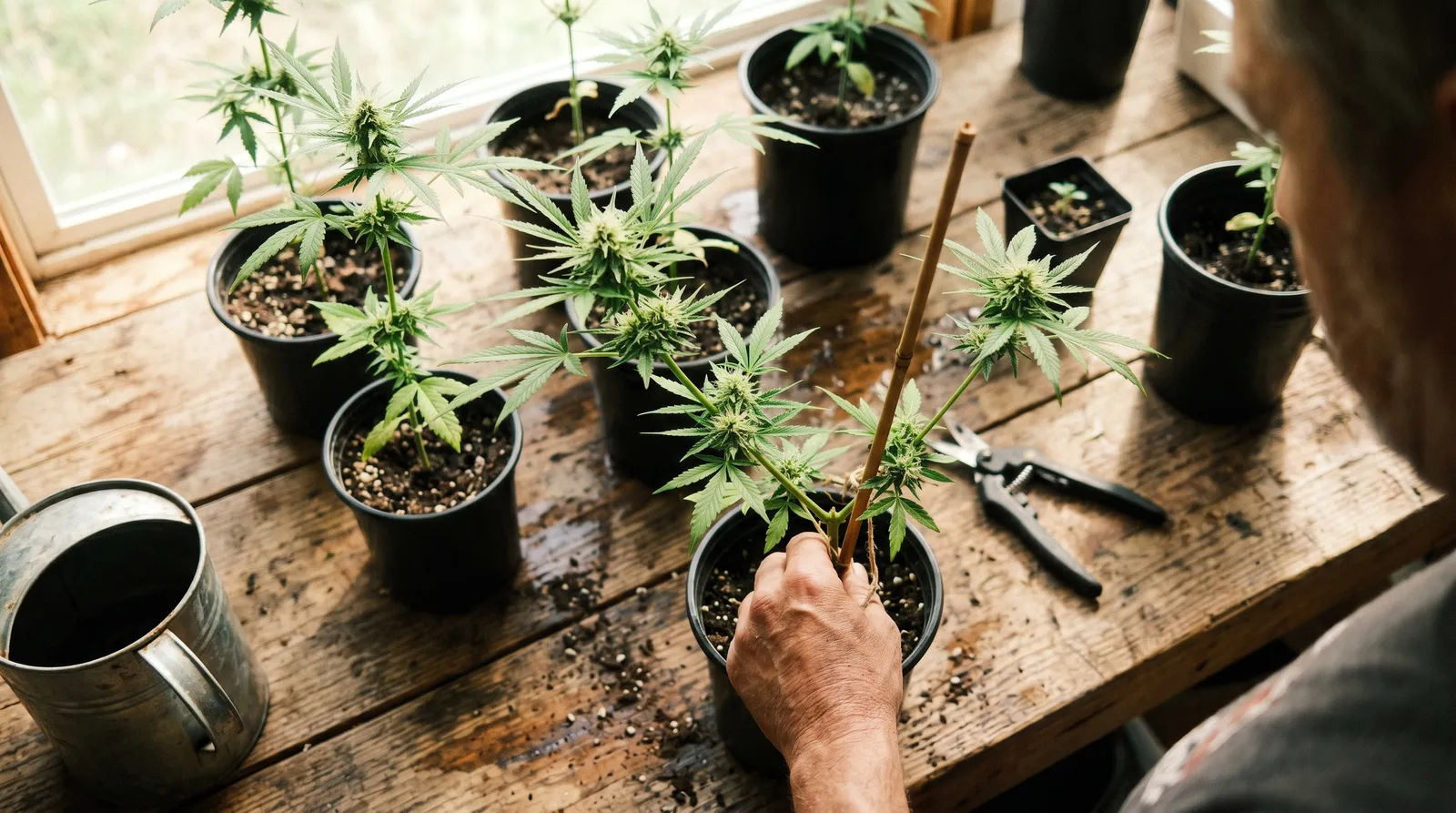
The stretch: Weeks 1–3 of flower. Plants can double or triple in height. Finish LST and defoliation before the stretch ends — after week 3, handling the plant is risky.
Feeding shifts to a bloom nutrient: lower nitrogen, higher phosphorus and potassium, roughly 1-3-2 ratio. EC in coco/hydro climbs to 1.8–2.4 mS/cm during peak flower. Growers in soil with pre-amended bloom mixes can get away with water-only for weeks, depending on the soil.
Humidity drops as flower progresses. Target 50–55% RH by weeks 4–5, 40–50% in the final weeks. High humidity on dense, wet buds is how you get botrytis (bud rot) — and bud rot in a crowded tent can take out half a crop in 72 hours.
IPM rule: no systemic pesticides, ever. No neem oil past week 3 of flower. If you get spider mites or thrips late in flower, options narrow to mechanical removal, predator insects, or accepting some damage. A clean grow room, sealed tent, and no plants-from-outside rule prevent 90% of pest problems.
Step 7: Harvest, dry, cure
Harvest timing is decided by trichomes, not by the breeder's "9 weeks" claim. Pick up a jeweller's loupe (30×–60×) or USB microscope and check the trichomes on the buds, not the sugar leaves. Clear trichomes = not ready. Cloudy = peak. Amber = past peak (some growers like 10–20% amber for a heavier effect — but that's consumption territory, not cultivation).
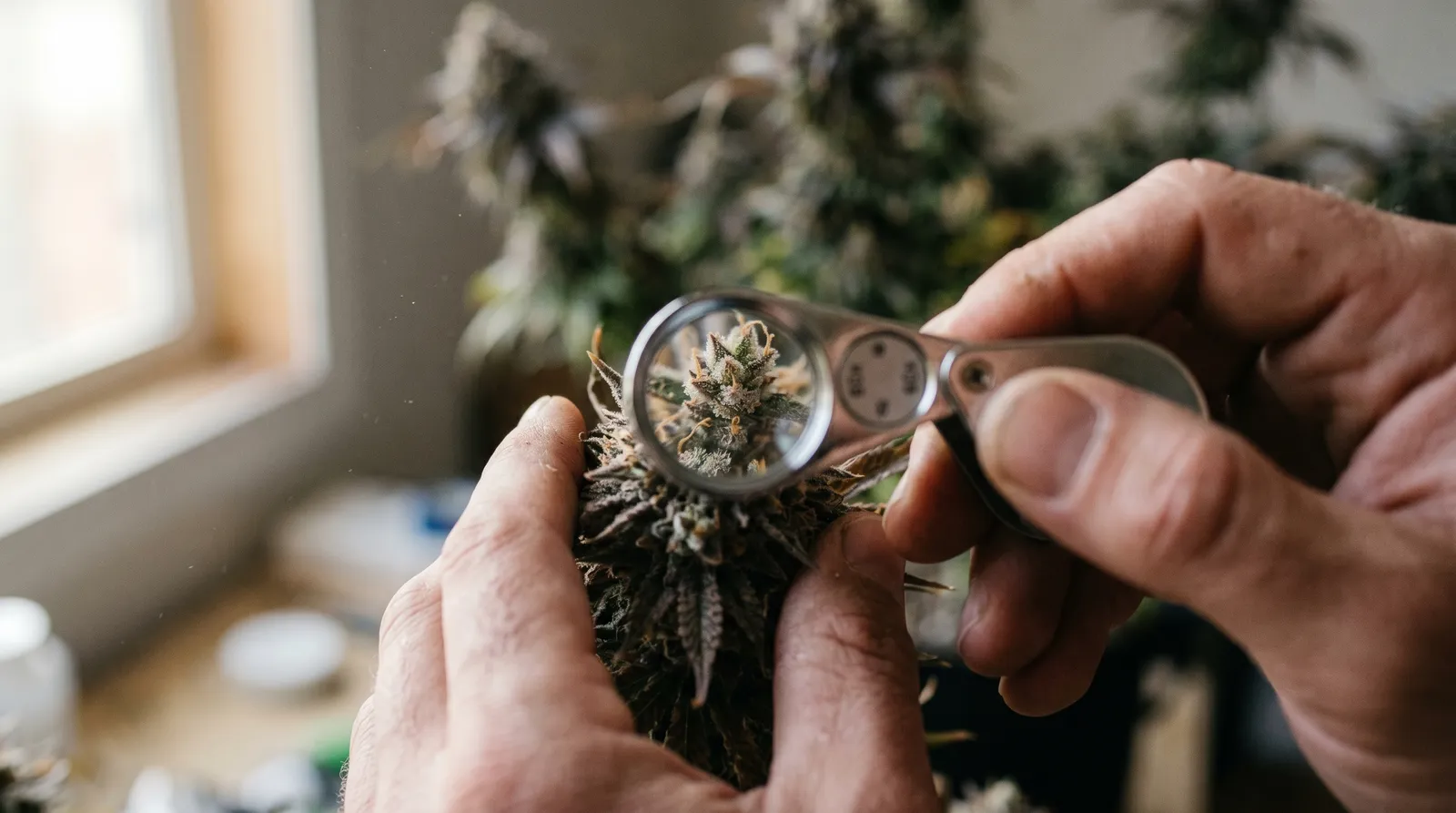
Drying: Hang whole branches (or whole plant, trimmed or not) in a dark room at 18–20°C and 55–60% RH for 10–14 days. The "snap test" on a small stem — it bends, bends, then snaps cleanly — means it's ready to jar. Too fast (under a week) locks in chlorophyll. Too slow risks mould.
Curing: Jar the dried buds loosely in glass mason jars at 55–62% RH. Burp the jars (open for a few minutes) daily for the first week, every few days for the second, weekly after that. Two-way humidity packs (Boveda 62%) make this nearly foolproof. A proper cure takes 4–6 weeks minimum; the terpene profile keeps improving for months.
Common mistakes and how to avoid them
- Overwatering seedlings and young plants. Wet medium starves roots of oxygen. Lift the pot — if it's heavy, wait.
- pH drift. Check runoff pH weekly in soil/coco. Nutrient lockout from pH drift mimics deficiencies and sends growers chasing the wrong problem.
- Ignoring VPD. 80°F and 30% humidity is brutal on plants, even if both numbers look "fine" individually. Check VPD, not just temperature and RH separately.
- Harvesting too early. The last 10–14 days add weight and potency. Patience beats enthusiasm.
- Skipping the cure. A two-week cure is noticeably worse than a four-week cure. Don't put in 14 weeks of work and smoke it harsh.
Yield expectations (honestly)
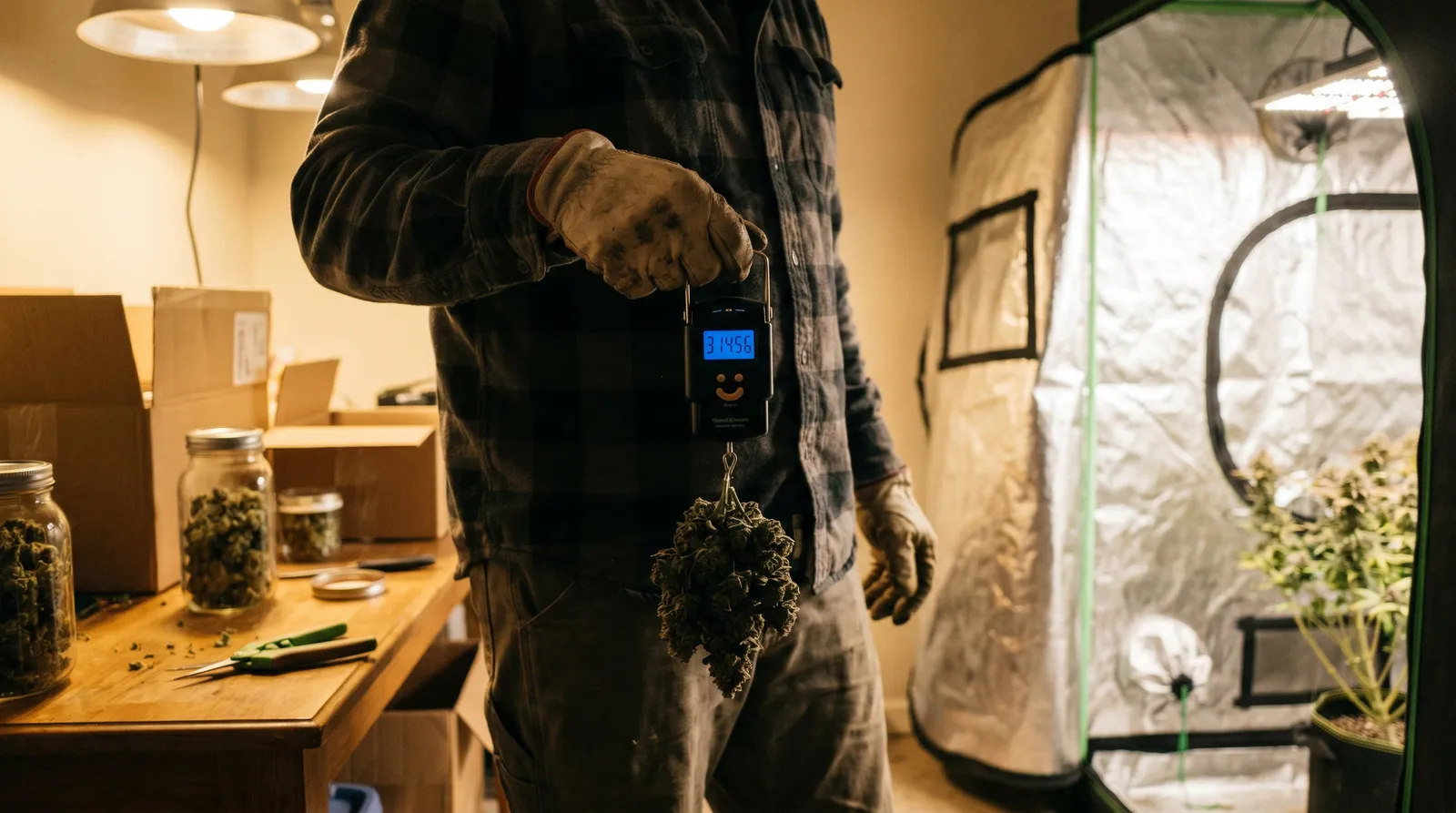
Any "500g per plant" claim without context is marketing. Under a 250W LED in an 80×80 tent, with feminised photoperiod genetics, competent training, and a clean run, a dried-and-cured yield of 200–400g total for 2–4 plants is a realistic target for experienced home growers. First grows often come in at half that. Autoflowers in the same space typically produce 100–250g total. Outdoor yields in Northern Europe vary enormously with latitude, weather, and how much the birds and the neighbours notice.
Azarius cannabis seeds and grow supplies
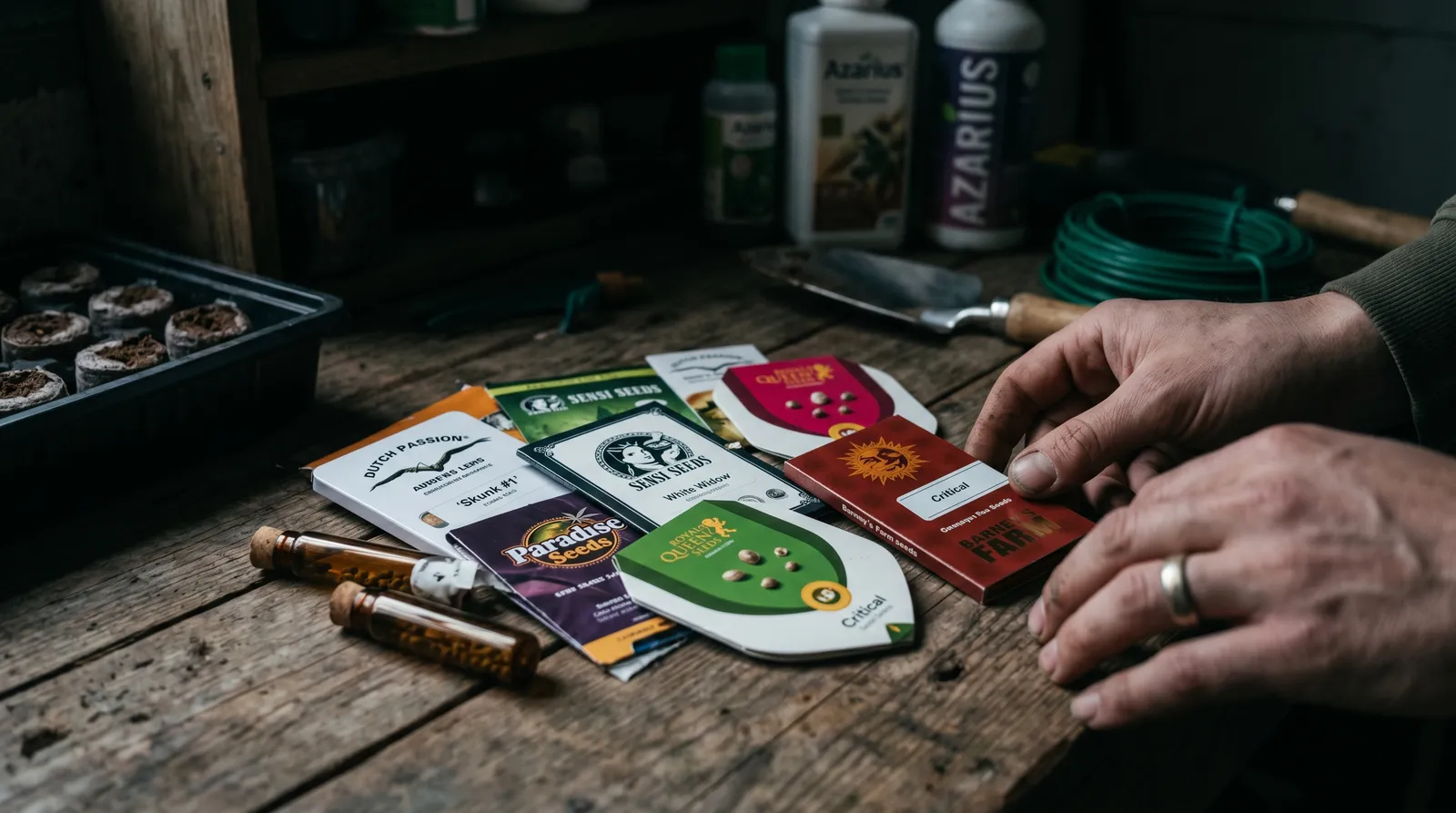
Azarius has sold cannabis seeds since 1999 and carries breeder-direct genetics from Dutch Passion, Paradise Seeds, Royal Queen Seeds, Ministry of Cannabis, Sensi Seeds, and Barney's Farm, alongside tents, LED lights, nutrients, and IPM supplies. If you want a starting point: a feminised photoperiod variety with a documented short flowering time, an 80×80 tent kit with a carbon filter, and a basic bottled nutrient line for your chosen medium. That's the setup we'd run ourselves for a first grow.
Last updated: April 2026
Frequently Asked Questions
8 questionsHow long does it take to grow cannabis from seed to harvest?
What is the easiest cannabis to grow for beginners?
Can I grow cannabis in a regular closet?
What nutrients do cannabis plants need?
How much light does a cannabis plant need?
What is VPD and why does it matter for cannabis?
What size grow tent do I need for my first cannabis grow?
What is the difference between autoflowering and feminised photoperiod cannabis seeds?
About this article


Luke Sholl has been writing about cannabis, cannabinoids, and the broader benefits of nature since 2011, and has personally grown cannabis in home grow tents for more than a decade. That first-hand cultivation experience
This wiki article was drafted with AI assistance and reviewed by Luke Sholl, External contributor since 2026. Editorial oversight by Adam Parsons.
Medical disclaimer. This content is for informational purposes only and does not constitute medical advice. Consult a qualified healthcare provider before use of any substance.
Last reviewed April 24, 2026
References (9)
- [1]Bundesministerium für Gesundheit (2024). Cannabisgesetz (CanG). Bundesgesetzblatt Jahrgang 2024 Teil I.
- [2]European Union Drugs Agency (EUDA) (2024). European Drug Report 2024: Trends and Developments. Publications Office of the European Union, Luxembourg.
- [3]Chandra, S., Lata, H., ElSohly, M. A. (eds.) (2017). Cannabis sativa L. – Botany and Biotechnology. Springer International Publishing.
- [4]Caplan, D., Dixon, M., Zheng, Y. (2017). Optimal rate of organic fertilizer during the vegetative-stage for cannabis grown in two coir-based substrates. HortScience, 52(9), 1307–1312.
- [5]Rodriguez-Morrison, V., Llewellyn, D., Zheng, Y. (2021). Cannabis yield, potency, and leaf photosynthesis respond differently to increasing light levels in an indoor environment. Frontiers in Plant Science, 12, 646020.
- [6]Fluence Bioengineering (2022). PPFD and DLI Recommendations for Cannabis Cultivation. Technical documentation.
- [7]Punja, Z. K. (2021). Epidemiology of Fusarium oxysporum causing root and crown rot of cannabis in northern hemisphere greenhouses. Plant Pathology, 70(6), 1334–1347.
- [8]Small, E. (2015). Evolution and classification of Cannabis sativa in relation to human utilization. The Botanical Review, 81(3), 189–294.
- [9]Parliament of Malta (2021). Act No. LXVI of 2021 – Authority on the Responsible Use of Cannabis.
Related Articles
Cannabis Hermaphrodite: Identify, Prevent, Act
A cannabis hermaphrodite is a female plant that develops male pollen sacs or banana-shaped anthers (nanners), self-pollinating and seeding your harvest.
DIY Cannabis Fertilizer: Homemade Nutrient Guide
DIY cannabis fertilizer guide: compost, teas, banana ferments and feed schedules, with safety notes and cited research for home growers.
What To Do With Male Cannabis Plants: 6 Practical Uses
What to do with male cannabis plants: identify, isolate, breed, extract, or compost. A practical 6-step guide with sourcing and safety notes.
Mushroom Grow Kit Temperature & Humidity: Full Setup Guide
A temperature humidity control grow kit is the small set of climate tools — hygrometer, heat mat, humidifier or perlite tray — that keeps a mushroom fruiting…
When to Harvest Mushrooms: Veil Break Timing Explained
Harvest timing veil break is a cultivation technique that uses the tearing of the partial veil on maturing Psilocybe cubensis to mark peak alkaloid content.
First Grow Checklist: What You Need for Mushroom Kits
A first grow checklist is the short list of supplies and environmental conditions needed to run a home psilocybin mushroom kit from inoculated substrate to…
Sclerotia vs Fruit Bodies: Cultivation Comparison
Sclerotia and fruit bodies are two different life stages of Psilocybe fungi: sclerotia are hardened underground mycelial storage bodies (the 'magic…
Storing Dried Mushrooms Long Term: Full Guide
Storing dried mushrooms long term means keeping well-dried Psilocybe fruit bodies in airtight, opaque containers with desiccant, cool and dark, to slow…
Drying Mushrooms Air Desiccant Oven: Methods Compared
Drying mushrooms air desiccant oven refers to the three home methods for reducing fresh fruit bodies from ~90% water to cracker-dry (<5%). Gotvaldová et al.