
This article discusses psychoactive substances intended for adults (18+). If you have a health condition or take medication, consult a doctor before use. Our age policy
Terpene Entourage Effect: Current Evidence Reviewed

Definition
The terpene entourage effect proposes that cannabis terpenes modulate cannabinoid activity, producing different outcomes than isolated compounds alone. First framed by Mechoulam and Ben-Shabat (1998) for endocannabinoids and extended to terpenes by Russo (2011), the hypothesis is influential but only partially supported by current evidence — most data remains preclinical.
What is the terpene entourage effect?
The terpene entourage effect is a hypothesis proposing that cannabinoids, terpenes, and other compounds in cannabis produce different — potentially stronger or more varied — effects when consumed together than any single compound delivers alone. The term was coined by Mechoulam and Ben-Shabat (1998) in the context of endocannabinoid metabolism, then expanded by Russo (2011) into a broader framework for how terpenes might modulate the psychoactive and physiological profile of cannabis. It is one of the most-cited ideas in cannabis science, and also one of the most contested.

The distinction matters: the terpene entourage effect is a working hypothesis, not a demonstrated pharmacological mechanism. Some evidence, as reviewed by Russo (2011), points toward partial support. Quite a lot of evidence is missing. And a few studies directly challenge it. This article walks through what the current data actually says — broken into what's solid, what's suggestive, and what remains unresolved. Whether you want to buy whole-plant cannabis extracts or isolated terpene products, understanding this science helps you make informed choices.
Where the idea came from
The terpene entourage effect traces its intellectual roots to endocannabinoid research, not plant chemistry. Mechoulam and Ben-Shabat (1998) observed that certain endogenous lipids — 2-acyl-glycerols — don't bind to cannabinoid receptors themselves but appear to enhance the activity of the endocannabinoid 2-AG when present alongside it. They called this an "entourage effect": inactive compounds amplifying the effect of an active one. The original concept had nothing to do with terpenes or plant cannabis. It was about endogenous mammalian biochemistry.

Russo (2011) published a widely cited review arguing that cannabis terpenes could produce analogous modulation of cannabinoid activity. The paper proposed specific terpene–cannabinoid pairings: myrcene potentiating THC's sedative qualities, limonene enhancing mood effects, pinene potentially counteracting THC-induced short-term memory impairment. These proposals drew on a mix of preclinical pharmacology, traditional use, and mechanistic reasoning. The review was rigorous in its scope but speculative in its conclusions — Russo himself framed many claims with "would" and "could," though downstream media often dropped the conditional language entirely.
What the evidence supports
Beta-caryophyllene holds the strongest evidence for a terpene contributing directly to the cannabis entourage. Gertsch et al. (2008) demonstrated that β-caryophyllene is a selective agonist at the CB2 receptor, with a binding affinity (Ki) of approximately 155 nM. This is not a vague "may interact with" claim — it is a documented receptor–ligand interaction, replicated and accepted in the pharmacology literature. CB2 receptors are expressed primarily in immune cells and peripheral tissues, so β-caryophyllene's mechanism is distinct from the CB1-mediated psychoactivity of THC. But it is a real, measurable, receptor-level event caused by a terpene found in cannabis at meaningful concentrations (typically 0.1–0.5% of dry weight in caryophyllene-dominant cultivars).

Beyond β-caryophyllene, the picture gets murkier. A 2019 study by Santiago et al. examined whether five common cannabis terpenes (myrcene, α-pinene, β-pinene, β-caryophyllene, and linalool) modulate CB1 or CB2 receptor signalling when combined with THC or the synthetic cannabinoid CP55,940. The terpenes alone showed no agonist, antagonist, or allosteric modulator activity at either receptor at concentrations up to 30–100 µM. β-Caryophyllene's known CB2 activity was confirmed, but the other four terpenes did not affect cannabinoid receptor function in this assay system.
However, a more recent study by LaVigne et al. (2021) found that several terpenes — including α-humulene, geraniol, linalool, and β-pinene — produced additive effects alongside the cannabinoid WIN55,212-2 in a CB1 receptor activity assay. The effects were additive rather than synergistic (an important distinction: additive means the combined effect equals the sum of individual effects; synergistic means it exceeds the sum). These terpenes also appeared to activate cannabinoid receptors on their own at high concentrations, though the physiological relevance of those concentrations in a person consuming cannabis flower is unclear.
Whole-plant versus isolate studies
Whole-plant cannabis extracts appear to behave differently from isolated cannabinoids in several preclinical and retrospective studies. Gallily et al. (2015) reported that a whole-plant CBD-rich extract produced a bell-shaped dose–response curve that was absent with purified CBD — suggesting other compounds in the extract modified CBD's activity. A 2018 retrospective by Pamplona et al. examined clinical data on CBD use in epilepsy and found that patients using CBD-rich extracts reported effective doses roughly four times lower than those using purified CBD.

These findings are suggestive but come with caveats. Whole-plant extracts contain minor cannabinoids (CBG, CBN, CBC), flavonoids, and other non-terpene compounds alongside the terpene fraction. Attributing the observed differences specifically to terpenes requires isolating their contribution from the rest of the chemical matrix — and that work, for the most part, has not been done in human subjects. The difference between "whole-plant extracts work differently from isolates" and "terpenes are the reason" is a gap that the current literature has not bridged.
The full-spectrum, broad-spectrum, and isolate distinction in CBD products maps directly onto this question. If you order a full-spectrum CBD oil, it retains the terpene and minor cannabinoid profile of the source plant. Whether that retention produces meaningfully different outcomes in humans remains an active research question rather than a settled fact. Products such as Azarius full-spectrum CBD oil preserve these naturally occurring terpene ratios, while isolate-based products strip them away.
The sceptical case
Terpene–cannabinoid receptor interaction at realistic concentrations has not been demonstrated for most common terpenes. Finlay et al. (2020) published a pointed critique of the terpene entourage effect. Their receptor-binding data showed no direct modulation of CB1 by myrcene, limonene, pinene, or linalool at physiologically plausible concentrations. Their argument: terpenes in cannabis flower are present at 0.1–3% by dry weight, and after combustion or vaporisation, the actual concentration reaching cannabinoid receptors in the brain is far lower than the concentrations used in most in-vitro studies claiming terpene activity.

This is a legitimate pharmacokinetic objection. A terpene producing an effect at 100 µM in a cell culture dish does not necessarily produce that effect in a human brain after inhalation of cannabis flower. The route of administration, metabolism, blood-brain barrier permeability, and receptor-site concentration all intervene between the petri dish and the person.
There is also a confounding-variable problem. Cultivars high in myrcene tend to be indica-leaning varieties that also carry specific cannabinoid ratios and other chemical signatures. When someone reports that a myrcene-dominant cultivar feels "sedating," the myrcene may be a marker of the cultivar's overall chemical profile rather than the cause of the sedation. Correlation and causation are notoriously difficult to separate in whole-plant pharmacology.
How the terpene entourage effect compares to single-compound pharmacology
Single-compound pharmacology isolates one molecule, measures its dose–response curve, and identifies its receptor targets — a reductionist approach that has produced most modern pharmaceuticals. The terpene entourage effect challenges this framework by proposing that the therapeutic or experiential profile of cannabis emerges from the interaction of dozens of compounds acting on multiple receptor systems simultaneously. Neither approach is inherently superior; they answer different questions.
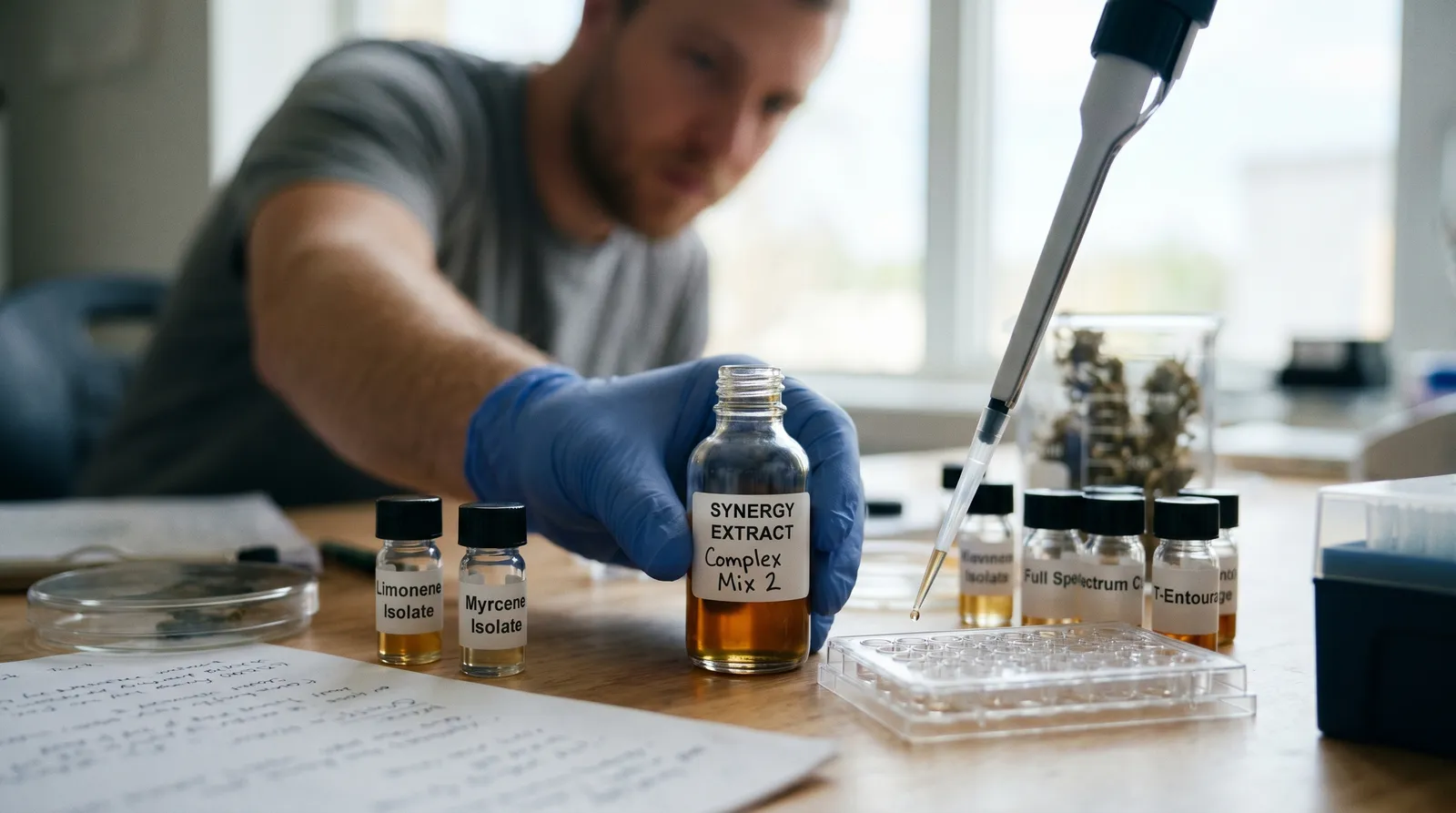
In practice, the pharmaceutical model has the advantage of reproducibility and regulatory clarity. A defined dose of a single molecule is easier to standardise, test, and approve. The entourage model has the advantage of ecological validity — it describes how people actually consume cannabis, which is almost never as a single purified compound. The tension between these two frameworks explains much of the disagreement in the literature: researchers trained in single-compound pharmacology find the entourage hypothesis frustratingly vague, while clinicians and ethnobotanists find the single-compound model frustratingly narrow.
Key studies at a glance
The following table summarises the most frequently cited studies on the terpene entourage effect, their models, findings, and limitations.

| Study | Model | Key finding | Limitation |
|---|---|---|---|
| Gertsch et al. (2008) | In vitro (human CB2) | β-Caryophyllene is a selective CB2 agonist (Ki ≈ 155 nM) | CB2 mechanism — does not address CB1 or psychoactivity |
| Russo (2011) | Literature review | Proposed terpene–cannabinoid pairings for modulated effects | Hypothesis-generating, not experimental validation |
| Gallily et al. (2015) | Mouse model | Whole-plant CBD extract outperformed purified CBD | Cannot attribute difference specifically to terpenes |
| Santiago et al. (2019) | In vitro (CB1/CB2) | Common terpenes showed no CB1/CB2 modulation alongside THC | Single assay system; does not rule out non-receptor mechanisms |
| Finlay et al. (2020) | In vitro (CB1) | No direct terpene modulation of CB1 at physiological concentrations | Tested five terpenes only; non-receptor pathways not assessed |
| LaVigne et al. (2021) | In vitro (CB1/CB2) | Several terpenes showed additive effects with a CB1 agonist | Additive, not synergistic; concentrations may exceed in-vivo levels |
| Pamplona et al. (2018) | Retrospective clinical review | CBD-rich extracts effective at ~4× lower doses than purified CBD | Retrospective design; multiple confounders |
What about non-receptor mechanisms?
Terpenes interact with biological systems through multiple pathways beyond CB1 and CB2 receptors. Much of the sceptical literature focuses on cannabinoid receptors — CB1 and CB2. But linalool and limonene activate TRP ion channels (particularly TRPA1 and TRPV1) in preclinical models (Pereira et al., 2021). Myrcene has shown GABA-A receptor potentiation in rodent studies, though the doses used were high relative to what cannabis inhalation delivers. β-Caryophyllene activates PPARγ in addition to CB2 (Irrera et al., 2020).

If terpenes modulate the cannabis experience through these non-cannabinoid-receptor pathways — TRP channels, GABA receptors, PPARs, serotonin receptors — then studies testing only CB1/CB2 interaction would miss the effect entirely. This does not prove the terpene entourage effect exists; it means the negative results from CB1/CB2-focused studies are not the final word.
Isolated terpenes versus in-plant terpenes
Isolated terpene products and whole-plant terpene profiles are pharmacologically distinct. A critical distinction that much consumer media ignores: terpenes in cannabis flower exist at roughly 0.1–3% of dry weight, blended with cannabinoids and dozens of other compounds. Isolated terpene products — particularly terpene-fortified vape liquids and "strain-replication" blends — deliver concentrations and ratios that do not occur in nature. The pharmacology of myrcene at 1% in a complex plant matrix is not the same as the pharmacology of myrcene at 95% in a vape cartridge. The former is a sensory observation embedded in whole-plant chemistry; the latter is an industrial product with its own safety questions, including limited long-term inhalation data.

Terpene entourage effect in different consumption methods
Consumption method directly determines which terpenes survive to reach the body. Vaporisation at lower temperatures (around 160–180°C) preserves more volatile monoterpenes such as myrcene and limonene, while combustion (above 230°C) destroys a significant fraction of the terpene content. Edible preparations lose most volatile terpenes during decarboxylation. Sublingual oils and tinctures retain terpenes only if the extraction method is designed to preserve them — CO2 extraction generally retains more terpene content than ethanol extraction.
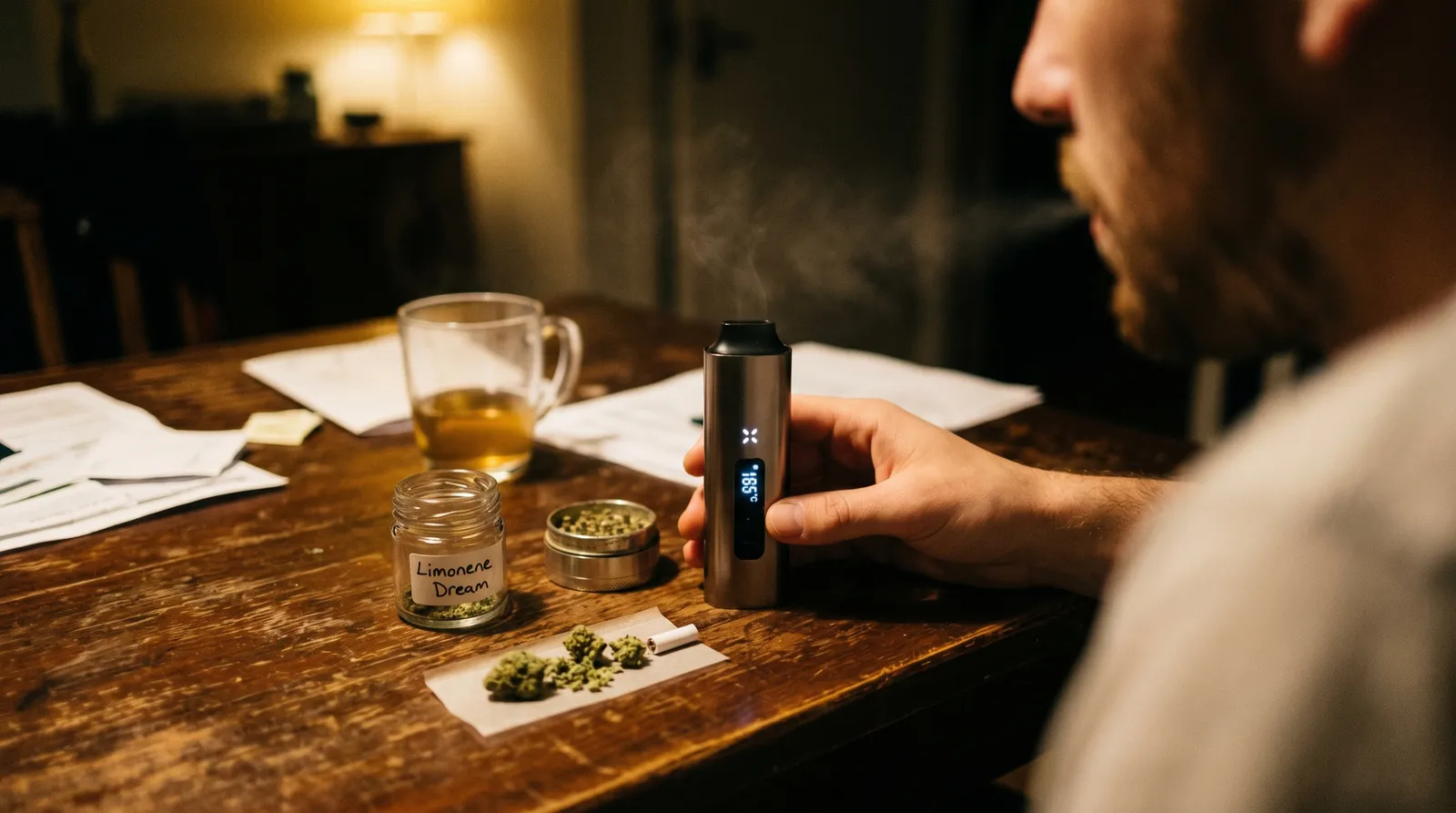
This means the terpene entourage effect, if it exists at the concentrations present in whole-plant material, would manifest differently depending on how someone consumes cannabis. A person who chooses to get a dry-herb vaporiser and uses it at controlled low temperatures is preserving a fundamentally different chemical profile than someone smoking a joint. Products like the Volcano Hybrid or Mighty+ vaporiser from Storz and Bickel allow precise temperature control, which is directly relevant to terpene preservation. This is worth considering when evaluating personal experiences with different cultivars and consumption methods.
Where the science stands now
The terpene entourage effect is a plausible but unproven hypothesis that awaits human clinical validation. The honest summary: the terpene entourage effect as a broad concept — that cannabis compounds interact in ways that matter — is partially supported. β-Caryophyllene's CB2 activity is documented by Gertsch et al. (2008). Whole-plant extracts appear to behave differently from isolates in some contexts, as reported by Pamplona et al. (2018) and Gallily et al. (2015). But the specific claim that common cannabis terpenes like myrcene, limonene, and pinene meaningfully modulate THC or CBD activity at the concentrations present in cannabis flower has not been demonstrated in human clinical trials. Most positive data comes from in-vitro assays or rodent models using concentrations that may not reflect real-world exposure.
The hypothesis is not dead — it is under-tested. What is needed, and what barely exists, are controlled human studies comparing cannabinoid administration with and without defined terpene fractions at realistic concentrations. Until those studies arrive, the terpene entourage effect remains an influential and reasonable hypothesis rather than an established pharmacological principle.
References
- Mechoulam, R. and Ben-Shabat, S. (1998). From gan-zi-gun-nu to anandamide and 2-arachidonoylglycerol. European Journal of Pharmacology, 359(1), 1–18.
- Russo, E.B. (2011). Taming THC: potential cannabis combination and phytocannabinoid-terpenoid entourage effects. British Journal of Pharmacology, 163(7), 1344–1364.
- Gertsch, J. et al. (2008). Beta-caryophyllene is a dietary cannabinoid. Proceedings of the National Academy of Sciences, 105(26), 9099–9104.
- Santiago, M. et al. (2019). Absence of entourage: terpenoids commonly found in Cannabis sativa do not modulate the functional activity of Δ9-THC at human CB1 and CB2 receptors. Cannabis and Cannabinoid Research, 4(3), 165–176.
- Finlay, D.B. et al. (2020). Terpenoids from cannabis do not mediate an entourage effect by acting at cannabinoid receptors. Frontiers in Pharmacology, 11, 359.
- LaVigne, J.E. et al. (2021). Cannabis terpenes produce additive effects with cannabinoid receptor type 1 agonists. Scientific Reports, 11, 8232.
- Gallily, R. et al. (2015). Overcoming the bell-shaped dose-response of cannabidiol by using cannabis extract enriched in cannabidiol. Pharmacology & Pharmacy, 6(2), 75–85.
- Pamplona, F.A. et al. (2018). Potential clinical benefits of CBD-rich cannabis extracts over purified CBD in treatment-resistant epilepsy. Frontiers in Neurology, 9, 759.
- Pereira, E.C. et al. (2021). Terpenes and phytocannabinoids interaction with TRP channels. Frontiers in Pharmacology, 12, 583596.
- Irrera, N. et al. (2020). β-Caryophyllene: a sesquiterpene with countless biological properties. Applied Sciences, 10(14), 5305.
This article describes terpene chemistry, aroma profiles, and natural sources for educational purposes. Information about preclinical research is provided for context only and does not constitute medical advice or claims of efficacy. Consult a qualified professional before using any botanical product to address a health concern.
Last updated: April 2026
Frequently Asked Questions
8 questionsDo terpenes directly activate cannabinoid receptors?
Is the terpene entourage effect proven or just a hypothesis?
What is the difference between additive and synergistic terpene effects?
Why do whole-plant CBD extracts seem to work differently from CBD isolate?
Can isolated terpene vape products replicate the terpene entourage effect?
Does vaporisation temperature affect the terpene entourage effect?
Which terpenes are most relevant to the entourage effect discussion?
Where can I buy products that preserve the natural terpene profile?
About this article


Luke Sholl has been writing about cannabis, cannabinoids, and the broader benefits of nature since 2011, and has personally grown cannabis in home grow tents for more than a decade. That first-hand cultivation experience
This wiki article was drafted with AI assistance and reviewed by Luke Sholl, External contributor since 2026. Editorial oversight by Toine Verleijsdonk.
Medical disclaimer. This content is for informational purposes only and does not constitute medical advice. Consult a qualified healthcare provider before use of any substance.
Last reviewed April 26, 2026
Related Articles

Pinene Alpha and Beta: Aroma, Chemistry & Vaporisation Guide
Pinene is a bicyclic monoterpene occurring as two isomers — α-pinene and β-pinene — and ranks as the most abundant terpene in the plant kingdom.

CBD and Recovery: What the Research Actually Shows
CBD and recovery is a research topic spanning exercise-induced muscle damage, sleep quality, and perceived soreness. As McCartney et al.

CBD Pet Dosing Vet Consultation: Prepare for Your Visit
Veterinary CBD dosing is not a scaled-down version of human dosing — dogs and cats metabolise cannabidiol through different enzymatic pathways and at…

CBD for Cats Veterinary Considerations: Feline Research, Safety and Guidance
Cats metabolise cannabinoids differently from dogs and humans, lacking key glucuronidation enzymes that affect CBD clearance. Deabold et al.

EU Novel Food Regulation CBD: Country Status, EFSA Safety & Guide
EU novel food regulation CBD is a policy framework under EU rule 2015/2283 that classifies cannabidiol extracts as a novel food, requiring safety assessment…
CBD Topical Creams Medical Grade: CE-Marked Class I Explained
CBD topical creams deliver cannabidiol directly to the skin rather than the bloodstream.

Humulene Effects and Aroma Profile | Terpene Guide
Humulene (α-humulene) is a monocyclic sesquiterpene named after Humulus lupulus — hops.

CBD and Skin Conditions: What Research Shows
Cannabidiol (CBD) interacts with the endocannabinoid system expressed in human skin — including CB1 and CB2 receptors on keratinocytes, sebocytes, and…
CBD and Stress: What Research Actually Shows
Cannabidiol (CBD) has been studied in a growing number of human trials measuring stress-related outcomes — from cortisol levels to subjective anxiety under…