
This article discusses psychoactive substances intended for adults (18+). If you have a health condition or take medication, consult a doctor before use. Our age policy
Full Spectrum, Broad Spectrum & CBD Isolate: What's the Difference?
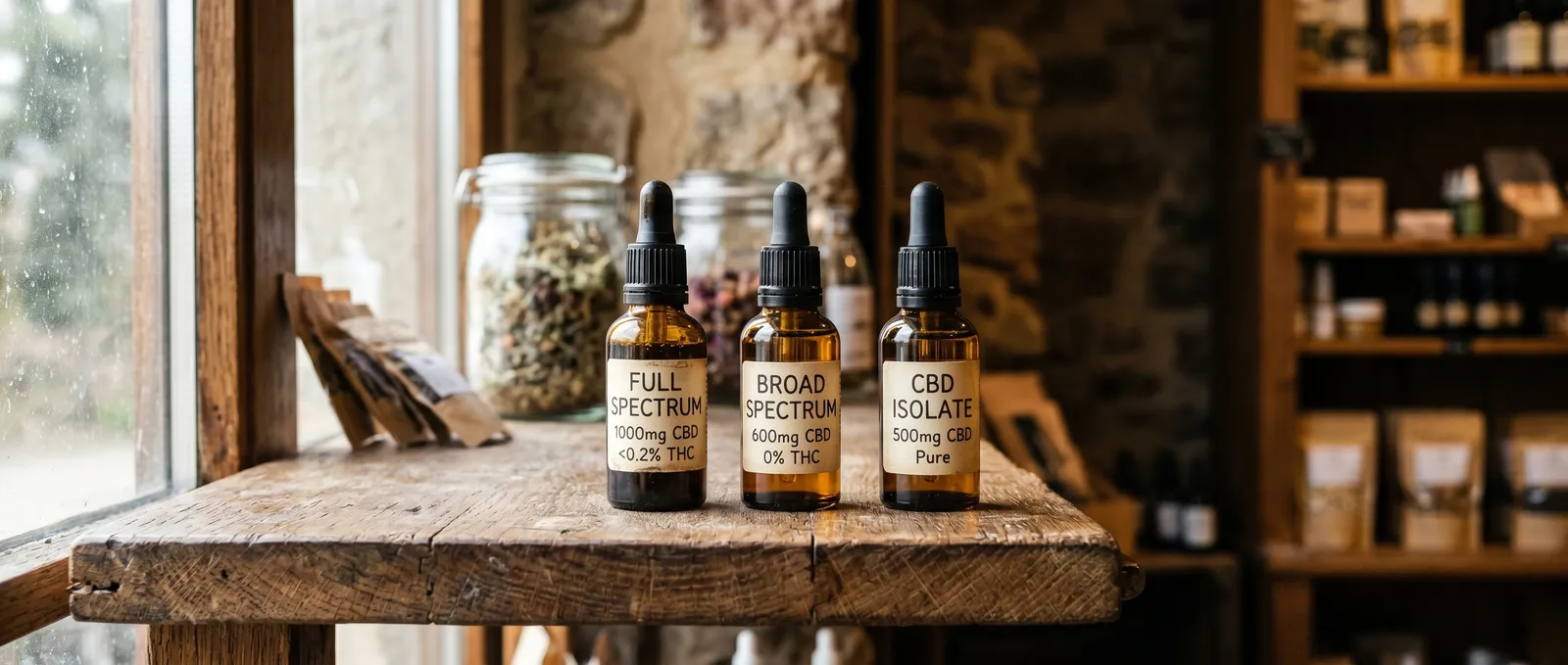
Definition
Full spectrum, broad spectrum, and CBD isolate are the three main categories of cannabidiol extract, each containing a different range of hemp-derived compounds. Full-spectrum products retain all cannabinoids including trace THC, broad-spectrum removes THC while keeping some secondary compounds, and isolate is 99%+ pure CBD. Research by Gallily et al. (2015) found whole-plant extracts produced more predictable dose-response curves than purified CBD alone.
18+ only — this guide covers cannabinoid products and applies to adult physiology.
Full spectrum broad spectrum CBD isolate — these are the three extract types you will encounter when browsing any CBD product range. Each is a distinct category of cannabidiol preparation defined by which hemp compounds survive the extraction process. In short, full spectrum broad spectrum CBD isolate is a classification system where full spectrum retains all plant compounds including trace THC, broad spectrum removes THC while keeping some secondary cannabinoids and terpenes, and isolate is 99%+ pure cannabidiol with nothing else. Walk into any CBD section and you'll hit these terms almost immediately. They all come from the same plant, they all contain cannabidiol, and yet they behave differently once they're in your body. The distinction matters more than most marketing copy lets on — it determines which other compounds ride along with the CBD, and that changes how the product works. Below, we break down exactly what separates these three extract types, what the research actually says about each, and which situations favour one over another.
This article is for informational purposes only and does not constitute medical advice. Always consult a qualified healthcare professional before using CBD products, especially if you take medication or have a health condition.
| Feature | Full Spectrum | Broad Spectrum | CBD Isolate |
|---|---|---|---|
| CBD present | Yes | Yes | Yes (99%+ purity) |
| Other cannabinoids (CBG, CBN, CBC) | Yes — full range | Yes — partial range | No |
| THC content | Up to 0.2–0.3% (depending on jurisdiction) | Non-detectable or removed | None |
| Terpenes | Yes — plant-native profile | Some retained, varies by brand | None |
| Flavonoids | Yes | Some | None |
| Entourage effect potential | Highest | Partial | Absent |
| Taste | Earthy, hempy, sometimes bitter | Milder than full spectrum | Nearly tasteless |
| Risk of positive drug test | Low but possible | Very unlikely | Negligible |
What Does Full Spectrum Actually Mean?
Full spectrum is a hemp extract that retains the complete chemical profile of the plant — CBD alongside minor cannabinoids like CBG, CBN, and CBC, plus terpenes (myrcene, linalool, beta-caryophyllene and others), flavonoids, and trace amounts of THC. In the EU, that THC level sits at or below 0.2% for products derived from industrial hemp; in some national markets it's 0.3%.
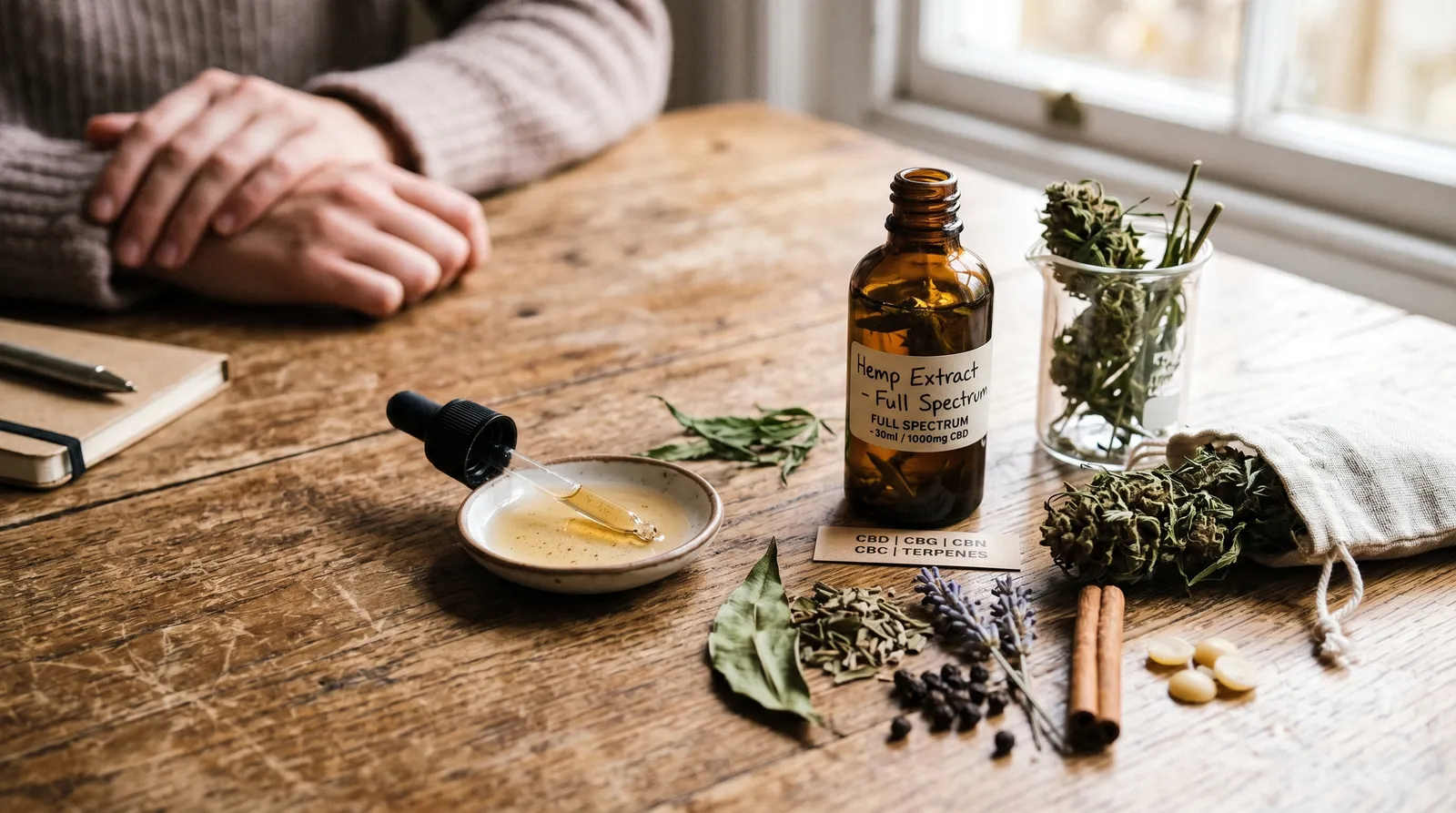
The idea behind keeping everything together is what researchers call the entourage effect. According to a widely cited review by Russo (2011), cannabinoids and terpenes may modulate each other's activity at receptor sites — terpenes like myrcene potentially influencing how cannabinoids cross the blood-brain barrier, while beta-caryophyllene acts on CB2 receptors independently. A 2015 study from the Hebrew University of Jerusalem (Gallily et al., 2015) found that a full-plant extract produced a bell-shaped dose-response curve that was more predictable than purified CBD alone, suggesting the surrounding compounds help stabilise the effect across a wider dose range.
The trade-off? That earthy, sometimes grassy flavour. If you've ever opened a bottle of full-spectrum oil and caught a sharp, herbal hit — that's the terpenes and chlorophyll doing their thing. Some people genuinely enjoy it. Others find it hard to stomach, especially at higher concentrations.
Broad Spectrum: The Middle Ground
Broad spectrum is a CBD extract that has undergone additional processing — usually chromatography or distillation — to strip out THC while attempting to preserve the remaining cannabinoids and terpenes. The goal is entourage-effect potential without any THC exposure.

In practice, "broad spectrum" is the least standardised of the three categories. There's no industry-wide agreement on what must be retained. One brand's broad-spectrum oil might contain five detectable cannabinoids and a dozen terpenes; another might be closer to an isolate with a small amount of CBG added back in. Without third-party lab reports (Certificates of Analysis), you're essentially trusting the label.
This category emerged largely in response to workplace drug testing concerns and to regulations in countries where even trace THC is problematic. If you want some of the supporting compounds but zero THC risk, broad spectrum is the logical pick — just verify the CoA to know what you're actually getting.
CBD Isolate: Pure Cannabidiol, Nothing Else
CBD isolate is cannabidiol in its most refined form — a white, crystalline powder that's typically 99%+ pure with no terpenes, no other cannabinoids, no flavonoids, and no plant fats. It dissolves into carrier oils or can be measured with near-pharmaceutical precision, which is why it's the form most commonly used in clinical trials.
The Gallily et al. (2015) study mentioned above found that isolated CBD produced a narrow bell-shaped dose-response curve — meaning there was a relatively tight window where it was effective, and going above or below that window reduced the benefit. That's a meaningful practical difference compared to full-plant extracts, where the effective range appeared wider.
Isolate's strength is its predictability. Each milligram is a milligram of CBD and nothing else. For people who are sensitive to other cannabinoids, who get drug-tested regularly, or who simply want to know exactly what's entering their body, isolate removes the variables. The downside is that you lose whatever cooperative effects the entourage might provide.
The Entourage Effect — How Strong Is the Evidence?
The entourage effect is a hypothesis — not a proven mechanism — proposing that cannabinoids and terpenes work more effectively together than in isolation. It is probably the most-discussed concept in the CBD world. It's worth being straight about where the science stands. Russo's 2011 paper in the British Journal of Pharmacology laid the theoretical groundwork convincingly — terpene-cannabinoid interactions are pharmacologically plausible, and some have been demonstrated in vitro. The Gallily et al. (2015) mouse model showed measurable differences between whole-plant extract and isolate for anti-inflammatory activity.

But human clinical data specifically comparing full-spectrum versus isolate in controlled conditions remains thin. A 2020 systematic review by Huestis et al. noted that while preclinical evidence supports the concept, most human CBD trials have used isolate (because it's easier to standardise), making direct comparison difficult. The EMCDDA's 2020 report on low-THC cannabis products similarly noted that evidence for synergistic effects in humans remains preliminary. The Beckley Foundation's ongoing cannabinoid research programme has also highlighted the need for more rigorous human trials on whole-plant preparations. So the entourage effect is a reasonable working hypothesis with good preclinical backing — not yet a settled fact in human medicine.
That gap in the research doesn't mean the concept is wrong. It means the definitive head-to-head human trial hasn't been published yet, and anyone claiming certainty either way is getting ahead of the data.
Which Type Suits Which Situation?
The best extract type depends on your priorities, tolerance for taste, and whether you face drug testing — there is no single winner across all contexts.
Full spectrum makes the most sense if you want the broadest range of plant compounds working together, you're comfortable with trace THC, and you don't face drug testing. The flavour is stronger, and the colour of the oil tends to be darker. Research ranges used in studies involving whole-plant extracts have varied widely — Gallily et al. (2015) worked with doses scaled to body weight in animal models, while human observational data from Project CBD's patient surveys (2019) reported that most users of full-spectrum products settled between 15–50 mg of CBD daily. When you're ready to explore, you can buy full spectrum CBD oils in the Azarius CBD collection — products like the CBD Oil 5% Full Spectrum from Cibdol are a popular starting point.
Broad spectrum fits if you want some entourage potential but need to avoid THC entirely. Just check the CoA — the quality difference between brands is larger in this category than in either of the other two. You can order broad spectrum options from brands like Swiss FX and Jacob Hooy through the Azarius webshop.
Isolate works well for precise dosing, for mixing into food or drinks where you don't want a hemp taste, or for anyone who reacts poorly to terpenes or trace cannabinoids. Clinical studies on epilepsy (the basis for the prescription product Epidiolex) used purified CBD at doses of 5–20 mg/kg/day (Devinsky et al., 2017), though those are clinical doses for a specific condition and shouldn't be generalised to wellness use. You can get CBD isolate products in the Azarius smart shop, where crystalline isolate powders are available for those who prefer maximum purity.
What We Don't Know Yet
We should be honest about the limits of current guidance: nobody can tell you with certainty whether full spectrum, broad spectrum, or CBD isolate will work best for your specific body. The preclinical evidence favours full spectrum for general use, but individual responses vary enormously. Some of our customers report better results with isolate than with full-plant extracts — and that's not something the published literature fully explains yet. The only reliable method is methodical self-experimentation with one variable at a time, starting low and adjusting slowly.
A Note on Interactions with Other Substances
CBD — regardless of extract type — is metabolised by the cytochrome P450 enzyme system, particularly CYP3A4 and CYP2C19. This means it can interact with a range of other substances, including certain supplements and compounds that use the same metabolic pathways. According to the FDA's 2020 review of Epidiolex safety data, liver enzyme elevations occurred in approximately 13% of patients taking CBD alongside valproate. The dedicated CBD interactions article on the Azarius wiki covers the specifics in detail — if you take any regular supplements or other products, that's essential reading before starting any CBD product. Always consult a qualified healthcare professional before combining CBD with anything else you take regularly.
Full Spectrum Broad Spectrum CBD Isolate: Side-by-Side Buyer Considerations
When deciding between full spectrum broad spectrum CBD isolate options, it helps to think in terms of trade-offs rather than rankings. Full spectrum gives you the richest compound profile but comes with trace THC and a strong taste. Broad spectrum removes the THC but varies wildly in quality between manufacturers. Isolate offers precision and purity but strips away every supporting compound.
If you want to buy any of these extract types, the Azarius CBD oil category carries options across all three from brands including Cibdol, Swiss FX, and Jacob Hooy. The Azarius wiki article on CBD dosage guidelines walks through how to find your effective range regardless of extract type. For those interested in other cannabinoids, the CBG oil guide and the CBN for sleep article on the Azarius wiki cover the minor cannabinoids that appear in full-spectrum and some broad-spectrum products. The Azarius blog also features a comparison of CBD oil versus CBD capsules for those deciding on a format.
Last updated: April 2026
Frequently Asked Questions
8 questionsDoes full spectrum CBD show up on a drug test?
Is the entourage effect scientifically proven?
Can you mix CBD isolate with full spectrum oil?
Why does full spectrum CBD oil taste so strong?
Is CBD isolate less effective than full spectrum?
Where can I buy full spectrum broad spectrum or CBD isolate products?
What is the difference between broad spectrum and full spectrum CBD?
Is CBD isolate better for beginners than full spectrum?
About this article


Luke Sholl has been writing about cannabis, cannabinoids, and the broader benefits of nature since 2011, and has personally grown cannabis in home grow tents for more than a decade. That first-hand cultivation experience
This wiki article was drafted with AI assistance and reviewed by Luke Sholl, External contributor since 2026. Editorial oversight by Toine Verleijsdonk.
Medical disclaimer. This content is for informational purposes only and does not constitute medical advice. Consult a qualified healthcare provider before use of any substance.
Last reviewed April 24, 2026
References (7)
- [1]Russo, E.B. (2011). 'Taming THC: potential cannabis combination and phytocannabinoid-terpenoid entourage effects.' British Journal of Pharmacology, 163(7), pp. 1344–1364.
- [2]Gallily, R., Yekhtin, Z. and Hanuš, L.O. (2015). 'Overcoming the Bell-Shaped Dose-Response of Cannabidiol by Using Cannabis Extract Enriched in Cannabidiol.' Pharmacology & Pharmacy, 6(2), pp. 75–85.
- [3]Huestis, M.A. et al. (2020). 'Cannabidiol Adverse Effects and Toxicity.' Current Neuropharmacology, 17(10), pp. 974–989.
- [4]Devinsky, O. et al. (2017). 'Trial of Cannabidiol for Drug-Resistant Seizures in the Dravet Syndrome.' New England Journal of Medicine, 376, pp. 2011–2020.
- [5]U.S. Food and Drug Administration (2020). 'FDA Briefing Document: Epidiolex (cannabidiol) Safety Review.' FDA.gov.
- [6]European Monitoring Centre for Drugs and Drug Addiction (EMCDDA) (2020). 'Low-THC Cannabis Products in Europe.' EMCDDA, Lisbon.
- [7]Beckley Foundation (2021). 'Cannabis and Cannabinoid Research Programme: Overview and Findings.' Beckley Foundation, Oxford.
Related Articles

Pinene Alpha and Beta: Aroma, Chemistry & Vaporisation Guide
Pinene is a bicyclic monoterpene occurring as two isomers — α-pinene and β-pinene — and ranks as the most abundant terpene in the plant kingdom.

CBD and Recovery: What the Research Actually Shows
CBD and recovery is a research topic spanning exercise-induced muscle damage, sleep quality, and perceived soreness. As McCartney et al.

CBD Pet Dosing Vet Consultation: Prepare for Your Visit
Veterinary CBD dosing is not a scaled-down version of human dosing — dogs and cats metabolise cannabidiol through different enzymatic pathways and at…

CBD for Cats Veterinary Considerations: Feline Research, Safety and Guidance
Cats metabolise cannabinoids differently from dogs and humans, lacking key glucuronidation enzymes that affect CBD clearance. Deabold et al.

EU Novel Food Regulation CBD: Country Status, EFSA Safety & Guide
EU novel food regulation CBD is a policy framework under EU rule 2015/2283 that classifies cannabidiol extracts as a novel food, requiring safety assessment…
CBD Topical Creams Medical Grade: CE-Marked Class I Explained
CBD topical creams deliver cannabidiol directly to the skin rather than the bloodstream.
Humulene Effects and Aroma Profile | Terpene Guide
Humulene (α-humulene) is a monocyclic sesquiterpene named after Humulus lupulus — hops.

Terpene Entourage Effect: Current Evidence Reviewed
The terpene entourage effect proposes that cannabis terpenes modulate cannabinoid activity, producing different outcomes than isolated compounds alone.
CBD and Skin Conditions: What Research Shows
Cannabidiol (CBD) interacts with the endocannabinoid system expressed in human skin — including CB1 and CB2 receptors on keratinocytes, sebocytes, and…