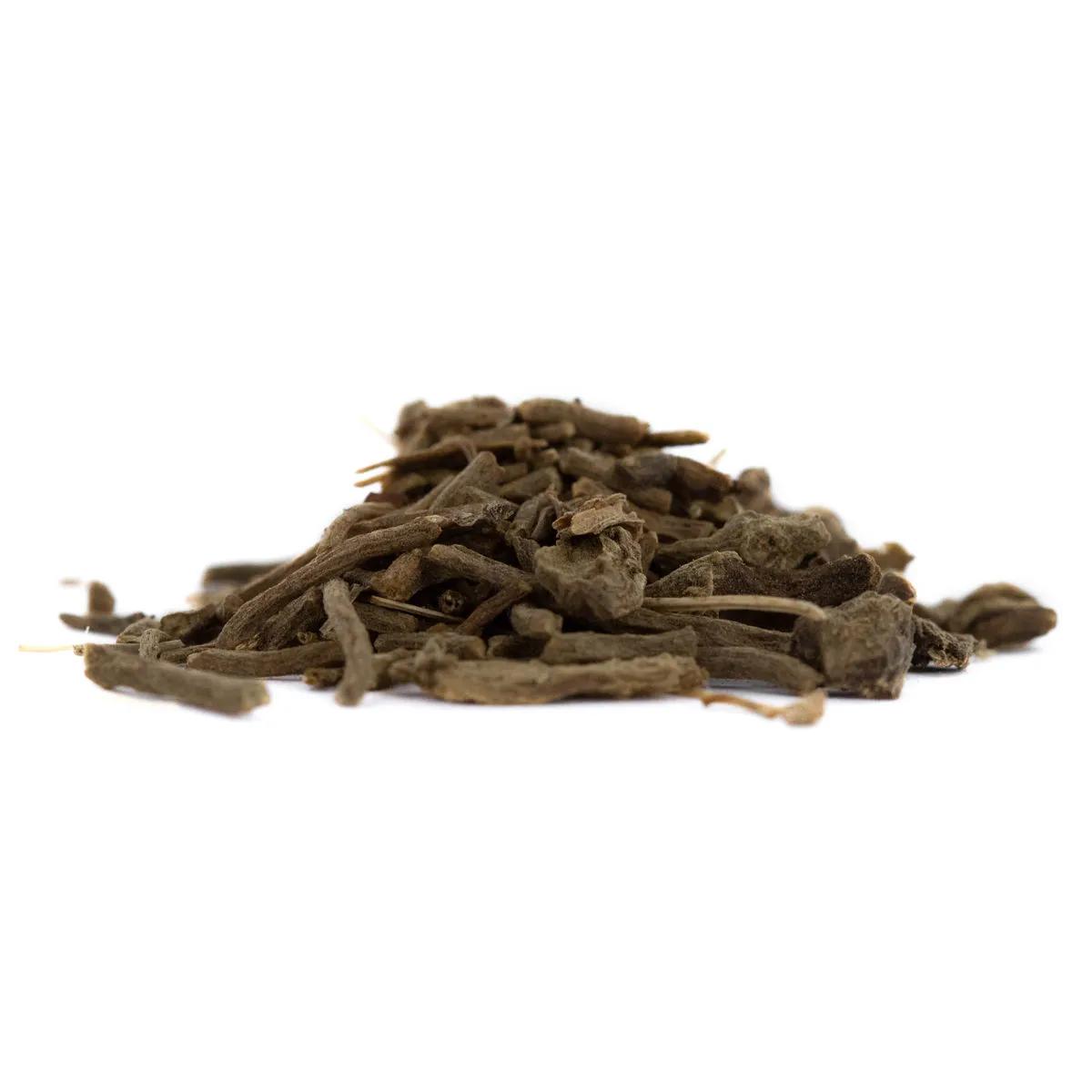
Valerian root — the old Germanic sleep herb
Valerian root is a dried botanical herb that traditionally serves as a sedative tea across European herbalism. This pack gives you 80 grams of cut Valeriana officinalis root — ready to boil into a strong, earthy decoction. Sacred to the Germanic goddess Hertha and hung above doorways for centuries, it's one of the oldest sleep herbs on the continent. Written for adults.
Why brew valerian root instead of taking a capsule
Brewing gives you potency and tradition in one cup. Capsules give you a standardised milligram dose, but the whole root brewed as a decoction pulls the full profile of compounds into your cup — valerenic acid, the sesquiterpene ketone valeranon, and the alkaloid actinidine. That actinidine is the one that interacts with the GABA system, the same neurotransmitter pathway targeted by a lot of conventional sleep medicines.
Fair warning on the smell. Valerian is pungent, earthy, and slightly funky — people compare it to old socks left in a forest. That's not a defect; it's the valerenic acid and valeranon signalling potency. If your valerian smells mild and hay-like, it's weak. Ours does not smell mild.
According to a 2015 systematic review and meta-analysis (Leach & Page, PubMed PMC4394901), valerian has been studied across multiple clinical trials for sleep complaints, with insomnia affecting roughly one third of the adult population. A 2023 randomised, double-blind trial of 80 adults taking V. officinalis extract for 8 weeks reported improvements in sleep parameters versus placebo (PubMed 37899385). Research suggests the combination of valerian with Humulus lupulus (hops) is the most frequently studied herbal pairing for sleep support in clinical literature. The European Monitoring Centre for Drugs and Drug Addiction (EMCDDA) does not schedule valerian, and it remains widely available across EU herbal apothecaries.
How 80 grams breaks down in practice
One 80 g pack yields roughly 25–40 evening cups. Traditional preparations steep 2–3 g of dried root per cup, so the maths lands on weeks of brewing depending on strength preference. Clinical studies on dried valerian root have used capsules of 530 mg daily (Taavoni et al., PMC8077445), while extract studies typically sit in the 300–600 mg range — tea is a looser format, which is why traditional brewing uses more material.
Brewing guide at a glance
| Strength | Root per cup | Water | Boil time |
|---|---|---|---|
| Mild evening cup | 1–2 g | 250 ml | 5 minutes |
| Traditional sleep brew | 2–3 g | 250 ml | 5 minutes |
| Strong decoction | 3–4 g | 300 ml | 5–10 minutes |
Specifications
Here are the core specifications for this 80 g pack of cut valerian root.
| Botanical name | Valeriana officinalis |
| Part used | Root, cut and sifted |
| Weight | 80 g per pack |
| Active compounds | Valerenic acid, valeranon (sesquiterpene), actinidine (alkaloid) |
| Preparation | Decoction — boil 5 minutes |
| Pairs with | Hops, kava-kava, chamomile |
| Storage | Airtight, dry, away from light |
| Shelf life | 24 months sealed |
How to brew valerian root as a decoction
Simmer 2–3 g of cut root per cup in 250 ml of water for 5 minutes with the lid on. Full steps below.
- Measure 2–3 g of cut root per cup into a small saucepan.
- Add 250 ml of cold water per cup.
- Bring to a boil, then reduce to a gentle simmer for 5 minutes with the lid on — keeps the volatile compounds in the pot rather than steaming off.
- Strain through a fine sieve or tea strainer.
- Drink 30–60 minutes before bed. The taste is earthy and sharp — honey, lemon, or a splash of apple juice helps.
- For a stronger sleep brew, blend 50/50 with dried hops. For traditionally vivid dreams, blend 50/50 with kava-kava before simmering.
Honest limitations — read this before you buy
Valerian is not for everyone and a minority of drinkers get the opposite effect. A small percentage of people experience stimulation rather than sedation. It's genuinely uncommon but it happens, and if it does, this isn't the herb for you. Try passionflower or hops instead.
The taste is divisive. It's not chamomile. If you're sensitive to earthy, rooty flavours, brew it weaker or blend it with mint. Also: valerian has documented interactions with CNS depressants (benzodiazepines, sleep medications, alcohol) because it acts on the same GABA pathway. Drugs.com lists 258 documented drug interactions for valerian. If you're on prescription sleep or anxiety medication, talk to your doctor before brewing.
Long-term safety data is limited. Most clinical studies run 4–8 weeks. Traditional use suggests it's fine for extended periods, but if you're brewing it every night for months, take the occasional week off.
Complete your sleep blend with dried hop flowers — the most clinically studied pairing with valerian. For a deeper, more dream-leaning brew, add kava-kava root to the pot. Both sit on the same shelf in our botanicals section.
Frequently Asked Questions
How much valerian root should I use per cup?
Traditional preparations use 2–3 g of cut dried root per 250 ml cup, simmered for 5 minutes. Clinical studies on extract capsules have used 300–600 mg; Taavoni et al. (2021) used 530 mg of dried root. Tea is a looser format — start with 2 g and adjust upward if the effect is mild.
When should I drink valerian tea?
30 to 60 minutes before bed. Valerian isn't immediate — the GABA-active compounds need time to reach peak effect. Drinking it right as you're getting into bed means it kicks in after you've already been tossing for half an hour.
Can I combine valerian with hops or kava-kava?
Yes — both are traditional pairings. Valerian with hops is the most clinically studied herbal sleep combination in the literature. A 50/50 blend of valerian and kava-kava is traditionally used for more vivid dream states. Simmer both roots together for 5 minutes.
Why does valerian smell so strong?
The pungent, funky smell comes from valerenic acid and the sesquiterpene valeranon — the same compounds responsible for its sedative character. Strong smell means potent root. Mild-smelling valerian is usually old or poorly dried.
Is valerian safe to drink every night?
Most clinical studies run 4–8 weeks, so long-term data is limited. Traditional herbalism considers it fine for extended use, but a week off every month or two is sensible. Avoid combining with CNS depressants, sleep medications, or alcohol — valerian acts on the same GABA pathway.
What's the difference between valerian tea and valerian extract?
Tea pulls the full spectrum of water-soluble compounds including actinidine and valerenic acid; extracts concentrate specific fractions into a standardised dose. Tea is the traditional form and what most European herbal monographs reference. Extract capsules are more convenient and easier to dose precisely.
Last updated: April 2026