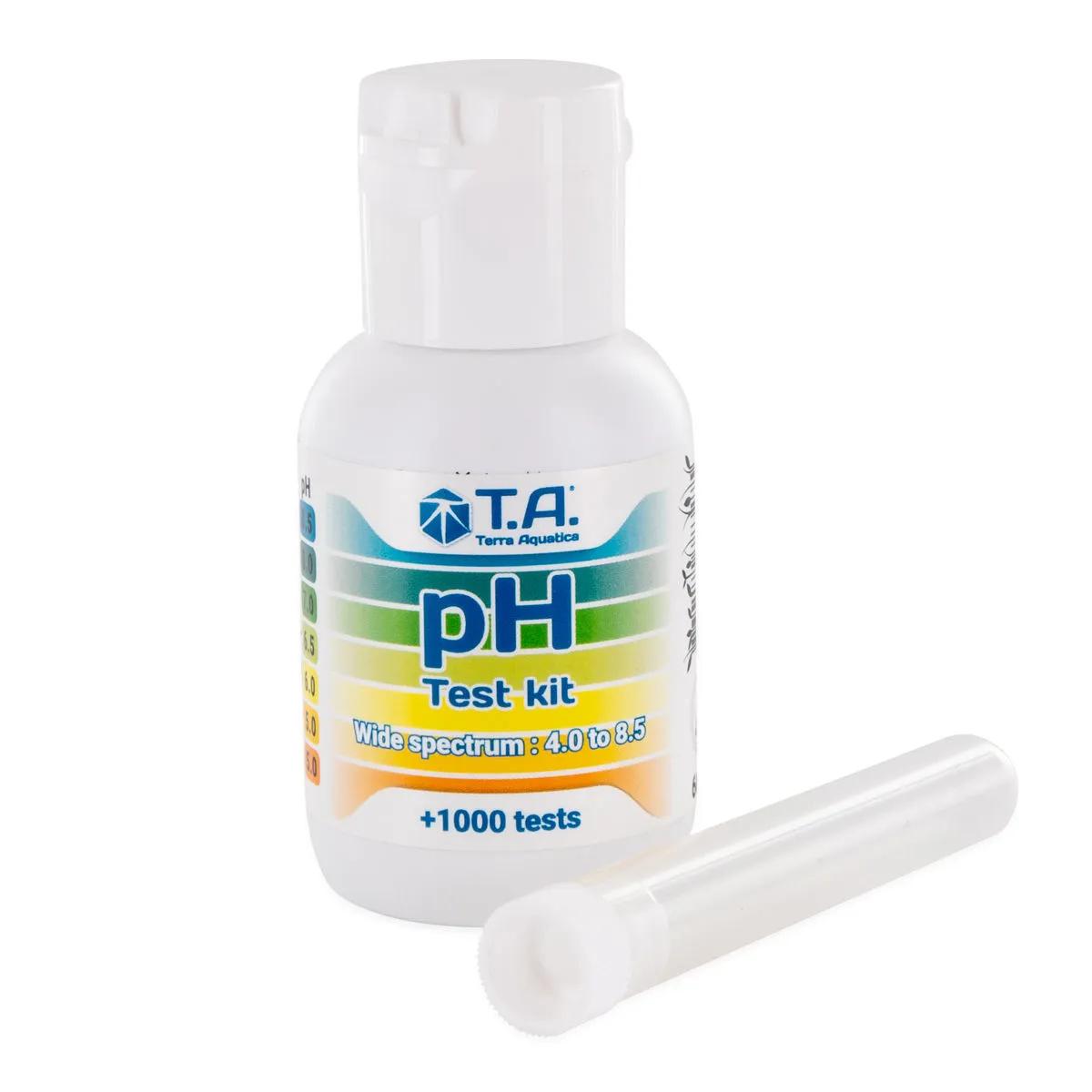
Liquid pH Test Kit by Terra Aquatica — No Batteries, No Nonsense
The Liquid pH Test Kit from Terra Aquatica is a chemical indicator solution that gives you a reliable pH reading in under a minute — no electronics, no calibration, no fuss. One 60ml bottle covers roughly 1,000 tests across a pH range of 4.0 to 8.5, making it the best low-cost pH testing method for growers who want accuracy without maintaining a digital meter. Two drops, a quick shake, and a colour match — that's genuinely all there is to it.
| Specification | Detail |
|---|---|
| Brand | Terra Aquatica (formerly GHE) |
| Volume | 60ml |
| Approximate tests per bottle | ~1,000 |
| pH range | 4.0–8.5 |
| Method | Liquid indicator + colour chart |
| Power source | None — fully chemical |
| Included | 60ml indicator solution, test tube, colour comparison chart |
| SKU | HS1563 |
Once you know your pH reading, you'll need to adjust it. Pair this kit with Terra Aquatica pH Down or pH Up solutions to dial in your nutrient solution precisely. If you're running a full hydro or soil setup, grab TriPart nutrients to complete the feeding programme — this test kit is built to work hand-in-hand with the entire Terra Aquatica range.
Why pH Testing Matters More Than Most Growers Think
pH is the gatekeeper of nutrient uptake. Your plants can be sitting in the richest feed solution money can buy, and if the pH is off, they'll starve anyway. Nutrients lock out at the wrong pH — iron becomes unavailable above 6.5, phosphorus locks out below 5.5, and calcium goes sideways in either direction. According to research published in PMC, salinity and phosphorus availability directly affect the physiological responses and nutrient uptake in plants, with pH playing a mediating role in how effectively roots absorb what's in the solution (PMC, 2022).
We've seen growers pour money into expensive nutrients, fancy substrates, and top-shelf genetics — then never once check their pH. The symptoms show up as yellowing leaves, burnt tips, or stunted growth, and the first question is always "what's wrong with my nutes?" Nine times out of ten, the nutes are fine. The pH isn't. Terra Aquatica themselves recommend keeping your nutrient solution between 5.5 and 6.5, with a sweet spot of 5.5 to 6.2 for most setups. That's a narrow window, and you won't hit it by guessing.
The honest limitation here: a liquid test kit gives you a colour-match reading, not a decimal-precise digital number. You're reading 5.5 vs 6.0 vs 6.5 by comparing shades of yellow, green, and blue. For most home growers, that resolution is more than enough — you need to know "am I in the zone or not," and this tells you clearly. If you're running a commercial operation where you need to distinguish 5.8 from 6.0, you'll want a digital pH pen. But for the price of this kit versus a decent digital meter, the value per test is hard to argue with.
How to Use the Terra Aquatica Liquid pH Test Kit
The whole process takes about 30 seconds once you've done it twice. No warm-up time, no electrode storage solution, no calibration buffers. Here's the method:
- Fill the included test tube with your nutrient solution up to the marked line. Use the solution you've already mixed — testing plain water before adding nutrients tells you nothing useful.
- Add exactly 2 drops of the pH indicator liquid into the test tube. Not 1, not 3 — the colour accuracy depends on a consistent 2-drop dose.
- Cap the test tube and give it a firm shake for about 5 seconds. The solution will change colour immediately.
- Hold the test tube against the colour comparison chart included in the kit. Match the resulting colour to the nearest value on the chart. Yellow tones indicate acidic (below 6.0), green sits around neutral (6.0–7.0), and blue shades mean alkaline (above 7.0).
- If the pH falls outside the 5.5–6.5 range, adjust with pH Up or pH Down solution, wait 15 minutes, and test again. Always retest after adjusting — overshooting happens easily.
- Rinse the test tube with clean water after each use. Residual indicator dye will throw off your next reading if you skip this step.
pH Ranges and What They Mean for Your Plants
Keeping pH within the right window directly affects how efficiently your plants absorb nutrients from solution. According to research on nutrient uptake in hydroponic systems, the availability of both essential and potentially toxic elements shifts significantly with pH changes in the growing medium (PMC, 2024). Here's a quick reference for what the colour chart readings mean in practice:
| pH Reading | What It Means | Action |
|---|---|---|
| 4.0–5.0 | Too acidic — nutrient lockout likely, especially calcium and magnesium | Add pH Up gradually |
| 5.5–6.2 | Sweet spot for most hydro and soil setups (Terra Aquatica recommended range) | No adjustment needed |
| 6.2–6.5 | Acceptable upper range — still functional but approaching the limit | Monitor closely |
| 6.5–7.5 | Too alkaline — iron and phosphorus become unavailable | Add pH Down gradually |
| 7.5–8.5 | Far too alkaline — serious nutrient deficiencies will appear | Add pH Down, check water source |
Research into the combined effects of salinity and phosphorus availability on wheat plants demonstrated that nutrient uptake and antioxidant responses vary significantly depending on the chemical environment of the root zone (PMC, 2023). While that study focused on wheat and salinity, the principle holds across species: the chemistry of your solution determines what your roots can actually absorb, and pH is the single biggest variable you can control.
Frequently Asked Questions
How accurate is a liquid pH test compared to a digital meter?
A liquid indicator kit reads in increments of roughly 0.5 pH units — so you can distinguish 5.5 from 6.0, but not 5.7 from 5.8. For home growing, that's precise enough to keep your nutrient solution in the right zone. Digital meters offer 0.01 resolution but require regular calibration and electrode maintenance to stay accurate.
How long does a 60ml bottle of pH test indicator last?
At 2 drops per test, the 60ml bottle provides approximately 1,000 tests. If you're testing once daily, that's nearly 3 years of use. Even testing twice daily with multiple reservoirs, you're looking at well over a year before you need a replacement.
Can I use this liquid pH test kit for soil runoff as well as hydroponics?
Yes. Collect the runoff water from your soil or coco pots, fill the test tube, and test exactly as you would a hydro reservoir. This is actually one of the best ways to check whether your substrate pH has drifted — the runoff tells you what's happening at root level.
Does the pH indicator liquid expire?
The indicator solution can lose accuracy over time, especially if exposed to direct sunlight or extreme temperatures. Store it in a cool, dark place with the cap tightly sealed. Under normal conditions, it stays reliable for 2–3 years. If the colours start looking washed out or inconsistent, replace the bottle.
Why does my pH keep changing after I adjust it?
pH drift is normal, especially in small reservoirs. Nutrient uptake by roots, temperature changes, and organic matter breakdown all shift pH over time. Test daily rather than assuming yesterday's adjustment still holds. This is exactly why a kit that lasts 1,000 tests makes more sense than expensive single-use strips.
What pH range should I aim for when growing in soil versus hydroponics?
Terra Aquatica recommends 5.5–6.2 as the optimal range for most setups. In soil, you can stretch slightly higher to 6.0–6.5 because soil buffers pH naturally. In hydro or coco, stick closer to 5.5–6.0 where nutrient availability peaks.
Do I need to test pH if I'm using tap water with bottled nutrients?
Absolutely. Tap water pH varies wildly by region — anywhere from 6.5 to 8.5 depending on your local supply. Adding nutrients typically drops the pH, but by how much depends on the water and the nutrient concentration. Never assume. Test every time you mix a fresh batch.
Last updated: April 2026