
This article discusses psychoactive substances intended for adults (18+). If you have a health condition or take medication, consult a doctor before use. Our age policy
Psilocybin Drug Interactions
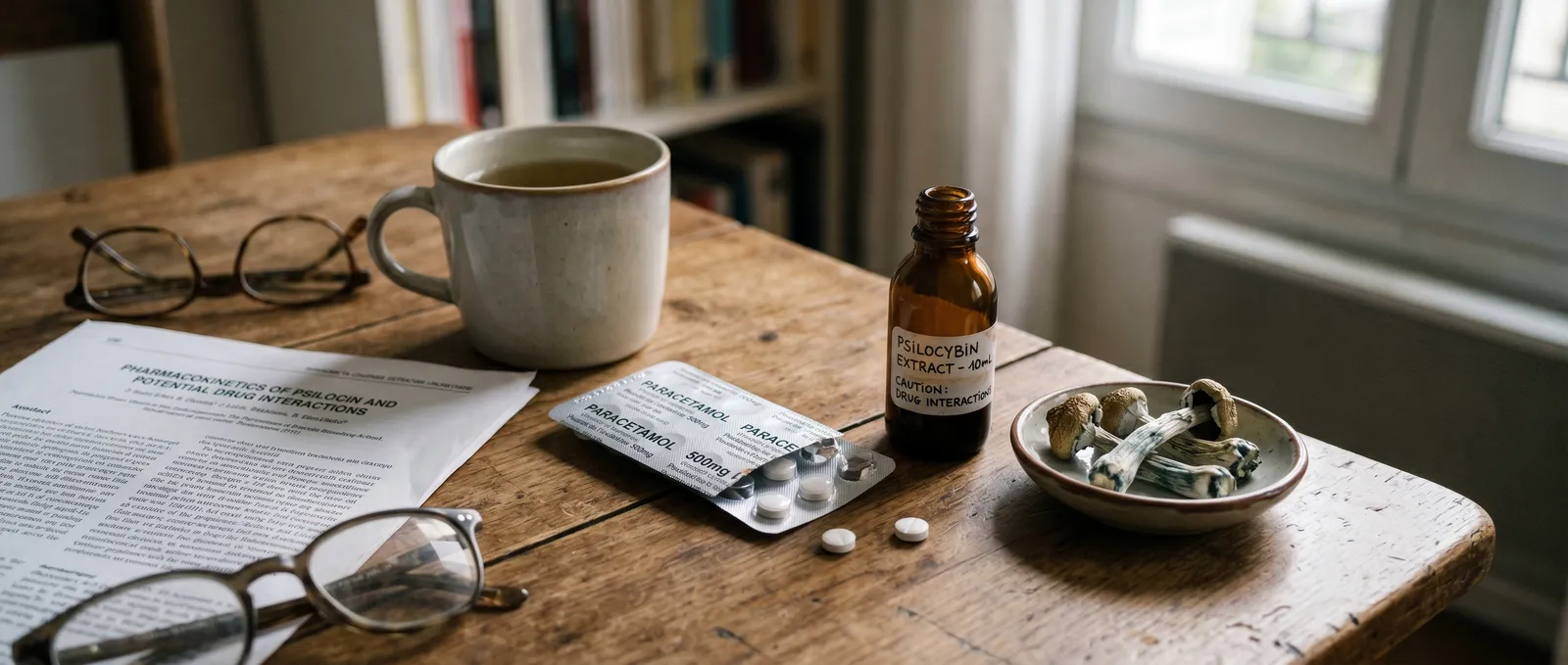
Definition
Psilocybin drug interactions occur when psilocin — the active metabolite of psilocybin — encounters other substances that affect the serotonin system. Some combinations blunt effects, others intensify them dangerously, and a few (notably lithium) carry seizure risk. Understanding the pharmacological mechanisms behind each interaction is critical for harm reduction.
A psilocybin drug interaction is a pharmacological event that occurs when psilocin — the active metabolite of psilocybin — encounters another substance in your body, producing effects that are sometimes dangerous, sometimes merely unexpected. Because psilocin acts primarily on serotonin receptors (specifically 5-HT2A), any other compound that touches the serotonin system can amplify, dampen, or destabilise the response. Some of these psilocybin drug interactions are merely inconvenient; others, like psilocybin with lithium, can trigger seizures. This article catalogues what the clinical and pharmacological literature tells us so far about how psilocybin interacts with other drugs, explains the mechanisms behind each combination, and flags the gaps where evidence is still thin.
Adult audience (18+). The dosing ranges and effects described in this article apply to adult physiology. This content is not intended for minors.
How Psilocybin Works — and Why Interactions Happen
Psilocybin is a prodrug that your body converts into psilocin, and this conversion is the foundation of every psilocybin drug interaction. Your liver enzyme alkaline phosphatase strips off a phosphate group, completing this conversion within about 20–40 minutes of ingestion (Passie et al., 2002). Psilocin then binds with high affinity to 5-HT2A receptors throughout the cortex, and with moderate affinity to 5-HT2C, 5-HT1A, and several other serotonin receptor subtypes (Halberstadt & Geyer, 2011). It also shows weak activity at dopamine D1 receptors, though the clinical significance of that remains unclear.
This serotonergic profile is the reason most psilocybin drug interactions follow a predictable pattern. Anything that increases serotonin availability (SSRIs, SNRIs, MAOIs, tramadol) risks additive effects. Anything that blocks 5-HT2A receptors (most antipsychotics, some mood stabilisers) can blunt or abolish the response. And anything that independently raises seizure risk or blood pressure becomes more dangerous when psilocin is already nudging those parameters upward — a 2020 double-blind crossover study found psilocybin increased systolic blood pressure by an average of 24 mmHg in healthy volunteers (Holze et al., 2022). Research supported by the Beckley Foundation has further explored how psilocin's receptor binding profile shapes these interactions at the neuronal level.
The half-life of psilocin is short — roughly 2.5–3 hours — but many interacting medications have far longer half-lives. Fluoxetine, for example, has an active metabolite (norfluoxetine) that lingers for 4–16 days. Washout periods matter enormously and differ for every drug class.
Primary Interaction Table
The table below is the most complete publicly available summary of clinically relevant psilocybin drug interactions. Risk levels reflect the current weight of evidence: "Dangerous" means documented cases of serious adverse events or strong pharmacological rationale for harm; "Significant" means reliable reports of altered effects or moderate safety concern; "Moderate" means the interaction is real but generally manageable with awareness; "Minor/Theoretical" means limited evidence or minor clinical impact.
| Drug / Drug Class | Interaction Mechanism | Clinical Effect | Risk Level | Key Evidence |
|---|---|---|---|---|
| Lithium | Lithium lowers seizure threshold and affects serotonin signalling; combined 5-HT2A stimulation may trigger cortical hyperexcitability | Seizures, cardiac arrhythmias, loss of consciousness — multiple case reports | Dangerous | Nayak et al., 2021 (survey of 1,993 respondents: lithium + psilocybin associated with seizures in multiple cases) |
| MAOIs (phenelzine, tranylcypromine, moclobemide, Syrian rue / harmine) | MAO-A inhibition slows psilocin metabolism and increases synaptic serotonin; dual serotonergic load | Serotonin toxicity risk; dramatically intensified and prolonged effects; hypertensive crisis possible | Dangerous | Gillman, 2005; pharmacological extrapolation from tryptamine-MAOI interactions |
| SSRIs (fluoxetine, sertraline, citalopram, escitalopram, paroxetine) | Chronic SSRI use downregulates 5-HT2A receptors; acute serotonin reuptake inhibition raises synaptic 5-HT | Substantially blunted subjective effects in most users; theoretical serotonin syndrome risk at higher doses, though documented cases are rare | Significant | Becker et al., 2022 (online survey, n=1,963: chronic SSRI users reported ~50% reduction in psilocybin effects); Gukasyan et al., 2023 |
| SNRIs (venlafaxine, duloxetine) | Similar to SSRIs — serotonin reuptake inhibition plus noradrenaline effects; venlafaxine has additional weak 5-HT2A activity | Blunted effects; serotonin syndrome risk somewhat higher than SSRIs due to dual mechanism | Significant | Becker et al., 2022 (SNRIs showed effect reduction comparable to SSRIs) |
| Tramadol | Serotonin reuptake inhibition + opioid agonism + seizure threshold lowering | Elevated serotonin syndrome and seizure risk | Significant | Pharmacological rationale; tramadol-related seizures are well-documented independently (Marquardt et al., 2005) |
| Typical antipsychotics (haloperidol, chlorpromazine) | Potent 5-HT2A and D2 antagonism | Near-complete abolition of psilocybin effects; used clinically as "abort switch" in research settings | Significant | Vollenweider et al., 1998 (ketanserin, a 5-HT2A antagonist, fully blocked psilocybin effects at 40 mg) |
| Atypical antipsychotics (risperidone, olanzapine, quetiapine) | Variable 5-HT2A and D2 antagonism depending on agent | Risperidone blocks effects almost completely; quetiapine (weaker 5-HT2A binding) may reduce but not eliminate effects | Significant | Vollenweider et al., 1998; clinical trial exclusion criteria consistently list antipsychotics |
| Benzodiazepines (diazepam, alprazolam, lorazepam) | GABAergic anxiolysis; no direct serotonergic mechanism | Reduced intensity and anxiety; used as rescue medication in clinical trials. No dangerous pharmacological interaction, but may blunt therapeutic benefit | Moderate | Johnson et al., 2018 (Johns Hopkins protocol uses benzodiazepines as optional rescue) |
| Cannabis / THC | Endocannabinoid modulation of glutamate and serotonin circuits; CB1 agonism in cortical areas | Unpredictable: some report amplified visual effects and anxiety, others report smoother experience. Increased heart rate likely additive | Moderate | Nayak et al., 2021 (survey data: cannabis co-use associated with higher rates of challenging psychological effects) |
| Stimulants (amphetamine, methylphenidate, MDMA, cocaine) | Increased dopamine and noradrenaline; MDMA additionally releases serotonin | Elevated cardiovascular strain (blood pressure, heart rate); MDMA combination carries additional serotonin syndrome risk | Moderate | Holze et al., 2022 (psilocybin cardiovascular data); pharmacological extrapolation |
| Other serotonergic psychedelics (LSD, DMT, mescaline) | Additive 5-HT2A agonism; cross-tolerance develops rapidly | If taken concurrently: unpredictable intensification. If taken within 7–14 days: reduced effects due to rapid receptor downregulation | Moderate | Nichols, 2016 (cross-tolerance review) |
| Tricyclic antidepressants (amitriptyline, nortriptyline) | Serotonin reuptake inhibition plus anticholinergic effects; chronic use downregulates 5-HT2A | Likely blunted effects, similar to SSRIs; anticholinergic load may add confusion at high doses | Minor / Theoretical | Limited direct evidence; mechanism inferred from SSRI data and receptor pharmacology |
| Alcohol (ethanol) | GABAergic CNS depression; no direct serotonergic interaction | Impaired judgement; nausea more likely; no known dangerous pharmacological combination, but set and setting are compromised | Minor / Theoretical | No controlled studies; anecdotal reports consistently negative regarding experience quality |
The SSRI Question: Blunted Effects vs Serotonin Syndrome
Chronic SSRI use blunts psilocybin's subjective effects by approximately 50%, making this the most commonly asked-about psilocybin drug interaction. According to a large online survey by Becker et al. (2022) involving 1,963 participants, people on chronic SSRIs reported roughly half the subjective intensity of psilocybin compared to non-medicated users. Some reported feeling almost nothing at all. The mechanism is well understood: weeks of SSRI use cause 5-HT2A receptors to downregulate — there are simply fewer receptors available for psilocin to bind.
The flip side is serotonin syndrome. Psilocin flooding a system already loaded with extra synaptic serotonin from SSRI reuptake inhibition could theoretically tip the balance into toxicity — characterised by agitation, hyperthermia, clonus (involuntary muscle jerking), and in severe cases, organ failure. In practice, documented cases of full serotonin syndrome from psilocybin + SSRIs are extremely rare. A 2023 review by Gukasyan et al. found no confirmed cases in clinical trial settings, though trials systematically exclude SSRI users, so the data is inherently limited.
What does this mean practically? The blunting effect is near-universal. The serotonin syndrome risk is low but not zero, and it likely increases with higher SSRI doses and shorter washout windows. Abruptly stopping SSRIs to try to get more out of psilocybin is itself dangerous — SSRI discontinuation syndrome can be severe, and the psychological destabilisation of withdrawal is a terrible foundation for a serotonergic experience. Anyone on SSRIs considering psilocybin should involve their prescribing physician in that conversation.
Lithium: The Hard No
Lithium combined with psilocybin carries a documented risk of seizures, making it the single most dangerous psilocybin drug interaction in the current literature. Nayak et al. (2021) surveyed 1,993 people who had combined psychedelics with lithium. Multiple respondents reported seizures — an outcome essentially absent in psilocybin-only reports. Others described cardiac irregularities and prolonged, distressing psychological states.
The mechanism is not fully mapped, but lithium affects serotonin transmission at multiple points: it enhances tryptophan uptake (increasing serotonin synthesis), modulates 5-HT1A and 5-HT2A receptor sensitivity, and independently lowers the seizure threshold. Layer psilocin's potent 5-HT2A agonism on top of that, and you have a recipe for cortical hyperexcitability. Every major psilocybin clinical trial — Johns Hopkins, Imperial College, COMPASS Pathways — lists lithium as an absolute exclusion criterion.
MAOIs and the Ayahuasca Parallel
MAO-A inhibitors dramatically intensify and prolong psilocybin's effects while introducing genuine serotonin toxicity risk, making this one of the most dangerous categories of psilocybin drug interactions. Monoamine oxidase inhibitors come in two flavours relevant here: pharmaceutical (phenelzine, tranylcypromine, moclobemide) and botanical (harmine and harmaline from Banisteriopsis caapi or Syrian rue). Both inhibit MAO-A, the enzyme that breaks down serotonin, noradrenaline, and — critically — psilocin.
When MAO-A is inhibited, psilocin sticks around longer and synaptic serotonin climbs higher. Gillman (2005) outlined the pharmacological basis for serotonin syndrome with tryptamine-MAOI combinations, and while his work focused primarily on DMT (the basis of ayahuasca), the mechanism applies directly to psilocin as a closely related tryptamine.
Moclobemide, a reversible MAO-A inhibitor (RIMA), is sometimes perceived as safer. It is — compared to irreversible MAOIs — but "safer" does not mean "safe in combination." A 2023 case report described a patient who combined moclobemide with psilocybin and developed serotonin toxicity requiring hospital admission (Malcolm & Thomas, 2023). Reversibility of the enzyme inhibition helps, but it does not eliminate the risk when a potent serotonin agonist enters the picture.
Antipsychotics: The Off-Switch
Antipsychotics block psilocybin's effects almost entirely by antagonising the 5-HT2A receptors that psilocin requires. Vollenweider et al. (1998) demonstrated this cleanly: pre-treatment with ketanserin (a selective 5-HT2A antagonist) completely abolished the subjective effects of psilocybin in healthy volunteers. Haloperidol, a typical antipsychotic, partially blocked effects through a combination of 5-HT2A and D2 antagonism.
This is why clinical research protocols keep antipsychotics on hand as emergency abort medication. If someone is in acute distress, risperidone or haloperidol will end the experience within 20–30 minutes. Quetiapine — often prescribed off-label for sleep at low doses — has weaker 5-HT2A binding, so its blocking effect is less complete and dose-dependent.
The interaction is not dangerous in the traditional sense. Nobody has been harmed by the combination. But for anyone taking antipsychotics therapeutically, the implications are twofold: psilocybin likely will not work as expected, and discontinuing antipsychotic medication to enable a psilocybin session is a serious clinical decision that belongs firmly in the hands of a psychiatrist.
Stimulants and Cardiovascular Load
Stimulants combined with psilocybin produce additive cardiovascular strain, raising both blood pressure and heart rate beyond what either substance causes alone. Holze et al. (2022) measured mean peak increases of 24 mmHg systolic and 17 bpm heart rate with psilocybin alone in healthy adults. These numbers are clinically unremarkable for most people, but they become relevant when stacked with stimulants.

Amphetamine, methylphenidate (Ritalin/Concerta), cocaine, and MDMA all independently raise cardiovascular parameters. The combination is additive at minimum. MDMA adds a specific wrinkle: it triggers massive serotonin release, creating a dual-agonist scenario at 5-HT2A receptors (psilocin directly, MDMA indirectly via serotonin flood). The theoretical serotonin syndrome risk is higher here than with SSRIs, though controlled data on this specific psilocybin drug interaction does not exist — no ethics board would approve that trial.
For people prescribed stimulants for ADHD, the picture is less alarming. Methylphenidate primarily affects dopamine and noradrenaline, with minimal serotonergic activity. The main concern is cardiovascular. Clinical trials at Johns Hopkins and Imperial College have generally required stimulant washout, but this reflects an abundance of caution rather than documented harm.
Cannabis: The Wildcard
Cannabis produces unpredictable modulation of psilocybin effects, with survey data linking co-use to higher rates of challenging psychological experiences. The Nayak et al. (2021) survey found that cannabis co-use was associated with more anxiety, more confusion, and more difficulty integrating the experience afterward. The endocannabinoid system modulates glutamate and serotonin circuits in ways that are still being mapped, so predicting individual responses is essentially impossible with current knowledge.
What can be said with confidence: THC raises heart rate (typically 20–50% above baseline), so combining it with psilocybin's cardiovascular effects means a faster, harder-working heart. CBD, by contrast, has anxiolytic properties and does not raise heart rate, though whether it meaningfully modulates psilocybin effects is unknown — no published study has examined this combination directly.
Cannabis Co-Use vs Psilocybin Alone: A Comparison
Compared to psilocybin taken on its own, adding cannabis tends to increase heart rate more substantially, introduces a layer of cognitive fogginess that many users find disorienting, and — according to the Nayak survey — roughly doubles the likelihood of a "challenging" experience. On the other hand, some users report that low-dose CBD-dominant cannabis softens the come-up anxiety without adding confusion. The honest limitation here is that we simply do not have controlled data: every observation comes from self-report, and set, setting, and individual neurochemistry likely matter more than the combination itself.
Washout Periods and Timing
Washout periods determine how long after stopping a medication the psilocybin drug interaction risk persists. For psilocin itself, it is gone in roughly 6–8 hours. But for interacting medications, the relevant window is how long they take to clear your system:
- Fluoxetine: Active metabolite norfluoxetine has a half-life of 4–16 days. Full washout may take 5–6 weeks.
- Sertraline: Half-life ~26 hours. Approximately 5–7 days for clearance, though receptor normalisation takes longer.
- Venlafaxine: Half-life ~5 hours (active metabolite ~11 hours). Clears faster, but discontinuation syndrome can be brutal.
- Lithium: Half-life 18–36 hours. However, given the severity of the interaction, most clinical protocols require at least 2 weeks — and this must be medically supervised.
- Irreversible MAOIs: Enzyme regeneration takes approximately 2 weeks after the last dose.
- Moclobemide: Half-life ~2 hours, but 48–72 hours washout is typically recommended.
5-HT2A receptor upregulation after chronic SSRI use takes additional time — potentially 2–4 weeks beyond drug clearance — which is why someone who stopped fluoxetine six weeks ago may still find psilocybin effects muted. The pharmacology here involves receptor density changes at the cellular level, not just drug concentrations in blood, and individual variation is substantial.
What the Clinical Trials Exclude — and What That Tells Us
Clinical trial exclusion lists serve as a practical proxy for the severity of psilocybin drug interactions with other medications. The COMPASS Pathways phase IIb trial for treatment-resistant depression (Goodwin et al., 2022) excluded participants taking: lithium, MAOIs, antipsychotics, stimulants, and — notably — required a minimum 2-week washout from SSRIs and SNRIs (6 weeks for fluoxetine). The Johns Hopkins cancer anxiety trials (Griffiths et al., 2016) used similar criteria.

These exclusions are conservative by design — clinical trials cannot afford adverse events — but they reflect genuine pharmacological concern. The fact that benzodiazepines are not excluded (and are kept on hand as rescue medication) tells you something about the relative risk: benzodiazepines interact with psilocybin experientially but not dangerously.
Supplements and Over-the-Counter Interactions
St John's Wort acts as a mild serotonin reuptake inhibitor and CYP enzyme inducer, making it a theoretically relevant psilocybin drug interaction that most people overlook. Similarly, 5-HTP (5-hydroxytryptophan) directly increases serotonin synthesis and could amplify serotonergic load when combined with psilocin. Tryptophan supplements work through the same pathway. None of these combinations have been studied in controlled settings, which is an honest limitation of the current evidence base — we are reasoning from mechanism, not from data. Anyone taking herbal supplements should be aware that "natural" does not mean "interaction-free." Products containing St John's Wort or 5-HTP merit careful timing relative to any planned psilocybin use. You can get more background on these supplements in the Azarius encyclopedia, which covers topics like magic mushroom species, psilocybin tolerance, and the pharmacology of other psychoactive substances in our catalogue.
Harm Reduction in Practice
Practical harm reduction for psilocybin drug interactions starts with knowing exactly what is in your system.
The EMCDDA (European Monitoring Centre for Drugs and Drug Addiction) provides regularly updated information on drug interactions and emerging substances, and is a valuable resource for anyone in Europe seeking evidence-based harm reduction guidance. Checking their database before combining any substances is a reasonable precaution. Reagent testing supplies can help verify what substance you actually have — an essential first step before considering any combination. You can also find related reading in the Azarius encyclopedia on topics like magic truffles, microdosing protocols, and the pharmacology of other psychoactive substances in our catalogue.
If you are on any psychiatric medication and are considering psilocybin — whether in a therapeutic, ceremonial, or personal context — the single most important step is a conversation with your prescriber. Not because they will necessarily approve, but because they understand your specific pharmacological situation in a way that no article, however detailed, can replicate.
Gaps in the Evidence
Most of what we know about psilocybin drug interactions comes from pharmacological reasoning, survey data, and clinical trial exclusion criteria — not from controlled interaction studies. As of early 2026, no published randomised controlled trial has directly measured the effect of co-administering psilocybin with an SSRI, an antipsychotic, or lithium in a laboratory setting. The Becker et al. (2022) survey is the largest dataset, but self-reported experiences carry obvious limitations: imprecise dosing, unverified drug identification, recall bias.
The interaction with cannabis is particularly under-studied despite being one of the most common real-world combinations. The same is true for supplements like 5-HTP, St John's Wort, and tryptophan — all of which theoretically interact but lack formal investigation. We are being honest about what we do not know: for many of these psilocybin drug interactions, the evidence simply does not exist yet, and anyone who tells you otherwise is overstating the science.
Last updated: April 2026
Frequently Asked Questions
10 questionsCan you take psilocybin while on SSRIs?
Why is lithium dangerous to combine with psilocybin?
How long should you stop antidepressants before taking psilocybin?
Do antipsychotics block psilocybin effects?
Is it safe to combine cannabis with psilocybin?
Can MAOIs like Syrian rue cause serotonin syndrome with psilocybin?
Does psilocybin raise blood pressure and is it dangerous with hypertension medication?
How long does psilocin stay in your system and why do washout periods matter for drug interactions?
Does tramadol interact with psilocybin?
Can you drink alcohol with psilocybin?
About this article


Adam Parsons is an external cannabis and psychedelics writer and editor who contributes to Azarius's wiki as both author and reviewer. On the writing side, he authors Azarius's kratom and kanna clusters, drawing on exten
This wiki article was drafted with AI assistance and reviewed by Adam Parsons, External contributor. Editorial oversight by Joshua Askew.
Medical disclaimer. This content is for informational purposes only and does not constitute medical advice. Consult a qualified healthcare provider before use of any substance.
Last reviewed April 24, 2026
References (15)
- [1]Becker, A.M., et al. (2022). "Acute effects of psilocybin after escitalopram or placebo pretreatment in a randomized, double-blind, placebo-controlled, crossover study in healthy subjects." Clinical Pharmacology & Therapeutics , 111(4), 886–895.
- [2]Gillman, P.K. (2005). "Monoamine oxidase inhibitors, opioid analgesics and serotonin toxicity." British Journal of Anaesthesia , 95(4), 434–441. DOI: 10.1093/bja/aei210
- [3]Goodwin, G.M., et al. (2022). "Single-dose psilocybin for a treatment-resistant episode of major depression." New England Journal of Medicine , 387(18), 1637–1648.
- [4]Griffiths, R.R., et al. (2016). "Psilocybin produces substantial and sustained decreases in depression and anxiety in patients with life-threatening cancer." Journal of Psychopharmacology , 30(12), 1181–1197. DOI: 10.1177/0269881116675513
- [5]Halberstadt, A.L. & Geyer, M.A. (2011). "Multiple receptors contribute to the behavioral effects of indoleamine hallucinogens." Neuropharmacology , 61(3), 364–381. DOI: 10.1016/j.neuropharm.2011.01.017
- [6]Holze, F., et al. (2022). "Direct comparison of the acute effects of lysergic acid diethylamide and psilocybin in a double-blind placebo-controlled study in healthy subjects." Neuropsychopharmacology , 47(6), 1180–1187. DOI: 10.1038/s41386-022-01297-2
- [7]Johnson, M.W., et al. (2018). "Classic psychedelics: An integrative review of epidemiology, therapeutics, mystical experience, and brain network function." Pharmacology & Therapeutics , 197, 83–102.
- [8]Malcolm, B. & Thomas, K. (2023). "Serotonin toxicity of serotonergic psychedelics." Psychopharmacology , 239(6), 1881–1891.
- [9]Marquardt, K.A., et al. (2005). "Tramadol exposures reported to statewide poison control system." Annals of Pharmacotherapy , 39(6), 1039–1044. DOI: 10.1345/aph.1e577
- [10]Nayak, S.M., et al. (2021). "Classic psychedelic coadministration with lithium, but not lamotrigine, is associated with seizures: An analysis of online psychedelic community survey data." Psychopharmacology , 238, 3281–3291. DOI: 10.31234/osf.io/r726d
- [11]Nichols, D.E. (2016). "Psychedelics." Pharmacological Reviews , 68(2), 264–355.
- [12]Passie, T., et al. (2002). "The pharmacology of psilocybin." Addiction Biology , 7(4), 357–364.
- [13]Vollenweider, F.X., et al. (1998). "Psilocybin induces schizophrenia-like psychosis in humans via a serotonin-2 agonist action." NeuroReport , 9(17), 3897–3902. DOI: 10.1097/00001756-199812010-00024
- [14]Gukasyan, N., et al. (2023). "Psilocybin-assisted therapy and concurrent antidepressant use." Journal of Psychopharmacology , 37(1), 69–78.
- [15]EMCDDA (2025). "Drug Interactions and Emerging Substances." European Monitoring Centre for Drugs and Drug Addiction.
Related Articles

Hawaiian Baby Woodrose Sourcing
Hawaiian baby woodrose sourcing is a practice that covers how to obtain quality Argyreia nervosa seeds — a vine whose seeds contain LSA (lysergic acid amide).
LSA Legal Status in Europe
LSA (lysergic acid amide, or ergine) occupies a legal grey zone across Europe — rarely scheduled as a compound, yet subject to varied NPS legislation that…

Ololiuqui Mazatec Tradition: Ceremonial Seeds of the Sierra Mazateca
Ololiuqui — the seeds of Turbina corymbosa — played a specific ceremonial role among the Mazatec people of Oaxaca, distinct from their better-known use of…

Morning Glory LSA Plants Family
Morning glory LSA plants family is a group of Convolvulaceae vines whose seeds contain d-lysergic acid amide (ergine), a naturally occurring tryptamine first…

Hawaiian Baby Woodrose Plant Botany
Argyreia nervosa, commonly called Hawaiian baby woodrose, is a perennial climbing vine native to the Indian subcontinent, not Hawai'i.

Magic Truffle Quality Indicators
Magic truffle quality indicators are the measurable and sensory characteristics — psilocybin content, texture, aroma, packaging integrity, and storage…

Mescaline Cactus Market Observations
Mescaline cactus market observations is a research and retail term that describes the shifting patterns in sourcing, species selection, and consumption of…

Growing Mescaline Cacti as Ornamental Plants
Growing mescaline cacti ornamental is a horticultural practice that involves cultivating species like San Pedro, Peruvian Torch, and peyote for their…
Commercial Magic Truffle Cultivation
Commercial magic truffle cultivation is a large-scale agricultural process that produces psilocybin-containing sclerotia in climate-controlled indoor…