
This article discusses psychoactive substances intended for adults (18+). If you have a health condition or take medication, consult a doctor before use. Our age policy
Kratom Vs Kava
Definition
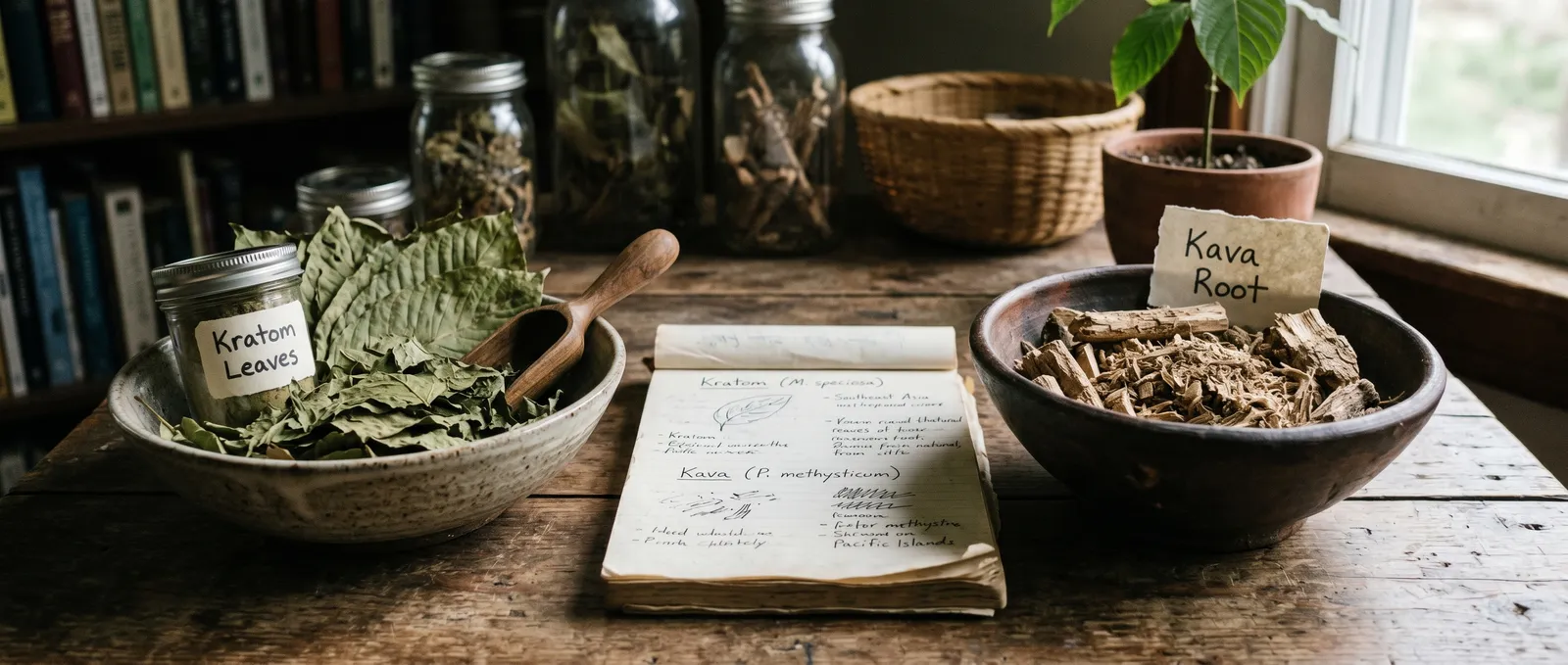
Kratom vs kava is a comparison that surfaces frequently, but kratom (Mitragyna speciosa) is a tropical tree in the coffee family whose leaves contain opioid-receptor-active alkaloids, while kava (Piper methysticum) is a pepper-family shrub whose root produces GABAergic kavalactones — making them fundamentally different substances despite both being sold as natural relaxants.
Kratom vs kava is a comparison that surfaces frequently, but kratom (Mitragyna speciosa) is a tropical tree in the coffee family whose leaves contain opioid-receptor-active alkaloids, while kava (Piper methysticum) is a pepper-family shrub whose root produces GABAergic kavalactones — making them fundamentally different substances despite both being sold as natural relaxants. This article breaks down where they overlap, where they diverge, and what the actual research says about each.
Adult audience (18+). The dosing ranges and effects described in this article apply to adult physiology. This content is not intended for minors.
Disclaimer: This article is for informational purposes only and does not constitute medical advice. Kratom and kava are pharmacologically active substances with real risks. Do not use either substance as a substitute for professional medical treatment. Consult a qualified healthcare provider before using kratom, kava, or any other supplement, especially if you have pre-existing health conditions, take medications, or are pregnant or breastfeeding. Neither the European Monitoring Centre for Drugs and Drug Addiction (EMCDDA) nor any regulatory body has approved kratom or kava as medicines in the EU.
Comparison at a Glance
The most important difference between kratom vs kava is their receptor pharmacology: kratom acts primarily on opioid receptors, while kava modulates GABA-A receptors and ion channels (Kruegel & Bhowmik, 2016; Cairney et al., 2012).
| Dimension | Kratom (Mitragyna speciosa) | Kava (Piper methysticum) |
|---|---|---|
| Plant family | Rubiaceae (coffee family) | Piperaceae (pepper family) |
| Traditional region | Southeast Asia (Thailand, Malaysia, Indonesia) | Pacific Islands (Fiji, Vanuatu, Tonga, Samoa) |
| Primary active compounds | Mitragynine, 7-hydroxymitragynine (40+ alkaloids total) | Kavalactones (6 major: kavain, dihydrokavain, methysticin, dihydromethysticin, yangonin, desmethoxyyangonin) |
| Primary receptor targets | Mu-opioid (partial agonist), adrenergic, serotonergic | GABA-A modulation, sodium/calcium channel blockade, dopaminergic |
| Traditional preparation | Fresh leaves chewed or brewed as tea | Root pounded and steeped in cold water |
| Onset (oral) | 15–40 minutes (leaf); faster for extracts | 15–30 minutes |
| Duration | 3–6 hours (wide individual variance) | 2–4 hours |
| Dependence potential | Recognised withdrawal syndrome in daily heavy users | Low; no well-documented physical withdrawal syndrome |
| Liver concerns | Case reports exist; mechanism under investigation | Historical concern (noble vs. tudei cultivar debate); risk appears low with traditional aqueous preparations (Teschke et al., 2012) |
| Dose-dependent character shift | Marked — lower doses reported as stimulating, higher doses as sedating | Less pronounced — generally sedating/anxiolytic across doses |
What Is Kratom?
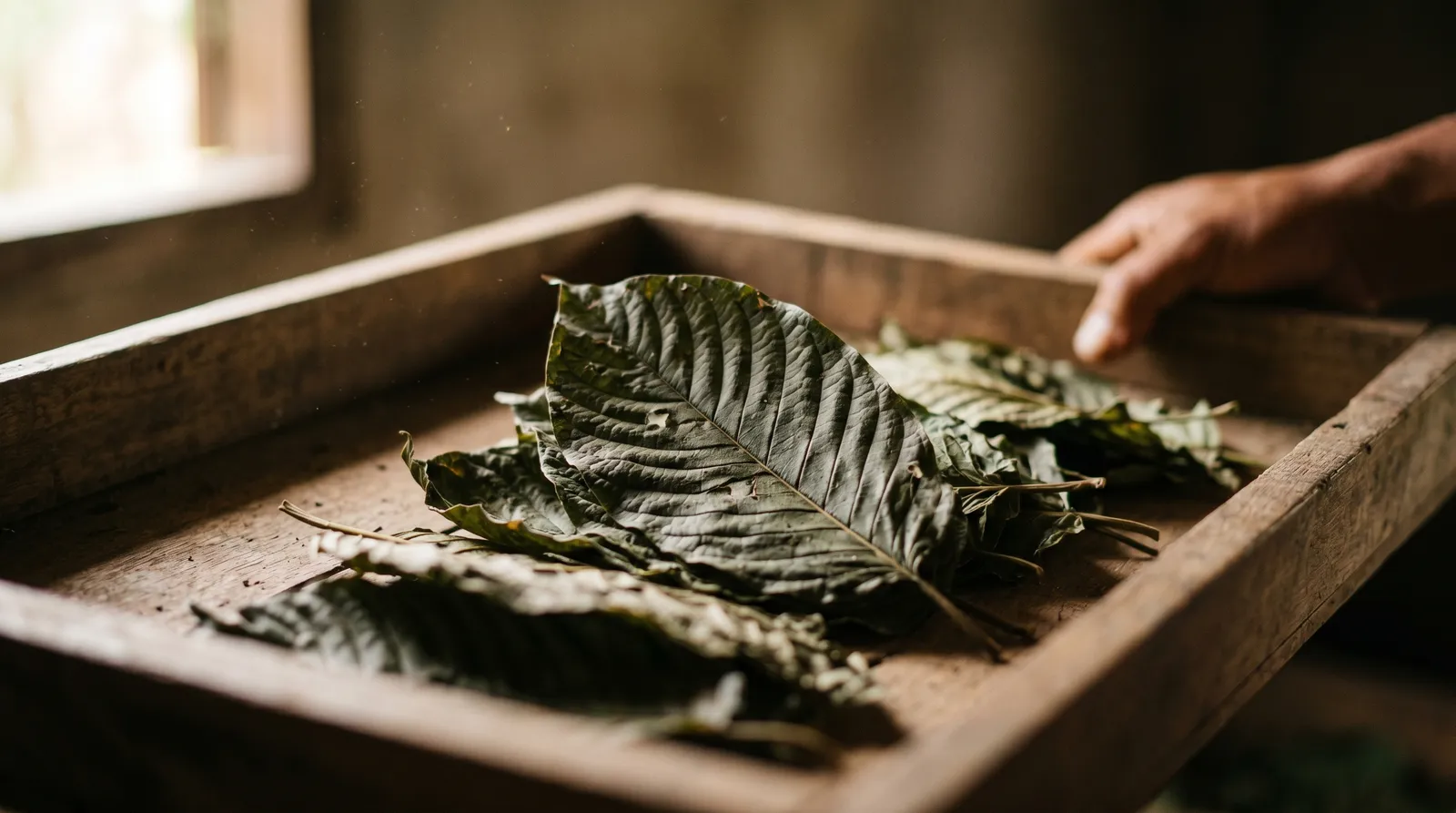
Kratom is a tropical evergreen tree native to Southeast Asia whose leaves contain over 40 alkaloids, the most pharmacologically significant being mitragynine and 7-hydroxymitragynine — both partial agonists at mu-opioid receptors (Kruegel & Bhowmik, 2016). These are the same receptors targeted by morphine and codeine, though kratom's binding profile is more complex, with activity also at adrenergic and serotonergic sites.
In Thailand and Malaysia, labourers have chewed fresh kratom leaves for generations, primarily for fatigue and physical discomfort during long working days. This ethnobotanical use is well documented (Suwanlert, 1975; Tanguay, 2011). The modern Western market, however, mostly deals in dried leaf powder, capsules, and concentrated extracts — and that distinction matters. Extracts concentrate mitragynine and 7-hydroxymitragynine substantially relative to plain leaf, which changes the risk profile in ways that aren't just about "strength." Tolerance builds faster, withdrawal can be more pronounced, and the margin between a dose that feels manageable and one that doesn't shrinks considerably.
A recognised withdrawal syndrome — irritability, muscle aches, insomnia, nausea — has been documented in daily heavy users (Singh et al., 2014). This is not a fringe finding; it's consistent across multiple survey studies. Tolerance also develops rapidly with consecutive daily dosing. The EMCDDA has flagged kratom as a substance of concern in its monitoring reports, noting the limited but growing body of adverse event data in European contexts (EMCDDA, 2021).
What Is Kava?
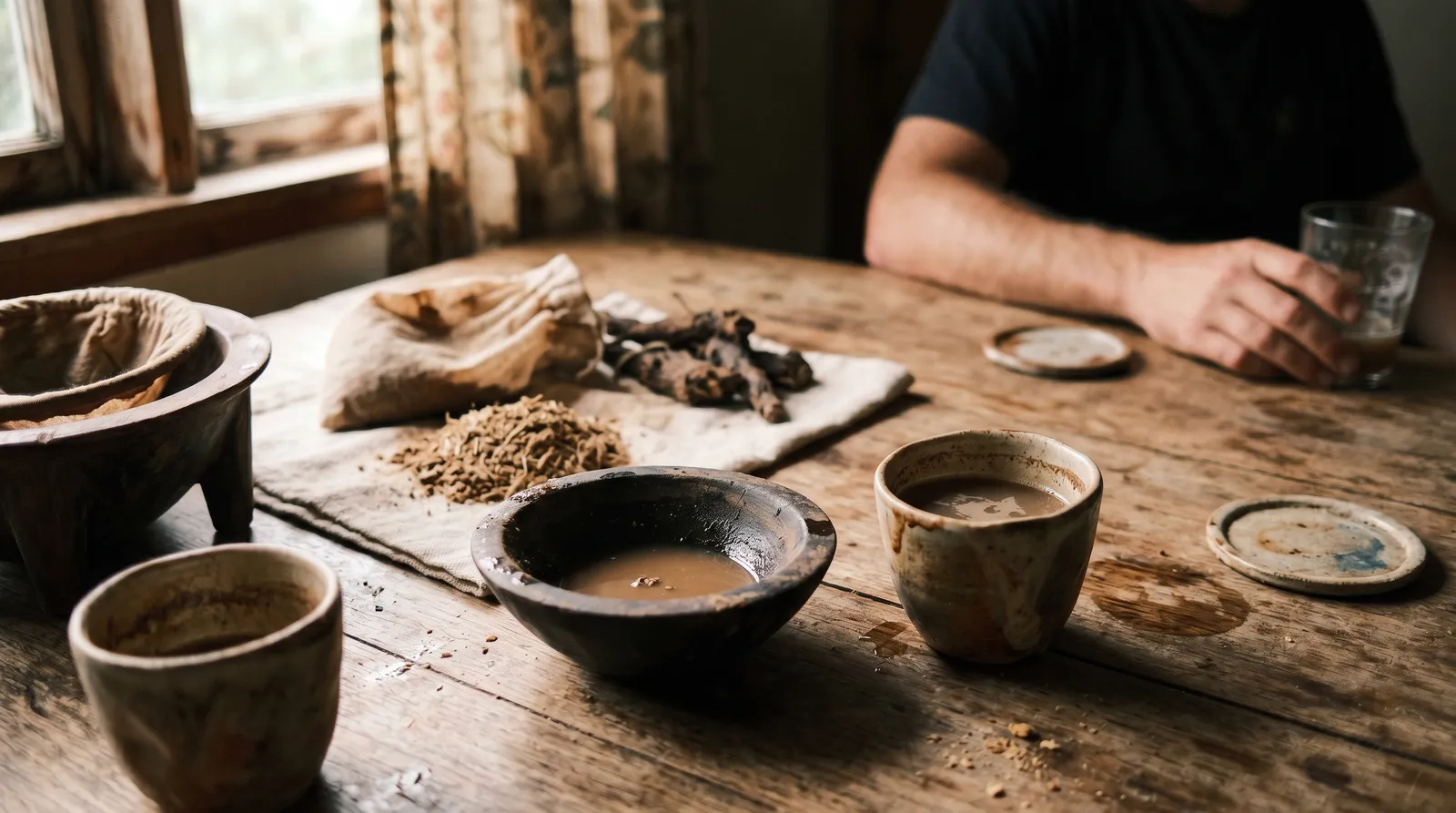
Kava is a shrubby plant from the Pacific Islands that has been central to ceremonial and social life for roughly 3,000 years, with its root containing six major kavalactones responsible for its anxiolytic and muscle-relaxant effects (Cairney et al., 2012). Traditional preparation involves pounding the root and straining it in cold water, producing a muddy, slightly numbing drink that tastes like earthy pepper water. If you've never tried it, imagine licking a dirty coin that somehow also relaxes your jaw muscles. It's an acquired taste.
Pharmacologically, kavalactones work through a different set of mechanisms than kratom's alkaloids. They modulate GABA-A receptors (similar in broad strokes to how benzodiazepines work, though the binding site and mechanism differ), block voltage-gated sodium and calcium channels, and influence dopamine reuptake (Cairney et al., 2012). The net result is anxiolytic and muscle-relaxant — a body-focused calm without the cognitive fog that alcohol tends to produce.
A Cochrane review (Pittler & Ernst, 2003) found kava extract superior to placebo for short-term anxiety, though the authors noted that trial quality was variable. More recent meta-analyses have broadly supported a modest anxiolytic effect (Smith & Leiras, 2018).
The liver toxicity scare of the early 2000s — which led several countries to restrict kava — has been substantially re-evaluated. Teschke et al. (2012) concluded that the hepatotoxicity cases were largely linked to non-traditional preparations (acetone or ethanol extracts using stem peelings and leaves, not root) and that aqueous root preparations carry a much lower risk. The distinction between noble kava cultivars (traditional, lower-risk) and tudei cultivars (higher in potentially problematic compounds like flavokavain B) is now considered relevant, though population-level incidence data for liver injury remains limited.
How the Mechanisms Differ
Kratom acts primarily on opioid receptors while kava modulates the GABAergic system — this is the single most important pharmacological distinction when weighing kratom vs kava (Kruegel et al., 2016; Cairney et al., 2012). Most comparison articles fall short precisely here.
Kratom's primary mechanism is opioid receptor agonism. Mitragynine and 7-hydroxymitragynine bind as partial agonists at the mu-opioid receptor (Kruegel et al., 2016). Partial agonism means they activate the receptor but with a ceiling effect — they don't produce the same maximal response as full agonists like morphine. This is pharmacologically significant: it's part of why kratom, at leaf-powder doses, carries a lower respiratory depression risk than classical opioids, though the risk is not zero, particularly with concentrated extracts or polydrug use.
Kava's mechanism centres on GABAergic modulation and ion channel activity. Kavalactones enhance GABA-A receptor function — increasing inhibitory signalling in the central nervous system — while also blocking sodium and calcium channels in a manner that contributes to muscle relaxation and local anaesthetic effects (the mouth-numbing sensation is not incidental; it reflects real sodium channel blockade). There is no meaningful opioid receptor activity.
In plain terms: kratom talks to the same system as painkillers. Kava talks to the same system as anti-anxiety medications. The subjective overlap — both can produce relaxation — masks a deep pharmacological divergence. When comparing kratom vs kava, this mechanistic difference should inform every other consideration, from dosing to dependence risk.
Effects and Dose-Dependence
Kratom produces a biphasic effect profile — stimulating at lower doses, sedating at higher doses — while kava remains consistently anxiolytic and sedating across its dose range (Grundmann, 2017; Foo & Lemon, 2004). Survey data (Grundmann, 2017; Swogger et al., 2015) consistently report that users describe lower doses (roughly 1–5 g of leaf powder) as stimulating — increased energy, alertness, sociability — while higher doses (5 g and above) shift toward sedation, analgesia, and what some users describe as a warm, heavy calm. This biphasic character is unusual and likely reflects the complex receptor pharmacology: at lower concentrations, adrenergic and serotonergic effects may dominate, while at higher concentrations, opioid agonism becomes more prominent. The exact crossover point varies between individuals, and pharmacokinetic data remains limited to small-sample studies with wide variance.
Kava is more consistent across its dose range. The primary experience is anxiolytic and muscle-relaxant: reduced social anxiety, physical relaxation, mild sociability. Higher doses intensify sedation and can impair motor coordination — a 2004 study by Foo and Lemon found significant slowing of reaction times at moderate-to-high kava doses. But you don't get the stimulant-to-sedative flip that characterises kratom. Kava is kava; it just gets heavier.
Neither substance should be framed as producing specific therapeutic outcomes for named conditions — claims about anxiety, depression, or pain management remain either contested (kratom for opioid cessation, for instance, where evidence is mixed and outcomes data are limited) or supported only by small trials and traditional use patterns. We want to be honest about the limits of current evidence: most kratom vs kava comparisons overstate certainty in both directions.
Dependence and Withdrawal
Kratom carries a significantly higher dependence risk than kava, based on documented withdrawal syndromes in daily users (Singh et al., 2014) and the absence of equivalent findings for kava (Cairney et al., 2012). Here's where the two diverge most sharply in terms of risk.
Kratom produces a well-characterised withdrawal syndrome in daily heavy users. Singh et al. (2014) documented symptoms including muscle aches, insomnia, irritability, nausea, and emotional disturbance. Whether moderate or occasional users develop clinically meaningful dependence is less clear — the evidence base skews heavily toward daily high-dose users, and controlled studies on intermittent use are sparse. What is clear: daily use, especially of extracts, builds tolerance rapidly and makes cessation progressively harder.
Kava does not have a well-documented physical withdrawal syndrome. Long-term heavy use in Pacific Island communities has been associated with a dry, scaly skin condition called kava dermopathy (Ruze, 1990), and very heavy users report tolerance to some effects, but the absence of an opioid-receptor mechanism means the withdrawal profile is fundamentally different. You can stop kava after weeks of daily use without the kind of rebound symptoms that kratom users report.
This doesn't make kava "safe" and kratom "dangerous" in absolute terms — context, dose, frequency, and individual biology all matter. But the dependence risk differential is real and pharmacologically grounded.
Safety and Interactions
Both kratom and kava interact with other drugs through CYP enzyme inhibition, and both carry dose-dependent risks that increase with frequency of use (Mathews et al., 2002; Kruegel & Bhowmik, 2016). The EMCDDA has noted kratom among new psychoactive substances warranting continued surveillance in Europe (EMCDDA, 2021).
Kratom should not be combined with other opioids, benzodiazepines, alcohol, MAOIs, or drugs that inhibit CYP3A4 or CYP2D6 enzymes (including fluoxetine, paroxetine, clarithromycin, and ketoconazole). Hepatotoxicity case reports exist, though the mechanism is under investigation and population-level incidence remains unclear. Anyone with pre-existing liver disease, a history of substance use disorder, or who is pregnant or breastfeeding should avoid kratom entirely. For a complete breakdown, see the dedicated Azarius wiki article on kratom drug interactions.
Kava should not be combined with alcohol, benzodiazepines, or other CNS depressants — the additive sedation can be significant. The liver concern, while re-evaluated, means kava is best avoided by anyone with existing liver conditions or those taking hepatotoxic medications. Kava also inhibits several CYP enzymes (notably CYP2E1), which can alter the metabolism of other drugs (Mathews et al., 2002).
Combining kratom and kava is not well studied. The theoretical concern is additive CNS depression at higher doses of both, plus overlapping hepatic metabolism burden. The absence of controlled data means the interaction profile is essentially unknown — which is itself a reason for caution.
Which Is Which, and Who Is It For?
The honest answer is that these are not interchangeable substances, and framing kratom vs kava as simple alternatives to each other — as many comparison articles do — is misleading.
Kava's pharmacological profile (GABAergic, no opioid activity, low dependence potential) makes it a very different proposition from kratom's (opioid partial agonism, recognised withdrawal syndrome, dose-dependent stimulant-sedative shift). A person interested in kava for social relaxation is not looking for the same thing as a person drawn to kratom's analgesic or stimulant properties.
If you're researching kratom vs kava, the most useful thing to understand is that the surface-level similarity — "natural plant, relaxing effects" — dissolves the moment you look at receptor pharmacology. They share a shelf in some shops. They don't share a mechanism, a risk profile, or a use case.
Related Azarius Products
Azarius carries both kratom leaf powders and kava products. Browse the kratom category to order current strains and formats including Bali kratom, Maeng Da kratom, and kratom extracts. You can also buy kava in the kava section, which includes noble-cultivar root powders and kava instant preparations. If you want to get started with either substance, begin with plain leaf or root powder rather than concentrated extracts — especially if you're new to either one. Those exploring related botanicals may also find the Azarius blog articles on ethnobotanicals and the wiki page on kratom effects worth reading.
Frequently Asked Questions
Do kratom and kava work on the same receptors?
No. Kratom's key alkaloids (mitragynine, 7-hydroxymitragynine) are partial agonists at mu-opioid receptors. Kava's kavalactones modulate GABA-A receptors and block sodium/calcium channels. They act on fundamentally different neurotransmitter systems despite both producing relaxation at certain doses.
Is kava less addictive than kratom?
Kava does not have a well-documented physical withdrawal syndrome. Kratom produces a recognised withdrawal syndrome in daily heavy users, including muscle aches, insomnia, and irritability (Singh et al., 2014). The dependence risk difference is grounded in their different receptor pharmacology.
Can you mix kratom and kava together?
There is no controlled research on this combination. The theoretical concern is additive CNS depression at higher doses of both, plus overlapping hepatic metabolism burden. The unknown interaction profile is itself a reason for caution — avoid combining them.
Why does kratom have stimulant and sedative effects but kava does not?
Kratom's complex alkaloid profile acts on opioid, adrenergic, and serotonergic receptors. At lower doses, stimulating adrenergic effects may dominate; at higher doses, opioid sedation takes over. Kava's kavalactones consistently modulate GABA and ion channels, producing anxiolytic and sedating effects across its dose range without a biphasic shift.
Is kava safer for the liver than kratom?
Both have hepatotoxicity concerns, but the evidence differs. Kava's liver scare has been substantially re-evaluated — risk appears low with traditional aqueous root preparations of noble cultivars (Teschke et al., 2012). Kratom hepatotoxicity case reports exist but the mechanism and population-level incidence remain unclear. Neither should be used by anyone with pre-existing liver disease.
Where can I buy kratom or kava?
Azarius carries both kratom leaf powders (including Bali, Maeng Da, and extracts) and kava products (noble-cultivar root powders and instant preparations). If you are new to either substance, start with plain leaf or root powder rather than concentrated extracts.
Are kratom and kava legal in Europe?
Legal status varies by country. Kratom is restricted or controlled in several EU member states, while kava is more widely available but was temporarily banned in some countries following the early-2000s liver scare. The EMCDDA monitors kratom as part of its new psychoactive substances programme (EMCDDA, 2021). Always check the current regulations in your specific country before you order.
Last updated: April 2026
Frequently Asked Questions
9 questionsDo kratom and kava work on the same receptors?
Is kava less addictive than kratom?
Can you mix kratom and kava together?
Why does kratom have stimulant and sedative effects but kava does not?
Is kava safer for the liver than kratom?
How long do the effects of kratom and kava last?
Which is better for anxiety — kratom or kava?
Which one has a stronger taste, kratom or kava?
Is kratom or kava legal in more countries?
About this article


Adam Parsons is an external cannabis and psychedelics writer and editor who contributes to Azarius's wiki as both author and reviewer. On the writing side, he authors Azarius's kratom and kanna clusters, drawing on exten
This wiki article was drafted with AI assistance and reviewed by Adam Parsons, External contributor. Editorial oversight by Joshua Askew.
Medical disclaimer. This content is for informational purposes only and does not constitute medical advice. Consult a qualified healthcare provider before use of any substance.
Last reviewed April 24, 2026
References (13)
- [1]Cairney, S., Maruff, P., & Clough, A. R. (2012). The neurobehavioural effects of kava. Australian and New Zealand Journal of Psychiatry , 36(5), 657–662.
- [2]Foo, H., & Lemon, J. (2004). Acute effects of kava, alone or in combination with alcohol, on subjective measures of impairment and intoxication and on cognitive performance. Drug and Alcohol Review , 16(2), 147–155.
- [3]Grundmann, O. (2017). Patterns of kratom use and health impact in the US — results from an online survey. Drug and Alcohol Dependence , 176, 63–70. DOI: 10.1016/j.drugalcdep.2017.03.007
- [4]Kruegel, A. C., & Bhowmik, S. (2016). Synthetic and receptor signaling explorations of the Mitragyna alkaloids. Journal of the American Chemical Society , 138(21), 6754–6764. DOI: 10.1021/jacs.6b00360
- [5]Mathews, J. M., Etheridge, A. S., & Black, S. R. (2002). Inhibition of human cytochrome P450 activities by kava extract and kavalactones. Drug Metabolism and Disposition , 30(11), 1153–1157. DOI: 10.1124/dmd.30.11.1153
- [6]Pittler, M. H., & Ernst, E. (2003). Kava extract versus placebo for treating anxiety. Cochrane Database of Systematic Reviews , (1), CD003383. DOI: 10.1002/14651858.cd003383
- [7]Ruze, P. (1990). Kava-induced dermopathy: a niacin deficiency? The Lancet , 335(8703), 1442–1445. DOI: 10.1016/0140-6736(90)91458-m
- [8]Singh, D., Müller, C. P., & Vicknasingam, B. K. (2014). Kratom (Mitragyna speciosa) dependence, withdrawal symptoms and craving in regular users. Drug and Alcohol Dependence , 139, 132–137. DOI: 10.1016/j.drugalcdep.2014.03.017
- [9]Smith, K., & Leiras, C. (2018). The effectiveness and safety of kava kava for treating anxiety symptoms: a systematic review and analysis of randomized clinical trials. Complementary Therapies in Clinical Practice , 33, 107–117. DOI: 10.1016/j.ctcp.2018.09.003
- [10]Suwanlert, S. (1975). A study of kratom eaters in Thailand. Bulletin on Narcotics , 27(3), 21–27.
- [11]Swogger, M. T., et al. (2015). Experiences of kratom users: a qualitative analysis. Journal of Psychoactive Drugs , 47(5), 360–367. DOI: 10.1080/02791072.2015.1096434
- [12]Tanguay, P. (2011). Kratom in Thailand. Legislative Reform of Drug Policies , 13, 1–16.
- [13]Teschke, R., Sarris, J., & Lebot, V. (2012). Kava hepatotoxicity solution: a six-point plan for new kava standardization. Phytomedicine , 18(2–3), 96–103.
Related Articles
Blue Lotus vs Kanna: Effects & Safety
Blue lotus vs kanna compared — Nymphaea caerulea's aporphine profile against Sceletium tortuosum's mesembrine chemistry, with interaction warnings.
Lotus Clinical Research Overview
What does lotus clinical research actually show? A critical review of Nymphaea caerulea and Nelumbo nucifera pharmacology, preclinical data, and…
Kanna South Africa To West History
Sceletium tortuosum was used by San and Khoekhoe communities in southern Africa for centuries before European colonists first documented it in the 1660s.
Sceletium Tortuosum Plant
Learn about the sceletium tortuosum plant: botany, alkaloids, fermentation, safety warnings, and where to buy kanna.
Kanna Pharmacokinetics Explained
Complete guide to kanna pharmacokinetics: how Sceletium tortuosum alkaloids are absorbed, metabolised via CYP2D6, and eliminated.
Kanna Chemistry: Sceletium Alkaloids Explained
Kanna chemistry explained: mesembrine, mesembrenone, their mechanisms, how fermentation and extraction change alkaloid profiles, and why it matters…

Rapé Shamanic Snuff Guide: How to Use It Safely
A practical rapé shamanic snuff guide covering dose, kuripe technique, effects, nicotine safety, interactions and Amazonian tradition.
White Sage Salvia Apiana Cultural Smudging Guide
Salvia apiana is a non-psychoactive shrub native to southern California's coastal sage scrub, burned as ceremonial incense in Indigenous North American…
Mulungu Erythrina Traditional Amazonian Use — Bark, Alkaloids & Research
Erythrina mulungu is a Brazilian legume tree whose bark has been brewed as a calming decoction in rural folk medicine for generations.