
This article discusses psychoactive substances intended for adults (18+). If you have a health condition or take medication, consult a doctor before use. Our age policy
Kratom and Opioid Cessation
Definition
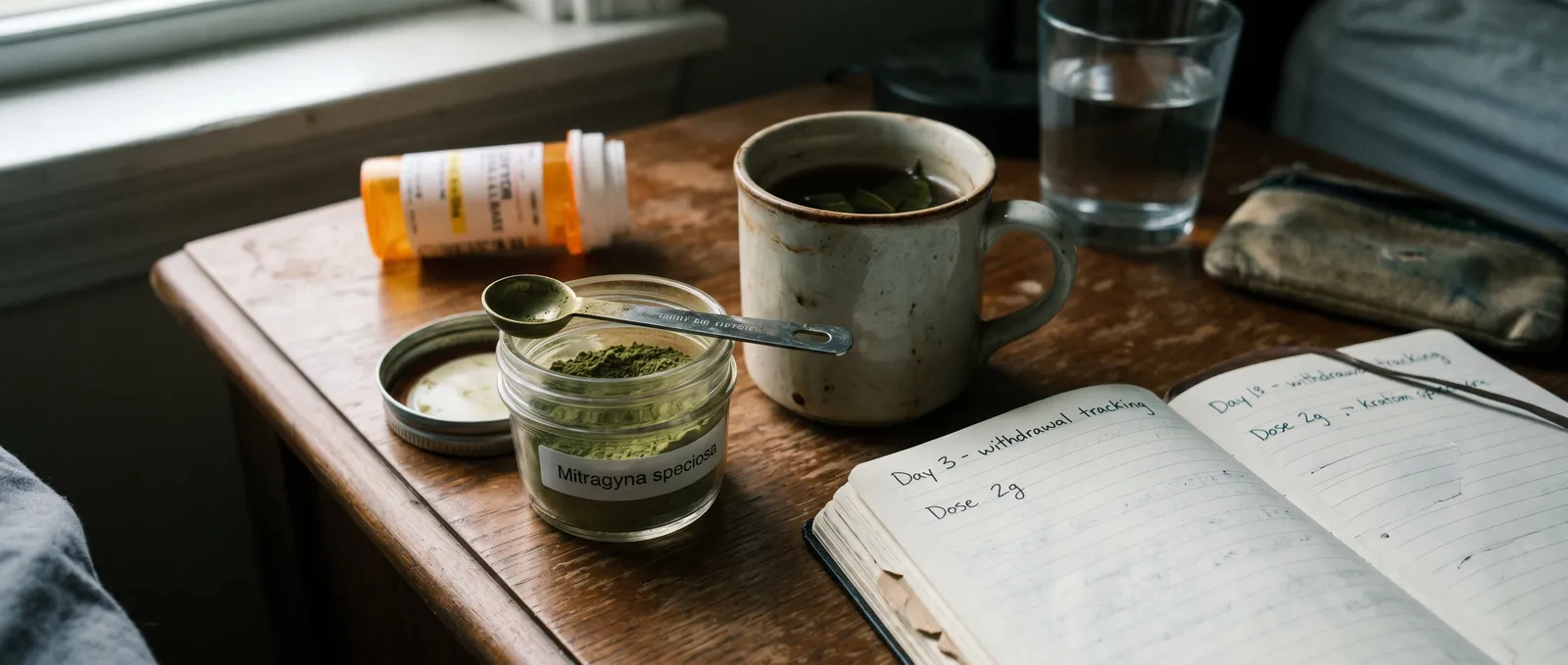
Kratom opioid cessation is a harm reduction approach in which people use Mitragyna speciosa leaf products to manage opioid withdrawal symptoms or taper off stronger opioids. Its active alkaloids are partial agonists at the mu-opioid receptor, which gives them a plausible mechanism for easing withdrawal — but controlled clinical trial data remain absent as of 2026.
Kratom opioid cessation is a harm reduction approach in which people use Mitragyna speciosa leaf products to manage opioid withdrawal symptoms or taper off prescription and illicit opioids. It is one of the most discussed — and most contested — topics in harm reduction today. Across online forums, survey studies, and a growing body of preliminary research, thousands of people report using kratom to ease the transition away from stronger opioids. The question isn't whether people are doing this. They clearly are. The question is whether the evidence, as assessed by pharmacological researchers such as Kruegel and Grundmann (2018), supports it, what the risks look like, and where the line sits between swapping one dependency for another.
Adult audience (18+). The dosing ranges and effects described in this article apply to adult physiology. This content is not intended for minors.
This article lays out what the research actually says about kratom opioid cessation — and, just as critically, what it doesn't.
Disclaimer: This article is for informational purposes only and does not constitute medical advice. Kratom is not approved as a treatment for opioid use disorder by any regulatory authority. If you are currently using opioids and considering cessation, consult a qualified healthcare professional before making any changes to your treatment. The information below reflects published research and user-reported data as of early 2026 and should not replace professional medical guidance.
Why Kratom Acts on Opioid Receptors at All
Kratom acts on opioid receptors because its two primary alkaloids — mitragynine and 7-hydroxymitragynine — are partial agonists at the mu-opioid receptor, according to pharmacological analysis by Kruegel and Grundmann (2018). That same receptor is targeted by morphine, heroin, oxycodone, and methadone. That partial agonism is the critical detail. A partial agonist activates the receptor but produces a lower maximum response than a full agonist, even at high doses. This is the same pharmacological principle behind buprenorphine (Suboxone), which is already a standard medication for opioid use disorder.
Mitragynine also interacts with adrenergic, serotonergic, and dopaminergic pathways (Prozialeck et al., 2012), which means its effects are not purely opioid-like. This multi-receptor profile may explain why users describe it differently from classical opioids — but it also makes the pharmacology harder to predict across individuals and doses.
One thing that matters enormously here: the distinction between plain leaf powder and concentrated extracts. Extracts meaningfully increase the ratio of 7-hydroxymitragynine relative to mitragynine. Since 7-hydroxymitragynine has roughly 13 times greater affinity for the mu-opioid receptor than mitragynine (Takayama, 2004), an extract is not simply "stronger leaf." It is pharmacologically distinct, with a risk profile closer to traditional opioids in terms of dependence potential. Any discussion of kratom opioid cessation that ignores the extract-versus-leaf distinction is incomplete at best, dangerous at worst.
What the Research Actually Shows
The evidence for kratom opioid cessation consists of observational studies and self-report surveys rather than randomised controlled trials, meaning no definitive clinical proof of efficacy exists as of early 2026. No large-scale RCTs have been completed, though promising signals exist in the data we do have.
A cross-sectional survey by Grundmann (2017) of 8,049 kratom users found that 68% reported using it specifically for pain, while a significant subset described using it to reduce or stop opioid use. A follow-up survey by Veltri and Grundmann (2019) found that among those using kratom for opioid withdrawal, the majority reported substantial symptom relief — but these are self-selected, self-reported data. No placebo control, no blinding, no follow-up on relapse rates.
A smaller but more controlled study by Swogger et al. (2022) found that kratom users transitioning from opioids reported reduced cravings and withdrawal severity, with a profile of side effects generally milder than those associated with abrupt opioid cessation. Again, observational. Again, no comparator arm against buprenorphine or methadone.
In Southeast Asia, where kratom has been used traditionally for generations, ethnobotanical research documents its use by manual labourers to manage pain and fatigue — and, notably, by people seeking to stop opium use (Vicknasingam et al., 2010). This traditional pattern is well-documented, but traditional use and clinical efficacy are different categories of evidence. The European Monitoring Centre for Drugs and Drug Addiction has flagged kratom as a substance requiring further investigation, noting both its potential therapeutic interest and its abuse liability.
What the research community broadly agrees on: kratom's partial mu-opioid agonism provides a plausible mechanism for withdrawal relief, according to published pharmacological analyses (Kruegel and Grundmann, 2018). What remains contested: whether that relief translates into durable cessation outcomes, and whether the risk-benefit ratio favours kratom over established medications like buprenorphine and methadone, which have decades of clinical trial data behind them.
The Dependency Trade-Off
Kratom itself produces a recognised withdrawal syndrome in daily heavy users, according to Singh et al. (2014), which means using it for opioid cessation carries its own dependency risk. Symptoms include irritability, muscle aches, insomnia, nausea, and emotional lability — milder than full-agonist opioid withdrawal in most reports, but real and sometimes distressing. Tolerance develops rapidly with consecutive daily dosing, often within one to two weeks of regular use.
So the practical question for someone considering kratom as an opioid cessation tool is not just "does it help with withdrawal?" but "am I replacing one daily dependency with another?" For some people, that trade-off may be worthwhile — kratom's ceiling effect as a partial agonist means respiratory depression risk is substantially lower than with full-agonist opioids, and overdose fatalities attributed to kratom alone (without co-intoxicants) are extremely rare according to toxicology reviews (Henningfield et al., 2018). For others, particularly those with a history of escalating substance use, introducing another mu-opioid agonist without medical supervision carries obvious risks.
The extract question resurfaces here with force. Survey data suggest that most people who develop problematic kratom use — meaning daily escalating doses, difficulty stopping, and functional impairment — are using concentrated extracts or enhanced products rather than plain leaf (Grundmann, 2017). This tracks with the pharmacology: higher 7-hydroxymitragynine loads push the partial-agonist profile closer to full agonism in practice.
We want to be straightforward: nobody can tell you with certainty that kratom is a safe or effective opioid cessation tool, because the clinical trials that would answer that question have not been completed. What we can tell you is what the pharmacology suggests, what users report, and where the known risks sit. That's the boundary of honest information right now.
How People Report Using It
Most people who report successful opioid tapering with kratom describe using plain leaf powder at moderate doses — typically 2–8 grams taken two to four times daily — over a defined period, then gradually reducing their kratom intake, according to survey data from Veltri and Grundmann (2019). Some users describe switching to kratom for a defined period — two to six weeks — and then tapering off kratom itself. Others describe ongoing daily use at stable doses for months or years.
Neither pattern has been studied in a controlled clinical setting. The dose ranges come from self-report surveys with all the limitations that implies: no standardisation of product, no verification of alkaloid content, no measurement of outcomes beyond the user's own assessment. And critically, these figures apply to plain leaf powder. Dose figures for extracts are not interchangeable — extract potency varies wildly depending on the concentration method and target alkaloid ratio.
The following table summarises the key differences between plain leaf and extract products in the context of kratom opioid cessation:
| Factor | Plain Leaf Powder | Concentrated Extracts |
|---|---|---|
| Primary alkaloid ratio | Higher mitragynine, lower 7-OH-mitragynine | Elevated 7-OH-mitragynine relative to mitragynine |
| Mu-opioid receptor profile | Partial agonist with ceiling effect | Closer to full agonist in practice |
| Reported dependency risk | Lower at moderate doses | Higher; escalation more commonly reported |
| Withdrawal severity | Generally mild to moderate | Can approach full-agonist opioid withdrawal |
| Dose standardisation | Variable but measurable by weight | Highly variable; concentration methods differ |
| Suitability for tapering | More commonly reported in taper protocols | Not recommended for tapering due to potency unpredictability |
Contraindications and Interactions
Combining kratom with other opioids is the single highest-risk scenario in any kratom opioid cessation attempt, according to toxicology data reviewed by Olsen et al. (2019). Stacking mu-opioid agonists increases respiratory depression risk even when one of them is a partial agonist. Benzodiazepines and alcohol compound this risk further. The majority of kratom-associated fatalities in toxicology reports involved co-intoxicants, most commonly other opioids or benzodiazepines (Olsen et al., 2019).

Key contraindications and interactions to be aware of:
- Other opioids (prescription or illicit) — additive respiratory depression risk
- Benzodiazepines — compounded sedation and respiratory depression
- Alcohol — increased CNS depression and liver strain
- CYP3A4 inhibitors (clarithromycin, ketoconazole, grapefruit juice) — can increase circulating alkaloid levels
- CYP2D6 inhibitors (fluoxetine, paroxetine, bupropion) — may elevate alkaloid concentrations
- MAOIs — contraindicated due to serotonergic interaction risk
- Pre-existing liver disease or concurrent hepatotoxic medication — case reports of kratom-associated hepatotoxicity exist (Schmuhl et al., 2020)
- Pregnancy and breastfeeding — insufficient safety data; not recommended
- Personal or family history of substance use disorder — elevated risk of dependency escalation
For a complete interaction breakdown, see the dedicated article Kratom Drug Interactions. For broader context on kratom's pharmacological profile, see the Kratom wiki page and the Kratom Alkaloids article.
Kratom Compared to Established Opioid Cessation Treatments
Kratom lacks the clinical trial evidence base that buprenorphine and methadone have accumulated over decades, and that is the fundamental difference between them as opioid cessation tools, according to systematic reviews of opioid use disorder treatments (Mattick et al., 2014). The following comparison is based on published pharmacological data and should not be read as an endorsement of kratom as a substitute for medically supervised treatment.
| Factor | Kratom (Plain Leaf) | Buprenorphine (Suboxone) | Methadone |
|---|---|---|---|
| Receptor profile | Partial mu-opioid agonist | Partial mu-opioid agonist | Full mu-opioid agonist |
| Clinical trial evidence | None completed (observational only) | Extensive RCT data | Extensive RCT data |
| Pharmaceutical classification | Herbal supplement (not a pharmaceutical product) | Prescription medication | Prescription medication (supervised dosing) |
| Respiratory depression risk | Low with plain leaf alone | Low (ceiling effect) | Higher (full agonist, dose-dependent) |
| Product standardisation | Variable; no pharmaceutical-grade QC | Pharmaceutical-grade | Pharmaceutical-grade |
| Medical supervision | Typically self-administered | Prescribed and monitored | Dispensed under supervision |
The lack of product standardisation is a genuine concern. Alkaloid content in commercial kratom powder varies between batches, vendors, and even harvest seasons. Buprenorphine and methadone deliver a known dose every time. That predictability matters enormously in a cessation protocol where dose accuracy determines whether someone experiences breakthrough withdrawal or excessive sedation.
We sometimes get asked why we sell kratom at all if we can't confirm it works for opioid cessation. The honest answer: kratom leaf has a long ethnobotanical history and a range of reported uses. We provide it as a botanical product, not as a medicine. We think people deserve accurate information about what it is and what it isn't, and that includes being upfront that the clinical evidence for kratom opioid cessation simply does not yet match the evidence behind buprenorphine or methadone.
What European Monitoring Bodies Say
European drug monitoring bodies classify kratom as a "new psychoactive substance" requiring further investigation before any clinical recommendations can be made, according to the European Monitoring Centre for Drugs and Drug Addiction. As of the most recent assessment, the agency notes both kratom's potential for dependence and its possible therapeutic interest. This aligns with the Beckley Foundation's broader stance on psychoactive plant research: that traditional use patterns deserve rigorous scientific investigation rather than either blanket prohibition or uncritical endorsement.
Regulatory positions like those of European drug monitoring bodies are often read as either condemnation or quiet approval. Neither reading is accurate. "More data needed" means exactly what it says — the mechanism is interesting enough to investigate, but the evidence isn't strong enough to act on clinically. We think that's a fair summary of where kratom opioid cessation stands overall, and we'd rather say that plainly than pretend the science is more settled than it is.
Choosing the Right Product Format for a Taper
Plain leaf powder is the format most commonly reported in successful kratom opioid cessation taper protocols, according to survey data from Veltri and Grundmann (2019). The reason is straightforward: leaf powder allows dose adjustments in small increments (fractions of a gram), which matters when you're trying to step down gradually over weeks. Capsules offer convenience and more consistent per-unit dosing, which some people find easier to track. Extracts, as discussed throughout this article, are not suitable for tapering due to their unpredictable potency and elevated dependency risk.
If you decide to order kratom for this purpose, choosing plain leaf powder or capsules from a vendor that provides batch-tested alkaloid content is the most risk-aware approach. The Kratom Powder product range and the broader Kratom category page on Azarius list available options with strain and format details. For understanding the differences between varieties, the Kratom Strains Explained article breaks down what "strain" actually means in practice — and what it doesn't. The How to Use Kratom Responsibly guide covers dosing fundamentals, and the Kratom wiki page provides broader botanical context.
Practical Tips for Structured Tapering
A structured taper schedule reduces the risk of simply transferring opioid dependence to kratom dependence, according to harm reduction principles outlined by Grundmann (2017). The core idea is simple: use the minimum effective amount of plain leaf powder to manage acute withdrawal symptoms, then reduce that amount on a fixed schedule rather than dosing by feel.

People who report successful tapers commonly describe these steps:
- Starting with 2–4 grams of plain leaf powder and waiting 45–60 minutes before considering a second dose
- Keeping a written log of every dose — time, amount, and symptom severity
- Reducing total daily intake by 0.5–1 gram every three to five days
- Switching from multiple daily doses to fewer doses as withdrawal symptoms stabilise
- Setting a target end date before beginning — typically four to eight weeks
- Involving a healthcare professional who can monitor progress and intervene if needed
These steps come from user-reported protocols (Veltri and Grundmann, 2019) rather than clinical guidelines. No medical authority has published an official kratom taper protocol. But the principle of gradual dose reduction is well-established in addiction medicine generally, and applying it to kratom use is a logical extension of that principle.
If you want to buy kratom powder for a structured taper, the Kratom Powder product range on Azarius offers plain leaf options in measured quantities. The Kratom Capsules range provides pre-measured doses that some people find easier to track during a reduction schedule. For background on alkaloid variability between products, the Kratom Alkaloids article explains what drives potency differences.
Long-Term Outcomes and Relapse Risk
Long-term cessation outcomes for people who use kratom to quit opioids are essentially unstudied, with no published data tracking relapse rates beyond the initial withdrawal period. This is one of the largest gaps in the evidence base. In established medication-assisted treatment, relapse rates are well-characterised: roughly 40–60% of people relapse within the first year even with buprenorphine or methadone, according to NIDA data. For kratom, we simply don't have comparable numbers.
What user communities report — and this is anecdotal — is a pattern where people who taper off kratom within a defined window (four to eight weeks) seem to fare better than those who transition into indefinite daily use. But "seem to" is doing a lot of work in that sentence. Without prospective studies tracking cohorts over months or years, we cannot distinguish between genuine long-term success and survivorship bias in online reports.
We'd love to point you to a study showing five-year outcomes for people who used kratom leaf to quit opioids. That study doesn't exist. The longest follow-up in any published kratom research is measured in weeks, not years. Until longitudinal data emerge, anyone claiming kratom produces durable opioid cessation is outrunning the evidence — and that includes us if we ever implied otherwise.
Where This Stands in 2026
The current state of kratom opioid cessation research is best described as "mechanistically plausible but clinically unproven," according to a 2023 review by Chakraborty and Bhatt in the Journal of Psychoactive Drugs. The University of Florida and other research groups have ongoing clinical trials examining kratom-derived compounds for opioid use disorder. That same 2023 paper called for "rigorous, adequately powered randomised controlled trials" — which is researcher-speak for "we think this might work but we genuinely don't have the data yet." Until those trials report, the evidence base remains observational, self-reported, and limited by confounders.

That doesn't mean the thousands of people who report that kratom helped them stop using opioids are wrong about their own experience. It means we can't generalise from those reports to population-level recommendations. The gap between "this worked for me" and "this is a reliable treatment" is exactly where clinical trials sit, and those trials haven't been completed.
If you're in this situation — actively using opioids and looking for a way out — the strongest evidence, according to published systematic reviews, still points toward medication-assisted treatment with buprenorphine or methadone under medical supervision. Kratom may have a role, but that role is not yet defined by the kind of evidence that lets anyone say it confidently. Plain leaf at moderate doses carries a lower risk profile than extracts, and a time-limited taper carries a lower dependency risk than open-ended daily use. If you do choose to get kratom for this purpose, start with plain leaf powder from a reputable source, begin at the lowest effective dose, and — we cannot stress this enough — involve a healthcare professional in your plan. For related reading, see the articles on Kratom Strains Explained and How to Use Kratom Responsibly. The Kratom category page and the Kratom Powder product range are useful for understanding what's available, and the Kratom wiki page provides broader botanical and pharmacological context. The Kratom Drug Interactions article is essential reading for anyone combining substances. Beyond that, the data runs thin.
Summary of Key Takeaways
Kratom opioid cessation remains a topic where the pharmacological rationale runs ahead of the clinical evidence. The partial mu-opioid agonism of mitragynine provides a plausible mechanism for easing withdrawal, and thousands of self-reports describe meaningful relief. But no randomised controlled trials have confirmed efficacy, long-term outcomes are unstudied, and the dependency trade-off is real. Plain leaf powder at moderate doses carries a more favourable risk profile than concentrated extracts. A structured taper with a defined end date, dose logging, and medical oversight represents the most risk-aware approach for anyone who chooses this path. For those ready to explore their options, the Kratom Powder product range and Kratom Capsules range on Azarius offer plain leaf formats suitable for measured dosing, and the Kratom Alkaloids article provides essential background on what drives potency differences between products.
Last updated: April 2026
References

- Grundmann, O. (2017). Patterns of kratom use and health impact in the US — results from an online survey. Drug and Alcohol Dependence, 176, 63–70.
- Henningfield, J. E., Fant, R. V., & Wang, D. W. (2018). The abuse potential of kratom: implications for regulation and research. Psychopharmacology, 235(2), 573–589.
- Kruegel, A. C., & Grundmann, O. (2018). The medicinal chemistry and neuropharmacology of kratom: a preliminary discussion of a promising medicinal plant and analysis of its potential for abuse. Neuropharmacology, 134, 108–120.
- Olsen, E.O. et al. (2019). Notes from the field: unintentional drug overdose deaths with kratom detected — 27 states, July 2016–December 2017. MMWR Morbidity and Mortality Weekly Report, 68(14), 326–327.
- Prozialeck, W.C., Jivan, J.K., & Andurkar, S.V. (2012). Pharmacology of kratom: an emerging botanical agent with stimulant, analgesic and opioid-like effects. Journal of the American Osteopathic Association, 112(12), 792–799.
- Schmuhl, K. K. et al. (2020). Kratom use and toxicities in the United States. Pharmacotherapy, 40(7), 575–585.
- Singh, D., Müller, C. P., & Vicknasingam, B. K. (2014). Kratom (Mitragyna speciosa) dependence, withdrawal symptoms and craving in regular users. Drug and Alcohol Dependence, 139, 132–137.
- Swogger, M. T. et al. (2022). Experiences of kratom users: a qualitative analysis. Journal of Psychoactive Drugs, 54(3), 280–288.
- Takayama, H. (2004). Chemistry and pharmacology of analgesic indole alkaloids from the rubiaceous plant, Mitragyna speciosa. Chemical and Pharmaceutical Bulletin, 52(8), 916–928.
- Veltri, C., & Grundmann, O. (2019). Current perspectives on the impact of kratom use. Substance Abuse and Rehabilitation, 10, 23–31.
- Vicknasingam, B. et al. (2010). The informal use of ketum (Mitragyna speciosa) for opioid withdrawal in the northern states of peninsular Malaysia and implications for drug substitution therapy. International Journal of Drug Policy, 21(4), 283–288.
- Chakraborty, S., & Bhatt, S. (2023). Kratom and opioid use disorder: a call for rigorous clinical investigation. Journal of Psychoactive Drugs, 55(1), 1–9.
- Mattick, R. P. et al. (2014). Buprenorphine maintenance versus placebo or methadone maintenance for opioid dependence. Cochrane Database of Systematic Reviews, (2), CD002207.
Frequently Asked Questions
10 questionsCan kratom replace Suboxone for opioid withdrawal?
Does kratom cause withdrawal symptoms of its own?
Are kratom extracts safer or more dangerous for opioid tapering?
What doses of kratom do people report using for opioid withdrawal?
Has kratom been studied in clinical trials for opioid use disorder?
Is kratom opioid cessation legal in Europe?
What is the difference between kratom leaf powder and extracts for opioid cessation?
How does kratom's partial agonism compare to buprenorphine for opioid withdrawal?
How long do people typically use kratom when tapering off opioids?
Which kratom strains do users most often mention for managing opioid withdrawal?
About this article


Adam Parsons is an external cannabis and psychedelics writer and editor who contributes to Azarius's wiki as both author and reviewer. On the writing side, he authors Azarius's kratom and kanna clusters, drawing on exten
This wiki article was drafted with AI assistance and reviewed by Adam Parsons, External contributor. Editorial oversight by Joshua Askew.
Medical disclaimer. This content is for informational purposes only and does not constitute medical advice. Consult a qualified healthcare provider before use of any substance.
Last reviewed April 24, 2026
References (9)
- [1]Grundmann, O. (2017). Patterns of kratom use and health impact in the US — results from an online survey. Drug and Alcohol Dependence , 176, 63–70.
- [2]Henningfield, J. E., Fant, R. V., & Wang, D. W. (2018). The abuse potential of kratom: implications for regulation and research. Psychopharmacology , 235(2), 573–589.
- [3]Olsen, E.O. et al. (2019). Notes from the field: unintentional drug overdose deaths with kratom detected — 27 states, July 2016–December 2017. MMWR Morbidity and Mortality Weekly Report , 68(14), 326–327.
- [4]Prozialeck, W.C., Jivan, J.K., & Andurkar, S.V. (2012). Pharmacology of kratom: an emerging botanical agent with stimulant, analgesic and opioid-like effects. Journal of the American Osteopathic Association , 112(12), 792–799.
- [5]Schmuhl et al. (2020). [reference pending verification]
- [6]Singh, D., Müller, C. P., & Vicknasingam, B. K. (2014). Kratom (Mitragyna speciosa) dependence, withdrawal symptoms and craving in regular users. Drug and Alcohol Dependence , 139, 132–137.
- [7]Takayama, H. (2004). Chemistry and pharmacology of analgesic indole alkaloids from the rubiaceous plant, Mitragyna speciosa. Chemical and Pharmaceutical Bulletin , 52(8), 916–928.
- [8]Veltri, C., & Grundmann, O. (2019). Current perspectives on the impact of kratom use. Substance Abuse and Rehabilitation , 10, 23–31.
- [9]Vicknasingam, B. et al. (2010). The informal use of ketum (Mitragyna speciosa) for opioid withdrawal in the northern states of peninsular Malaysia and implications for drug substitution therapy. International Journal of Drug Policy , 21(4), 283–288.
Related Articles
Blue Lotus vs Kanna: Effects & Safety
Blue lotus vs kanna compared — Nymphaea caerulea's aporphine profile against Sceletium tortuosum's mesembrine chemistry, with interaction warnings.

Lotus Clinical Research Overview
What does lotus clinical research actually show? A critical review of Nymphaea caerulea and Nelumbo nucifera pharmacology, preclinical data, and…
Kanna South Africa To West History
Sceletium tortuosum was used by San and Khoekhoe communities in southern Africa for centuries before European colonists first documented it in the 1660s.
Sceletium Tortuosum Plant
Learn about the sceletium tortuosum plant: botany, alkaloids, fermentation, safety warnings, and where to buy kanna.
Kanna Pharmacokinetics Explained
Complete guide to kanna pharmacokinetics: how Sceletium tortuosum alkaloids are absorbed, metabolised via CYP2D6, and eliminated.

Kanna Chemistry: Sceletium Alkaloids Explained
Kanna chemistry explained: mesembrine, mesembrenone, their mechanisms, how fermentation and extraction change alkaloid profiles, and why it matters…

Rapé Shamanic Snuff Guide: How to Use It Safely
A practical rapé shamanic snuff guide covering dose, kuripe technique, effects, nicotine safety, interactions and Amazonian tradition.

White Sage Salvia Apiana Cultural Smudging Guide
Salvia apiana is a non-psychoactive shrub native to southern California's coastal sage scrub, burned as ceremonial incense in Indigenous North American…

Mulungu Erythrina Traditional Amazonian Use — Bark, Alkaloids & Research
Erythrina mulungu is a Brazilian legume tree whose bark has been brewed as a calming decoction in rural folk medicine for generations.