
This article discusses psychoactive substances intended for adults (18+). If you have a health condition or take medication, consult a doctor before use. Our age policy
Kratom Contamination and Quality
Definition
Kratom quality is determined by what's in the powder beyond the alkaloids — heavy metals, bacteria, mycotoxins, and synthetic adulterants all show up in unregulated products. Third-party testing with batch-specific Certificates of Analysis is the only reliable way to verify what you're actually getting.
Kratom contamination and quality is the single biggest variable standing between you and a predictable experience with Mitragyna speciosa. Unlike a pharmaceutical tablet pressed under GMP conditions, kratom powder starts as a dried leaf from Southeast Asian farms, passes through multiple hands, and arrives at your door with no universal standard governing what's inside. The difference between a clean batch and a contaminated one isn't subtle — it can mean the difference between the alkaloid profile you expected and a product laced with heavy metals, bacteria, or synthetic adulterants you definitely didn't. For anyone buying kratom from any vendor, understanding contamination risk is non-negotiable.
Adult audience (18+). The dosing ranges and effects described in this article apply to adult physiology. This content is not intended for minors.
This article is for informational purposes only and does not constitute medical advice. Kratom is not an approved pharmaceutical product. If you have health concerns, consult a qualified healthcare professional before using kratom products.
What Actually Ends Up in Contaminated Kratom?
The most frequently documented contaminants in kratom are bacteria from open-air drying, heavy metals absorbed from soil, synthetic adulterants added during processing, and mycotoxins from mould growth. Contamination falls into a few distinct categories, and they don't all carry the same risk.
Microbial Contamination
Microbial contamination is the most frequently documented problem. A 2018 public health investigation documented a multistate Salmonella outbreak in the US linked to kratom products, with multiple samples testing positive across 20 states and at least 199 associated illnesses (Prozialeck et al., 2020). The bacteria typically enter during open-air drying, where leaves are spread on tarps or concrete floors exposed to animal contact and environmental runoff. A separate analysis by Prozialeck et al. (2020) found that unregulated kratom products showed bacterial counts exceeding safe thresholds in roughly 15–30% of samples tested, depending on the supplier tier. European monitoring bodies have also flagged kratom as a substance of concern partly because of these quality control gaps in the supply chain reaching European consumers.
Heavy Metals
Heavy metals are the quieter threat. A 2019 study published in Clinical Toxicology found detectable levels of lead and nickel in commercial kratom products, with some samples exceeding California Proposition 65 safe harbour levels for lead by more than tenfold (Prozialeck et al., 2019). Mitragyna speciosa is a bioaccumulator — the tree pulls metals from soil and water. Kratom grown near industrial activity or irrigated with contaminated water concentrates those metals in the leaf tissue. You can't taste or smell lead.
Synthetic Adulterants
Synthetic adulterants represent the most dangerous category, though they're less common than microbial issues. In 2016, Swedish researchers identified a product sold as "Krypton kratom" that contained O-desmethyltramadol, a synthetic opioid metabolite not naturally present in the plant (Kronstrand et al., 2011). Nine deaths in Sweden were associated with this adulterated product. More recently, some products marketed as kratom extracts have been found to contain synthetic 7-hydroxymitragynine — the naturally occurring alkaloid manufactured in a lab and added at concentrations far beyond what any leaf produces. This is a different pharmacological proposition entirely from whole-leaf material.
Pesticides and Mycotoxins
Pesticides and mycotoxins round out the list. Kratom is not subject to the agricultural standards applied to food crops in most producing regions, and aflatoxin-producing moulds thrive in the same warm, humid conditions where kratom dries. There is currently no published large-scale pesticide residue survey for commercial kratom — this is an honest gap in the available evidence, and anyone claiming otherwise is overstating what the literature supports.
Why Quality Varies So Much Between Products
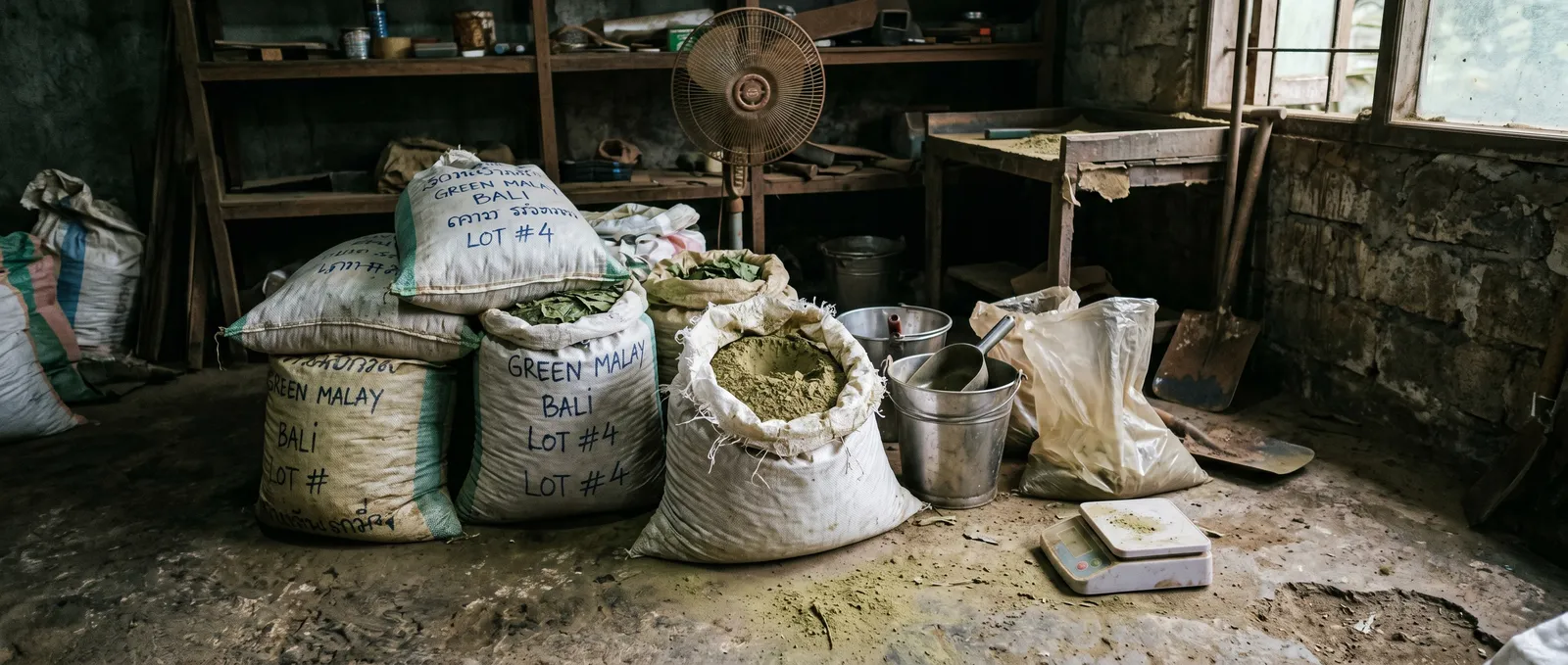
The supply chain is the primary reason kratom quality varies so dramatically from product to product. Kratom leaves are harvested from wild or semi-cultivated trees across Indonesia, primarily in Kalimantan (Borneo). After picking, leaves are dried — sometimes indoors on racks, often outdoors on the ground — then milled into powder at local facilities. That powder gets bagged, shipped to an exporter, and eventually reaches a vendor in Europe or North America who may or may not test it before repackaging.
At each stage, contamination can enter. Ground-level drying introduces soil bacteria. Milling equipment shared between batches can cross-contaminate. Warehouses without climate control encourage mould growth. And because mitragynine content in raw leaf varies from roughly 1% to 2% by dry weight depending on tree age, harvest season, and drying method (Hassan et al., 2013), even a "pure" product can deliver wildly different alkaloid doses batch to batch.
The following table summarises where contamination typically enters at each supply chain stage:
| Supply Chain Stage | Primary Contamination Risk | Detectable Without Lab Testing? |
|---|---|---|
| Tree growth and soil | Heavy metals (lead, cadmium, arsenic) | No |
| Harvest and field drying | Bacteria (Salmonella, E. coli), animal contamination | No |
| Milling and processing | Cross-contamination, synthetic adulterant addition | No |
| Warehousing and transport | Mould, mycotoxins, moisture damage | Sometimes (visible mould) |
| Vendor repackaging | Mislabelling, no testing performed | No |
Extracts amplify every quality problem. A concentrated extract made from contaminated leaf concentrates the contaminants alongside the alkaloids. And because extract potency can range from 2x to 50x or higher, an unlabelled or mislabelled extract introduces dosing unpredictability that leaf powder doesn't. Treat extracts as pharmacologically distinct products — the contamination and quality risks scale differently. For a fuller discussion of how extracts differ from leaf, see the article Kratom Extracts vs Leaf Powder.
What Good Testing Actually Looks Like
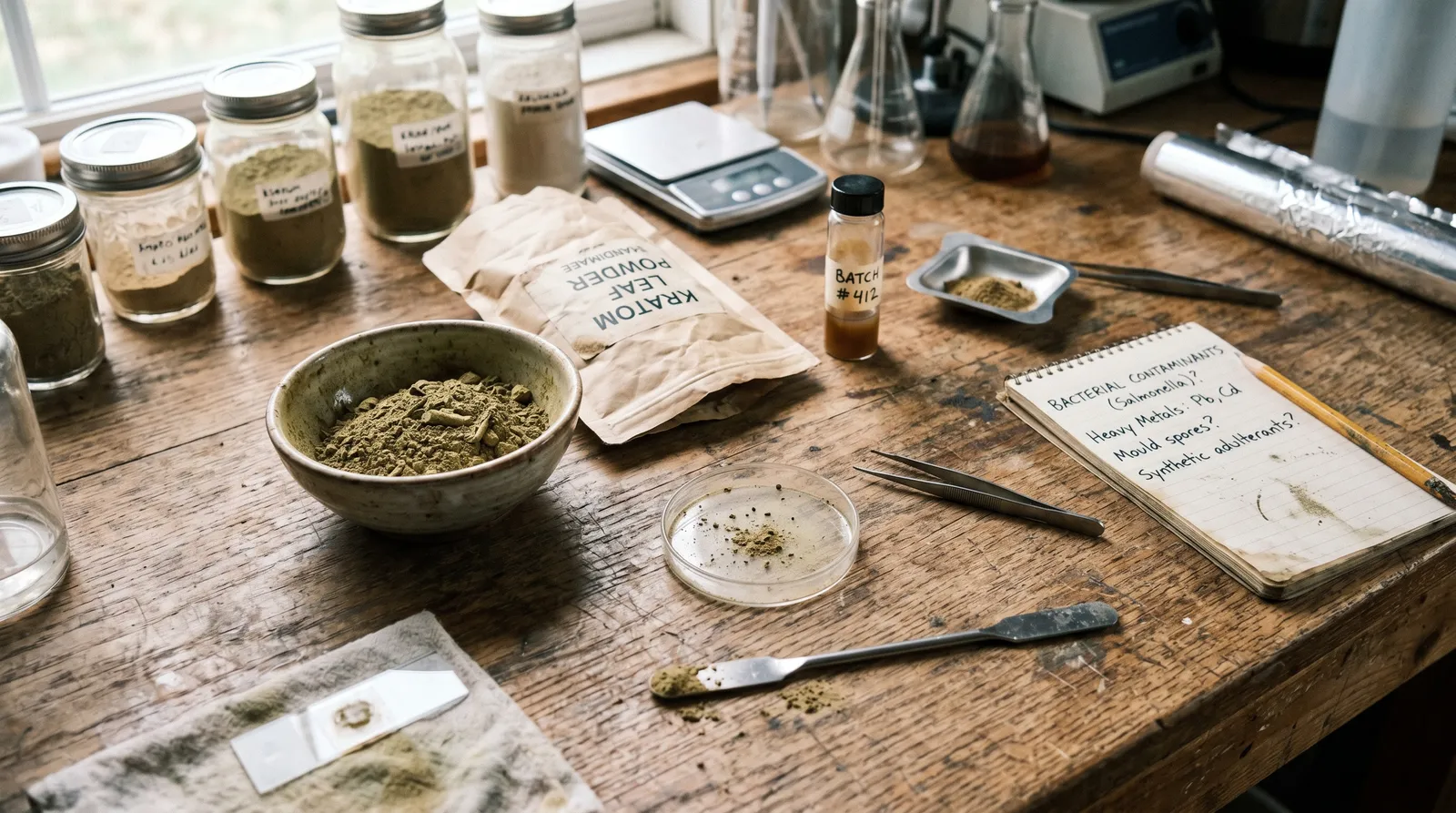
A meaningful Certificate of Analysis from an independent third-party lab, covering alkaloids, microbials, metals, and adulterants, is the only reliable quality gate for kratom. Not all testing is equal, though. A meaningful COA for kratom should cover at minimum:
- Alkaloid assay — quantified mitragynine and 7-hydroxymitragynine content, reported as percentage by weight. This tells you what's actually in the product and whether the label matches reality.
- Microbial panel — testing for Salmonella, E. coli, total aerobic plate count, yeast, and mould. The American Herbal Products Association (AHPA) published a kratom-specific GMP programme in 2019 recommending microbial limits aligned with USP dietary supplement standards (AHPA, 2019).
- Heavy metals screen — at minimum lead, arsenic, cadmium, and mercury, reported in parts per million with reference to established limits.
- Adulterant screening — checking for synthetic opioids, O-desmethyltramadol, and other compounds that shouldn't be there.
A COA that only lists alkaloid content without a microbial or metals panel is incomplete. And a COA from the manufacturer's own lab, rather than an independent third party, carries less weight — it's the difference between marking your own exam and having someone else do it.
Batch-specific testing matters too. A COA from six months ago for a different batch tells you nothing about the powder in front of you. Reputable vendors test each incoming batch and make the results accessible — not buried in a PDF you have to email customer service to obtain.
Comparing Quality Frameworks: AHPA vs No Standard
The difference between kratom sold under the AHPA's voluntary GMP programme and kratom sold with no quality framework is measurable and significant. The table below compares what each approach typically involves:
| Quality Criterion | AHPA GMP-Compliant Vendor | No Quality Framework |
|---|---|---|
| Third-party lab testing | Required per batch | Rare or absent |
| Microbial limits | Aligned with USP standards | No defined limits |
| Heavy metals screening | Lead, arsenic, cadmium, mercury tested | Usually not tested |
| Alkaloid quantification | Mitragynine and 7-OH-MG reported | Often absent or vague |
| Adulterant screening | Synthetic opioid panel included | Not performed |
| Traceability | Batch-to-source documentation | Minimal or none |
This isn't a guarantee that every AHPA-compliant product is perfect — voluntary standards depend on honest implementation — but it establishes a baseline that no-framework products simply don't have. European drug monitoring bodies's risk assessments for novel psychoactive substances have repeatedly noted that lack of quality control in herbal product supply chains is a primary driver of adverse events across Europe.
Red Flags When Evaluating Kratom Products
The clearest warning sign is a vendor who cannot or will not share batch-specific third-party test results. Some additional warning signs are straightforward:
- No COA available at all. If a vendor can't or won't share test results, that's the biggest red flag there is.
- Vague potency claims. Terms like "super enhanced" or "ultra-potent" without quantified alkaloid percentages are marketing, not quality indicators.
- Unusually low prices. Testing costs money. GMP-compliant processing costs money. A product priced significantly below market average is likely cutting corners somewhere — and that somewhere is usually testing or sourcing. Price should reflect the cost of doing things properly.
- Synthetic alkaloid additions to extracts. Some vendors add lab-synthesised 7-hydroxymitragynine to boost apparent potency. This creates a product with a fundamentally different risk profile from a natural extract, and it's rarely disclosed on the label. According to Lydecker et al. (2016), commercially available kratom products showed significant discrepancy between labelled and actual alkaloid content in over 30% of samples analysed.
- Health claims on the packaging. Any kratom product claiming to treat, cure, or relieve a specific condition is making an unsupported claim — and a vendor willing to make unsupported claims on the label may be equally careless about what's inside.
What You Can Actually Control
The most effective thing you can do is choose vendors who test transparently, publish batch-specific COAs, and source from suppliers with documented GMP practices. You can't test your own powder at home for heavy metals or Salmonella, so vendor selection is your primary quality lever. The AHPA's kratom-specific GMP programme (2019) remains the most detailed voluntary standard available — vendors who follow it are at least operating within a framework designed for this exact product.
Beyond vendor choice, store kratom in a cool, dry, sealed container. Moisture encourages mould growth post-purchase, and heat degrades mitragynine over time, though the exact degradation curve in home storage conditions hasn't been well characterised in published research. We should be honest about this limitation: most storage advice for kratom is extrapolated from general botanical guidance rather than kratom-specific stability studies.
If you're using extracts, the quality question becomes even more critical. An extract concentrates whatever is in the source material — alkaloids, metals, pesticides, all of it. Knowing the source leaf was clean matters more for extracts than for plain leaf powder, and a quantified alkaloid assay is non-negotiable for any extract product. For extracts specifically, insist on seeing both the extract COA and information about the source leaf testing.
When sourcing kratom from a vendor that takes testing seriously, the checklist is simple: batch-specific COAs covering all four panels (alkaloids, microbials, metals, adulterants), independent lab verification, and transparent sourcing information. For a broader look at how these quality concerns connect to the effects and pharmacology of different strains, see the article Kratom Strains and Effects. For information on how contamination and quality intersect with safety risks including drug interactions, see the dedicated article Kratom Safety and Side Effects.
Last updated: April 2026
Frequently Asked Questions
8 questionsWhat contaminants are most commonly found in kratom products?
How do I read a kratom Certificate of Analysis?
Are kratom extracts more likely to be contaminated than leaf powder?
Can you tell if kratom is contaminated by its appearance or smell?
What is the AHPA kratom GMP programme?
What should I look for when I buy kratom to ensure quality?
Does kratom need to be tested for heavy metals every batch?
How should kratom be stored to prevent mould or quality loss?
About this article


Adam Parsons is an external cannabis and psychedelics writer and editor who contributes to Azarius's wiki as both author and reviewer. On the writing side, he authors Azarius's kratom and kanna clusters, drawing on exten
This wiki article was drafted with AI assistance and reviewed by Adam Parsons, External contributor. Editorial oversight by Joshua Askew.
Medical disclaimer. This content is for informational purposes only and does not constitute medical advice. Consult a qualified healthcare provider before use of any substance.
Last reviewed April 24, 2026
References (6)
- [1]Prozialeck, W.C., Edwards, J.R., Lamar, P.C., Plotkin, B.J., Sigar, I.M., Grundmann, O. & Veltri, C.A. (2020). Evaluation of the mitragynine content, levels of toxic metals and the presence of microbes in kratom products purchased in the western suburbs of Chicago. International Journal of Environmental Research and Public Health , 17(15), 5512. DOI: 10.3390/ijerph17155512
- [2]Prozialeck, W.C., Avery, B.A., Boyer, E.W., Grundmann, O., Henningfield, J.E., Kruegel, A.C., McMahon, L.R., McCurdy, C.R., Swogger, M.T., Veltri, C.A. & Walsh, Z. (2019). Kratom policy: The challenge of balancing therapeutic potential with public health concerns. International Journal of Drug Policy , 70, 70–77. DOI: 10.1016/j.drugpo.2019.05.003
- [3]Hassan, Z., Muzaimi, M., Navaratnam, V., Yusoff, N.H., Suhaimi, F.W., Vadivelu, R., Vicknasingam, B.K., Amato, D., von Hörsten, S., Ismail, N.I., Jayabalan, N., Hazim, A.I., Mansor, S.M. & Müller, C.P. (2013). From kratom to mitragynine and its derivatives: Physiological and behavioural effects related to use, abuse, and addiction. Neuroscience & Biobehavioral Reviews , 37(2), 138–151. DOI: 10.1016/j.neubiorev.2012.11.012
- [4]Kronstrand, R., Roman, M., Thelander, G. & Eriksson, A. (2011). Unintentional fatal intoxications with mitragynine and O-desmethyltramadol from the herbal blend Krypton. Journal of Analytical Toxicology , 35(4), 242–247. DOI: 10.1093/anatox/35.4.242
- [5]Lydecker, A.G., Sharma, A., McCurdy, C.R., Avery, B.A., Babu, K.M. & Boyer, E.W. (2016). Suspected adulteration of commercial kratom products with 7-hydroxymitragynine. Journal of Medical Toxicology , 12(4), 341–349. DOI: 10.1007/s13181-016-0588-y
- [6]AHPA (2019). Kratom-Specific Good Manufacturing Practices. American Herbal Products Association.
Related Articles
Blue Lotus vs Kanna: Effects & Safety
Blue lotus vs kanna compared — Nymphaea caerulea's aporphine profile against Sceletium tortuosum's mesembrine chemistry, with interaction warnings.
Lotus Clinical Research Overview
What does lotus clinical research actually show? A critical review of Nymphaea caerulea and Nelumbo nucifera pharmacology, preclinical data, and…
Kanna South Africa To West History
Sceletium tortuosum was used by San and Khoekhoe communities in southern Africa for centuries before European colonists first documented it in the 1660s.
Sceletium Tortuosum Plant
Learn about the sceletium tortuosum plant: botany, alkaloids, fermentation, safety warnings, and where to buy kanna.
Kanna Pharmacokinetics Explained
Complete guide to kanna pharmacokinetics: how Sceletium tortuosum alkaloids are absorbed, metabolised via CYP2D6, and eliminated.
Kanna Chemistry: Sceletium Alkaloids Explained
Kanna chemistry explained: mesembrine, mesembrenone, their mechanisms, how fermentation and extraction change alkaloid profiles, and why it matters…
Rapé Shamanic Snuff Guide: How to Use It Safely
A practical rapé shamanic snuff guide covering dose, kuripe technique, effects, nicotine safety, interactions and Amazonian tradition.
White Sage Salvia Apiana Cultural Smudging Guide
Salvia apiana is a non-psychoactive shrub native to southern California's coastal sage scrub, burned as ceremonial incense in Indigenous North American…
Mulungu Erythrina Traditional Amazonian Use — Bark, Alkaloids & Research
Erythrina mulungu is a Brazilian legume tree whose bark has been brewed as a calming decoction in rural folk medicine for generations.