
This article discusses psychoactive substances intended for adults (18+). If you have a health condition or take medication, consult a doctor before use. Our age policy
Kratom Chemistry
Definition
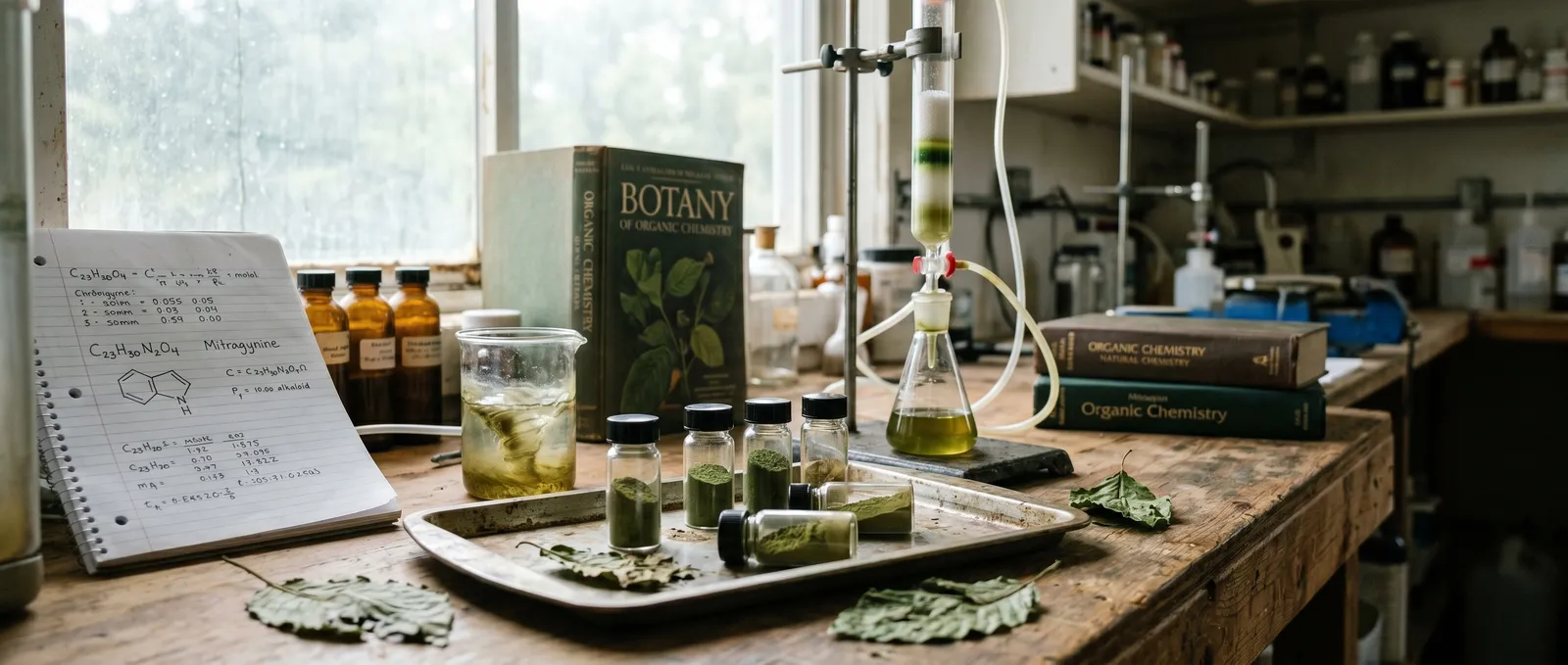
Kratom chemistry revolves around over 40 alkaloids found in Mitragyna speciosa leaves, with mitragynine and 7-hydroxymitragynine driving most of the pharmacological activity. Understanding these molecules — their receptor targets, metabolic pathways, and how extraction alters their ratios — is fundamental to making sense of kratom's effects and risks.
Kratom chemistry centres on over 40 alkaloids isolated from the leaves of Mitragyna speciosa, a tropical tree in the coffee family (Rubiaceae). Two of those alkaloids — mitragynine and 7-hydroxymitragynine — do the heavy pharmacological lifting, but the full picture is more crowded than most popular accounts suggest. Understanding what's actually in the leaf, how those molecules behave, and why an extract is a fundamentally different beast from dried powder matters if you want to make sense of dose, effect, and risk.
Adult audience (18+). The dosing ranges and effects described in this article apply to adult physiology. This content is not intended for minors.
Disclaimer: This article is for informational purposes only and does not constitute medical advice. Kratom is a pharmacologically active substance with real risks, including dependence and drug interactions. Consult a qualified healthcare professional before using kratom, especially if you take any medication. Nothing on this page should be interpreted as encouragement to self-treat any medical condition.
The Alkaloid Profile: More Than Two Molecules
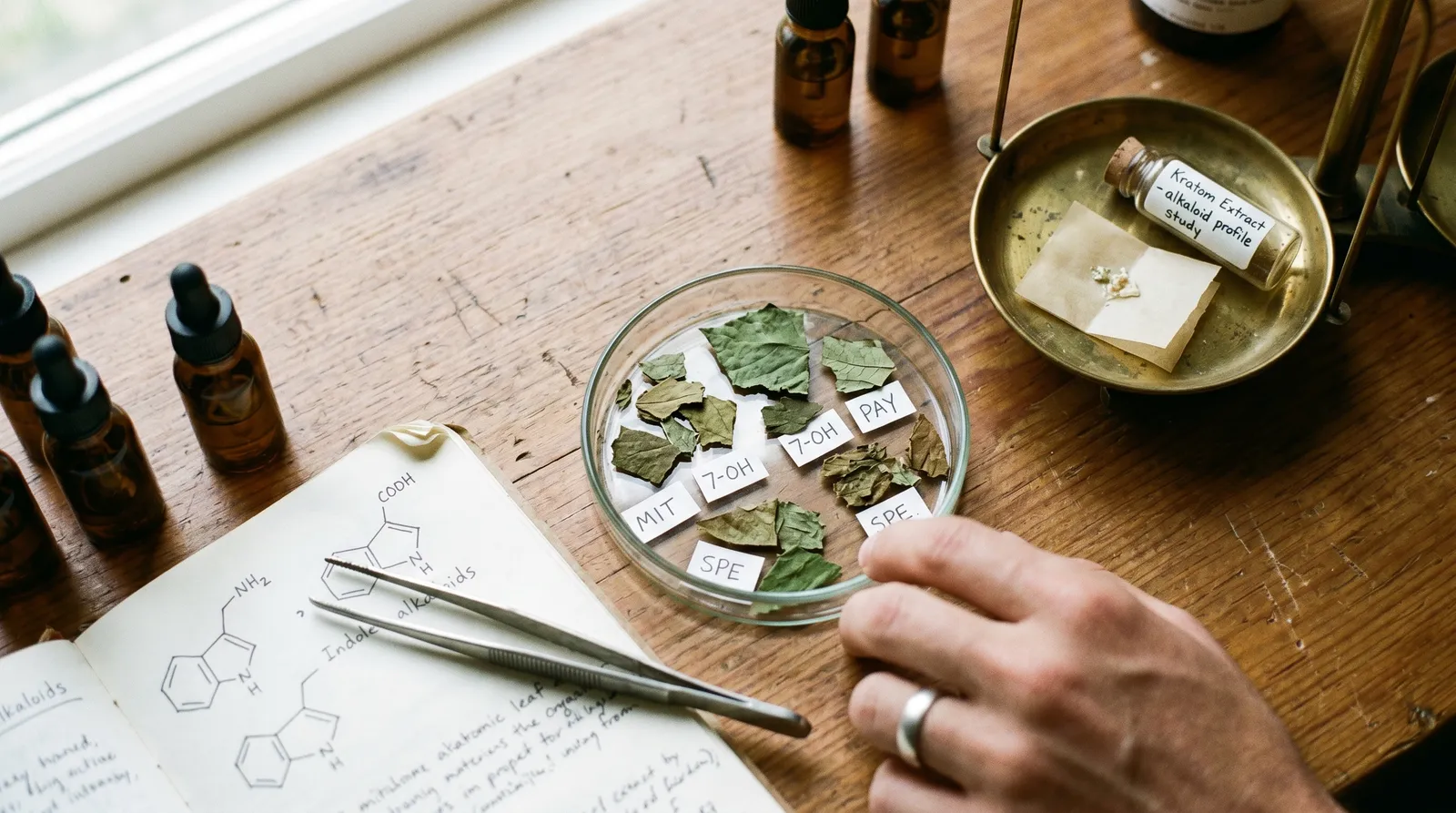
The kratom alkaloid profile comprises at least 40 structurally distinct compounds isolated from Mitragyna speciosa leaves, though only two — mitragynine and 7-hydroxymitragynine — drive the majority of opioid-receptor activity. According to Flores-Bocanegra et al. (2020), published in the Journal of Natural Products, many of these compounds still lack complete characterisation data — their stereochemistry, exact concentrations, and individual pharmacological contributions remain only partially mapped. That said, two indole alkaloids dominate the conversation for good reason.
Mitragynine typically accounts for roughly 12–66% of total alkaloid content in dried leaf, depending on the source material (Prozialeck et al., 2012). It is the most abundant active alkaloid by a wide margin. Structurally, it belongs to the corynantheidine class of monoterpene indole alkaloids — if you know your way around yohimbine, the backbone will look familiar, though the pharmacology diverges sharply.
7-Hydroxymitragynine (7-OH) is present at much lower concentrations — often below 2% of total alkaloid content in raw leaf — yet it binds to mu-opioid receptors with substantially greater affinity than mitragynine. Kruegel et al. (2016) measured its binding affinity at the mu-opioid receptor at roughly 13-fold higher than mitragynine in competitive binding assays. This disproportion between concentration and potency is critical: even small shifts in 7-OH levels, such as those produced by extraction or concentration, meaningfully alter the pharmacological profile of a product.
Beyond these two, other alkaloids worth knowing include:
- Paynantheine — the second or third most abundant alkaloid in most samples, a smooth-muscle relaxant with no significant opioid receptor activity.
- Speciogynine — another abundant constituent, also a smooth-muscle relaxant.
- Speciociliatine — a diastereomer of mitragynine, present in variable amounts. Its pharmacology is less well characterised, though Obeng et al. (2020) reported weak opioid activity.
- Corynantheidine and mitraphylline — present in trace amounts, with preliminary evidence of varied receptor interactions that are not yet well enough understood to make firm claims about.
The ratio of these alkaloids shifts with geography, harvest timing, drying method, and post-harvest processing. This natural variability is one reason why identical weights of leaf powder from different batches can produce noticeably different effects — a point the Kratom Dosage article covers in more detail. The European Monitoring Centre for Drugs and Drug Addiction has flagged this inconsistency as a key challenge for risk assessment of kratom products sold in Europe.
How Mitragynine Works at the Receptor
Mitragynine is a partial agonist at the mu-opioid receptor (MOR), meaning it activates the receptor but hits a response ceiling below that of full agonists like morphine. That "partial" matters enormously. A full agonist drives the receptor to its maximum response; a partial agonist activates it but plateaus — even at saturating concentrations, the response stays below what a full agonist achieves. Kruegel et al. (2016) and Váradi et al. (2016) both demonstrated this partial-agonist profile using in vitro receptor assays.
This partial agonism is why kratom chemistry produces opioidergic effects with a different character from classical opioids — and likely why respiratory depression, the primary killer in opioid overdose, appears far less pronounced with mitragynine alone. However, "less pronounced" is not "absent," and polydrug scenarios change the equation entirely. The Kratom Safety and Side Effects article addresses that risk in depth.
There is also a metabolic wrinkle. Kamble et al. (2019) showed that mitragynine is converted to 7-OH in the liver via CYP3A4 enzymes. This means some of mitragynine's in vivo effects may actually be mediated by its more potent metabolite — a detail that complicates dose-response predictions and makes CYP3A4 inhibitors (things like grapefruit juice, clarithromycin, or ketoconazole) a genuine interaction concern.
Beyond opioid receptors, mitragynine shows activity at adrenergic, serotonergic (5-HT2A), and dopaminergic receptor sites (Boyer et al., 2008). This multi-target pharmacology likely explains the stimulant-like effects reported at lower doses — effects that don't fit a purely opioidergic model. The full receptor profile is still being mapped, and claiming we have a complete picture would be premature.
Leaf Powder Versus Extracts: Chemistry Changes the Risk
Kratom extracts contain substantially higher concentrations of 7-hydroxymitragynine per gram than plain leaf powder, which fundamentally changes their pharmacological profile and risk. This distinction is not marketing — it is pharmacology. When raw leaf is processed into a concentrated extract, the ratio of alkaloids shifts. Most extraction methods preferentially concentrate mitragynine and 7-OH relative to the other 38-odd alkaloids. A "50x extract" does not mean 50 times the effect of leaf; it means the starting material was reduced roughly 50:1 by weight, concentrating certain alkaloids while potentially losing others.
The practical consequence: extracts deliver substantially more 7-OH per gram than leaf powder. Since 7-OH has roughly 13-fold greater mu-opioid affinity than mitragynine (Kruegel et al., 2016), even modest concentration shifts can push the pharmacological profile closer to that of a conventional opioid agonist. Tolerance develops more rapidly, withdrawal risk increases with regular use, and the margin between a desired dose and an uncomfortable one narrows.
Dose figures published for leaf powder — typically in the range of 1–8 grams in survey-based research (Grundmann, 2017) — are not transferable to extracts. Treating extract as simply "stronger leaf" is a category error that can produce genuinely unpleasant or dangerous outcomes. With any kratom extract, start with a fraction of what you would use in leaf powder and adjust slowly. The Kratom Dosage guide provides specific starting-point suggestions for both formats.
Natural Variability and the Vein-Colour Question
Current analytical evidence does not support the idea that vein colour reliably predicts a distinct alkaloid profile. The commercial vocabulary around kratom — red vein, green vein, white vein, yellow vein — implies distinct chemical profiles tied to leaf-vein colour, but the data tells a different story. Analytical studies that have compared alkaloid content across commercially labelled "strains" find significant overlap. Lydecker et al. (2016) analysed multiple commercial products and found that labelling did not reliably predict alkaloid ratios. Similarly, a 2020 analysis published in ACS Publications noted that mitragynine content varied more between individual product batches than between named strains.
What does vary meaningfully is growing region, harvest maturity, and drying/curing method — factors that affect kratom chemistry but don't map neatly onto the red/green/white system. Some users describe consistent subjective differences between vein colours, and those reports are worth noting, but controlled studies confirming a pharmacological basis for the distinction do not currently exist. We are honest about this limitation: the strain system may capture something real about processing differences, but the science to confirm it simply isn't there yet.
CYP450 Inhibition: Where Kratom Chemistry Meets Safety
Kratom alkaloids inhibit the same liver enzymes responsible for metabolising a large number of common medications, creating clinically relevant interaction risks. The alkaloids are metabolised primarily by CYP3A4 and CYP2D6 liver enzymes — and they also inhibit those same enzymes. Tanna et al. (2021) demonstrated that methanolic kratom extracts inhibited CYP2D6 by approximately 90% and CYP3A by approximately 50% at 20 μg/ml in vitro. CYP2C9 was also inhibited at around 65%.
This means co-consuming kratom with drugs metabolised by these pathways — which includes a large number of common medications, from SSRIs to blood-pressure drugs — may alter plasma concentrations of those drugs in unpredictable ways. The Kratom Interactions article covers specific drug classes in detail, but the core kratom chemistry point is this: kratom is not pharmacologically inert alongside other substances, and its enzyme-inhibition profile is broad enough to warrant caution with any concurrent medication.
How Kratom Chemistry Compares to Other Botanical Alkaloids
Kratom's alkaloid complexity is unusual but not unique among psychoactive botanicals. Coffee contains over 1,000 identified compounds but relies on one dominant alkaloid — caffeine — for its primary effect. Kratom similarly has one dominant player (mitragynine) but its secondary alkaloids contribute more meaningfully to the overall profile than caffeine's companions do in coffee. Compared to kava, which works through kavalactones on GABA pathways, kratom's mechanism is fundamentally different despite both being marketed as relaxation aids. Anyone approaching kratom expecting a kava-like experience will find the pharmacology surprising — the opioid-receptor component has no parallel in kava chemistry. The Kava article on our wiki covers that distinction from the other side.
Key Alkaloids at a Glance
| Alkaloid | Typical Leaf Abundance | Primary Receptor Targets | Notes |
|---|---|---|---|
| Mitragynine | 12–66% of total alkaloid content | Mu-opioid (partial agonist), adrenergic, serotonergic | Most abundant; converted to 7-OH via CYP3A4 |
| 7-Hydroxymitragynine | Below 2% in raw leaf | Mu-opioid (partial agonist, ~13x affinity vs mitragynine) | Concentrated in extracts; drives potency disproportionately |
| Paynantheine | Second–third most abundant | Smooth-muscle relaxant | No significant opioid activity |
| Speciogynine | Moderate | Smooth-muscle relaxant | Limited pharmacological data |
| Speciociliatine | Variable | Weak mu-opioid activity reported | Diastereomer of mitragynine; under-studied |
Last updated: April 2026
Frequently Asked Questions
9 questionsWhat is the most active alkaloid in kratom?
Why does kratom extract feel different from leaf powder?
Does kratom inhibit liver enzymes?
Is there a chemical basis for red, green, and white kratom strains?
How is mitragynine converted to 7-hydroxymitragynine in the body?
What are paynantheine and speciogynine and do they have opioid activity?
How many alkaloids are in kratom and how much variation is there between samples?
What are speciogynine and paynantheine in kratom?
Is mitragynine water-soluble or fat-soluble?
About this article


Adam Parsons is an external cannabis and psychedelics writer and editor who contributes to Azarius's wiki as both author and reviewer. On the writing side, he authors Azarius's kratom and kanna clusters, drawing on exten
This wiki article was drafted with AI assistance and reviewed by Adam Parsons, External contributor. Editorial oversight by Joshua Askew.
Medical disclaimer. This content is for informational purposes only and does not constitute medical advice. Consult a qualified healthcare provider before use of any substance.
Last reviewed April 24, 2026
References (10)
- [1]Boyer, E.W. et al. (2008). Self-treatment of opioid withdrawal using kratom. Addiction , 103(6), 1048–1050.
- [2]Flores-Bocanegra, L. et al. (2020). Alkaloid diversity in Mitragyna speciosa . Journal of Natural Products , 83(8), 2547–2559.
- [3]Grundmann, O. (2017). Patterns of kratom use and health impact in the United States. Drug and Alcohol Dependence , 176, 63–70. DOI: 10.1016/j.drugalcdep.2017.03.007
- [4]Kamble, S.H. et al. (2019). Metabolism of a kratom alkaloid metabolite in human plasma. AAPS Journal , 21(6), 104.
- [5]Kruegel, A.C. et al. (2016). Synthetic and receptor signaling explorations of the Mitragyna alkaloids. Journal of the American Chemical Society , 138(21), 6754–6764. DOI: 10.1021/jacs.6b00360
- [6]Lydecker, A.G. et al. (2016). Suspected adulteration of commercial kratom products. Journal of Medical Toxicology , 12(4), 341–349.
- [7]Obeng, S. et al. (2020). Pharmacological comparison of mitragynine and 7-hydroxymitragynine. ACS Chemical Neuroscience , 11(10), 1661–1672.
- [8]Prozialeck, W.C. et al. (2012). Pharmacology of kratom. Journal of the American Osteopathic Association , 112(12), 792–799.
- [9]Tanna, R.S. et al. (2021). Kratom drug interactions: CYP inhibition. Clinical Pharmacology & Therapeutics , 109(1), 201–208.
- [10]Váradi, A. et al. (2016). Mitragynine/corynantheidine pseudoindoxyls as opioid analgesics. Journal of Medicinal Chemistry , 59(18), 8381–8397.
Related Articles
Blue Lotus vs Kanna: Effects & Safety
Blue lotus vs kanna compared — Nymphaea caerulea's aporphine profile against Sceletium tortuosum's mesembrine chemistry, with interaction warnings.
Lotus Clinical Research Overview
What does lotus clinical research actually show? A critical review of Nymphaea caerulea and Nelumbo nucifera pharmacology, preclinical data, and…
Kanna South Africa To West History
Sceletium tortuosum was used by San and Khoekhoe communities in southern Africa for centuries before European colonists first documented it in the 1660s.
Sceletium Tortuosum Plant
Learn about the sceletium tortuosum plant: botany, alkaloids, fermentation, safety warnings, and where to buy kanna.
Kanna Pharmacokinetics Explained
Complete guide to kanna pharmacokinetics: how Sceletium tortuosum alkaloids are absorbed, metabolised via CYP2D6, and eliminated.
Kanna Chemistry: Sceletium Alkaloids Explained
Kanna chemistry explained: mesembrine, mesembrenone, their mechanisms, how fermentation and extraction change alkaloid profiles, and why it matters…

Rapé Shamanic Snuff Guide: How to Use It Safely
A practical rapé shamanic snuff guide covering dose, kuripe technique, effects, nicotine safety, interactions and Amazonian tradition.
White Sage Salvia Apiana Cultural Smudging Guide
Salvia apiana is a non-psychoactive shrub native to southern California's coastal sage scrub, burned as ceremonial incense in Indigenous North American…
Mulungu Erythrina Traditional Amazonian Use — Bark, Alkaloids & Research
Erythrina mulungu is a Brazilian legume tree whose bark has been brewed as a calming decoction in rural folk medicine for generations.