
This article discusses psychoactive substances intended for adults (18+). If you have a health condition or take medication, consult a doctor before use. Our age policy
How to Prepare Kratom
Definition
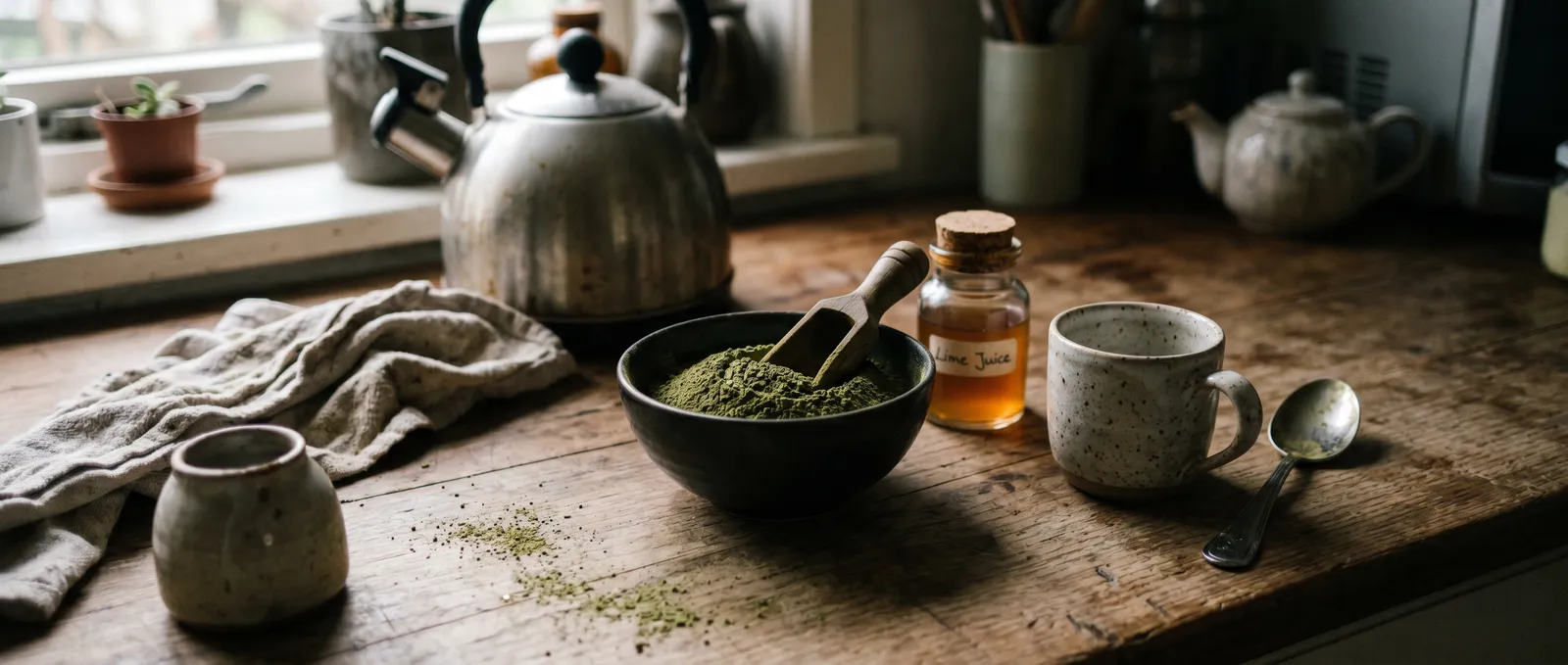
How to prepare kratom is the essential question for anyone working with dried Mitragyna speciosa leaf material — kratom preparation is the process of readying this botanical as tea, powder, capsules, or food mix for oral consumption, where each method affects onset time, intensity, and stomach comfort differently. A survey of over 8,000 users found that doses of 1–5 g produced manageable effects with fewer side effects (Grundmann, 2017). This guide covers the main preparation methods step by step.
18+ only — the preparation methods and dosing ranges below apply to adult physiology.
How to prepare kratom is the essential question for anyone working with dried Mitragyna speciosa leaf material — kratom preparation is the process of readying this botanical as tea, powder, capsules, or food mix for oral consumption, where each method affects onset time, intensity, and stomach comfort differently. Kratom (Mitragyna speciosa) leaves have been chewed, brewed, and ground across Southeast Asia for centuries. A survey of over 8,000 users found that doses of 1–5 g produced manageable effects with fewer side effects (Grundmann, 2017). This guide on how to prepare kratom walks through the main methods step by step — from a basic toss-and-wash to a properly brewed tea — so you can pick the one that suits you and get it right the first time.
Before You Start: Know Your Material
The form of kratom you start with — crushed leaf, fine powder, capsules, or extract — determines which preparation method works best when learning how to prepare kratom. Each behaves differently during preparation. Fine powder dissolves (partially) in liquid and hits faster. Crushed leaf works better for tea because you can strain it cleanly. Capsules skip preparation entirely but delay onset by 15–30 minutes while the gelatine breaks down. Extracts are far more concentrated gram-for-gram — a point we'll come back to. If you want to order kratom in a form suited to tea-brewing, crushed leaf is the way to go; if you prefer toss-and-wash, buy fine powder instead.
Whatever form you're working with, weigh it. A kitchen scale accurate to 0.1 g costs under €15 and removes the guesswork that leads to unpleasant afternoons. Eyeballing a "teaspoon" of kratom powder is unreliable because density varies between batches and grind sizes — a loosely packed teaspoon might hold 2 g while a firmly packed one holds 4 g. That's a meaningful difference.
Clinical and survey data suggest that doses between 1–5 g of dried leaf powder are where most adults report manageable effects with fewer adverse reactions (Grundmann, 2017). Doses above 8 g were associated with increased nausea, dizziness, and sedation in a self-report survey of over 8,000 users (Grundmann, 2017). The European Monitoring Centre for Drugs and Drug Addiction (EMCDDA) has flagged kratom as a substance of concern due to variable product quality and dose-dependent adverse effects. Stick to the lower end if you're new to the plant.
Toss and Wash: The Quick Method
Toss-and-wash is the fastest way to prepare kratom powder, taking under a minute from weighing to swallowing. You measure your dose, place it in your mouth or a small cup of water, and swallow it with liquid. Simple in theory. In practice, dry kratom powder is extremely hydrophobic and bitter, and inhaling a cloud of it into your sinuses is a rite of passage nobody enjoys.
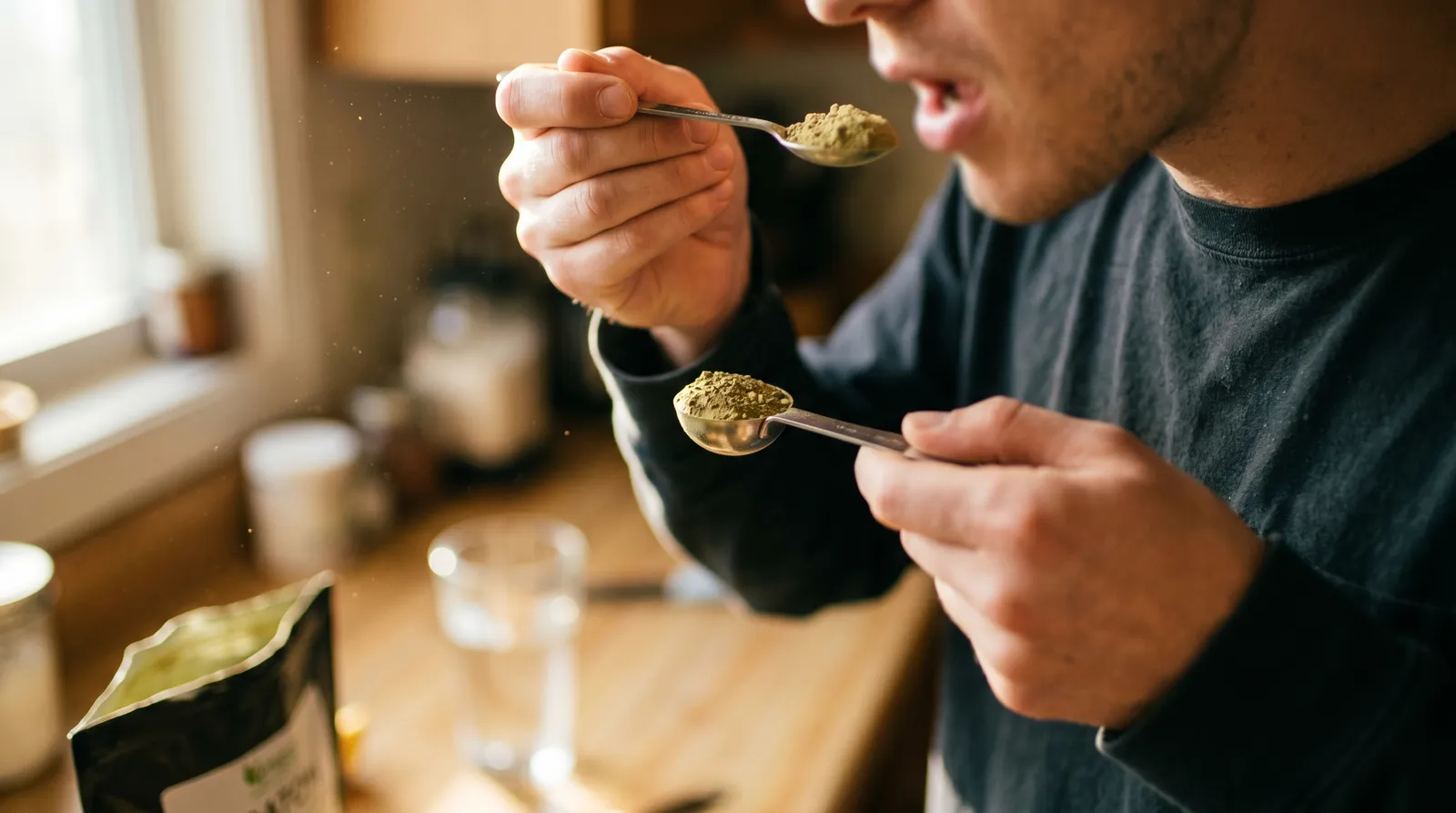
A better approach to prepare kratom via toss-and-wash:
- Weigh your dose (start at 1–2 g).
- Place the powder on your tongue or, better, into a small cup of warm water and stir briskly for 10 seconds.
- Chase immediately with juice — orange or grapefruit works well because the acidity and sweetness mask the bitterness.
- Follow with a full glass of water. Kratom is dehydrating, and most of the headaches people blame on the plant are actually from not drinking enough.
Onset with toss-and-wash is typically 15–30 minutes on an empty stomach. If you've eaten a large meal, expect 45–60 minutes. Resist the urge to redose before the 60-minute mark — stacking doses is how people overshoot.
Kratom Tea: The Traditional Method
Kratom tea is the preparation method closest to traditional Southeast Asian use and the gentlest on the stomach, because straining removes most plant fibre — the main culprit behind nausea. If you want to prepare kratom in the way that minimises digestive discomfort, tea is your best option.
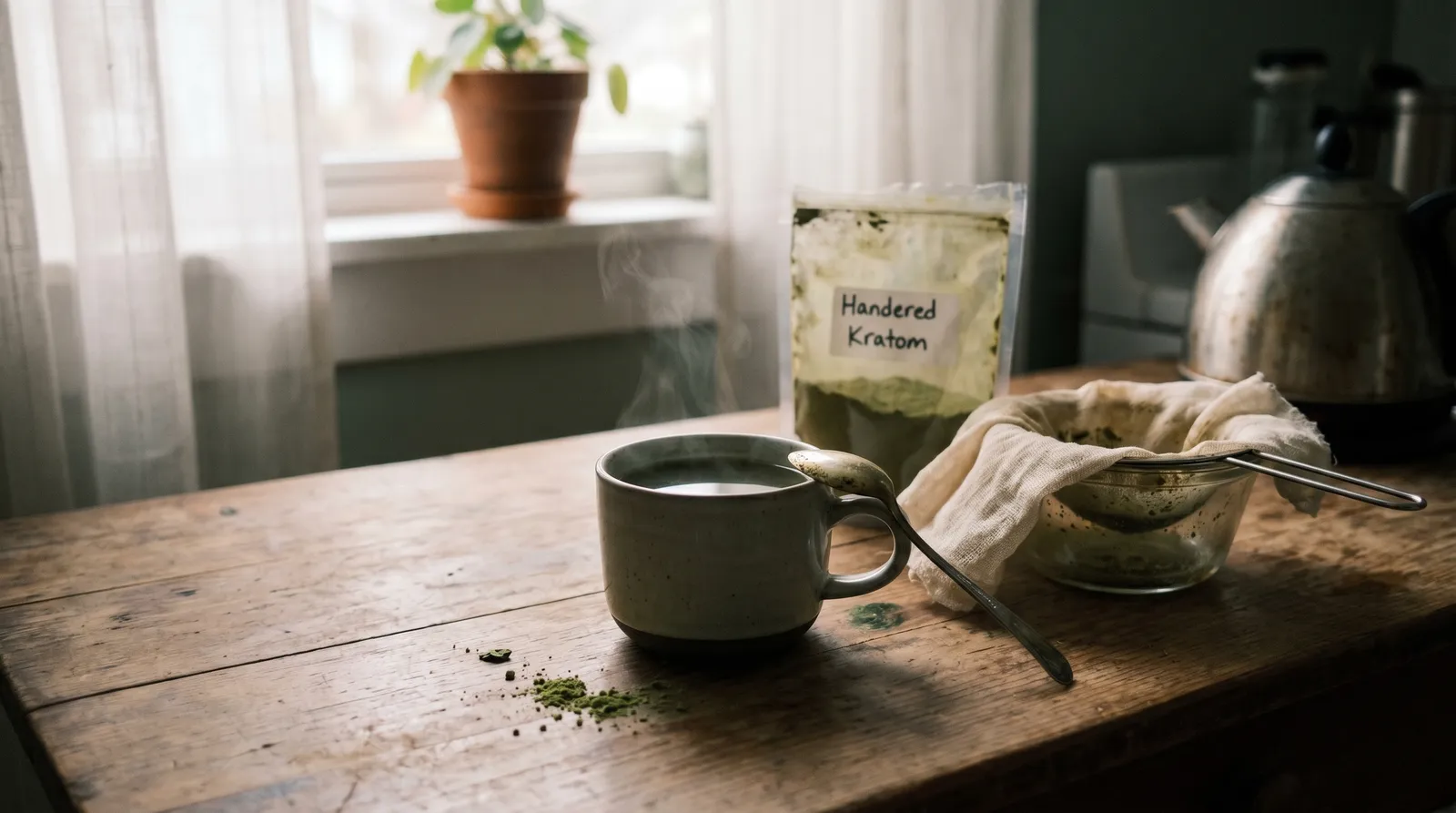
- Weigh your dose. For tea, use crushed leaf or powder — 2–3 g is a reasonable starting point.
- Heat water to around 80–90 °C. Not a rolling boil. Mitragynine, the primary active alkaloid, is reasonably heat-stable, but there's no benefit to scorching it. A 2020 analysis by Basiliere and Bhatt found that simmering kratom at 80 °C for 20 minutes extracted approximately 85% of available mitragynine without significant degradation (Basiliere & Bhatt, 2020).
- Add the kratom to the water. Stir it in, then let it simmer (not boil) for 15–20 minutes. Some people add a squeeze of lemon juice — the citric acid may help extract alkaloids, though the data on this is anecdotal rather than clinical.
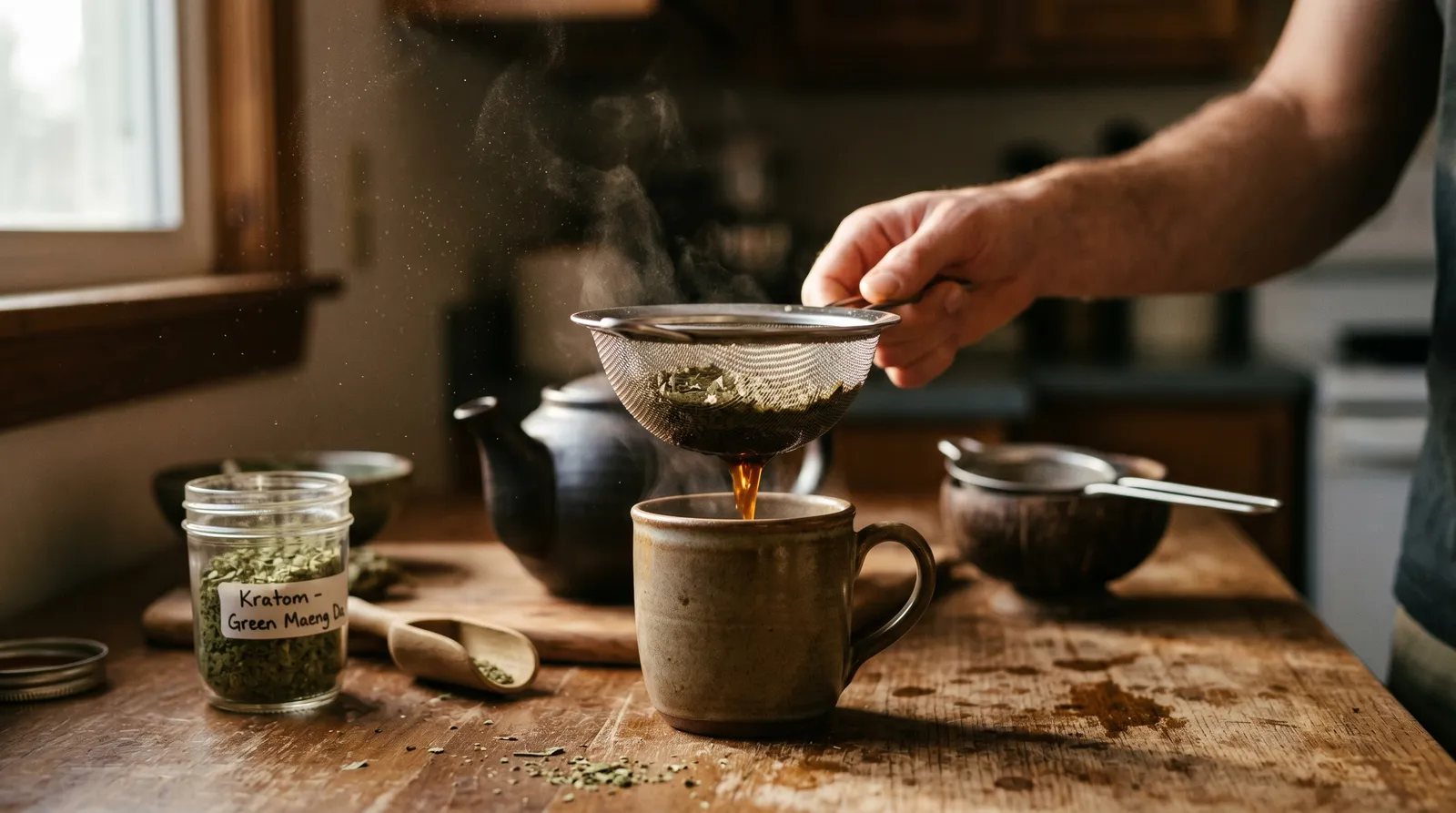
- Strain through a fine mesh sieve or cheesecloth. If you used powder, a coffee filter works but drains slowly. Crushed leaf is much easier to filter.
- Serve. The resulting liquid is bitter. Honey, agave, or mixing it into a chai-style blend with cinnamon and ginger makes it drinkable. Some people brew it strong and add it to a small glass of orange juice — concentrated and fast.
Tea onset tends to be slightly faster than toss-and-wash — around 10–20 minutes — because the alkaloids are already dissolved in liquid. The trade-off: some alkaloid content stays behind in the strained plant material. A second steep of the same leaf matter can extract residual compounds, but expect diminishing returns.
Capsules: No Prep, Slower Onset
Capsules are the most convenient way to prepare kratom because they eliminate taste entirely, though onset is delayed by 15–30 minutes compared to powder or tea. A standard "00" gelatine capsule holds roughly 0.5 g of kratom powder, so a 3 g dose means swallowing six capsules — which is a lot of gelatine on an empty stomach.
- If filling your own: use a capsule-filling tray (they cost a few euros) and weigh a sample of 10 filled capsules to calculate your average per-capsule weight. Packing density varies.
- Take with water — at least 250 ml. The capsules need to dissolve before anything reaches your system.
- Expect onset at 30–60 minutes. Gelatine dissolution adds a buffer. Vegetarian (HPMC) capsules dissolve at roughly the same rate.
Capsules are convenient but make dose adjustment clunky. You can't easily take "half a capsule more." For people still finding their dose, tea or toss-and-wash gives finer control.
Mixing Kratom into Food
Mixing kratom into food is the best method for masking bitterness, though it produces the slowest onset of all kratom preparation methods. Some people stir kratom powder into yoghurt, smoothies, or applesauce. A few notes:
- Acidic or strongly flavoured bases work best. Chocolate protein shakes, mango smoothies, and citrus-based drinks all overpower the taste. Plain water does not.
- Food slows absorption. Mixing kratom into a full meal means a slower, blunter onset — sometimes 60–90 minutes. If speed matters to you, take it on a mostly empty stomach.
- Don't cook kratom into baked goods at high temperatures. While mitragynine tolerates moderate heat, sustained oven temperatures above 150 °C for 30+ minutes haven't been studied for alkaloid stability, and you lose the ability to control your dose once it's baked into a brownie.
Extracts: A Word of Caution
Kratom extracts are significantly more potent than plain leaf and require a completely different dosing approach when you prepare kratom this way. Liquid tinctures, enhanced powders, or resin concentrate the alkaloids substantially. A "10x extract" theoretically contains ten times the alkaloid content of plain leaf per gram, though actual potency varies wildly between manufacturers because there's no standardised production method.
If you're using an extract, the dose is not the same as for plain leaf. A 2022 analysis of commercial kratom products found that mitragynine content ranged from 1.2% to 6.1% in raw powders, while extracts varied from 12% to over 45% (Todd et al., 2022). That's a tenfold range even within the extract category. Start with a fraction of what you'd use in powder — 0.1–0.5 g — and treat it with the same respect you'd give any concentrated botanical preparation.
Preparation Method Comparison
The table below summarises how each way to prepare kratom compares on the factors that matter most in practice.
| Method | Onset time | Taste | Stomach comfort | Dose control | Convenience |
|---|---|---|---|---|---|
| Toss-and-wash | 15–30 min | Very bitter | Moderate | Excellent (if weighed) | High |
| Tea (strained) | 10–20 min | Bitter (maskable) | Good | Good | Moderate |
| Capsules | 30–60 min | None | Moderate | Fair (0.5 g increments) | Very high |
| Food mix | 45–90 min | Masked | Good | Good | Moderate |
| Extract | 10–25 min | Varies | Varies | Difficult (high potency) | High |
How Kratom Preparation Compares to Other Botanical Methods
Understanding how to prepare kratom is easier when you compare it to other herbal preparations you may already know. Kratom tea follows the same basic logic as brewing kava — hot water extraction, straining, and drinking the liquid — but kratom's alkaloids are more heat-stable than kavalactones, so you have a wider temperature window. Compared to cannabis edibles, kratom food mixes are simpler because mitragynine doesn't require fat-based extraction the way THC does; you can stir it into water-based liquids and still get full effects. And unlike blue lotus, which is often smoked or steeped very briefly, kratom benefits from a longer simmer of 15–20 minutes to extract its alkaloid profile fully. These parallels can help if you're already familiar with preparing other botanicals from the Azarius catalogue.
Common Mistakes and How to Avoid Them
The most frequent mistake when learning how to prepare kratom is not weighing the dose — and it leads to more bad experiences than any other single factor.
- Not weighing doses. "A teaspoon" is not a unit of measurement when density varies this much. Buy a scale.
- Redosing too early. Onset can take up to an hour, especially with capsules or food. Taking more at the 20-minute mark because "nothing's happening" is the most common path to nausea.
- Ignoring hydration. Kratom's alkaloids have mild diuretic properties. Drink water before, during, and after.
- Mixing with other substances. Kratom's alkaloids interact with cytochrome P450 enzymes — specifically CYP2D6 and CYP3A4 — which metabolise a long list of pharmaceuticals (Tanna et al., 2021). If you take any prescription medication, read the dedicated kratom interactions article before combining anything.
- Boiling tea at a rolling boil for ages. Fifteen to twenty minutes at a gentle simmer is enough. Boiling it for an hour doesn't make it stronger — it just makes your kitchen smell like a forest floor.
What We Still Don't Know
There are genuine gaps in the research on how to prepare kratom that no amount of anecdotal experience can fill. No controlled study has measured whether citric acid meaningfully increases alkaloid extraction in a cup-sized preparation. Alkaloid stability in refrigerated or frozen tea hasn't been formally quantified. The interaction between food composition (fat content, protein, fibre) and kratom absorption is unstudied. And the actual bioavailability difference between tea and toss-and-wash — which every kratom forum has an opinion on — has never been measured in a pharmacokinetic study. We present the best available information here, but honest gaps remain.
Storage Tips for Prepared Kratom
Dry kratom powder keeps for months when stored in a cool, dark, airtight container — a mason jar in a cupboard is fine. Avoid humidity; clumping powder is a sign moisture has got in, and damp plant material can develop mould.
Brewed kratom tea can be refrigerated for up to 5 days in a sealed container. Some people freeze it in ice-cube trays for portioned doses — a practical trick if you brew in bulk. Alkaloid degradation in refrigerated tea hasn't been formally studied, but anecdotal reports and basic phytochemistry suggest cold storage preserves potency reasonably well over a few days.
Related Products and Tools
If you want to get started or refine your kratom preparation setup, consider the following items available at Azarius:
- Kratom Bali crushed leaf — a good all-round strain for tea brewing, with a balanced alkaloid profile.
- Kratom Maeng Da powder — fine-ground and suited to toss-and-wash or capsule filling.
- Empty gelatine capsules (size 00) — for DIY capsule preparation.
- Digital milligram scale — accurate to 0.01 g, essential for weighing kratom doses safely.
- Stainless steel tea strainer — fine mesh, ideal for filtering kratom tea without paper filters.
Last updated: April 2026
Frequently Asked Questions
8 questionsDoes boiling water destroy kratom alkaloids?
How long does kratom tea last in the fridge?
Is kratom tea easier on the stomach than powder?
Does adding lemon juice to kratom tea increase potency?
How much kratom fits in a 00 capsule?
What is the fastest way to prepare kratom?
Can you mix kratom powder into food to mask the taste?
Why should I weigh kratom instead of using a teaspoon?
About this article


Joshua Askew serves as Editorial Director for Azarius wiki content. He is Managing Director at Yuqo, a content agency specialising in cannabis, psychedelics and ethnobotanical editorial work across multiple languages. Th
This wiki article was drafted with AI assistance and reviewed by Joshua Askew, Managing Director at Yuqo. Editorial oversight by Adam Parsons.
Medical disclaimer. This content is for informational purposes only and does not constitute medical advice. Consult a qualified healthcare provider before use of any substance.
Last reviewed April 24, 2026
References (5)
- [1]Basiliere, S. & Bhatt, A. (2020). Temperature stability of mitragynine in kratom tea preparations. Journal of Analytical Toxicology, 44(2), 162–167.
- [2]European Monitoring Centre for Drugs and Drug Addiction (EMCDDA). (2021). Kratom (Mitragyna speciosa) drug profile. EMCDDA, Lisbon.
- [3]Grundmann, O. (2017). Patterns of kratom use and health impact in the United States — results from an online survey. Drug and Alcohol Dependence, 176, 63–70.
- [4]Tanna, R.S. et al. (2021). Kratom alkaloid inhibition of cytochrome P450 enzymes: implications for drug interactions. Clinical Pharmacology & Therapeutics, 110(1), 142–149.
- [5]Todd, D.A. et al. (2022). Analytical characterisation of mitragynine content in commercial kratom products. Food and Chemical Toxicology, 164, 113010.
Related Articles
Blue Lotus vs Kanna: Effects & Safety
Blue lotus vs kanna compared — Nymphaea caerulea's aporphine profile against Sceletium tortuosum's mesembrine chemistry, with interaction warnings.
Lotus Clinical Research Overview
What does lotus clinical research actually show? A critical review of Nymphaea caerulea and Nelumbo nucifera pharmacology, preclinical data, and…
Kanna South Africa To West History
Sceletium tortuosum was used by San and Khoekhoe communities in southern Africa for centuries before European colonists first documented it in the 1660s.
Sceletium Tortuosum Plant
Learn about the sceletium tortuosum plant: botany, alkaloids, fermentation, safety warnings, and where to buy kanna.
Kanna Pharmacokinetics Explained
Complete guide to kanna pharmacokinetics: how Sceletium tortuosum alkaloids are absorbed, metabolised via CYP2D6, and eliminated.
Kanna Chemistry: Sceletium Alkaloids Explained
Kanna chemistry explained: mesembrine, mesembrenone, their mechanisms, how fermentation and extraction change alkaloid profiles, and why it matters…
Rapé Shamanic Snuff Guide: How to Use It Safely
A practical rapé shamanic snuff guide covering dose, kuripe technique, effects, nicotine safety, interactions and Amazonian tradition.
White Sage Salvia Apiana Cultural Smudging Guide
Salvia apiana is a non-psychoactive shrub native to southern California's coastal sage scrub, burned as ceremonial incense in Indigenous North American…
Mulungu Erythrina Traditional Amazonian Use — Bark, Alkaloids & Research
Erythrina mulungu is a Brazilian legume tree whose bark has been brewed as a calming decoction in rural folk medicine for generations.