
This article discusses psychoactive substances intended for adults (18+). If you have a health condition or take medication, consult a doctor before use. Our age policy
When to Harvest Mushrooms: Veil Break Timing Explained
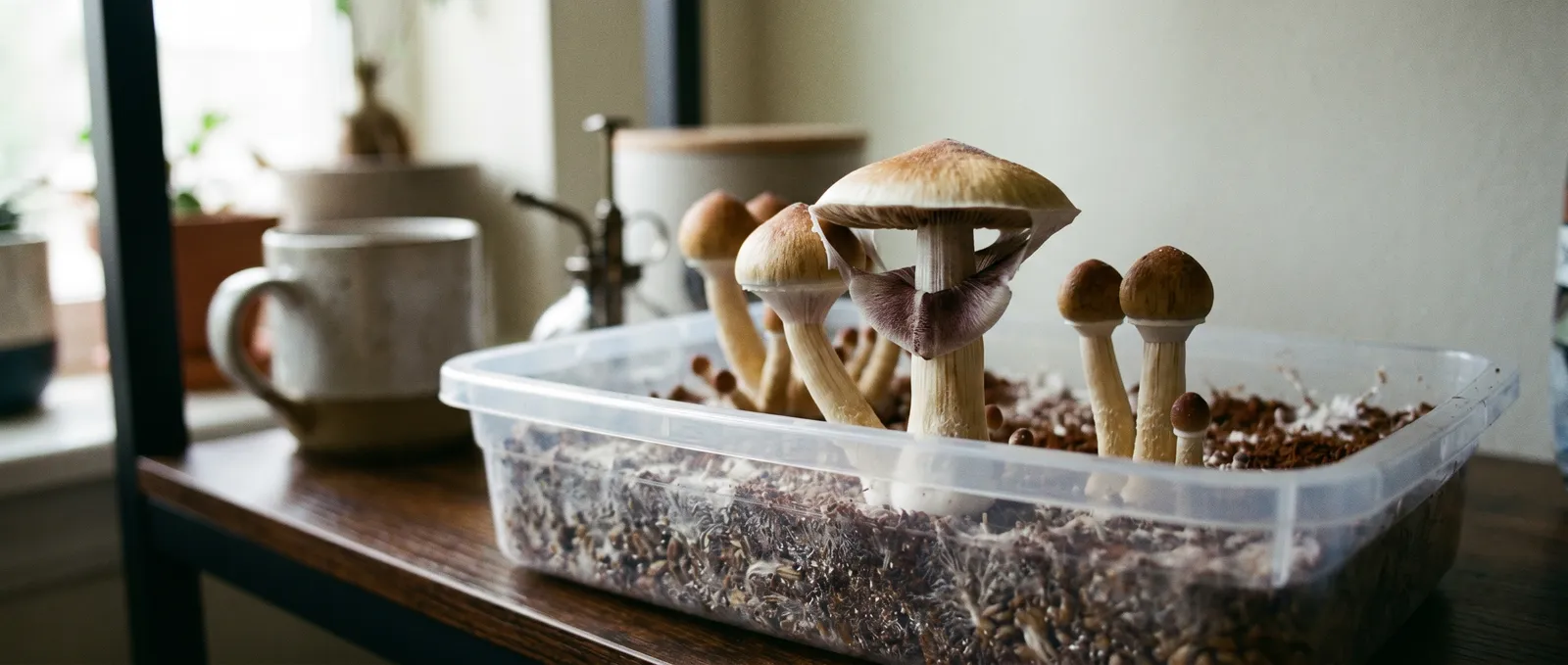
Definition
Harvest timing veil break is a cultivation technique that uses the tearing of the partial veil on maturing Psilocybe cubensis to mark peak alkaloid content. Bigwood & Beug (1982) showed psilocybin concentrations are highest just before full sporulation, making this narrow window the optimal harvest point for home growers.
This guide is written for adults aged 18 and over. Cultivation techniques described here apply to adult home growers.
Educational disclaimer: This article is educational information for adult home cultivators. It is not medical advice. Psilocybin-containing mushrooms can cause intense psychological effects and are not compatible with MAOIs, SSRIs, or lithium. If you have a personal or family history of psychosis, bipolar disorder, or severe cardiovascular conditions, do not consume these mushrooms. Always start low, go slow, and have a sober trip sitter present. Consult a qualified healthcare professional before use.
Harvest timing veil break is a visual cultivation cue that lets home growers pick Psilocybe cubensis at peak alkaloid content. The veil is the thin membrane that connects the cap edge to the stem on a young cubensis, and watching it is the single most reliable signal for when to get the scissors out — pick too early and you sacrifice yield, pick too late and spores dump across your casing layer, staining everything purple-black and reducing the potency of subsequent flushes. Growers who buy a Grow Kit and want to order the best possible result from it learn to read this harvest timing veil break signal first.
Psilocybin content peaks just before spore maturation — Bigwood & Beug (1982) measured total indole alkaloids in cubensis fruit bodies and found the highest concentrations in specimens harvested before the partial veil had fully ruptured. After sporulation, alkaloid content declines as the fungus redirects energy. This guide walks through what the veil actually is, how to read it, and the exact moment to cut.
Step 1: Understand what you're looking at
The partial veil is a tissue membrane stretched between the stem and the underside of the cap. On a young cubensis, it hides the gills completely — the cap looks sealed shut from below. As the mushroom matures and the cap expands, tension on the veil increases until the membrane tears away from the cap margin, exposing the gills and releasing spores.
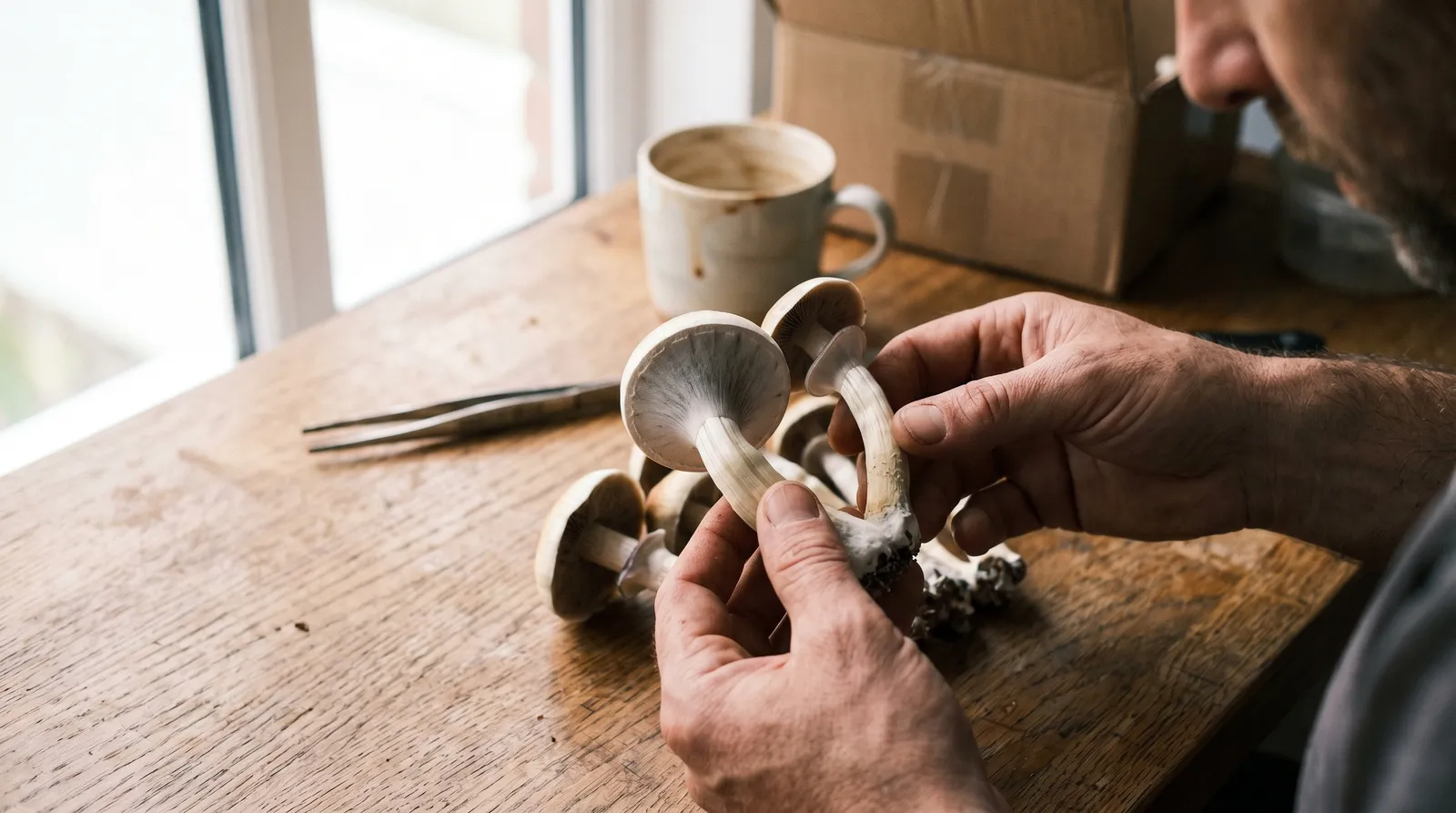
Two things to train your eye on:
- The veil itself — a whitish, papery sheet under the cap. Intact = not ready. Torn but still hanging in ragged fragments = harvest window open. Completely gone with dark purple gills exposed = you've waited too long.
- Cap shape — convex (domed) and still slightly curled at the edges means the mushroom is pushing growth into its mass. Flat or upturned ("uplifted") means it's switched into spore dispersal mode.
Step 2: Identify the harvest window
The harvest timing veil break window is narrow — usually 12–24 hours per fruit body at standard kit conditions. On a Golden Teacher Grow Kit at 23 °C with 90% RH, this window holds steady; fast strains like McKennaii can move through it in under 12 hours.
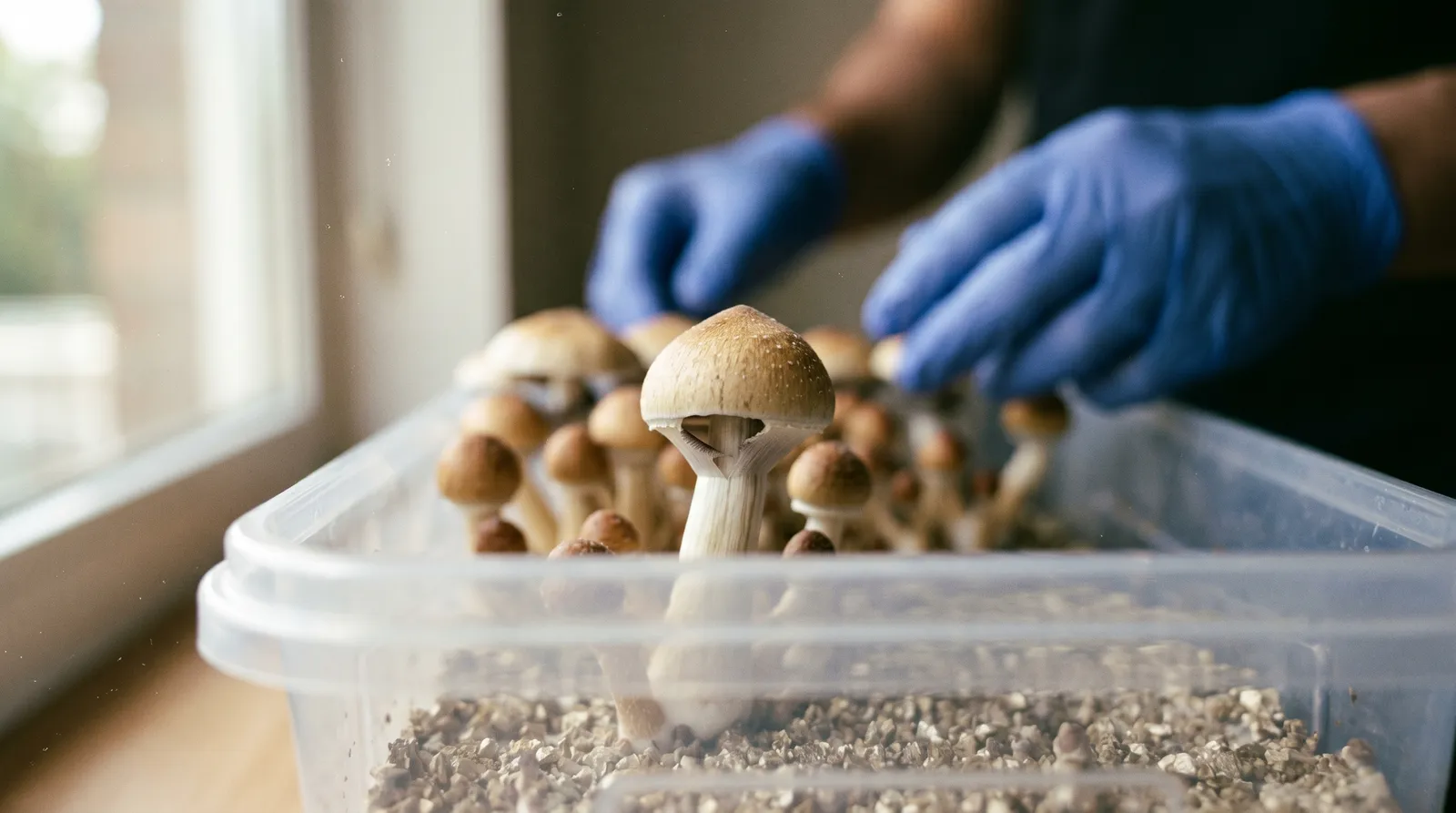
Visual checklist for "pick now":
- Veil torn or stretched to translucency — you can see the dark gill colour through it
- Cap still convex, edges curled inward or just straightening
- Cap colour darkening from golden-caramel (young) toward the strain's mature tone
- No visible spore deposit on nearby caps or the casing layer yet
Visual checklist for "you waited too long":
- Caps flat or upturned at the edges
- Purple-black spore print on surrounding caps, stems, or perlite
- Gills fully exposed, dark chocolate-purple across the whole underside
Quick reference table for the three visible stages of harvest timing veil break:
| Stage | Veil | Cap shape | Action |
|---|---|---|---|
| Immature | Intact, opaque white | Tightly convex, curled edges | Wait 12–24 h |
| Veil break (peak) | Torn, stretched, translucent | Convex, edges just straightening | Harvest now |
| Post-sporulation | Gone, gills fully exposed | Flat or upturned | Harvest anyway; potency reduced |
Step 3: Know why timing matters for potency
Alkaloid content in cubensis peaks just before sporulation and falls afterward — that's the core reason harvest timing veil break matters. Tsujikawa et al. (2003) analysed P. cubensis samples by LC-MS and reported total psilocybin + psilocin in the range of 0.5–1.3% of dry weight, with higher concentrations in younger specimens. Gartz (1994) observed similar patterns across multiple Psilocybe species — peak alkaloid content before sporulation, decline afterward.

The practical consequence: a flush harvested at correct veil break will outperform the same flush harvested two days later in both dry weight and potency per gram. Home growers who wait "for the caps to open up" are trading both.
Honest limitation: Research on cubensis potency loss post-sporulation is thinner than the cultivation forums suggest — most of the peer-reviewed work was done on wild specimens rather than indoor kit flushes, so exact percentages for a given strain and substrate are hard to pin down. European data via EMCDDA briefings on psilocybin prevalence also focuses on consumption rather than cultivation, so kit-level numbers remain a gap. Beckley Foundation pharmacology briefings help on the consumption side but don't close the cultivation data gap either.
Step 4: Pick cleanly
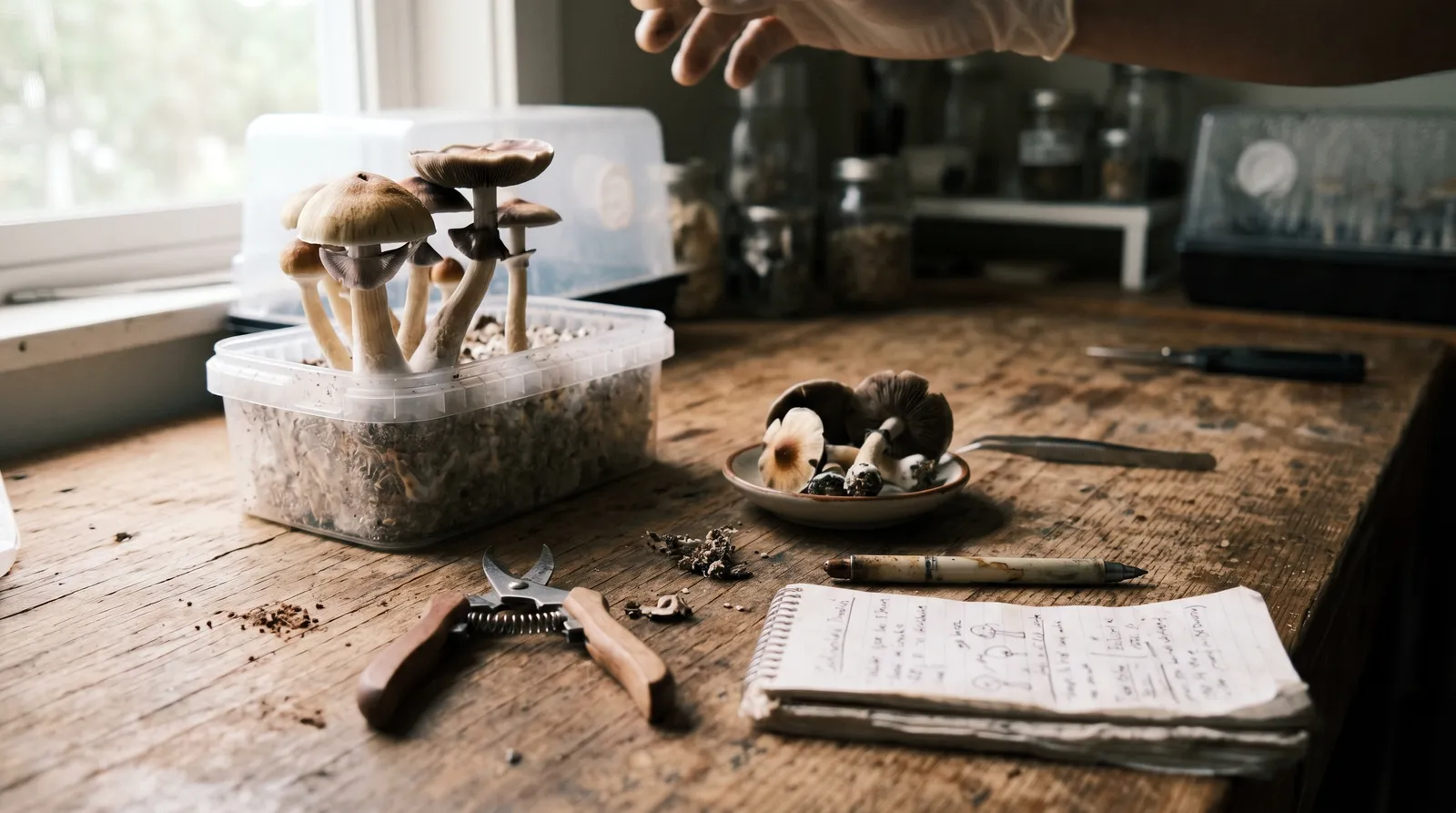
Twist and pull from the base — never cut at the casing surface. Tools: disposable nitrile gloves, rubbing alcohol (70% isopropyl), and either your fingers or sterilised small scissors.
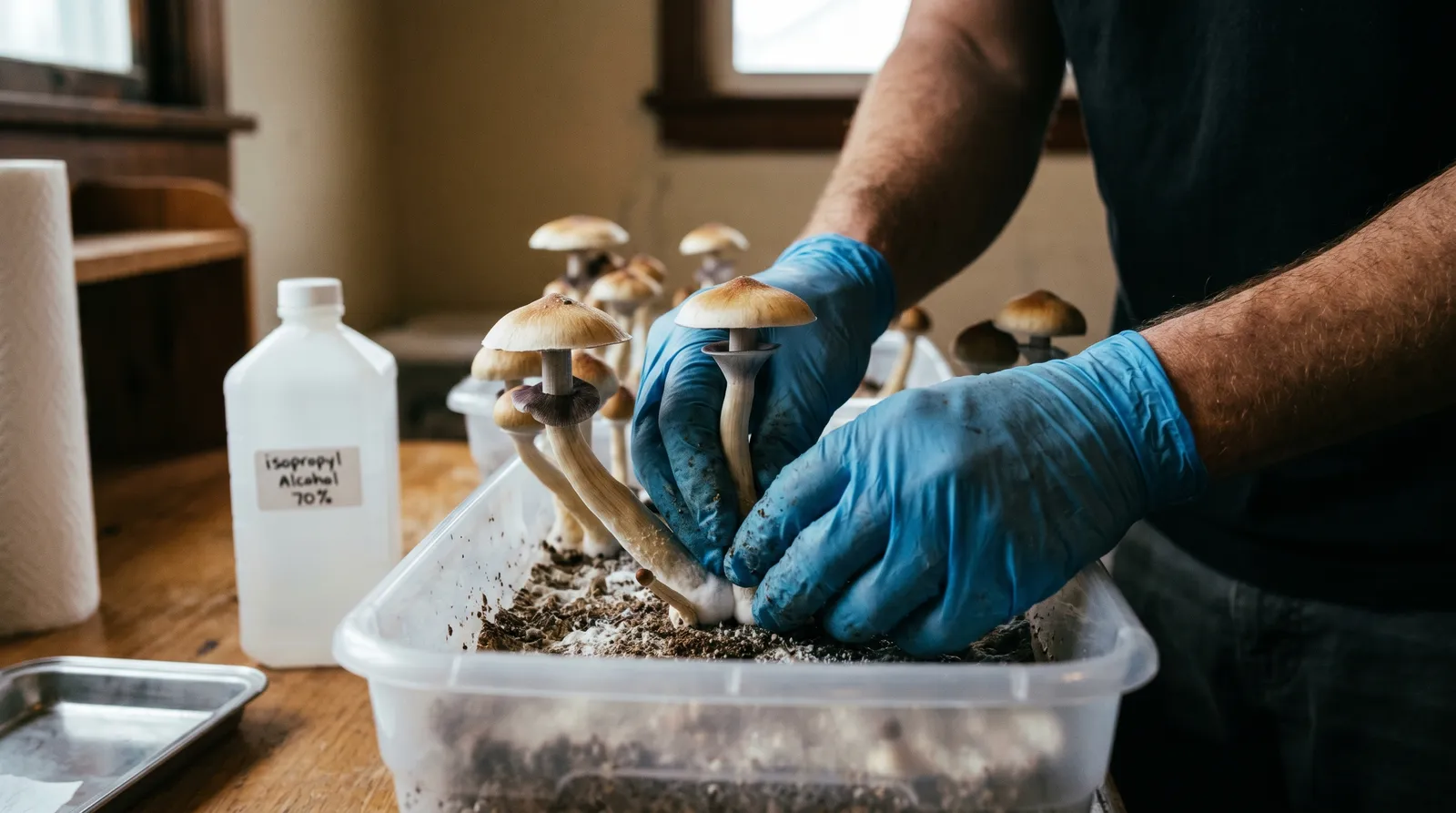
- Wipe hands and work surface with alcohol before opening the kit.
- Grip the base of the stem where it meets the casing layer. Twist gently while pulling — the mushroom should release with a small piece of mycelium attached.
- Do not cut stems at the casing surface. Leaving stem stumps in the substrate promotes bacterial rot (pink or grey wet spots) and blocks pinning sites for the next flush.
- Pick the whole cluster at once when possible. Mushrooms in a cluster mature within hours of each other; picking one and leaving its neighbours disturbs the casing and risks contamination.
- Brush off vermiculite or perlite with a soft dry brush before weighing. Do not rinse — water absorbed pre-drying throws off dry-weight calculations and invites mould during drying.
Step 5: If spores have already dropped
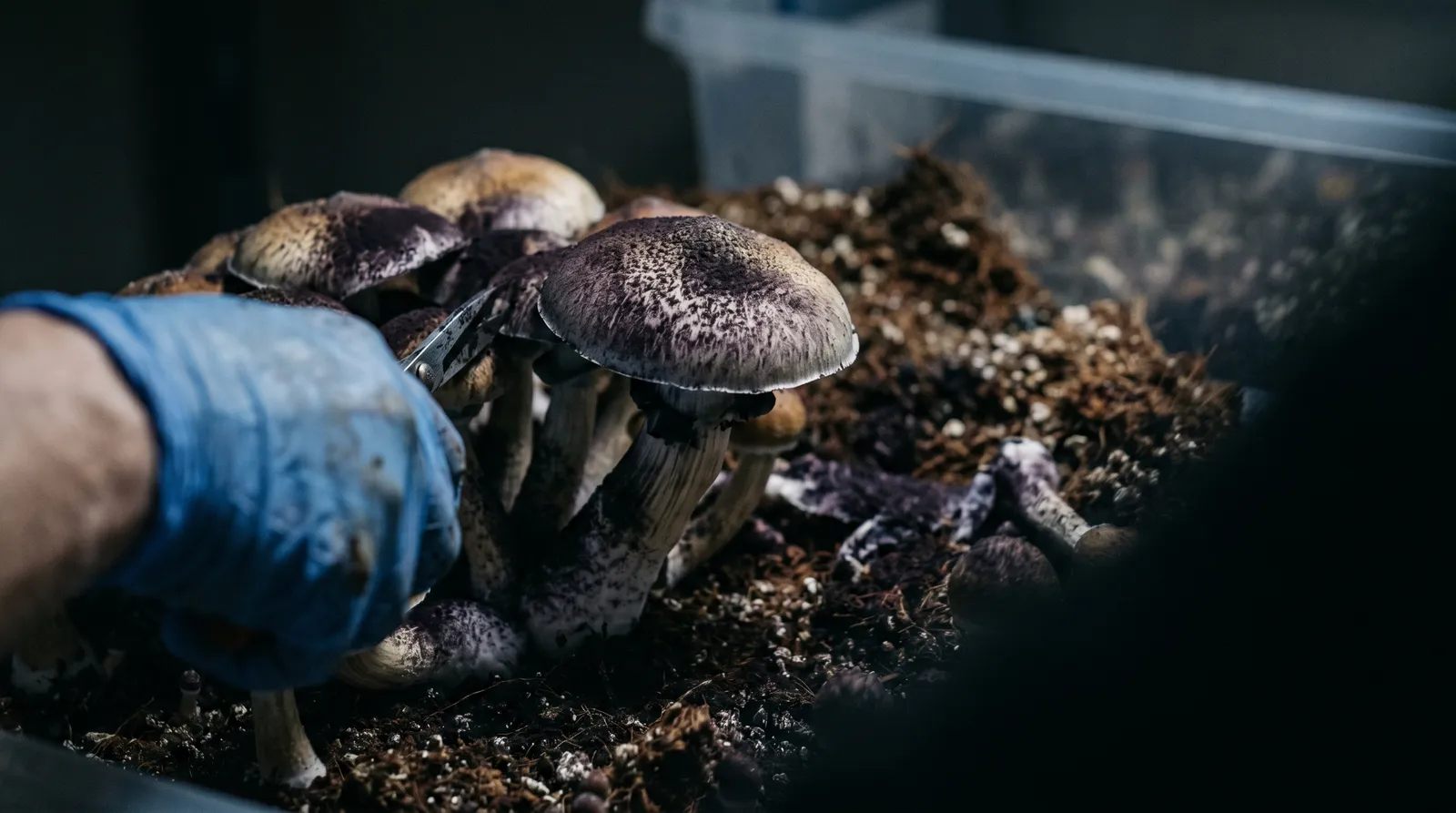
Harvest anyway — sporulated caps are still usable, just lower in potency. Purple-black spore coating on caps is cosmetic and doesn't ruin the mushrooms, but it indicates the individual fruit body has passed peak alkaloid content. The casing layer absorbs spores too, which can complicate subsequent flushes by creating a thick dark crust that interferes with pin formation.
If your entire flush has gone to full spore drop:
- Harvest everything. Nothing is gained by leaving mature fruits.
- Wipe the inside of the kit bag with a damp (not wet) paper towel to remove excess spores.
- Consider whether the next flush will benefit from dunking the cake in cold water (the standard rehydration technique) — a heavily spore-loaded casing sometimes needs it more than a clean one.
Step 6: Manage the flush, not the individual mushroom
A cubensis flush doesn't mature uniformly — expect a 2–3 day spread between first and last pins. On a standard plastic-tub Grow Kit, you'll see the first pins open up 2–3 days before the last ones. Two approaches work:
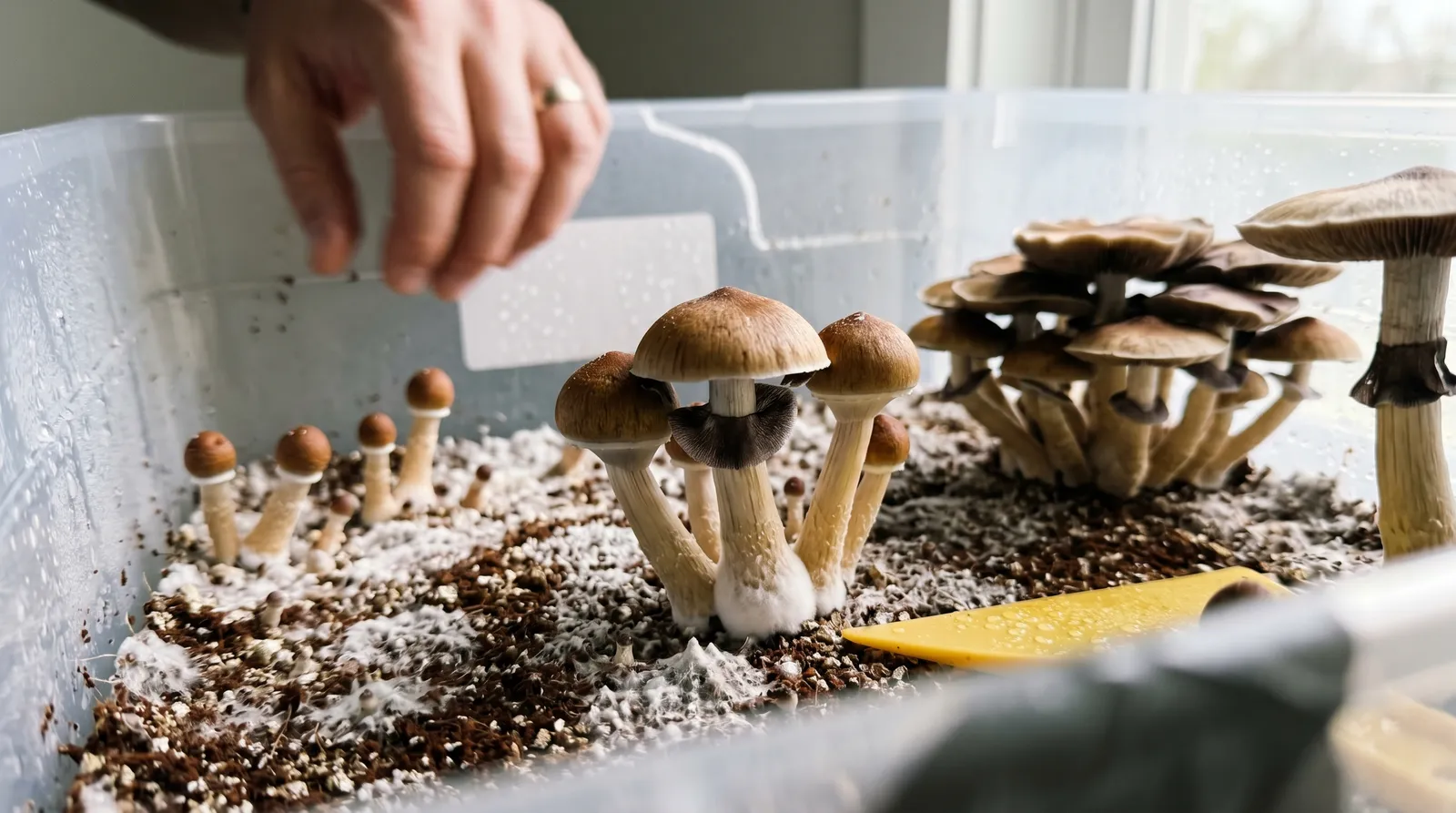
- Single harvest — wait until roughly 70% of the flush is at veil break, then pick everything including smaller pins. Simpler, cleaner, better for beginners. Loses a small amount of yield on the youngest fruits.
- Rolling harvest — pick each cluster at its own veil break across 2–3 days. Maximises yield per flush but requires opening the kit multiple times, which raises contamination risk and dries out the casing.
Comparison: Compared to Ready-2-Grow Bags — the sealed one-bag-one-flush format — a plastic-tub kit tolerates rolling harvest better because you can reseal it cleanly. For Ready-2-Grow, single harvest is almost always the right call because the sealed design isn't meant for repeated opening. Growers who want to buy a kit and get consistent results with minimum fuss should default to the single-harvest approach.
Common mistakes
- Waiting for "fully open" caps. A flat or upturned cap is not a sign of readiness; it's a sign the mushroom is trying to disperse spores. You've already lost potency.
- Harvesting only the biggest fruits. Leaving smaller mushrooms to "grow more" often means they abort because picking disturbs the substrate. Better to take the cluster.
- Cutting at the surface. Leaves stem base in the casing; rot follows. Twist-and-pull the whole base out.
- Rinsing before drying. Adds moisture, skews dry weight, promotes mould.
- Opening the kit hourly to check. FAE disruption and contamination risk. Check twice a day — morning and evening — and you'll catch the window.
Consumption, dosing, and preparation of dried mushrooms are covered on the psilocybin hub — this guide stops at the harvest. For drying technique, see the sibling article on drying and long-term storage. Note that psilocybin is not compatible with MAOIs, SSRIs, or lithium; the dedicated interactions article covers this in detail. Growers looking to buy a starter kit or order spore prints can find strain-specific guidance in the cultivation category.
Last updated: April 2026
Frequently Asked Questions
8 questionsWhat does the veil on a magic mushroom actually look like?
How long does the veil break harvest window last?
Is it safe to eat mushrooms after the veil has broken and spores dropped?
Should I cut or twist mushrooms at harvest?
Can I harvest some mushrooms and leave others to grow?
Why did my mushrooms go from veil-closed to flat caps overnight?
Does harvesting before the veil breaks reduce overall mushroom yield?
How does temperature affect how fast the veil breaks on Psilocybe cubensis?
About this article


Adam Parsons is an external cannabis and psychedelics writer and editor who contributes to Azarius's wiki as both author and reviewer. On the writing side, he authors Azarius's kratom and kanna clusters, drawing on exten
This wiki article was drafted with AI assistance and reviewed by Adam Parsons, External contributor. Editorial oversight by Joshua Askew.
Medical disclaimer. This content is for informational purposes only and does not constitute medical advice. Consult a qualified healthcare provider before use of any substance.
Last reviewed April 25, 2026
References (3)
- [1]Bigwood, J., & Beug, M. W. (1982). Variation of psilocybin and psilocin levels with repeated flushes of cultivated Psilocybe cubensis. Journal of Ethnopharmacology, 5(3), 287-291. DOI: 10.1016/0378-8741(82)90014-9
- [2]Gartz, J. (1994). Magic Mushrooms Around the World. LIS Publications, Los Angeles, CA.
- [3]Stamets, P. (1996). Psilocybin Mushrooms of the World: An Identification Guide. Ten Speed Press, Berkeley, CA. Source
Related Articles
Cannabis Hermaphrodite: Identify, Prevent, Act
A cannabis hermaphrodite is a female plant that develops male pollen sacs or banana-shaped anthers (nanners), self-pollinating and seeding your harvest.
DIY Cannabis Fertilizer: Homemade Nutrient Guide
DIY cannabis fertilizer guide: compost, teas, banana ferments and feed schedules, with safety notes and cited research for home growers.
What To Do With Male Cannabis Plants: 6 Practical Uses
What to do with male cannabis plants: identify, isolate, breed, extract, or compost. A practical 6-step guide with sourcing and safety notes.
Mushroom Grow Kit Temperature & Humidity: Full Setup Guide
A temperature humidity control grow kit is the small set of climate tools — hygrometer, heat mat, humidifier or perlite tray — that keeps a mushroom fruiting…
First Grow Checklist: What You Need for Mushroom Kits
A first grow checklist is the short list of supplies and environmental conditions needed to run a home psilocybin mushroom kit from inoculated substrate to…
Sclerotia vs Fruit Bodies: Cultivation Comparison
Sclerotia and fruit bodies are two different life stages of Psilocybe fungi: sclerotia are hardened underground mycelial storage bodies (the 'magic…
Storing Dried Mushrooms Long Term: Full Guide
Storing dried mushrooms long term means keeping well-dried Psilocybe fruit bodies in airtight, opaque containers with desiccant, cool and dark, to slow…
Drying Mushrooms Air Desiccant Oven: Methods Compared
Drying mushrooms air desiccant oven refers to the three home methods for reducing fresh fruit bodies from ~90% water to cracker-dry (<5%). Gotvaldová et al.
Grow Kit vs Ready 2 Grow Bag: Which to Pick
The grow kit vs Ready 2 Grow Bag choice compares two Psilocybe cubensis home-cultivation formats: a tub with rye substrate and casing layer designed for…