
This article discusses psychoactive substances intended for adults (18+). If you have a health condition or take medication, consult a doctor before use. Our age policy
Main-Lining Cannabis: Manifolding Step by Step
Definition
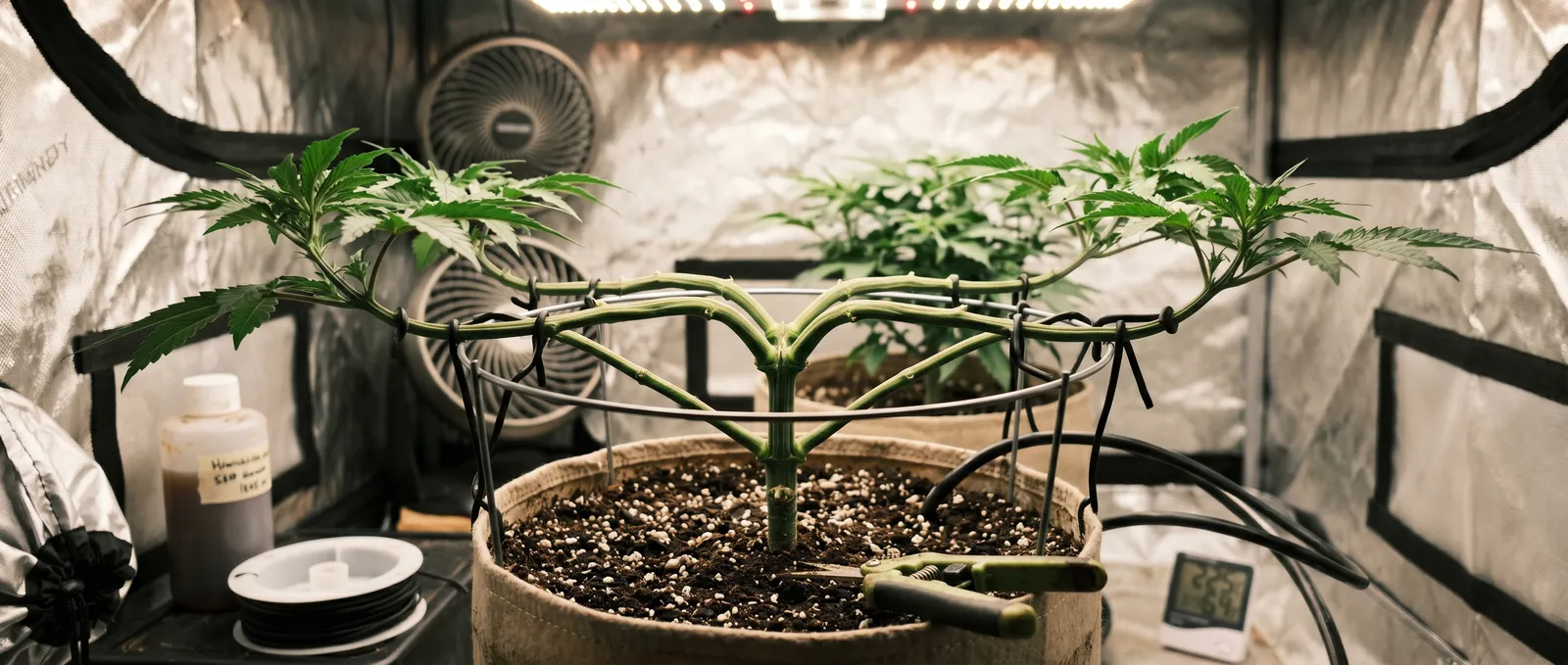
Main-lining cannabis, also called manifolding, is a photoperiod training method where a seedling is topped to the third node and trained into a symmetrical Y-shaped hub, producing 8–16 equal colas under one flat canopy (Caplan et al., 2019). It prioritises uniformity and light distribution over speed.
Adult use only — this guide covers cultivation technique for adult home growers.
Main-lining cannabis is a high-control training technique that turns a single seedling into a symmetrical plant with multiple equal-sized colas fed by one central hub. Also called manifolding, you top the seedling down to the third node, strip everything below, and tie the two remaining shoots flat into a Y — that Y becomes the "manifold," the plumbing from which every future cola grows. Done right, you get 8, 16, or 32 uniform colas sharing a flat canopy under one light.
It's slower than just flipping a bushy plant to flower, and it's not forgiving of sloppy cuts. But for growers running a single plant under a fixed LED footprint, main-lining is one of the cleanest ways to get even light distribution and predictable yields. This guide walks through the technique step by step, with the timing and recovery windows we've actually used in our own tent.
Disclaimer: This guide is educational and intended for adult home growers in jurisdictions where cultivation is permitted. Always verify the rules that apply to you before you buy seeds or order grow supplies. Azarius does not provide formal advice.
What main-lining actually does to the plant
Main-lining redirects the plant's hormonal plumbing so every cola receives roughly equal resources. It exploits apical dominance — the biological tendency for cannabis to funnel hormones (mainly auxin) into a single dominant top. By removing that top early and forcing growth into two symmetrical shoots, each subsequent topping doubles the number of main colas: 2 → 4 → 8 → 16.
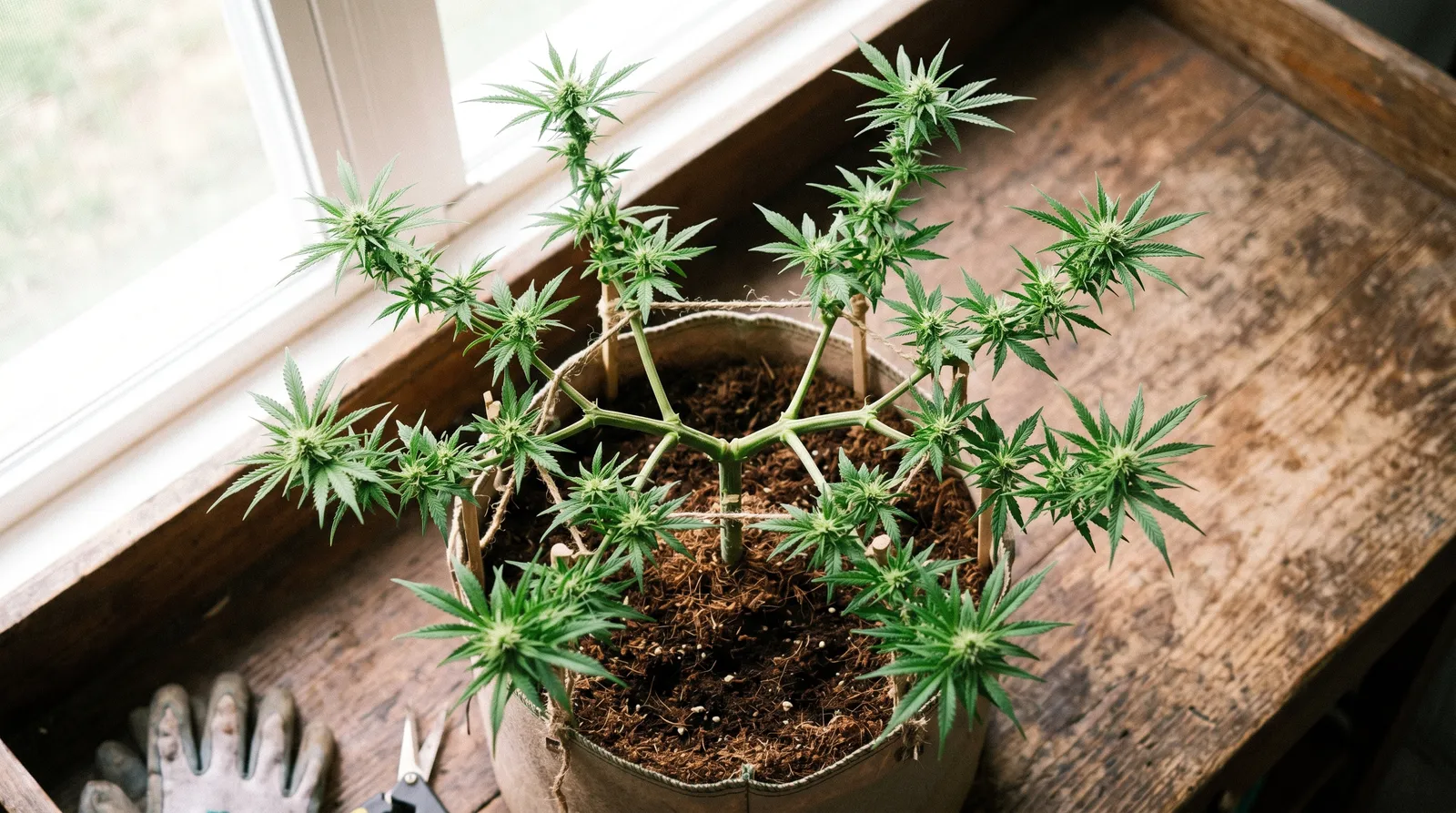
Compared to LST (low-stress training) or a standard topping, main-lining is structural surgery done early. LST bends what's already there; main-lining rebuilds the plant from the third node up. The payoff is uniformity — a main-lined plant under good light tends to produce colas of nearly identical size, rather than one fat central bud surrounded by smaller shoulder buds.
Photoperiod only. This technique assumes photoperiod genetics. Autoflowers shouldn't be main-lined — they flower on an internal clock (typically 9–11 weeks seed-to-harvest), and the recovery time from heavy training eats directly into their veg window. Stick to gentle LST on autos.
Step 1 — Wait for 5–6 nodes before cutting
Start main-lining when your photoperiod seedling has developed 5–6 fully-formed nodes (not counting the cotyledons). At this stage the main stem is thick enough to take a clean topping without collapsing, and the plant has enough stored energy to recover inside a week. This usually lands around week 3–4 of veg from seed.
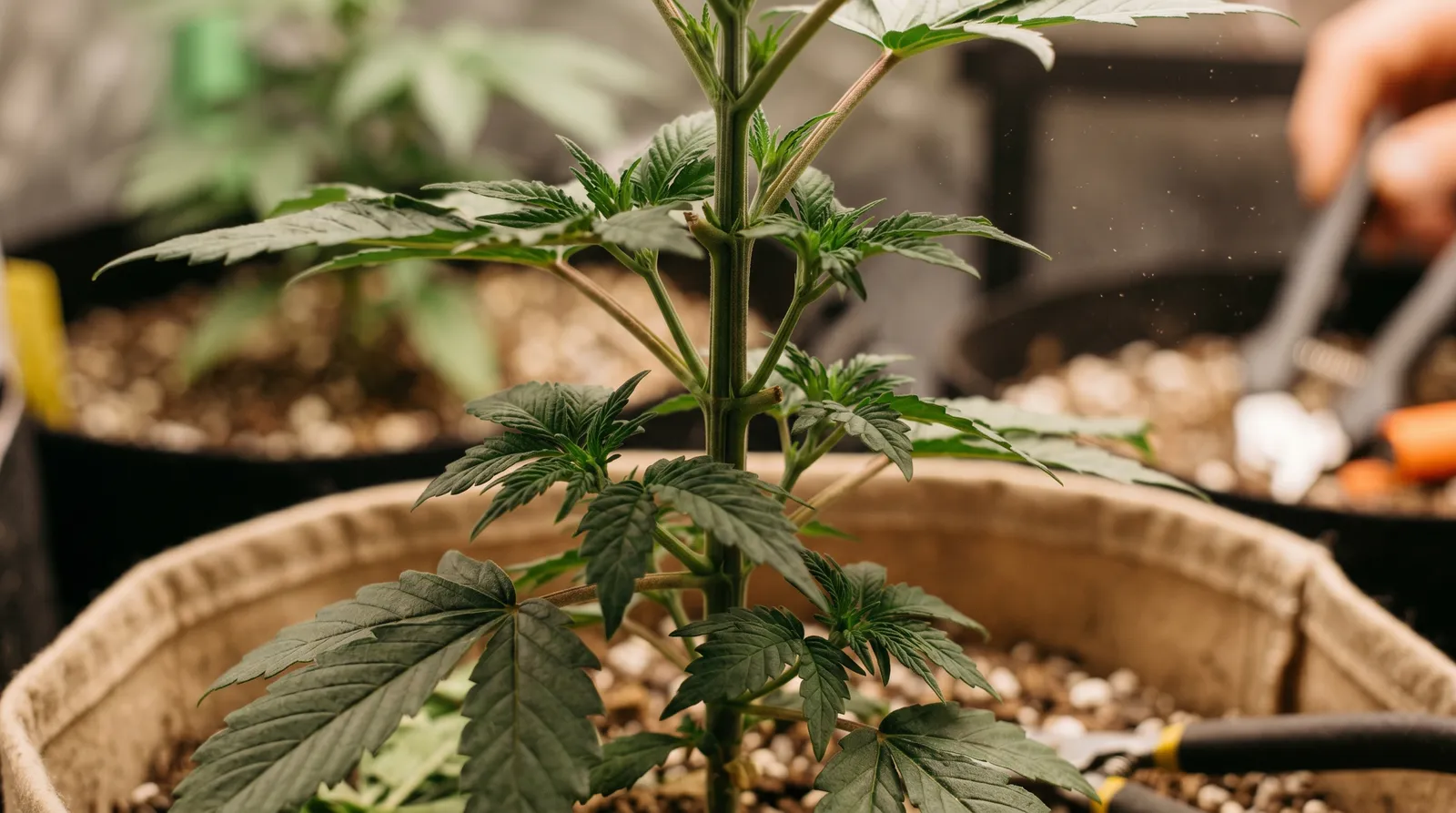
Skip this if the plant looks stressed — droopy leaves, pale growth, recent transplant shock. Main-lining a healthy, vigorous plant takes 5–7 days to recover. Main-lining a stressed one can stall it for a fortnight.
Step 2 — Top down to the third node
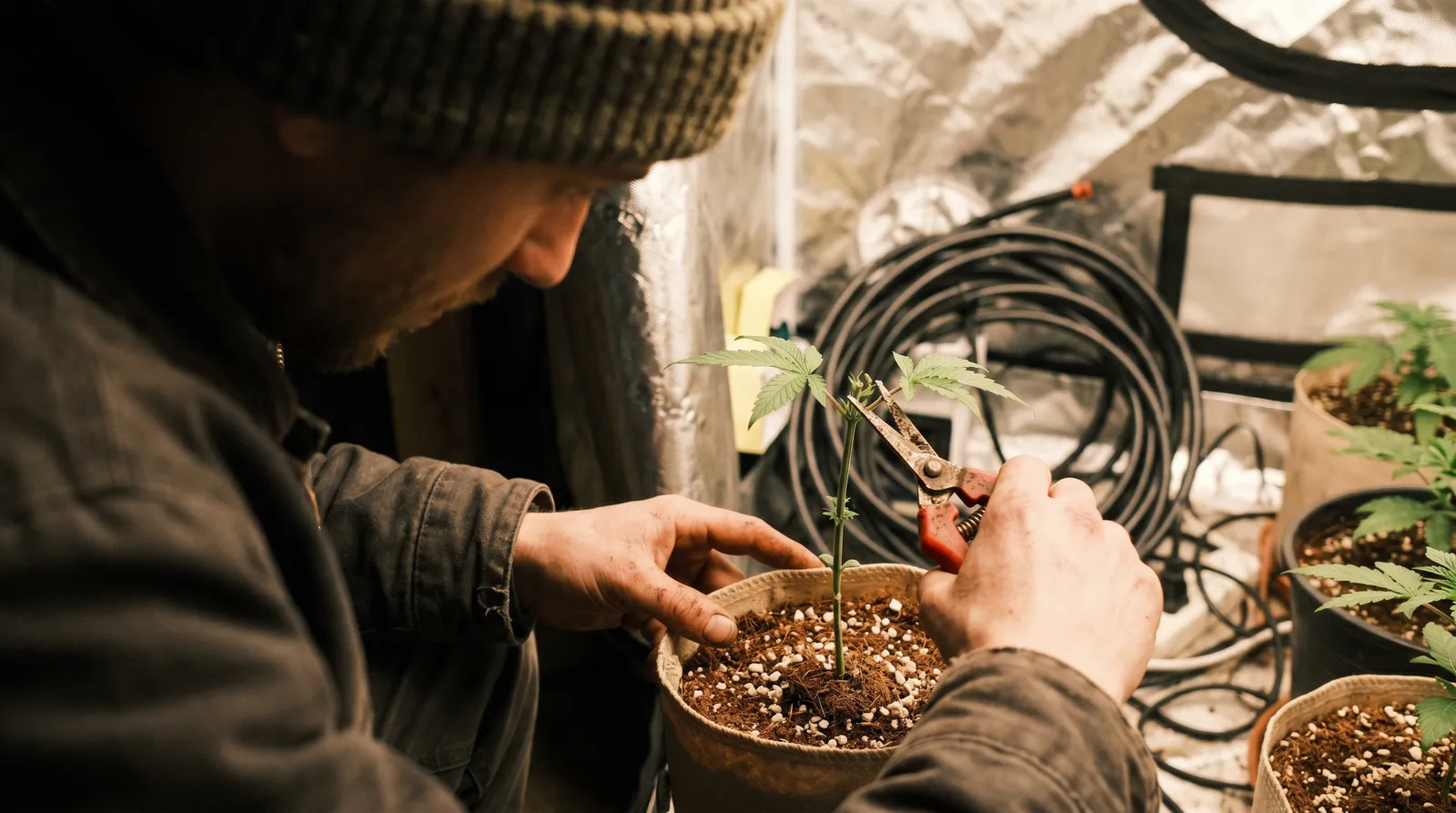
The first top defines the whole structure. Using sharp, sterilised scissors (70% isopropyl wipe between cuts), cut the main stem just above the third node. You're removing the top 2–3 nodes of the plant. What's left: a stem with three sets of branches, the top pair being the ones that will form your manifold Y.
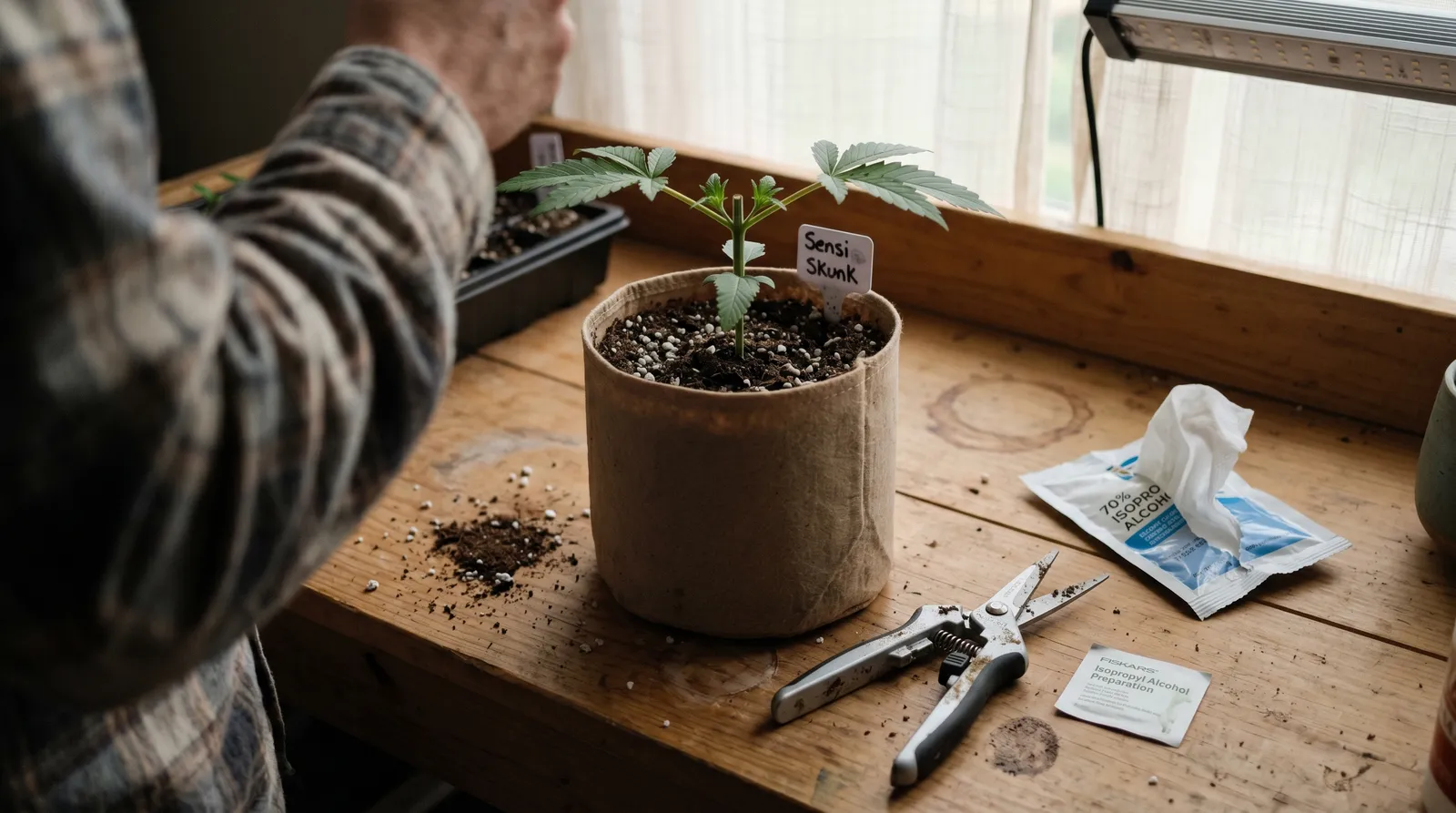
Cut cleanly at a slight angle, about 5 mm above the node. A ragged cut invites rot; a flush cut into the node invites infection. If the stem bleeds a bit of sap, that's normal — leave it to seal on its own.
Step 3 — Strip everything below the top two shoots
Remove the lower two sets of branches and any growth coming off the main stem below the top pair. Pinch them off at the stem with clean fingers or snip them flush. The goal is a bare stalk with exactly two symmetrical shoots at the top — the future left and right arms of your manifold.
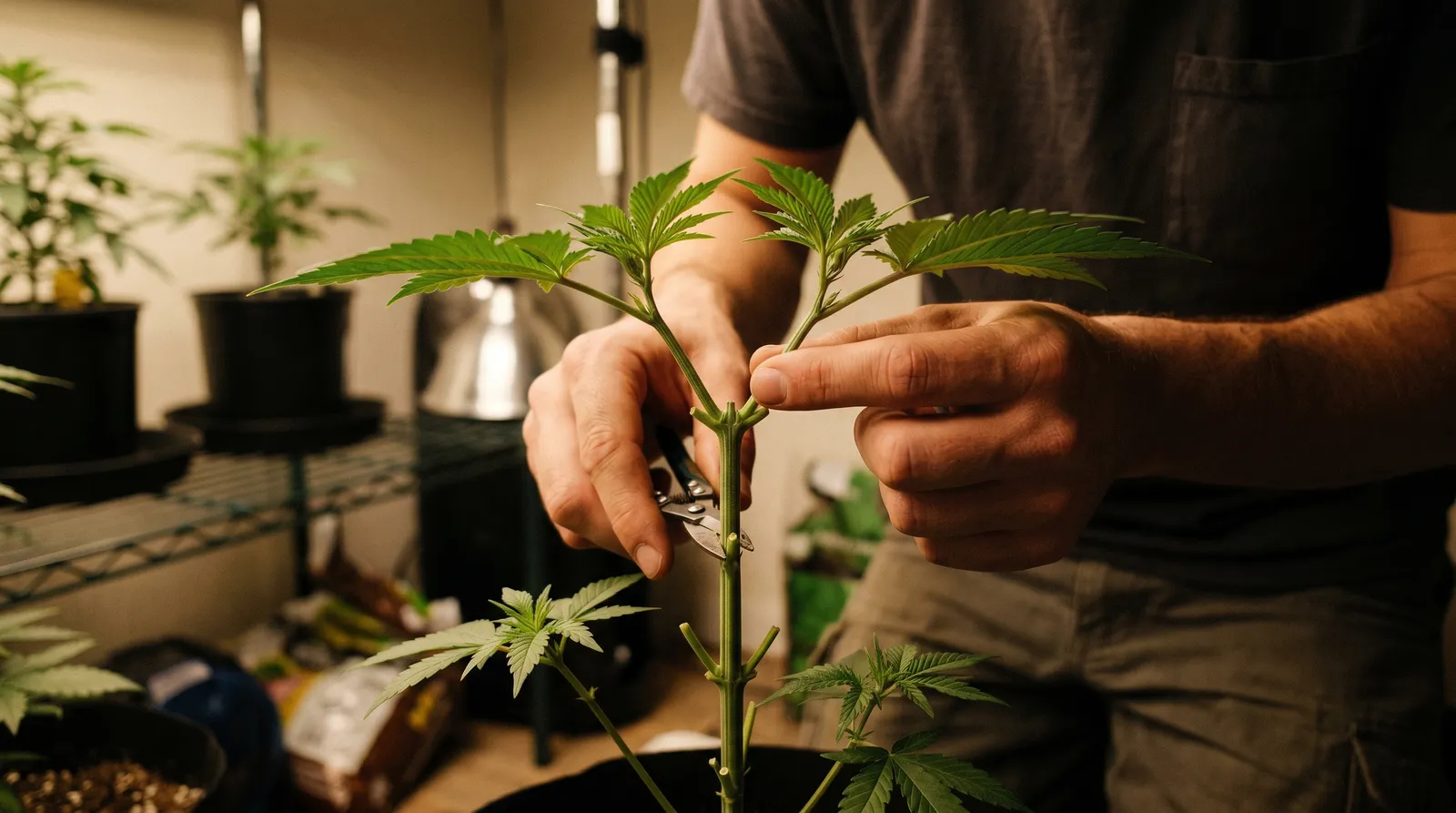
Strip the fan leaves from those lower nodes too. You want the plant to commit fully to the two remaining shoots. Anything below is competing for resources you've just redirected upward.
Step 4 — Tie the two shoots flat into a horizontal Y
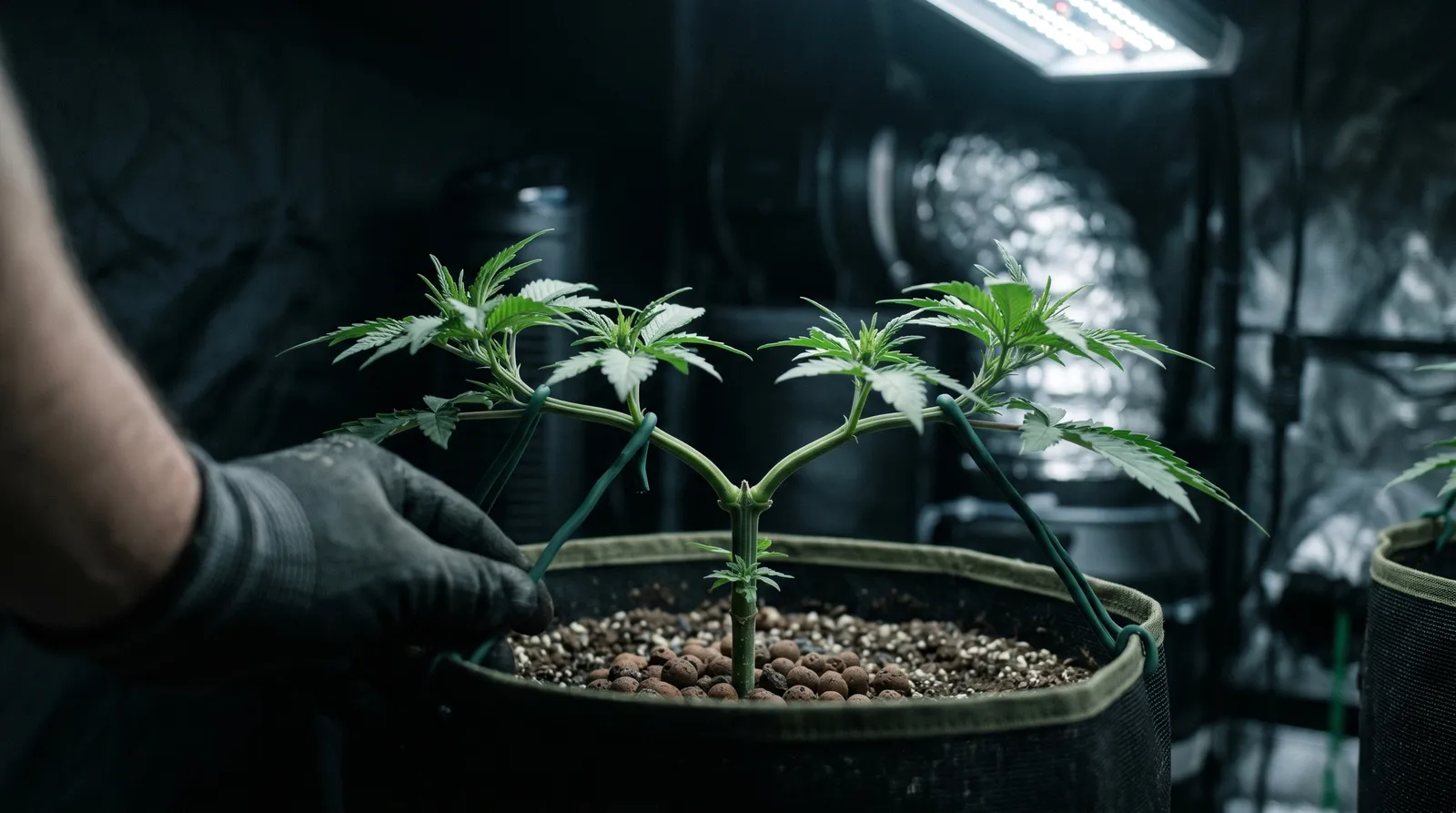
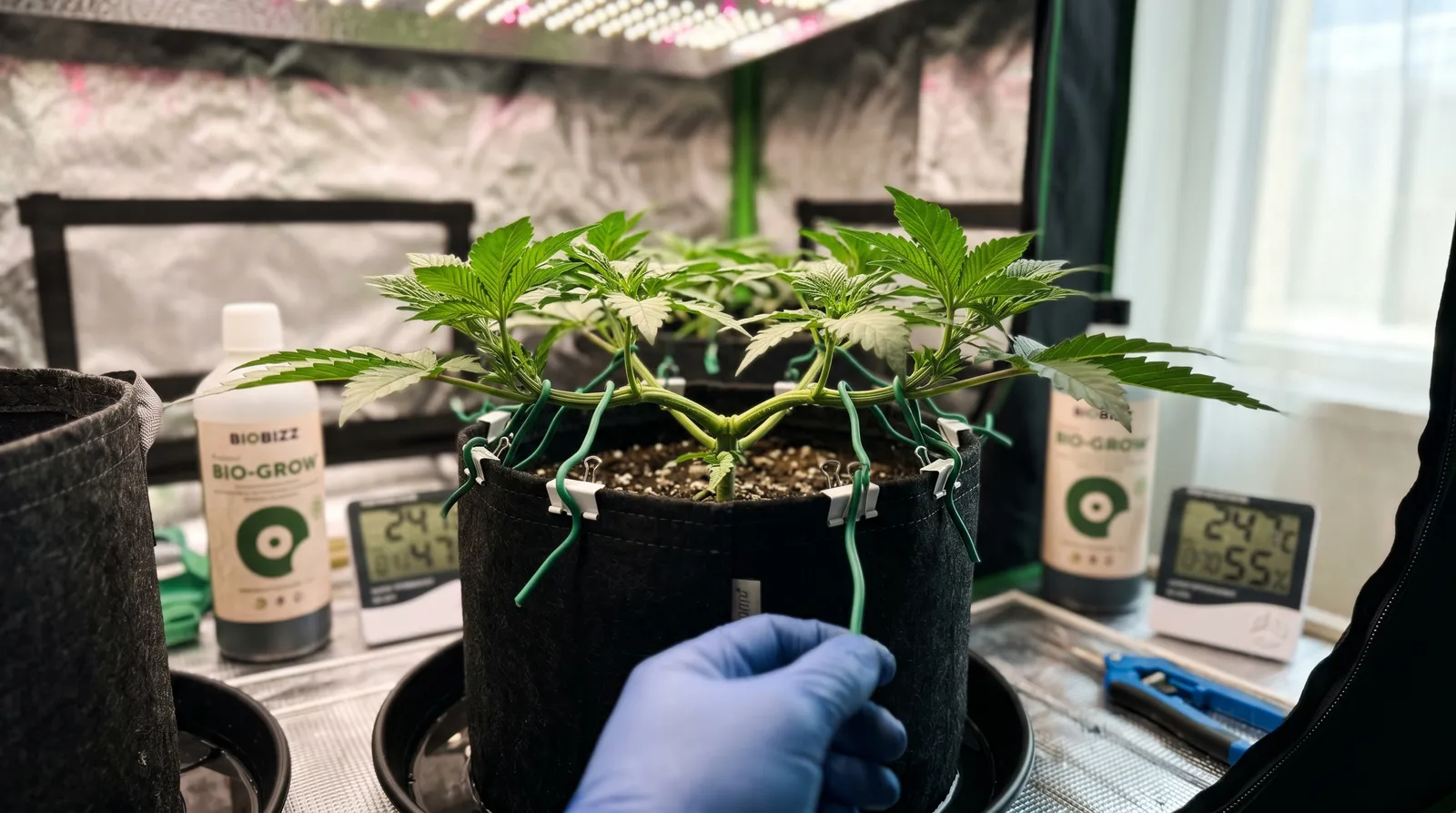
The two remaining shoots need to sit flat, not arched. Using soft plant ties (garden wire wrapped in foam, or rubber-coated twist ties — never bare string, which cuts into the stem), bend each shoot outward and downward until they sit at roughly 180° to each other, parallel to the soil surface. Anchor them to the rim of the pot or to stakes.
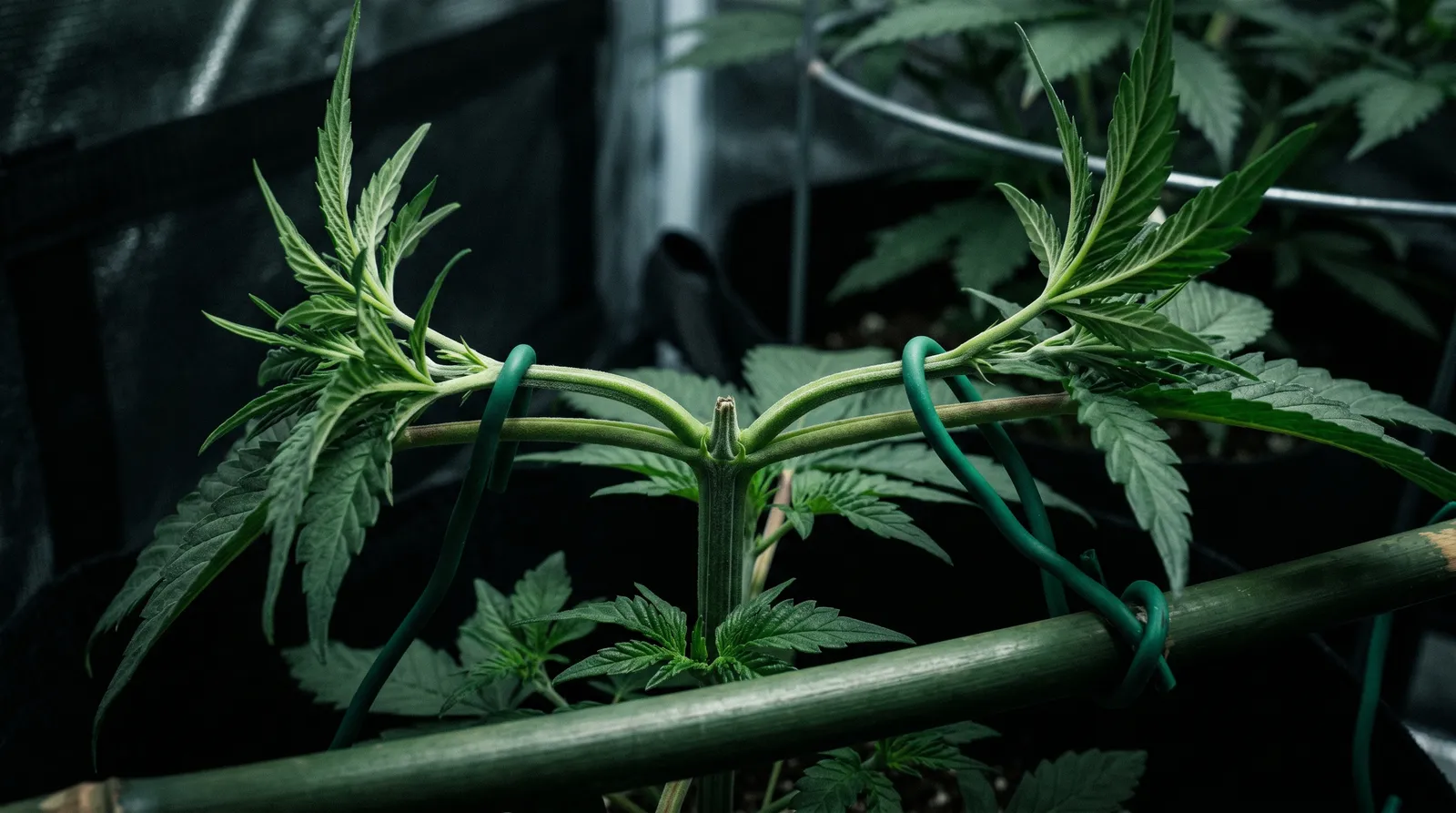
The bend is gentle but firm. This flat Y is the "manifold" — the symmetrical hub that every future cola will branch from. Over the next 5–7 days the stems will lignify (harden) in this new position and stop trying to spring back up.
Step 5 — Recover for 7–10 days
Leave the plant alone for a full week. No more topping, no defoliation, no transplanting. Water normally and feed at roughly 60–70% of your usual veg EC (around 1.0–1.2 mS/cm for most soil or coco feeds) — a stressed plant can't drink what a happy one drinks. VPD target during recovery: ~0.8–1.0 kPa.
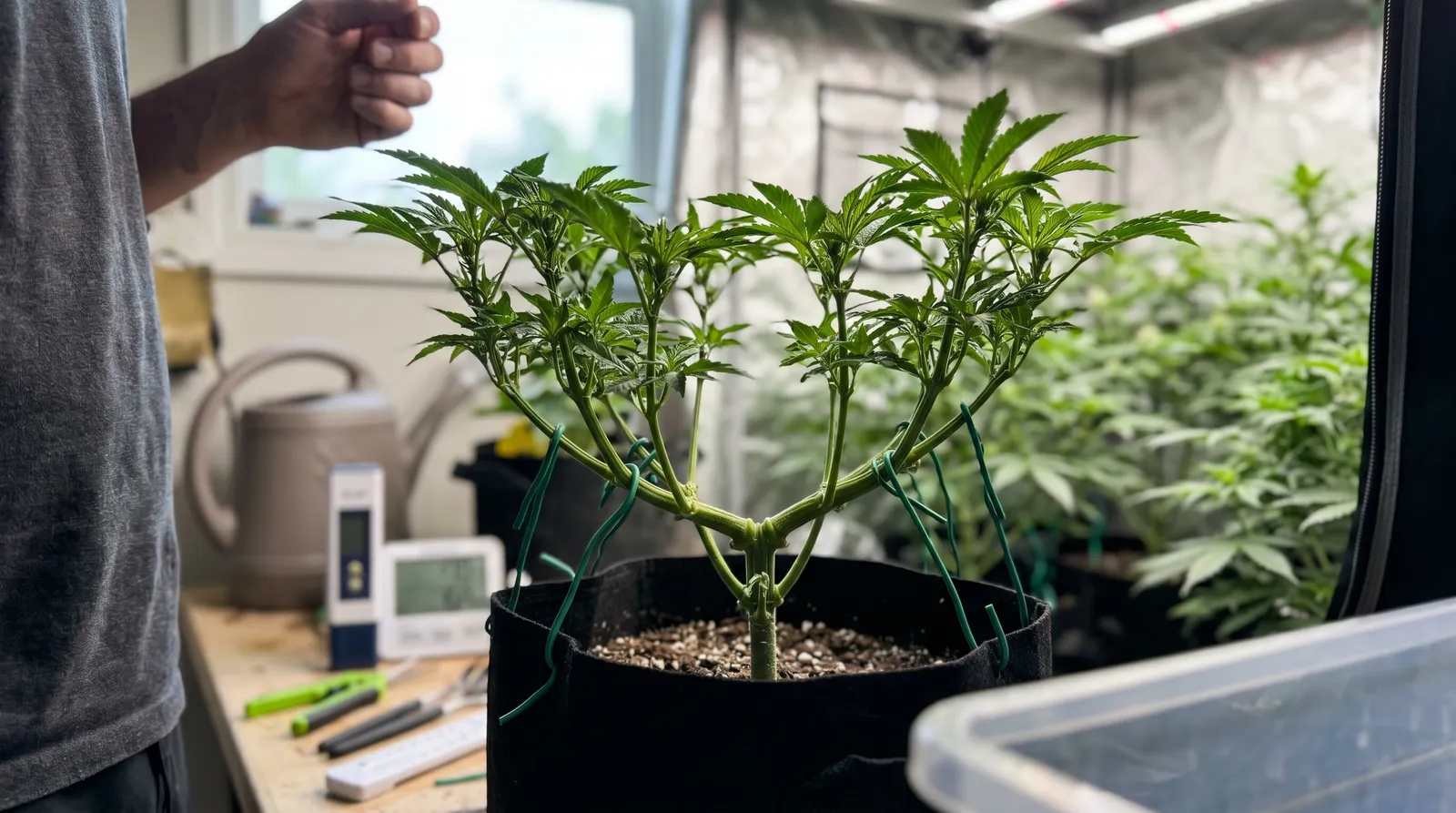
You'll know recovery is underway when the two shoots stop growing upward at their tips and start pushing new secondary growth from the nodes along their length. That secondary growth is the next generation of colas waiting to be trained.
Step 6 — Top each arm at its third node (the multiplier step)
Each multiplier round doubles your cola count. Once the two arms of your Y have each grown out 3 new nodes, repeat the topping process on each one. Cut each arm back to its third node, strip the lower growth off that arm, and tie the two new resulting shoots flat. You've now gone from 2 main colas to 4.
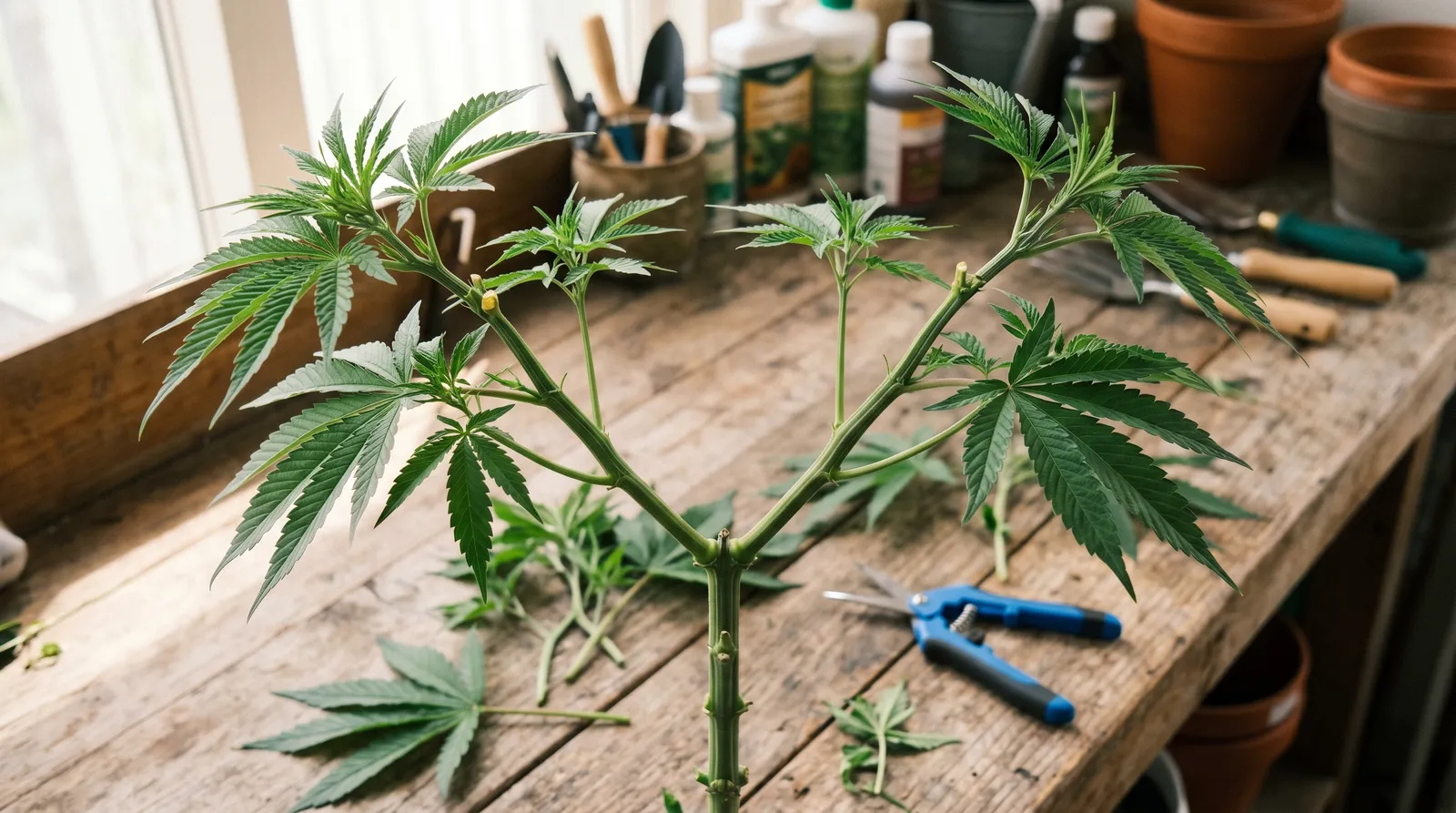
Repeat this multiplier step as many times as your timeline allows: 4 → 8 → 16. Each round adds 10–14 days to your total veg time. Most growers stop at 8 colas for a 60×60 tent or 16 for an 80×80. Going to 32 is possible but demands a long veg and excellent light uniformity across the whole footprint.
Step 7 — Flip to 12/12 with a flat, even canopy
Flip to 12/12 when your final cola count is locked in and each tip sits within 2–3 cm of its neighbours. The plant will stretch 1.5–2× during the first 2–3 weeks of flower, so flip when your canopy is about half the height you want at harvest.
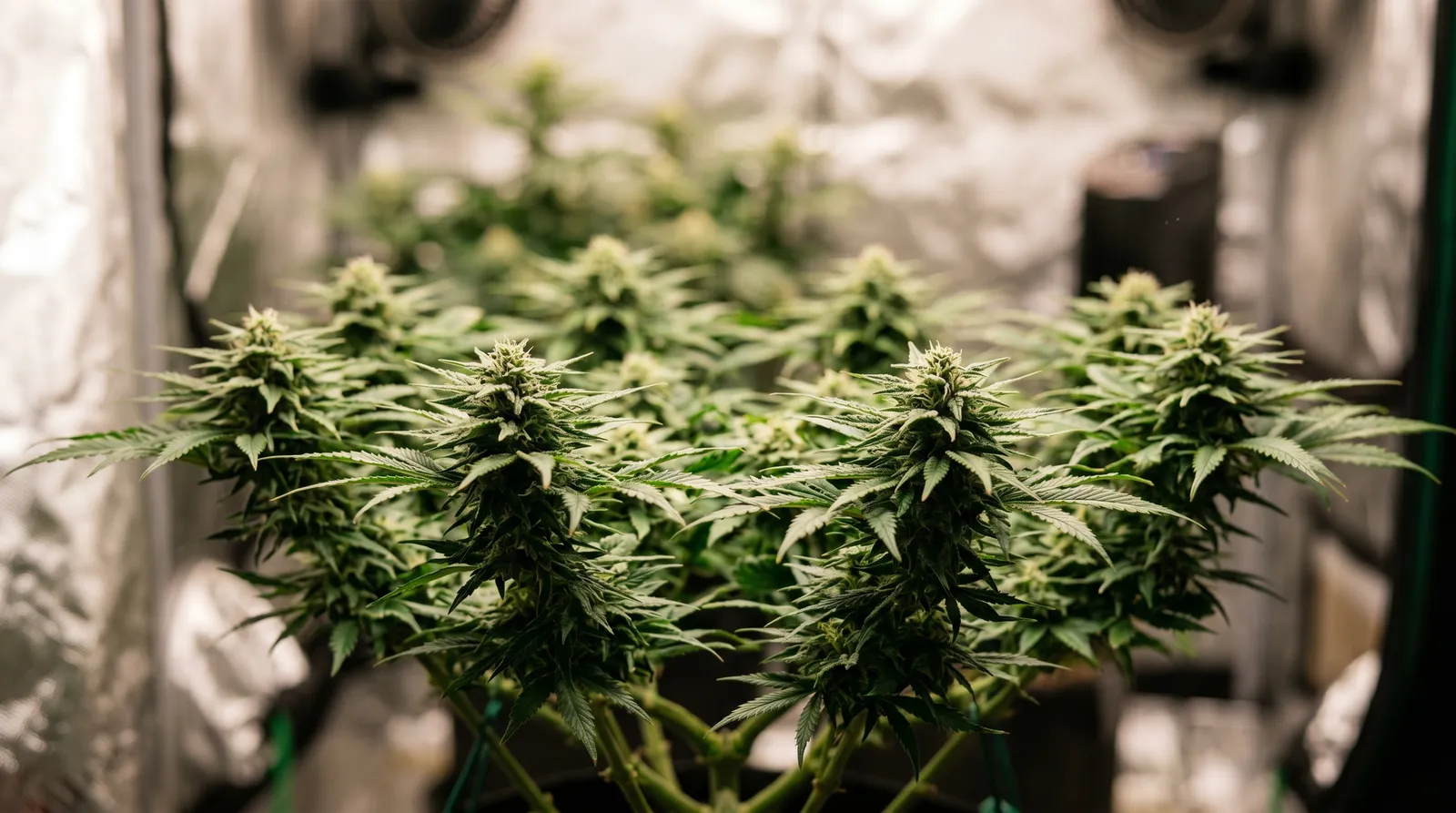
Flowering PPFD target sits around 600–900 µmol/m²/s across the flat canopy (Fluence Bioengineering horticulture guidance, 2023). Because main-lining forces a near-perfectly flat top, nearly every cola sits in the high-intensity zone — which is the whole point of doing this in the first place.
Main-lining target specs at a glance
| Stage | Target | Timing |
|---|---|---|
| First top | 5–6 nodes, cut above node 3 | Week 3–4 from seed |
| Recovery per round | EC 1.0–1.2 mS/cm, VPD 0.8–1.0 kPa | 7–10 days |
| Multiplier rounds | 2 → 4 → 8 → 16 colas | +10–14 days each |
| Flip height | ~½ target harvest height | End of veg |
| Flowering PPFD | 600–900 µmol/m²/s | Weeks 1–8 of flower |
Common mistakes and how to avoid them
Most failures come down to five repeatable errors. Fix these and the technique is reliable.
Topping too early. Below 5 nodes the stem isn't thick enough and recovery drags. Wait.
Asymmetric ties. If one arm sits higher than the other after tying, the plant will favour the higher shoot and your whole structure goes lopsided. Check from directly above.
Skipping sterilisation. Dirty scissors are the fastest route to stem rot at the cut site. Wipe between every cut.
Using it on autoflowers. Worth repeating — the recovery time costs you flowering time you can't get back.
Over-pruning during recovery. Leave the plant alone for a full week after each topping. The urge to "tidy up" is how you stall growth.
Main-lining vs manifold vs quadline — is there a difference?
Main-lining and manifolding describe the same technique, coined by grower Nugbuckets in the early 2010s. Some growers use "manifold" for the physical Y structure and "main-lining" for the whole training process, but most treat the terms as synonyms.
Quadline is a simpler relative — you top once to create 4 tops via two consecutive toppings without the node-3 hub structure, and tie them into a cross. Faster, less symmetrical, smaller per-plant yields but quicker veg. Main-lining is the more disciplined technique; quadline is the weekday shortcut.
Legal notice: Cannabis cultivation laws vary by country and region and change frequently. This guide is educational. Before growing, verify current laws for your specific jurisdiction. Azarius does not provide legal advice.
Azarius cannabis seeds and grow supplies
Main-lining works best on photoperiod feminised genetics with predictable structure — indica-dominant hybrids and 50/50 balanced strains respond more uniformly than sativa-dominant stretchers. Growers who want to buy suitable seeds can get feminised genetics from Royal Queen Seeds, Sensi Seeds, Paradise Seeds and Dutch Passion through Azarius, alongside soft plant ties, LST clips, and sterilised pruning scissors in the grow-supplies section.
Last updated: April 2026
Frequently Asked Questions
8 questionsWhen should I start main-lining a cannabis plant?
Can you main-line autoflowers?
What's the difference between main-lining and manifolding?
How many colas should I aim for when main-lining?
How long does main-lining add to total grow time?
Does main-lining increase yield compared to SCROG?
What node should I top at when main-lining cannabis?
How do I know if my plant is healthy enough to start main-lining?
About this article


Luke Sholl has been writing about cannabis, cannabinoids, and the broader benefits of nature since 2011, and has personally grown cannabis in home grow tents for more than a decade. That first-hand cultivation experience
This wiki article was drafted with AI assistance and reviewed by Luke Sholl, External contributor since 2026. Editorial oversight by Adam Parsons.
Medical disclaimer. This content is for informational purposes only and does not constitute medical advice. Consult a qualified healthcare provider before use of any substance.
Last reviewed April 24, 2026
References (5)
- [1]Fluence Bioengineering. (2023). Cannabis cultivation light science: PPFD targets by growth stage.
- [2]Chandra, S., Lata, H., ElSohly, M. A. (2017). Cannabis sativa L. — Botany and Horticulture. Springer.
- [3]Caplan, D., Dixon, M., Zheng, Y. (2019). Increasing inflorescence dry weight and cannabinoid content through pruning. HortScience, 54(5), 964–969.
- [4]EMCDDA. (2023). Cannabis cultivation in Europe: practices and policy overview.
- [5]Beckley Foundation. (2022). Cannabis policy and cultivation science briefing.
Related Articles
Cannabis Hermaphrodite: Identify, Prevent, Act
A cannabis hermaphrodite is a female plant that develops male pollen sacs or banana-shaped anthers (nanners), self-pollinating and seeding your harvest.
DIY Cannabis Fertilizer: Homemade Nutrient Guide
DIY cannabis fertilizer guide: compost, teas, banana ferments and feed schedules, with safety notes and cited research for home growers.
What To Do With Male Cannabis Plants: 6 Practical Uses
What to do with male cannabis plants: identify, isolate, breed, extract, or compost. A practical 6-step guide with sourcing and safety notes.
Mushroom Grow Kit Temperature & Humidity: Full Setup Guide
A temperature humidity control grow kit is the small set of climate tools — hygrometer, heat mat, humidifier or perlite tray — that keeps a mushroom fruiting…
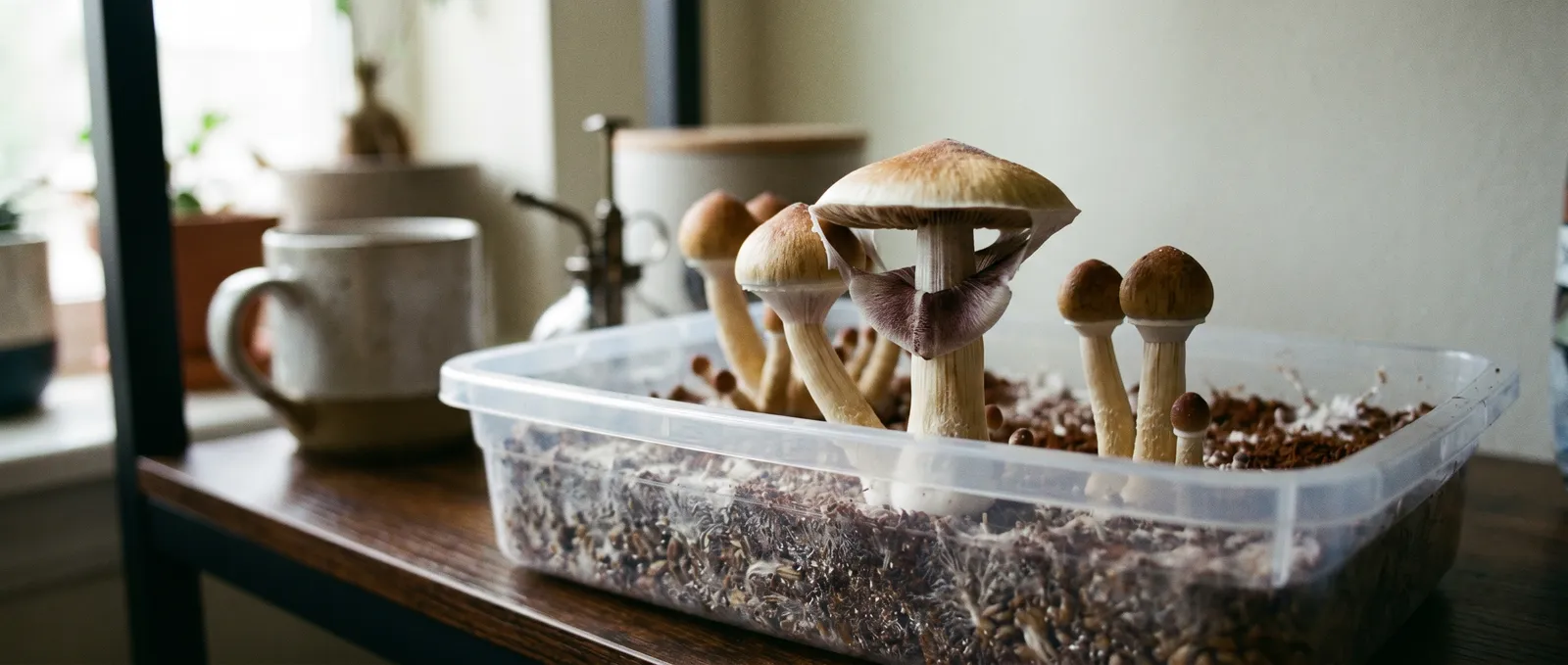
When to Harvest Mushrooms: Veil Break Timing Explained
Harvest timing veil break is a cultivation technique that uses the tearing of the partial veil on maturing Psilocybe cubensis to mark peak alkaloid content.
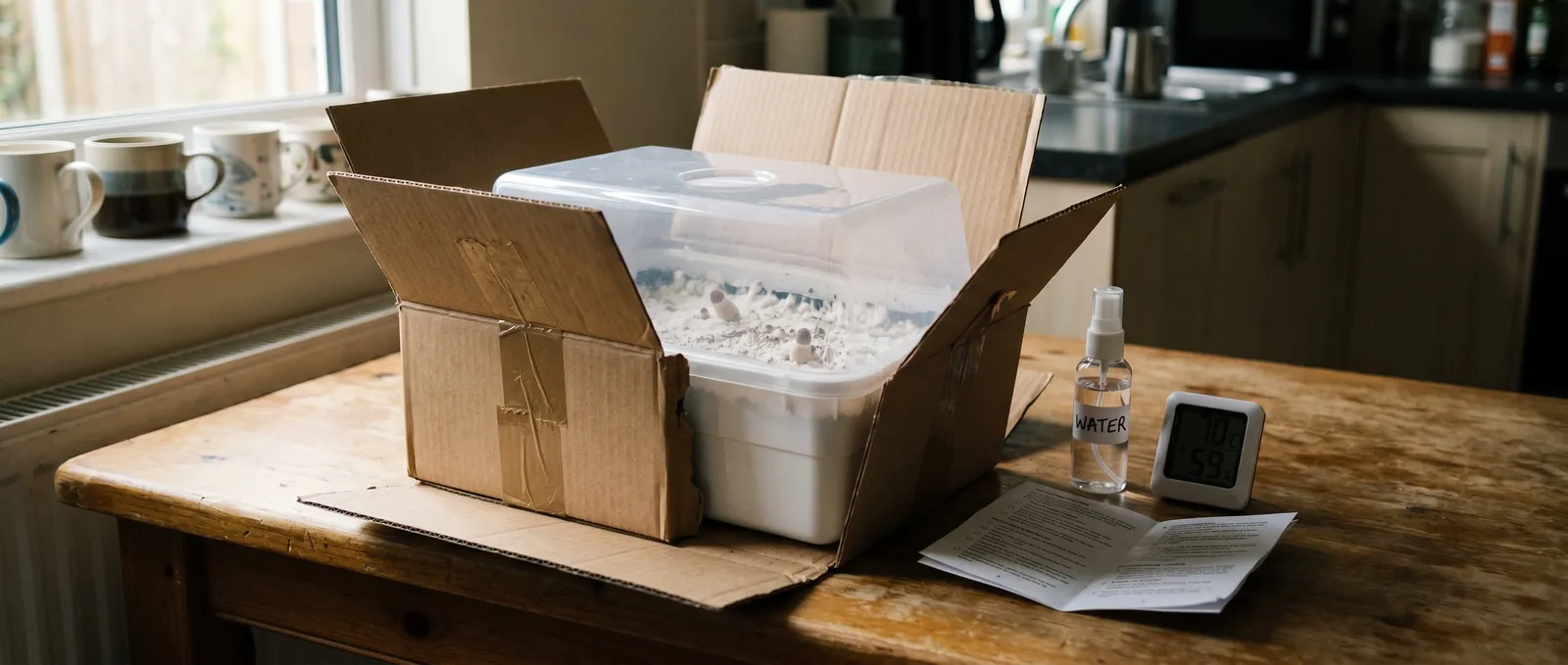
First Grow Checklist: What You Need for Mushroom Kits
A first grow checklist is the short list of supplies and environmental conditions needed to run a home psilocybin mushroom kit from inoculated substrate to…
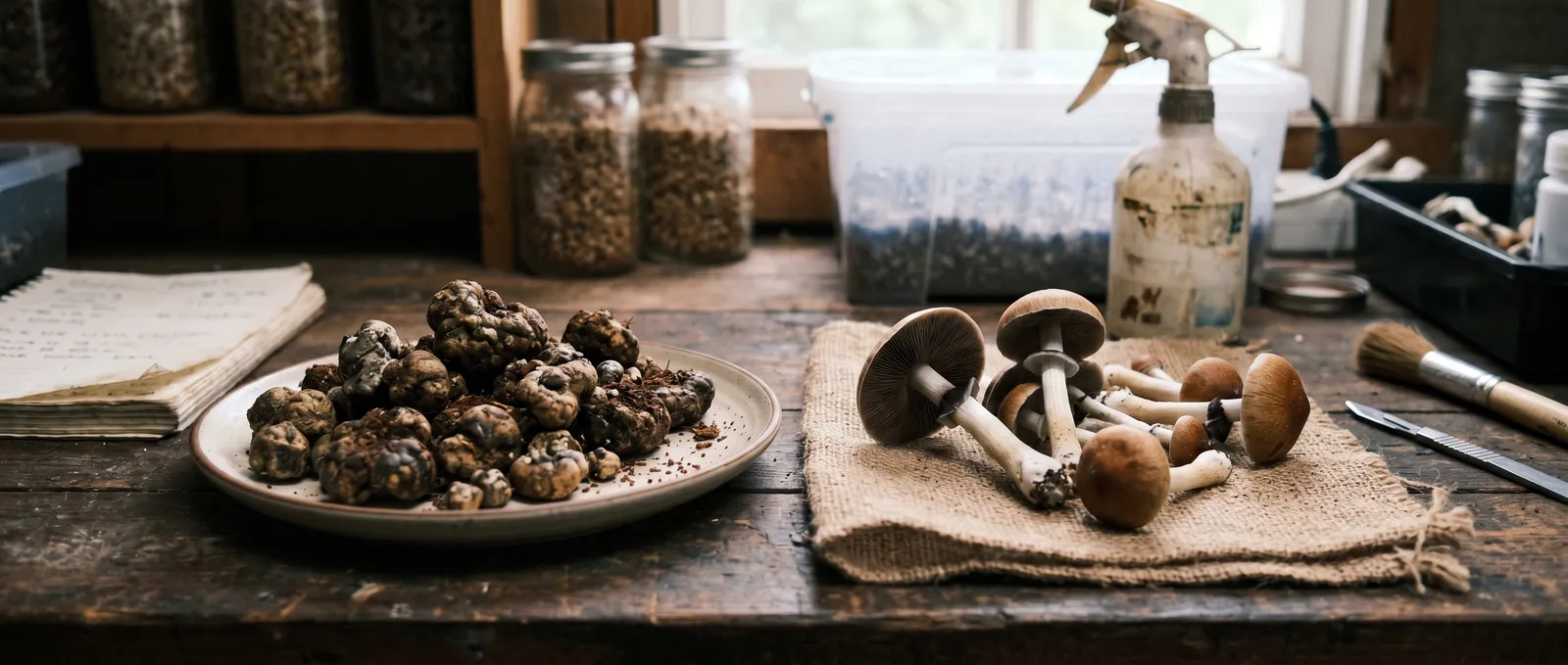
Sclerotia vs Fruit Bodies: Cultivation Comparison
Sclerotia and fruit bodies are two different life stages of Psilocybe fungi: sclerotia are hardened underground mycelial storage bodies (the 'magic…
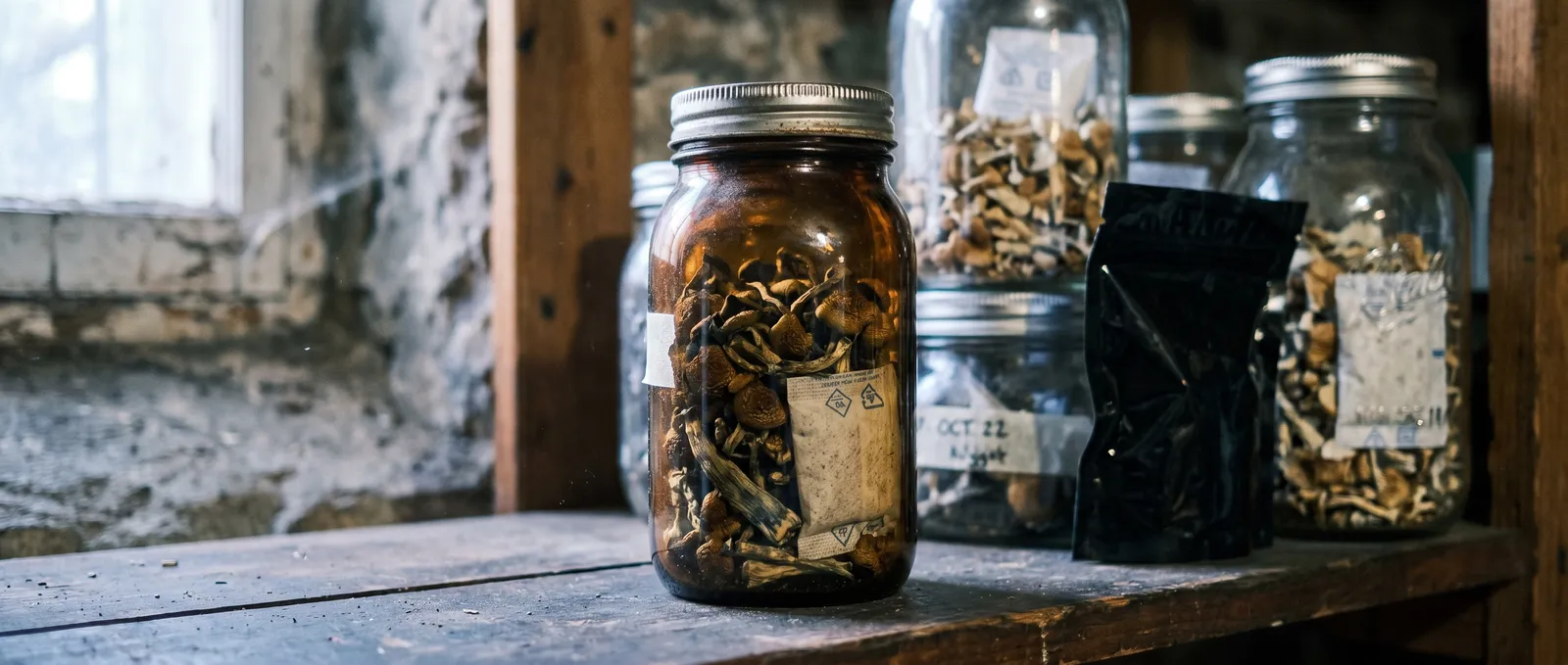
Storing Dried Mushrooms Long Term: Full Guide
Storing dried mushrooms long term means keeping well-dried Psilocybe fruit bodies in airtight, opaque containers with desiccant, cool and dark, to slow…
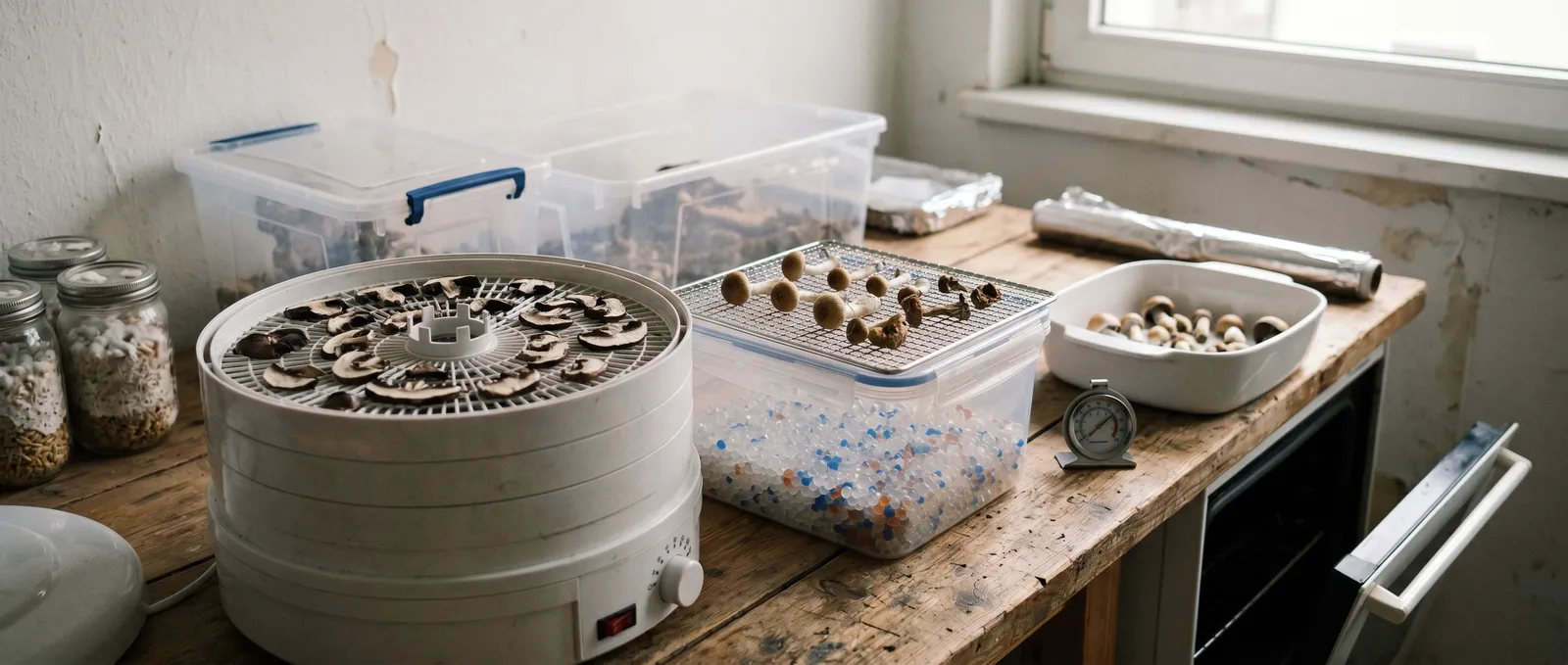
Drying Mushrooms Air Desiccant Oven: Methods Compared
Drying mushrooms air desiccant oven refers to the three home methods for reducing fresh fruit bodies from ~90% water to cracker-dry (<5%). Gotvaldová et al.