
Buy more, pay less
CBD Oil 30% — Cibdol's Strongest Single-Bottle Concentration
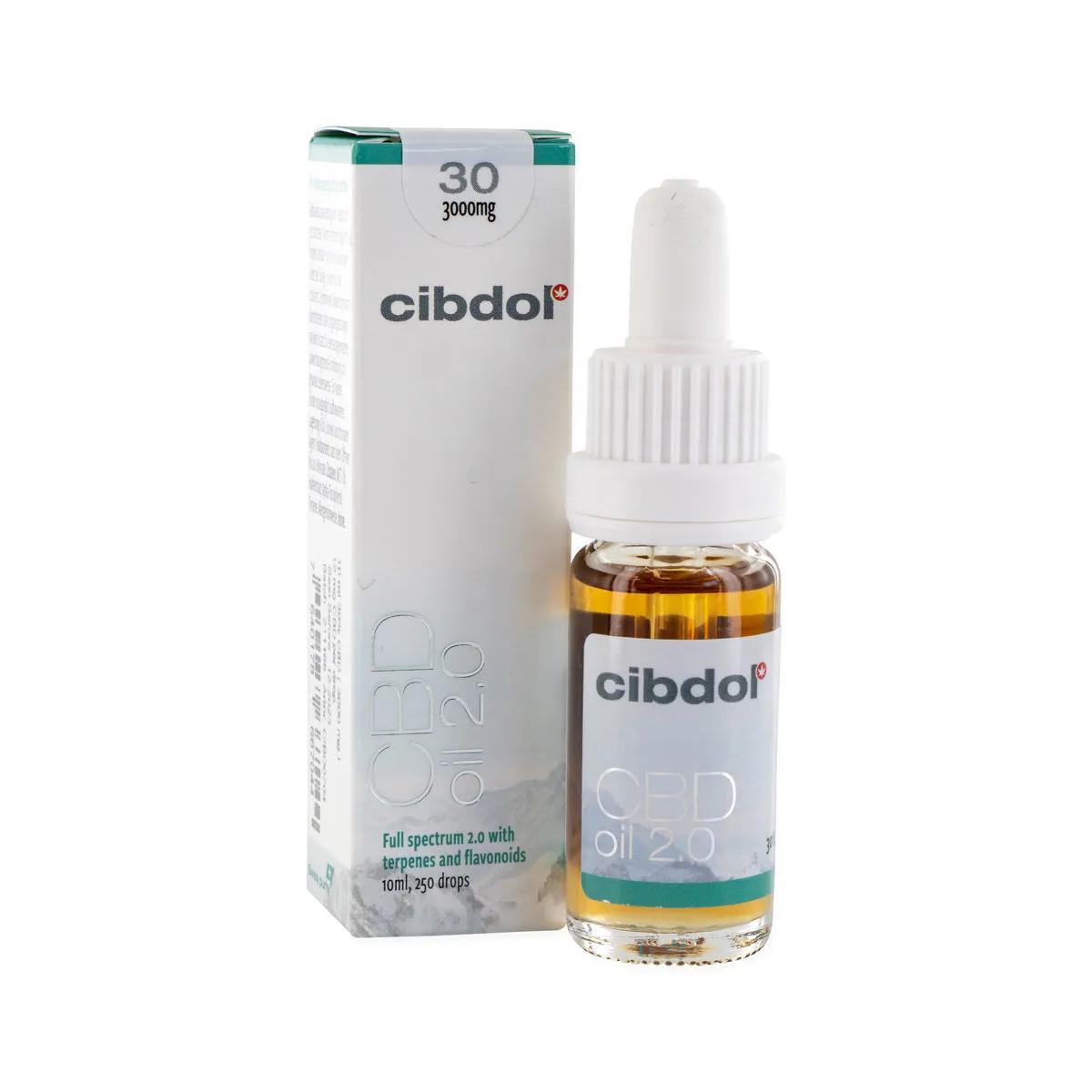
Cibdol CBD Oil 2.0 30% is a high-concentration cannabidiol oil that delivers 12 mg of CBD per drop in a coconut-derived MCT oil carrier — 3,000 mg total across 250 drops. If you already know your daily milligram target and you're tired of counting out eight or nine drops three times a day, this is the bottle that cuts your routine roughly in half. The 2.0 formula goes beyond a standard extract by adding standardised levels of four secondary cannabinoids — CBC, CBG, CBN, and CBDA — at consistent amounts batch to batch, not just whatever trace quantities survived extraction.
Why CBD Oil 30% Over a Lower Concentration
The short answer: fewer drops, same dose. A 10% Cibdol oil gives you 4 mg per drop. A 20% gives you 8 mg. This 30% delivers 12 mg. If your daily target sits around 36–72 mg — a range commonly referenced in clinical research — you're looking at three to six drops per dose instead of nine to eighteen. That matters when you're dosing under the tongue and trying to hold oil there for sixty seconds without swallowing.
The MCT oil carrier is the other reason to step up. Cibdol uses MCT (medium-chain triglyceride) oil derived from coconut in their higher concentrations rather than hemp seed oil. MCT oil has a thinner consistency and absorbs noticeably faster sublingually. You'll feel the difference the first time you use it — it doesn't sit on your tongue like a thicker hemp oil does. It spreads, it absorbs, it's done.
One honest limitation: 12 mg per drop leaves less room for fine-tuning. If you're still dialling in your dose and want to adjust by 2 mg increments, a 5% or 10% oil gives you more granularity. The 30% is best if you've already found your sweet spot with a lower concentration and you just want to get there more efficiently.
The 2.0 Formula — What Cibdol Changed
Cibdol's 2.0 line isn't just CBD in a bottle. The formula includes standardised levels of four additional cannabinoids that contribute to a broader entourage effect — the idea that cannabinoids work better together than in isolation. Here's what's in there beyond CBD:
| Cannabinoid | Full Name | What Research Suggests |
|---|---|---|
| CBC | Cannabichromene | Research suggests CBC may support the body's natural inflammatory response |
| CBG | Cannabigerol | Shown to interact with both CB1 and CB2 receptors in preclinical studies |
| CBN | Cannabinol | Associated with relaxation and sleep support in early research |
| CBDA | Cannabidiolic acid | The raw precursor to CBD, with its own distinct receptor activity |
The key difference between 2.0 and a conventional full-spectrum extract: these aren't trace leftovers from the extraction process. Cibdol adds them at controlled, consistent levels so every bottle matches the last. If you've used a full-spectrum oil before and noticed batch-to-batch variation, the 2.0 approach addresses that directly.
CBD Oil 30% — Milligrams Per Dose
Forget percentages for a moment — what actually matters is how many milligrams you're taking per dose. With 12 mg per drop, the arithmetic stays simple. According to commonly referenced dosage guidance, a range of 30–60 mg per day is frequently suggested as a starting point for experienced users, while clinical studies have used varied ranges depending on the condition being studied.
Cibdol recommends taking drops sublingually up to three times daily. Using their standard, here's what the numbers look like at this concentration:
- 3 drops per dose = 36 mg CBD. Taken three times daily, that's 108 mg.
- 4 drops per dose = 48 mg CBD. Taken three times daily, that's 144 mg.
- 3 drops per dose taken twice daily = 72 mg total.
If you're stepping up from a 15% or 20% oil, match your current milligram intake first rather than your drop count. Going from six drops of 20% (48 mg) to six drops of 30% (72 mg) is a 50% increase — not the same dose in a stronger bottle.
Specifications
| Spec | Value |
|---|---|
| Brand | Cibdol |
| Product line | CBD Oil 2.0 |
| CBD concentration | 30% |
| Total CBD | 3,000 mg |
| CBD per drop | 12 mg |
| Drops per bottle | 250 |
| Bottle size | 10 ml |
| Carrier oil | MCT (coconut-derived) |
| Additional cannabinoids | CBC, CBG, CBN, CBDA |
| Lab testing | IFHA certified |
| SKU | CB0078 |
If you're new to CBD oil and 12 mg per drop feels like too large a step, Cibdol's CBD Oil 2.0 10% gives you 4 mg per drop with the same 2.0 formula — easier to fine-tune while you find your dose. Already sorted on CBD and looking to support sleep specifically? Cibdol's Meladol combines CBD with melatonin and liposomes for targeted nighttime use.
What the Research Says About CBD
CBD has been studied across a broad range of applications, though most research is still in early or mid-stage. According to a WHO Critical Review Report, CBD demonstrates a favourable safety profile, though the report notes that many studies lack control groups, limiting the strength of conclusions drawn about specific effects. According to a review published in PMC (Use of Cannabidiol in the Treatment of Epilepsy, 2019), CBD has been investigated for its anticonvulsant effects for decades, with several studies confirming efficacy in treatment-resistant epilepsy — this is the area where the clinical evidence is strongest.
According to Healthline (6 CBD Benefits and Uses), cannabis has been used to treat pain since approximately 2900 B.C. in Chinese medicine, and researchers suggest that components like CBD may be responsible for some of these effects. That said, most pain-related CBD research involves combinations with THC rather than CBD in isolation. We mention this because honesty matters more than hype — CBD oil is not a cure-all, and anyone telling you otherwise is selling something other than information.
How to Use Cibdol CBD Oil 30%
- Shake the bottle gently before each use. The cannabinoids can settle between doses, and a quick shake keeps the concentration consistent drop to drop.
- Use the built-in pipette dropper to place your drops under the tongue. The sublingual area is rich in capillaries, which allows CBD to enter the bloodstream faster than swallowing it directly.
- Hold the oil under your tongue for 60 seconds before swallowing. This is the step most people skip — and it makes a real difference to how quickly you feel the effects. Set a mental timer.
- Start by matching your current milligram dose if stepping up from a lower concentration. If this is your first CBD oil, begin with 2–3 drops (24–36 mg) once daily and observe your response over several days before increasing.
- Store the bottle upright in a cool, dark place. MCT oil is stable, but direct sunlight and heat will degrade cannabinoids over time. A kitchen cupboard works fine — skip the windowsill.
Safety and Interactions
CBD is generally well-tolerated, but it does interact with certain medications. According to research published in PMC, CBD has been reported to interact with anti-epileptic drugs, antidepressants, opioid analgesics, and — perhaps less obviously — common medications like acetaminophen. According to LiverTox (NCBI Bookshelf), serum aminotransferase elevations arose during CBD therapy in 34% to 47% of patients in prelicensure epilepsy studies, compared to 18% of those on placebo. These were clinical doses significantly higher than typical supplement use, but if you're taking prescription medication or have liver concerns, speak with your doctor before adding CBD oil to your routine. That's not a hedge — it's the same advice we'd give a mate.
Frequently Asked Questions
What are the side effects of CBD oil 30%?
According to a 2023 review in PMC, the most commonly reported adverse effects of CBD are diarrhoea, somnolence, sedation, and upper respiratory disturbances, mostly mild to moderate in severity. At 12 mg per drop, the 30% concentration doesn't change the side effect profile — it just means fewer drops to reach the same dose.
How many drops of 30% CBD oil should I take per day?
That depends on your target milligram dose, not the percentage. Each drop delivers 12 mg. Commonly referenced ranges in research sit between 30 and 60 mg daily for general use. Three drops three times daily gives you 108 mg — a dose some experienced users find effective. Match your current milligram intake if stepping up from a lower concentration.
What is the difference between CBD Oil 2.0 and regular full-spectrum CBD oil?
Standard full-spectrum oils contain whatever cannabinoids survive the extraction process, which varies batch to batch. Cibdol's 2.0 formula adds CBC, CBG, CBN, and CBDA at standardised, consistent levels. You get the same cannabinoid profile every time you buy a bottle, rather than a slightly different mix each batch.
Why does the 30% CBD oil use MCT oil instead of hemp seed oil?
MCT oil derived from coconut has a thinner consistency and absorbs faster sublingually than hemp seed oil. At higher concentrations, this matters — you're holding fewer drops under your tongue for a shorter time. Cibdol uses hemp seed oil in their lower concentrations and switches to MCT for the 20% and above.
Can CBD oil interact with my medication?
Yes. According to published research, CBD interacts with anti-epileptic drugs, antidepressants, opioid analgesics, and several common medications including acetaminophen. If you take prescription medication, talk to your doctor before starting CBD oil — this applies to any concentration, not just the 30%.
Is 30% CBD oil stronger than 10% or 20%?
It's more concentrated, not "stronger" in the way people usually mean. A drop of 30% oil contains 12 mg of CBD versus 4 mg (10%) or 8 mg (20%). The CBD molecule is identical — you're just getting more of it per drop, which means fewer drops to reach the same daily dose.
How should I store CBD oil 30%?
Keep the bottle upright in a cool, dark place — a kitchen cupboard is fine. Avoid direct sunlight and heat, which degrade cannabinoids over time. MCT oil itself is stable and won't go rancid quickly, but the CBD and secondary cannabinoids are the sensitive part.
Last updated: April 2026
Related products
Medical disclaimer. This content is for informational purposes only and does not constitute medical advice. Consult a qualified healthcare provider before use of any substance.