
This article discusses psychoactive substances intended for adults (18+). If you have a health condition or take medication, consult a doctor before use. Our age policy
Magic Mushroom Grow Kit Guide
Definition
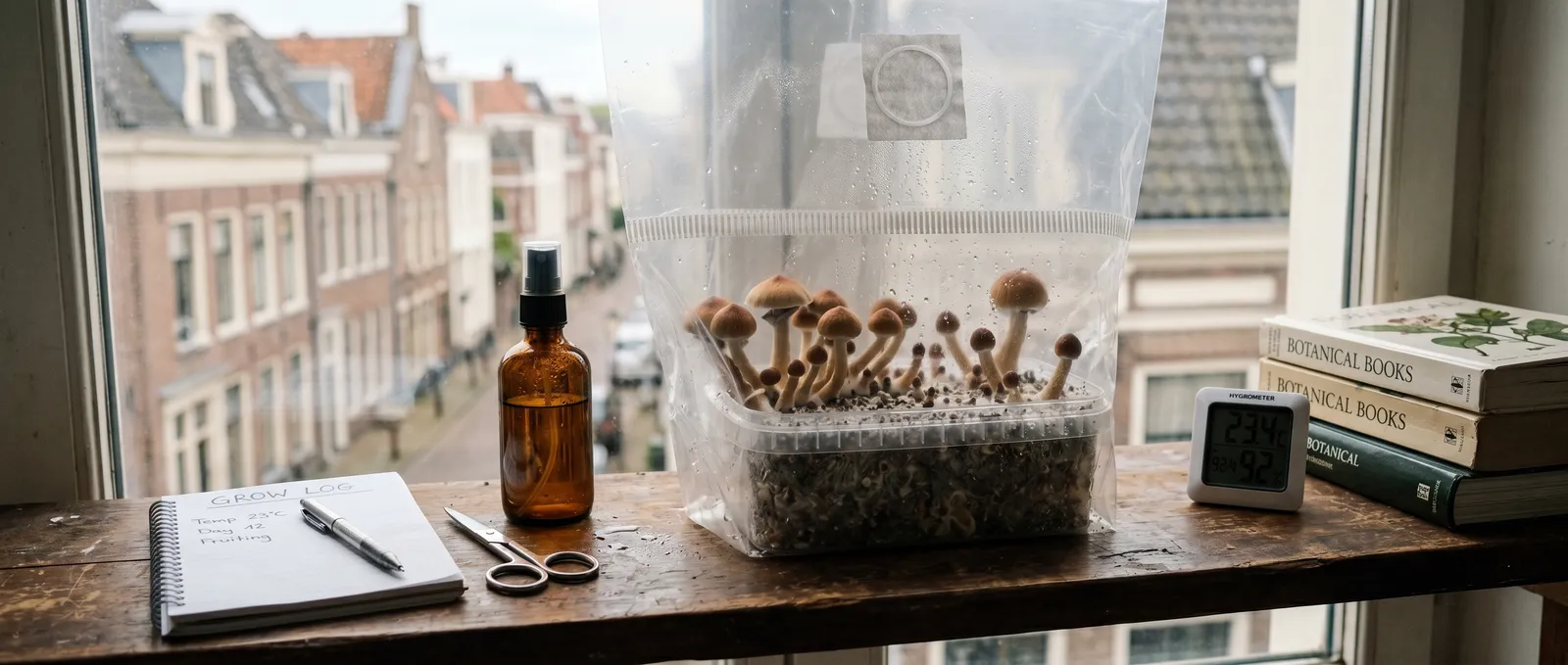
A magic mushroom grow kit is a pre-colonised substrate that produces fresh Psilocybe cubensis mushrooms at home without sterile technique or spore work. This guide covers every step from setup to drying and storage, plus the mistakes that ruin most first grows.
Magic Mushroom Grow Kit Guide
A magic mushroom grow kit is a pre-colonised substrate block — typically rye grain inoculated with Psilocybe cubensis mycelium — that lets you produce fresh mushrooms at home without sterile lab work, spore syringes, or months of waiting. The kit arrives ready to fruit. Your job is to provide moisture, warmth, and patience. Most growers see their first pins within 7–14 days and harvest a full flush inside three weeks. Whether you're looking to buy your first magic mushroom grow kit or ordering a replacement after a successful run, this guide walks through every step, from unboxing to drying, so nothing gets lost to contamination or rookie mistakes along the way.
Adult audience (18+). The dosing ranges and effects described in this article apply to adult physiology. This content is not intended for minors.
What You Need Before You Start
You need the magic mushroom grow kit, a filtered grow bag, a spray bottle, gloves, a clip, and optionally a thermometer — nothing else. Gather everything before you open the kit. Once that lid comes off, the clock starts ticking on contamination risk.
- The magic mushroom grow kit itself — a plastic tub containing fully colonised substrate.
- A grow bag with microfilter — usually included. The filter allows gas exchange while blocking airborne contaminants.
- A clean spray bottle — filled with still mineral water or water that has been boiled and cooled. Tap water with heavy chlorination can inhibit growth.
- Latex or nitrile gloves — non-negotiable. A single ungloved fingerprint introduces bacteria and mould spores.
- A paperclip or small clip — to seal the bag between mistings.
- A thermometer — optional but useful. Ideal fruiting temperature for most cubensis strains sits between 21–25 °C.
You do not need a pressure cooker, a still air box, or agar plates. The substrate is already colonised — the hard microbiological work is done.
Step 1 — Prepare Your Workspace
A clean workspace is the single most important factor in preventing contamination of your magic mushroom grow kit. Clean a flat surface — a shelf, desk, or countertop — with isopropyl alcohol or a mild bleach solution. Close windows. Turn off fans. Airborne mould spores are the number one killer of mushroom grows, and they're everywhere: on your skin, in dust, floating in from the kitchen. A 2017 study in Fungal Biology found that Trichoderma (green mould) spores can remain viable on household surfaces for over 6 months (Kredics et al., 2017). You're not building a cleanroom, but five minutes of wiping down surfaces makes a real difference.
Wash your hands thoroughly, then put on gloves. Keep them on for every step that involves touching the magic mushroom grow kit or the inside of the bag.
Step 2 — Soak the Substrate (If Required)
Not every magic mushroom grow kit needs an initial soak — check the instructions that came with yours, because this varies by brand and substrate type.
If soaking is required:
- Remove the lid from the tub.
- Fill the tub with clean, cool water until the substrate is just submerged.
- Replace the lid and leave it for 12 hours (overnight works well).
- After 12 hours, tip out the excess water by tilting the tub over a sink with the lid slightly ajar. Let it drain for 10–15 seconds.
If no soak is needed, skip straight to Step 3. Adding water to a magic mushroom grow kit that doesn't need it can waterlog the substrate and encourage bacterial contamination rather than mushroom growth.
Step 3 — Set Up the Grow Bag
The grow bag acts as a humidity chamber — mushrooms need relative humidity above 90% to form proper fruit bodies. Place the open tub (lid off) inside the grow bag. According to Stamets (2000), Psilocybe cubensis pins abort when humidity drops below 80% for extended periods.
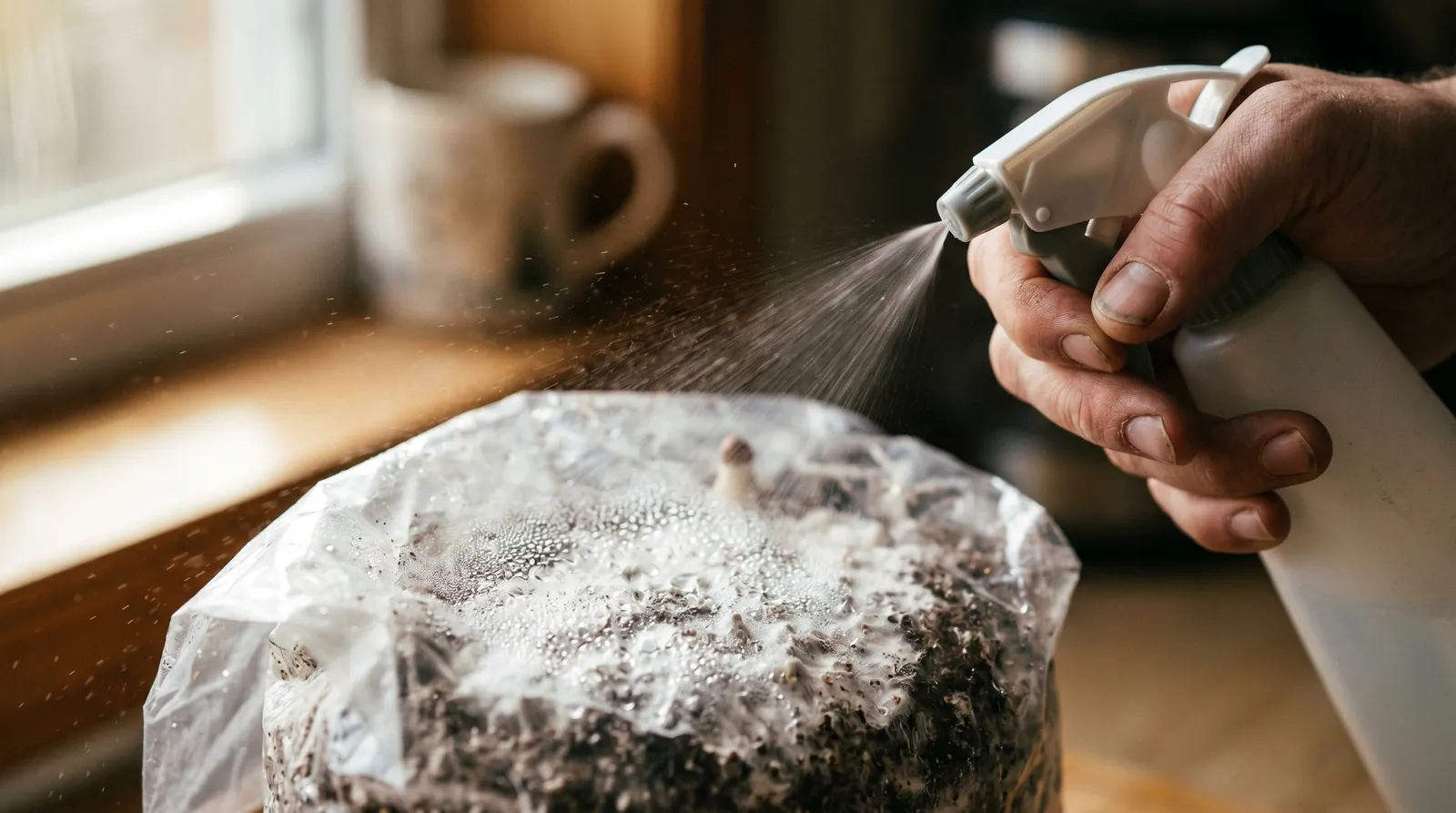
Mist the inside walls of the bag with your spray bottle — 2 or 3 sprays per wall. You want visible droplets on the plastic, not a pool of water at the bottom. Never spray directly onto the substrate surface. Direct water on the mycelium encourages bacterial blotch and can drown forming pins.
Fold the top of the bag over twice and secure it with a paperclip. The microfilter patch on the bag handles gas exchange — CO₂ out, oxygen in — so the bag should stay closed between mistings.
Step 4 — Find the Right Spot
The ideal location for your magic mushroom grow kit is a quiet room at a steady 21–25 °C with indirect natural light. Place the bagged kit somewhere with:
- Temperature between 21–25 °C. Below 18 °C, growth stalls. Above 28 °C, the mycelium can overheat and contamination risk spikes. A consistent 23 °C is the sweet spot for most cubensis strains.
- Indirect light. Mushrooms aren't plants — they don't photosynthesise. But they do use light as a directional cue (phototropism). A room with natural daylight, away from direct sun, is fine. A desk lamp on a 12/12 cycle works if you're growing in a cupboard.
- Minimal foot traffic. Every time someone walks past, they stir up spores and dust. A spare bedroom or the top of a wardrobe beats the kitchen counter.
Avoid placing the magic mushroom grow kit near radiators, in bathrooms (too many competing mould species), or on windowsills where temperature swings between day and night.
Step 5 — Mist and Fan Daily
Open the bag once or twice a day, mist the inner walls (not the substrate), and gently fan the opening 3–4 times to exchange stale air. Then reseal. That's it. The whole process takes under 60 seconds.
Resist the urge to check constantly. Every time you open the bag, you're introducing fresh contaminants and disrupting the humidity equilibrium. Once in the morning, once in the evening — that's plenty.
Within 5–12 days, you should see tiny white bumps forming on the substrate surface. These are pins — baby mushrooms. Once pins appear, keep misting as normal but handle the magic mushroom grow kit even more gently. Pins are fragile and abort easily if conditions fluctuate.
Step 6 — Harvesting
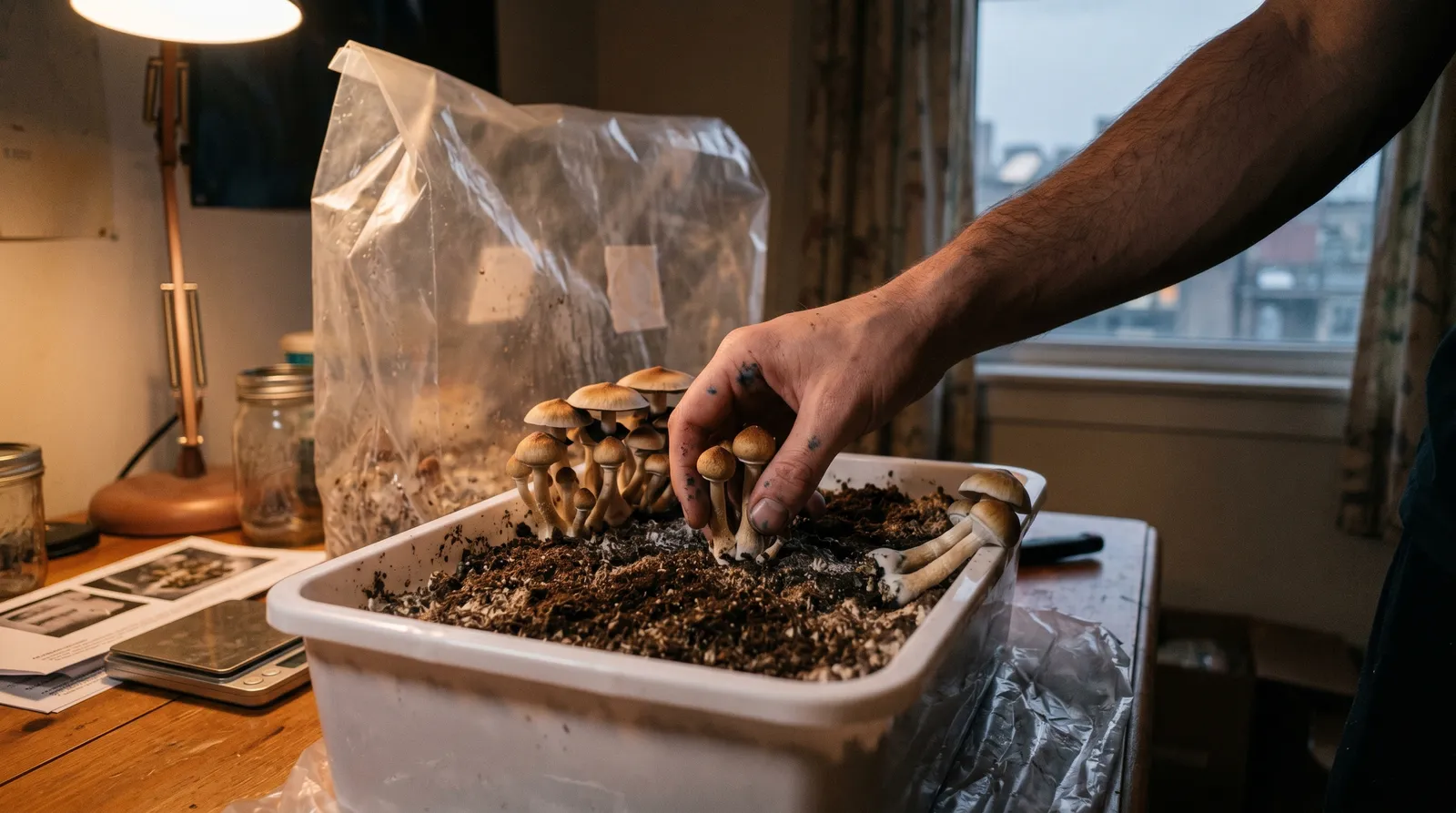
Harvest when the caps are still slightly convex or just starting to flatten — before the veil underneath the cap tears and releases spores. Timing matters: once spores drop, they coat the substrate in a dark layer that can inhibit the next flush. A study by Gotvaldová et al. (2022) in the Journal of Fungi analysed psilocybin content across growth stages and found that alkaloid concentration peaks just before veil break, making this the ideal harvest window both for potency and for keeping the magic mushroom grow kit productive.
To harvest:
- Put on clean gloves.
- Grip the mushroom gently at the base of the stem.
- Twist and pull with a slow, steady motion. You want to remove the entire fruit body without leaving a stump that could rot.
- If mushrooms are growing in dense clusters, harvest the whole cluster at once rather than trying to pick individuals.
A single magic mushroom grow kit typically produces 150–300 g of fresh mushrooms per flush, though this varies by strain and conditions. Golden Teacher and B+ are among the more generous producers; strains like Mazatapec may yield slightly less per flush but are less fussy about temperature — the strain comparison section below covers these differences in detail.
Step 7 — Second and Third Flushes
After the first harvest, most magic mushroom grow kits can produce 2–4 additional flushes. Each subsequent flush tends to yield less than the one before, though individual mushrooms sometimes grow larger in later flushes.
- After picking everything, fill the tub with clean water again.
- Replace the lid and soak for 12 hours. This rehydrates the substrate — the mycelium has used a lot of moisture producing that first flush.
- Drain, place back in the grow bag, mist, seal, and repeat the process from Step 5.
Expect the second flush in 7–14 days. By the third or fourth flush, yields drop significantly. When the substrate starts pulling away from the walls of the tub or develops green, black, or orange patches, it's spent. Dispose of it in household waste or compost.
Grow Kit Comparison by Strain
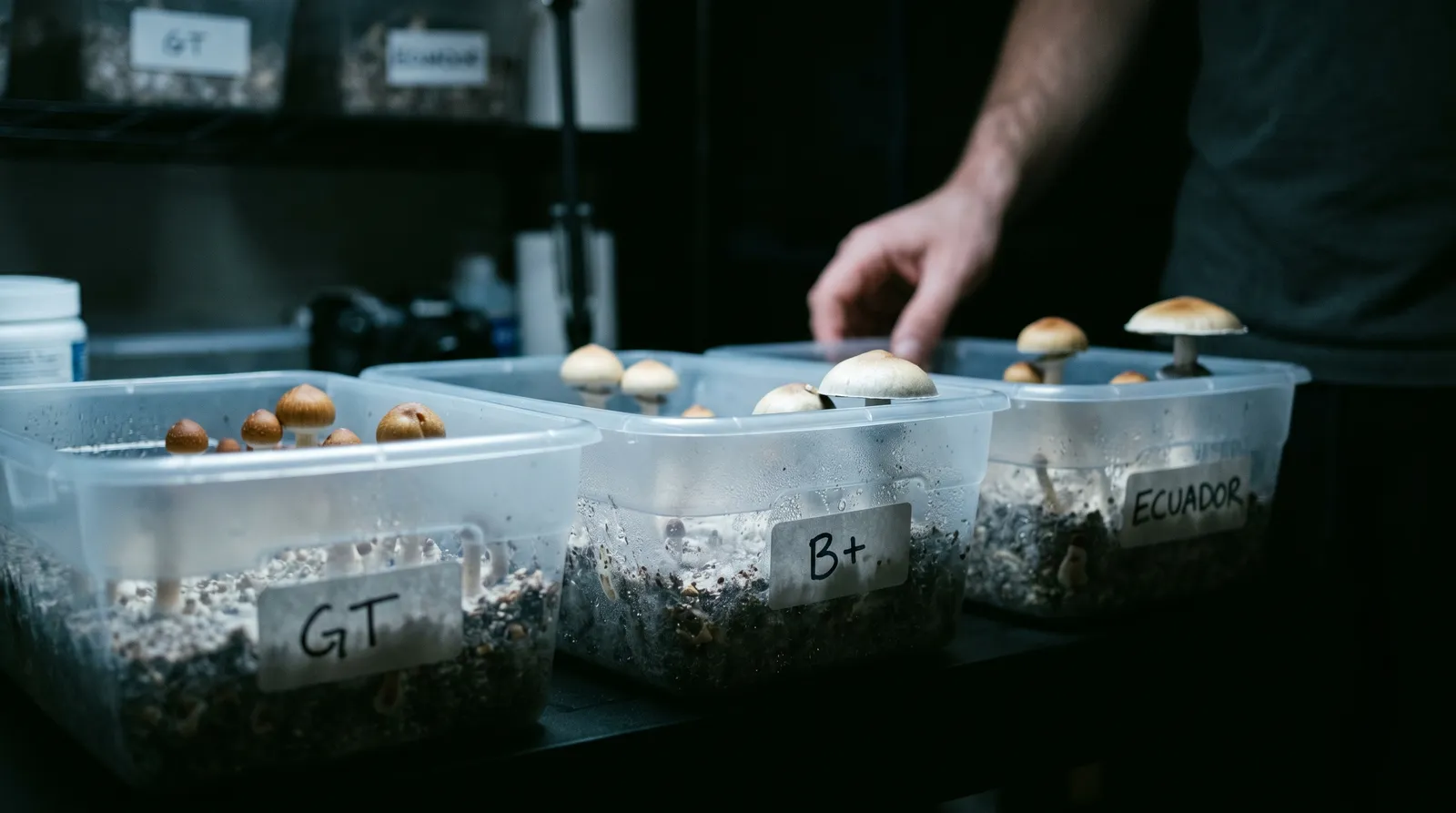
Not every magic mushroom grow kit performs the same way. The strain of Psilocybe cubensis inside determines yield, speed, and how forgiving the kit is for beginners. The table below summarises the most popular strains available to order from Azarius.
| Strain | Typical First-Flush Yield (fresh) | Days to First Pins | Temperature Tolerance | Beginner Friendliness |
|---|---|---|---|---|
| Golden Teacher | 200–300 g | 7–10 | 21–25 °C (moderate) | ★★★★★ |
| B+ | 200–350 g | 7–12 | 20–26 °C (wide) | ★★★★★ |
| Mazatapec | 150–250 g | 10–14 | 19–26 °C (wide) | ★★★★☆ |
| McKennaii | 150–250 g | 10–14 | 22–25 °C (narrow) | ★★★☆☆ |
| Colombian | 180–280 g | 8–12 | 21–25 °C (moderate) | ★★★★☆ |
If you order your first magic mushroom grow kit and want the least fuss, Golden Teacher or B+ is the standard recommendation. McKennaii is a rewarding strain but less forgiving of temperature swings — we'd suggest it for your second or third grow once you've dialled in your environment.
Grow Kit Brands Compared — Honest Differences
Not all magic mushroom grow kit brands are interchangeable, and we think it's worth being upfront about the differences we've observed over years of stocking them. FreshMushrooms kits use a 100% mycelium substrate with no added vermiculite or perlite — they tend to colonise fast and don't require an initial soak, which makes them slightly more convenient for first-timers. Mondo kits use a more traditional rye-based substrate and do require a 12-hour soak before the first flush, but many experienced growers prefer them for slightly higher total yields across multiple flushes. Both brands produce reliable results when the instructions are followed. The honest limitation is that neither brand guarantees a specific yield — substrate quality, shipping conditions, and your home environment all introduce variability that no manufacturer can fully control.
Kit Sizes and Which to Get
Most magic mushroom grow kit options in the Azarius smartshop come in 1200 cc and 2100 cc sizes. The 1200 cc kit is the better choice for a first grow — it produces enough for several sessions without committing a large amount of space, and if contamination strikes you lose less substrate. The 2100 cc kit makes sense once you're confident in your technique and want to maximise yield per run. An honest limitation worth noting: the larger kit doesn't simply produce proportionally more mushrooms. It needs more consistent humidity across a bigger surface area, and uneven misting is more common with the bigger tub. If you want to buy a magic mushroom grow kit and you're still learning, start with the smaller size.
Drying and Storage
Fresh mushrooms are roughly 90% water and start degrading within 24–48 hours at room temperature if you don't dry them.
The most reliable method is a food dehydrator set to 35–45 °C. Spread the mushrooms in a single layer on the trays and run the dehydrator for 8–12 hours until the mushrooms snap cleanly when bent — they should feel cracker-dry, not leathery. According to Tsujikawa et al. (2003), psilocybin content remains stable during low-temperature drying below 50 °C, but degrades measurably above 70 °C.
No dehydrator? Place mushrooms on a wire rack over a fan in a well-ventilated room. This takes 24–48 hours and works reasonably well in dry climates, though in humid environments you may end up with partially dried mushrooms that still feel rubbery — these won't store well.
Once cracker-dry, store in an airtight glass jar with a silica gel packet. Keep the jar in a cool, dark place. Properly dried and stored mushrooms retain most of their potency for 6–12 months, though some degradation is inevitable over time — the storage guide article on the Azarius blog goes deeper on long-term preservation methods.
Common Mistakes and How to Avoid Them
Most failed grows come down to one of six errors. Here's what to watch for when using any magic mushroom grow kit:
- Spraying water directly onto the substrate. Mist the bag walls. Pooling water on the mycelium surface is the fastest route to bacterial contamination.
- Growing in a cold room. Below 18 °C, cubensis mycelium barely grows. If your flat runs cold, a seedling heat mat underneath the kit (set to 23 °C) solves this cheaply.
- Opening the bag too often. Curiosity kills kits. Twice a day is enough.
- Harvesting too late. Spore-covered substrates look ugly and produce weaker subsequent flushes. Pick before the veil tears.
- Touching the substrate without gloves. Your hands carry Trichoderma, Aspergillus, and dozens of other fungi that will happily outcompete Psilocybe mycelium. Gloves every time.
- Giving up after one flush. The first flush is rarely the biggest. Some kits hit their stride on the second or third round.
What a Grow Kit Cannot Do
A magic mushroom grow kit is genuinely easy to use, but it has real limitations worth being honest about. The substrate is finite — you'll get 2–4 flushes, not an endless supply. Yields vary; the numbers in this guide are averages, and your first attempt may fall below them. Contamination can happen even if you do everything right — these kits are resistant to it, not immune. And no kit compensates for a room that's consistently below 18 °C or above 28 °C; environment matters more than brand. If you're expecting laboratory-level consistency, you'll need to learn grain-to-grain transfers and monotub growing, which is a different hobby entirely.
A Note on Dosage
Once you've harvested and dried your mushrooms, dosage becomes the next question. Research literature typically references dried Psilocybe cubensis in gram amounts: Crew 2000, a Scottish harm-reduction organisation, lists 1–2 g of dried mushroom as a common dose, while higher amounts (3.5 g+) appear in clinical settings such as the Johns Hopkins psilocybin studies (Griffiths et al., 2016). Potency varies between strains, between individual mushrooms, and even between the cap and stem of the same fruit body. The dosage and effects article on the Azarius wiki covers this in much more detail, including weight-based considerations — roughly 0.5 mg of active psilocybin per kilogram of body weight is referenced as a moderate dose in clinical literature.
Psilocybin is a serotonergic compound, and combining it with SSRIs, MAOIs, or lithium carries real risks — a hypertensive emergency case report highlighted the danger of mixing psilocybin with MAOIs and stimulants. The dedicated interactions article on the Azarius wiki covers contraindications thoroughly. The EMCDDA (European Monitoring Centre for Drugs and Drug Addiction) provides regularly updated risk profiles for psilocybin-containing mushrooms, and the Beckley Foundation has funded several of the clinical trials referenced in this guide — both are worth consulting for the latest evidence.
Disclaimer: This article is provided for informational and harm-reduction purposes only. Psilocybin is classified as a controlled substance in many countries. The legal status of magic mushroom grow kits varies by jurisdiction — it is your responsibility to verify the laws that apply where you live before you order. Azarius does not encourage or condone any illegal activity. The health information in this guide does not constitute medical advice. If you are taking medication, pregnant, or have a pre-existing mental health condition, consult a qualified healthcare professional before using psilocybin-containing mushrooms.
Where to Get a Magic Mushroom Grow Kit
Azarius stocks FreshMushrooms and Mondo magic mushroom grow kits in all the strains covered above. You can browse the full magic mushroom grow kit category in the Azarius smartshop to compare strains and kit sizes. The Azarius wiki articles on psilocybin dosage and drug interactions are worth reading before your first session. For growers who want to explore beyond cubensis cultivation, the Azarius blog covers topics like truffle microdosing and psilocybin storage in separate guides.
Frequently Asked Questions
How long does a magic mushroom grow kit take to produce mushrooms?
Most magic mushroom grow kits show first pins within 7–14 days and are ready to harvest within 2–3 weeks of setup. Second and third flushes follow at roughly 7–14 day intervals after resoaking the substrate.
How many flushes can you get from one grow kit?
Typically 2–4 flushes. The first or second flush is usually the largest. Yields drop with each subsequent flush, and the magic mushroom grow kit is spent once the substrate shrinks away from the tub walls or shows coloured mould.
What temperature do magic mushroom grow kits need?
Between 21–25 °C for Psilocybe cubensis. Below 18 °C growth stalls; above 28 °C contamination risk increases sharply. A consistent 23 °C is the sweet spot. A seedling heat mat helps in cold rooms.
Why is my grow kit not producing mushrooms?
The most common causes are low temperature (below 18 °C), insufficient humidity, contamination from ungloved handling, or waterlogged substrate from over-misting. Check temperature first — it's the issue roughly half the time.
Do you need to soak a mushroom grow kit before starting?
It depends on the brand. FreshMushrooms kits do not require an initial soak, while Mondo kits need a 12-hour cold-water soak before the first flush. Always follow the specific instructions included with your magic mushroom grow kit — adding water to a kit that doesn't need it can cause bacterial contamination.
Which magic mushroom grow kit strain is best for beginners?
Golden Teacher and B+ are the most beginner-friendly strains. Both tolerate minor temperature fluctuations, colonise quickly, and produce generous yields. McKennaii is more potent but less forgiving of environmental mistakes — better saved for a second or third grow.
Last updated: April 2026
Frequently Asked Questions
10 questionsHow long does a magic mushroom grow kit take to produce mushrooms?
How many flushes can you get from one grow kit?
What temperature do magic mushroom grow kits need?
Why is my grow kit not producing mushrooms?
Do you need to soak a mushroom grow kit before starting?
Which magic mushroom grow kit strain is best for beginners?
How do I prevent contamination in my magic mushroom grow kit?
Can I reuse a magic mushroom grow kit after the last flush?
How should you store a magic mushroom grow kit before use?
When is the right time to harvest mushrooms from a grow kit?
About this article


Adam Parsons is an external cannabis and psychedelics writer and editor who contributes to Azarius's wiki as both author and reviewer. On the writing side, he authors Azarius's kratom and kanna clusters, drawing on exten
This wiki article was drafted with AI assistance and reviewed by Adam Parsons, External contributor. Editorial oversight by Joshua Askew.
Medical disclaimer. This content is for informational purposes only and does not constitute medical advice. Consult a qualified healthcare provider before use of any substance.
Last reviewed April 19, 2026
References (8)
- [1]Gotvaldová, K. et al. (2022). 'Stability of psilocybin and its four analogs in the biomass of the psychotropic mushroom Psilocybe cubensis.' Journal of Fungi , 8(11), 1225.
- [2]Griffiths, R.R. et al. (2016). 'Psilocybin produces substantial and sustained decreases in depression and anxiety in patients with life-threatening cancer.' Journal of Psychopharmacology , 30(12), 1181–1197. DOI: 10.1177/0269881116675513
- [3]Kredics, L. et al. (2017). 'Trichoderma — biology, ecology and applications.' In Fungal Biology . Springer.
- [4]Stamets, P. (2000). Growing Gourmet and Medicinal Mushrooms . 3rd edn. Ten Speed Press.
- [5]Tsujikawa, K. et al. (2003). 'Degradation of psilocybin and psilocin in seized "magic mushrooms" under various storage conditions.' Forensic Science International , 134(1), 21–26.
- [6]Crew 2000 (n.d.). 'Magic mushrooms.' Harm reduction factsheet. Edinburgh.
- [7]EMCDDA (2024). 'Psilocybin mushrooms drug profile.' European Monitoring Centre for Drugs and Drug Addiction. Lisbon.
- [8]Beckley Foundation (2023). 'Psilocybin research programme.' Oxford.
Related Articles
Hawaiian Baby Woodrose Sourcing
Hawaiian baby woodrose sourcing is a practice that covers how to obtain quality Argyreia nervosa seeds — a vine whose seeds contain LSA (lysergic acid amide).
LSA Legal Status in Europe
LSA (lysergic acid amide, or ergine) occupies a legal grey zone across Europe — rarely scheduled as a compound, yet subject to varied NPS legislation that…
Ololiuqui Mazatec Tradition: Ceremonial Seeds of the Sierra Mazateca
Ololiuqui — the seeds of Turbina corymbosa — played a specific ceremonial role among the Mazatec people of Oaxaca, distinct from their better-known use of…
Morning Glory LSA Plants Family
Morning glory LSA plants family is a group of Convolvulaceae vines whose seeds contain d-lysergic acid amide (ergine), a naturally occurring tryptamine first…
Hawaiian Baby Woodrose Plant Botany
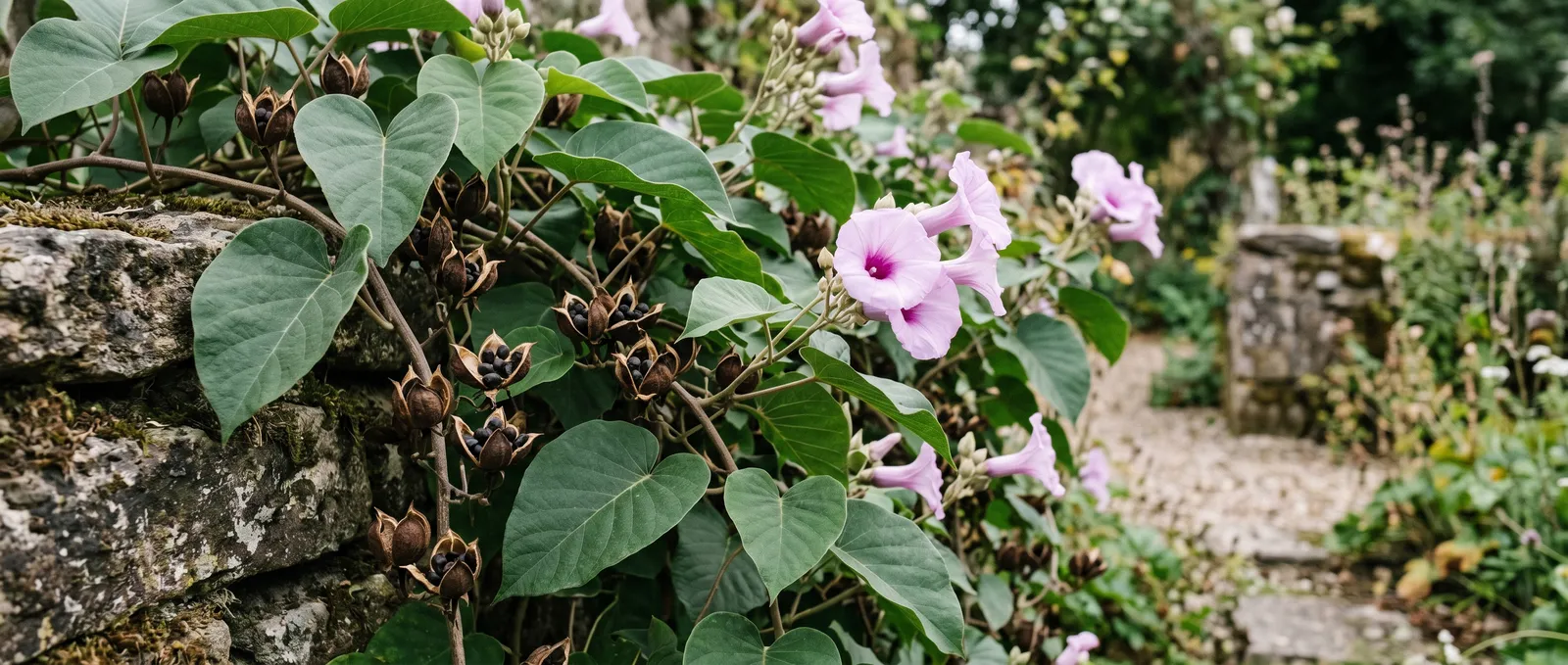
Argyreia nervosa, commonly called Hawaiian baby woodrose, is a perennial climbing vine native to the Indian subcontinent, not Hawai'i.
Magic Truffle Quality Indicators
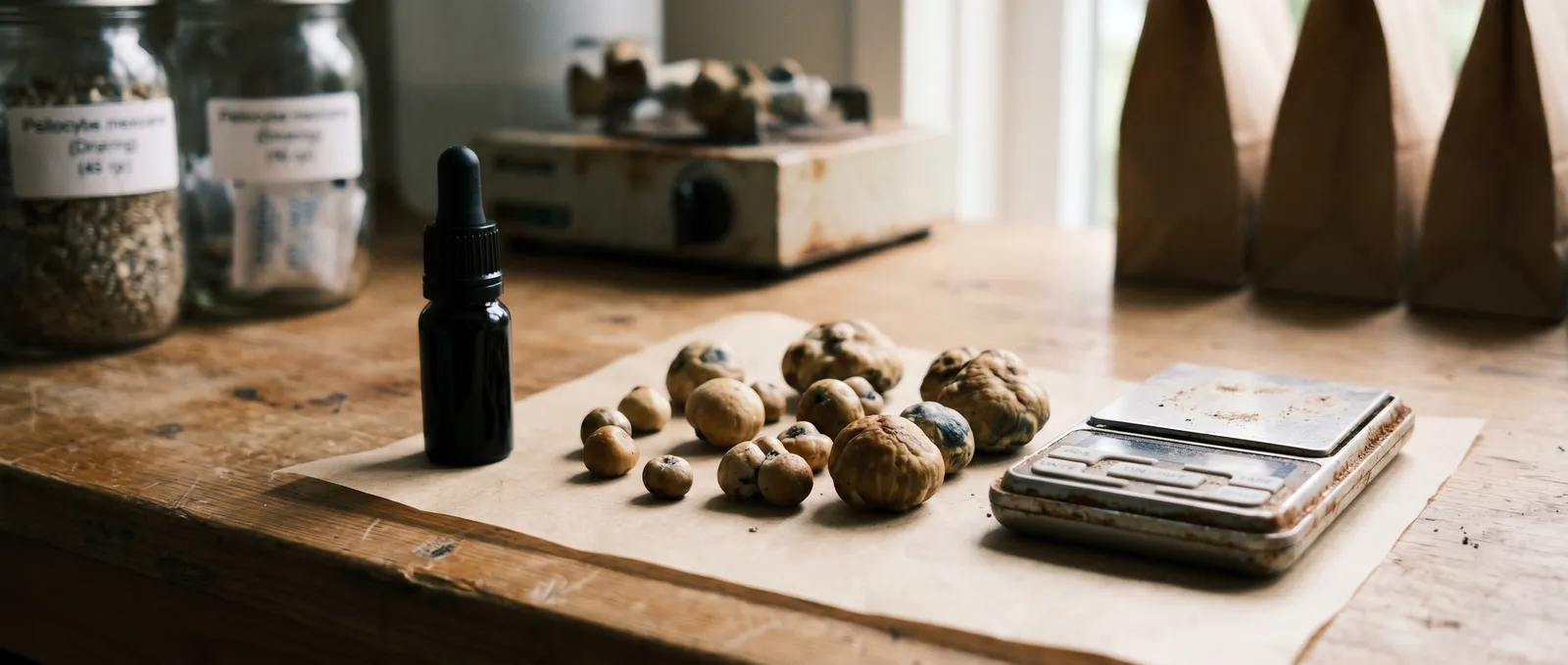
Magic truffle quality indicators are the measurable and sensory characteristics — psilocybin content, texture, aroma, packaging integrity, and storage…
Mescaline Cactus Market Observations
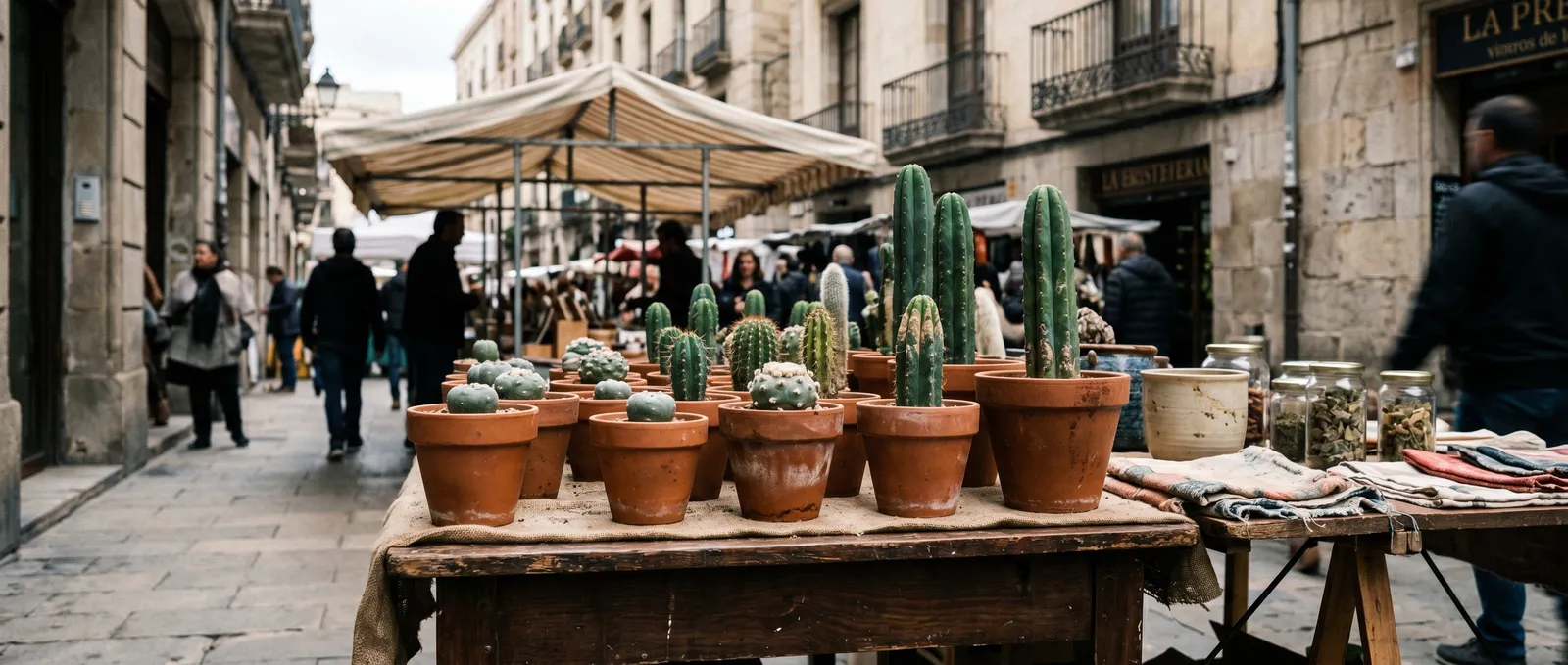
Mescaline cactus market observations is a research and retail term that describes the shifting patterns in sourcing, species selection, and consumption of…
Growing Mescaline Cacti as Ornamental Plants
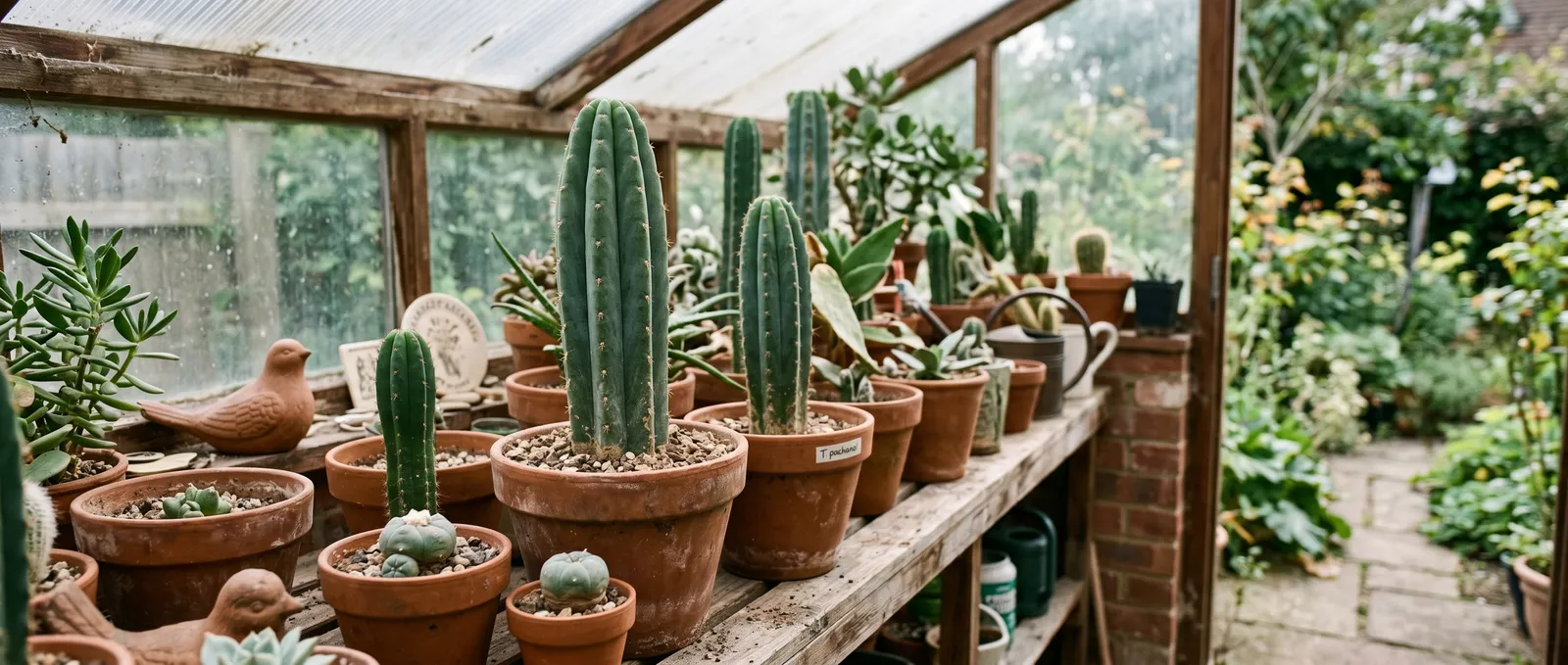
Growing mescaline cacti ornamental is a horticultural practice that involves cultivating species like San Pedro, Peruvian Torch, and peyote for their…
Commercial Magic Truffle Cultivation
Commercial magic truffle cultivation is a large-scale agricultural process that produces psilocybin-containing sclerotia in climate-controlled indoor…