
Percolator Types Explained: Honeycomb, Tree & Showerhead
Definition
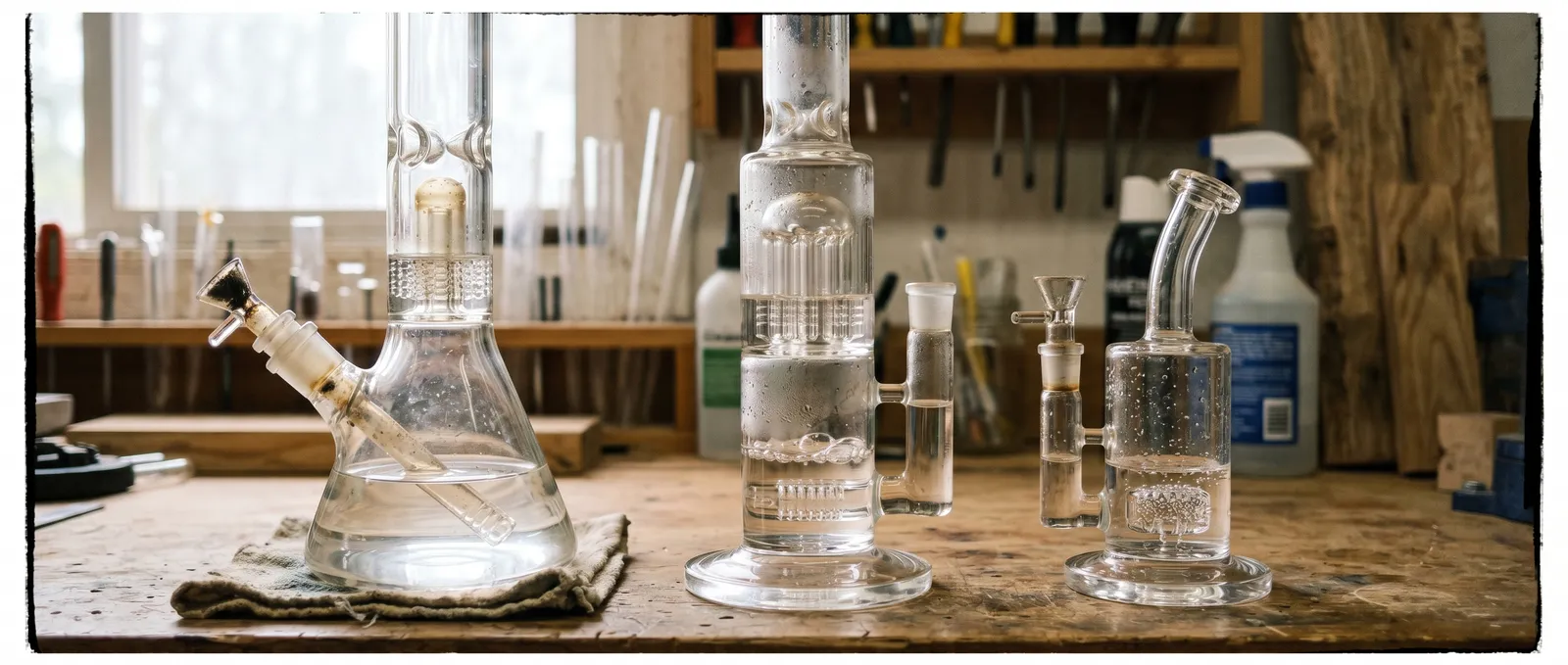
Percolators break bong smoke into smaller bubbles, increasing water contact for cooler, smoother hits. Reducing bubble diameter by half roughly doubles available surface area for filtration (Kulkarni & Joshi, 2005). The three most common designs — honeycomb, tree and showerhead — each balance diffusion, draw resistance and cleaning effort differently.
Percolator Comparison at a Glance
Every percolator does the same basic job: it forces smoke through water, breaking it into smaller bubbles so more surface area contacts the liquid. More surface area means more cooling, more particulate filtration, and a smoother draw. But how each design achieves that differs wildly — and those differences affect your daily experience far more than most buyers expect. This guide covers the three most common perc types you'll find in glass bongs: honeycomb, tree, and showerhead.
Adult use only — the hardware and techniques below are intended for users aged 18 and over.
| Feature | Honeycomb | Tree | Showerhead |
|---|---|---|---|
| Bubble size | Very fine — dozens of tiny holes | Medium — slit-based diffusion | Medium-fine — slitted dome dispersal |
| Diffusion level | High | High (scales with arm count) | Moderate to high |
| Draw resistance | Low to moderate | Moderate to high | Low |
| Drag when clean | Minimal | Noticeable | Minimal |
| Drag when dirty | Increases fast | Increases moderately | Increases slowly |
| Cleaning difficulty | Hard — tiny holes clog | Hard — arms trap residue | Moderate — open dome rinses easier |
| Durability | Good (flat disc, no protruding parts) | Fragile (thin glass arms) | Good (single dome structure) |
| Stacking potential | Excellent — flat discs stack easily | Poor — tall profile | Moderate |
| Best for | Maximum smoothness, daily drivers | Visual appeal, heavy filtration | Balance of smoothness and easy maintenance |
That table tells you the headline story. Now let's unpack each design so you actually understand why these differences exist — and which one suits the way you smoke.
How Percolators Work — the 30-Second Physics
When smoke enters water, it forms bubbles. Each bubble's outer surface is where heat transfer and particulate trapping happen. A single large bubble has far less surface area relative to its volume than dozens of small bubbles. According to research on gas-liquid mass transfer, reducing bubble diameter by half roughly doubles the available surface area per unit volume (Kulkarni & Joshi, 2005). That's the entire engineering principle behind percolator design: break the smoke into the smallest, most numerous bubbles possible.
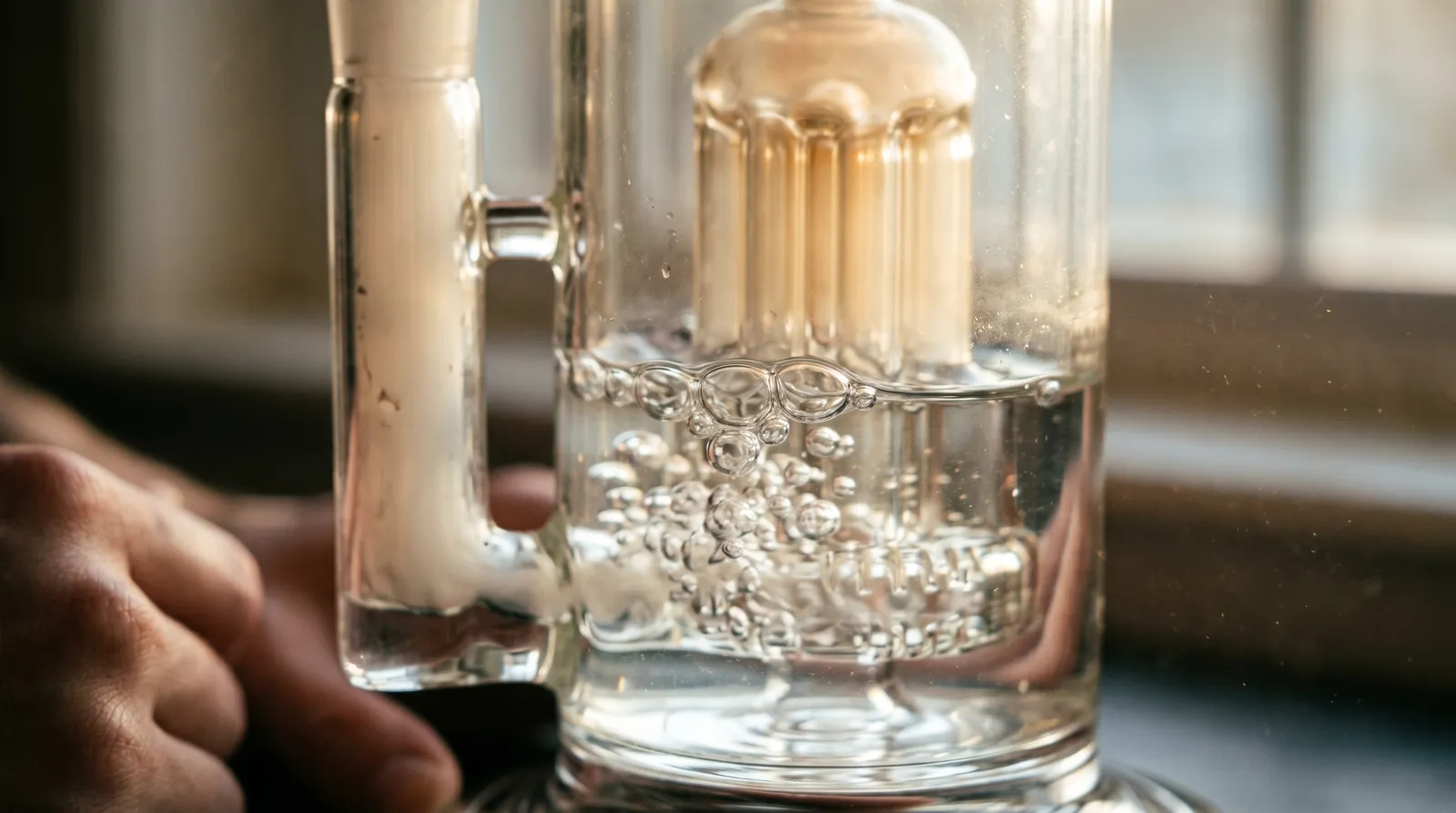
Every perc type is just a different mechanical solution to that problem. Some punch tiny holes in a flat disc. Some split the airflow down multiple tubes. Some force it through a slitted dome. The trade-off is always the same: finer diffusion means more drag and faster clogging. There's no free lunch.
Honeycomb Percolators
A honeycomb perc is a flat glass disc — usually 2–4mm thick — perforated with anywhere from 30 to over 100 small holes arranged in a hexagonal pattern (hence the name). It sits horizontally inside the tube, spanning the full diameter of the bong's chamber.
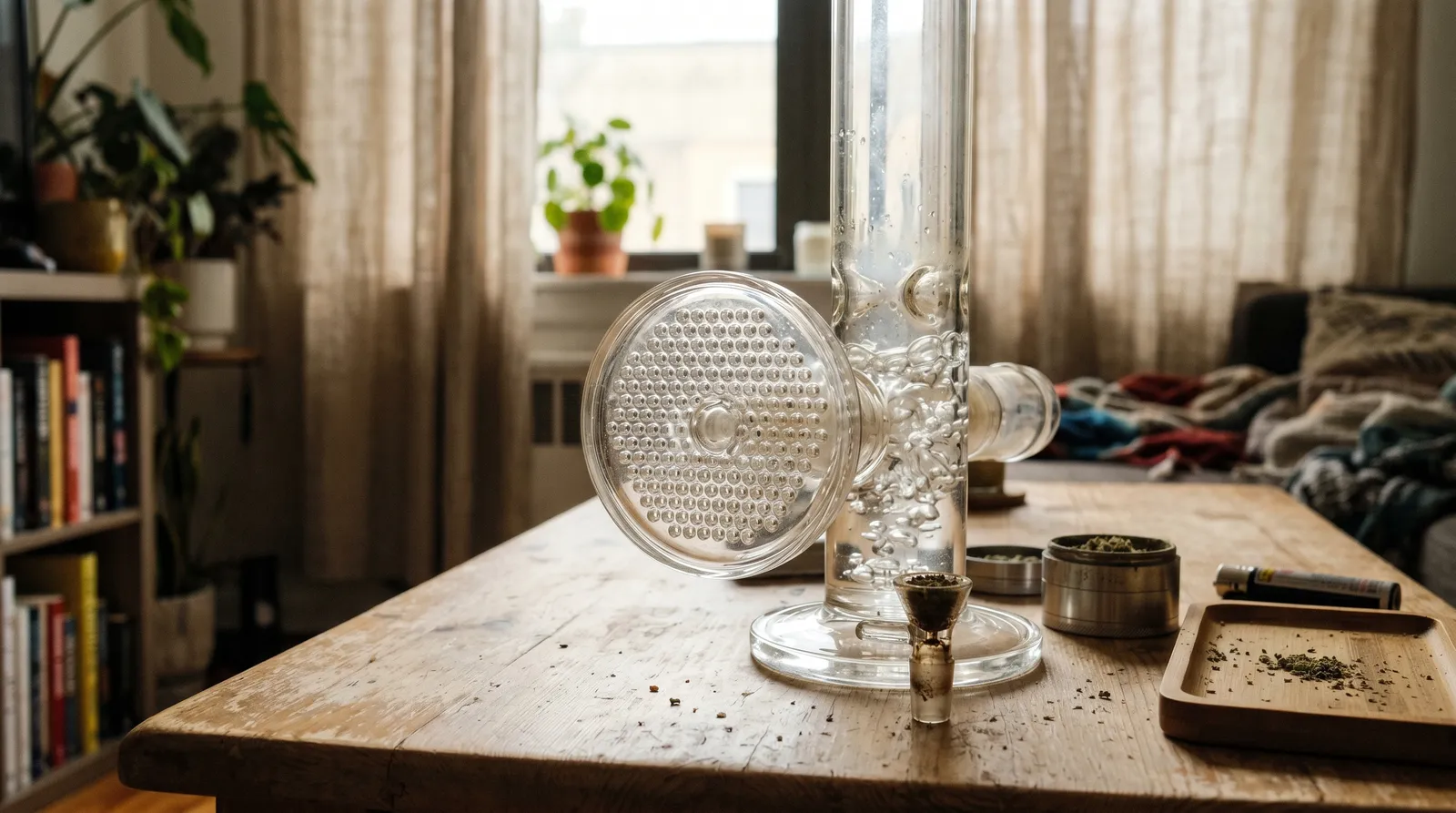
The design is elegant in its simplicity. Smoke hits the disc from below and gets forced through every hole simultaneously, producing a dense field of fine bubbles. Because the holes are small and numerous, you get excellent diffusion with surprisingly little draw resistance — at least when the piece is clean.
The flat profile is the honeycomb's real advantage. You can stack two or even three discs vertically in the same tube, each one further breaking up the bubbles from the disc below. Double and triple honeycomb bongs are common. Each additional disc adds filtration, though the returns diminish after two — a third disc smooths things only marginally while noticeably increasing drag.
The catch: those tiny holes are a magnet for resin buildup. After a week of regular use, you'll feel the draw tighten. After two weeks without cleaning, some holes will be fully blocked. Isopropyl alcohol (90%+) and coarse salt work, but you need to soak the piece — a quick rinse won't cut it. Ensure good ventilation when using isopropyl, especially near any heat source.
Honeycomb percs are structurally tough. No protruding arms, no delicate tubes — just a solid disc fused to the inner wall. They rarely break from normal handling.
Tree Percolators
Tree percs look exactly like what the name suggests: a central trunk with multiple arms (typically 4 to 12) branching downward, each arm tipped with slits or small holes. Smoke travels up the trunk, splits into the arms, and exits through those slits into the water.
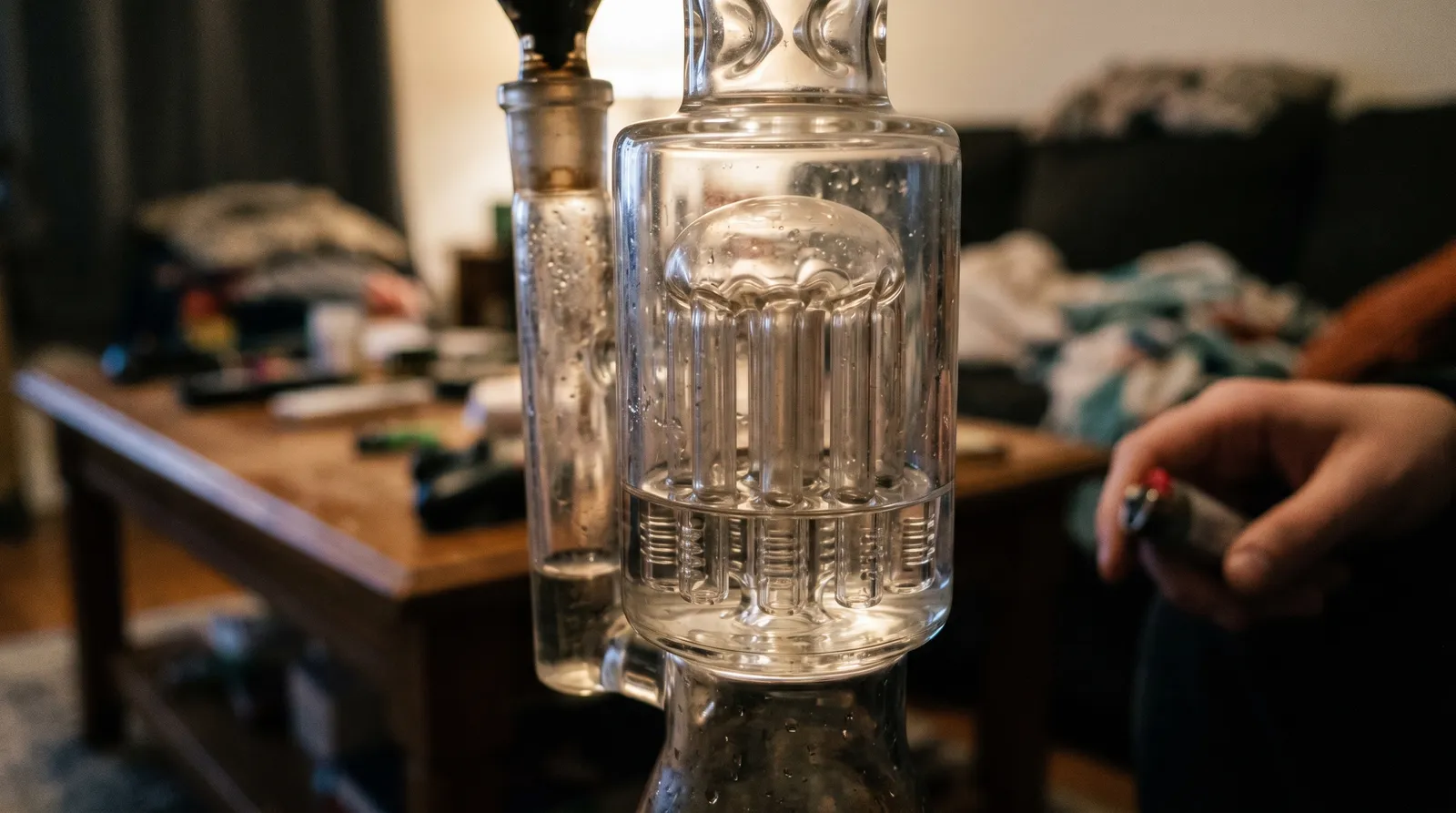
The visual effect is genuinely impressive. Each arm produces its own column of bubbles, and a well-made 8-arm tree perc in action looks like a tiny underwater chandelier. It's one of the reasons tree percs remain popular despite being outperformed on paper by newer designs — people like watching them work.
Filtration scales directly with arm count. A 4-arm tree perc provides moderate diffusion. An 8-arm version roughly doubles the slit count, producing finer bubbles and noticeably smoother hits. Some high-end pieces push to 12 or even 16 arms, though beyond 8 the practical improvement flattens out while complexity (and price) keeps climbing.
The catch: fragility. Each arm is a thin glass tube, and they're the most breakage-prone component in any bong. A hard knock, a careless cleaning session, or even thermal shock from very hot water can snap an arm. Once one arm breaks, airflow becomes uneven — smoke preferentially rushes through the broken path of least resistance, bypassing the remaining arms entirely. A tree perc with a broken arm isn't just cosmetically damaged; it's functionally compromised.
Cleaning is also fiddly. Resin collects inside the arms and around the slits. You can't physically reach in there with a brush — you're relying entirely on soaking and shaking. The tight geometry means isopropyl needs longer contact time than with more open designs.
Draw resistance tends to be higher than honeycomb or showerhead designs, especially on tree percs with many arms. Each slit creates a small pressure drop, and those add up. Some smokers enjoy the slower, more controlled draw this creates. Others find it tiring.
Showerhead Percolators
A showerhead perc is a vertical tube that flares out at the bottom into a rounded dome or disc, with slits cut around the flared edge. Smoke travels down the tube and exits through those slits, dispersing into the water in a ring pattern — like water coming out of, well, a showerhead.
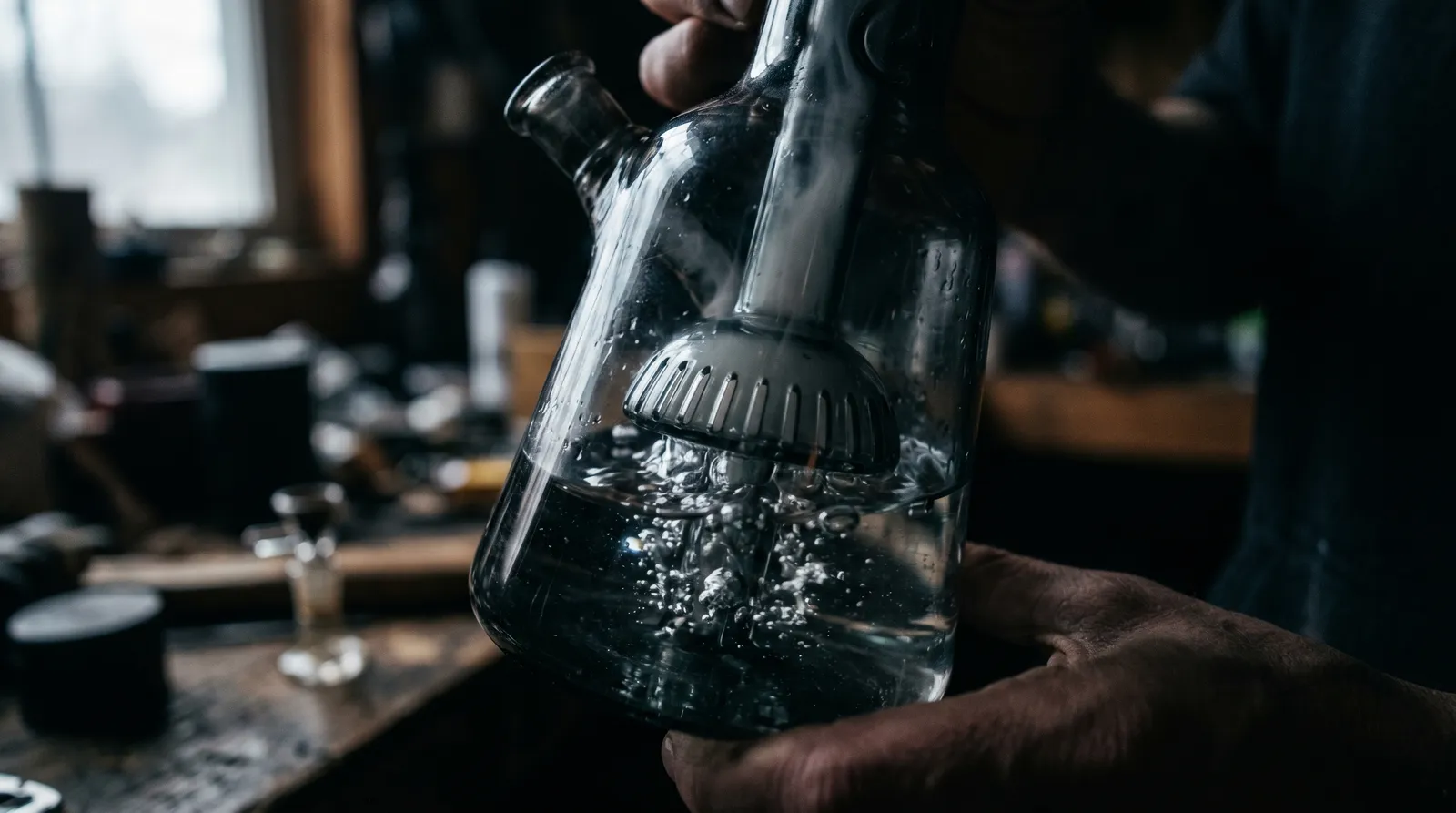
The slit count varies. Budget pieces might have 4–6 slits; better ones run 10–16 or more. More slits means finer diffusion, same principle as everywhere else. The dome shape naturally directs bubbles outward and upward, creating good water circulation without requiring much lung effort.
Showerhead percs hit a sweet spot that the other two designs miss. They offer genuinely smooth hits — not quite as silky as a clean double honeycomb, but close — with noticeably less drag than a tree perc and significantly easier maintenance than either. The open dome structure means resin has fewer places to hide. A 5-minute soak in isopropyl usually clears everything out.
Durability sits between the other two. The dome is a single piece of glass without the fragile arms of a tree perc, but it does protrude into the chamber more than a flush-mounted honeycomb disc. Reasonable care keeps it intact.
The catch: showerhead percs are less visually dramatic than tree percs and don't stack as neatly as honeycombs. If maximum diffusion is your priority and you're disciplined about cleaning, a double honeycomb will outperform a single showerhead. But if you want something that performs well and doesn't punish you for skipping a cleaning session, the showerhead is hard to beat.
How Many Percolators Do You Actually Need?
One good perc is enough for most people. Seriously. A single well-made honeycomb or showerhead perc will cool and filter smoke to the point where the difference between one perc and two is subtle — noticeable side by side, but not transformative.
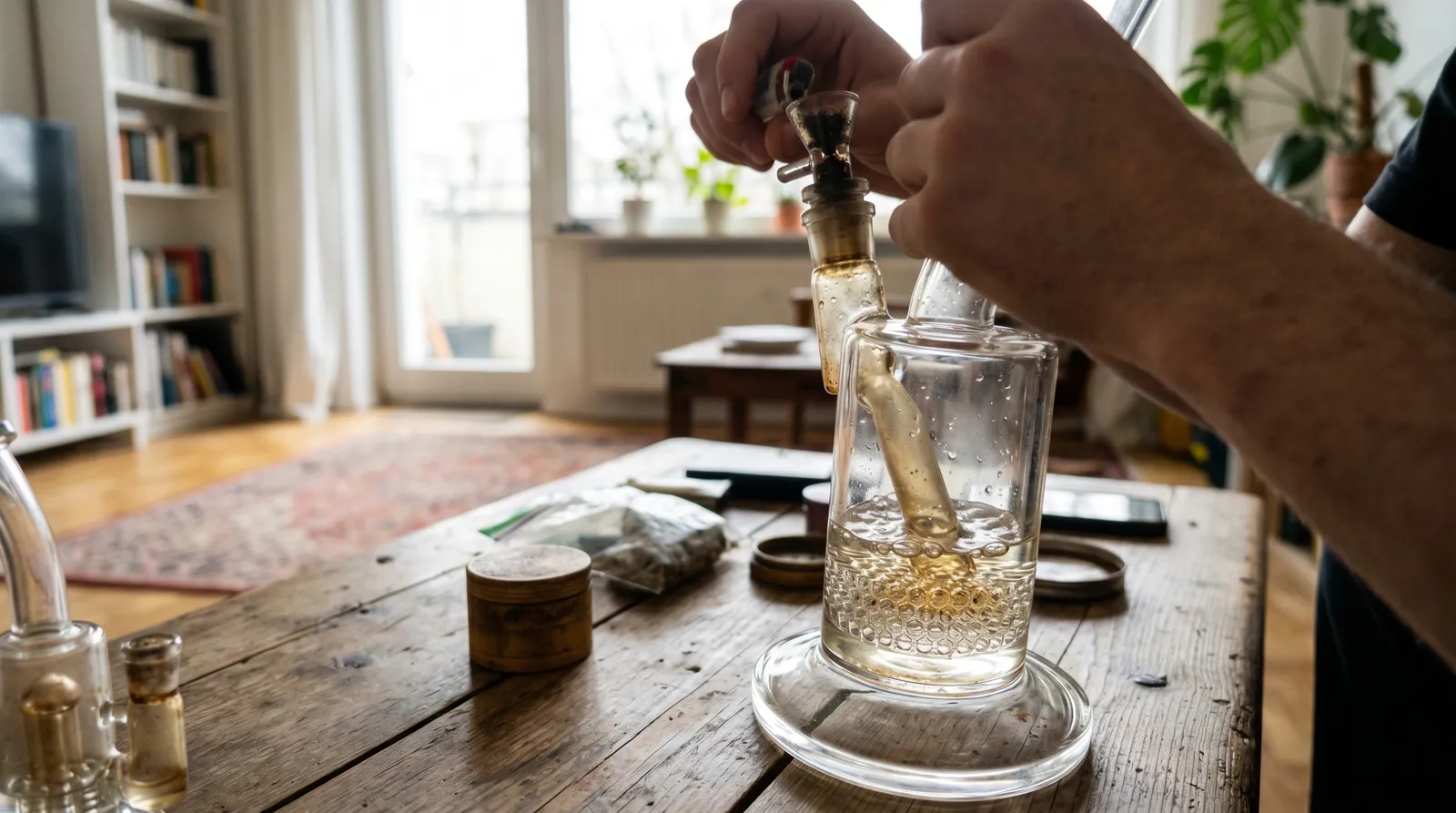
Double-perc setups make sense if you're particularly sensitive to throat irritation or you're pulling large volumes of smoke. Triple percs exist, but the added drag usually outweighs the marginal smoothness gain. There's also a flavour consideration: each pass through water strips some volatile compounds alongside the harshness. Heavy percolation can mute flavour, which matters if you're particular about terpene profiles.
A practical guideline based on what we see customers actually prefer: one perc for standard daily use, two for sessions where smoothness is the priority. Three or more is collector territory — impressive to look at, diminishing returns to smoke through.
Filling and Maintaining a Percolator Bong
Water level matters more than most people realise. Each perc needs to be submerged by roughly 1–2cm of water above its highest diffusion point (holes, slits, or arm tips). Too little water and the smoke bypasses the perc. Too much and you'll get splashback or an uncomfortably heavy draw.
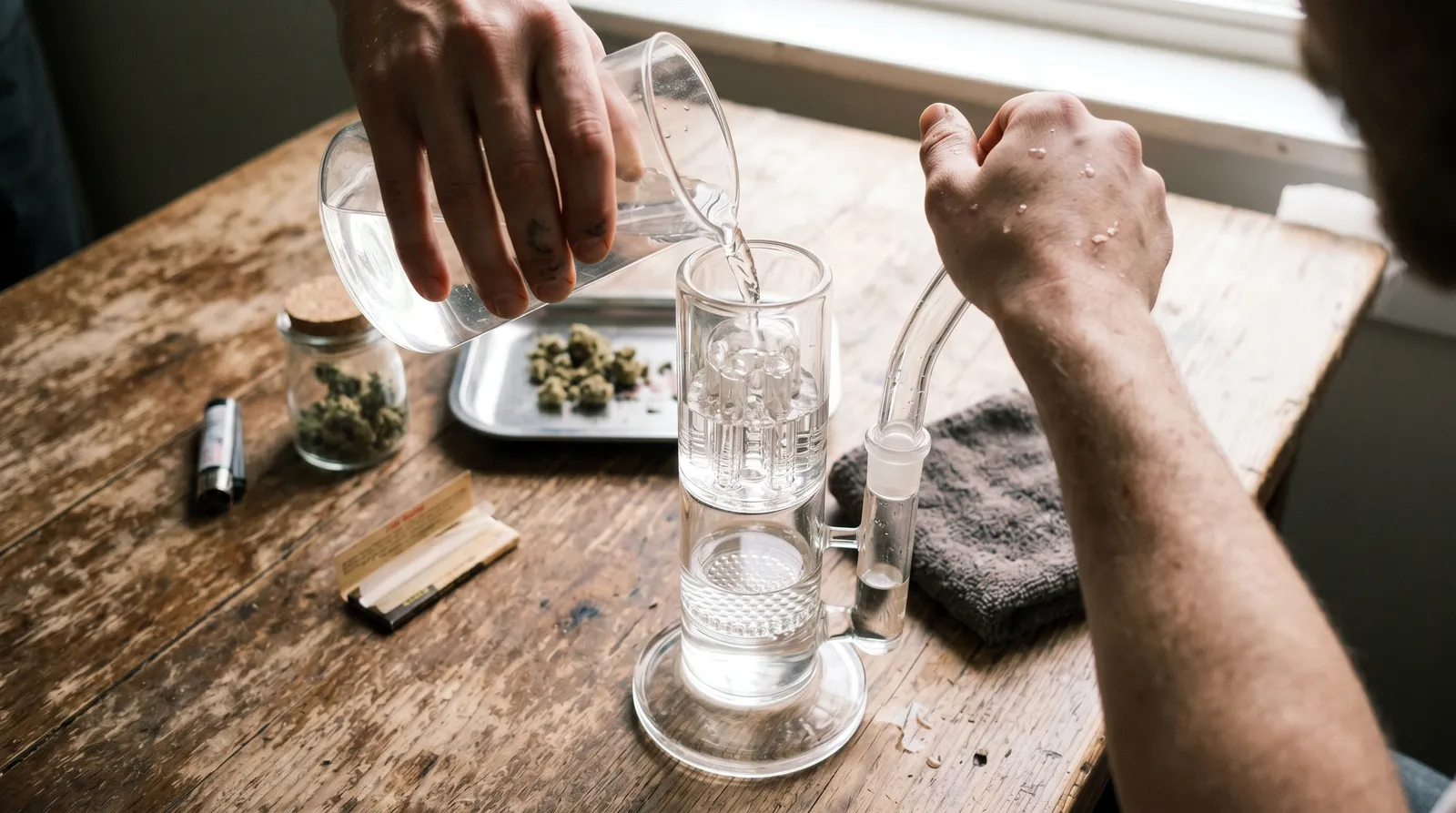
For multi-perc bongs, fill through the mouthpiece and let water settle down through each chamber. Tilt gently to distribute. Test with a dry pull (no bowl lit) — you should feel even resistance and hear consistent bubbling from each perc. If one chamber sounds dead, it needs more water.
Change the water after every session. Stale bong water isn't just unpleasant — according to a 2020 analysis of biofilm formation in water pipes, bacterial colonies can establish within 22 hours in standing water at room temperature (Mooney et al., 2020). Fresh water, every time.
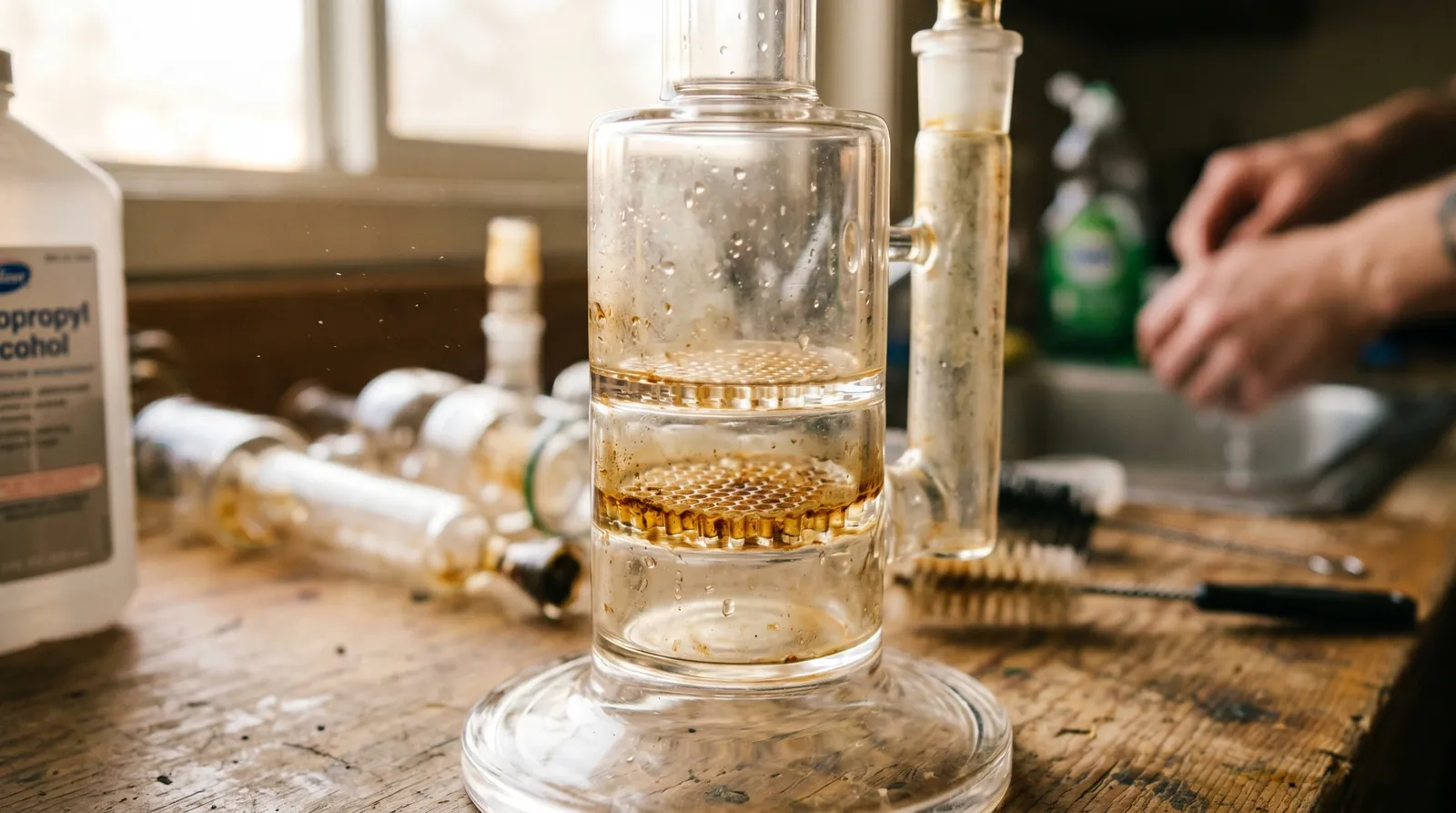
For deeper cleaning, a weekly soak in 90%+ isopropyl alcohol with coarse salt handles most resin buildup. Seal the openings, shake vigorously, and rinse thoroughly with warm water. Avoid boiling water — thermal shock cracks glass, especially around thin perc structures. And always clean in a well-ventilated space; isopropyl fumes are no joke in an enclosed bathroom.
Which Perc Suits Your Priorities
If smoothness is everything and you don't mind regular cleaning: honeycomb. Stack two discs for an even silkier draw, but commit to weekly maintenance or accept the consequences.
If you want the visual spectacle and don't mind a slower draw: tree. Handle the piece carefully, clean it gently, and accept that a broken arm means a functionally different bong.
If you want the best balance of performance and low maintenance: showerhead. It won't win any single category outright, but it won't frustrate you either. For most daily smokers, that's the smarter pick.
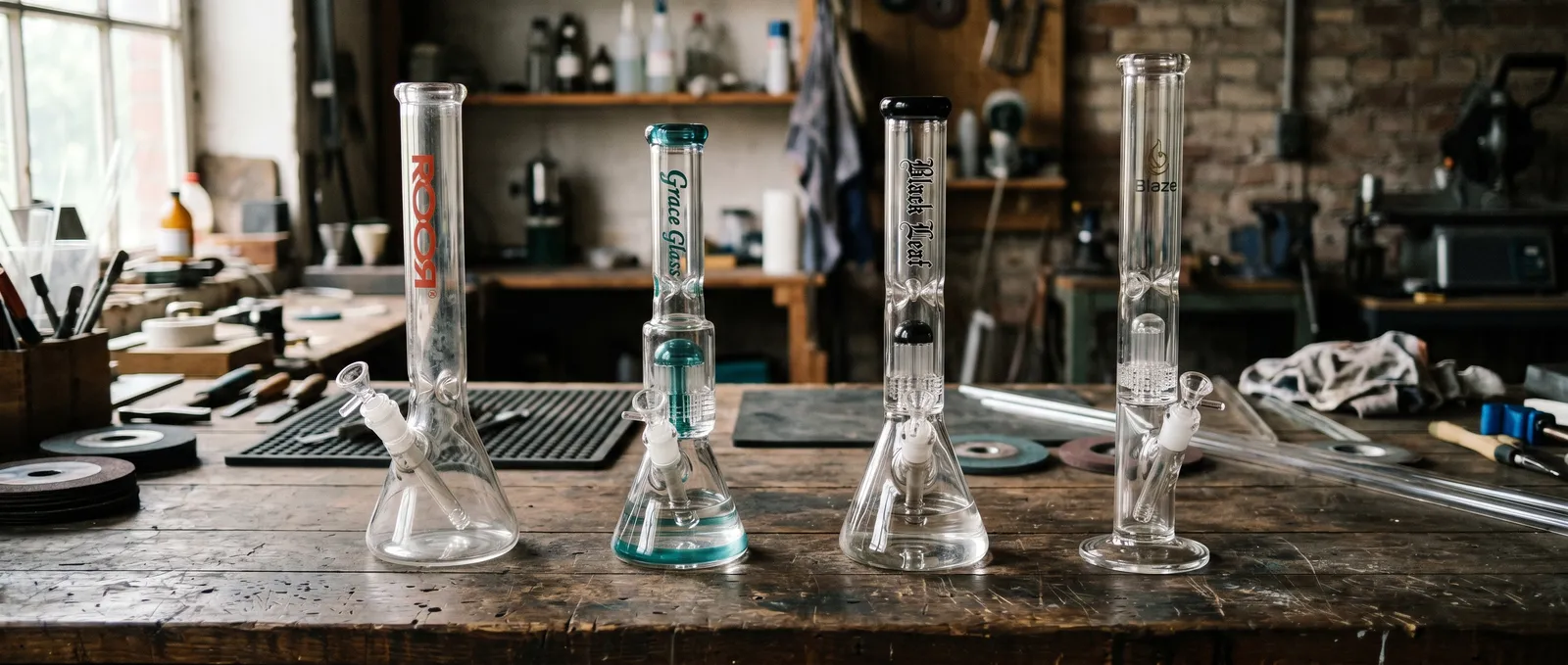
Black Leaf and Grace Glass both offer pieces across all three perc types, and Blaze Glass covers the entry-level end well. ROOR pieces tend toward simpler diffusion designs but with heavier glass — worth considering if durability outranks maximum percolation on your list.
This guide covers hardware for adults (18+). Use of vaporizers, bongs, pipes, dab rigs and rolling accessories is for adult use only. Verify your local laws on the substances you choose to use — Azarius does not provide legal advice. Consult a qualified professional if you have a health condition or take medication.
Last updated: April 2026
Frequently Asked Questions
7 questionsDoes a percolator bong filter out active compounds?
How do you put water in a multi-perc bong?
Can you have too much percolation in a bong?
What is the easiest type of percolator to clean?
Do percolator bongs really make smoke smoother?
Which percolator type has the least drag?
Can you stack multiple percolators in one bong?
About this article


Adam Parsons is an external cannabis and psychedelics writer and editor who contributes to Azarius's wiki as both author and reviewer. On the writing side, he authors Azarius's kratom and kanna clusters, drawing on exten
This wiki article was drafted with AI assistance and reviewed by Adam Parsons, External contributor. Editorial oversight by Joshua Askew.
Medical disclaimer. This content is for informational purposes only and does not constitute medical advice. Consult a qualified healthcare provider before use of any substance.
Last reviewed April 25, 2026
Related Articles
Gravity Bongs Explained: How They Work and Why
A gravity bong uses water displacement to pull concentrated smoke into a chamber, then forces it into your lungs under positive pressure.
Storz Bickel Volcano Complete Guide: Setup, Temps & Cleaning
The Storz & Bickel Volcano is a convection desktop vaporizer that fills detachable balloons with vapour — a system clinically validated by Hazekamp et al.
TinyMight Boundless XMAX Premium Portables Compared
The TinyMight 2, Boundless CFX/CFC and XMAX V3/Starry/Ace represent three tiers of portable dry-herb vaporizer — from budget conduction to premium convection.
How To Clean a Vaporizer: Step-by-Step Guide
How to clean a vaporizer is a straightforward maintenance routine that keeps your device tasting fresh, drawing smoothly, and lasting years longer than a…
ROOR Grace Glass Black Leaf Blaze Brand Comparison — Glass Bong Guide
Four borosilicate glass bong brands — ROOR, Grace Glass, Black Leaf, and Blaze Glass — dominate the European market at different price points.
Joint Filters Crutches Glass Tips Activated Charcoal — Buyer's Guide
Joint filters range from simple card crutches that block loose herb to activated charcoal tubes that trap 40–60% of gas-phase toxicants like benzene and…

Quartz Banger Temperature and Care Guide
A quartz banger's performance depends almost entirely on temperature control and maintenance.
Arizer Portable Lineup Compared: Solo vs Solo 2 vs Solo 3 vs ArGo
Arizer's portable vaporizers all use borosilicate glass vapour paths and session-style heating, but differ meaningfully in battery architecture, heating…
Kief: What It Is and How to Collect It | Full Guide
Kief is the fine, powdery accumulation of trichome heads that detach from cannabis flower during grinding or handling.