
Cordyceps Himalayan History

Definition
Cordyceps Himalayan history is a centuries-long narrative tracing how Ophiocordyceps sinensis, a parasitic fungus first documented in fifteenth-century Tibetan medical texts (Winkler, 2008), rose from alpine obscurity to global demand. Found only above 3,000 metres on the Tibetan Plateau and surrounding ranges, it infects ghost moth larvae and produces a prized fruiting body that became one of the most expensive biological commodities on earth.
18+ only — this article covers a functional mushroom with bioactive compounds; the information below applies to adult physiology.
Cordyceps Himalayan history is a centuries-long narrative that traces how a parasitic alpine fungus became one of the most sought-after natural supplements on earth. Long before cordyceps capsules lined the shelves of health food shops, Tibetan and Nepali herders were scrambling across alpine meadows above 3,500 metres to pluck a strange, finger-like fungus from the frozen ground. The story stretches back at least to the fifteenth century, when the organism first appeared in Tibetan medical texts — not as a curiosity, but as a prized tonic reserved for royalty and high-ranking monks. Understanding where this fungus came from, and how it went from yak-pasture oddity to globally traded supplement, tells you a lot about why people still reach for it today.
The information in this article is provided for educational purposes only and does not constitute medical advice. Cordyceps supplements are not intended to diagnose, treat, cure, or prevent any disease. Consult a qualified healthcare professional before use, especially if you are pregnant, nursing, or taking medication. Regulatory status varies by country; check local rules before you buy or order any cordyceps product.
What Exactly Were They Finding Up There?
The species at the centre of the cordyceps Himalayan history is Ophiocordyceps sinensis (formerly Cordyceps sinensis), a parasitic fungus that infects ghost moth larvae (Thitarodes spp.) living in the soil of the Tibetan Plateau and surrounding Himalayan ranges. The larva burrows underground in autumn; the fungal spore colonises it over winter; and by late spring a slender, dark-brown stroma — the fruiting body — pushes up through the thawing earth. The result looks like a caterpillar with a twig growing out of its head, which is exactly what it is. Tibetans call it yartsa gunbu (summer grass, winter worm), and the Chinese name dōng chóng xià cǎo translates to the same idea.
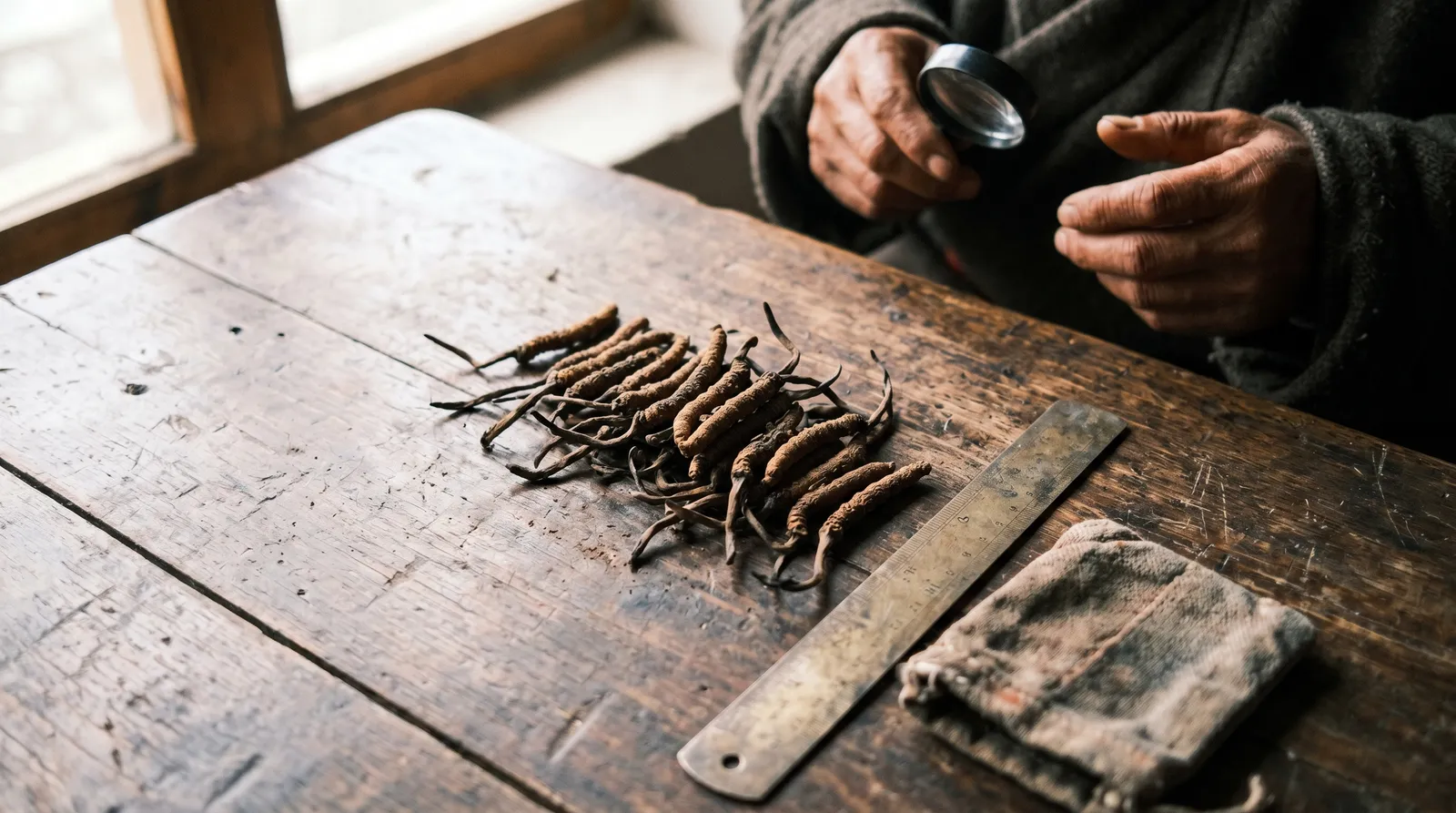
It only grows between roughly 3,000 and 5,000 metres of elevation, across a band stretching from eastern Tibet through Qinghai, Sichuan, Yunnan, and into Nepal and Bhutan. That narrow ecological niche is what makes wild O. sinensis so scarce — and so expensive.
Earliest Written Records
The oldest known Tibetan reference to cordyceps appears in the fifteenth-century text An Ocean of Aphrodisiacal Qualities by Zurkhar Nyamnyi Dorje, dated to around 1439 (Winkler, 2008). This early mention anchors the cordyceps Himalayan history in a concrete documentary record. The fungus was described as a tonic for vitality and stamina — a theme that would persist for centuries. By the late seventeenth century, it had entered Chinese materia medica. The Qing-dynasty physician Wang Ang included it in his 1694 compendium Bencao Beiyao, listing it among substances traditionally used for kidney and lung support.
The first Western scientific description came much later. In 1843, the British mycologist Miles Joseph Berkeley formally described the species from specimens collected in the Himalayas, though European awareness of the fungus dates to at least the eighteenth century through Jesuit missionaries stationed in Beijing. According to Sung et al. (2007), the taxonomic reclassification from Cordyceps to Ophiocordyceps wouldn't happen until molecular phylogenetics caught up in the early 2000s — so for most of the cordyceps Himalayan history, everyone just called it cordyceps.
The Yartsa Gunbu Economy
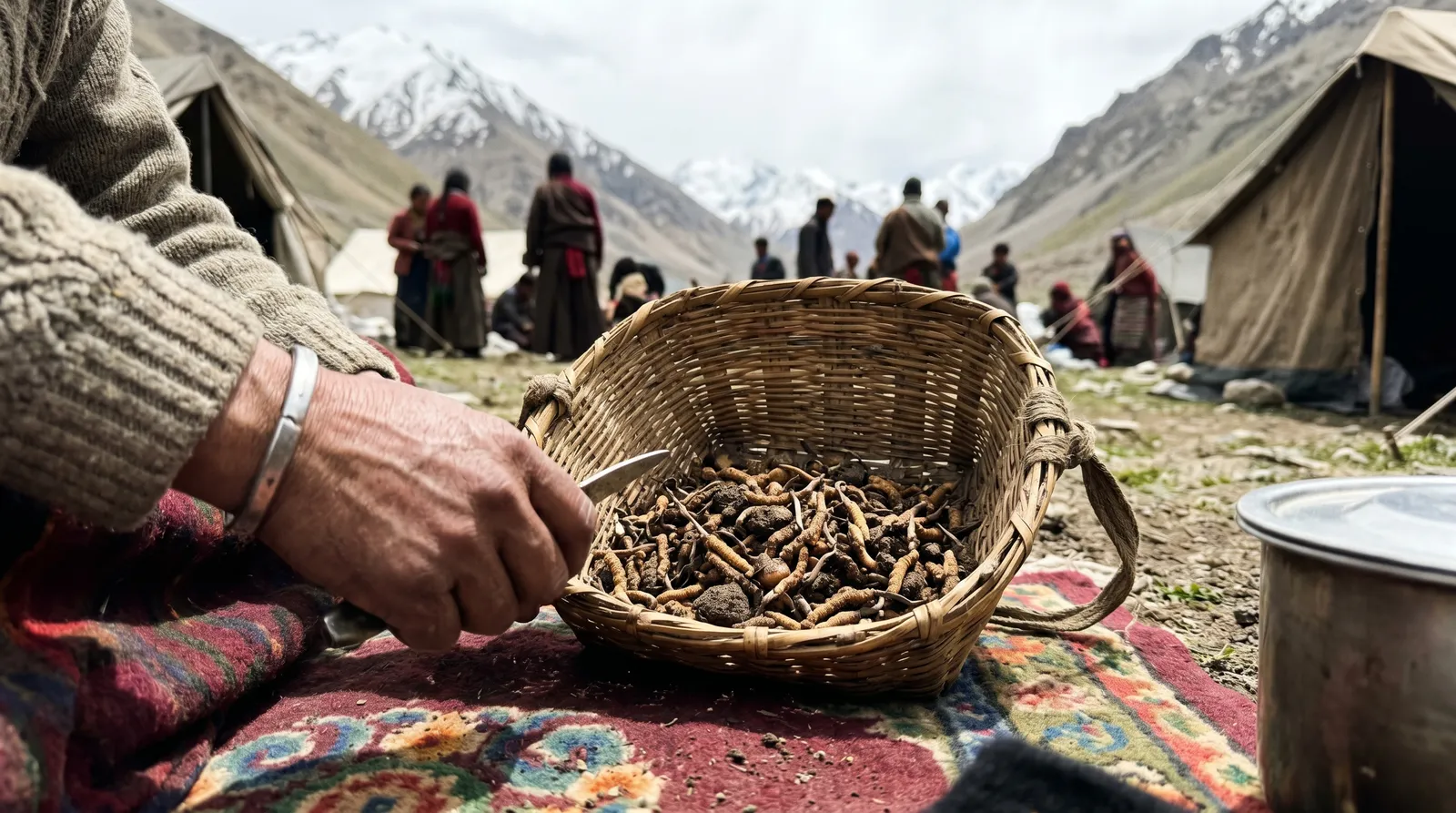
Wild O. sinensis became one of the most valuable biological commodities on earth by the 1990s, transforming Himalayan rural economies almost overnight. For Himalayan communities, the fungus was never just medicine — it was currency. Winkler (2008) documented that in parts of rural Tibet, yartsa gunbu collection accounted for 50–80% of household cash income. Entire villages would relocate to high-altitude collection grounds each spring, with families staking out patches of meadow the way prospectors once staked mining claims.
Prices tracked demand from Chinese traditional medicine markets. In the early 1990s, a kilogram of high-grade wild cordyceps fetched around $5,000. By 2008, that figure had climbed past $25,000 per kilogram for top-quality specimens, and peak retail prices in Chinese pharmacies exceeded $100,000/kg by the 2010s — more expensive per gram than gold (Shrestha & Bawa, 2014). The 1993 Chinese National Games added fuel: three female runners from Liaoning province smashed multiple world records, and their coach, Ma Junren, publicly attributed their performance to a training regimen that included cordyceps-enriched tonics. Whether the fungus actually contributed is debatable — the coach's methods were later scrutinised for other reasons — but the publicity sent demand through the roof.
Ecological Pressure and Decline
Wild cordyceps populations have declined significantly since the late 1990s due to overharvesting and rising temperatures at high altitude. A study by Hopping et al. (2018) analysed production data from the Tibetan Plateau and found measurable yield reductions, with climate modelling suggesting that suitable habitat could shrink by 20–30% under moderate warming scenarios. The fungus depends on a precise combination of cold winters, specific soil moisture, and the presence of its host larvae — shift any of those variables and the life cycle breaks down.
Nepal and Bhutan have introduced collection permits and seasonal restrictions, though enforcement at 4,500 metres is exactly as difficult as you'd imagine. China's State Forestry Administration listed O. sinensis as a protected species in certain provinces, but demand continues to outstrip supply. The ecological fragility of wild cordyceps is one of the main reasons the supplement industry pivoted so heavily toward Cordyceps militaris, a related species that can be cultivated on grain substrates at sea level — no caterpillars or Himalayan meadows required. Data from the EMCDDA's broader monitoring of natural product markets confirms that regulatory attention to wild-harvested biologicals has increased across Europe as well.
From Himalayan Meadows to Lab-Grown Mycelium
Cultivated Cordyceps militaris replaced wild O. sinensis as the commercial standard because the wild species has never been successfully farmed at scale. The complex relationship between fungus, host larva, and alpine environment has resisted every attempt to replicate it in a lab. What you find in virtually every cordyceps supplement on the market today is either C. militaris fruiting bodies grown on rice or grain, or mycelium-on-grain products (sometimes called CS-4, a fermented mycelium strain isolated from wild O. sinensis in the 1980s by Chinese researchers).
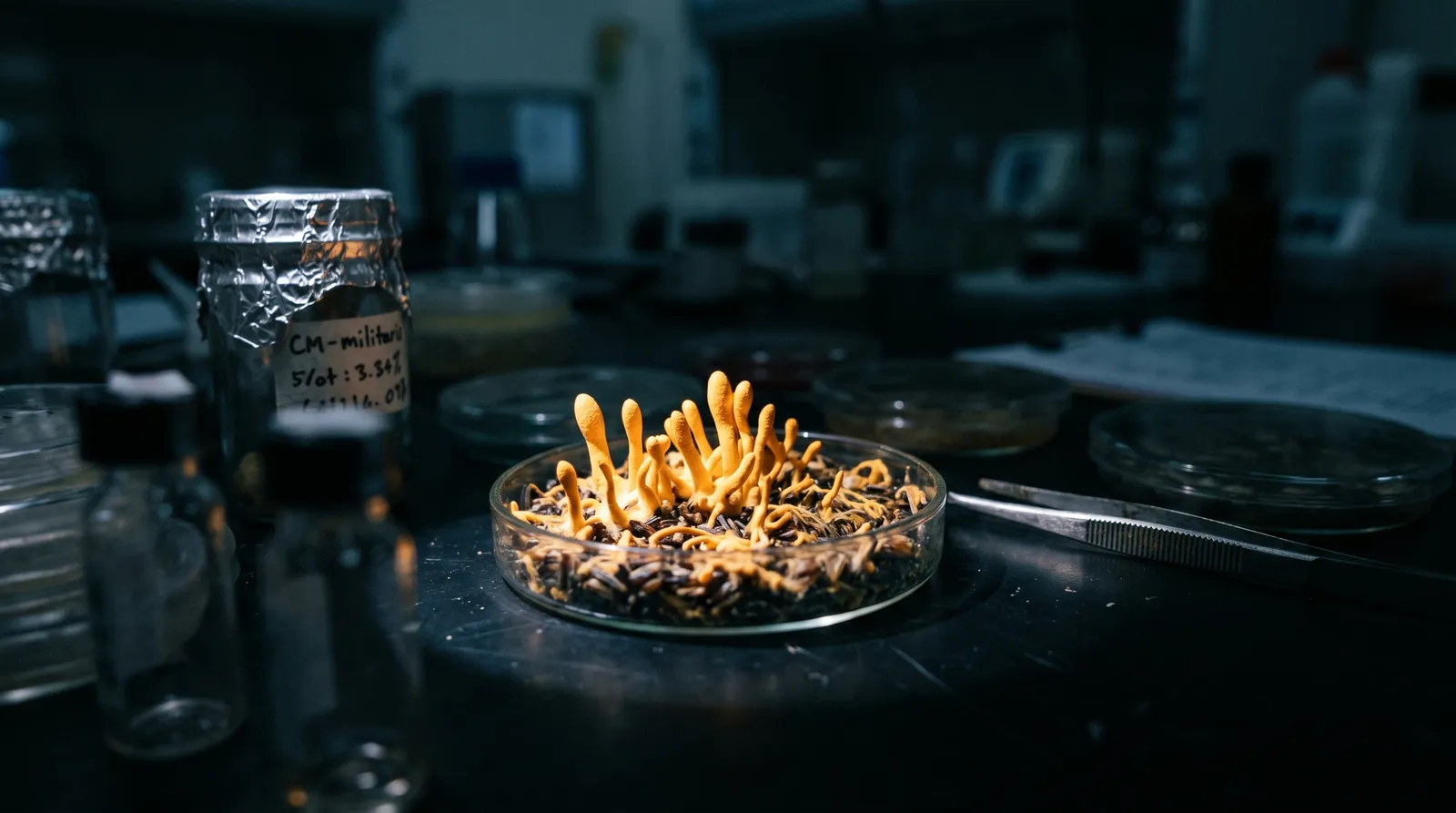
The bioactive profiles differ between species. According to a comparative metabolite study by Qin et al. (2018) using UHPLC-MS/MS, O. sinensis contained a broader array of unique metabolites, while C. militaris produced significantly higher concentrations of cordycepin — the adenosine analogue that most modern research focuses on. Whether that makes one "better" than the other depends entirely on which compound you care about, and the honest answer is that clinical data comparing the two species head-to-head in humans remains thin.
| Compound | Found in O. sinensis | Found in C. militaris | Notes |
|---|---|---|---|
| Cordycepin | Low–moderate | High | Adenosine analogue; most-studied compound |
| Adenosine | Moderate | Moderate | Supports cellular energy pathways |
| Beta-glucans | Present | Present | Polysaccharides; immune-related research |
| Ergosterol | Present | Present | Precursor to vitamin D₂ |
| Polypeptides | Diverse | Less diverse | Varies by extraction method |
| Period | Event | Significance |
|---|---|---|
| c. 1439 | First Tibetan medical text reference (Zurkhar Nyamnyi Dorje) | Earliest documented mention of yartsa gunbu as a tonic |
| 1694 | Wang Ang includes cordyceps in Bencao Beiyao | Entry into Chinese materia medica |
| 1843 | Miles Joseph Berkeley formally describes the species | First Western scientific classification |
| 1980s | CS-4 mycelium strain isolated in China | Opens path to affordable fermented cordyceps products |
| 1993 | Chinese National Games world records attributed to cordyceps | Global demand spike begins |
| 2000s | Reclassification to Ophiocordyceps sinensis | Molecular phylogenetics updates taxonomy |
| 2010s | Wild prices exceed $100,000/kg; cultivated C. militaris dominates market | Commercial shift to sustainable cultivation |
The pillar article on cordyceps covers the compound profile and current research in more detail.
Cultural Weight Beyond the Chemistry
The cordyceps Himalayan history carries cultural weight that goes far beyond pharmacology. In Tibetan and Nepali communities, yartsa gunbu collection season is a social event, an economic lifeline, and increasingly a source of conflict. Disputes over collection rights have turned violent in parts of rural Tibet and Nepal, with communities guarding meadows against outsiders. The fungus sits at the intersection of traditional medicine, rural economics, climate science, and conservation policy — all packed into something smaller than your little finger.
For the average person looking to buy a cordyceps supplement in Europe, the Himalayan backstory matters for one practical reason: it explains why genuine wild O. sinensis essentially doesn't exist in the Western supplement market. If someone is selling you "wild Himalayan cordyceps" at a normal supplement price, they're either confused or being creative with the truth. What you're getting — and what the research increasingly supports — is cultivated C. militaris, which has its own merits but a very different origin story.
Wild vs. Cultivated: A Practical Comparison
Comparing wild O. sinensis with cultivated C. militaris side by side helps cut through the marketing noise. Wild specimens carry centuries of traditional prestige and a broader metabolite fingerprint, but they are ecologically unsustainable, impossible to standardise, and priced beyond any reasonable supplement budget. Cultivated C. militaris, by contrast, delivers higher cordycepin concentrations, consistent batch-to-batch quality, and full traceability — all at a price that makes daily supplementation realistic. For anyone looking to get cordyceps into their routine, the cultivated version is the only sensible option in 2026.
What We Still Don't Know
There are significant gaps in the cordyceps Himalayan history that no amount of enthusiasm should paper over. Most traditional accounts are anecdotal, passed down orally or recorded in texts that don't meet modern evidentiary standards. The pharmacological claims made in fifteenth-century Tibetan medicine have not been validated by randomised controlled trials in humans. Even the better-studied cultivated C. militaris lacks large-scale clinical evidence for most of the benefits attributed to it. We sell cordyceps products because the existing research is promising and customer experience is consistently positive — but we won't pretend the science is settled, because it isn't.
Getting Cordyceps Today
Modern cordyceps supplements are accessible, affordable, and widely available — a stark contrast to the Himalayan original. If you want to buy cordyceps in a form backed by current research, look for cultivated C. militaris fruiting-body extracts standardised for cordycepin and beta-glucan content. The Azarius smartshop stocks cordyceps capsules and cordyceps extract options that meet these criteria. You can order cordyceps products from the Azarius functional mushrooms category, where each product page lists extraction method and active compound percentages. For those exploring functional mushrooms more broadly, the lion's mane capsules and reishi extract in the Azarius range complement cordyceps well, though each has a distinct compound profile and research base. The Azarius mushroom supplements wiki page provides a broader overview of the functional mushroom category, and the Azarius blog covers emerging research on adaptogenic fungi.
The Himalayan chapter of cordyceps Himalayan history is, in many ways, a closed one. The wild fungus is too rare, too expensive, and too ecologically fragile to sustain global demand. But it's the chapter that gave us everything that followed — the traditional knowledge, the initial pharmacological curiosity, and the economic incentive to figure out how to grow the stuff in a warehouse in Fujian province. Not a bad legacy for a parasitised caterpillar.
Last updated: April 2026
Frequently Asked Questions
10 questionsWhy is wild Himalayan cordyceps so expensive?
Can wild Cordyceps sinensis be farmed?
What is yartsa gunbu?
How has climate change affected wild cordyceps?
Is the cordyceps in supplements the same as wild Himalayan cordyceps?
Where can I buy cordyceps supplements in Europe?
When was cordyceps first documented in Tibetan medicine?
At what altitude does wild Ophiocordyceps sinensis grow?
How do collectors find cordyceps in the Himalayas?
What caterpillar does Ophiocordyceps sinensis infect?
About this article


Joshua Askew serves as Editorial Director for Azarius wiki content. He is Managing Director at Yuqo, a content agency specialising in cannabis, psychedelics and ethnobotanical editorial work across multiple languages. Th
This wiki article was drafted with AI assistance and reviewed by Joshua Askew, Managing Director at Yuqo. Editorial oversight by Adam Parsons.
Medical disclaimer. This content is for informational purposes only and does not constitute medical advice. Consult a qualified healthcare provider before use of any substance.
Last reviewed April 24, 2026
References (6)
- [1]Hopping, K.A. et al. (2018). 'The demise of caterpillar fungus in the Himalayan region due to climate change and overharvesting.' Proceedings of the National Academy of Sciences, 115(45), pp. 11489–11494.
- [2]Qin, P. et al. (2018). 'Comparative metabolite profiling between Cordyceps sinensis and other Cordyceps using UHPLC-MS/MS.' Molecules, 23(2), p. 246.
- [3]Shrestha, U.B. & Bawa, K.S. (2014). 'Economic contribution of Chinese caterpillar fungus to the livelihoods of mountain communities in Nepal.' Biological Conservation, 177, pp. 194–202.
- [4]Sung, G.H. et al. (2007). 'Phylogenetic classification of Cordyceps and the clavicipitaceous fungi.' Studies in Mycology, 57, pp. 5–59.
- [5]Winkler, D. (2008). 'Yartsa Gunbu (Cordyceps sinensis) and the fungal commodification of Tibet's rural economy.' Economic Botany, 62(3), pp. 291–305.
- [6]EMCDDA (2023). 'European Monitoring Centre for Drugs and Drug Addiction — natural product regulatory overview.' Available at: emcdda.europa.eu.
Related Articles

Medicinal Mushrooms TCM Western Pharmacognosy Guide
Guide to medicinal mushrooms TCM Western pharmacognosy — how reishi, lion's mane, cordyceps are classified, extracted, and studied.

Research on Immune Modulation by Functional Mushrooms
What does research on immune modulation by functional mushrooms actually show? Beta-glucans, Dectin-1 signalling, human trials, and the honest gap...

Allergic Reactions & Mushroom Sensitivities
Understand allergic reactions and mushroom sensitivities: mould cross-reactivity, shiitake dermatitis, species-specific risks, and safer product…
Turkey Tail Trametes versicolor — Buy Supplements
Buy turkey tail Trametes versicolor supplements at Azarius. PSK and PSP evidence, beta-glucan dosage, extraction methods, and safety.

Triterpenes In Medicinal Mushrooms
Triterpenes in medicinal mushrooms are a class of 30-carbon terpenoid compounds produced as secondary metabolites by several functional mushroom species…
Chaga Siberian Nordic Folk Use
Chaga Siberian Nordic folk use is a centuries-old tradition in which indigenous Siberians and Nordic communities brewed the birch-parasitising fungus…
Red and Black Reishi Varieties
Red reishi (Ganoderma lucidum) and black reishi (Ganoderma sinense) both fall under the lingzhi umbrella in traditional Chinese medicine, but they differ in…
Lion's Mane Identification & Habitat
Hericium erinaceus is a tooth fungus that fruits as a single white, spine-covered mass on wounded or dead hardwood trees.
Cordyceps Lifecycle
The cordyceps lifecycle is a parasitic biological sequence in which a fungus infects an insect host, colonises its body from within, and erupts as a…