
This article discusses psychoactive substances intended for adults (18+). If you have a health condition or take medication, consult a doctor before use. Our age policy
Mushroom Grow Kit Temperature & Humidity: Full Setup Guide
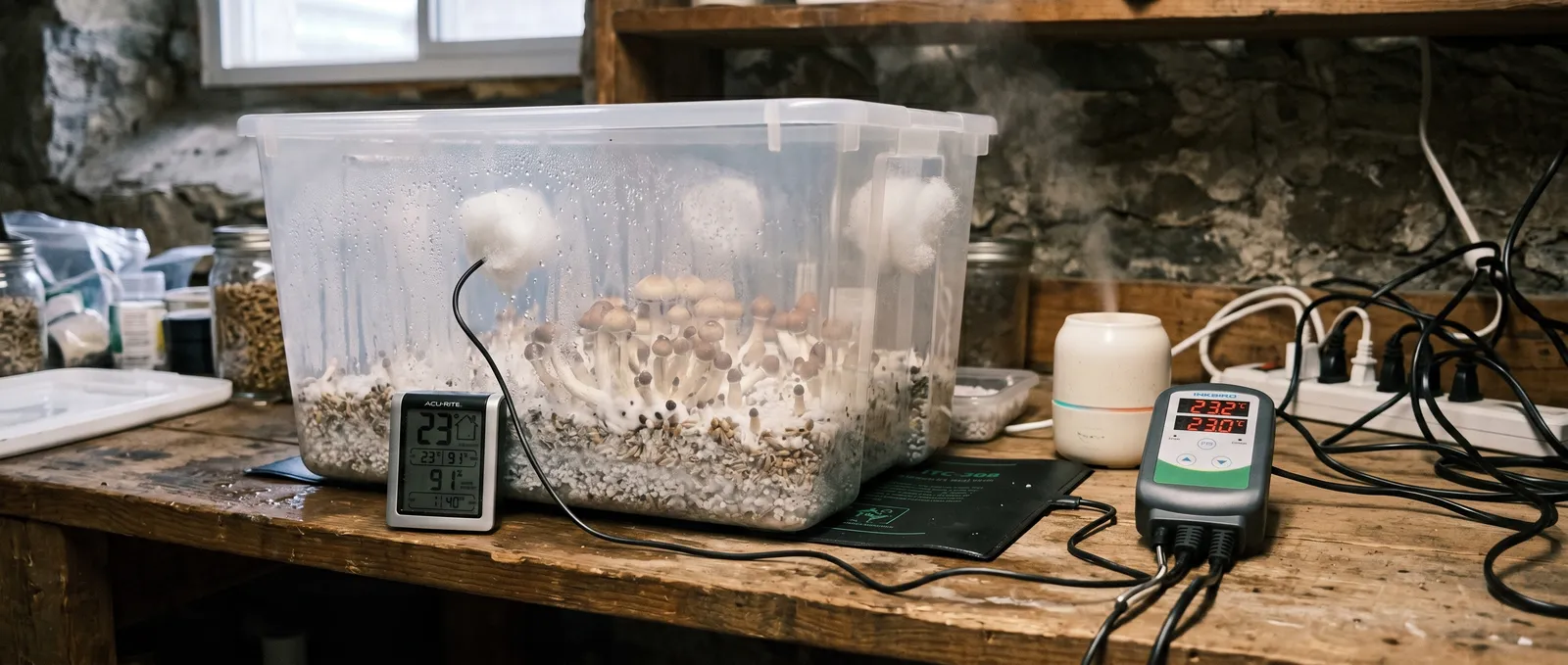
Definition
A temperature humidity control grow kit is the small set of climate tools — hygrometer, heat mat, humidifier or perlite tray — that keeps a mushroom fruiting chamber inside the 22–25 °C, 85–92% RH window Psilocybe cubensis needs to pin and fruit cleanly (Stamets, 2000). Without it, aborts and contamination dominate.
What a temperature & humidity control kit actually is
A temperature humidity control grow kit is a small cluster of environmental gear — hygrometer, heat mat, humidifier or perlite tray, and sometimes a thermostat controller — that keeps a mushroom fruiting chamber inside the narrow climate window Psilocybe cubensis actually wants to pin and fruit in. This guide is written for adults who want to buy or assemble a reliable setup. The ranges and techniques below apply to home mycology of psilocybin-producing fungi, and the substance is not appropriate for people under 18.
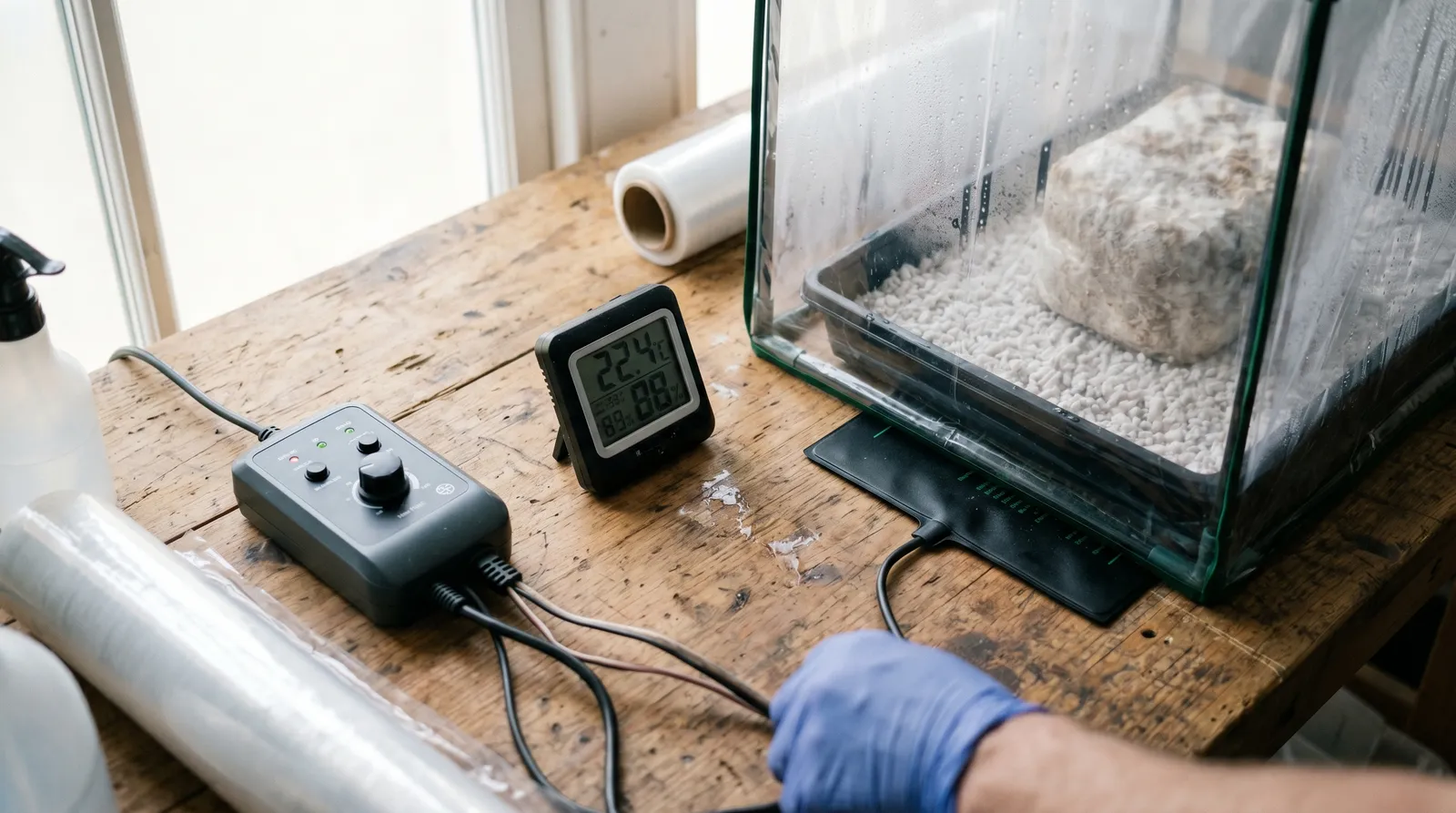
Cubensis mycelium colonises happily in a heated airing cupboard. Fruiting is fussier. Stamets (2000, Growing Gourmet and Medicinal Mushrooms) puts the cubensis fruiting optimum at 23–26 °C air temperature with 90–95% relative humidity during pinning, dropping to 85–92% once fruits are developing. Miss that window by a few degrees or 15 RH points and you get aborts, leather caps, or a cobweb bloom across the casing. The whole point of a temperature humidity control grow kit is to stop guessing.
The numbers that matter
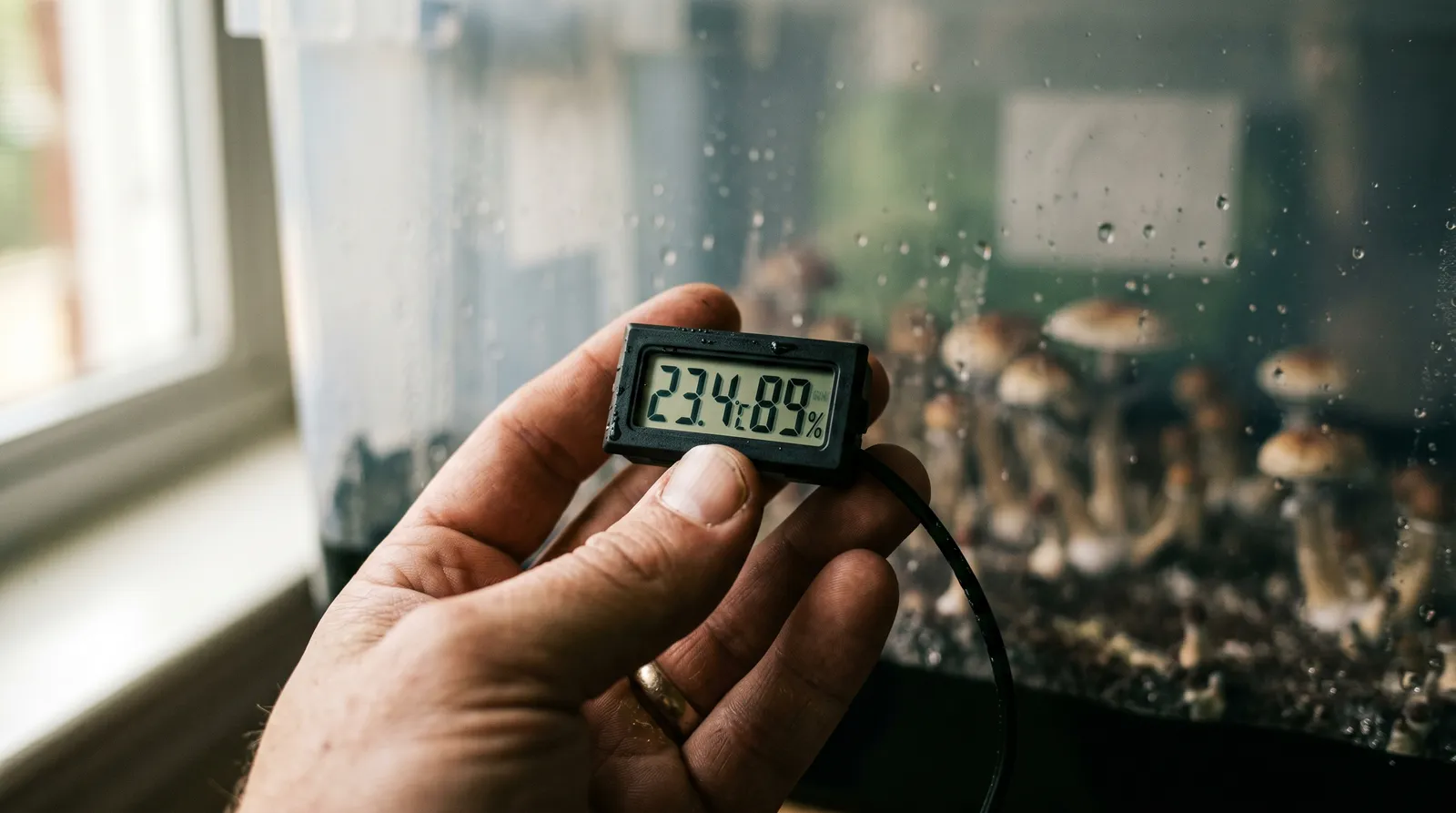
Cubensis wants 22–25 °C air and 85–92% RH during fruiting — those are the two numbers everything else in this guide serves. Every step below refers back to this table.
| Stage | Air temp | Substrate temp | Relative humidity | FAE (air changes/hour) |
|---|---|---|---|---|
| Colonisation | 24–27 °C | ~27 °C | not critical (sealed) | 0 |
| Pinning | 21–24 °C | 22–24 °C | 95–100% | 2–4 |
| Fruiting | 22–25 °C | 22–24 °C | 85–92% | 4–6 |
| Sclerotia (truffles) | 20–25 °C | 20–23 °C | sealed bag — N/A | 0 |
Sources: Stamets (2000); Shroomery cultivation wiki (accessed 2024); grow kit user guide (2022); EMCDDA drug profile on psilocybin mushrooms (accessed 2024). Truffles — Psilocybe tampanensis, Atlantis, Mexicana and the rest of the Azarius range — don't need a fruiting chamber at all. They finish inside their sealed bag at room temperature. The kit below is aimed at fruiting cubensis in a Grow Kit or Ready-2-Grow Bag.
Step 1: Put a hygrometer inside the chamber, not next to it
Measure humidity where the mushrooms live, not where you stand. A cheap digital hygrometer-thermometer (10–15 EUR range, the kind with a probe on a wire) is the single most useful piece of gear in this whole setup. Sit the probe inside the fruiting chamber — tub, tent, or the clear bag on a Grow Kit — with the display outside. Reading the room's humidity tells you nothing about what the mycelium is experiencing two millimetres above the casing layer.
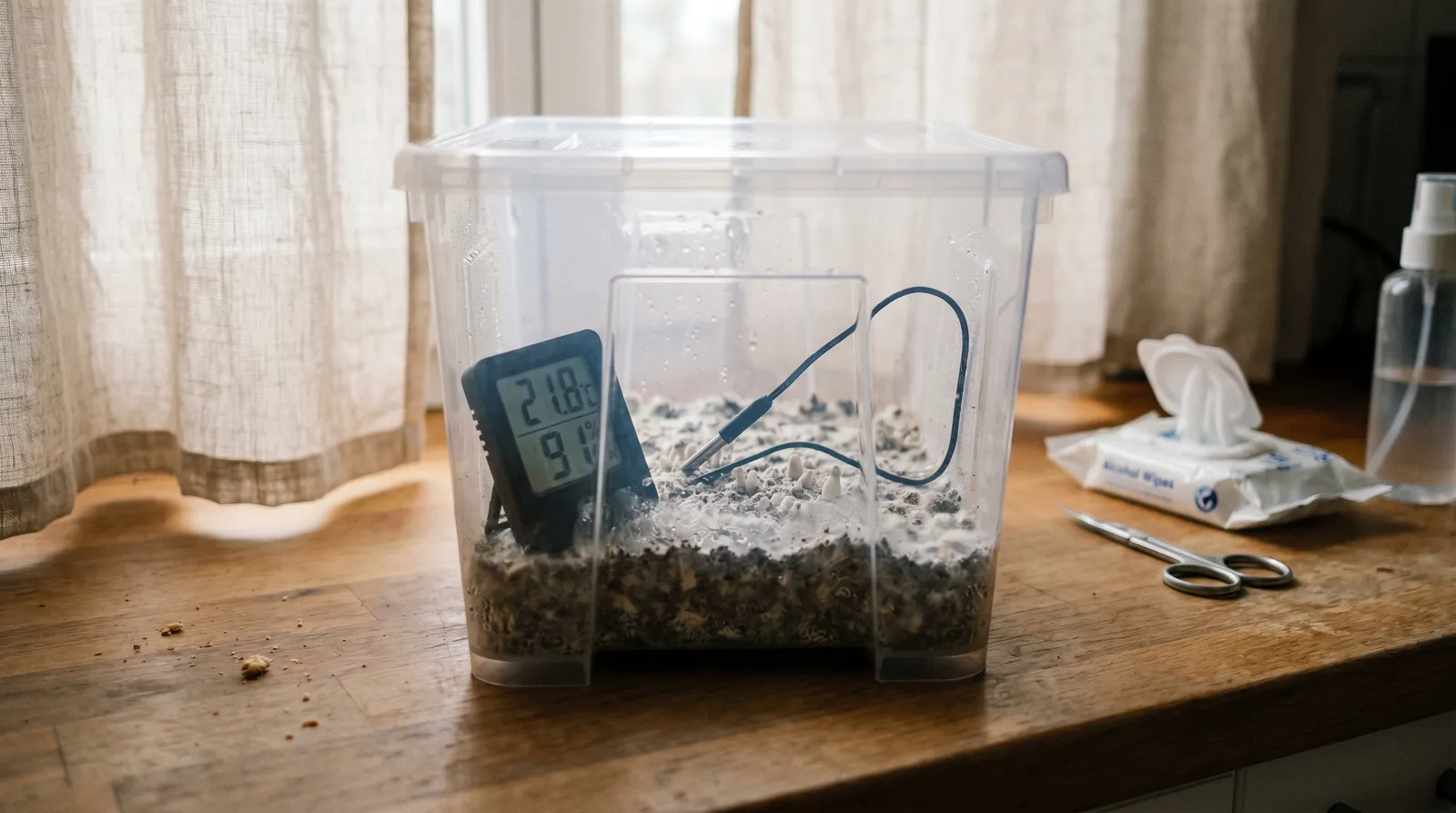
Aim for ±1 °C and ±3% RH accuracy. Budget hygrometers drift; calibrate once with the salt test (saturated NaCl slurry in a sealed container reads 75% RH at 20 °C, per Greenspan 1977). If yours reads 68%, you know it's reading 7% low for the rest of its life.
Step 2: Heat from below, gently
Warm the substrate from underneath with a regulated heat mat — never from above. Cubensis mycelium generates its own heat during colonisation — often 2–3 °C above ambient in a fully colonised cake. During fruiting that drops. If your room sits below 20 °C in winter, you need supplementary heat, but not the kind that scorches a substrate.
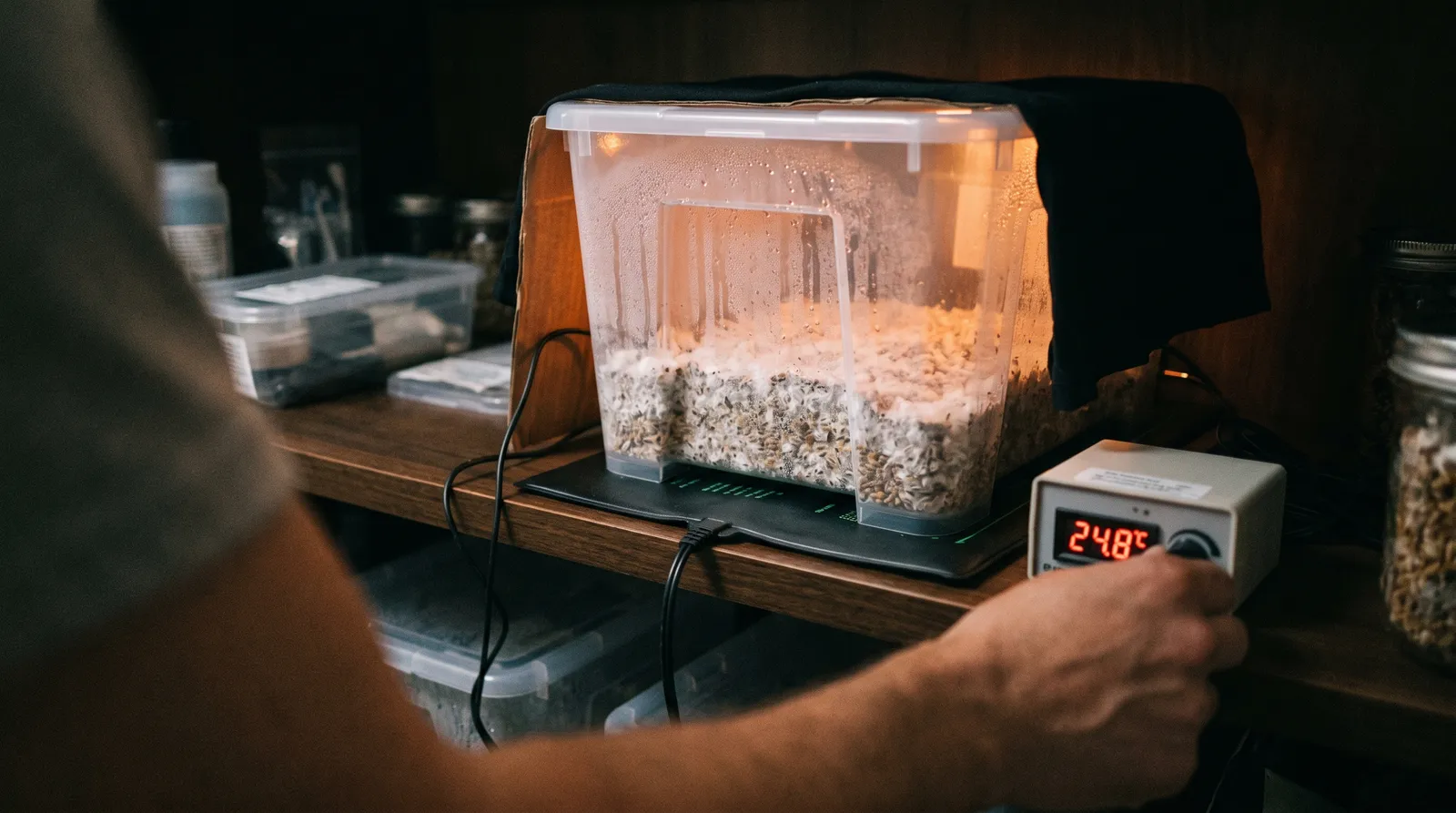
A 10–20 W seedling heat mat under the tub, plugged into an inline thermostat with the probe taped to the substrate bag, is the standard solution. Set the thermostat to cut at 24 °C. Never use a reptile basking lamp, never use a radiator — both create hot spots over 35 °C that kill mycelium locally and fuel thermophilic contaminants like Bacillus. If your Golden Teacher or McKennaii Grow Kit is sitting at 18 °C and refusing to pin, this is almost always the fix.
Step 3: Humidity — passive first, active only if you must
Start passive; add an ultrasonic humidifier only when a room genuinely runs dry. Most home grows don't need one. A shotgun fruiting chamber (clear tub, holes drilled at 2.5 cm intervals, 10 cm of wet perlite in the base) holds 90%+ RH through simple evaporation. The Grow Kit format solves this even more simply: the casing layer plus the supplied microporous bag maintains 95–100% RH for the first week of fruiting, so you mist the inside walls of the bag twice a day and fan it out once.
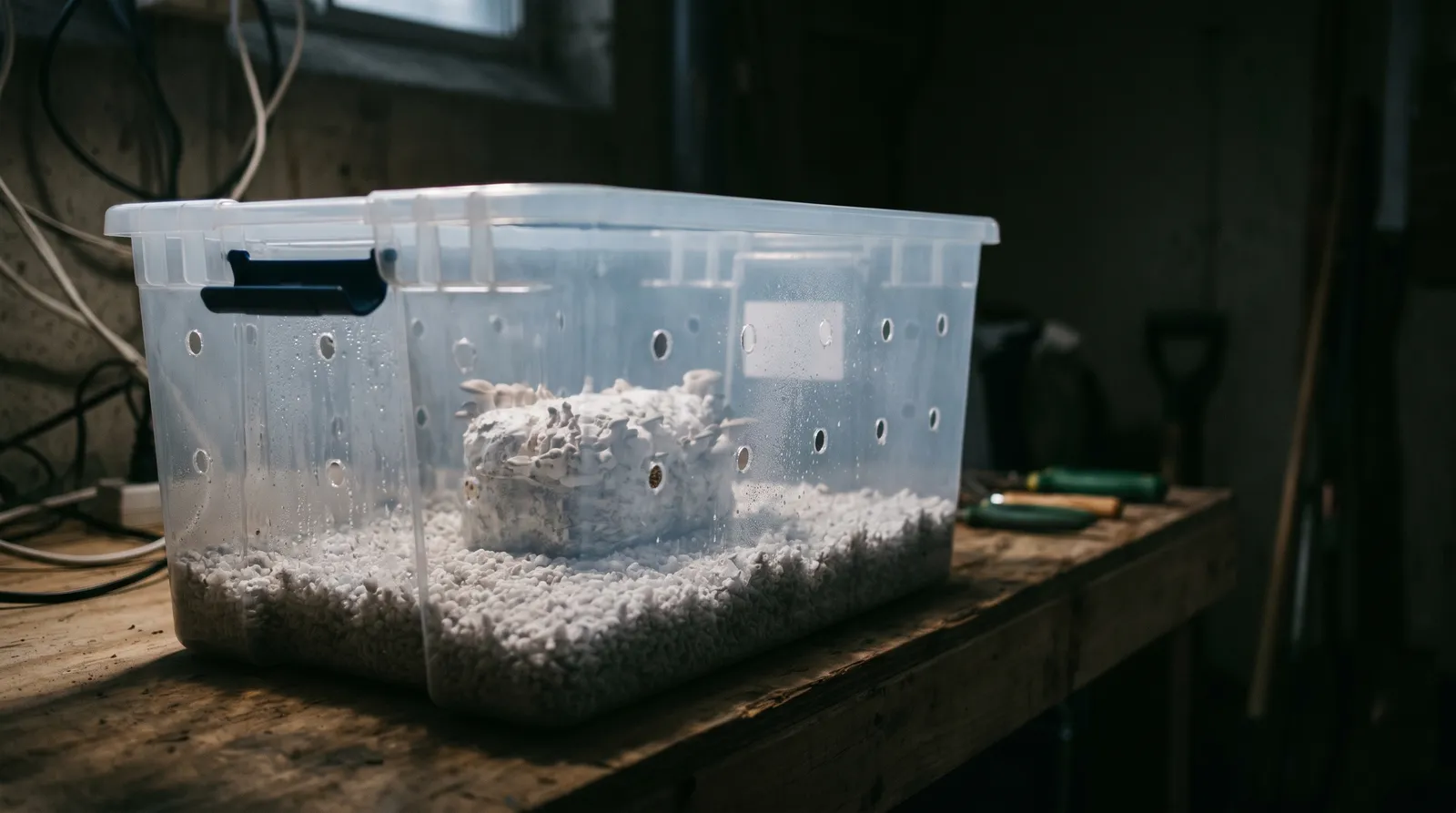
If you're running a larger grow tent (60×60 or bigger) and ambient drops below 40% RH — common in European winters with central heating — then yes, a small ultrasonic humidifier on a humidistat earns its keep. Set the humidistat to cycle at 88%, not 95%, or you'll end up with standing water on the cap surfaces, and that's where bacterial blotch (Pseudomonas tolaasii) lives.
Step 4: Fresh air exchange — the step everyone skips
Cubensis needs CO₂ below ~1000 ppm to form normal fruits. Above that, you get long stems, tiny caps, and aborts. Fanning a Grow Kit's bag 2–4 times a day, or cracking a tent's passive intake while running a small clip fan on low, is usually enough.
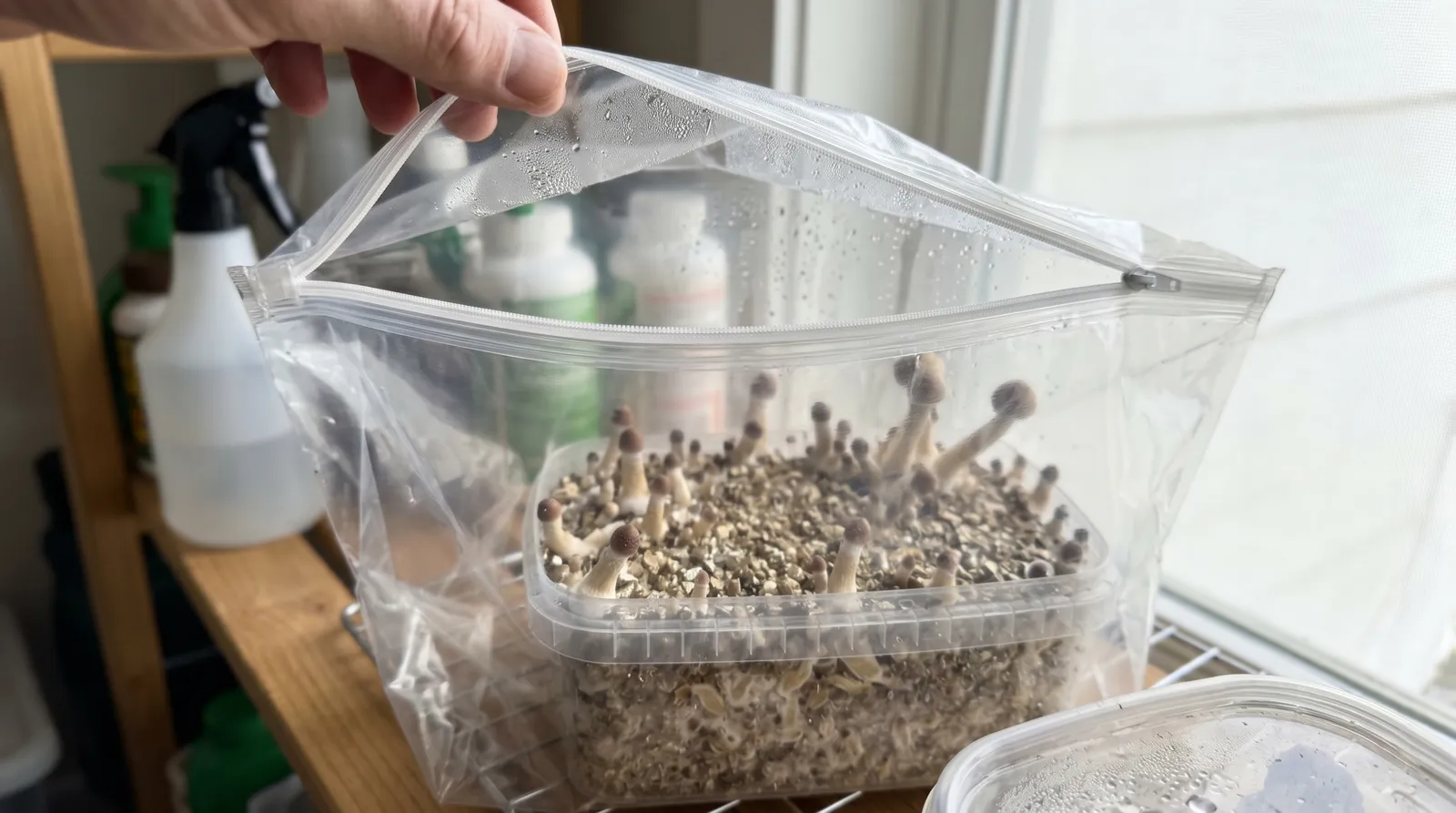
Humidity and FAE fight each other — every air swap drops RH by 10–20%. This is the single biggest reason beginners lose fruits. The workflow: mist the chamber walls (never the fruits directly), fan it out for 30 seconds, close it up. Repeat every 12 hours during fruiting.
Step 5: Watch for the contamination that climate kits cause
A humid, warm chamber is also ideal for everything you don't want. The three you'll actually see:
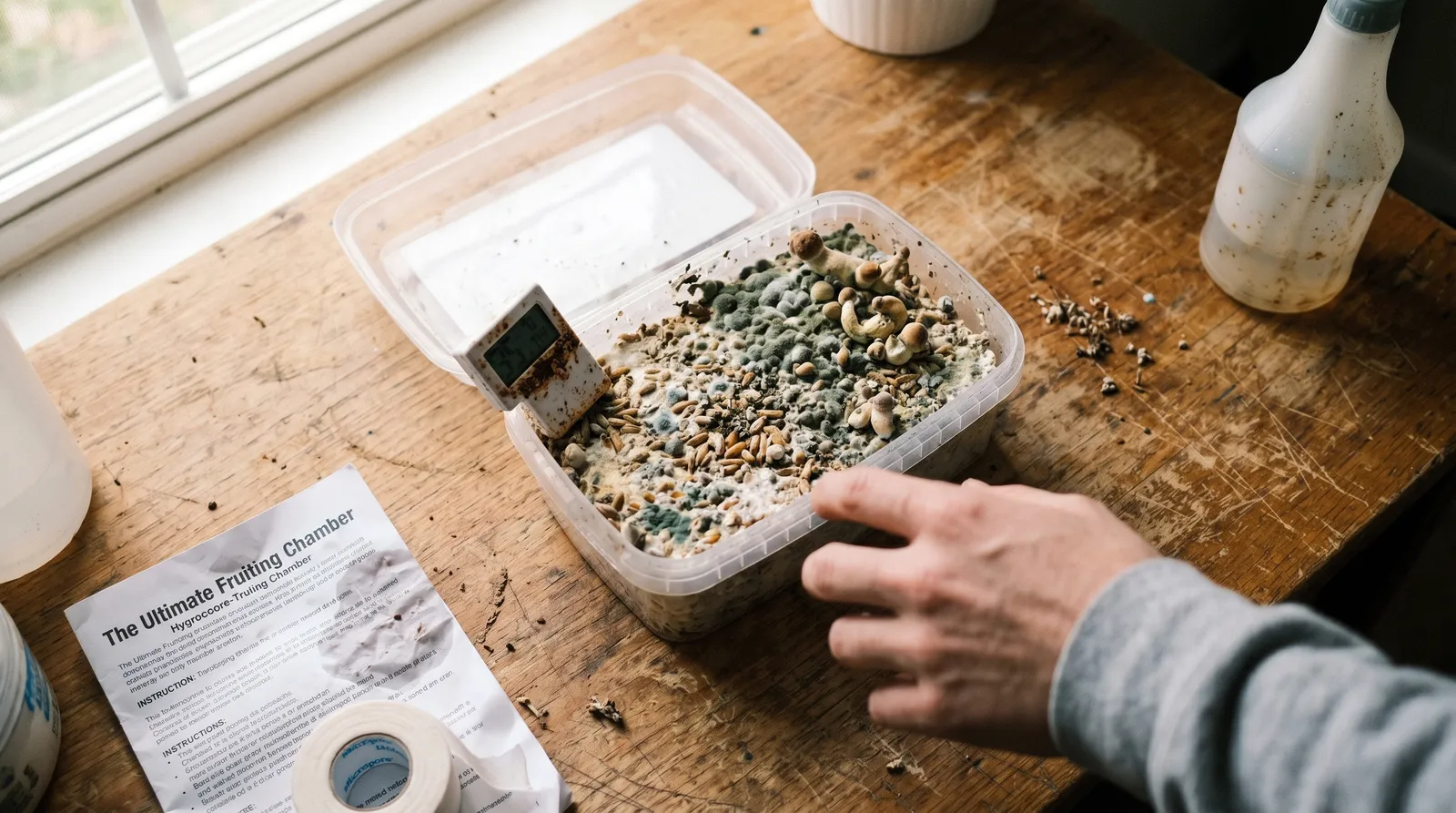
- Cobweb mould (Cladobotryum) — grey, fluffy, fast-moving, looks like actual spiderweb across the casing. Grows above 90% RH with poor FAE. Increase air exchange, spot-treat with a 3% hydrogen peroxide mist on the affected patch.
- Trichoderma (green mould) — starts white, turns forest green from the centre out. Too warm, too wet, contaminated tools. No saving it — bag the kit, bin it, bleach the tub.
- Bacterial blotch — yellow-brown wet patches on cap surfaces. Direct misting onto fruits. Stop misting fruits; only mist chamber walls.
A climate kit stabilises conditions; it does not rescue a weak inoculation, a bad casing mix, or a contaminated Grow Kit. We've watched people order every gadget on the shelf and still lose flushes because the underlying tub was already compromised. Fix the biology first, then dial in the climate — not the other way round.
A note on sclerotia
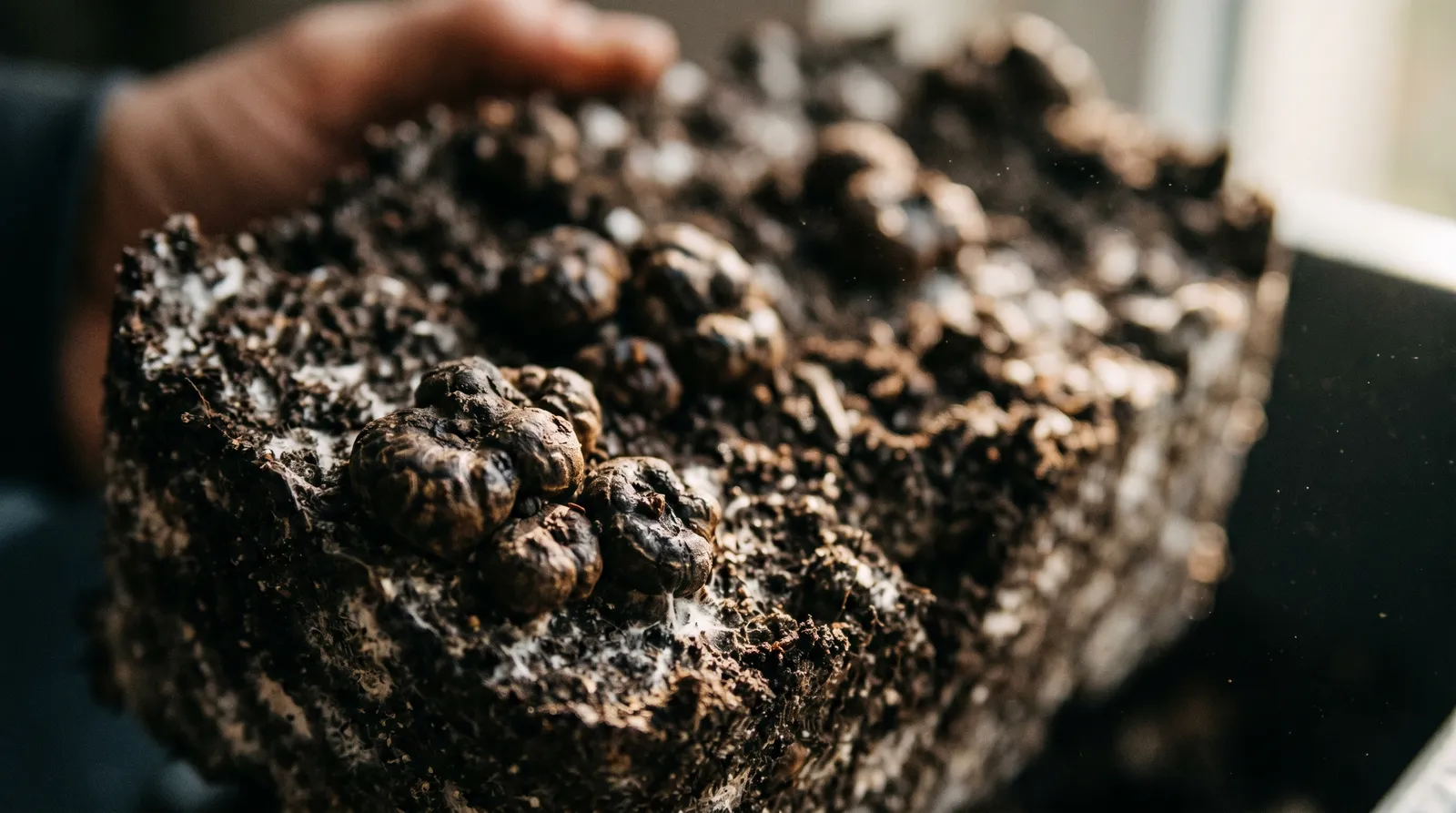
If you want to get truffles — Atlantis, Tampanensis, Hollandia, Pajaritos, any of the Azarius range or third-party bags like Dragon's Dynamite — skip this whole kit. Sclerotia form underground inside a sealed, humid bag over 8–14 weeks at normal room temperature (20–22 °C is fine). No FAE, no misting, no heat mat. Just leave the bag somewhere dark and vaguely warm. The climate control conversation is a fruiting-body conversation.
The minimal kit, realistically
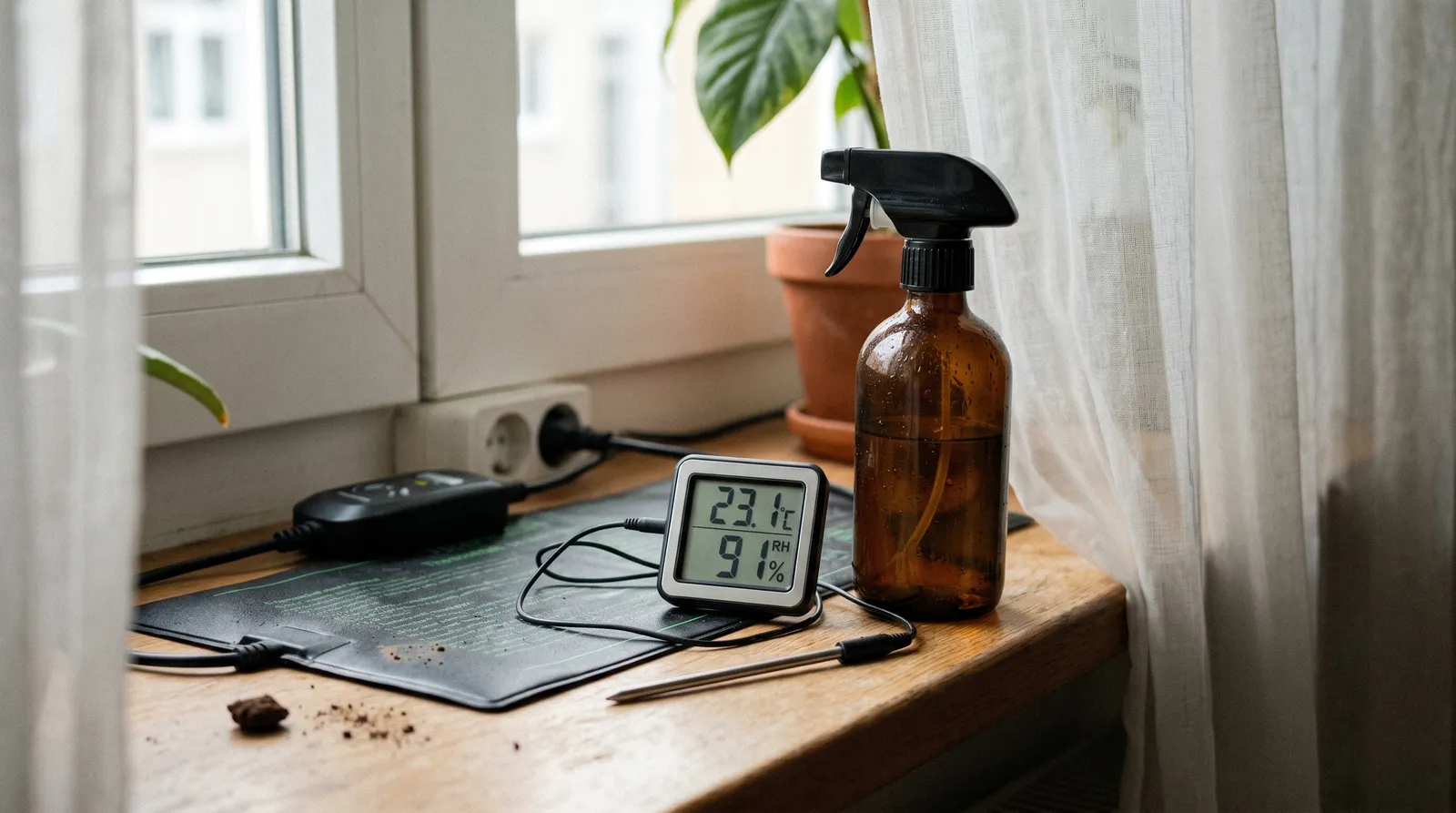
Buy three things and stop: a probe hygrometer, a spray bottle, and — if the room runs cold — a thermostat-controlled heat mat. For a single Grow Kit or R2G Bag in a normal European living room, you need: a probe hygrometer-thermometer, a spray bottle with dechlorinated water, and — if the room sits under 20 °C — a heat mat with an inline thermostat. That's it. Total spend sits around 30–50 EUR and it covers you through 3–4 kits' worth of flushes. The fancier setup (tent, humidifier, inline fan, CO₂ meter) only starts paying back when you're running multiple tubs at once — and honestly, compared to a shotgun tub plus perlite, the ROI on a full tent is marginal for a single kit.
Harm reduction note: This guide is provided for educational purposes to adults interested in home mycology. Psilocybin-containing mushrooms can interact with mental health conditions, SSRIs, and lithium; start low, go slow, and never combine with driving or operating machinery. The EMCDDA (European Monitoring Centre for Drugs and Drug Addiction) maintains current harm-reduction resources on psilocybin mushrooms, and the Beckley Foundation publishes peer-reviewed research on safer use. If you or someone you know is struggling, contact a local harm-reduction service.
See also on the Azarius wiki: Grow Kit care basics, Ready-2-Grow Bag walkthrough, Magic truffle storage, Contamination identification guide, Dosage and harm reduction for psilocybin.
Last updated: April 2026
Frequently Asked Questions
8 questionsWhat temperature and humidity do Psilocybe cubensis fruits actually need?
Do I actually need a humidifier, or is perlite enough?
Why are my mushrooms aborting before they form caps?
Can I use a reptile heat lamp or radiator to warm my grow?
How accurate does my hygrometer need to be?
Does a climate kit help with magic truffle cultivation?
How often should I mist my mushroom fruiting chamber?
What is the salt test and how do I calibrate my hygrometer with it?
About this article


Adam Parsons is an external cannabis and psychedelics writer and editor who contributes to Azarius's wiki as both author and reviewer. On the writing side, he authors Azarius's kratom and kanna clusters, drawing on exten
This wiki article was drafted with AI assistance and reviewed by Adam Parsons, External contributor. Editorial oversight by Joshua Askew.
Medical disclaimer. This content is for informational purposes only and does not constitute medical advice. Consult a qualified healthcare provider before use of any substance.
Last reviewed April 25, 2026
References (1)
- [1]Greenspan, L. (1977). Humidity fixed points of binary saturated aqueous solutions. Journal of Research of the National Bureau of Standards, 81A(1), 89-96. DOI: 10.6028/jres.081A.011
Related Articles
Cannabis Hermaphrodite: Identify, Prevent, Act
A cannabis hermaphrodite is a female plant that develops male pollen sacs or banana-shaped anthers (nanners), self-pollinating and seeding your harvest.
DIY Cannabis Fertilizer: Homemade Nutrient Guide
DIY cannabis fertilizer guide: compost, teas, banana ferments and feed schedules, with safety notes and cited research for home growers.
What To Do With Male Cannabis Plants: 6 Practical Uses
What to do with male cannabis plants: identify, isolate, breed, extract, or compost. A practical 6-step guide with sourcing and safety notes.
When to Harvest Mushrooms: Veil Break Timing Explained
Harvest timing veil break is a cultivation technique that uses the tearing of the partial veil on maturing Psilocybe cubensis to mark peak alkaloid content.
First Grow Checklist: What You Need for Mushroom Kits
A first grow checklist is the short list of supplies and environmental conditions needed to run a home psilocybin mushroom kit from inoculated substrate to…
Sclerotia vs Fruit Bodies: Cultivation Comparison
Sclerotia and fruit bodies are two different life stages of Psilocybe fungi: sclerotia are hardened underground mycelial storage bodies (the 'magic…
Storing Dried Mushrooms Long Term: Full Guide
Storing dried mushrooms long term means keeping well-dried Psilocybe fruit bodies in airtight, opaque containers with desiccant, cool and dark, to slow…
Drying Mushrooms Air Desiccant Oven: Methods Compared
Drying mushrooms air desiccant oven refers to the three home methods for reducing fresh fruit bodies from ~90% water to cracker-dry (<5%). Gotvaldová et al.
Grow Kit vs Ready 2 Grow Bag: Which to Pick
The grow kit vs Ready 2 Grow Bag choice compares two Psilocybe cubensis home-cultivation formats: a tub with rye substrate and casing layer designed for…