
This article discusses psychoactive substances intended for adults (18+). If you have a health condition or take medication, consult a doctor before use. Our age policy
Misting Schedule & Fresh Air Exchange: Grow Kit Guide
Definition
A misting schedule fresh air exchange routine is a daily fruiting protocol that controls the two variables making grow kits work: surface humidity and CO₂ levels. For Psilocybe cubensis, the target is 90–95% RH during pinning and CO₂ below ~1,000 ppm, adjusted by reading the casing rather than the clock (Stamets, 2000).
A misting schedule fresh air exchange routine is a daily fruiting protocol that keeps surface humidity high and CO₂ low so colonised substrate turns into mushrooms. This guide is written for adult home growers working with grow kits they buy or order from specialist shops like Azarius.
What misting and FAE actually do
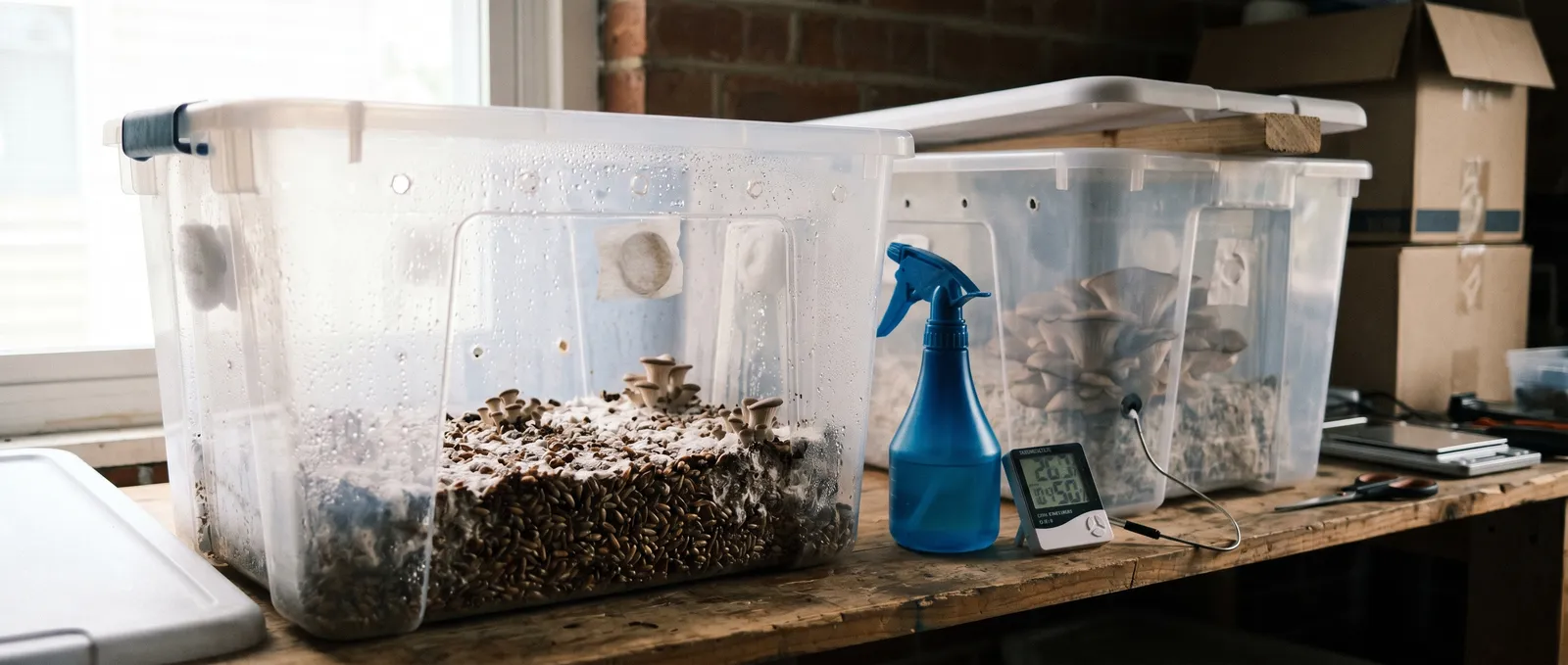
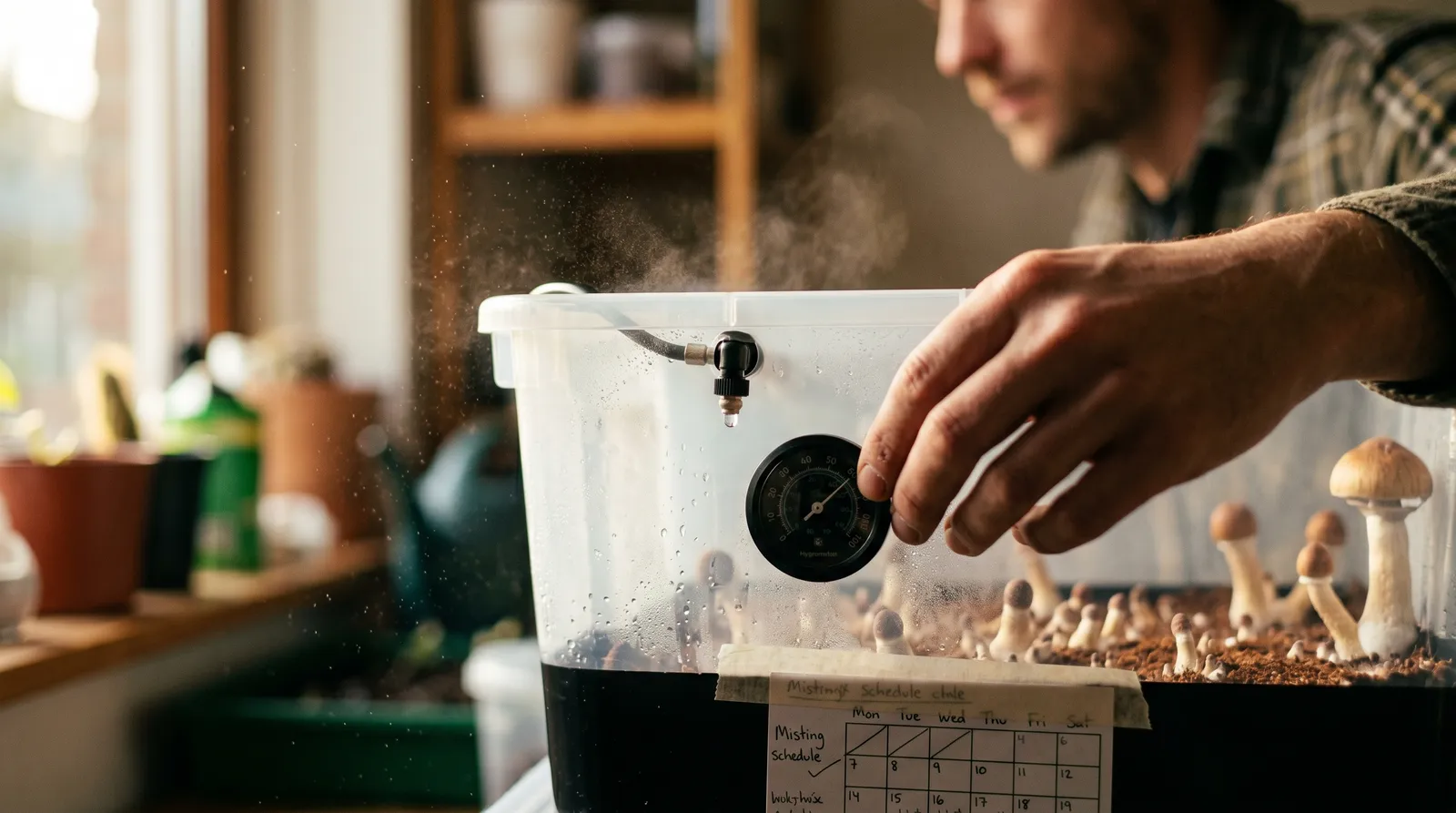
Misting and fresh air exchange (FAE) are the two environmental levers you pull during fruiting to turn colonised substrate into mushrooms. Misting keeps the casing surface and pin set from drying out; FAE flushes out the CO₂ that mycelium exhales and triggers the fruiting response. Get the balance wrong and you get one of two classic failure modes: long wispy stems with tiny caps (too much CO₂, not enough FAE) or aborts and dry, matte pins that never develop (too little humidity, or misting too aggressively onto young pins).
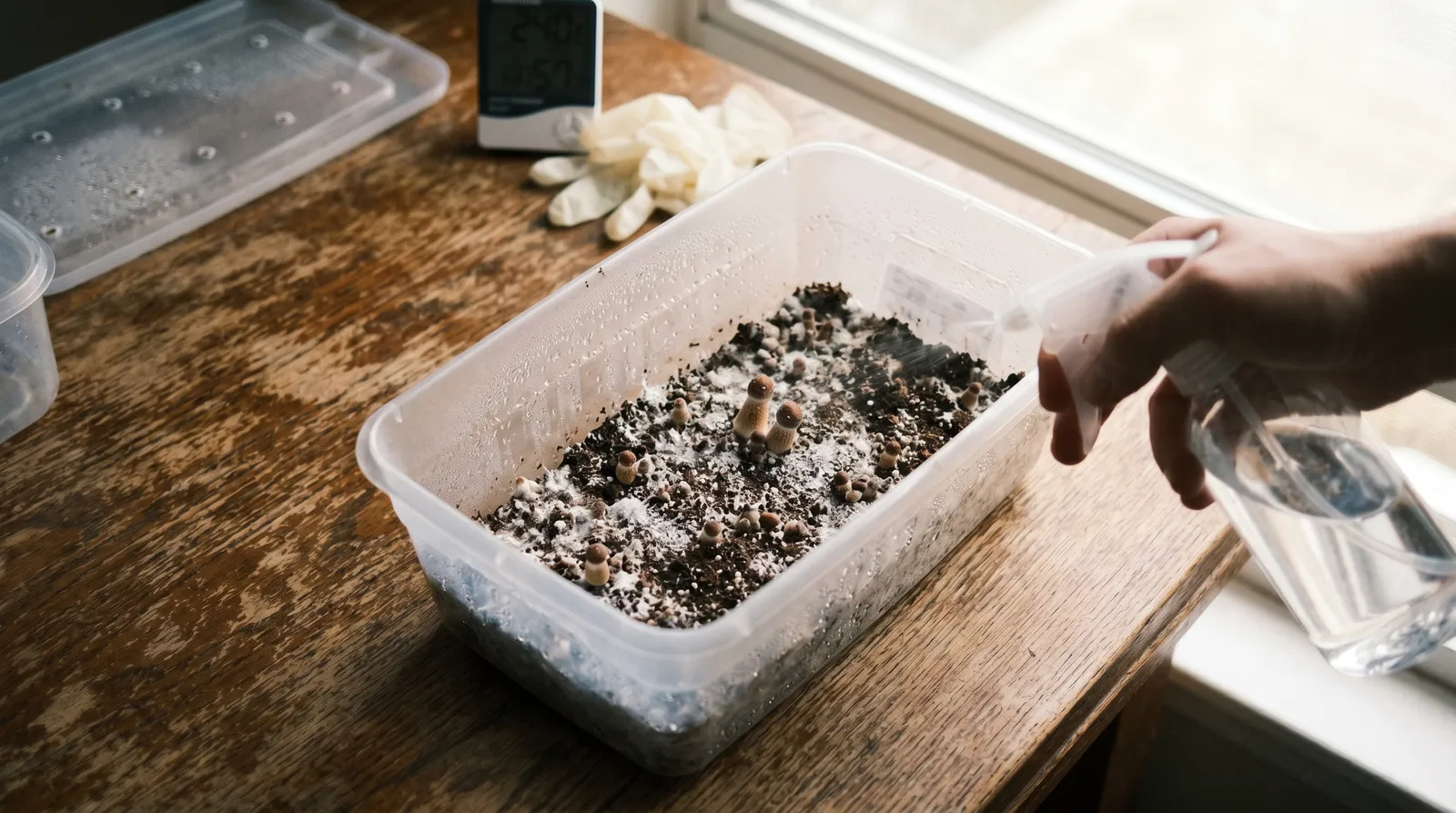
The goal isn't "moist and warm." The numbers matter. Psilocybe cubensis fruits best at 22–24 °C surface temperature, 90–95% relative humidity during pinning, 85–92% during fruit development, and CO₂ below roughly 1,000 ppm once primordia have formed (Stamets, 2000). Your misting schedule fresh air exchange routine exists to hit those numbers — nothing more, nothing less.
Step 1: Read the substrate before you mist
Check the casing surface before every misting — that single habit prevents most beginner failures. If the perlite/vermiculite surface is still visibly wet — dark, glistening, with standing droplets on the bag walls — skip the mist. If the casing has gone pale and matte, or the bag walls are dry and clear, it's time. A healthy fruiting surface looks damp but not soaked: small condensation beads on the bag wall, perlite that reads mid-grey rather than white.
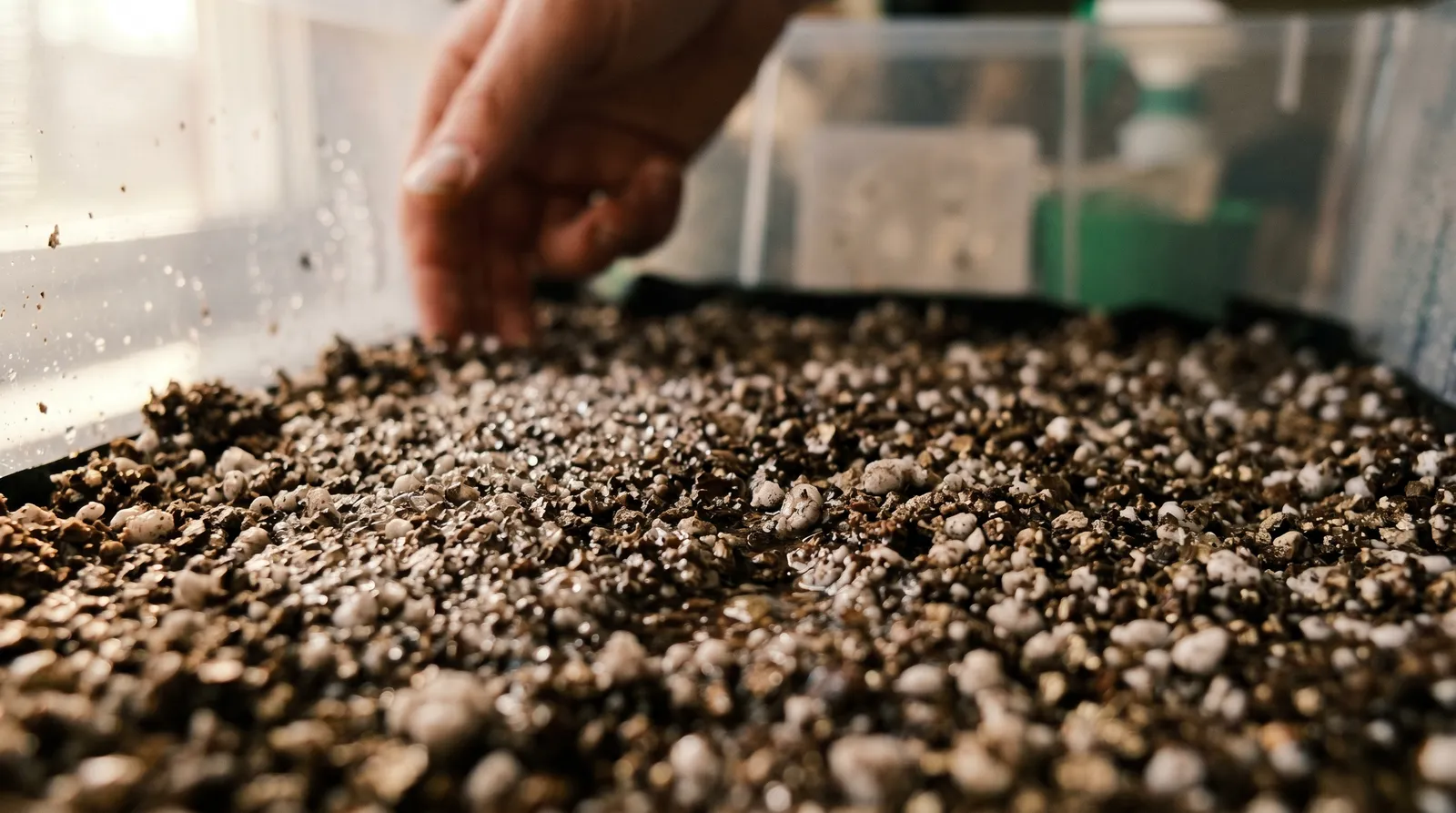
This matters because the "mist twice a day" advice in generic guides assumes a room climate you probably don't have. A living room at 21 °C and 45% ambient humidity loses surface moisture much faster than a tiled bathroom at 60%. Read the kit, don't read the clock.
Step 2: The baseline schedule for a plastic-tub Grow Kit
A workable daily rhythm for any standard plastic-tub kit is one structured mist-and-fan in the morning plus a visual check in the evening. For an Azarius Grow Kit (fully colonised rye-grain substrate with perlite/vermiculite casing in a microporous filter bag — Golden Teacher, McKennaii, B+, Cambodia, Mazatapec, Mexican, PES Amazonian, Treasure Coast), it looks like this:
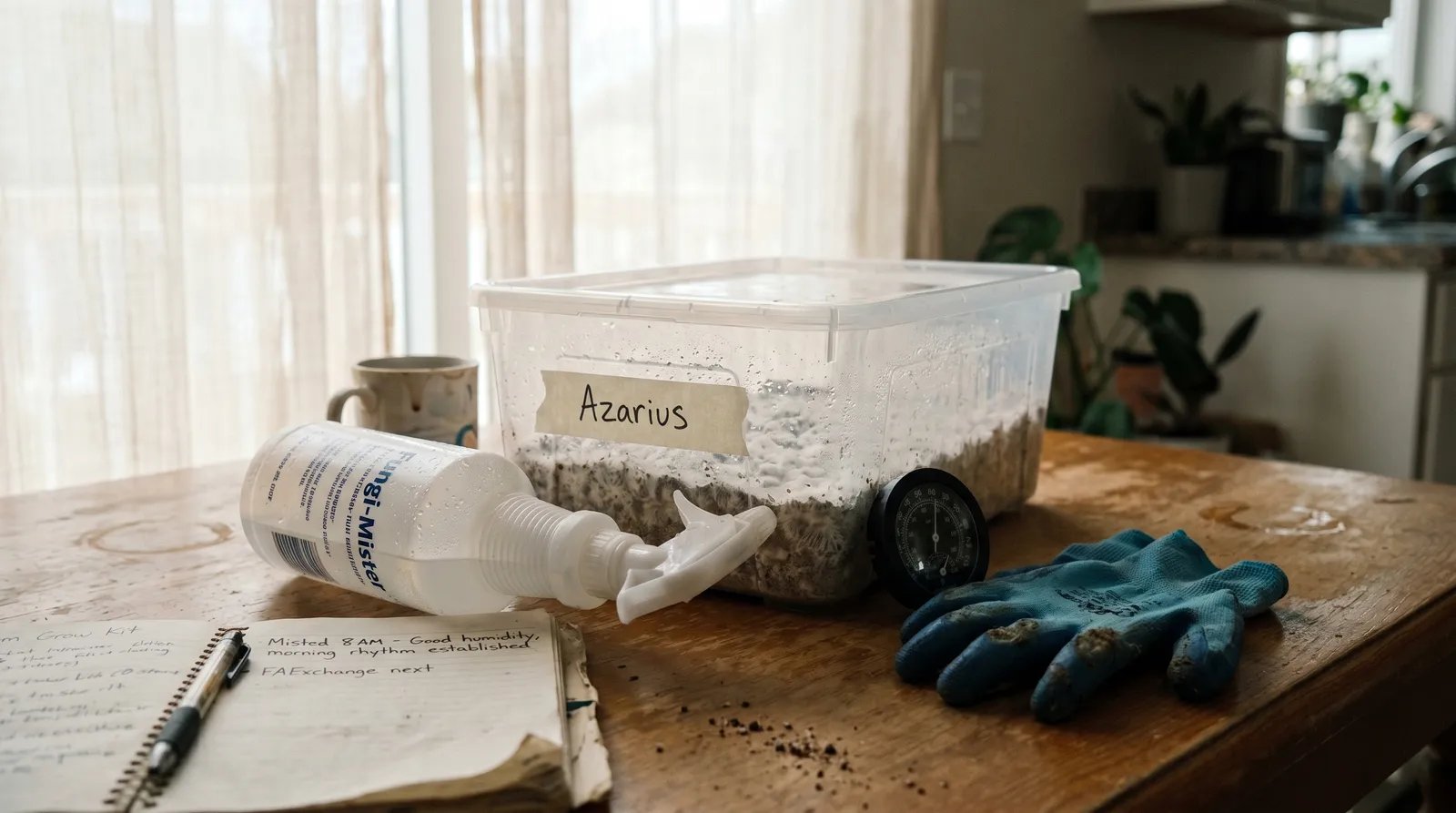
- Morning (once daily): Open the bag, lift the kit out of the bag if casing looks dry, mist the inside walls of the bag with 4–6 sprays of bottled spring water or cooled boiled water. Do not spray directly onto pins or young fruits once they're past the primordia stage — droplets sitting on caps cause bruising and bacterial blotch.
- Fan the bag: With the bag opened, wave it gently for 20–30 seconds to force stale, CO₂-heavy air out and pull fresh air in. Three or four full exchanges of the bag's internal air volume is plenty.
- Reseal: Fold the top over twice and clip with the included paperclips. The microporous filter does slow passive gas exchange, which is why active FAE still matters.
- Evening check: Look only. Only mist a second time if the casing has visibly dried — usually only needed in very dry rooms or under strong heating in winter.
That's it. One structured FAE + mist per day, plus a read-and-react evening check. More is not better.
Step 3: Adjust the schedule to what you're seeing
The baseline is a starting point — adjust based on what the kit tells you, not a fixed timer:
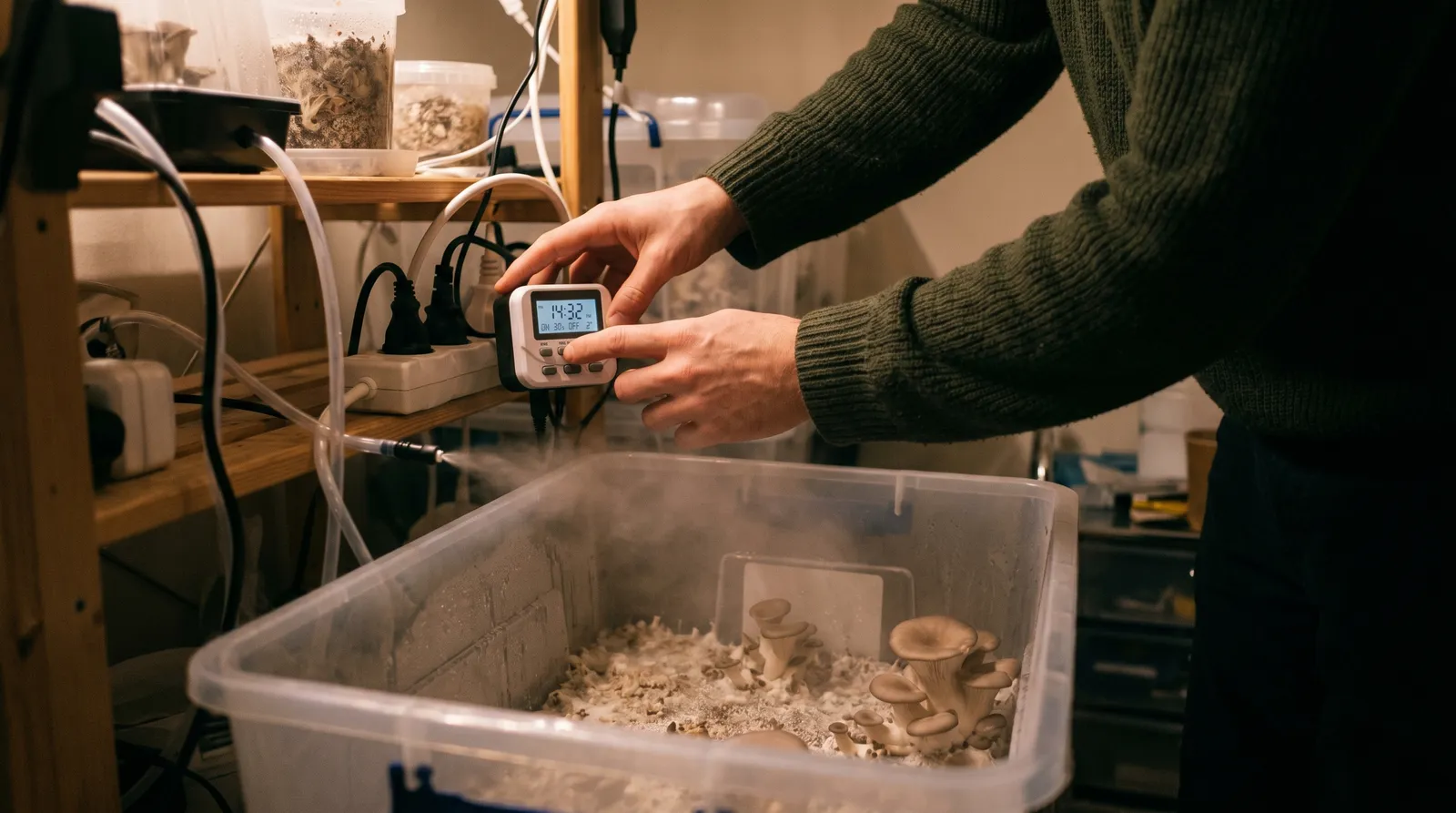
- Long, leggy stems with pinhead caps: Classic low-FAE morphology. CO₂ is accumulating. Fan longer (45–60 seconds), twice a day, and mist less aggressively. A 2003 study on Agaricus bisporus fruiting dynamics showed stem elongation correlates directly with CO₂ concentrations above ~2,000 ppm, and cubensis responds similarly (Noble et al., 2003).
- Aborts (small fruits turning blue-black and stalling): Usually humidity shock — either from over-fanning (drying the surface) or from a sharp temperature swing. Reduce fan time, check your room temperature stability.
- Dry, matte casing, pins slow to form: Mist the bag walls more generously but still not the substrate directly. Add a second mist in the evening. Consider a humidity tent (clear plastic storage box inverted over the kit with a damp towel at the base).
- Waterlogged casing, yellow metabolite puddles: Stop misting for 24–48 hours. Open the bag and fan for 60 seconds to dry the surface. Yellow "mycelium sweat" isn't contamination, but standing water is an invitation to bacterial wet rot.
Step 4: Handle Ready-2-Grow Bags differently
Ready-2-Grow bags use a sealed filter-patch design and need far less active handling than plastic-tub kits. The R2G format (APE, Enigma, Golden Teacher R2G, Hillbilly Pumpkin, Jack Rabbit, Jedi Mind Fuck, Makilla Gorilla, McKennaii R2G, MVP) is a 2 kg all-in-one bag with its own filter patch, and the misting/FAE logic shifts.
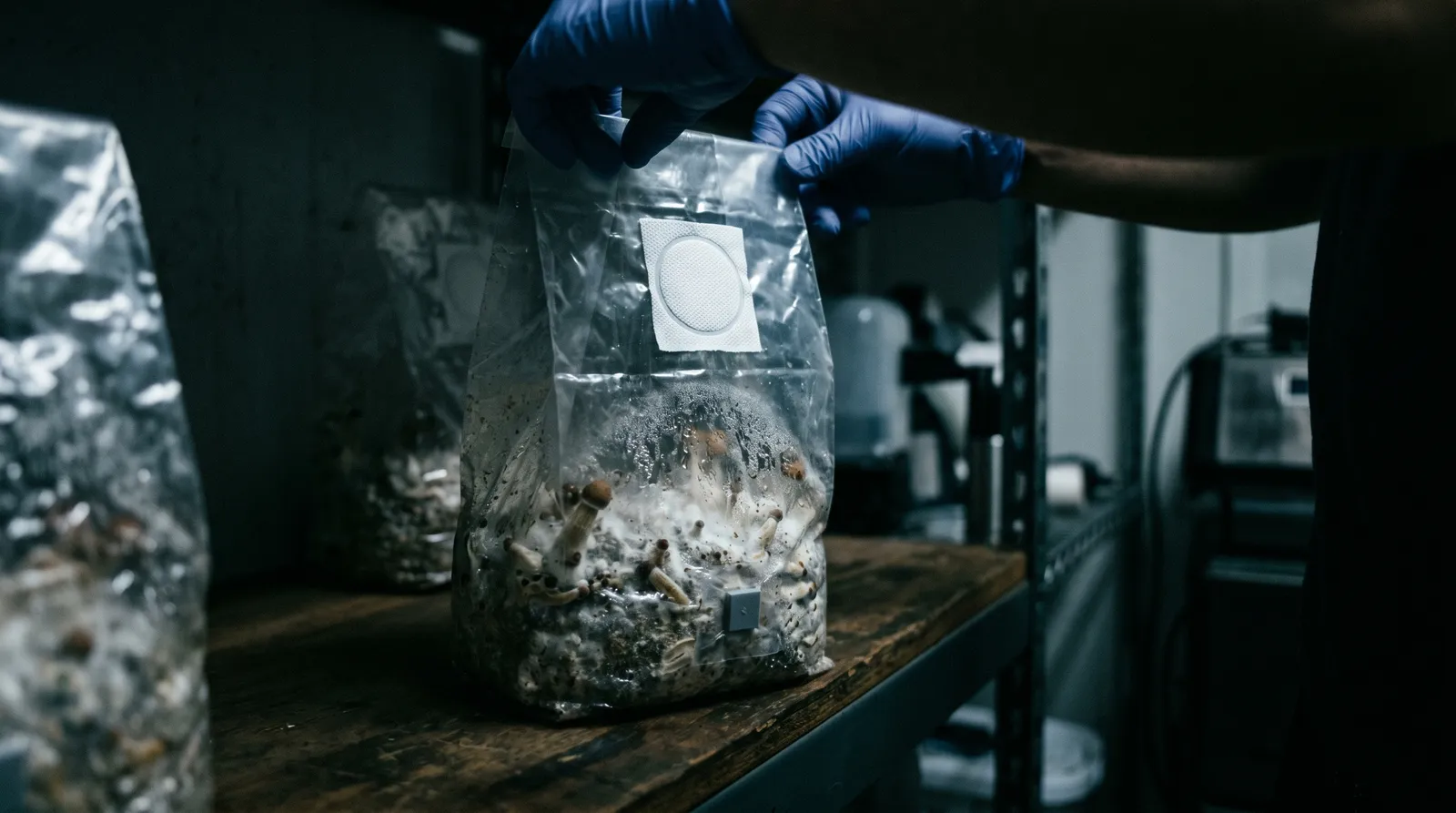
You don't open an R2G bag for daily misting — the bag is designed to hold its own microclimate through the filter patch. FAE happens passively through that patch; active fanning is reserved for once the cut is made and pinning is triggered. Follow the supplied instructions for the cut-and-fold step, then mist only if the interior bag surface looks dry when you check. Over-misting an R2G is the more common failure mode than under-misting.
Step 5: Water quality and spray technique
Use bottled spring water or tap water that's been boiled for five minutes and cooled. Chlorinated tap water straight from the tap can suppress pinning on sensitive strains; heavily chlorinated water (common in parts of Germany, France, and the UK) is worth boiling off for 5 minutes before use.
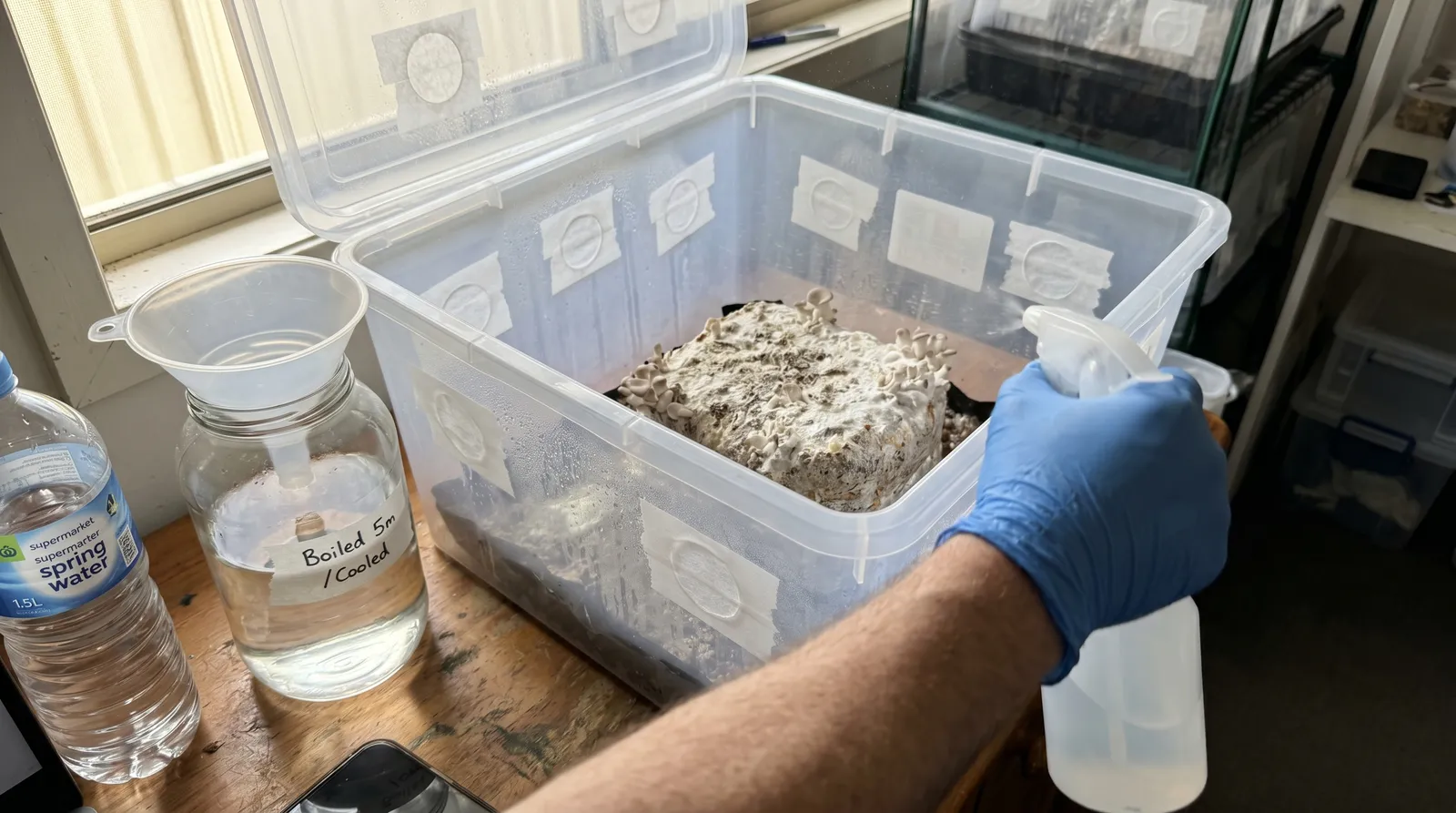
The sprayer matters more than people think. A fine mist-head from a garden centre produces tiny droplets that settle on bag walls as a light fog. A trigger sprayer set to "jet" produces big droplets that sit on fruit caps and cause bacterial blotch (Pseudomonas tolaasii) within 48 hours — brown sunken spots, usually mistaken for bruising (Beyer, 2003). If you need to order one, get a plant-mister with an adjustable nozzle rather than a kitchen spray bottle. Mist the bag walls, not the mushrooms.
No written schedule beats a hygrometer and a week of watching your own kit. Rooms vary enormously, and every grower we've spoken to ends up tweaking the baseline. Treat the numbers here as a starting calibration, not gospel — the EMCDDA and harm-reduction resources like MAPS consistently emphasise that cultivation outcomes depend heavily on individual environment.
Step 6: Between flushes — the dunk and rest
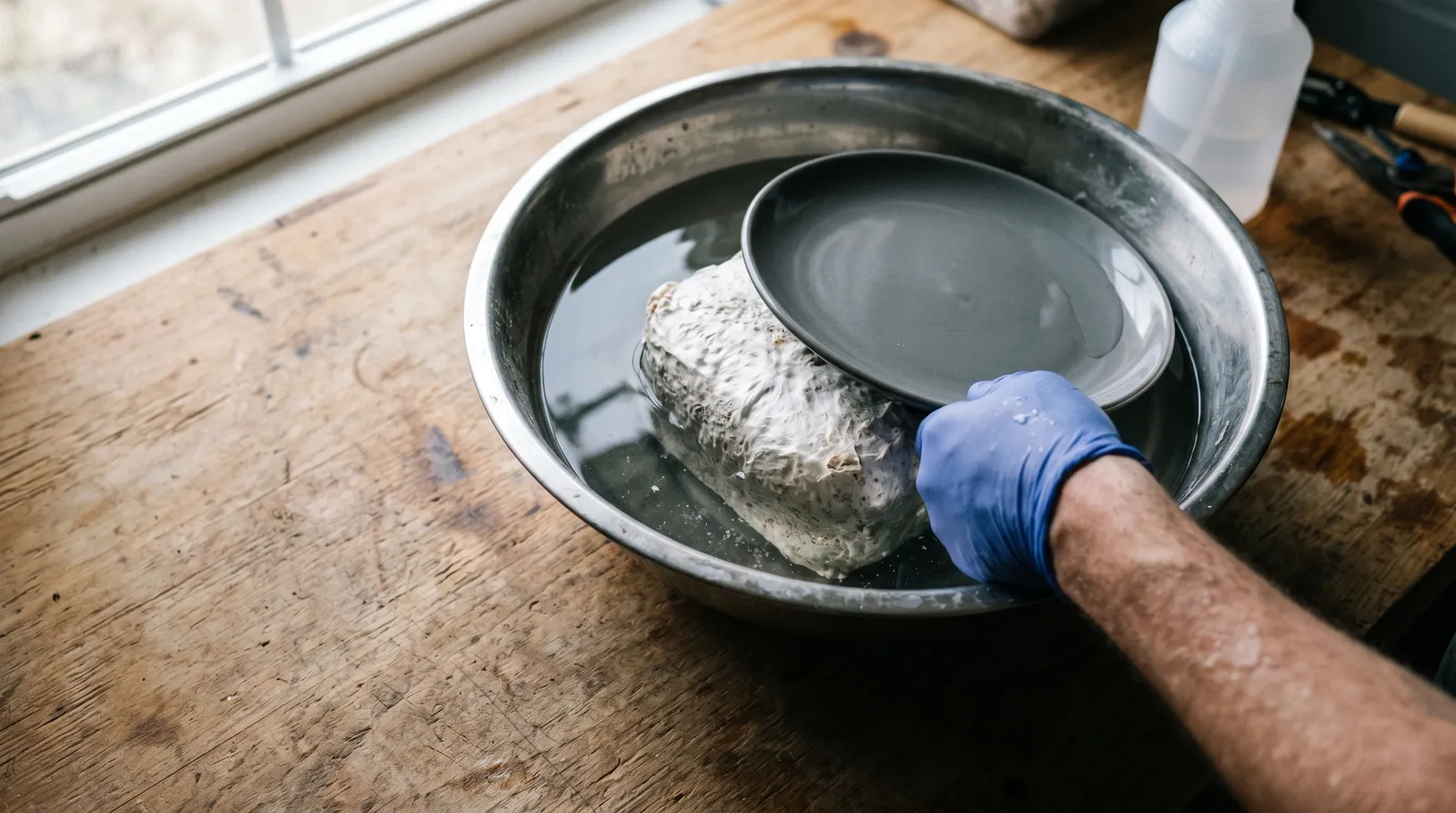
Misting and FAE needs change between flushes. After harvesting the first flush, a cold-water dunk (submerge the cake in chilled 4–10 °C water for 12 hours, weighted down) rehydrates the substrate. Drain fully, put it back in the bag, and return to the daily mist-and-fan rhythm. Flushes typically come 7–14 days apart; a Grow Kit that produced well on flush one can reasonably be expected to deliver two or three further flushes with diminishing yields.
Dry-weight yields across strains vary widely — published figures for cubensis home kits typically land in the 20–40 g dry total range across all flushes, though this depends heavily on strain, room conditions, and how disciplined the misting/FAE cycle was (Stamets, 2000).
Quick troubleshooting reference
| Symptom | Likely cause | Fix |
|---|---|---|
| Long stems, tiny caps | Low FAE, high CO₂ | Fan longer, twice daily |
| Brown spots on caps | Direct misting + bacterial blotch | Mist walls only, finer sprayer |
| Pins aborting, dry surface | Humidity too low | Mist more, reduce fan duration |
| Yellow puddles on casing | Over-misting metabolite pooling | Stop misting 24–48h, fan longer |
| Green patches in substrate | Trichoderma mould contamination | Dispose of kit, do not salvage |
| Wet, slimy, foul smell | Bacterial wet rot | Dispose of kit, sterilise area |
On interactions: consumption of harvested mushrooms is out of scope here, but note that psilocybin has significant interactions with MAOIs, SSRIs, and lithium — see the dedicated psilocybin interactions article before consuming any harvest.
Disclaimer: This article is educational only and does not constitute medical, professional, or personalised advice. Psilocybin has significant interactions with MAOIs, SSRIs, and lithium. If you have a medical condition, take prescription medication, or are pregnant or breastfeeding, consult a qualified healthcare professional before consuming any harvested material. Azarius does not provide medical guidance.
Last updated: April 2026
Frequently Asked Questions
8 questionsHow often should I mist a mushroom grow kit?
How long should I fan the bag for fresh air exchange?
Should I mist directly onto the mushrooms?
What water should I use for misting?
Why are my mushrooms growing long stems with tiny caps?
Do Ready-2-Grow Bags need the same misting schedule?
What temperature and humidity levels are ideal during fruiting?
Can I over-mist my grow kit and what happens if I do?
About this article


Adam Parsons is an external cannabis and psychedelics writer and editor who contributes to Azarius's wiki as both author and reviewer. On the writing side, he authors Azarius's kratom and kanna clusters, drawing on exten
This wiki article was drafted with AI assistance and reviewed by Adam Parsons, External contributor. Editorial oversight by Joshua Askew.
Medical disclaimer. This content is for informational purposes only and does not constitute medical advice. Consult a qualified healthcare provider before use of any substance.
Last reviewed April 25, 2026
References (3)
- [1]Stamets, P. (2000). Growing Gourmet and Medicinal Mushrooms (3rd ed.). Ten Speed Press, Berkeley, CA. Source
- [2]Noble, R., Dobrovin-Pennington, A., Hobbs, P. J., Pederby, J., & Rodger, A. (2003). Volatile C8 compounds and pseudomonads influence primordium formation of Agaricus bisporus. Mycologia, 95(4), 551-559. DOI: 10.1080/15572536.2004.11833063
- [3]Beyer, D. M. (2003). Basic Procedures for Agaricus Mushroom Growing. Penn State College of Agricultural Sciences Extension Bulletin. Source
Related Articles
Cannabis Hermaphrodite: Identify, Prevent, Act
A cannabis hermaphrodite is a female plant that develops male pollen sacs or banana-shaped anthers (nanners), self-pollinating and seeding your harvest.
DIY Cannabis Fertilizer: Homemade Nutrient Guide
DIY cannabis fertilizer guide: compost, teas, banana ferments and feed schedules, with safety notes and cited research for home growers.
What To Do With Male Cannabis Plants: 6 Practical Uses
What to do with male cannabis plants: identify, isolate, breed, extract, or compost. A practical 6-step guide with sourcing and safety notes.
Mushroom Grow Kit Temperature & Humidity: Full Setup Guide
A temperature humidity control grow kit is the small set of climate tools — hygrometer, heat mat, humidifier or perlite tray — that keeps a mushroom fruiting…
When to Harvest Mushrooms: Veil Break Timing Explained
Harvest timing veil break is a cultivation technique that uses the tearing of the partial veil on maturing Psilocybe cubensis to mark peak alkaloid content.
First Grow Checklist: What You Need for Mushroom Kits
A first grow checklist is the short list of supplies and environmental conditions needed to run a home psilocybin mushroom kit from inoculated substrate to…
Sclerotia vs Fruit Bodies: Cultivation Comparison
Sclerotia and fruit bodies are two different life stages of Psilocybe fungi: sclerotia are hardened underground mycelial storage bodies (the 'magic…
Storing Dried Mushrooms Long Term: Full Guide
Storing dried mushrooms long term means keeping well-dried Psilocybe fruit bodies in airtight, opaque containers with desiccant, cool and dark, to slow…
Drying Mushrooms Air Desiccant Oven: Methods Compared
Drying mushrooms air desiccant oven refers to the three home methods for reducing fresh fruit bodies from ~90% water to cracker-dry (<5%). Gotvaldová et al.