
This article discusses psychoactive substances intended for adults (18+). If you have a health condition or take medication, consult a doctor before use. Our age policy
First Grow Checklist: What You Need for Mushroom Kits
Definition
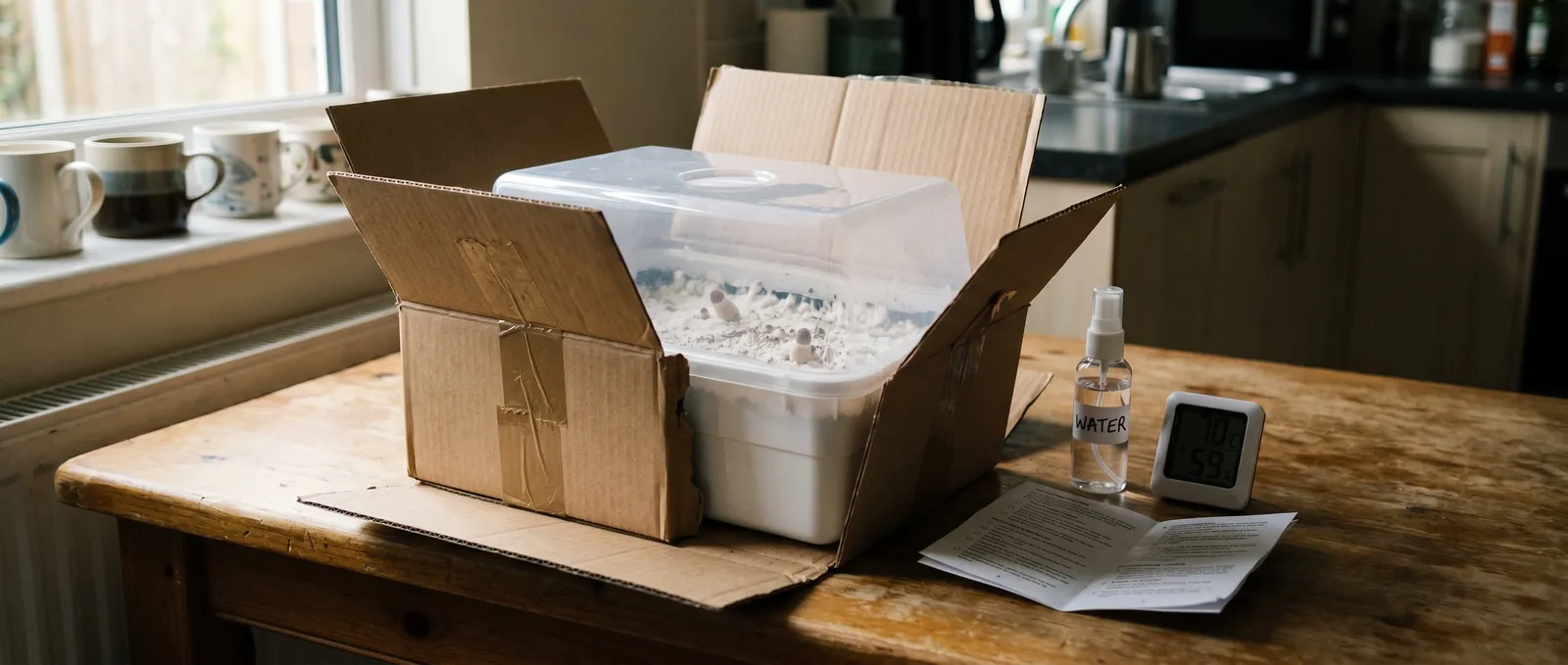
A first grow checklist is the short list of supplies and environmental conditions needed to run a home psilocybin mushroom kit from inoculated substrate to first flush, typically 14–21 days (Stamets, 2000). It covers kit format, sterile handling tools, temperature and humidity targets, and contamination identification.
A first grow checklist is a pre-flight list that gets a home psilocybin mushroom kit from sealed box to first flush in 14–21 days. Starting your first mushroom grow is mostly about not skipping the boring bits. The kit does the hard work — your job is to give it clean hands, the right temperature, and a bit of patience. This guide is written for adults who buy a kit and want to get it right the first time. The checklist below covers what actually matters in a living-room cupboard setup, drawn from a quarter-century of European home growers walking through our shop door with the same questions.
Step 1 — Pick a kit that matches your patience
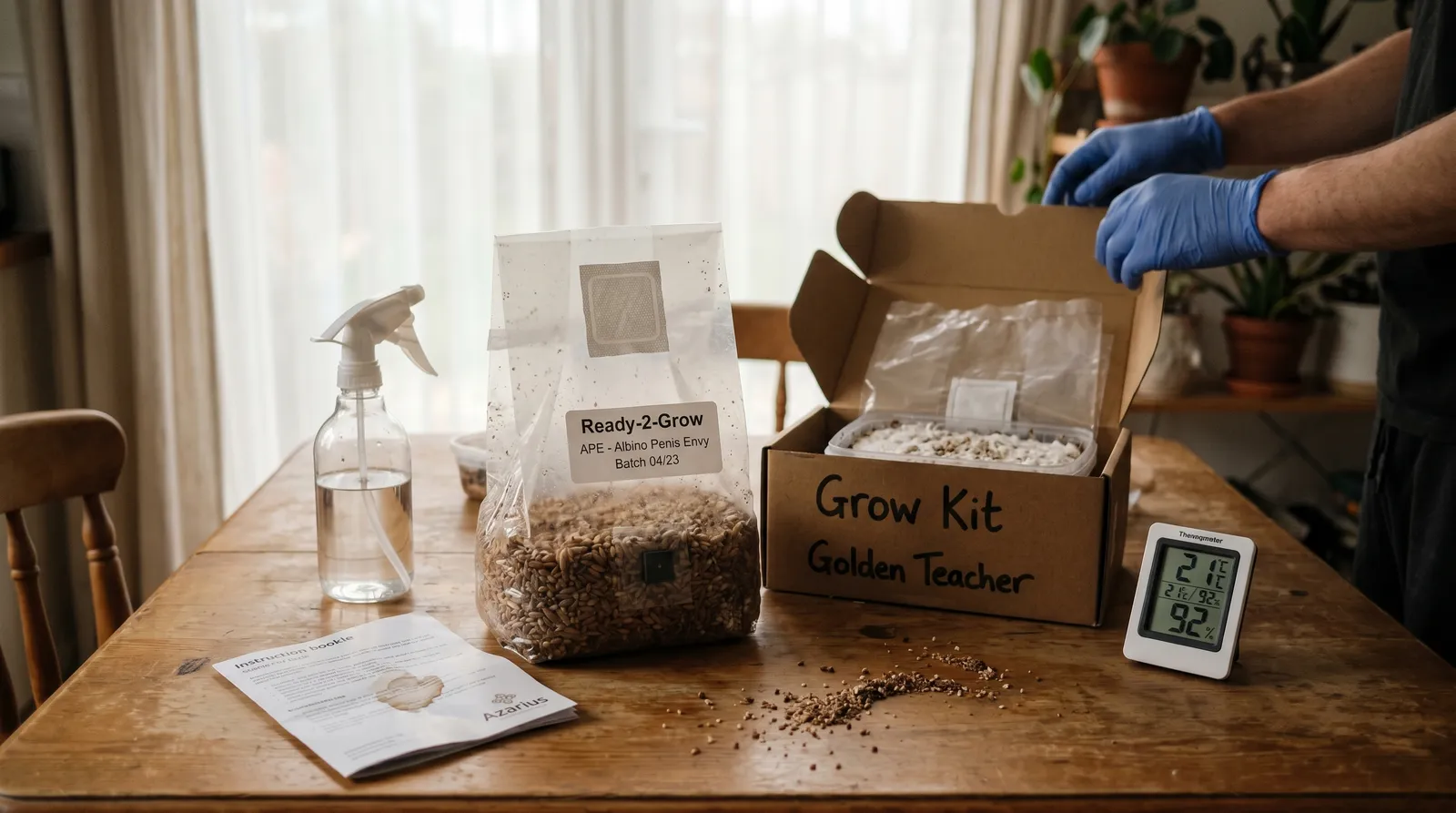
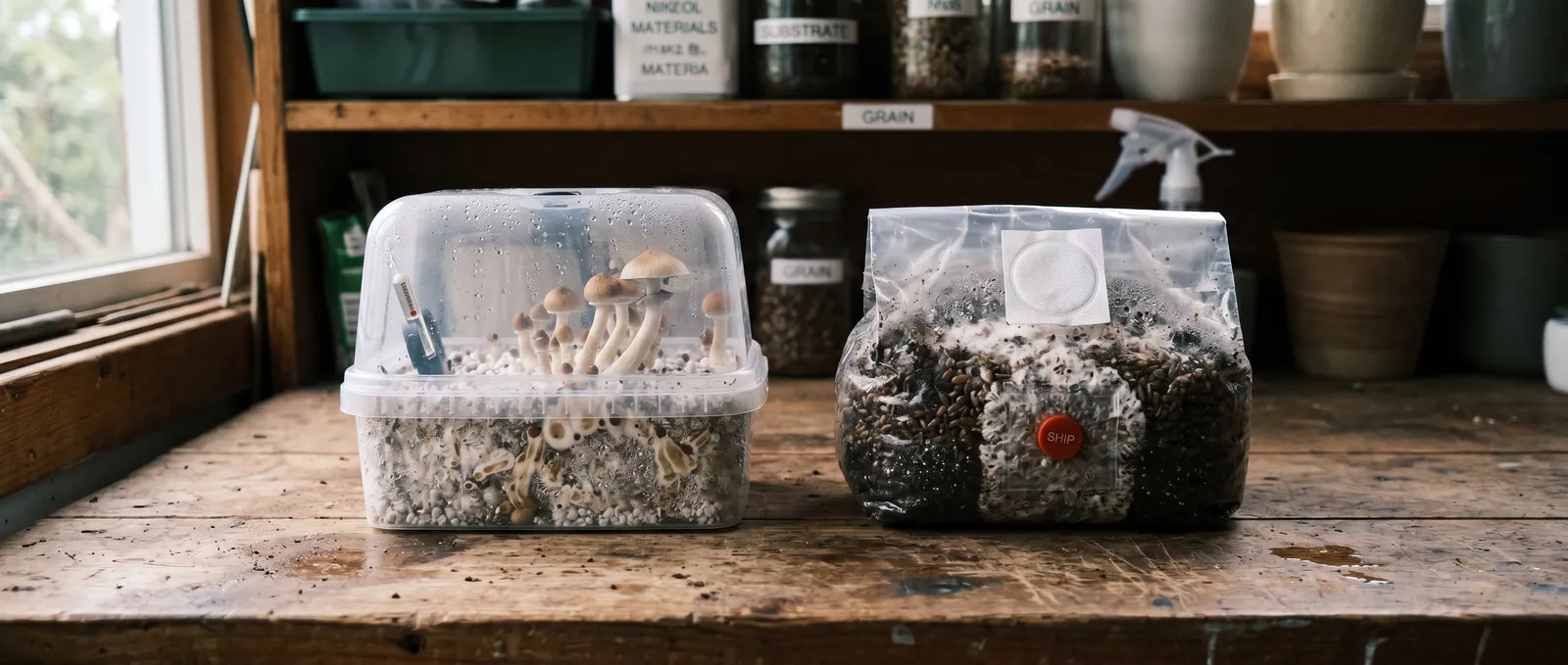
Your first grow checklist starts with format choice: tub kit or all-in-one bag. Azarius sells two: the Grow Kit (a transparent tub with fully colonised rye-grain substrate plus a perlite/vermiculite casing layer, sealed in a microporous filter bag) and the Ready-2-Grow Bag (a 2 kg sealed all-in-one, one bag one flush). The tub kits — Golden Teacher, B+, McKennaii, Cambodia, Mexican, Mazatapec, PES Amazonian, Treasure Coast — can produce two to four flushes if you dunk and re-hydrate properly. R2G bags like APE, Enigma or Jedi Mind Fuck are single-flush by design but ask almost nothing of you beyond airing and misting.
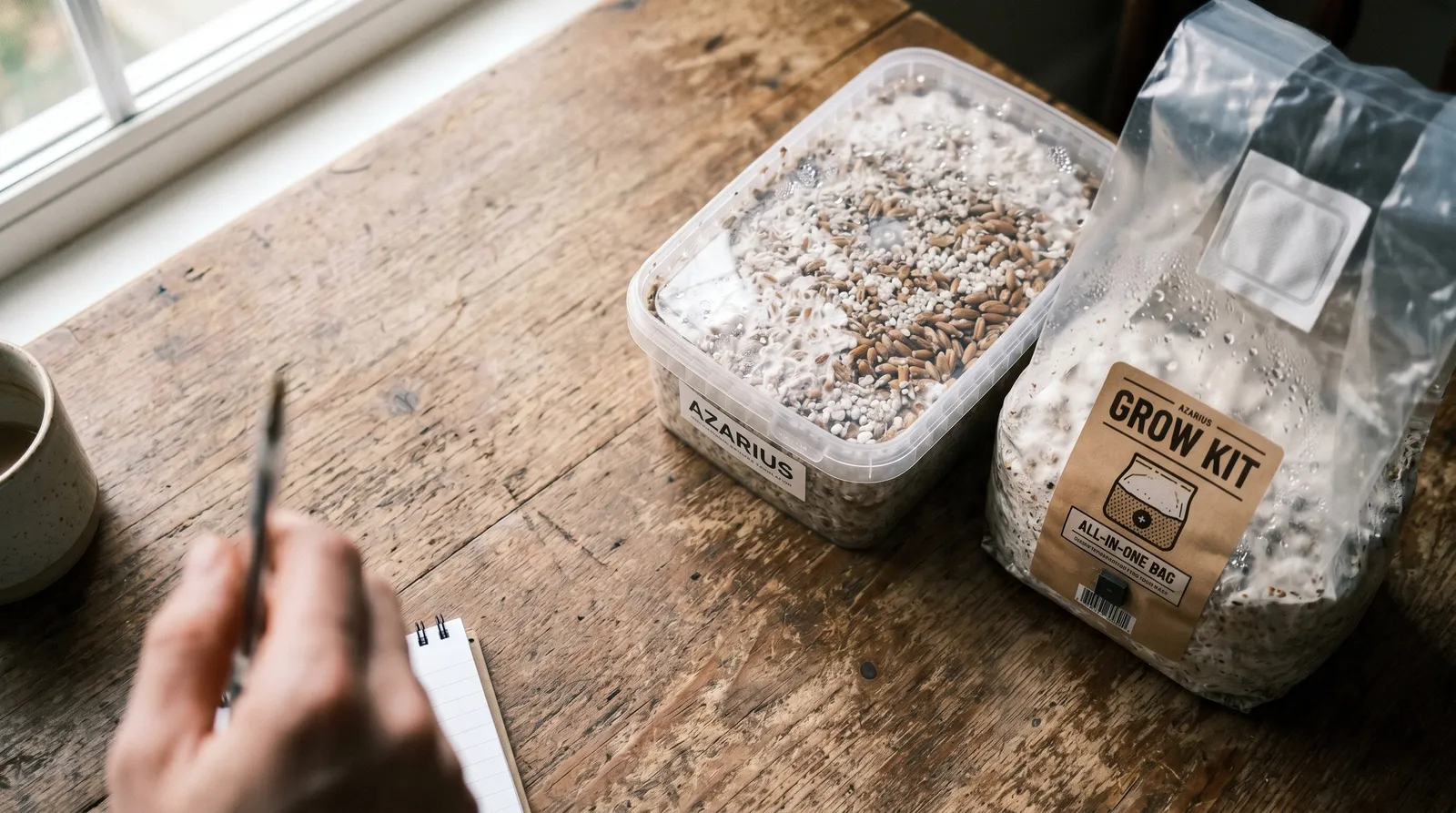
First grow? Most counter staff would point you at a Golden Teacher tub kit. It's forgiving, pins evenly, and tolerates the temperature swings of a normal flat. Order one format, learn its rhythm, then branch out.
Step 2 — Get your environment right before you open anything
Psilocybe cubensis fruits best between 22–24 °C ambient, with relative humidity above 90% during pinning (Stamets, 2000). The kit's filter bag handles humidity for you, but ambient temperature is on you. A bedroom radiator cupboard works. A cold north-facing windowsill in February does not — below 18 °C, colonised substrate sulks and contamination takes the lead.
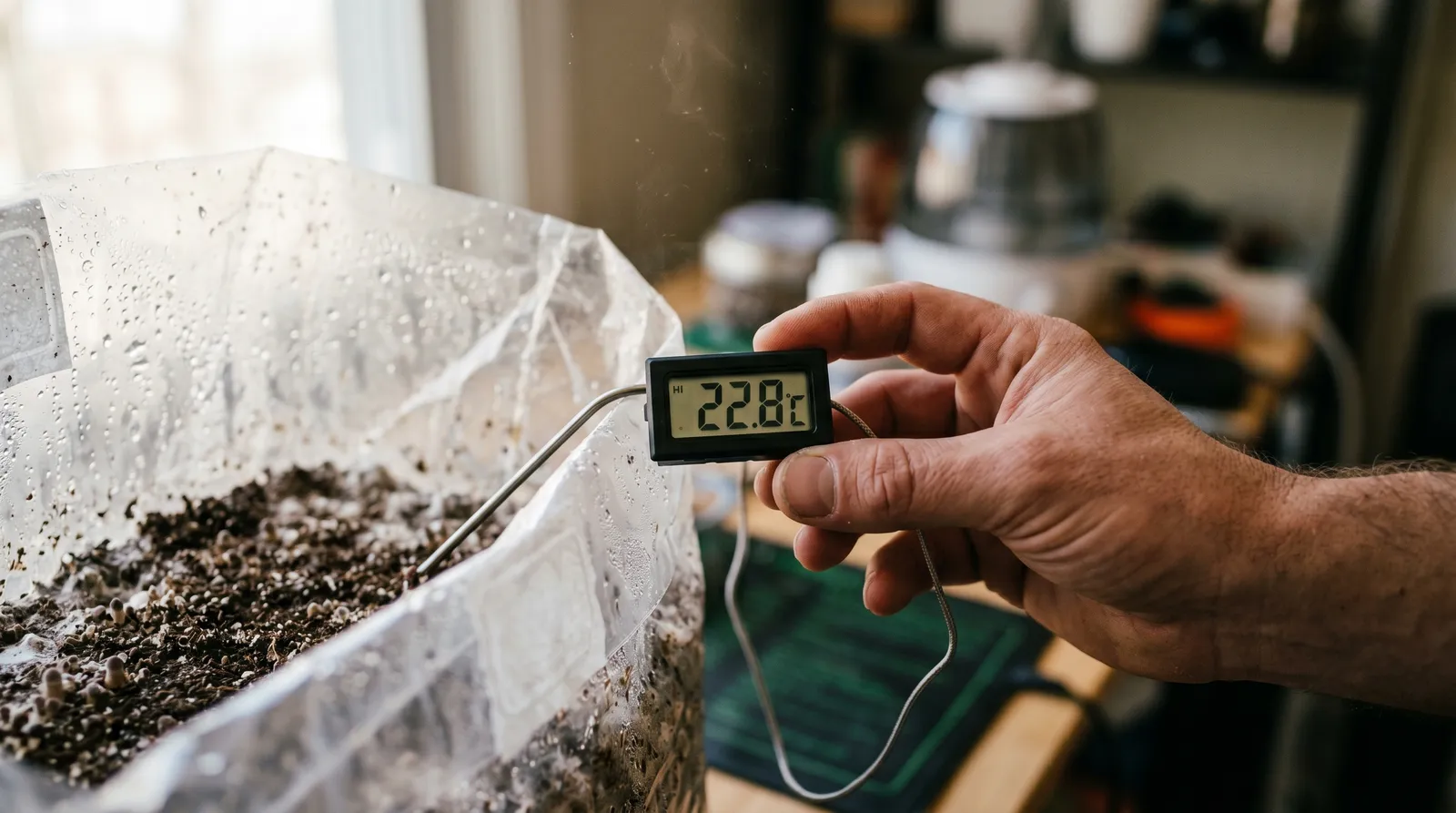
Checklist for the space itself:
- Stable 21–24 °C, away from direct sunlight (indirect daylight is enough — cubensis doesn't photosynthesise, it just uses light as a directional cue)
- Out of the kitchen. Airborne yeast, bread mould, and cooking aerosols are a contamination lottery
- Away from houseplants and pets — soil moulds love fresh substrate
- Flat, level surface the kit won't get knocked off
Step 3 — The sterile handling kit
You don't need a flow hood — you need six cheap items ready on the table before you break any seal. Get them together first:
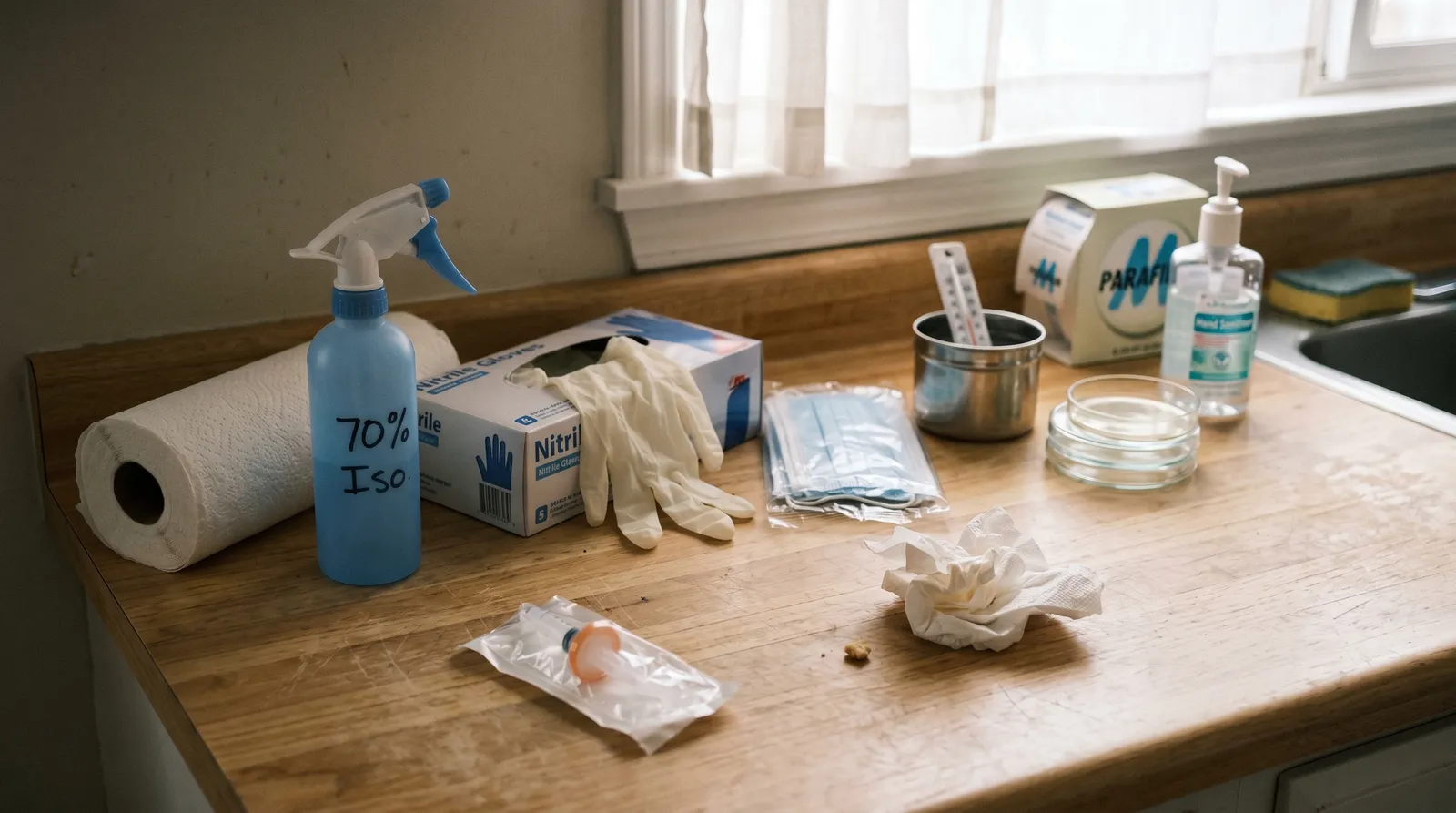
- Nitrile or latex gloves — a box of 100. Change them every time you open the kit
- 70% isopropyl alcohol in a spray bottle (higher concentrations evaporate too fast to actually sterilise)
- Paper towels — wipe the table, the outside of the kit, and your forearms before any handling
- A clean spray mister for water — a dedicated one, not the one you use for ironing shirts
- Bottled or filtered still water — chlorinated tap is usable but filtered is kinder to the mycelium during cold-shocking
- Large clear plastic bag + paperclips (tub kits only — the kit ships with these; if yours is missing a clip, any office clip works)
- A clean thermometer/hygrometer — the £6 digital kind. Guessing the temperature is how people end up with a 28 °C cupboard and a fuzzy trichoderma outbreak
Masks are optional for setup but genuinely useful at harvest, when dried-cap spore dust becomes airborne and can trigger hypersensitivity reactions in repeat growers (Cox, 1988, Journal of Allergy and Clinical Immunology). A basic FFP2 is fine.
Step 4 — The cold shock and first mist
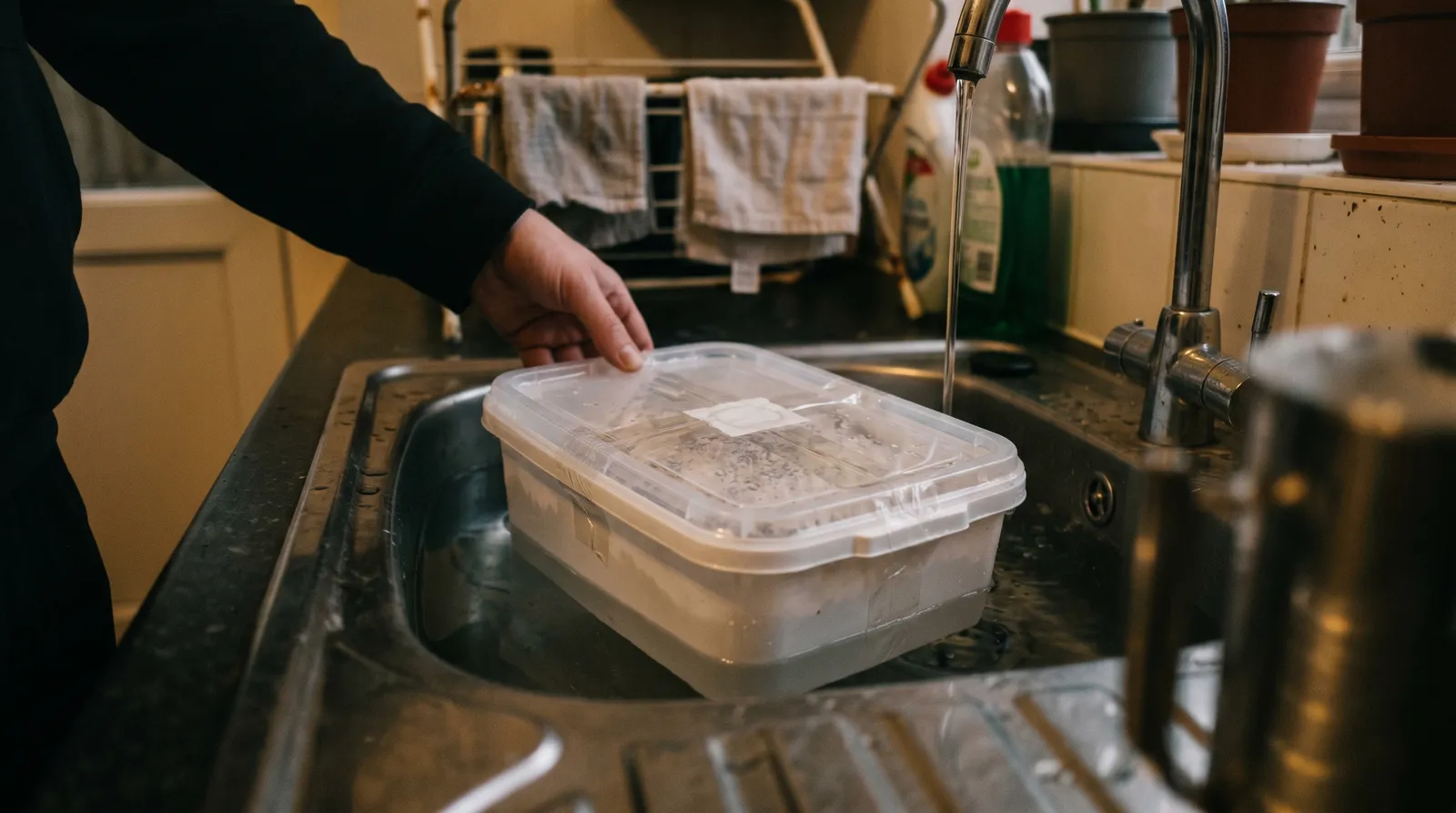
Both formats benefit from a cold-shock to trigger pinning. For tub kits: soak the sealed tub upside-down in cold tap water (around 5–10 °C) for 12 hours, drain, place in the filter bag, paperclip loosely. For R2G bags: most suppliers skip the dunk and rely on a temperature drop alone — follow the enclosed instructions, because opening the bag prematurely ruins the sealed-environment design.
First mist goes on the inside walls of the filter bag, not the casing layer itself. Two or three puffs. Saturating the casing drowns pins before they form.
Step 5 — Daily routine during pinning and fruiting
Fresh air exchange (FAE) and humidity are the whole game. Twice a day:
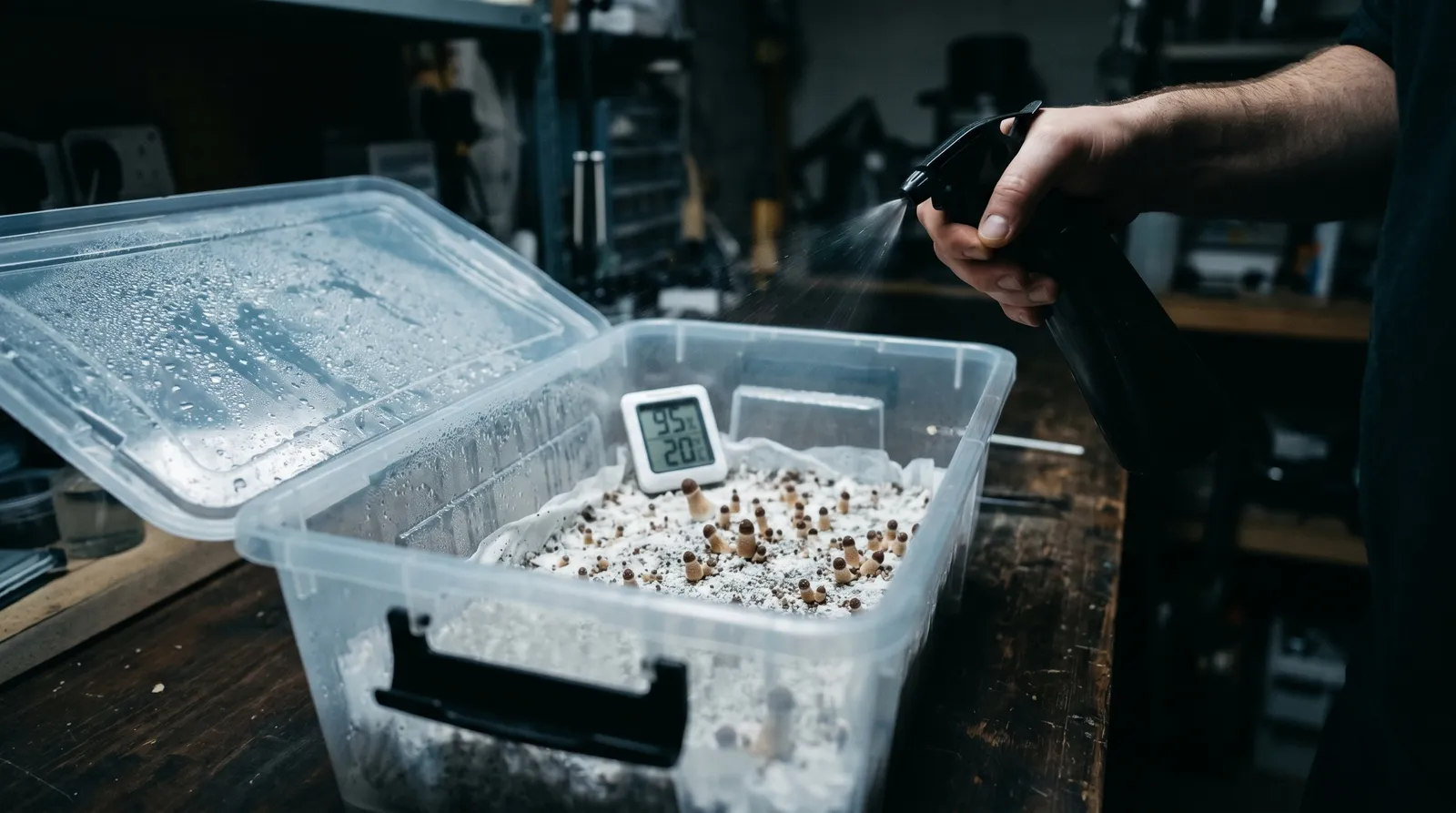
- Open the filter bag, wave it once or twice to flush stale CO₂
- Mist the inner walls — four or five puffs
- Re-clip the bag loosely (not airtight — the filter needs to breathe)
Pins typically appear 5–12 days after cold-shock. Full fruits follow 4–7 days after that. Harvest when the veil under the cap tears but before the cap fully opens and darkens — that's the potency sweet spot for most cubensis strains (Bigwood & Beug, 1982).
Step 6 — Know what contamination looks like
The kit is going to grow something. You want it to be white mycelium. Learn these signs now, before panic sets in:
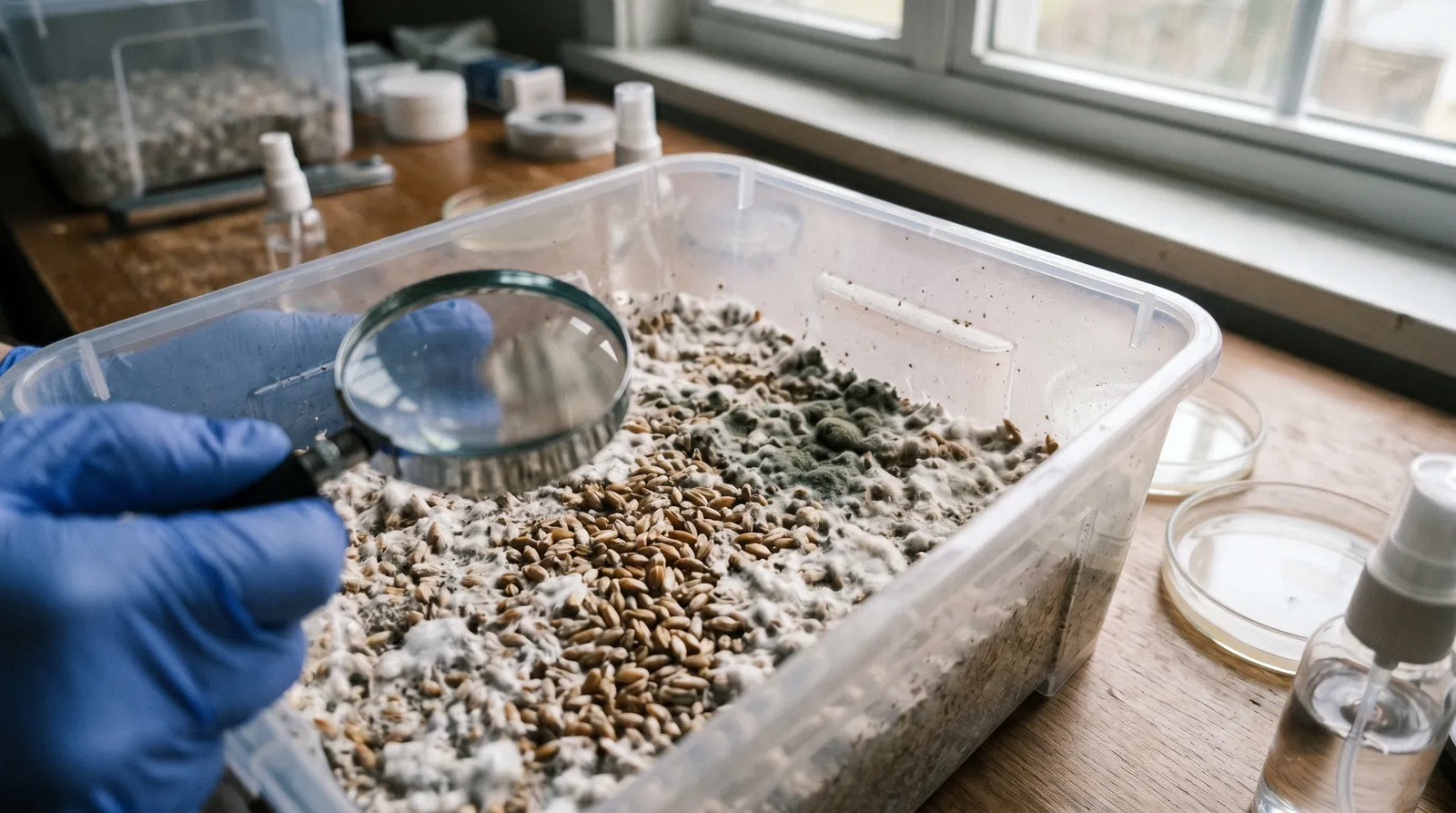
| Appearance | Likely cause | Action |
|---|---|---|
| Forest-green patches, often at casing edges | Trichoderma (green mould) | Bin the kit, sealed, outside |
| Fast, fluffy grey-white strands | Cobweb mould | Spot-mist 3% hydrogen peroxide early; otherwise toss |
| Yellow or brown slimy patches, sour smell | Wet rot / bacterial blotch | Toss |
| Pink or orange slimy colonies | Bacterial contamination | Toss |
| Bright white with faint blue bruising; yellow droplets | Healthy mycelium + normal metabolite exudate | Continue routine |
Step 7 — Harvest, dry, and store
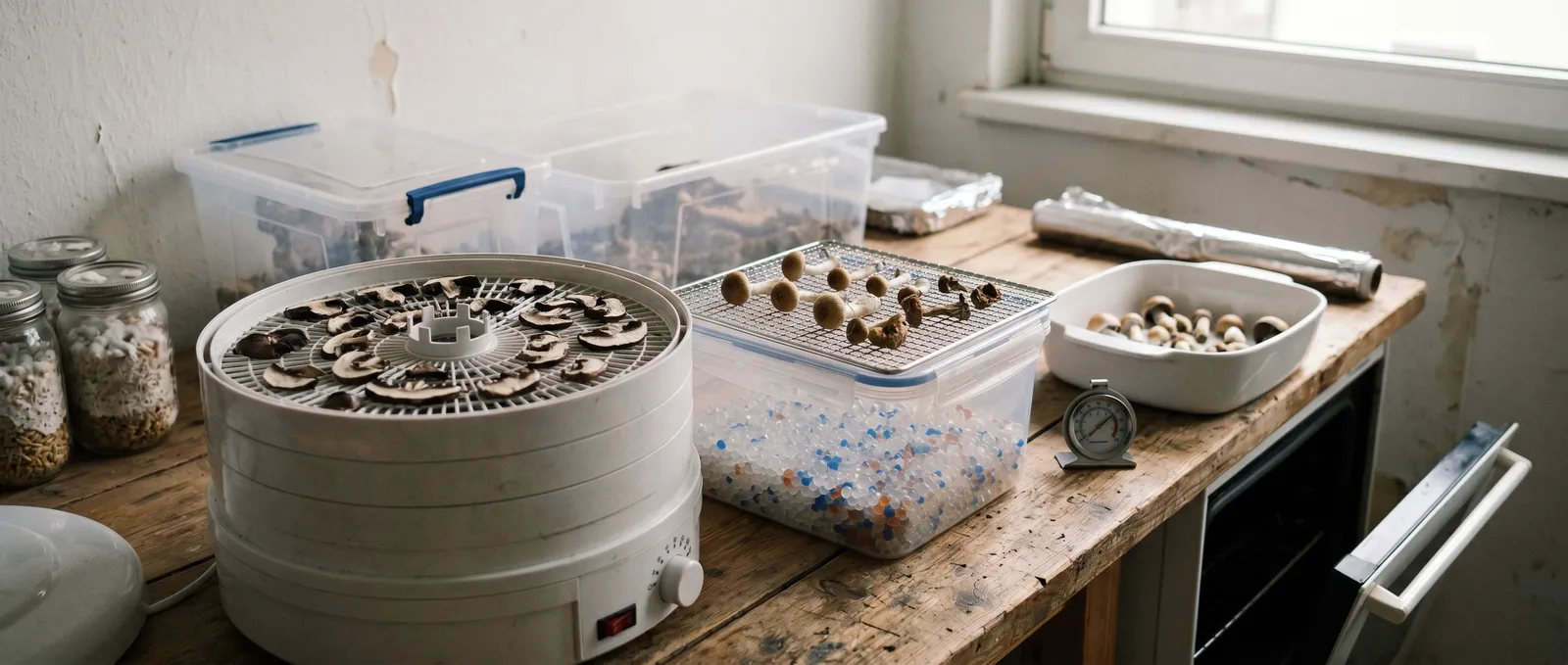
Twist-pick each fruit at the base — don't cut, which leaves wet stumps that invite rot. Wipe any substrate off with a clean paper towel. Fresh mushrooms are ~90% water; they need to go from fresh to cracker-dry (not leathery, not bendy) or potency degrades fast.
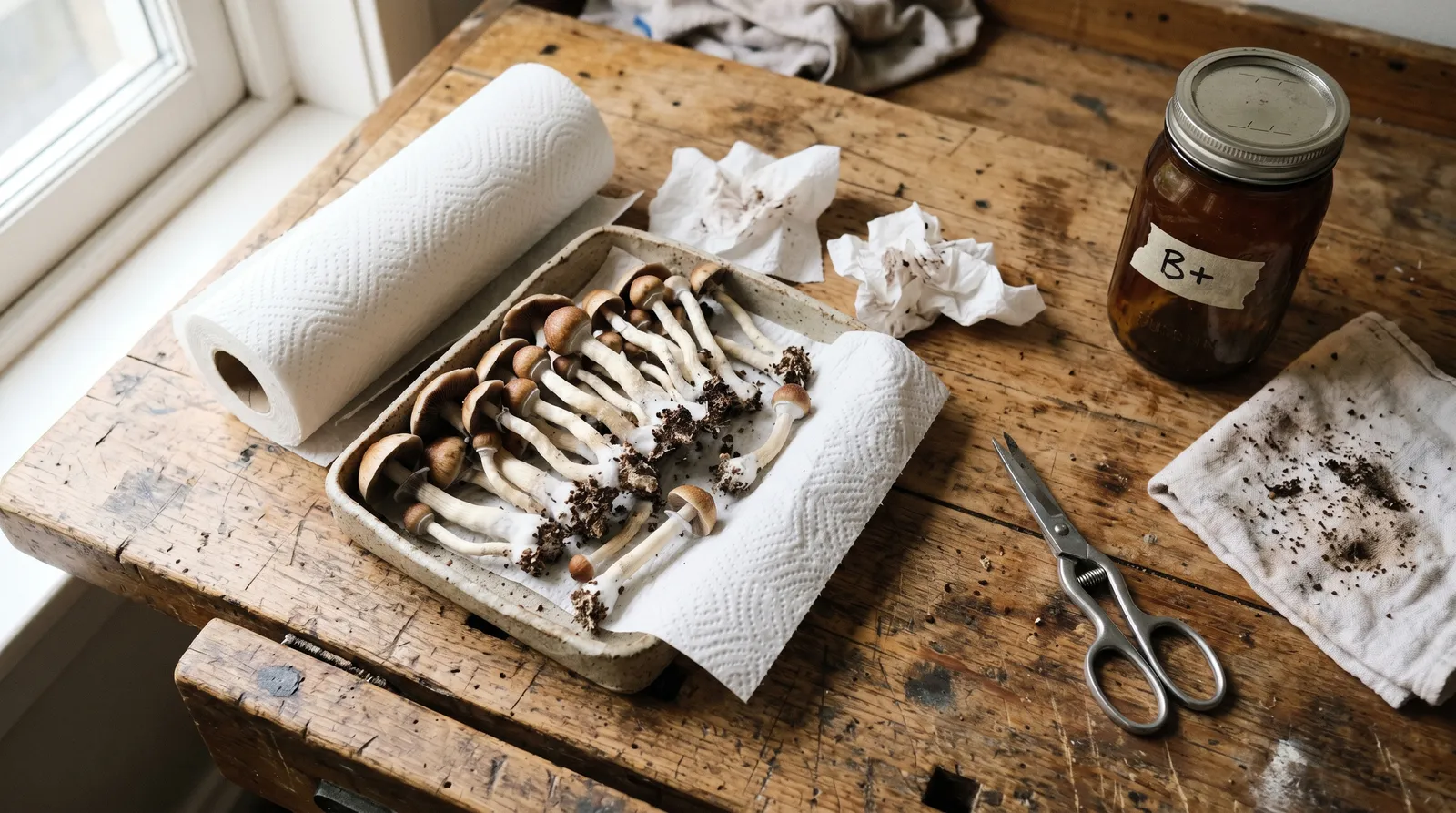
- Air-dry 12–24 hours on kitchen paper in a well-ventilated room, out of sunlight
- Then desiccant-dry in a sealed container with silica gel or food-grade calcium chloride for 24–48 hours until they snap when bent
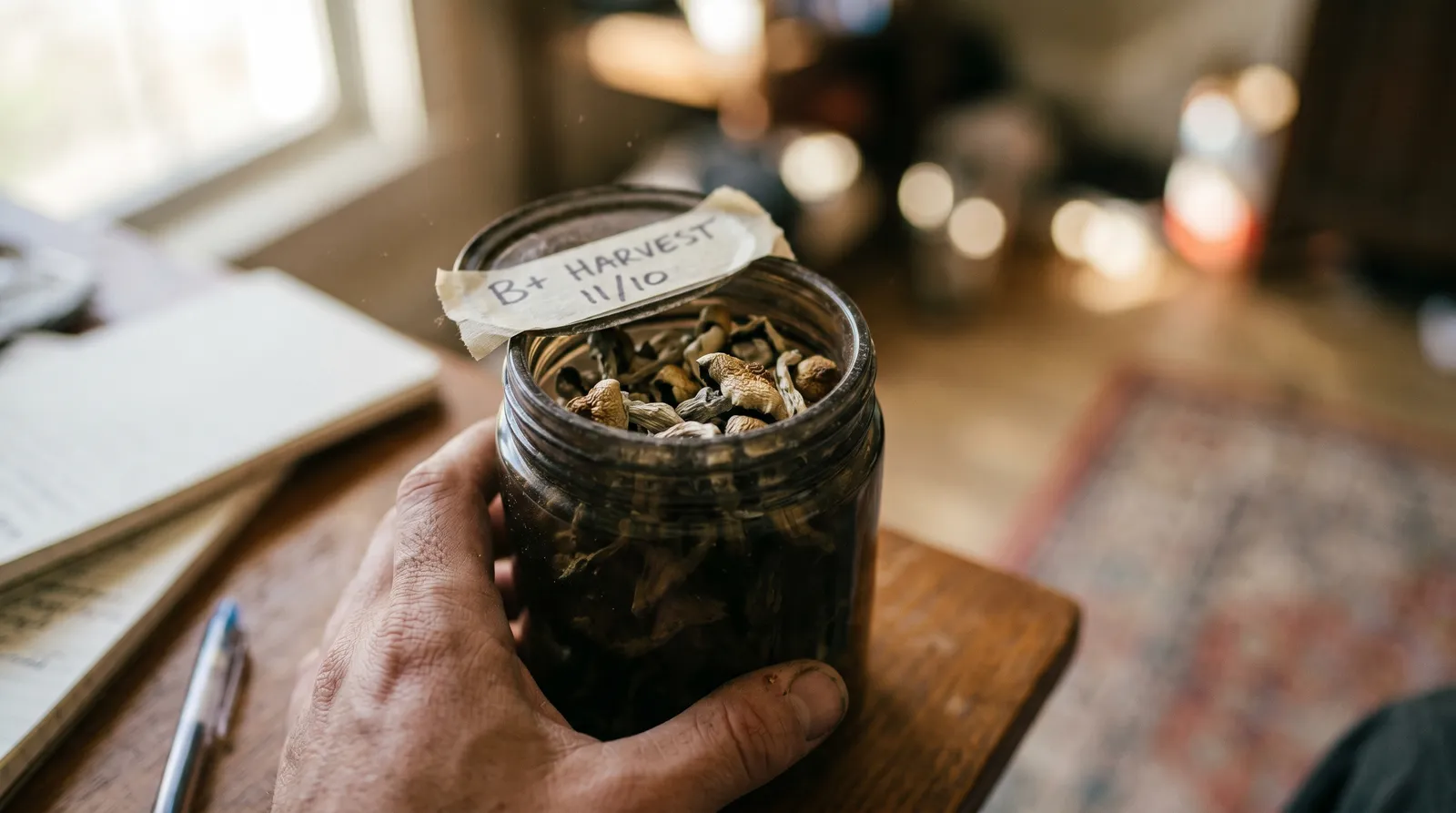
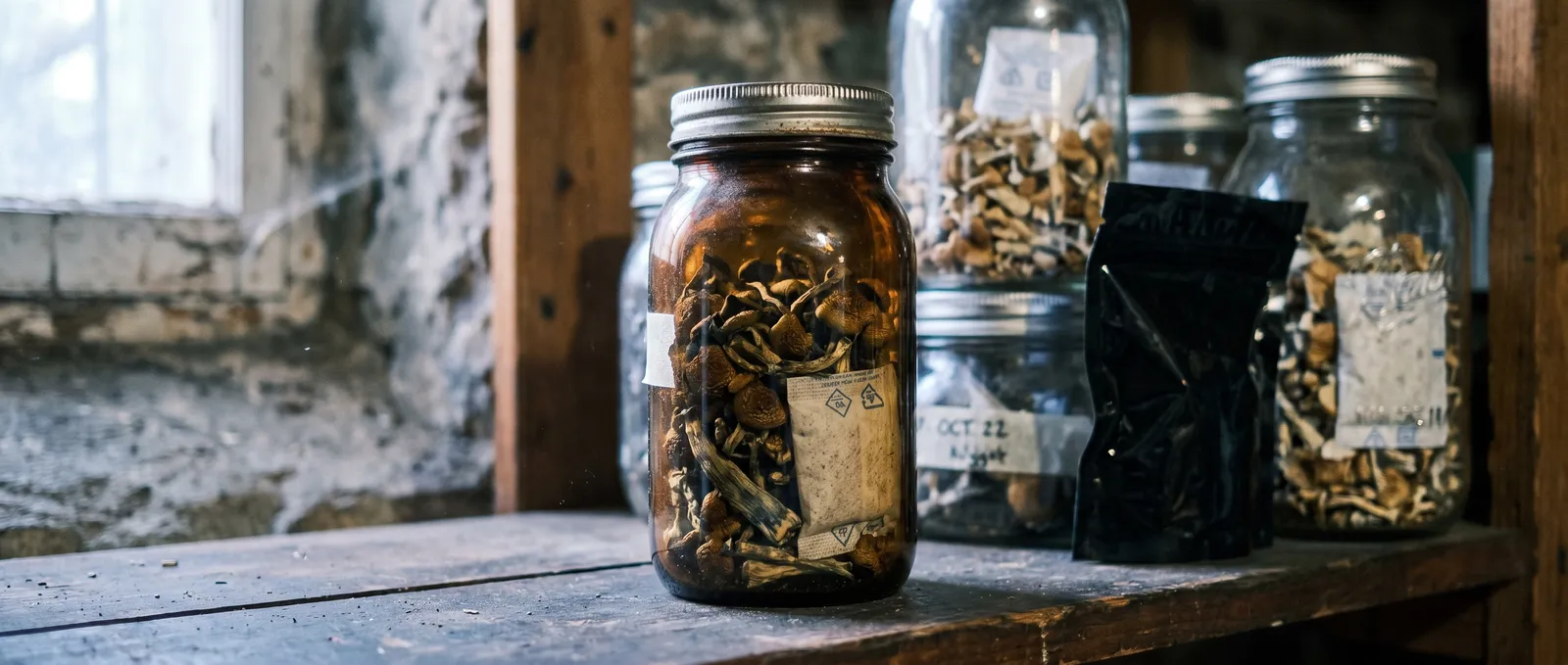
- Store in an airtight jar with fresh desiccant, in a dark cupboard. Well-dried cubensis retains a large fraction of its psilocybin at 12 months — long-term stability data is mostly from Gartz (1989) and limited to fruit-body material, so treat anything past a year as an estimate rather than a guarantee
Lock the jar up. Dried cubensis looks unremarkable and is indistinguishable from edible species to a child or pet — a key lockbox is not optional in a shared household.
Honest limitations of this guide
This checklist handles the kit side of things and nothing past the harvest jar. Consumption, dosing, set and setting, microdosing, and interactions with other substances (SSRIs, MAOIs, lithium in particular — all meaningful risks) live on the psilocybin hub, not here. The EMCDDA and the Beckley Foundation both publish harm-reduction material worth reading separately. This article is about producing a clean, healthy harvest — what you do with the jar afterwards is a separate conversation with separate sources.
Azarius mushroom grow kits
The catalogue covers eight strains in the Grow Kit format (B+, Cambodia, Golden Teacher, Mazatapec, McKennaii, Mexican, PES Amazonian, Treasure Coast) and nine in the Ready-2-Grow Bag format (APE, Enigma, Golden Teacher, Hillbilly Pumpkin, Jack Rabbit, Jedi Mind Fuck, Makilla Gorilla, McKennaii, MVP). Beginners tend to do best if they buy a Golden Teacher, Mexican, or Cambodia tub. Experienced growers looking for potency lean toward APE or Jedi Mind Fuck in the R2G format.
Last updated: April 2026
Frequently Asked Questions
8 questionsDo I need a sterile flow hood for my first grow?
What temperature should the room be?
How often should I mist and fan the kit?
How long until the first flush?
What does contamination look like?
Can I reuse a Grow Kit for multiple flushes?
Can I use tap water for misting my mushroom kit?
Where should I place my mushroom grow kit in the house?
About this article


Adam Parsons is an external cannabis and psychedelics writer and editor who contributes to Azarius's wiki as both author and reviewer. On the writing side, he authors Azarius's kratom and kanna clusters, drawing on exten
This wiki article was drafted with AI assistance and reviewed by Adam Parsons, External contributor. Editorial oversight by Joshua Askew.
Medical disclaimer. This content is for informational purposes only and does not constitute medical advice. Consult a qualified healthcare provider before use of any substance.
Last reviewed April 25, 2026
References (2)
- [1]Stamets, P. (2000). Growing Gourmet and Medicinal Mushrooms (3rd ed.). Ten Speed Press, Berkeley, CA. Source
- [2]Bigwood, J., & Beug, M. W. (1982). Variation of psilocybin and psilocin levels with repeated flushes of cultivated Psilocybe cubensis. Journal of Ethnopharmacology, 5(3), 287-291. DOI: 10.1016/0378-8741(82)90014-9
Related Articles
Cannabis Hermaphrodite: Identify, Prevent, Act
A cannabis hermaphrodite is a female plant that develops male pollen sacs or banana-shaped anthers (nanners), self-pollinating and seeding your harvest.
DIY Cannabis Fertilizer: Homemade Nutrient Guide
DIY cannabis fertilizer guide: compost, teas, banana ferments and feed schedules, with safety notes and cited research for home growers.
What To Do With Male Cannabis Plants: 6 Practical Uses
What to do with male cannabis plants: identify, isolate, breed, extract, or compost. A practical 6-step guide with sourcing and safety notes.
Mushroom Grow Kit Temperature & Humidity: Full Setup Guide
A temperature humidity control grow kit is the small set of climate tools — hygrometer, heat mat, humidifier or perlite tray — that keeps a mushroom fruiting…
When to Harvest Mushrooms: Veil Break Timing Explained
Harvest timing veil break is a cultivation technique that uses the tearing of the partial veil on maturing Psilocybe cubensis to mark peak alkaloid content.
Sclerotia vs Fruit Bodies: Cultivation Comparison
Sclerotia and fruit bodies are two different life stages of Psilocybe fungi: sclerotia are hardened underground mycelial storage bodies (the 'magic…
Storing Dried Mushrooms Long Term: Full Guide
Storing dried mushrooms long term means keeping well-dried Psilocybe fruit bodies in airtight, opaque containers with desiccant, cool and dark, to slow…
Drying Mushrooms Air Desiccant Oven: Methods Compared
Drying mushrooms air desiccant oven refers to the three home methods for reducing fresh fruit bodies from ~90% water to cracker-dry (<5%). Gotvaldová et al.
Grow Kit vs Ready 2 Grow Bag: Which to Pick
The grow kit vs Ready 2 Grow Bag choice compares two Psilocybe cubensis home-cultivation formats: a tub with rye substrate and casing layer designed for…