
This article discusses psychoactive substances intended for adults (18+). If you have a health condition or take medication, consult a doctor before use. Our age policy
Cannabis LST Low Stress Training: Step-by-Step Guide
Definition
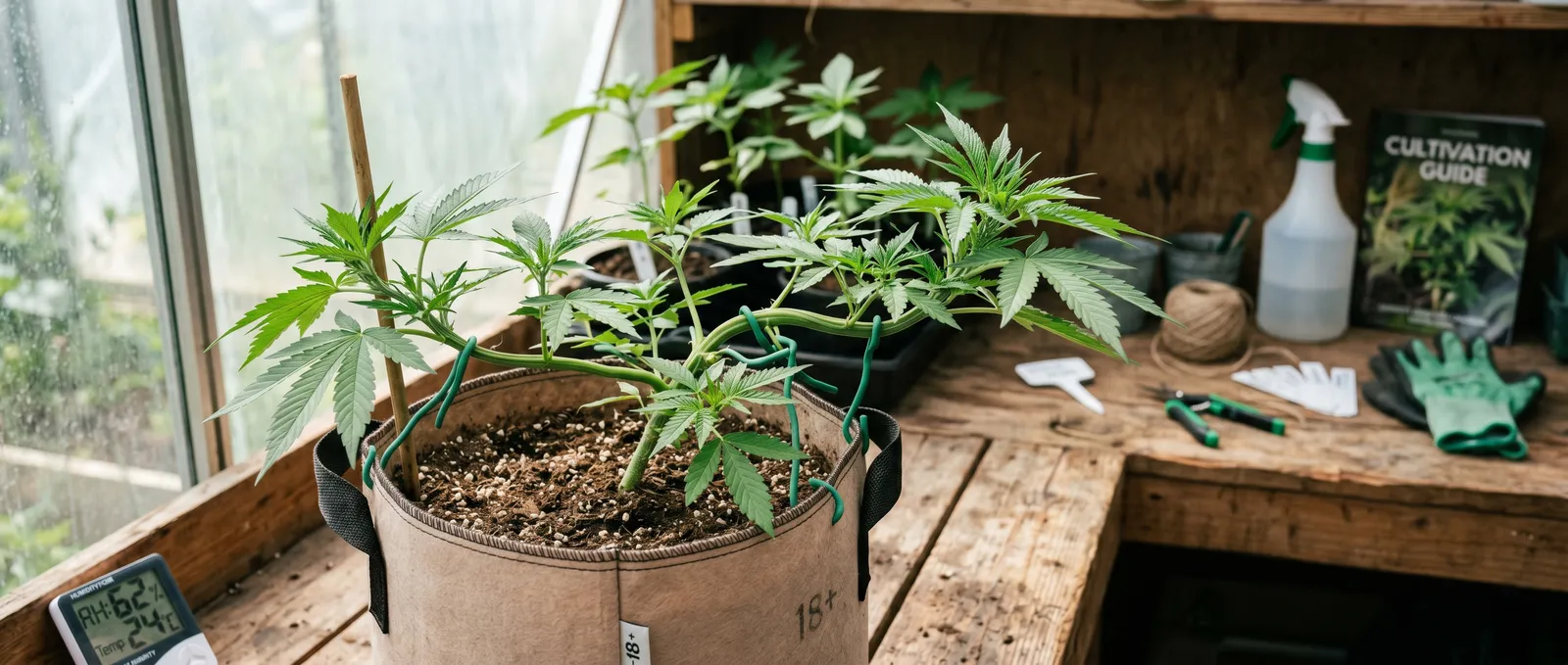
Cannabis LST low stress training is a non-cutting technique that gently bends and ties down branches to flatten the canopy and break apical dominance without cutting. Research on cannabis canopy photosynthesis (Chandra et al., 2017) shows yield scales with usable canopy area under direct light — which is exactly what LST creates.
Adult use only — this guide is written for growers aged 18+. Cultivation rules vary by country and region and change frequently. This guide is educational only and is not formal advice.
What LST actually does to a cannabis plant
Cannabis LST low stress training is a non-cutting technique that gently bends and ties down branches to flatten the canopy and break apical dominance. You're not cutting anything — you're just redirecting growth. The goal is more bud sites receiving direct light, which in a canopy-limited tent is the single biggest lever on yield per watt.
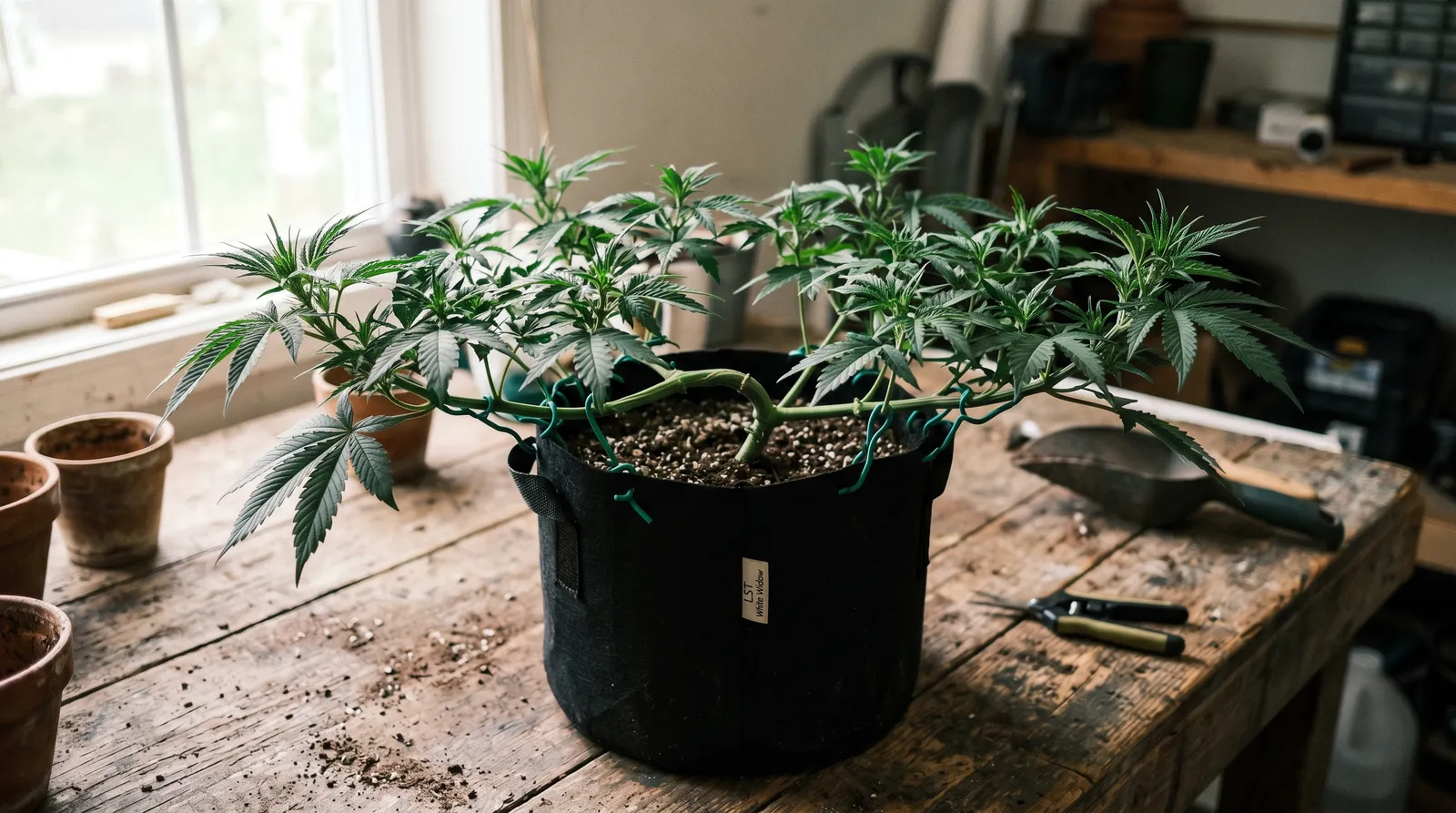
The mechanism is simple: cannabis has strong apical dominance, meaning the main cola produces a hormone (auxin) that suppresses side branch growth. Bend the main stem sideways and that hormonal hierarchy flattens out. The side branches, freed from suppression, shoot up to compete for the top spot — and now you have eight or ten colas instead of one. In our own tent over the past decade, LST on a single photoperiod plant has roughly doubled usable bud sites compared to letting it grow untrained.
Published canopy research backs the intuition: Chandra et al. (2017) showed cannabis photosynthesis saturates around 1,500 µmol/m²/s PPFD at the leaf level, but whole-plant yield is limited by how much canopy you can keep inside the 600–1,000 PPFD sweet spot during flower. LST is how you expand that productive canopy without adding light.
When to start, and on which plants
Start LST at 4–6 nodes on photoperiod plants (roughly 3–4 weeks from germination) and at node 3–4 on autoflowers. Keep training throughout the vegetative stage and stop roughly a week after the 12/12 flip, once flowering stretch has settled. Bending during peak stretch (days 7–14 of flower) can still work but risks snapping stems that have lignified.
On autoflowers, the window is tighter and the rules are different. Autos flower on age, not light cycle, so you have about 3–5 weeks total before they're committed to bud production. Start LST at the 3rd or 4th node and be gentler — recovery time is a luxury autos don't have. Some growers skip training autos entirely for this reason; it's a reasonable call on fast 9-week strains (Pepin et al., 2020).
Step 1: Gather the kit
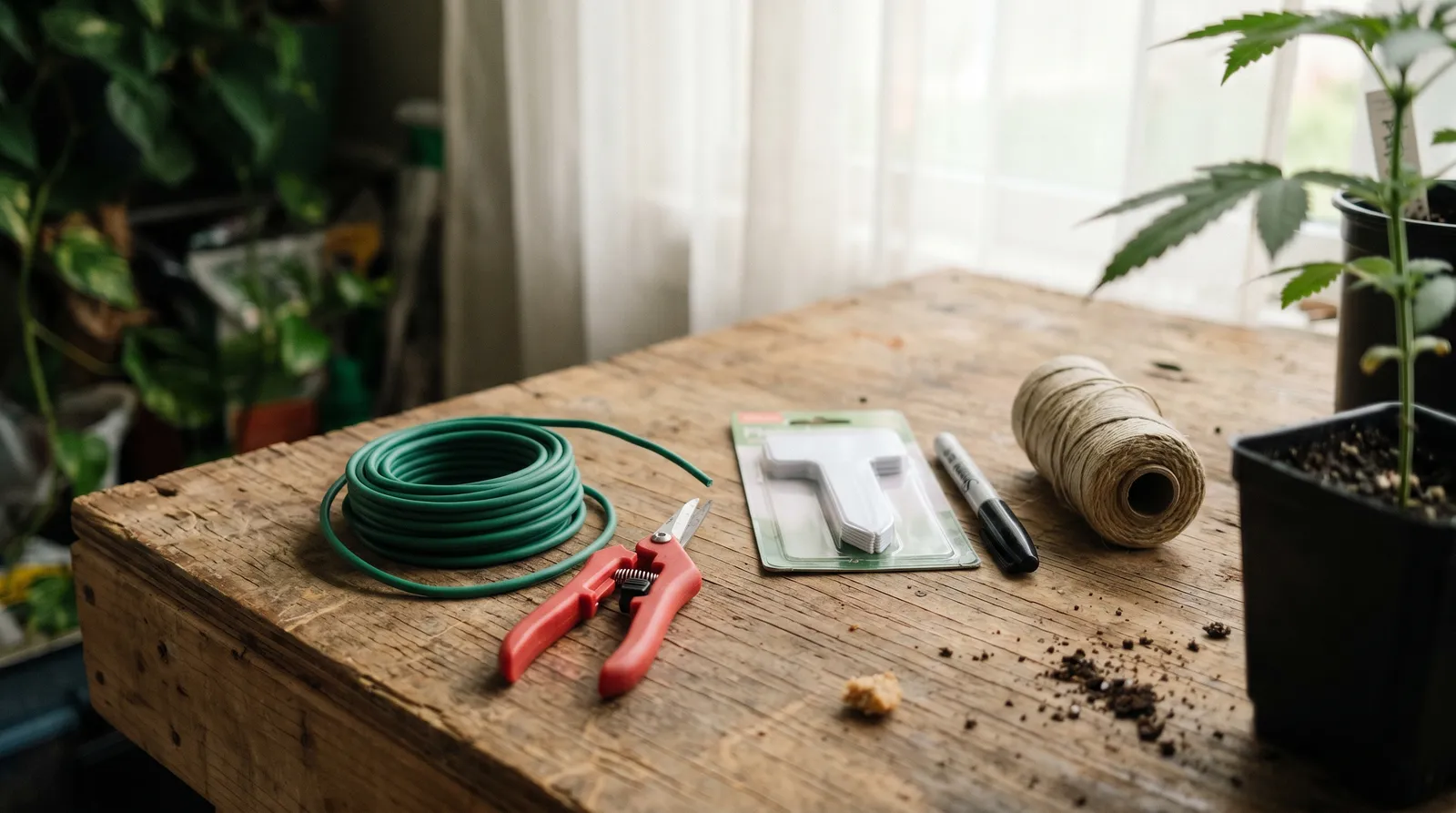
You need five basic items to start, and none of them are expensive to buy. What matters is that the ties won't cut into the stem:
| Item | Purpose | Notes |
|---|---|---|
| Soft plant ties | Bending and anchoring stems | Plastic-coated wire, Velcro tape, or pipe cleaners. Avoid thin wire or fishing line. |
| Fabric or drilled plastic pot | Anchor points for ties | 11–20L pot for a 60×60 or 80×80 tent. |
| Drill bit or hole punch | Rim holes for plastic pots | Drill 4–8 holes before transplanting. |
| Stakes or bamboo skewers | Mid-pot anchor points | Optional, useful when rim is too far away. |
| Small sharp scissors | Cutting and repositioning ties | Clean blades reduce damage when untying. |
- Soft plant ties — plastic-coated wire, Velcro garden tape, or pipe cleaners work best.
- Skip the fishing line — thin material slices through a swelling stem under load.
Step 2: The first bend (topping the apical dominance)
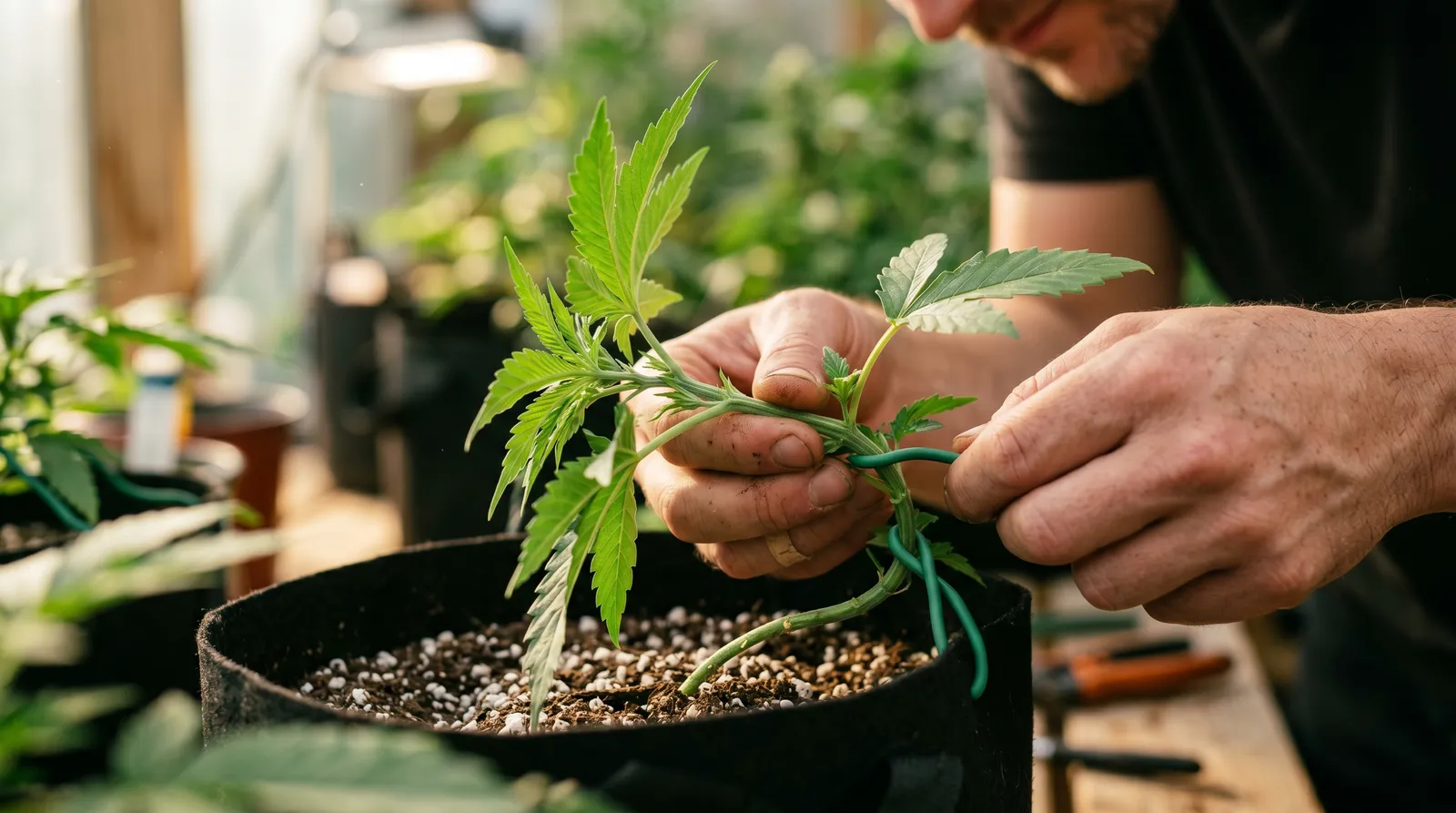
The first bend breaks apical dominance by tipping the main stem sideways so side branches can compete. Once the plant has 4–6 nodes and the main stem is pliable, pick a direction and bend the top down and away from the centre of the pot, aiming for the rim. You want the tip of the main stem ending up lower than the surrounding side branches.
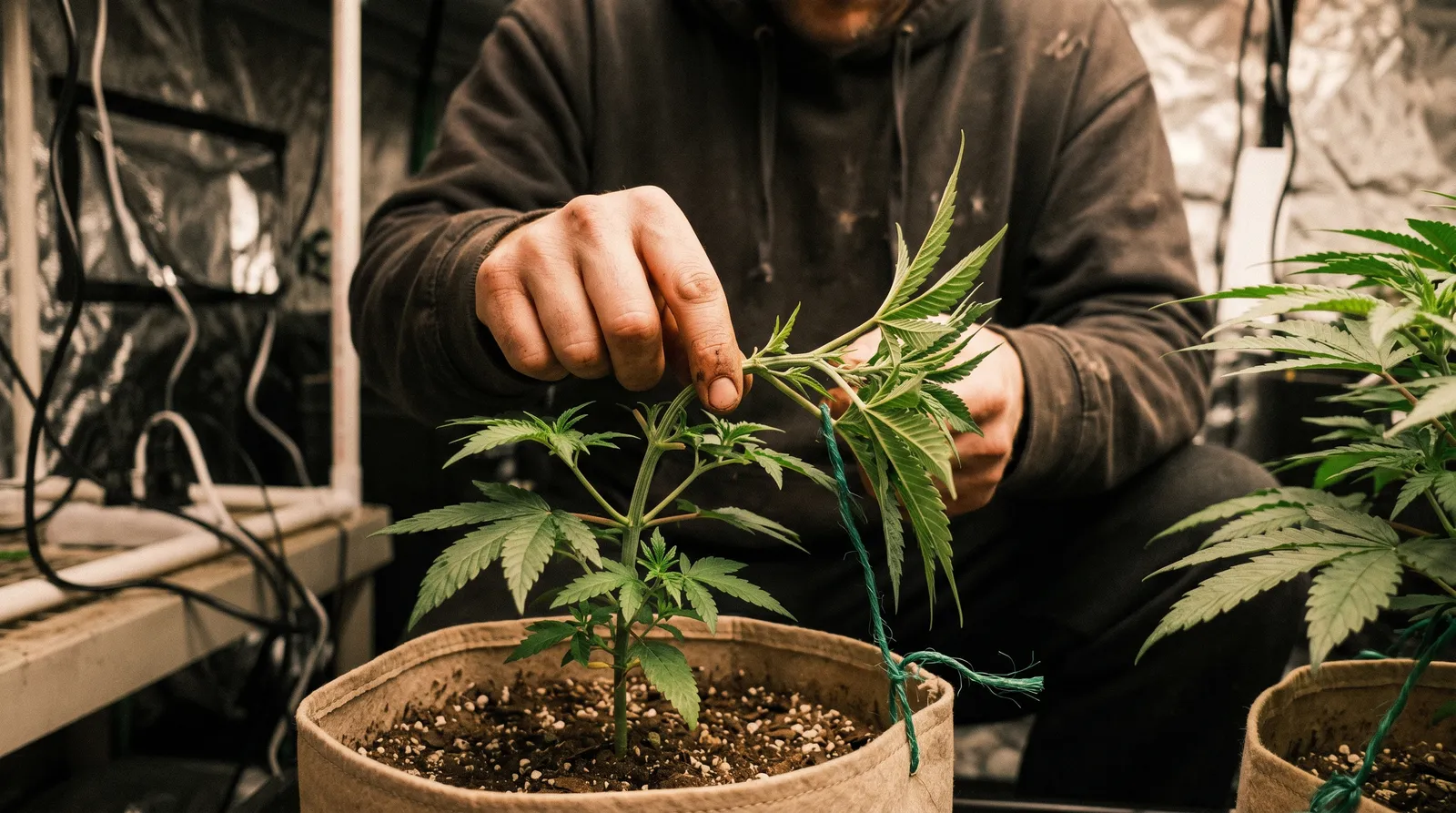
Loop a soft tie loosely around the main stem just below the top and anchor the other end to a pot-rim hole. The tie should hold the stem in its new position but not bite into it — a loose figure-eight works well. If the stem feels stiff, bend slowly over 30 seconds rather than forcing it. A clean "green snap" (stem bends and doesn't fully break) typically recovers in a few days according to grower reports; a full break is a setback.
Step 3: Spread the canopy over the next 2–4 weeks
Spread the canopy by tying each strong side branch outward toward the pot rim as it reaches for the new top spot. The aim is a shape that looks like a wheel from above, with 6–10 main colas spaced roughly evenly around the centre. Retie every 3–5 days during active veg — a stem you tied down on Monday may need re-bending by Friday because it's already reaching back upward.
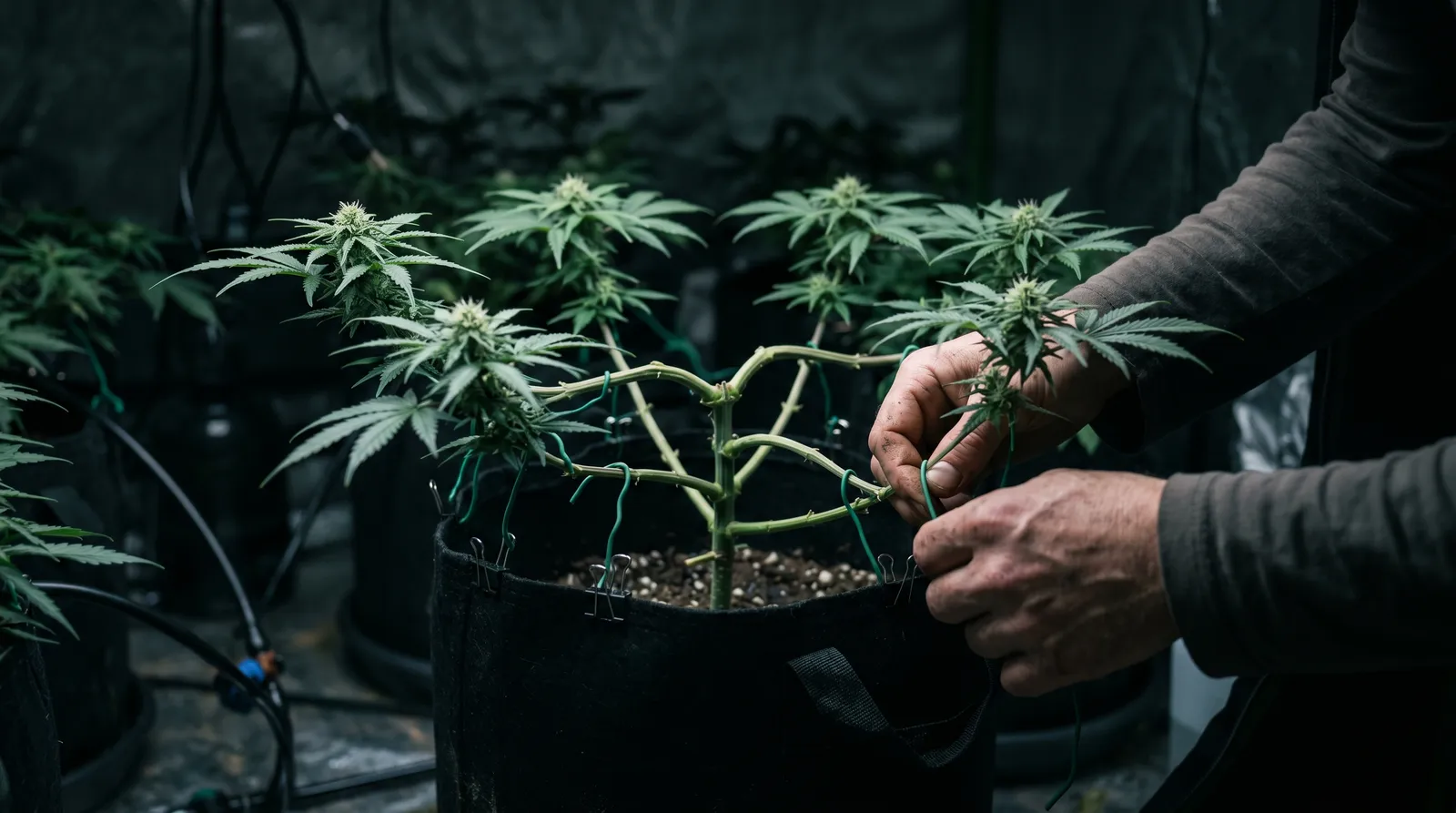
Two things to watch: don't let any single branch tower over the others (bend the tallest back down each time), and don't bunch foliage on top of itself (tuck large fan leaves under smaller branches rather than removing them during veg). Defoliation is a separate technique — LST works fine without it.
Step 4: Transition into flower
Do your final major tie-down a week before the 12/12 flip on photoperiod plants. You want the canopy as flat as you can get it, because the flowering stretch (roughly days 1–21 of 12/12) will push everything upward by 50–100% depending on genetics. Sativa-dominant hybrids stretch more than indica-dominant ones.
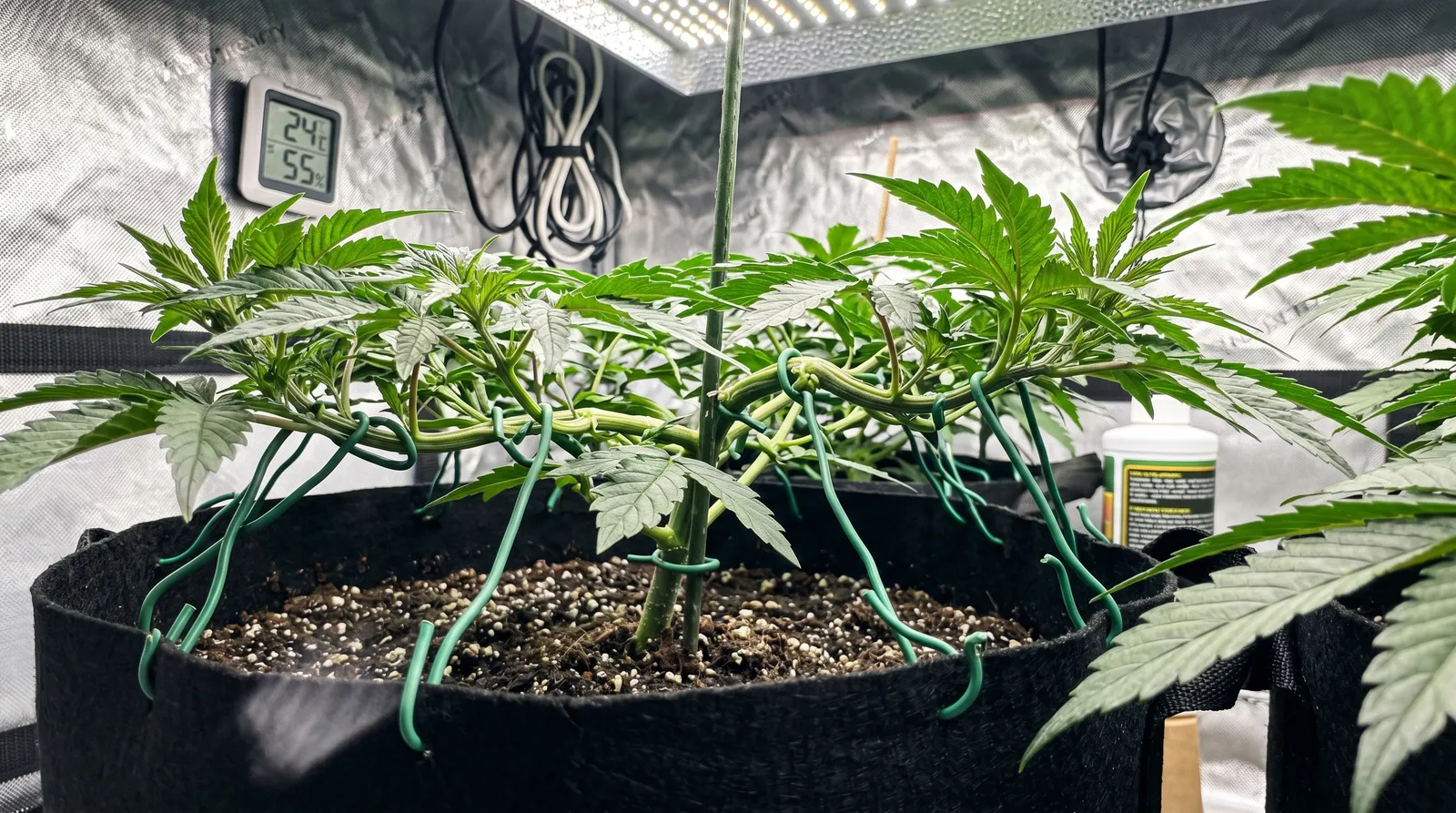
During stretch, keep making small adjustments — a light tug here, a re-tie there — until the plant stops growing vertically and starts putting energy into flower formation. After week 3 of flower, stop training entirely. The stems are woody, the plant is committed, and any further bending risks snapping a cola-loaded branch.
Common mistakes and how to avoid them
- Tying too tight. Ties should slide a millimetre if you tug them. Stems swell during flower; what was snug in week 4 can girdle the plant by week 8.
- Training too early. Wait for 4–6 nodes. Seedlings with 2 nodes haven't built enough root mass to handle redirection.
- Ignoring autoflower timing. Bending an auto at week 5 when it's already flowering wastes the plant's limited vegetative window.
- Over-bending once. Better to tie a stem 60° down this week and another 30° next week than to force a 90° bend that splits the stem.
- Forgetting VPD. None of this matters if environment is off. Keep veg at ~0.8–1.1 kPa VPD and flower at 1.0–1.5 kPa (Fluence, 2022). A stressed plant in the wrong climate won't recover from training as cleanly.
LST vs. topping, FIM, and SCROG
LST is the lowest-risk training method, which is why it's usually the first technique new growers learn. Topping (cutting the apical meristem) and FIMing (pinching it) achieve similar canopy-spreading effects but require a cut that takes the plant 5–10 days to recover from. SCROG (Screen of Green) is essentially LST with a horizontal mesh screen — you tuck branches under the screen as they grow rather than tying each one individually. For a single plant in a small tent, LST alone is usually enough. For 2+ plants or tents above 80×80, SCROG starts paying off.
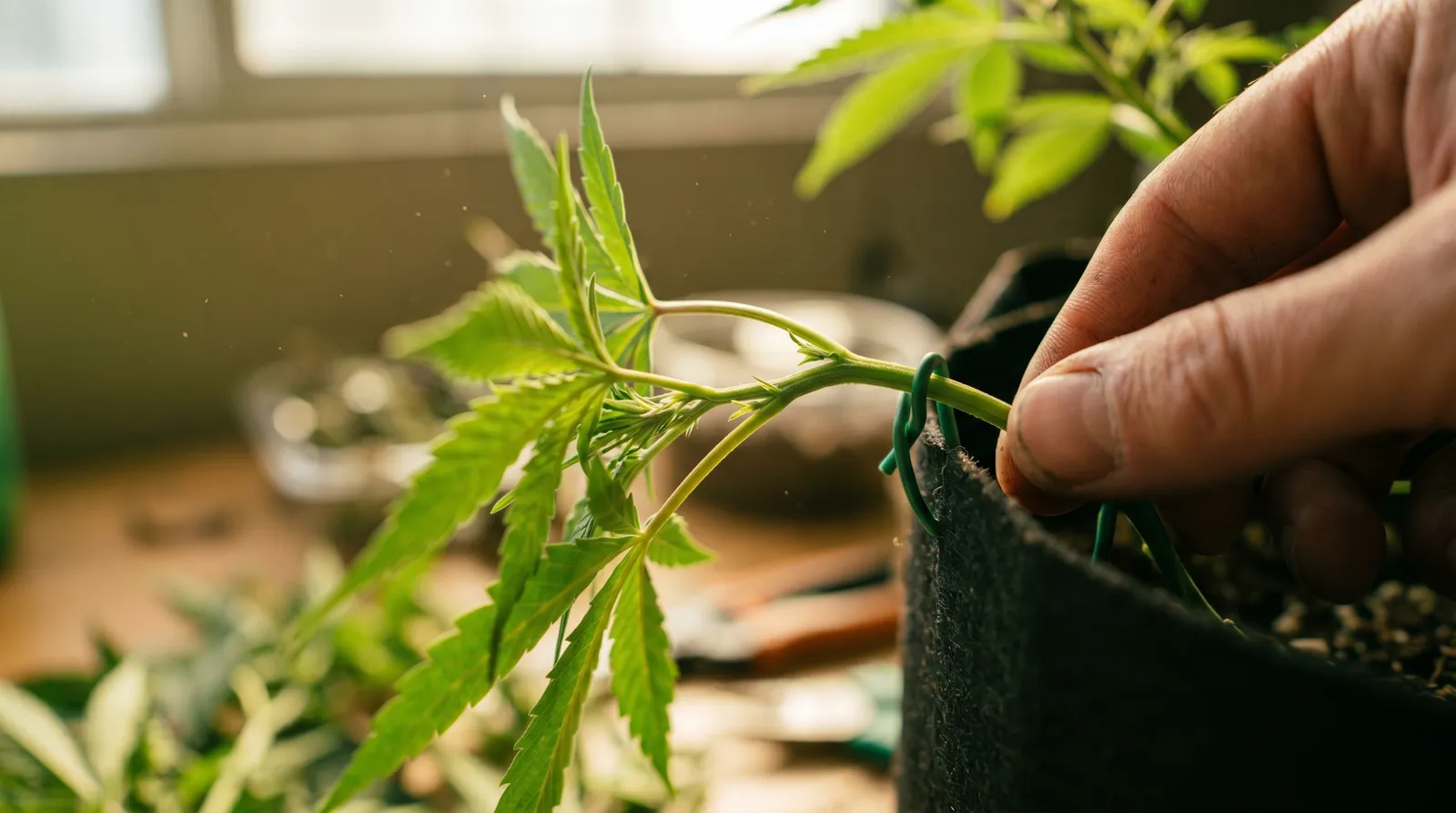
You can also combine techniques: top once at node 5, then LST the resulting two main stems outward. This is called main-lining or manifolding when taken to its logical conclusion, and it produces the cleanest symmetrical canopy of any method — at the cost of 2–3 extra weeks of veg (EMCDDA grower surveys, 2021).
Related seeds at Azarius
LST works on any cannabis genetics, but some handle it better than others. If you want to buy seeds suited to training, photoperiod hybrids from breeders like Royal Queen Seeds, Dutch Passion, and Sensi Seeds tolerate aggressive work well because they have long veg windows and flexible stems. Autoflower feminised seeds from the same breeders are also worth getting for LST, just with the tighter timing described above. Many growers order a mixed pack to test how different genetics respond to the same training schedule.
Last updated: April 2026
Legal notice: Cannabis cultivation laws vary by country and region and change frequently. This guide is educational. Before growing, verify current laws for your specific jurisdiction. Azarius does not provide legal advice.
Frequently Asked Questions
8 questionsWhen should I start LST on a cannabis plant?
Can you LST autoflowers safely?
What's the difference between LST and topping?
Will LST increase my cannabis yield?
How do I stop branches from growing back upward after tying?
Do I need to defoliate when using LST?
Can LST snap or damage stems, and how do I fix a broken branch?
What size pot and tent do I need for effective LST training?
About this article


Luke Sholl has been writing about cannabis, cannabinoids, and the broader benefits of nature since 2011, and has personally grown cannabis in home grow tents for more than a decade. That first-hand cultivation experience
This wiki article was drafted with AI assistance and reviewed by Luke Sholl, External contributor since 2026. Editorial oversight by Adam Parsons.
Medical disclaimer. This content is for informational purposes only and does not constitute medical advice. Consult a qualified healthcare provider before use of any substance.
Last reviewed April 24, 2026
References (2)
- [1]Backer, R., Schwinghamer, T., Rosenbaum, P., McCarty, V., Eichhorn Bilodeau, S., Lyu, D., et al. (2019). Closing the yield gap for cannabis: a meta-analysis of factors determining cannabis yield. Frontiers in Plant Science, 10, 495. DOI: 10.3389/fpls.2019.00495
- [2]Stamets, P. (1996). Psilocybin Mushrooms of the World. Ten Speed Press, Berkeley, CA.
Related Articles
Cannabis Hermaphrodite: Identify, Prevent, Act
A cannabis hermaphrodite is a female plant that develops male pollen sacs or banana-shaped anthers (nanners), self-pollinating and seeding your harvest.
DIY Cannabis Fertilizer: Homemade Nutrient Guide
DIY cannabis fertilizer guide: compost, teas, banana ferments and feed schedules, with safety notes and cited research for home growers.
What To Do With Male Cannabis Plants: 6 Practical Uses
What to do with male cannabis plants: identify, isolate, breed, extract, or compost. A practical 6-step guide with sourcing and safety notes.
Mushroom Grow Kit Temperature & Humidity: Full Setup Guide
A temperature humidity control grow kit is the small set of climate tools — hygrometer, heat mat, humidifier or perlite tray — that keeps a mushroom fruiting…
When to Harvest Mushrooms: Veil Break Timing Explained
Harvest timing veil break is a cultivation technique that uses the tearing of the partial veil on maturing Psilocybe cubensis to mark peak alkaloid content.
First Grow Checklist: What You Need for Mushroom Kits
A first grow checklist is the short list of supplies and environmental conditions needed to run a home psilocybin mushroom kit from inoculated substrate to…
Sclerotia vs Fruit Bodies: Cultivation Comparison
Sclerotia and fruit bodies are two different life stages of Psilocybe fungi: sclerotia are hardened underground mycelial storage bodies (the 'magic…
Storing Dried Mushrooms Long Term: Full Guide
Storing dried mushrooms long term means keeping well-dried Psilocybe fruit bodies in airtight, opaque containers with desiccant, cool and dark, to slow…
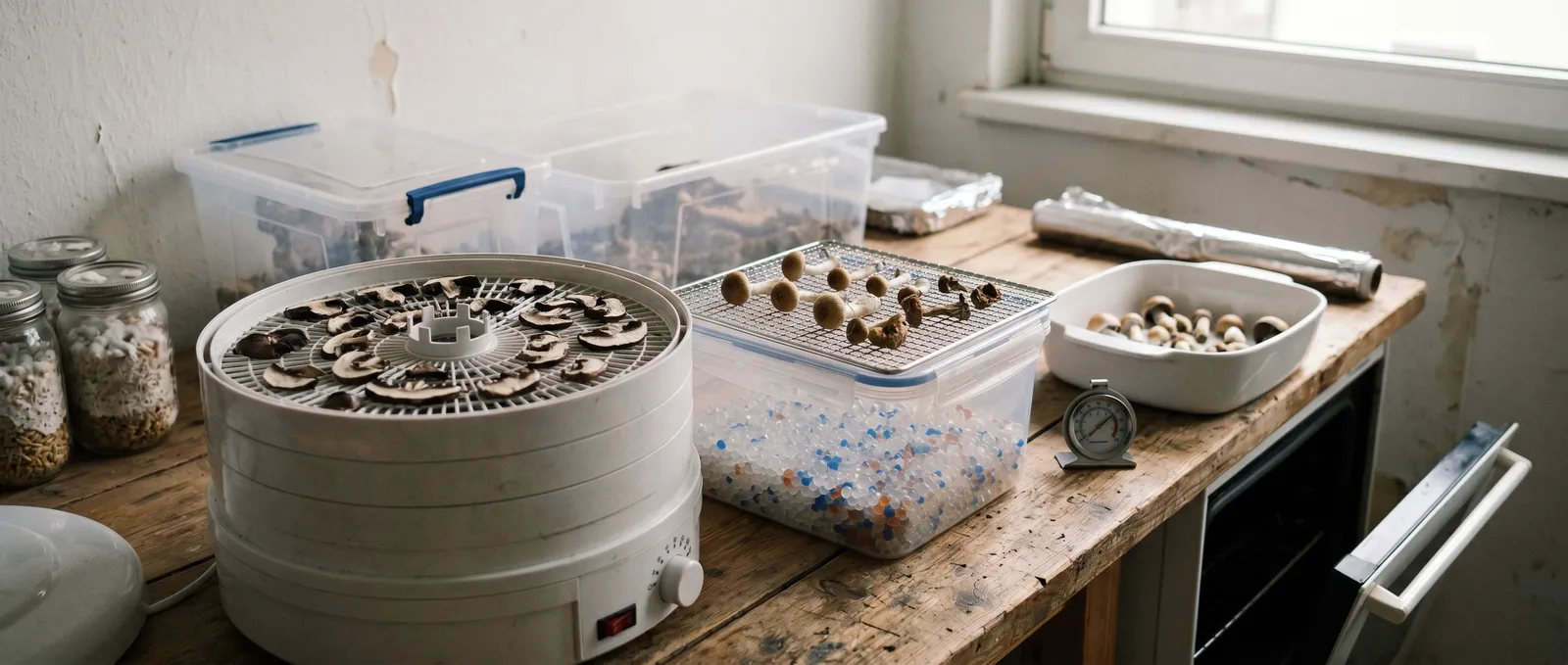
Drying Mushrooms Air Desiccant Oven: Methods Compared
Drying mushrooms air desiccant oven refers to the three home methods for reducing fresh fruit bodies from ~90% water to cracker-dry (<5%). Gotvaldová et al.